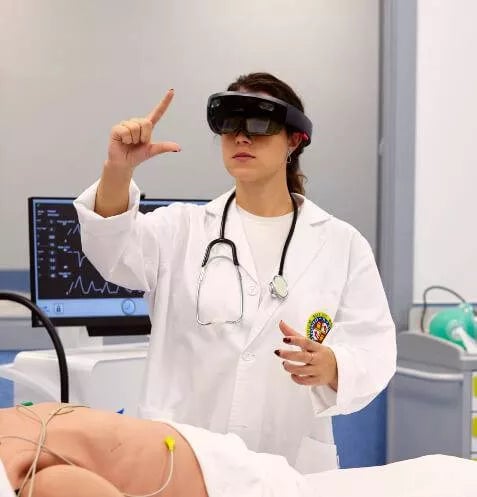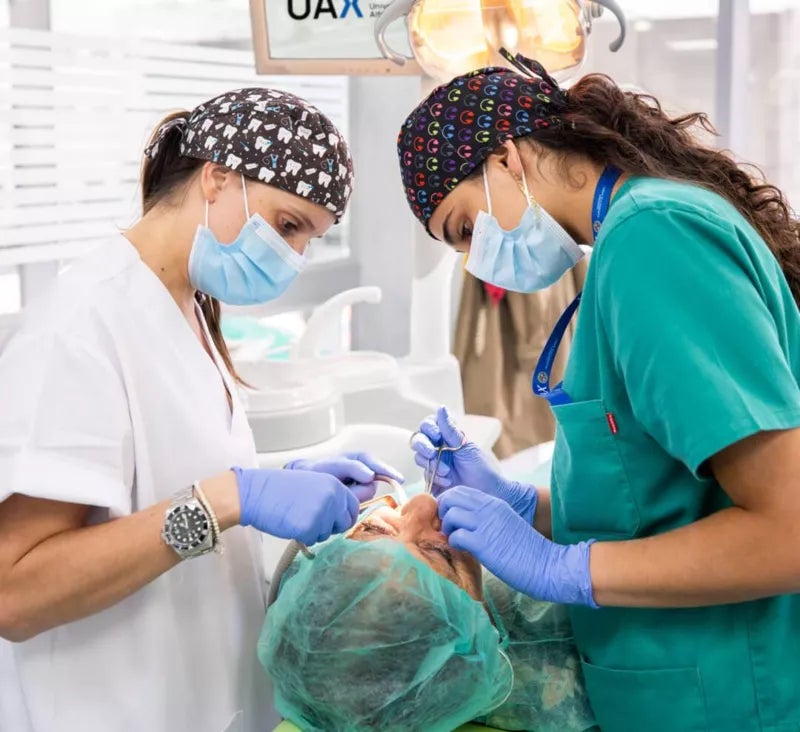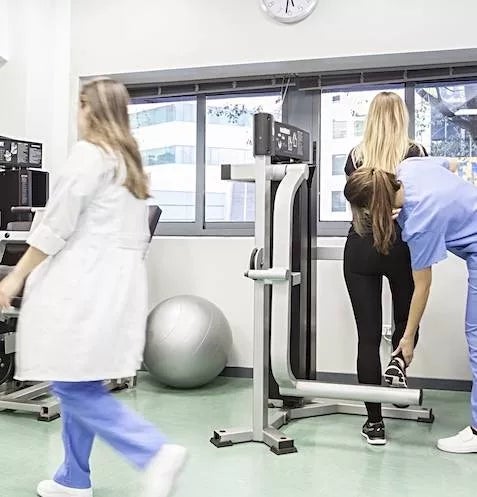


See all Online Master's Degrees in Health


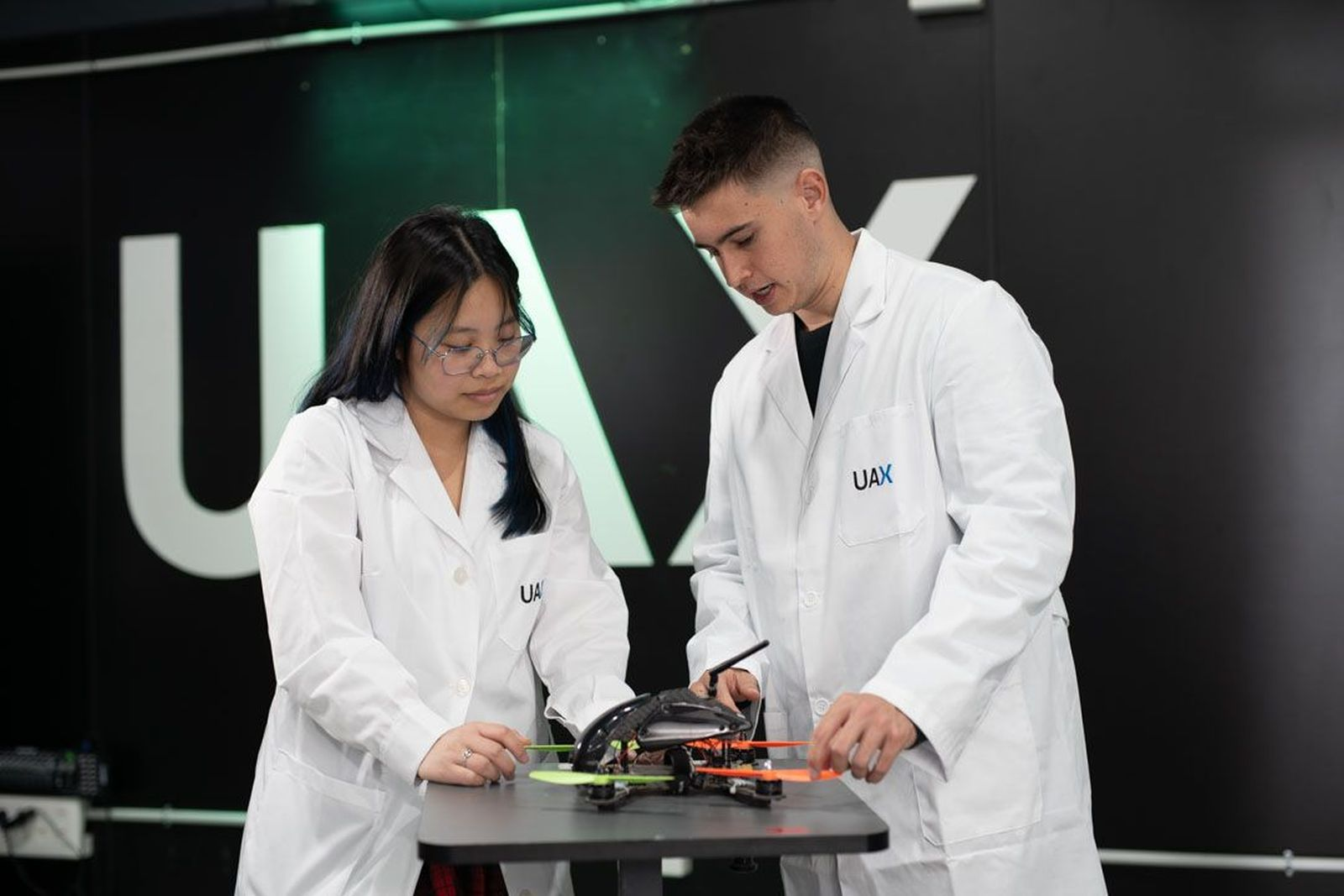



See all Master's Degrees in Engineering
Most searched curriculums
In collaboration with:


Study at the 4th best university in Spain for Dentistry, according to El Mundo Ranking 2024.
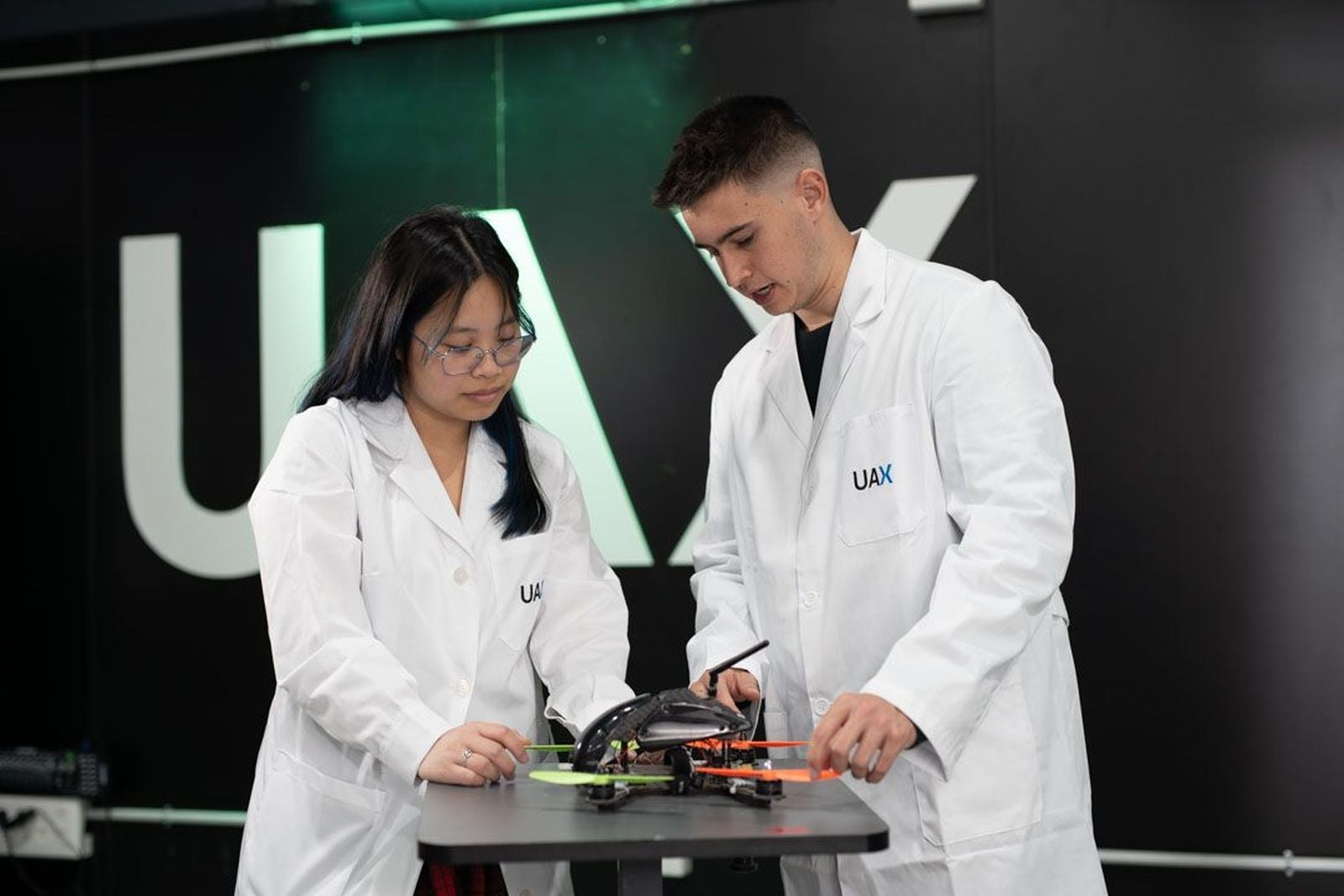
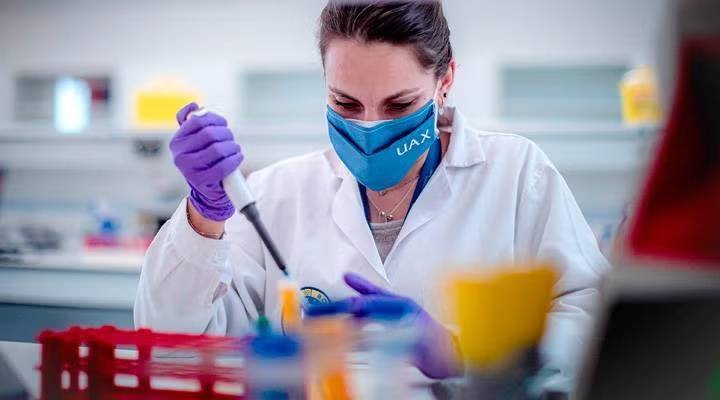
Our Dentistry Degree in Madrid is designed to build your skills as a dentist through intensive practical training and by staying ahead of digital trends in clinical practice.
Take the step and live the reality of your professional future from day one.
During the Dentistry degree at UAX, we place special emphasis on ensuring that our students receive extensive theoretical and practical training in case planning and the management of real clinical cases. The goal is for you to acquire the confidence, experience, and skills necessary to work as a dentist capable of treating dental pathologies of any level of complexity.
In addition, students will receive training in cross-disciplinary skills such as Management and Marketing (where they will learn the keys to starting their own business), as well as Medical English, among others. To ensure they remain closely connected to the realities of the profession, students will also take part in conferences, seminars, and university events
Bachelor’s Degree in Dentistry
First Year
ANNUAL SUBJECTS
| Code | Subjects | Character* | ECTS | ||||||||||||||||||||||||||||||||||||||||||||||||||||||||||||||||||||||||||||||||||||||||||||||||||||||||||||||||||||||||||||||||||||||||||||||||||||||||||||||||||||||||||||||||||||||||||||||||||||||||||||||||||||||||||||||||||||||||||||||||||||||
|---|---|---|---|---|---|---|---|---|---|---|---|---|---|---|---|---|---|---|---|---|---|---|---|---|---|---|---|---|---|---|---|---|---|---|---|---|---|---|---|---|---|---|---|---|---|---|---|---|---|---|---|---|---|---|---|---|---|---|---|---|---|---|---|---|---|---|---|---|---|---|---|---|---|---|---|---|---|---|---|---|---|---|---|---|---|---|---|---|---|---|---|---|---|---|---|---|---|---|---|---|---|---|---|---|---|---|---|---|---|---|---|---|---|---|---|---|---|---|---|---|---|---|---|---|---|---|---|---|---|---|---|---|---|---|---|---|---|---|---|---|---|---|---|---|---|---|---|---|---|---|---|---|---|---|---|---|---|---|---|---|---|---|---|---|---|---|---|---|---|---|---|---|---|---|---|---|---|---|---|---|---|---|---|---|---|---|---|---|---|---|---|---|---|---|---|---|---|---|---|---|---|---|---|---|---|---|---|---|---|---|---|---|---|---|---|---|---|---|---|---|---|---|---|---|---|---|---|---|---|---|---|---|---|---|---|---|---|---|---|---|---|---|---|---|---|---|---|---|---|
| 0130201 | Human Anatomy I | FB | 6 | ||||||||||||||||||||||||||||||||||||||||||||||||||||||||||||||||||||||||||||||||||||||||||||||||||||||||||||||||||||||||||||||||||||||||||||||||||||||||||||||||||||||||||||||||||||||||||||||||||||||||||||||||||||||||||||||||||||||||||||||||||||||
Human Anatomy ICódigo: 0130201 Imprimir Year 1. Annual module. Foundational studies. 6 credits. Profesores
Objectives 1. To use the standard anatomical terminology relating to the body’s axes and planes correctly, in order to locate the structures studied in space and describe them accurately. 2. Classify the different types of joints, muscles and bones, describe their general functions and establish their common ontogeny. 3. Describe the morphology and general function of the spine and the pelvis 4. To describe, in broad terms, the anatomical structure and contents of the thoracic, abdominal and pelvic cavities, topographically locating the various organs that comprise them. 5. Describe the bony and muscular elements of the limbs, noting their functional limitations and their specific motor apparatus. 6. Study of epithelial, connective, muscular and nervous tissues 7. Explain how blood and lymph circulation occur in the body, taking into account the morphology of the heart and the major vessels. 8. Explain the development and general organisation of the nervous system (NS), detailing the parts into which it is subdivided. 9. Explain the structures of the Respiratory System 10. Explain the components of the Digestive System, describing the digestive tract and associated organs. 11. Describe the urinary system, the kidney and the urinary tracts, including a study of their histology. 12. Explain the components of the female reproductive system and the male reproductive system Prerequisites There are no legal prerequisites, apart from those required to undertake the Bachelor’s Degree in Dentistry. It is advisable to have a knowledge of general biology at A-level. It is also advisable to be able to read texts in English and to have basic computer literacy. Attendance at lectures, seminars and practical sessions is compulsory. Competencies 1. GENERAL COMPETENCIES ACQUIRED 1.1. To promote independent learning of new knowledge and techniques, as well as a commitment to quality. 1.2. To understand the basic biomedical sciences on which dentistry is founded, in order to ensure proper oral and dental care. 1.3. To understand and recognise the normal structure and function of the stomatognathic system at the molecular, cellular, tissue and organ levels, throughout the different stages of life. 1.4. To understand the general processes of disease, including infection, inflammation, immune system disorders, degeneration, neoplasia, metabolic disorders and genetic disorders. 1.5. To be familiar with the scientific method and possess the critical ability to evaluate established knowledge and new information. To be able to formulate hypotheses, collect and critically evaluate information for problem-solving, following the scientific method. 2. SPECIFIC COMPETENCIES TO BE ACQUIRED 2.1. To understand the biomedical sciences on which dentistry is based, in order to ensure the provision of appropriate oral healthcare. Amongst other sciences, the curriculum must include relevant content on: - Embryology, anatomy, histology and physiology of the human body. - Genetics, biochemistry, cellular and molecular biology. - Microbiology and immunology. 2.2. To understand the morphology and function of the stomatognathic system, including relevant content on specific aspects of embryology, anatomy, histology and physiology. 2.3. To acquire knowledge of general disease processes, metabolic disorders and genetic disorders. 2.4. To acquire, develop and practise the skills required for laboratory work on the morphology, structure and function of the human body in general and the oral cavity in particular. Learning outcomes 1. The student understands and explains the main constituent characteristics of the human being, from the most basic (biochemical) level to the most complex (organic and systemic) level, and their role in the development of disease. 2. The student is competent in morphologically distinguishing each of the components of the human body. 3. Students are familiar with the appropriate scientific terminology and biomedical reasoning, enabling a better understanding of the various aspects of health and medicine. Description of the content THEORETICAL SYLLABUS FOR HUMAN ANATOMY I 1. INTRODUCTION. DEFINITION OF ANATOMY. LEVELS OF STRUCTURAL ORGANISATION. 2. ANATOMICAL TERMS. REGIONS AND PLANE. BODY CAVITIES. ABDOMINAL REGIONS AND QUADRANTS. 3. THE SKELETAL SYSTEM: SKELETON. DIVISIONS. BONE ANATOMY AND REFERENCE POINTS. 4. THE SKELETAL SYSTEM: AXIAL SKELETON: SKULL, FACE, HYPOID BONE, 5. THE SKELETAL SYSTEM: AXIAL SKELETON: SPINAL COLUMN, RIB CAGE AND STERNUM. 6. THE SKELETAL SYSTEM: APPENDICULAR SKELETON: SHOULDER GIRDLE, UPPER LIMB, PELVIC GIRDLE, LOWER LIMB. SKELETAL DIFFERENCES BETWEEN MEN AND WOMEN. 7. JOINTS. DEFINITION. CLASSIFICATION. SYNOVIAL JOINTS: TYPES AND RANGES OF MOTION. TEMPOROMANDIBULAR JOINT. 8. THE MUSCULAR SYSTEM: MAIN SKELETAL MUSCLES: FACIAL EXPRESSION MUSCLES. MASTICATORY MUSCLES. EYE MUSCLES. TONGUE MUSCLES. NECK MUSCLES. THORACIC MUSCLES. ABDOMINAL WALL MUSCLES. SPINAL COLUMN MUSCLES. UPPER LIMB MUSCLES. LOWER LIMB MUSCLES. 9. TISSUE LEVEL OF ORGANISATION I. TYPES OF TISSUES AND ORIGIN. CELLULAR JOINTS. EPITHELIAL TISSUE. 10. TISSUE LEVEL OF ORGANISATION II. CONNECTIVE, MUSCULAR AND NERVOUS TISSUE. 11. THE INTEGMENTARY SYSTEM. STRUCTURE OF THE SKIN. SKIN COLOUR. STRUCTURE OF THE SKIN APPENDAGES. TYPES OF SKIN. FUNCTIONS OF THE SKIN. HOMEOSTASIS: WOUND HEALING. 12. THE SKELETAL SYSTEM. FUNCTIONS. STRUCTURE AND TYPES OF BONES. BONE HISTOLOGY. BONE DEVELOPMENT: OSTEOGENESIS, GROWTH, REMODELLING AND REPAIR. REGULATION OF CALCIUM LEVELS. BONE TISSUE: EXERCISE AND AGEING. 13. MUSCULAR TISSUE. TYPES, FUNCTIONS AND PROPERTIES. STRUCTURE AND TYPES OF SKELETAL FIBRES. SIZE, SHAPE AND ARRANGEMENT OF THE FIBRES. HOW THEY PRODUCE MOVEMENT (INSERTIONS, LEVERS, ACTIONS). NAMING OF MUSCLES. THE CARDIAC MUSCLE. SMOOTH MUSCLE. 14. THE NERVOUS SYSTEM. GENERAL OVERVIEW. ORGANISATION. HISTOLOGY OF NERVOUS TISSUE. REGENERATION AND REPAIR OF NERVOUS TISSUE. 15. THE CENTRAL NERVOUS SYSTEM (I). DEVELOPMENT OF THE NERVOUS SYSTEM. MEMBRANES OF THE BRAIN AND SPINAL CORD. CEREBROSPINAL FLUID. STRUCTURE OF THE SPINAL CORD. ORGANISATION OF THE BRAIN. STRUCTURE OF THE BRAIN. 16. THE CENTRAL NERVOUS SYSTEM (II). SOMATIC SENSORY TRACKS. SOMATIC MOTOR TRACKS. REFLEX ARCS. INTEGRATIVE FUNCTIONS OF THE BRAIN. 17. THE PERIPHERAL NERVOUS SYSTEM (SOMATIC). SPINAL NERVES. CRANIAL NERVES. 18. THE PERIPHERAL NERVOUS SYSTEM (AUTONOMIC). COMPARISON BETWEEN SOMATIC AND AUTONOMIC SYSTEMS. ANATOMY OF THE SYMPATHETIC AND PARASYMPATHETIC SYSTEMS. NEUROTRANSMITTERS AND RECEPTORS. FUNCTIONS OF THE ANS. 19. THE CARDIOVASCULAR SYSTEM. ANATOMY OF THE HEART. BLOOD CIRCULATION. ANATOMY OF THE BLOOD VESSELS. CIRCULATORY PATHWAYS. 20. THE LYMPHATIC SYSTEM. STRUCTURE AND FUNCTION. 21. THE RESPIRATORY SYSTEM. ANATOMY OF THE UPPER RESPIRATORY TRACT. ANATOMY OF THE LOWER RESPIRATORY TRACT. 22. THE DIGESTIVE SYSTEM. STRUCTURE: MOUTH, PHARYNX, OESOPHAGUS, STOMACH, SMALL INTESTINE, LARGE INTESTINE, PERITONEUM, LIVER, GALLBLADDER, PANCREAS. 23. THE URINARY SYSTEM. ANATOMY AND HISTOLOGY OF THE KIDNEY. ANATOMY OF THE URETER, BLADDER AND URETHRA. 24. THE REPRODUCTIVE SYSTEM. MALE: TESTICLES, SEMINAL VESICLES, PROSTATE. FEMALE: OVARIES, FALLOPIAN TUBES, UTERUS, VAGINA AND VULVA. BREASTS. SYLLABUS HUMAN ANATOMY PRACTICAL SESSIONS I 1. ANATOMICAL REFERENCE TERMS, PLANE, AXES AND BODY REGIONS. 2. SKELETAL SYSTEM. BONE ANATOMY AND REFERENCE POINTS. GENERAL BONE TERMINOLOGY. 3. SKELETAL STRUCTURE OF THE HEAD. 4. BONES OF THE SKULL. 5. BONES OF THE FACE. 6. SPINAL COLUMN. THORAX. 7. BONES OF THE LIMBS. 8. JOINTS. 9. MAIN MUSCLE GROUPS. Training activities 1) LECTURES (SS): Explanation of theoretical principles, using IT tools. (1 hour per week) 2) ASSIGNMENTS (ASS): Presentation, study and discussion of case studies. Problem-solving. Presentation of assignments/case studies. (1 one-off hour) 3) LABORATORIES (LB): Practical application of the knowledge acquired in the laboratory. Acquisition of skills and competences. (1 hour per week) 4) VIRTUAL CAMPUS: Software, documentation, practical protocols, useful links, problem-solving, self-assessment tests, forums, blog, Wiki, notices. 5) TUTORIALS (individual and group): Guidance and clarification of queries. Supervision of assignments/case studies and presentations. Monitoring of learning progress. 6) INDEPENDENT STUDY: Study. Literature review. Preparation of assignments/case studies and presentations. 7) ASSESSMENT: Oral and written tests/exams, assessment tests for laboratory practicals. Continuous assessment. Assessment system and criteria ASSESSMENT CRITERIA FOR HUMAN ANATOMY I ACADEMIC YEAR 2025–26 Without prejudice to any other requirements that may be set out in the relevant course syllabus, as a general rule, failure to attend more than 70 per cent of the course’s teaching activities—which require the student’s physical or virtual presence—will result in the loss of the right to continuous assessment during the standard examination period. In this case, the examination to be held during the official period set by the University will be the sole assessment criterion, with the corresponding weighting as specified in the course syllabus. To pass the module, students must: 1. To have successfully completed all the scheduled teaching activities. 2. To have achieved a positive continuous assessment mark. 3. To have completed all laboratory practicals. 4. Have passed the practical assessment tests/exams (LB). 5. Have passed the theoretical assessment tests/exams (SESSION AND ASSIGNMENT) The areas to be assessed in the standard assessment period are: A. Laboratory practicals, to be carried out during the first term: Acquisition of practical knowledge: Theoretical and practical assessment tests. The final mark (CO21Q) will be calculated in accordance with the criteria set out in a separate document. B. Course activities: o Assessments of competence acquisition: an assessment will be held halfway through the first term (CO11Q) and the second term (CO12Q). This will contribute up to 1 cumulative mark to the mark for the corresponding term. o Classwork (2nd term): attendance and completion during class of the worksheets provided on the course content. º Assessment test/theoretical examination for the 1st and 2nd terms: The theoretical assessment of the course will take various forms, which may include multiple-choice questions, short-answer questions or essay questions. In all cases, students will be informed in good time of the specific assessment method to be used in each sitting”. In the case of a multiple-choice exam, only one answer will be marked correctly, worth 1 mark; incorrect answers will result in a deduction of 0.33 marks. To pass, students must achieve a mark equivalent to 50 per cent. Assessments: To pass the module, students must have acquired the required competences in both the theoretical and practical components; the final mark will be calculated using the following weighting, out of 10 marks: ;;;; Assessment of theoretical competences acquired (MG+TB mark): up to 8 points of the total mark. ;;;; Assessment of practical skills acquired (LB mark): up to 2 marks. January exam (PARCFEB): Exam on theoretical content (lectures and assignments) The January mark will be determined by the theoretical exam plus continuous assessment. Students who pass will be exempt from the theoretical syllabus for the first term, provided they have an attendance rate of 70 per cent or higher by the end of the teaching period. Standard assessment period: • Exam on the theoretical content of the second term syllabus: (provided the PARCFEB has been passed and attendance of 70 per cent or more is demonstrated). The mark for the second term will be based on the theoretical exam plus continuous assessment. • Exam on the theoretical content of the first and second four-month term syllabuses: Students who have not completed the first four-month term syllabus via the PARCFEB will sit an exam, with the same format, covering the syllabus for the entire module. In this case, the continuous assessment for the first term will not be taken into account. Extraordinary sitting: If a student passes either the theoretical or practical component in the ordinary sitting, this result will be carried over to the extraordinary sitting. The mark for the January theoretical exam (PARCFEB) will NOT be carried over; therefore, the syllabus will not be divided by terms, and the assessment/theoretical exam to be taken will cover all the theoretical content of the course. Theoretical assessment (lectures and coursework) covering the entire course syllabus. Practical assessment (LB): an exam consisting of short-answer or multiple-choice questions. The mark for the resit will be based on the theory exam, accounting for 80 per cent of the mark, plus the practical mark, accounting for 20 per cent of the mark. Students must have achieved a mark of 5 or above in both the theory and practical components. There will be no specific mark allocated for continuous assessment. Bibliography Essential: 1. NETTER, FH. Atlas of Human Anatomy Elsevier Masson. 2023. ISBN: 9788445820650 2. Patton K, Anatomy and Physiology 11th ed. Elsevier. 2023. ISBN: 9788413825427 Supplementary: 3.- Drake, Richard L. GRAY’s Anatomy for Students 5th ed. Madrid: Elsevier, 2024. ISBN: 9788413826226 4.- POIRIER HISTOLOGY MASSON. 2002. ISBN: 8445811371 5. Tortora and Derrickson Principles of Anatomy and Physiology Editorial Medica Panamericana. 2021. ISBN: 9788411060264 Others: 6. DORTLAND DORTLAND’S ILLUSTRATED ENCYCLOPAEDIC DICTIONARY OF MEDICINE 30th ed. ELSEVIER. 2005. ISBN: 978848174790- |
|||||||||||||||||||||||||||||||||||||||||||||||||||||||||||||||||||||||||||||||||||||||||||||||||||||||||||||||||||||||||||||||||||||||||||||||||||||||||||||||||||||||||||||||||||||||||||||||||||||||||||||||||||||||||||||||||||||||||||||||||||||||||
| 0130202 | Biochemistry | FB | 6 | ||||||||||||||||||||||||||||||||||||||||||||||||||||||||||||||||||||||||||||||||||||||||||||||||||||||||||||||||||||||||||||||||||||||||||||||||||||||||||||||||||||||||||||||||||||||||||||||||||||||||||||||||||||||||||||||||||||||||||||||||||||||
BiochemistryCódigo: 0130202 Imprimir Year 1. Annual module. Foundation course. 6 credits. Profesores
Objectives 1. To understand and explain the main structural characteristics of biomolecules and their relationship to the functions they perform in metabolism. 2. To understand the metabolic pathways involved in the synthesis and breakdown of carbohydrates and the regulatory mechanisms involved, as well as the diseases associated with them. 3. To understand the metabolic pathways involved in the synthesis and breakdown of lipids and the regulatory mechanisms, as well as the diseases associated with them. 4. Understand the metabolic pathways involved in the synthesis and breakdown of the main nitrogenous compounds and the regulatory mechanisms involved, as well as the diseases associated with them. 5. Be able to explain the mechanisms of interaction between the main anabolic and catabolic pathways of metabolism. 6. Be able to integrate the metabolic pathways within the body’s different tissues. 7. To be familiar with and understand the mechanisms of enzyme action. 8. Understand the basic concepts associated with oral and dental biochemistry, in particular the biochemical basis of the mineralisation and demineralisation processes of tooth enamel, the mechanism of caries formation and the role of fluorinated compounds in dental care. 9. To be familiar with and able to carry out the basic experimental techniques used in a biochemistry laboratory. Prerequisites Basic knowledge of General Biology, Organic Chemistry and Biochemistry. A thorough understanding of the following basic concepts is required: - Atomic structure and molecular bonds -Formulae and units -Chemical equilibrium - pH, acid-base, buffer solutions -The concepts of polar and non-polar molecules, solubility -Types of weak interactions -Oxidation-reduction Competencies • To understand the basic biomedical sciences on which dentistry is founded, in order to ensure proper oral healthcare. • Be able to acquire, develop and practise the skills required for work in the laboratory on the morphology, structure and function of the human body in general and the oral cavity in particular. • Be able to acquire, develop and practise the skills required for work in the laboratory focusing on biology, genetics, microbiology and immunology. Learning outcomes • To understand and recognise the normal structure and function of the oral system at the molecular, cellular, tissue and organ levels throughout the different stages of life. • To be familiar with the general processes of disease, including infection, inflammation, immune system disorders, degeneration, neoplasia, metabolic disorders and genetic disorders. • Be familiar with the general pathological characteristics of diseases and disorders affecting the organ systems, specifically those with oral implications. • To acquire knowledge of the fundamentals of biological chemistry, cellular and molecular biology, and genetics. • To understand the biomedical sciences on which dentistry is based, in order to ensure the provision of appropriate oral healthcare. Among other sciences, this should include relevant content on the embryology, anatomy, histology and physiology of the human body. Genetics, Biochemistry, Cellular and Molecular Biology, Microbiology and Immunology. • To understand the morphology and function of the stomatological system, including relevant content on specific aspects of embryology, anatomy, histology and physiology. • Acquire knowledge of general disease processes, metabolic disorders and genetic disorders. Description of the content 1. MOLECULAR BASICS. 2. CARBOHYDRATES 3. LIPIDS 4. AMINO ACIDS AND PROTEINS 5. NUCLEOTIDES AND NUCLEIC ACIDS 6. ENZYMATIC KINETICS AND REGULATION 7. CARBOHYDRATE METABOLISM 8. INTERMEDIATE METABOLISM 9. LIPID METABOLISM 10. METABOLISM OF NITROGEN-CONTAINING COMPOUNDS Teaching activities 1) LECTURES (SS): Explanation of theoretical principles, using IT tools. 2) ASSIGNMENTS (ASS): Presentation, study and discussion of case studies. Problem-solving. Presentation of assignments/case studies. 3) LABORATORIES (LB): Practical application of the knowledge acquired in the laboratory. Acquisition of skills and competences. 4) VIRTUAL CAMPUS: Software, documentation, practical protocols, useful links, problem-solving, self-assessment tests, forums, blog, Wiki, announcements. 5) TUTORIALS (individual and group): Guidance and clarification of queries. Supervision of assignments/case studies and presentations. Monitoring of learning progress. 6) INDEPENDENT STUDY: Study. Literature review. Preparation of assignments/case studies and presentations. 7) ASSESSMENT: Oral and written tests/exams, assessment tests for laboratory practicals. Continuous assessment. Assessment system and criteria Without prejudice to any other requirements that may be specified in the relevant course syllabus, as a general rule, failure to attend more than 70 per cent of the course’s teaching activities—which require the student’s physical or virtual presence—will result in the loss of the right to continuous assessment during the standard examination period. In this case, the examination to be held during the official period set by the University will be the sole assessment criterion, with the weighting specified in the course syllabus. ---- GENERAL DESCRIPTION OF ASSESSMENT CRITERIA: 1. The module is divided into two parts: THEORY and LABORATORY. 2. To pass the module, students must pass both parts independently with a mark of 5 POINTS or above. 3. The theory is divided into two terms, and the laboratory sessions will take place exclusively during the first term. 4. The theory mark will be the average of the two terms. 5. The laboratory mark will be the mark obtained in the examination to be held at the end of the practical sessions. 6. The final mark for the module, once both parts have been passed, is the weighted average of the theoretical and practical components respectively (80% theory and 20% laboratory work). 7. For the mark for each term, the student’s Continuous Assessment (CA) will be taken into account provided that the mark obtained in the official examinations is 4 POINTS or higher and class attendance is 70 per cent or higher by the end of the course. 8. The CA may contribute up to 1.5 POINTS (15 per cent) to the final mark obtained in the official examinations. 9. The theory or practical components passed in each term will be carried over until the end of the Extraordinary Examination Period. 10. Students will have a maximum of 4 official examination sessions in which to pass the module. Both the ordinary examination session (May/June) and the extraordinary examination session (June/July) are considered official examination sessions. THEORY ASSESSMENT 1. The theory syllabus will be covered in lectures (SESSIONS). 2. The January exam (MID-TERM) is a qualifying exam and will cover the syllabus taught in the first term. If the mark is 5 POINTS or higher, the student will be exempt from the theory component of the first term. If attendance at classes at the end of the course is less than 70 per cent, the student will have to sit an examination on this material in the Ordinary Examination Period. 3. The Ordinary Examination (May/June) will cover the syllabus taught in the second term and, should the student have failed the January exam or their class attendance be less than 70 per cent, they will also be examined on the syllabus covered in the first term. 4. The theory mark will be the arithmetic mean of both terms and, as this is a year-long module, students may make up for marks in both terms during the Ordinary Examination Period, but to do so, students must have sat the assessments in both terms and achieved a minimum of 3.5 POINTS in the official examinations. 5. In the Extraordinary Examination, students will be examined on the theory from those terms in which they failed, or on the practical component if that was failed. The Extraordinary Examination will be held until the end of the academic year, provided that class attendance during the academic year is 70 per cent or higher. LABORATORY ASSESSMENT 1. The laboratory practicals comprise FIVE SESSIONS (3 hours each) AND WILL TAKE PLACE IN THE FIRST SEMESTER. During four sessions, students will receive a theoretical explanation and practise various laboratory techniques; in the fifth session, queries will be addressed and an exam will be held on the techniques and concepts covered. 2. Sitting the laboratory examinations is COMPULSORY FOR ALL STUDENTS ENROLLED on the module. 3. Attendance at and completion of the practical laboratory sessions is COMPULSORY FOR STUDENTS ENROLLED FOR THE FIRST TIME OR WHO HAVE NOT COMPLETED THE LABORATORY WORK IN PREVIOUS YEARS. 4. Each instance of unauthorised absence during the practical sessions will result in a deduction of 25 per cent from the laboratory mark. 5. If, during the practical sessions, a student commits minor disciplinary offences (repeated tardiness, failure to participate, lack of attention), they may lose up to 20 per cent of their laboratory mark. If the offence is serious (playing in the laboratory, failing to comply with safety regulations, disrespect), the student may be expelled from the session and it will be recorded as an unexcused absence, which may lead to disciplinary proceedings being initiated. 6. In the case of authorised absences, students may make up the missed practical session with another group, where possible, and sit the examination with the group in which they make up the session. 7. Justified absences must be reported and documented as soon as possible, ideally before the absence occurs, and in any case before the end of the allocated practical sessions; otherwise, the absence will be deemed unjustified. 8. Students who, having attended practical sessions, have failed or not sat the exam must sit the THEORETICAL LABORATORY EXAM during the ordinary examination period (May/June); if they fail this, they will have a further opportunity during the supplementary examination period (July). 9. The pass mark for the PRACTICAL EXAMINATION is set at 5 POINTS. Practical marks will be published in January alongside those obtained in the MID-TERM EXAM. 10. Failure to attend TWO OR MORE DAYS OF LABORATORY PRACTICUM, whether for JUSTIFIED or UNJUSTIFIED reasons, will result in FAILURE OF THE LABORATORY MODULE, and students must sit two examinations during the REGULAR EXAMINATION PERIOD: a THEORETICAL EXAMINATION (20 per cent of the practicals mark) and a PRACTICAL EXAMINATION (80 per cent of the practicals mark). 11. Failing or not sitting the examinations described in the previous point will result in both examinations having to be retaken during the EXTRAORDINARY EXAMINATION PERIOD. EXAMINATION FORMAT: 1. The theoretical assessment for the module will take various forms, which may include multiple-choice questions, short-answer questions or essay questions. In all cases, students will be informed in good time of the specific assessment method to be used in each sitting. 2. The pass mark for ALL examinations is set at 5 POINTS. CONTINUOUS ASSESSMENT CRITERIA: Continuous Assessment (CA) provides an insight into how students are progressing in their understanding of the course content. The marks obtained in this type of assessment DO NOT represent a percentage of the final mark for any part of the module, but they DO help to improve the marks obtained in the THEORY AND/OR PRACTICAL component. 1. THEORY CA: a) Throughout each term, one or two NON-EXEMPT continuous assessment tests will be held. b) The format of these tests will be clearly set out in the course syllabus d) The mark for these EC tests will be the arithmetic mean of both tests in each four-month term. Students may add up to 1 POINT (10 per cent) to their theory mark for each four-month term, provided that the mark obtained in the official examination is 4 POINTS or higher and their attendance is 70 per cent or more. e) As the EC does not adversely affect the student’s final mark, these tests are NOT COMPULSORY and there are NO RESIT SESSIONS; students who fail to attend these sessions, whether for justified or unjustified reasons, will forfeit the opportunity to sit them. 2. LABORATORY EC: a) This will consist of a self-assessment test which will be available during the week of the laboratory practicals. Students may earn up to 1 POINT (10%) provided that the mark obtained in the laboratory exam is 4 POINTS or higher. b) This will consist of a test comprising 10 questions on the content of the laboratory practicals. The test allows for an unlimited number of attempts. There are five options per question, only one of which is correct, and incorrect answers do not result in marks being deducted. Time allowed: 1 min per question (+10% extra). c) As the EC does not negatively affect the student’s final mark, taking these tests is NOT COMPULSORY and they will close once the Laboratory Practical exam has finished; students who do not take the tests during the practical week will lose the opportunity to do so. PRACTICE TEST: 1. Two weeks before the start of the official exams, ALL students will be given a practice test, with the aim of practising and reinforcing the content covered, both theoretical and practical. The marks obtained in these tests will not adversely affect the student’s final marks; however, as they form part of the assessment criteria, achieving a mark of 8 or above will help to increase the final mark by up to 0.5 POINTS (5 per cent), provided that attendance at classes throughout the course is 70 per cent or higher. 2. It will consist of a test comprising 10 questions on the theoretical and/or practical content. The test allows for ‘n’ attempts (unlimited). There are five options per question, of which only one is correct, and incorrect answers do not result in marks being deducted. 3. Time allowed: 1 min per question (+10% extra). STUDENTS WITH AN OFFICIAL ACADEMIC EXEMPTION: Students with an OFFICIAL ACADEMIC EXEMPTION must undertake the compulsory practical sessions in the same way as the rest of the students, in accordance with the schedule allocated to their respective laboratory groups, and are exempt from all other teaching activities. Furthermore, if they wish to sit the EC assessments, they must do so on the dates set for this purpose, in the same way as all other students. HONOURS Once the REGULAR EXAMINATION PERIOD has ended, those students who have demonstrated exemplary academic progress during the academic year will be selected for the HONOURS distinction. To qualify, students must meet the following requirements: 1. Achieve a FINAL GRADE of 9 POINTS or more 2. Have demonstrated active participation during teaching activities (SESSIONS, ASSIGNMENTS, LABORATORY WORK). 3. Have a class attendance rate of 80 per cent or higher. 4. The number of HONOURS is limited, and the awarding of this distinction is at the discretion of the course coordinator. Timetable Click on this link to view the detailed timetable in Excel
Bibliography Core: 1. Feduchi Canosa E, Romero Magdalena C, Yáñez Conde E, García-Hoz Jiménez C. Biochemistry. Essential Concepts. 3rd ed. Médica Panamericana. 2025. ISBN: 9788491106807 2.- Narváez Carrasco CG. Elements of Biochemistry for Dentistry. Applied Biochemistry in Dentistry. Editorial Académica Española. 2012. ISBN: 9783847356905 Supplementary: 3.- Baynes JW and Dominicszak MH. Medical Biochemistry 5th ed. Elsevier. 2019. ISBN: 9788491134060 4. Lehninger AL, Nelson DL, Cox MM and Cuchillo Foix CM. Lehninger. Principles of Biochemistry 7th ed. Omega. 2018. ISBN: 9788428216678 Others: 5.- Gupta A. Comprehensive Biochemistry for Dentistry. Textbook for Dental Students. Springer Nature. 2019. ISBN: 9789811310348 |
|||||||||||||||||||||||||||||||||||||||||||||||||||||||||||||||||||||||||||||||||||||||||||||||||||||||||||||||||||||||||||||||||||||||||||||||||||||||||||||||||||||||||||||||||||||||||||||||||||||||||||||||||||||||||||||||||||||||||||||||||||||||||
| 0130203 | Physiology | FB | 6 | ||||||||||||||||||||||||||||||||||||||||||||||||||||||||||||||||||||||||||||||||||||||||||||||||||||||||||||||||||||||||||||||||||||||||||||||||||||||||||||||||||||||||||||||||||||||||||||||||||||||||||||||||||||||||||||||||||||||||||||||||||||||
PhysiologyCódigo: 0130203 Imprimir Year 1. Annual module. Foundation course. 6 credits. Profesores
Objectives 1. For students to acquire knowledge of how the various organs and systems that make up the human body function, as well as their regulatory and control systems. 2. Students will be able to relate the various functions to one another and understand that the different organs and systems work in a coordinated and integrated manner within the body. 3. To acquire the theoretical and practical knowledge enabling them to understand that a disruption to normal function leads to disease, and that physiology forms the basis for understanding the mechanisms of disease. 4. To acquire a basic level of skills and competence in the use of basic laboratory equipment. 5. Students should understand the need for study in order to keep their knowledge up to date and to develop critical and scientific thinking. Prerequisites There are no legal prerequisites, apart from those required to undertake the Bachelor’s Degree in Dentistry. It is advisable to have a knowledge of general biology at A-level. It is advisable to have a good understanding of the fundamental laws of physics as they apply to the functioning of biological systems. It is also advisable to be able to read texts in English and to have basic computer skills. Attendance at lectures, seminars and practical sessions is compulsory. Competencies 1. GENERAL COMPETENCIES ACQUIRED 1.1. To promote independent learning of new knowledge and techniques, as well as a commitment to quality. 1.2. To understand the basic biomedical sciences on which dentistry is founded, in order to ensure proper oral and dental care. 1.3. To understand and recognise the normal structure and function of the stomatognathic system at the molecular, cellular, tissue and organ levels, throughout the different stages of life. 1.4. To be familiar with the general processes of disease, including infection, inflammation, immune system disorders, degeneration, neoplasia, metabolic disorders and genetic disorders. 1.5. Understand the scientific method and possess the critical ability to evaluate established knowledge and new information. Be able to formulate hypotheses, and to collect and critically evaluate information for problem-solving, following the scientific method. 2. SPECIFIC COMPETENCIES TO BE ACQUIRED 2.1. To have an understanding of the biomedical sciences on which dentistry is based, in order to ensure the provision of appropriate oral healthcare. Amongst other sciences, this should include relevant content from: - Embryology, anatomy, histology and physiology of the human body. - Genetics, biochemistry, cellular and molecular biology. - Microbiology and immunology. 2.2. To understand the morphology and function of the stomatognathic system, including relevant content on specific aspects of embryology, anatomy, histology and physiology. 2.3. To acquire knowledge of general disease processes, metabolic disorders and genetic disorders. 2.4. To acquire, develop and practise the skills required for work in the laboratory on the morphology, structure and function of the human body in general and the oral cavity in particular. Learning outcomes 1. The student is familiar with the morphology and understands the normal functioning of each organ and system, as well as their potential dysfunctional states. 2. Students are familiar with the appropriate scientific terminology and biomedical reasoning, enabling a better understanding of the various aspects of health and medicine. Course Content THEORETICAL PHYSIOLOGY SYLLABUS 1. INTRODUCTION. DEFINITION OF PHYSIOLOGY. CHARACTERISTICS OF THE LIVING HUMAN ORGANISM. HOMEOSTASIS. BODY FLUIDS. 2. CHEMICAL LEVEL OF ORGANISATION. CHEMICAL REACTIONS. INORGANIC COMPOUNDS AND SOLUTIONS. ACID-BASE BALANCE. ORGANIC COMPOUNDS. 3. CELLULAR LEVEL OF ORGANISATION. THE CELL MEMBRANE: STRUCTURE, TRANSPORT MECHANISMS. 4. CELLULAR POTENTIALS. RESTING POTENTIAL. ION CHANNELS. GRADIENT POTENTIAL. ACTION POTENTIAL. CONDUCTION. 5. SYNAPTIC TRANSMISSION. SYNAPSES. TYPES. POSTSYNAPTIC POTENTIALS. NEUROTRANSMITTERS. NERVE CIRCUITS. NEUROMUSCULAR JOINT. MOTOR END-PLATE. 6. SKELETAL MUSCLE CONTRACTION. HISTOLOGY OF MUSCLE FIBRES. CONTRACTILE CYCLE: CONTRACTION AND RELAXATION. EXCITATION-CONTRACTION COUPLING. TYPES OF CONTRACTION. 7. SENSORY RECEPTORS. SENSATIONS. SENSITIVE RECEPTORS. SOMATIC SENSATIONS. 8. SPECIAL SENSES (I). SMELL, TASTE, SIGHT. 9. SPECIAL SENSES (II). HEARING AND BALANCE. ________ 10. ENDOCRINE PHYSIOLOGY. COMPARISON OF NERVOUS AND ENDOCRINE CONTROL. HORMONAL ACTIVITY: TYPES, MECHANISMS OF ACTION, CONTROL. HYPOTHALAMUS AND PITUITARY GLAND. PINEAL GLAND. THYROID AND PARATHYROID GLANDS. ADRENAL GLANDS. GONADS. THYMUS. OTHER ENDOCRINE TISSUES. 11. HAEMATOLOGICAL PHYSIOLOGY. COMPOSITION AND FUNCTIONS OF BLOOD. HAEMOSTASIS. BLOOD GROUPS. 12. CARDIOVASCULAR PHYSIOLOGY. CARDIAC CONDUCTION SYSTEM. CARDIAC CYCLE. HAEMODYNAMICS. CARDIAC OUTPUT. BLOOD PRESSURE. CAPILLARY EXCHANGE. EVALUATION OF THE CIRCULATORY SYSTEM. 13. RESPIRATORY PHYSIOLOGY. LUNG VENTILATION. VOLUMES AND CAPACITIES. GAS EXCHANGE. GAS TRANSPORT. EXERCISE AND THE RESPIRATORY SYSTEM. 14. DIGESTIVE PHYSIOLOGY. DIGESTION, SECRETION, ABSORPTION AND ELIMINATION. 15. RENAL PHYSIOLOGY. FUNCTIONS. GENERAL PRINCIPLES. FILTRATION, REABSORPTION AND SECRETION. 16. PHYSIOLOGY OF THE REPRODUCTIVE SYSTEM. SPERMATOGENESIS. THE FEMALE REPRODUCTIVE CYCLE. PHYSIOLOGY OF THE BREAST. PHYSIOLOGY PRACTICAL SESSIONS SYLLABUS 1. MEDICAL HISTORY. 2. VISUAL SENSATION. 3. THE SENSE OF HEARING. ACOUSTIC TESTS. AUDIOMETRY. 4. SENSE OF BALANCE. 5. REFLEXES. 6. CARDIAC EXAMINATION. 7. BLOOD PRESSURE AND PERIPHERAL PULSES 8. ELECTROCARDIOGRAM. 9. LUNG EXAMINATION. SPIROMETRY 10. BASIC CPR. Training activities 1) LECTURES (SS): Explanation of theoretical principles, using IT tools. (1 hour per week) 2) ASSIGNMENTS (AS): Presentation, study and discussion of case studies. Problem-solving. Presentation of assignments/case studies. (1 one-off hour) 3) LABORATORIES (LB): Practical application of the knowledge acquired in the laboratory. Acquisition of skills and competences. (1 hour per week) 4) VIRTUAL CAMPUS: Software, documentation, practical protocols, useful links, problem-solving, self-assessment tests, forums, blog, Wiki, notices. 5) TUTORIALS (individual and group): Guidance and clarification of queries. Supervision of assignments/case studies and presentations. Monitoring of learning progress. 6) INDEPENDENT STUDY: Study. Literature review. Preparation of assignments/case studies and presentations. 7) ASSESSMENT: Oral and written tests/exams, assessment tests for laboratory practicals. Continuous assessment. Assessment system and criteria ASSESSMENT CRITERIA FOR PHYSIOLOGY ACADEMIC YEAR 2025–26 Without prejudice to any other requirements that may be specified in the relevant course syllabus, as a general rule, failure to attend more than 70 per cent of the course’s teaching activities—which require the student’s physical or virtual presence—will result in the loss of the right to continuous assessment in the standard examination period. In this case, the examination to be held during the official period set by the University shall be the sole assessment criterion, with the weighting specified in the course syllabus. o To pass the module, students must: 1. To have successfully completed all the scheduled learning activities. 2. To have achieved a positive continuous assessment mark. 3. To have completed all laboratory practicals. 4. Have passed the practical assessment tests/exams (LB). 5. Have passed the theoretical assessment tests/exams (SESSION AND ASSIGNMENT) The components to be assessed in the ordinary assessment period are: A. Laboratory practicals, to be carried out during the 2nd term: Acquisition of practical knowledge: Theoretical and practical assessment tests. The final mark (CO22Q) will be determined in accordance with the criteria set out in a separate document. B. Course activities: o Assessments of competence acquisition: an assessment will be held halfway through the first term (CO11Q) and the second term (CO12Q). This will contribute up to 1 progressive mark to the mark for the corresponding term. o Classwork (1st term): attendance and completion during lessons of the worksheets provided on the course content. o Assessment test/theoretical examination for the 1st and 2nd terms: The theoretical assessment for the course will take various forms, which may include multiple-choice questions, short-answer questions or essay questions. In all cases, students will be informed in good time of the specific assessment method to be used in each examination session.” In the case of a multiple-choice exam, only one answer will be marked as correct, worth 1 mark; incorrect answers will result in a deduction of 0.33 marks. To pass, students must achieve a score equivalent to 50 per cent. Assessments: To pass the module, students must have acquired the required competences in both the theoretical and practical components; the final mark will be calculated using the following weighting, out of a total of 10 marks: ;;;; Assessment of theoretical competences acquired (MG+TB mark): up to 8 points of the mark. ;;;; Assessment of practical skills acquired (LB mark): up to 2 marks of the total mark. January exam (PARCFEB): Exam on theoretical content (lectures and assignments) The January mark will be determined by the theoretical examination plus continuous assessment. Students who pass will be exempt from the theoretical syllabus for the first term, provided they can demonstrate attendance of 70 per cent or more by the end of the teaching period. Standard assessment period: • Exam on the theoretical content of the second term syllabus: (provided the PARCFEB has been passed and attendance of 70 per cent or more is demonstrated). The mark for the second term will be based on the theoretical exam plus continuous assessment. • Exam on the theoretical content of the syllabus for the first and second terms: Students who have not completed the first-term syllabus in the PARCFEB will sit an exam, with the same format, covering the syllabus for the entire module. In this case, the continuous assessment for the first term will not be taken into account. Extraordinary examination session: If a student passes either the theoretical or practical part during the ordinary examination session, this result will be carried over to the extraordinary examination session. The mark for the January theoretical exam (PARCFEB) will NOT be carried over; consequently, the syllabus will not be divided by terms, and the assessment/theoretical exam to be taken will therefore cover all the theoretical content of the module. Exam covering the theoretical content of the entire module. Practical component exam (LB): an exam comprising short-answer or multiple-choice questions. The mark for the supplementary examination will be based on the theory exam (80% of the mark) plus the practical mark (20% of the mark). Students must have achieved a mark of 5 or above in both the theory and practical components. There will be no specific mark for continuous assessment. Bibliography Essential: 1. Patton K, Anatomy and Physiology 11th ed. Elsevier. 2023. ISBN: 9788413825427 2. Tortora & Derrickson Principles of Anatomy and Physiology Editorial Medica Panamericana. 2021. ISBN: 9788411060264 Supplementary: 3.- BEST-TAYLOR PHYSIOLOGICAL BASES OF MEDICAL PRACTICE 14th ed. MEDICA PANAMERICANA. 2010. ISBN: 978-950-06-02 4.- D. U. Silverthorn, Human Physiology: An Integrated Approach Panamericana. 2013. ISBN: 9786079356149 5. Guyton A. C. Compendium of Medical Physiology Elsevier. 2021. ISBN: 9788491139546 6. MULRONEY FUNDAMENTALS OF PHYSIOLOGY 1st ed. ELSEVIER MASSON. 2011. ISBN: 9788445802007 |
|||||||||||||||||||||||||||||||||||||||||||||||||||||||||||||||||||||||||||||||||||||||||||||||||||||||||||||||||||||||||||||||||||||||||||||||||||||||||||||||||||||||||||||||||||||||||||||||||||||||||||||||||||||||||||||||||||||||||||||||||||||||||
| 0130204 | General and Oral Microbiology and Immunology | FB | 6 | ||||||||||||||||||||||||||||||||||||||||||||||||||||||||||||||||||||||||||||||||||||||||||||||||||||||||||||||||||||||||||||||||||||||||||||||||||||||||||||||||||||||||||||||||||||||||||||||||||||||||||||||||||||||||||||||||||||||||||||||||||||||
General and Oral Microbiology and ImmunologyCódigo: 0130204 Imprimir Year 1. Annual module. Foundation course. 6 credits. Profesores
Objectives 2.1. To gain an understanding of the biomedical sciences on which dentistry is based, in order to provide appropriate oral healthcare. This should include, amongst other things, relevant content on: - Embryology, anatomy, histology and physiology of the human body. - Genetics, biochemistry, cellular and molecular biology. - Microbiology and immunology. 2.2. To acquire knowledge of general disease processes, metabolic disorders and genetic disorders. 2.3. To acquire knowledge of and understand the structures and functions of microorganisms, the relationships between them and humans, and the diseases they cause, as well as to recognise and control them. 2.4. To acquire knowledge of general processes of infection, and to understand the structures and functions of the body’s defences against microorganisms. 2.5. To acquire, develop and practise the skills required for laboratory work in biology, genetics, microbiology and immunology. Prerequisites Basic knowledge of biology and chemistry Competencies 1.2. To understand the basic biomedical sciences on which dentistry is founded, in order to ensure proper oral and dental care. 1.3. To understand and recognise the normal structure and function of the stomatognathic system at molecular, cellular, tissue and organ levels, throughout the different stages of life. 1.4. To be familiar with the general processes of disease, including infection, inflammation, immune system disorders, degeneration, neoplasia, metabolic disorders and genetic disorders. 1.5. To be familiar with the scientific method and possess the critical thinking skills to evaluate established knowledge and new information. To be able to formulate hypotheses, and to collect and critically evaluate information for problem-solving, following the scientific method. Learning outcomes 1. The student understands oral infectious diseases, the microorganisms involved, the use of microbiological diagnostic techniques applied to dentistry, and the treatments and preventive measures to avoid communicable diseases. 2. Students are familiar with the structures and functions of the immune system’s defences against microorganisms. 3. Students are familiar with the appropriate scientific terminology and biomedical reasoning, enabling a better understanding of bio-health issues Course content description MODULE 5: MICROBIOLOGY AND IMMUNOLOGY GENERAL OVERVIEW. Introduction to microbiology. The microbial world. Levels of cellular organisation. General bacteriology. Bacterial structure. Bacterial physiology. Metabolism. Growth and development. Bacterial genetics. Physical and chemical agents. The concepts of disinfection and sterilisation. Antimicrobials: antibiotics. HOST-PARASITE RELATIONSHIP. Models. Normal flora. Colonisation. Pathogenicity and virulence. Factors determining pathogenic action. Penetration. Multiplication and invasion. Models of infection. IMMUNOLOGY. General characteristics of the immune response. Cellular basis. Antigens. Cellular immune response. Humoral response: Antibodies. Complement. Antigen-antibody reactions. Immunity in infections. AETIOLOGICAL AGENTS OF INFECTIONS. Genus Staphylococcus. Genus Streptococcus. Corynebacterium and others. Genus Neisseria. Enterobacteria. Pseudomonas and other Gram-negative bacteria. Anaerobic bacteria. Genus Actinomyces. Genus Mycobacterium. Spirochaetes. Treponema species of interest in dentistry. VIROLOGY AND MYCOLOGY. Viruses. Morphology. Structure and chemical composition. Infectious cycle. Orthomyxoviruses and Paramyxoviruses. Herpesviruses, Adenoviruses. Hepatitis viruses. Human immunodeficiency virus (HIV). General mycology. Pathogenic and opportunistic fungi. Cutaneous and mucosal mycoses. Antimicrobials II: Antivirals and antifungals. DENTAL MICROBIOLOGY. Composition and ecology of the oral microbiota. Ecological determinants of the oral cavity. Dental plaque. Composition. Formation. Bacterial succession and plaque control. Microbiology of dental caries. Dental and systemic complications. Gingivitis and periodontitis: types, microorganisms involved. Infections of the oral cavity mucosa and submucosa. Infectious complications of odontogenic origin. LABORATORY: STANDARD MICROBIOLOGICAL PROCEDURES. Sample collection, inoculation, microscopic examination, culture, staining, susceptibility testing. Contribution to dental practice. Teaching activities 1) LECTURES (SS): Explanation of theoretical principles, using IT tools. (1 hour per week) 2) ASSIGNMENTS (ASS): Presentation, study and discussion of case studies. Problem-solving. Presentation of assignments/case studies. (1 one-off hour) 3) LABORATORIES (LB): Practical application of the knowledge acquired in the laboratory. Development of skills and competencies. (1 hour per week) 4) VIRTUAL CAMPUS: Software, documentation, practical protocols, useful links, problem-solving, self-assessment tests, forums, blog, Wiki, notices. 5) TUTORIALS (individual and group): Guidance and clarification of queries. Supervision of assignments/case studies and presentations. Monitoring of learning progress. 6) INDEPENDENT STUDY: Study. Literature review. Preparation of assignments/case studies and presentations. 7) ASSESSMENT: Oral and written tests/exams, assessment tests for laboratory practicals. Continuous assessment. Assessment system and criteria Without prejudice to any other requirements that may be specified in the relevant course syllabus, as a general rule, failure to attend more than 70 per cent of the course’s teaching activities—which require the student’s physical or virtual presence—will result in the loss of the right to continuous assessment during the standard examination period. In this case, the examination to be held during the official period set by the University will be the sole assessment criterion, with the weighting specified in the course syllabus. ---- The following elements will be assessed: • Laboratory practicals. These are compulsory. (Grades from 0 to 10. Weighting: 20 per cent of the final course mark): Acquisition of practical knowledge in microbiology and immunology; development of skills in the use of equipment, laboratory materials and biosafety regulations. Practical work booklet. Theoretical and practical assessment. Students’ knowledge will be assessed through two practical exercises: one carried out in the first term (10 per cent of the final course mark) and another in the second term (10 per cent of the final course mark). Students are permitted to sit these practical exercises only once per term, with an examination taking place on the final day of the laboratory practicals in all cases. Laboratory practicals are compulsory for all enrolled students; therefore, students who have not attended the practical sessions must sit an examination on the theoretical content of those sessions, in which they must demonstrate that they have acquired the practical competences required for this module (practical skills and abilities in microbiology, handling of laboratory equipment and materials, and laboratory biosafety regulations), as well as being able to answer any questions on this subject put to them by the lecturers. -Students who did not attend the microbiology practical sessions will have one ordinary sitting (JUNE) and one supplementary sitting (JULY) to sit the practical examinations. -Students who have not undertaken the practical sessions in either the first and/or second term will not be eligible for continuous assessment for the module; in order to pass the module, they must sit and pass an exam in either the June or July sitting. • Course activities. Continuous Assessment (marks from 0 to 10. Weighting: 10% of the final course mark): o Critical workshops (reading and discussion of academic papers). o Bibliographic research. Class presentations and group work o Regular assessments of knowledge acquisition. o Attitude, attendance, punctuality, participation, engagement and collaboration in Session classes (previously known as Lectures), Project classes (previously known as Seminars) and tutorials. • Final theoretical assessment/exam in May–June (accounting for 70 per cent of the final mark for the module): In May–June, students will sit the final theoretical examination. However, during the academic year, a mid-term examination (which counts towards the final mark) will be held in the January–February sitting (1P) and another assessment will take place during the May–June sitting (2P). To pass the module, students must pass (with a minimum mark of 5 out of 10) the mid-term exams (mid-term exams are exempted with a mark of 6 out of 10) that are set, or the overall exam in May–June (1P+2P) must be passed with a minimum mark of 5. Exams held as part of the official examination session may be oral and/or written, comprising multiple-choice questions and/or short-answer questions and/or long-answer questions and/or essay questions and/or problems and/or practical activities. The details of the exam will be announced when the official examination session is announced. Students who did not attend the practical sessions, or those who, having attended them, have failed any of the practical sessions (a mark of less than 5 points), will have the opportunity to retake them in the ordinary (JUNE) and/or extraordinary (JULY) examination sessions, by means of a comprehensive written examination in a format similar to that used in the practical sessions. In May–June, the final mark for the module will be calculated as follows: the marks for the first and second term practical sessions, or, failing that, the marks for the practical examinations held in May–June (20 per cent of the final mark) + the marks for continuous assessment in the first and second four-month terms (10 per cent of the final mark) + the mark for the comprehensive theory examination in June (70 per cent of the final mark); or, 70 per cent of the average mark for the qualifying examinations (1P and 2P), both of which must have been passed with a mark of 5 points or higher. In July, there will be a supplementary session for the theoretical and practical examinations, with similar arrangements to those described for June. To pass the module, students must achieve a minimum mark of 5 points in the exercises set during this session. For this supplementary session, the final mark will consist solely of the mark obtained in the examination. Bibliography Essential: 1. Liébana Ureña, José Oral Microbiology Madrid: McGraw-Hill Interamericana de España, 200. 2002. ISBN: 8448604601 2. Negroni, M. Stomatological Microbiology Panamericana. 2008. ISBN: 9500615843 3. Rosa Fraile, Manuel de la Microbiology in Health Sciences: Concepts and Applications 2nd ed. Madrid [etc.]: Elsevier, 2003. ISBN: 8481746738 |
|||||||||||||||||||||||||||||||||||||||||||||||||||||||||||||||||||||||||||||||||||||||||||||||||||||||||||||||||||||||||||||||||||||||||||||||||||||||||||||||||||||||||||||||||||||||||||||||||||||||||||||||||||||||||||||||||||||||||||||||||||||||||
| 0130205 | Psychology | FB | 6 | ||||||||||||||||||||||||||||||||||||||||||||||||||||||||||||||||||||||||||||||||||||||||||||||||||||||||||||||||||||||||||||||||||||||||||||||||||||||||||||||||||||||||||||||||||||||||||||||||||||||||||||||||||||||||||||||||||||||||||||||||||||||
PsychologyCódigo: 0130205 Imprimir Year 1. Annual module. Foundation course. 6 credits. Profesores
Objectives - To understand basic psychological processes (learning, memory, perception, emotion, motivation, personality) - To acquire knowledge of developmental psychology - To understand the defining characteristics of the main psychopathological disorders - To understand the basic principles of social behaviour - To understand psychological intervention techniques for managing different patients Prerequisites • No prior requirements have been set Competencies 1. The ability to work in a holistic, tolerant, non-judgemental, caring and sensitive manner, ensuring that the rights, beliefs and wishes of different individuals or groups are not compromised. 2. The ability to educate, facilitate, support and promote the health, wellbeing and comfort of groups and individuals whose lives are affected by ill health, suffering, illness, disability and death. 3. To identify people’s psychosocial responses to different health situations (in particular, illness and suffering), and to select appropriate actions to provide support in such situations. 4. To recognise and identify the psychological and physical problems arising from gender-based violence, in order to equip students with the skills for the prevention, early detection, care and rehabilitation of victims of this form of violence 5. The ability to adapt one’s role in order to respond effectively to the needs of the population or patients. Where necessary and appropriate, to be able to challenge existing systems in order to meet the needs of the population and patients. 6. The ability to respond to patients’ needs by planning, delivering and evaluating the most appropriate individualised care programmes in collaboration with patients, their carers and families, and other healthcare or social care professionals. 7. The ability to question, evaluate, interpret and synthesise a range of information and data sources to facilitate the patient’s decision-making. 8. The ability to uphold the patient’s dignity, privacy and confidentiality. 9. The ability to respond to personal needs throughout the life cycle and in the context of health or illness. For example, pain, life choices, disability or in the process of imminent death. 10. The ability to inform, educate and supervise patients, carers and their families. 11. Relevant knowledge and the ability to apply social, behavioural and health sciences. 12. Ability to communicate effectively with patients, families and social groups. 13. Ability to use counselling skills appropriately. 14. Ability to identify and manage challenging behaviours. Learning outcomes 1. To understand psychological functions, their disturbances and their development throughout the life cycle. 2. Be able to develop communication skills at both the interpersonal level and within large and small groups. 3. To understand the foundations of the therapeutic relationship and to explore the various psychosocial intervention techniques that are useful in the health sciences. Course description • Traditional and contemporary models of health. Psychology, scientific methodology, areas of knowledge and application. Different schools of psychology. Study of psychological functions, their disturbances and their development throughout the life cycle. Basic knowledge of mental health. • Explores communication in depth, both at an interpersonal level and within large and small groups. • Lays the foundations of the therapeutic relationship and covers the various psychosocial intervention techniques that are useful in the health sciences. Training activities 1) LECTURES (SS): Explanation of theoretical principles, using IT tools. (1 hour per week) 2) ASSIGNMENTS (ASS): Presentation, study and discussion of case studies. Problem-solving. Presentation of assignments/case studies. (1 one-off hour) 3) VIRTUAL CAMPUS: Programmes, documentation, practical protocols, useful links, problem-solving, self-assessment tests, forums, blog, Wiki, notices. 4) TUTORIALS (individual and group): Guidance and clarification of queries. Supervision of assignments/case studies and presentations. Monitoring of learning progress. 5) INDEPENDENT STUDY: Study. Literature review. Preparation of assignments/case studies and presentations. 6) ASSESSMENT: Oral and written tests/exams, assessment of laboratory practicals. Continuous assessment. Assessment system and criteria Without prejudice to any other requirements that may be specified in the relevant course syllabus, as a general rule, failure to attend more than 70 per cent of the course’s teaching activities—which require the student’s physical or virtual presence—will result in the loss of the right to continuous assessment in the regular examination session. In this case, the examination to be held during the official period set by the University shall be the sole assessment criterion, with the weighting specified in the course syllabus. Continuous assessment will be taken into account provided that the examination mark is 5 or above. ---- REGULAR EXAM SESSION IN JUNE: The assessment for the module is broken down as follows: - EXAMS, 60 per cent: 2 eliminatory exams in the official February and June examination sessions. To calculate the average of both exams, both parts must be passed. The exam will consist of 50 random multiple-choice questions with four answer options. Each incorrect answer deducts one-third of a mark. Students who do not pass the February session must sit the May session covering the entire course, taking a single exam covering the material from both semesters. CONTINUOUS ASSESSMENT, 40 per cent. This is broken down as follows: - 10% Group project linking aspects of psychology and dentistry. -10 per cent: 2 non-eliminatory tests, one per term, each worth 5 per cent. Each test will consist of 30 random multiple-choice questions with four answer options. Incorrect answers will result in a deduction of 1/3. -20% Attendance at lectures and practical sessions during seminars JULY SUPPLEMENTARY EXAMINATION: - ONE EXAMINATION, which will account for 100 per cent of the final course mark, regardless of the other marks obtained through continuous assessment. The entire first and second term syllabus will be covered in a single examination. The exam will consist of 60 random multiple-choice questions with four answer options. Each incorrect answer deducts one-third of a mark. If you have to retake the module, your continuous assessment mark will be retained for one year and you will be exempt from the attendance requirement. ADDITIONAL ASSESSMENT REQUIREMENTS. To pass the module, it is ESSENTIAL that the exam mark is five or above. If the exam is not passed, the module will be marked as failed and this mark will be the one published. - The academic originality of the work submitted by students is assessed. Should any similarity with previously indexed documents or inappropriate use of AI be detected, the reason for and percentage of such overlap will be assessed before the submission is deemed invalid. In the event of a repeat offence by a student, further disciplinary measures will be considered. Similarly, dishonest behaviour in assessment tasks, such as examinations, will result in disciplinary measures commensurate with the offence. Bibliography Essential: 1. ALONSO GARCIA, JOSE IGNACIO Psychology McGraw-Hill. 2012. ISBN: 9788448180607 2. Fuentenebro, F. Medical Psychology, Psychopathology and Psychiatry McGraw-Hill. 1990. ISBN: 8476155883 3. Llor Esteban, Bartolomé Psychosocial Sciences Applied to Health Madrid [etc.]: McGraw-Hill Interamericana, 1996. 1998. ISBN: 8448601254 4.- Vallejo Ruiloba An Introduction to Psychopathology and Psychiatry Barcelona [etc.]: Masson, 2003. 2003. ISBN: 8445811312 |
|||||||||||||||||||||||||||||||||||||||||||||||||||||||||||||||||||||||||||||||||||||||||||||||||||||||||||||||||||||||||||||||||||||||||||||||||||||||||||||||||||||||||||||||||||||||||||||||||||||||||||||||||||||||||||||||||||||||||||||||||||||||||
| TOTAL: | 30 | ||||||||||||||||||||||||||||||||||||||||||||||||||||||||||||||||||||||||||||||||||||||||||||||||||||||||||||||||||||||||||||||||||||||||||||||||||||||||||||||||||||||||||||||||||||||||||||||||||||||||||||||||||||||||||||||||||||||||||||||||||||||||
FIRST FOUR-MONTH PERIOD
| Code | Subjects | Character* | ECTS | ||||||||||||||||||||||||||||||||||||||||||||||||||||||||||||||||||||||||||||||||||||||||||||||||||||||||||||||||||||||||||||||||||||||||||||||||||||||||||||||||||||||||||||||||||||||||||||||||||||||||||||||||||||||||||||||||||||||||||||||||||||||
|---|---|---|---|---|---|---|---|---|---|---|---|---|---|---|---|---|---|---|---|---|---|---|---|---|---|---|---|---|---|---|---|---|---|---|---|---|---|---|---|---|---|---|---|---|---|---|---|---|---|---|---|---|---|---|---|---|---|---|---|---|---|---|---|---|---|---|---|---|---|---|---|---|---|---|---|---|---|---|---|---|---|---|---|---|---|---|---|---|---|---|---|---|---|---|---|---|---|---|---|---|---|---|---|---|---|---|---|---|---|---|---|---|---|---|---|---|---|---|---|---|---|---|---|---|---|---|---|---|---|---|---|---|---|---|---|---|---|---|---|---|---|---|---|---|---|---|---|---|---|---|---|---|---|---|---|---|---|---|---|---|---|---|---|---|---|---|---|---|---|---|---|---|---|---|---|---|---|---|---|---|---|---|---|---|---|---|---|---|---|---|---|---|---|---|---|---|---|---|---|---|---|---|---|---|---|---|---|---|---|---|---|---|---|---|---|---|---|---|---|---|---|---|---|---|---|---|---|---|---|---|---|---|---|---|---|---|---|---|---|---|---|---|---|---|---|---|---|---|---|
| 0130206 | Statistics | FB | 6 | ||||||||||||||||||||||||||||||||||||||||||||||||||||||||||||||||||||||||||||||||||||||||||||||||||||||||||||||||||||||||||||||||||||||||||||||||||||||||||||||||||||||||||||||||||||||||||||||||||||||||||||||||||||||||||||||||||||||||||||||||||||||
StatisticsCódigo: 0130206 Imprimir Course 1: Subject; First term. Basic training. 6 credits. Profesores
Objectives GENERAL AND SPECIFIC SKILLS General Competencies: CG.7. To promote independent learning of new knowledge and techniques, as well as a commitment to quality. CG.8. Be able to share information with other healthcare professionals and work as part of a team. CG.9. To understand the importance of maintaining and using patient records for subsequent analysis, whilst preserving the confidentiality of the data. CG18 – To be familiar with, critically evaluate and know how to use clinical and biomedical information sources to obtain, organise, interpret and communicate scientific and healthcare information. CG19 – Understand the scientific method and possess the critical capacity to evaluate established knowledge and new information. Be able to formulate hypotheses, collect and critically evaluate information for problem-solving, following the scientific method. CG29 – Recognise the determinants of oral health in the population, including genetic factors as well as those related to lifestyle, demographics, the environment, society, economics, psychology and culture. CG30 – Recognise the role of the dentist in the prevention and protection against oral diseases, as well as in the maintenance and promotion of health, at both individual and community levels. CG31 – Be familiar with the National Health System, as well as the basic aspects of health legislation, clinical management and the appropriate use of healthcare resources, whilst understanding the importance of the dentist’s role within the Primary Healthcare sector. Cross-cutting Competencies: 1. Ability to analyse and synthesise information. 2. Organisational and planning skills. 3. Oral and written communication in the native language. 4. Knowledge of a foreign language. 5. Computer skills relevant to the field of study. 6. Ability to manage information. 7. Problem-solving and decision-making. Specific Competences: CMII.01 – Understanding the scientific method and possessing the critical ability to evaluate established knowledge and new information. CMII.05 – Understanding clinical and laboratory diagnostic procedures and tests, recognising their reliability and diagnostic validity, and being competent in interpreting their results. CMII.18 – Understand the implications of demographic and epidemiological trends for dental practice. Competencies 1. To understand the scientific method and possess the critical thinking skills to evaluate established knowledge and new information. 2. Understand the scientific principles of sterilisation, disinfection and antisepsis necessary to prevent cross-infection in dental practice. 3. Understand the dangers of ionising radiation and its effects on biological tissues, as well as the legislation governing its use. Manage oral radiodiagnostic facilities 4. To take the X-rays required in dental practice, interpret the images obtained and be familiar with other relevant diagnostic imaging techniques To understand and recognise the social and psychological aspects relevant to the treatment of patients. 5 – Know how to apply the principles of anxiety and stress management to oneself, to patients and to other members of the dental team. 6 – Understand the importance of practising professionally whilst respecting the patient’s autonomy, beliefs and culture. 7 - To promote independent learning of new knowledge and techniques, as well as a commitment to quality 8 - Be able to share information with other healthcare professionals and work as part of a team. 9 - Understand the importance of maintaining and using patient records for subsequent analysis, whilst preserving the confidentiality of the data. 10 - To recognise and identify the psychological and physical problems arising from gender-based violence, in order to equip students to prevent, detect early, provide care for, and rehabilitate victims of this form of violence 11 - To understand and recognise the biomaterials sciences essential to dental practice, as well as the of any potential allergies to them. 12 - To understand and recognise the principles of ergonomics and health and safety at work (including the control of cross-infection, radiation protection, and occupational and biological diseases). 13 - To be familiar with, critically evaluate and know how to use clinical and biomedical information sources to obtain, organise, interpret and communicate scientific and health-related information. 14 - Understand the scientific method and possess the critical ability to evaluate established knowledge and . Be able to formulate hypotheses, collect and critically evaluate information for problem-solving, following the scientific method. 15 - Be able to obtain and compile a medical record containing all relevant information. 16 – Be able to carry out a comprehensive oral examination, including the appropriate radiographic and supplementary examinations , as well as obtaining appropriate clinical referrals 17 – Recognise the determinants of oral health in the population, including both genetic and lifestyle-related factors, demographic, environmental, social, economic, psychological and cultural factors. 18 – Recognise the dentist’s role in the prevention and protection against oral diseases, as well as in the maintenance and promotion of health, at both individual and community levels. 19 - Understand the National Health Service, as well as the basic aspects of health legislation, clinical management and the of health resources, whilst understanding the importance of the dentist’s role within the Primary Health Care Health. Learning outcomes 1. The student critically evaluates articles and information using the scientific method. 2. Students apply methods of sterilisation, disinfection and antisepsis for preventive purposes. 3. Students will be familiar with radiographic techniques and other relevant diagnostic imaging techniques. 4. Students will be able to use photographs as an important component of the patient’s medical history. 5. Students will take the X-rays required for dental practice and interpret the images obtained. 6. The student will be able to manage oral radiodiagnostic facilities. 7. Students will be familiar with and able to correctly interpret the results of diagnostic tests and procedures. 8. Students are able to recognise normal and pathological oral conditions, as well as to evaluate clinical signs. 9. The student is competent in compiling a general clinical history of the patient and a clinical record that accurately reflects the patient’s records, identifying the main reason for the consultation and monitoring and tracking the history of the current illness. 10. The student is familiar with the behavioural sciences and communication skills required for dental practice. 11. The student is able to handle, distinguish between and select the appropriate materials and instruments used in dentistry. 12. The student is familiar with and knows how to use the equipment required for dental practice. 13. The student is familiar with dental biomaterials: their handling, properties and environmental impact. 14. The student is familiar with the National Health Service, the basic aspects of health legislation, clinical management and the appropriate use of resources. 15. Students are competent in applying the principles of ergonomics in dental work, both individually and as part of a team. 16. The student is familiar with the principles of occupational risk prevention associated with dental practice. 17. The student is competent in providing a holistic approach to oral care and in applying the principles of health promotion and the prevention of oral diseases. 18. The student is competent in educating and motivating patients regarding the prevention of oral diseases, monitoring , instructing them on proper oral hygiene, dietary and nutritional measures and, in short, on all methods of maintaining oral health. 19. The student knows how to inform, motivate and educate patients to give up smoking by developing prevention programmes. 20. The student is familiar with the procedures aimed at assessing the oral health of the community. 21. The student understands the implications of demographic and epidemiological trends for dental practice, and is able to develop and implement and understanding the inter-institutional and inter-professional coordination required for their implementation. 22. The student will have knowledge of the application of the legal and administrative aspects of management and clinical practice. 23. The student is familiar with the organisation, remit and functions of professional bodies. 24. The student completes all types of medical and legal documents and records. 25. Students will understand the role of the dentist within the healthcare professions, working as part of a team with other healthcare professionals and other members of the dental team. 26. Students will recognise that the patient is the centre of care and that all interactions, including prevention, diagnosis, planning and treatment delivery and maintenance, must be in the patient’s best interests, avoiding any form of discrimination and respecting confidentiality. 27. The student is competent in showing respect for patients and colleagues without holding prejudices relating to gender, diversity of background and opportunity, language or culture. 28. The student is competent in recognising and taking appropriate action in the event of misconduct by other healthcare professionals and in supporting their patients. 29. The student is competent in identifying signs and behaviours that suggest the possible existence of abuse. 30. The student will undertake clinical placements, applying their knowledge of prevention and oral health. Course content description 1. Scientific research and methodology in health sciences: an introduction to research and research protocols. 2. Descriptive statistics: types of data, classification and tabulation, graphical representation of data. Quantitative and categorical variables. 3. Descriptive statistics: description of quantitative data. 4. Descriptive statistics: description of categorical data. 5. Inferential statistics: confidence intervals, hypothesis testing, significance testing, parametric tests and non-parametric tests. 6. Inferential statistics: comparison of two proportions, measures of association and chi-squared tests. 7. Inferential statistics: comparison of two means, comparison of multiple means and analysis of paired data. 8. Correlation, linear regression, logistic regression and survival analysis. 9. Scientific research designs: types of study and the hierarchy of evidence. 10. Scientific research designs: observational studies. Cohort studies, case-control studies and cross-sectional studies. 11. Scientific research designs: experimental studies, quasi-experimental studies, clinical trials and randomisation. 12. Diagnostic tests. Questionnaire design and validation. 13. Scientific documentation: sources of knowledge, literature searches and databases. 14. Scientific writing: the original article, managing bibliographic references, evidence-based dentistry and medicine, review articles (systematic reviews and meta-analyses), reading a scientific article, oral presentations and poster presentations. Training activities 1) LECTURES (SS): Explanation of theoretical principles, using IT tools. (2 hours per week) 3) LABORATORIES (LB): Practical application of the knowledge acquired in the laboratory. Development of skills and competencies. (2 hours per week) 4) VIRTUAL CAMPUS: Software, documentation, practical protocols, useful links, problem-solving, self-assessment tests, forums, blog, Wiki, notices. 5) TUTORIALS (individual and group): Guidance and clarification of queries. Supervision of assignments/case studies and presentations. Monitoring of learning progress. 6) INDEPENDENT STUDY: Study. Literature review. Preparation of assignments/case studies and presentations. 7) ASSESSMENT: Oral and written tests/exams; laboratory practical assessments. Continuous assessment. Assessment system and criteria Without prejudice to any other requirements that may be specified in the relevant course syllabus, as a general rule, failure to attend more than 70 per cent of the course’s teaching activities—which require the student’s physical or virtual presence—will result in the loss of the right to continuous assessment in the standard examination session. In this case, the examination to be held during the official period set by the University shall be the sole assessment criterion, with the weighting specified in the course syllabus. ---- ASSESSMENT SYSTEMS (in %) 1. 20% Laboratory assessment 2. 20% Course activities: Critical workshops (reading and discussion, academic papers). Literature reviews. Regular assessments of knowledge acquisition. Attitude, attendance, punctuality, participation, engagement and collaboration in seminars and tutorials. 3 60%. Assessment Test/Final Theoretical Examination To pass the module, students must: 1. To have successfully completed all the scheduled learning activities. 2. To have achieved a positive continuous assessment mark. 3. Have completed all laboratory practicals. 4. Have passed the practical assessment tests/exams (LB). 5. Have attended 80 per cent of classes Addendum TRAINING ACTIVITIES Lectures (26 hours, 100% face-to-face) Practical laboratory sessions (60 hours, 100 per cent face-to-face) Independent study (60 hours, 0 per cent face-to-face) Individual and group tutorials (2 hours, 100% face-to-face) Assessment (2 hours, 100% face-to-face) BIBLIOGRAPHY: 1. Altman DG. Practical statistics for medical research. London: Chapman and Hall; 1991. 2. Sheskin DJ. Handbook of Parametric and Nonparametric Statistical Procedures, 2nd ed. Boca Raton, Florida: Chapman & Hall/CRC; 2000. 3. Colton T. Statistics in medicine. Barcelona: Salvat; 1979. 4. Delgado M, Llorca J, Doménech JM. Scientific research: methodological and statistical foundations. Barcelona: Graunt 21; 2022. 5. Lang TA, Altman DG. Basic statistical reporting for articles published in clinical medical journals: the SAMPL Guidelines. In: Smart P, Maisonneuve H, Polderman A (eds). Science Editors’ Handbook, European Association of Science Editors, 2013 6. Rothman KJ, Greenland S, Lash TL. Modern Epidemiology. 3rd ed. Philadelphia: Lippincott Williams & Wilkins; 2008. Bibliography Basic: 1. Hernández-Aguado Manual of Epidemiology and Public Health Panamericana. 2011. ISBN: 9788498353587 2. Martínez González, M.A. Biostatistics Made Easy: StudentConsult in Spanish, 3rd ed. Elsevier. 2014. ISBN: 9788490225004 3. Morton, Richard F. Biostatistics and Epidemiology: with 125 multiple-choice questions Mexico: McGraw Hill – Interamericana, 1993. 1999. ISBN: 9682518946 |
|||||||||||||||||||||||||||||||||||||||||||||||||||||||||||||||||||||||||||||||||||||||||||||||||||||||||||||||||||||||||||||||||||||||||||||||||||||||||||||||||||||||||||||||||||||||||||||||||||||||||||||||||||||||||||||||||||||||||||||||||||||||||
| 0130207 | Modern Language | FB | 6 | ||||||||||||||||||||||||||||||||||||||||||||||||||||||||||||||||||||||||||||||||||||||||||||||||||||||||||||||||||||||||||||||||||||||||||||||||||||||||||||||||||||||||||||||||||||||||||||||||||||||||||||||||||||||||||||||||||||||||||||||||||||||
Modern LanguageCódigo: 0130207 Imprimir Course 1: First-term module. Foundational training. 6 credits. Profesores
Objectives To provide an introduction to the specialist English used in the Health Sciences and Dentistry. To develop comprehension and expression skills, both oral and written, with an emphasis on reading and understanding texts related to medicine and dentistry. To teach grammar and vocabulary relating to oral health and communication with patients. Prerequisites Modern Language (Level B1) Competencies Ability to communicate orally in the foreign language, both in English specific to dentistry and in general English, as required by the context. Ability to communicate in writing in English specific to the health sciences. Ability to understand spoken discourse, both specialised and non-specialised, within the field of dentistry. Ability to understand texts written in English specific to dentistry. Learning outcomes 1. Understanding and use of English specific to the health sciences and dentistry at an intermediate level. 2. Knowledge of medical and healthcare vocabulary and terminology related to the health sciences and dentistry in English. 3. Ability to distinguish between specialised English and general English. 4. Knowledge of how plurals are formed in medical terms of Greco-Latin origin. 5. Ability to conduct a simple interview with a patient and take notes using the most common medical abbreviations in English. 6. Understanding of and familiarity with certain types of medical and healthcare texts in English (medical history, clinical records, medicine leaflets, research articles, descriptive texts on medical conditions, etc.). Course content Introduction to medical terminology in English. Oral presentation on a topic related to dentistry. Compiling a medical record. Common abbreviations in medical English. Describing pain or other problems in English. Distinguishing between terms specific to health sciences and those used in general English. Giving instructions and examining a patient. Providing explanations, reassuring a patient, and giving warnings and advice. This module will place particular emphasis on individual expression (spoken and written), the communication process (speaking and listening), the correct use of spoken and written language (accuracy, coherence and appropriateness, lexical accuracy, spelling, vocabulary, pronunciation and creativity) and reading texts (reading, comprehension and critical thinking). Learning activities The learning activities designed to enable students to acquire the intended competences will be as follows: 1) Seminars. Seminars consist of three main types of activity: presentation activities, practice activities and oral and written production activities. All of these will be carried out under the supervision of the lecturer and will be tailored to the required language level. 1a) Presentation activities: These introduce new functional content and, consequently, the vocabulary and grammar that students must acquire. Types of introductory activities: • Reading texts adapted to the required level and completing comprehension tasks based on them. • Listening comprehension tasks related to professional and/or everyday situations, adapted to the required level of foreign language proficiency. 1b) Practice activities: These involve practising the content previously introduced in class. Types of practice activities: • Activities and tasks for practising and reinforcing grammar or vocabulary. • Tasks involving identifying differences in information, based on guidelines set by the teacher and in accordance with the required level of foreign language proficiency. • Tasks involving the development of an oral scenario based on guidelines set by the teacher and in line with the required level of foreign language proficiency. • Individual or group work. 1c) Production activities: In these, the student must produce spoken or written texts using the content previously presented and practised, according to their language level. Types of production activities: • Writing tasks appropriate to the required level of foreign language proficiency. • Tasks involving distinguishing between pieces of information, which are more challenging than those carried out in the practice activities, based on guidelines set by the teacher. • Individual or group oral presentations. • Tasks involving the development of an oral scenario based on guidelines set by the teacher. 2) Language lab activities. Students must attend the language lab, with or without teacher supervision. 3) Students’ independent study. This will take place either individually or in study groups. 4) Assessment tests. Assessment system and criteria Without prejudice to any other requirements that may be specified in the relevant course syllabus, as a general rule, failure to attend more than 70 per cent of the course’s teaching activities—which require the student’s physical or virtual presence—will result in the loss of the right to continuous assessment during the standard examination period. In this case, the examination to be held during the official period set by the University shall be the sole assessment criterion, with the weighting specified in the course syllabus. ---- ASSESSMENT SYSTEM The assessment process will be carried out taking into account the intended learning outcomes. To this end, assessments will be used that follow the learning process and capture the skills the student acquires as they progress. These assessments aim to evaluate the four language skills (reading comprehension, listening comprehension, written expression and oral expression), as well as the lexical and grammatical content necessary to put into practice the functional content to be achieved, in accordance with the level of the foreign language being studied. These tests will consist of several of the following assessment activities, which will enable the extent to which the objectives have been achieved to be determined: • Written composition tasks. • Written tests involving filling in the blanks, true or false questions and answering questions. • Reading and reading comprehension exercises. • Vocabulary and grammar exercises. • Listening comprehension tests. • Oral expression tests. ASSESSMENT CRITERIA 1.1. REGULAR EXAM SESSION 1.1.1. Written component (Total 60 per cent): - An initial written test (vocabulary and terminology from the booklet and the first units of the ‘Dentistry’ textbook): 20 per cent. VERY IMPORTANT: The mark for this test will only be counted if the student has attended 70 per cent of classes THROUGHOUT THE ENTIRE COURSE. - Compulsory final theory exam, covering the content of the booklet and the ‘Dentistry’ textbook: 40 per cent. VERY IMPORTANT: This exam will take place on the scheduled date. Students will not be able to pass the module if they do not sit this exam. 1.1.2. Oral component (Total 40 per cent): -A compulsory oral assessment, consisting of an oral presentation on a topic related to dentistry: 30 per cent. VERY IMPORTANT: This assessment must ALWAYS be completed BEFORE the end of the first term’s classes. - Oral participation in class: 10 per cent. The dates of these assessments will be announced in advance by the lecturer. All of them (except for the final theory exam, which will take place in the classroom allocated for the standard assessment period) will be held in the usual classroom, unless the lecturer announces otherwise at the appropriate time. Any student with more than 30% of absences will forfeit the right to sit the first written assessment and, if they have already sat it, the mark obtained in that assessment will NOT be counted; therefore, the highest mark they can achieve at the end of the course will be an 8. 1.2. Type of examination 1.2.1. Written examinations The written examinations will include questions on vocabulary, medical terminology of Greco-Latin origin, medical abbreviations, the formation of plurals of certain medical terms, etc. There may also be reading comprehension exercises, short essays, sentence completion exercises, etc. 1.2.2. Oral examination Students will be required to give an oral presentation on a topic related to dentistry. VERY IMPORTANT: You cannot pass the module in the regular assessment period: - If neither the oral examination nor the final theoretical examination has been taken. The oral examination MUST ALWAYS be taken BEFORE the end of the first term’s classes. - If the AVERAGE MARK for the oral examination and the final theory examination is below 5. 2. EXTRAORDINARY EXAMINATION PERIOD 2.1. Final exam: Final exam: 100% This is divided into: Written part: 70% Oral component: 30% 2.2. Type of examination 2.2.1. Written section The written examination will include questions on vocabulary, medical terminology of Greco-Latin origin, medical abbreviations, the formation of plurals of certain medical terms, etc. There may also be reading comprehension exercises or short essays, sentence completion exercises, etc. 2.2.2. Oral component Students will be required to give an oral presentation on a topic related to dentistry. VERY IMPORTANT: You cannot pass the module in the resit period: - If neither the oral nor the written part of the final examination has been undertaken. - If the AVERAGE MARK for both parts is below 5. Furthermore, for those students who must sit the resit examination because they did not pass during the main examination period, the mark for the oral examination (if passed) will be retained. Timetable Click on this link to view the detailed timetable in Excel
Bibliography Essential: 1. Virginia Evans, Jenny Dooley, James Caldwell Career Paths: Dentistry Student’s Book Express Publishing. 2018. ISBN: 9781471562563 Supplementary: 2. Johannsen, K., et al. English for Health Sciences Cengage Learning. 2006. ISBN: 9781413020519 Other: 3.- Eric H. Glendinning, Beverly Holmström English in Medicine, 3rd Edition: Student’s Book – A Course in Communication Skills Cambridge University Press. 2005. ISBN: 9780521606660 |
|||||||||||||||||||||||||||||||||||||||||||||||||||||||||||||||||||||||||||||||||||||||||||||||||||||||||||||||||||||||||||||||||||||||||||||||||||||||||||||||||||||||||||||||||||||||||||||||||||||||||||||||||||||||||||||||||||||||||||||||||||||||||
| 0130208 | Public Health | OB | 3 | ||||||||||||||||||||||||||||||||||||||||||||||||||||||||||||||||||||||||||||||||||||||||||||||||||||||||||||||||||||||||||||||||||||||||||||||||||||||||||||||||||||||||||||||||||||||||||||||||||||||||||||||||||||||||||||||||||||||||||||||||||||||
Public HealthCódigo: 0130208 Imprimir Course 1: First-semester module. Compulsory. 3 credits. Objectives - The general objective is to provide dentistry students with the methodological foundations of public health. - The specific objectives are to identify health issues to be investigated, taking into account their importance and relevance, and to manage the data obtained from health sciences research studies in order to address, from a clinical and health planning perspective, the health issue that forms the subject of the study. Prerequisites Basic knowledge of biostatistics and epidemiology Competencies GENERAL: - To promote independent learning of new knowledge and techniques, as well as a commitment to quality. - Be able to share information with other healthcare professionals and work as part of a team. SPECIFIC: - To be familiar with the National Health Service, as well as the basic aspects of healthcare legislation, clinical management and the appropriate use of healthcare resources, whilst understanding the importance of the dentist’s role within Primary Healthcare. Learning outcomes 1. The student critically evaluates articles and information using scientific methodology. 2. Students understand the implications of demographic and epidemiological trends for dental practice, developing and implementing oral health programmes whilst recognising the inter-institutional and inter-professional coordination required for their implementation. 3. Students will recognise that the patient is the centre of care and that all interactions – including prevention, diagnosis, treatment planning and delivery, and maintenance – must be in the patient’s best interests, avoiding any form of discrimination and respecting confidentiality. 4. Students are competent in treating patients and colleagues with respect, free from prejudice based on gender, diversity of background and opportunity, language or culture. 5. Students are competent in identifying signs and behaviours that suggest the possible existence of abuse. Description of the content SESSION SYLLABUS Topic 1. Health and health determinants Topic 2. Public health Topic 3. Disease and levels of prevention Topic 4. Health education Topic 5. Health promotion and strategies Topic 6. Dental plaque. Risk factors for tooth decay Topic 7. Objectives of the oral health unit Topic 8. Paediatric dental care Topic 9. Immunity and Vaccines Topic 10. Infectious diseases LABORATORY SYLLABUS - Preventive healthcare in childhood and adolescence - Health promotion in adults - Health promotion for women - Health promotion in older people - Epidemiology and prevention of drug dependence in both non-institutionalised and institutionalised settings - Oral health in adults and older people. Prevention and care for a holistic approach Training activities 1) LECTURES (SS): Explanation of theoretical principles, using IT tools. (1 hour per week) 2) LABORATORIES (LB): Practical application of the knowledge acquired in the laboratory. Development of skills and competencies. (1 hour per week) 3) VIRTUAL CAMPUS: Programmes, documentation, practical protocols, useful links, problem-solving, self-assessment tests, forums, blog, Wiki, notices. 4) TUTORIALS (individual and group): Guidance and clarification of queries. Supervision of assignments/case studies and presentations. Monitoring of learning progress. 5) INDEPENDENT STUDY: Study. Literature review. Preparation of assignments/case studies and presentations. 6) ASSESSMENT: Oral and written tests/exams, assessment tests for laboratory practicals. Continuous assessment. Assessment system and criteria Without prejudice to any other requirements that may be specified in the relevant course syllabus, as a general rule, failure to attend more than 70 per cent of the course’s teaching activities—which require the student’s physical or virtual presence—will result in the loss of the right to continuous assessment in the ordinary examination session. In this case, the examination to be held during the official period set by the University will be the sole assessment criterion, with the weighting specified in the course syllabus. ---- The module is divided into two parts: 1. Sessions (Theory). A Continuous Assessment Test (CAT) will be held during the term. This test will account for 10 per cent of the final mark for the course. 2. Laboratories. During the course, students will undertake a project, on which they will be required to give an oral presentation in class; this will account for 20 per cent of the final mark for the module. Class attendance (80%), as well as a participatory and responsible attitude in class, will be viewed favourably in the Continuous Assessment. OFFICIAL EXAM SESSION (JANUARY) - In the Official Examination Period for the module (January), there will be an exam covering the relevant syllabus taught in the sessions, which will account for 70% of the final mark for the module. If students pass this exam with a mark of 5 or above, the final mark for the module will be calculated as follows: FINAL MARK: 70% of the mark obtained in the January Ordinary Examination + 20% of the work completed during the Laboratory + 10% of the mark for the Assessment (CEC) - Students whose final mark is 5 or above will have passed the module. - Students who fail or do not sit the January exam will fail the module and will have to sit the exam in the July supplementary sitting. EXTRAORDINARY EXAMINATION SESSION (JULY) - In the course’s Extraordinary Examination Period (July), an examination covering the entire syllabus taught during the sessions will be held. The student’s final mark for this examination period will be the mark obtained in that examination. Students whose final mark is 5 or above will have passed the course. Addendum FORMAT OF PUBLIC HEALTH EXAMS The exam consists of 30 multiple-choice questions, each with four options, of which only one is correct. Correct answers are worth 1 mark; incorrect answers result in a deduction of -0.33 marks; and unanswered questions do not result in a deduction. Students must obtain half the total marks available on the examination to pass (a mark of 5 out of 10). Bibliography Core: 1. Emili Cuenca Sala; Pilar Baca García Preventive and Community Dentistry Elsevier Masson. 2013. ISBN: 9788445822036 2. Hernández-Aguado Manual of Epidemiology and Public Health Panamericana. 2011. ISBN: 9788498353587 |
|||||||||||||||||||||||||||||||||||||||||||||||||||||||||||||||||||||||||||||||||||||||||||||||||||||||||||||||||||||||||||||||||||||||||||||||||||||||||||||||||||||||||||||||||||||||||||||||||||||||||||||||||||||||||||||||||||||||||||||||||||||||||
| TOTAL: | 15 | ||||||||||||||||||||||||||||||||||||||||||||||||||||||||||||||||||||||||||||||||||||||||||||||||||||||||||||||||||||||||||||||||||||||||||||||||||||||||||||||||||||||||||||||||||||||||||||||||||||||||||||||||||||||||||||||||||||||||||||||||||||||||
SECOND FOUR-MONTH TERM
| Code | Subjects | Character* | ECTS | ||||||||||||||||||||||||||||||||||||||||||||||||||||||||||||||||||||||||||||||||||||||||||||||||||||||||||||||||||||||||||||||||||||||||||||||||||||||||||||||||||||||||||||||||||||||||||||||||||||||||||||||||||||||||||||||||||||||||||||||||||||||
|---|---|---|---|---|---|---|---|---|---|---|---|---|---|---|---|---|---|---|---|---|---|---|---|---|---|---|---|---|---|---|---|---|---|---|---|---|---|---|---|---|---|---|---|---|---|---|---|---|---|---|---|---|---|---|---|---|---|---|---|---|---|---|---|---|---|---|---|---|---|---|---|---|---|---|---|---|---|---|---|---|---|---|---|---|---|---|---|---|---|---|---|---|---|---|---|---|---|---|---|---|---|---|---|---|---|---|---|---|---|---|---|---|---|---|---|---|---|---|---|---|---|---|---|---|---|---|---|---|---|---|---|---|---|---|---|---|---|---|---|---|---|---|---|---|---|---|---|---|---|---|---|---|---|---|---|---|---|---|---|---|---|---|---|---|---|---|---|---|---|---|---|---|---|---|---|---|---|---|---|---|---|---|---|---|---|---|---|---|---|---|---|---|---|---|---|---|---|---|---|---|---|---|---|---|---|---|---|---|---|---|---|---|---|---|---|---|---|---|---|---|---|---|---|---|---|---|---|---|---|---|---|---|---|---|---|---|---|---|---|---|---|---|---|---|---|---|---|---|---|
| 0130209 | Communication | FB | 6 | ||||||||||||||||||||||||||||||||||||||||||||||||||||||||||||||||||||||||||||||||||||||||||||||||||||||||||||||||||||||||||||||||||||||||||||||||||||||||||||||||||||||||||||||||||||||||||||||||||||||||||||||||||||||||||||||||||||||||||||||||||||||
CommunicationCódigo: 0130209 Imprimir Course 1. Second-term module. Foundation course. 6 credits. Profesores
Objectives The objectives of the module are to develop in students the oral and written communication skills required in the academic and professional fields of dentistry. Specifically, the course aims to equip students to manage stage fright, design, structure and deliver effective and persuasive speeches (such as the ‘Elevator Pitch’), master the use of non-verbal communication, apply techniques for writing, summarising, documentation and bibliographic citation, and to conduct clinical interviews with confidence (identifying patient types, communication strategies, stages of the interview and potential errors). Furthermore, the course aims to help students acquire skills in active listening, verbal courtesy, communicating bad news, negotiation and the drafting of professional documents (CVs and cover letters), whilst also integrating the fundamentals of artificial intelligence applied to communication. Competencies List of general competences: CG1 To understand the essential elements of the dental profession, including ethical principles and legal responsibilities. CG7 To promote independent learning of new knowledge and techniques, as well as a commitment to quality. CG8 Be able to share information with other healthcare professionals and work as part of a team. CG18 To understand, critically evaluate and know how to use clinical and biomedical information sources to obtain, organise, interpret and communicate scientific and healthcare information. CG19 Understand the scientific method and possess the critical ability to evaluate established knowledge and new information. Be able to formulate hypotheses, collect and critically evaluate information for problem-solving, following the scientific method. List of specific competences: CMVI.01 Acquire skills in the use of diagnostic imaging techniques. CMVI.02 Be competent in the use of current means of communication, including electronic, verbal and written forms. CMVI.03 Be competent in the use of Spanish to understand and communicate in this language, both in writing and orally, in matters relating to the health sciences. CMVI.04 Be competent in the use of written and/or digital texts in one’s own language or in English. CMVI.05 Be competent in using the Internet as a source of information. CMVI.06 Be familiar with and able to use the most widely used databases in the field of health sciences. CMVI.07 Be competent in assessing the validity of claims regarding the benefits attributed to various instruments, products and techniques. CMVI.08 Be competent in evaluating published basic scientific research and clinical studies, and in integrating this information to improve patients’ oral health. CMVI.09 Understand the importance of intellectual rigour and the capacity for self-criticism. CMVI.10 To understand and apply techniques for the layout, editing, sharing and distribution of digital content. CMVI.11 Be competent in creating presentations to defend ideas and projects. CMVI.12 Be competent in planning and organising the tasks and work carried out. CMVI.13 Be competent in the critical interpretation of scientific texts. CMVI.14 Be competent in the methodology for conducting a clinical trial and be familiar with the regulations governing them. CMVI.15 Be competent in the use of contemporary information technologies, in the use of search and retrieval systems for biomedical research, and in the management of clinical documentation procedures Learning outcomes 1. Understanding and use of Spanish in the health sciences. 2. Knowledge of the most common terms and expressions in the health sector. 3. Translation of scientific texts written in Spanish. 4. Drafting reports and other medical records in a clear and comprehensible manner. 5. Reading and critically analysing a scientific text. 6. Preparing and presenting a historical-medical paper in seminar format. 7. Search digital media for articles and relevant information on topics related to the health sciences. 8. Access electronic databases to compile texts. 9. Produce reports analysing information and data to support an idea or project. 10. Produce professional layouts, using IT, for various health sciences content. 11. Understand the scientific method. 12. Possess the critical thinking skills to evaluate established knowledge and new information. Course content Topic 1. Introduction to Communication This module covers the theoretical foundations of communication, the elements of the communication process and the basic principles governing human interaction. Topic 2. Oral communication Development of oral communication skills: designing, structuring and delivering effective and persuasive speeches (Elevator Pitch), oral presentation techniques, non-verbal communication tools and strategies for managing stage fright. Topic 3. Written Communication Academic and professional writing techniques: drafting summaries and outlines, academic email correspondence and the writing of formal texts. Topic 4. Academic Work Methodology of academic work: searching for and selecting bibliographic sources, using scientific databases, documentation and bibliographic citation systems. Topic 5. Professional Communication Study of the importance of internal and external communication within organisational and healthcare settings, as well as vertical (upward and downward) and cross-functional communication flows. Analysis of the written, oral and non-verbal dimensions of professional communication and the usual channels of transmission. Topic 6. The clinical interview The clinical interview in a dental context: types of patients, stages of the interview, the dentist’s communication strategies, data collection, compiling the clinical record and identifying communication errors. Communication strategies applied to the professional setting: active listening techniques, empathy, verbal courtesy, overcoming communication barriers, communicating bad news and negotiation techniques. Training activities 1) LECTURES (SS): Explanation of theoretical principles, using IT tools. (2 hours per week) 3) LABORATORIES (LB): Practical application of the knowledge acquired in the laboratory. Development of skills and competencies. (2 hours per week) 4) VIRTUAL CAMPUS: Programmes, documentation, practical protocols, useful links, problem-solving, self-assessment tests, forums, blog, Wiki, announcements. 5) TUTORIALS (individual and group): Guidance and clarification of queries. Supervision of assignments/case studies and presentations. Monitoring of learning progress. 6) INDEPENDENT STUDY: Study. Literature review. Preparation of assignments/case studies and presentations. 7) ASSESSMENT: Oral and written tests/exams, assessment tests for laboratory practicals. Continuous assessment. Assessment system and criteria Continuous assessment This accounts for 15 per cent of the final mark and comprises the Coursera course (5 per cent) and a 15-question multiple-choice test (10 per cent). In order for this mark to count towards the final mark, students must demonstrate a minimum attendance of 70 per cent at face-to-face sessions by the end of the term. Main examination session This accounts for 85% of the final mark and consists of two assessments: the Elevator Pitch (35%, minimum mark 5) and the clinical interview (50%, minimum mark 5). Provided the attendance requirement is met, the mark obtained in the continuous assessment will be added to this total. Supplementary assessment This accounts for 100 per cent of the mark and is assessed exclusively through the Elevator Pitch (40 per cent, minimum mark 5) and a written examination on the clinical interview (60 per cent, minimum mark 5). Partial marks from the standard assessment period are not carried forward, with the sole exception of the Elevator Pitch, provided it was passed with a mark higher than 5. Timetable Click on this link to view the detailed timetable in Excel
Bibliography Core: 1. Acinas, Patricia Mª Communication skills and care strategies in Alcalá la Real (Jaén): Formación Alcalá, 2007. 2007. ISBN: 84962246512 2.- Cibanal Juan, L., Arce Sánchez, M.C., Carballal Balsa, M.C. Communication techniques and the helping relationship in health sciences Elsevier, 2022. 2022. ISBN: 9788413822488 3. Cibanal, Luis Communication Techniques Elsevier. 2010. ISBN: 9788481746761 4. Clèries, Xavier Communication: An Essential Skill for Professionals Barcelona [etc.]: Masson, 2006. 2006. ISBN: 9788445816721 5. Jovani Sancho, M.M. A Handbook on Communicating with Patients in the Dental Practice San Pablo CEU University Foundation, 2020. 2020. ISBN: 9788417385507 6. Loscertales Abril, Felicidad Communication with the Patient Alhuia. 1999. ISBN: 9788495136213 7. Merayo Pérez, A., Bravo Pérez, E., Gordón, F. Communication with the patient: emotional skills for healthcare professionals Elsevier, 2014. 2014. ISBN: 978-84-9022-7 8. REYES, Graciela How to write well in Spanish: a guide to writing Madrid: Arco Libros, 1999. 1999. ISBN: 8476353278 9. Ruiz Moral, R. Clinical Communication Editorial Médica Panamericana S.A., 2014. 2014. ISBN: 9788498357820 Supplementary: 10.- Gómez de Enterría y Sánchez, Josefa Oral Communication in the Workplace Madrid: Arco Libros, [2008]. 2008. ISBN: 9788476357095 11. Gómez Torrego, Leonardo Speaking and Writing Correctly Madrid: Arco Libros. 2006. ISBN: 8476356536 12. Montolío, Estrella A Practical Guide to Academic Writing Barcelona: Ariel, 2000. 2000. ISBN: 8434428695 13. Royal Spanish Academy Dictionary of the Spanish Language [Madrid]: Royal Spanish Academy, 2001. 2001. ISBN: 8423968146 14. Royal Spanish Academy Spelling of the Spanish Language Espasa-Calpe. 2010. ISBN: 9788467034264 |
|||||||||||||||||||||||||||||||||||||||||||||||||||||||||||||||||||||||||||||||||||||||||||||||||||||||||||||||||||||||||||||||||||||||||||||||||||||||||||||||||||||||||||||||||||||||||||||||||||||||||||||||||||||||||||||||||||||||||||||||||||||||||
| 0130210 | Computer Science | FB | 6 | ||||||||||||||||||||||||||||||||||||||||||||||||||||||||||||||||||||||||||||||||||||||||||||||||||||||||||||||||||||||||||||||||||||||||||||||||||||||||||||||||||||||||||||||||||||||||||||||||||||||||||||||||||||||||||||||||||||||||||||||||||||||
Computer ScienceCódigo: 0130210 Imprimir Course 1: Second-term module. Foundation module. 6 credits. Profesores
Objectives • To build a foundation of knowledge and skills based on the optimised use of IT resources and tools designed for academic, training and professional purposes. • To foster information and knowledge management skills. • To provide a useful foundation for management and learning based on independent research using IT tools. • The ability to apply general knowledge of office automation and new information technologies in current practice and in future professional contexts. Prerequisites Basic user-level IT skills. Skills • Be competent in using the Internet as a source of information. • Be familiar with and able to use the most commonly used databases in the health sciences. • Be familiar with and apply techniques for layout, editing, sharing and distribution of digital content. • Be proficient in creating presentations to present ideas and projects. • Be competent in planning and organising tasks and work carried out. Learning outcomes - Search digital media for articles and relevant information on topics related to the health sciences. - Access electronic databases to compile texts. - Produce reports analysing information and data to support an idea or project. - Produce professional layouts, using IT, for a variety of health sciences content. Course content Information systems, data analysis and retrieval, etc. Document management. Document layout using software and the creation of templates and styles. Introduction to, handling, organisation and filtering of data. Types of charts, options and characteristics of data charts. Creation and configuration of a complete presentation. Integration and manipulation of digital images. Training activities 1) ASSIGNMENTS (ASS): Presentation, study and discussion of case studies. Problem-solving. Presentation of assignments/case studies. (2 hours per week) 2) VIRTUAL CAMPUS: Software, documentation, practical guidelines, useful links, problem-solving, self-assessment tests, forums, blog, Wiki, notices. 3) TUTORIALS (individual and group): Guidance and clarification of queries. Supervision of assignments/case studies and presentations. Monitoring of learning progress. 4) INDEPENDENT STUDY: Study. Literature review. Preparation of assignments/case studies and presentations. 5) ASSESSMENT: Oral and written tests/exams, assessment tests for laboratory practicals. Continuous assessment. Assessment system and criteria Without prejudice to any other requirements that may be specified in the relevant course syllabus, as a general rule, failure to attend more than 70 per cent of the course’s teaching activities—which require the student’s physical or virtual presence—will result in the loss of the right to continuous assessment during the ordinary assessment period. In this case, the examination to be held during the official period set by the University will be the sole assessment criterion, with the weighting specified in the course syllabus. ---- Continuous assessment For the continuous assessment of the Computer Science module, a class attendance rate of over 70 per cent will be required. Various exercises, practical computer-based case studies and theoretical-practical examinations will be set across the three main parts of the module, in each of which a minimum mark of 4 is required: - Generative artificial intelligence: 30% - Data analysis and spreadsheets using Excel: 40% - Word processing and document creation using Word: 30% Students who meet the requirements for attendance, submission of exercises, theoretical and practical examinations, and the minimum mark will have the percentages indicated for each part applied to their marks, and their final course mark will be calculated accordingly. Students who meet the requirements and ultimately achieve a mark of 5 or above in the continuous assessment will have passed the course and will not be required to sit the final exam in the ordinary examination session. Ordinary Examination Students who have not passed the course will be required to sit the final exam in the ordinary examination session, for which there are two options: - Students who, having met the continuous assessment requirements (attendance, exercises, tests and minimum mark), have not passed the course, may sit an exam in June on just one of the main components of the module (IA, Excel or Word, in which they must achieve a minimum mark of 4), so that, when the relevant weightings are reapplied, they may achieve a final pass (mark ≥ 5) in the ordinary examination session. - Students who do not meet the criteria set out above will have to sit the exam covering the entire syllabus of the module during the ordinary examination session. Extraordinary Examination In the supplementary examination session, students must sit an exam covering the entire syllabus of the course. The exam will consist of three main parts (IA, Excel and/or Word), requiring a minimum mark of 4 in each of these parts, after which the relevant weightings will be applied to calculate the final mark. Timetable Click on this link to view the detailed timetable in Excel
Bibliography Basic: 1. Lambert, Joan. MOS 2016 study guide for Microsoft Excel: Microsoft Press. 2016. ISBN: 9780735699434 2. Microsoft Microsoft 365 Microsoft. 2022. ISBN: 9782409024351 https://support.microsoft.com/es-es/training Supplementary: 3. Charte Ojeda, Francisco Word 2016 / Anaya Multimedia. 2016. ISBN: 9788441538160 4. CLAUDIA VALDES-MIRANDA EXCEL 2016 (ESSENTIAL HANDBOOK) Anaya Multimedia. 2016. ISBN: 9788441538023 5. Eni Microsoft Office 2019 and Office 365: Word, Excel, PowerPoint and Outlook Eni Editions. 2020. ISBN: 978-2-409-024 6. JOHN PIERCE MOS 2016 STUDY GUIDE FOR MICROSOFT WORD EXPERT Microsoft Press. 2016. ISBN: 9788441539266 7. JULIO F. CUARTERO SANCHEZ WORD 2016: STEP-BY-STEP PRACTICAL COURSE Altaria. 2015. ISBN: 9788494477607 8. Paz González, Francisco PowerPoint 2016 Anaya Multimedia. 2016. ISBN: 9788441538054 9. Peña Pérez, Rosario Office 2016: Ediciones Altaria. 2015. ISBN: 9788494404979 10. ROSARIO PEÑA PEREZ Office 2019–Office 365: Key new features Altaria. 2018. ISBN: 9788494731976 11.- VALENTIN, HANDZ EXCEL 2016 STEP BY STEP, 2nd UPDATED EDITION Ra-Ma. 2016. ISBN: 9788499646619 12. VALENTIN, HANDZ OFFICE 2016 PRACTICAL COURSE Ra-Ma. 2016. ISBN: 9788499646343 Links DIGITAL LITERACY AMONG STUDENTS AT THE UNIVERSITY OF SEVILLE’S FACULTY OF DENTISTRY - [Aimed primarily at teaching staff] A book that examines and analyses the practical implementation of Information and Communication Technologies in higher education, focusing on the experience gained from their implementation in the Dentistry programme at the University of Seville The Use of ICT in the Faculty of Dentistry at the University of Seville - [Aimed primarily at teaching staff] A book analysing the use of Information and Communication Technologies in the Dentistry programme at the University of Seville |
|||||||||||||||||||||||||||||||||||||||||||||||||||||||||||||||||||||||||||||||||||||||||||||||||||||||||||||||||||||||||||||||||||||||||||||||||||||||||||||||||||||||||||||||||||||||||||||||||||||||||||||||||||||||||||||||||||||||||||||||||||||||||
| 0130211 | Introduction to Dentistry and the Dental Laboratory | OB | 3 | ||||||||||||||||||||||||||||||||||||||||||||||||||||||||||||||||||||||||||||||||||||||||||||||||||||||||||||||||||||||||||||||||||||||||||||||||||||||||||||||||||||||||||||||||||||||||||||||||||||||||||||||||||||||||||||||||||||||||||||||||||||||
Introduction to Dentistry and the Dental LaboratoryCódigo: 0130211 Imprimir Course 1: Second-term module. Compulsory. 3 credits. Profesores
Objectives 1. To understand the most important characteristics and functions of the oral cavity, using specific terminology. 2. To understand the general workings of a dental practice, dental equipment and the dental laboratory. 3. To identify the basic anatomical features of the teeth, as well as their nomenclature and how they are represented on dental records. 4. To compile a clinical record containing all relevant information. 5. To identify methods of clinical diagnosis and the interpretation of X-ray images. 6. Handle and distinguish between the appropriate instruments for each treatment. 7. Understand preventive measures and personal protective equipment against physical, chemical and biological risks. 8. Understand the main methods of sterilisation and disinfection used in dental practice. 9. Gain an introduction to new digital technologies: 3D printing and CAD/CAM systems Prerequisites No prerequisites have been set Learning outcomes 1. GENERAL: 1.1. To promote independent learning of new knowledge and techniques, as well as a commitment to quality. 1.2. Understand the scientific method and possess the critical thinking skills to evaluate established knowledge and new information. Be able to formulate hypotheses, and to collect and critically evaluate information for problem-solving, following the scientific method. 1.3. To obtain and compile a medical history containing all relevant information. 1.4. Carry out a basic oral examination. 1.5. Analyse the results of a laboratory test in the biochemistry laboratory. 2. SPECIFIC: 2.1. Understand the scientific method and possess the critical thinking skills to evaluate established knowledge and new information. 2.2. Interpret the forms used to document the most common treatments and conditions in dentistry. 2.3. Understand the scientific principles of sterilisation, disinfection and antisepsis necessary to prevent cross-infection in dental practice. 2.4. To be familiar with the basic diagnostic procedures and tests used in clinical and laboratory settings, to understand their reliability and diagnostic validity, and to be competent in interpreting the most common (basic) results. 2.5. Recognise the basic procedures and materials used in prosthetic laboratories for the fabrication of prostheses. 2.6. Understand the specific instruments used for each of the therapeutic treatments in dentistry. 2.7. Correctly interpret the results of the most common biochemical laboratory tests. Learning outcomes 1. The student uses basic dental terminology. 2. The student uses the most common dental nomenclature in the dental chart. 3. The student applies sterilisation, disinfection and antisepsis methods for preventive purposes. 4. The student understands and correctly interprets the results of the most basic diagnostic tests and procedures. 5. The student recognises the specific instruments required for each treatment. 6. The student applies the general principles of ergonomics in their pre-clinical practice. 7. The student is able to recognise normal oral conditions and the most basic oral pathologies, as well as to evaluate clinical signs. 8. Students will recognise that the patient is the centre of attention and that all interactions – including prevention, diagnosis, treatment planning and delivery, and maintenance – must be in the patient’s best interests, avoiding any form of discrimination and respecting confidentiality. Description of the content THEORETICAL PROGRAMME - INTRODUCTION. Concepts. Classifications. - THE MEDICAL HISTORY. Medical history and clinical examination. Supplementary investigations. - NOMENCLATURE. Introduction to oral pathology. Dental chart. Periodontal chart. - THE MOST COMMONLY USED DIAGNOSTIC TESTS IN DENTISTRY. Interpretation of results. - THE PROSTHETIC LABORATORY: its main functions and techniques for the fabrication of dental prostheses . - INSTRUMENTS IN THE DENTAL CLINIC: their functions and handling. - THE DENTAL SURGERY: physical, chemical and biological risks. Most commonly used materials and instruments . - INFECTION CONTROL IN THE DENTAL CLINIC. The concepts of disinfection and sterilisation. disinfectants in the dental practice. - STERILISATION OF EQUIPMENT IN THE DENTAL SURGERY. Physical and chemical methods. Sterilisation controls. - PERSONAL PROTECTIVE MEASURES in the laboratory and in the dental practice. - 3D DIGITAL IMPRESSIONS. CAD/CAM SYSTEMS PRACTICAL PROGRAMME Completion of the Practical Workbook: 1. Medical history 2. Dental terminology. 3. Identification of dental structures. 4. Dental chart and periodontal chart. 5. Dental radiography and its interpretation. 6. Carving teeth in soap 7. Dental instruments. 8. Protective barriers. 9. Disinfection and sterilisation. Presentation: 3D digital impressions Training activities 1) LECTURES (SS): Explanation of theoretical principles, using computer-based tools. (1 hour per week) 2) LABORATORIES (LB): Practical application of the knowledge acquired in the laboratory. Development of skills and competences. (1 hour per week) 3) VIRTUAL CAMPUS: Software, documentation, practical protocols, useful links, problem-solving, self-assessment tests, forums, blog, Wiki, notices. 4) TUTORIALS (individual and group): Guidance and clarification of queries. Supervision of assignments/case studies and presentations. Monitoring of learning progress. 5) INDEPENDENT STUDY: Study. Literature review. Preparation of assignments/case studies and presentations. 6) ASSESSMENT: Oral and written tests/exams, assessment tests for laboratory practicals. Continuous assessment. Assessment system and criteria Without prejudice to any other requirements that may be specified in the relevant course syllabus, as a general rule, failure to attend more than 70 per cent of the course’s teaching activities—which require the student’s physical or virtual presence—will result in the loss of the right to continuous assessment in the standard examination session. In this case, the examination to be held during the official period set by the University will be the sole assessment criterion, with the weighting specified in the course syllabus. ---- To pass the module, students must: 1. Have completed all laboratory practicals. 2. Have successfully completed all the scheduled learning activities. 3. Have achieved a positive continuous assessment mark. 4. Have passed a final assessment/exam on the laboratory practicals. 5. Have passed a final theoretical assessment/exam. The components to be assessed in the OFFICIAL MAY/JUNE EXAMINATION SESSION are: • Final theoretical assessment/exam (40 per cent of the final mark). An exam comprising multiple-choice questions with four answer options, only one of which is correct. Incorrect answers on the test are penalised at 33 per cent, and a minimum of 50 per cent of the available marks must be obtained to pass. • Laboratory practicals (40% of the final mark): o Acquisition of practical skills: Assessment tests/theoretical-practical examination. o Submission of practical workbooks. o Production of 1 dental model in soap. o Application of knowledge: Practical assignments and continuous assessment. o Only two excused absences will be permitted. Failure to attend more than two practical sessions will result in failure of the practical sessions o Oral examination on the identification of basic dental treatment instruments and diagnostic radiographic images o For students who have failed any of the modules, a final practical examination will be held on the module not yet passed • Continuous assessment in the theoretical teaching component (20% of the final mark): o 1 or 2 non-eliminatory tests on theoretical aspects: To be awarded marks in the continuous assessment, students must achieve a mark of 5 or above in each test. These tests will consist of multiple-choice questions with four options, of which only one will be correct. Incorrect answers on the test result in a 33 per cent deduction, and to pass, students must obtain at least 50 per cent of the available marks. o Class attendance (>80 per cent). Consultations (individual or in small groups), attitude, punctuality, participation, engagement and collaboration. o Attendance at practical sessions/seminars is compulsory. To pass the module, students must pass both the assessment/theoretical exam and the assessment/practical exam separately; the final mark will be calculated using the following weighting, out of 10 marks: ➢;;;;;;;;;;;;; Theoretical exam: up to 4 marks. ➢;;;;;;;;;;;;; Practical exam: up to points of the mark. ➢;;;;;;;;;;;;; Continuous assessment: up to 2 points of the mark. This will only be added if the theoretical exam has been passed with a mark of 4. The assessment criteria for the JULY EXTRAORDINARY SESSION are as follows: In the extraordinary examination session, a multiple-choice exam will be held for the theoretical part, with the same format as in the ordinary examination session. There will also be an oral and written multiple-choice exam for the practical part. In the extraordinary examination session, the exam will cover THE ENTIRE SYLLABUS, both in theory and in practice. Passing both of these examinations means passing the module. The details of the examination and the criteria for passing will be specified in the announcement of the relevant examination session. An assignment – whether voluntary or not – may also be set to assess the acquisition of knowledge in the extraordinary examination session in July. Details regarding this assignment—including whether it is compulsory or voluntary, the conditions, length, marking scheme, etc.—will be communicated via the course portal. Addendum Bibliography Basic: 1. Boyd, L.R.B. Dental Instruments: A Practical Guide: Elsevier ISBN: 9788480864268 2. Echeverría, J.J. / Pumarola Suñé, J The Dentistry Handbook: The Dentistry Handbook ISBN: 9788445817797 3. Elsevier Dental Dictionary: 2nd ed. Elsevier-Mosby ISBN: 9788480864626 Supplementary: 4. Bartolomucci Boyd LR, Dental Instruments: A Practical Guide: Elsevier Saunders 5. Castillo JJ Ergonomics in the Introduction of New Technologies in the Workplace: Ministry of Labour and Social Security 6.- Lozano De Luaces, V. Control of Cross-Infections: Avances Médico Dentales S.L 7.- Phillips Dental Materials Science: Elsevier Links Oral Hygiene Campaign Website on recommendations for proper oral hygiene www.portalfarma.com/pfarma/...nsf/.../faqs.htm Permanent teeth Image of permanent teeth www.umm.edu/graphics/images/es/9445.jpg Dental nomenclature Image of dental nomenclature http://www.facedental.es/nomenclatura-denticion-permanente/ Bibliography Basic: 1. Boyd, L.R.B. Dental Instruments: A Practical Guide Elsevier. 2009. ISBN: 9788480864268 2. Echeverría, J.J. / Pumarola Suñé, J. The Dentistry Handbook The Dentistry Handbook. 2007. ISBN: 9788445817797 3. Elsevier Dental Dictionary 2nd ed. Elsevier-Mosby. 2009. ISBN: 9788480864626 Supplementary: 4. Bartolomucci Boyd LR, Dental Instruments: A Practical Guide Elsevier Saunders. 2009. 5.- Castillo JJ Ergonomics in the Introduction of New Technologies in the Workplace Ministry of Labour and Social Security. 1989. 6. Lozano de Luaces, V. Control of Cross-Infections Avances Médico Dentales S.L. 2000. 7. Phillips The Science of Dental Materials Elsevier. 2004. Links Oral Hygiene Campaign – Website on recommendations for proper oral hygiene Permanent teeth – Image of permanent teeth Dental nomenclature – Image of dental nomenclature |
|||||||||||||||||||||||||||||||||||||||||||||||||||||||||||||||||||||||||||||||||||||||||||||||||||||||||||||||||||||||||||||||||||||||||||||||||||||||||||||||||||||||||||||||||||||||||||||||||||||||||||||||||||||||||||||||||||||||||||||||||||||||||
| TOTAL: | 15 | ||||||||||||||||||||||||||||||||||||||||||||||||||||||||||||||||||||||||||||||||||||||||||||||||||||||||||||||||||||||||||||||||||||||||||||||||||||||||||||||||||||||||||||||||||||||||||||||||||||||||||||||||||||||||||||||||||||||||||||||||||||||||
Second Year
ANNUAL SUBJECTS
| Code | Subjects | Character* | ECTS | ||||||||||||||||||||||||||||||||||||||||||||||||||||||||||||||||||||||||||||||||||||||||||||||||||||||||||||||||||||||||||||||||||||||||||||||||||||||||||||||||||||||||||||||||||||||||||||||||||||||||||||||||||||||||||||||||||||||||||||||||||||||||||||||||||||||||||||||||||||||||||||||||||||||||||||||||||||||||||||||||||||||||||||||||||||||||||||||||||||||||||||||||||||||||||||||||||||||
|---|---|---|---|---|---|---|---|---|---|---|---|---|---|---|---|---|---|---|---|---|---|---|---|---|---|---|---|---|---|---|---|---|---|---|---|---|---|---|---|---|---|---|---|---|---|---|---|---|---|---|---|---|---|---|---|---|---|---|---|---|---|---|---|---|---|---|---|---|---|---|---|---|---|---|---|---|---|---|---|---|---|---|---|---|---|---|---|---|---|---|---|---|---|---|---|---|---|---|---|---|---|---|---|---|---|---|---|---|---|---|---|---|---|---|---|---|---|---|---|---|---|---|---|---|---|---|---|---|---|---|---|---|---|---|---|---|---|---|---|---|---|---|---|---|---|---|---|---|---|---|---|---|---|---|---|---|---|---|---|---|---|---|---|---|---|---|---|---|---|---|---|---|---|---|---|---|---|---|---|---|---|---|---|---|---|---|---|---|---|---|---|---|---|---|---|---|---|---|---|---|---|---|---|---|---|---|---|---|---|---|---|---|---|---|---|---|---|---|---|---|---|---|---|---|---|---|---|---|---|---|---|---|---|---|---|---|---|---|---|---|---|---|---|---|---|---|---|---|---|---|---|---|---|---|---|---|---|---|---|---|---|---|---|---|---|---|---|---|---|---|---|---|---|---|---|---|---|---|---|---|---|---|---|---|---|---|---|---|---|---|---|---|---|---|---|---|---|---|---|---|---|---|---|---|---|---|---|---|---|---|---|---|---|---|---|---|---|---|---|---|---|---|---|---|---|---|---|---|---|---|---|---|---|---|---|---|---|---|---|---|---|---|---|---|---|---|---|---|---|---|---|---|---|---|---|---|---|---|---|---|---|---|---|---|---|---|---|---|---|---|---|---|---|---|---|---|---|---|---|---|---|---|---|---|---|---|---|---|---|---|---|---|---|
| 0230201 | Human Anatomy II | FB | 6 | ||||||||||||||||||||||||||||||||||||||||||||||||||||||||||||||||||||||||||||||||||||||||||||||||||||||||||||||||||||||||||||||||||||||||||||||||||||||||||||||||||||||||||||||||||||||||||||||||||||||||||||||||||||||||||||||||||||||||||||||||||||||||||||||||||||||||||||||||||||||||||||||||||||||||||||||||||||||||||||||||||||||||||||||||||||||||||||||||||||||||||||||||||||||||||||||||||||||
Human Anatomy IICódigo: 0230201 Imprimir Year 2. Annual module. Foundation course. 6 credits. Profesores
Objectives General objectives: - To lay the foundations for a thorough understanding of oral anatomy and physiology, enabling students to acquire the anatomical terminology necessary for their day-to-day practice and to develop a better understanding of the subjects to be covered in subsequent courses. Specific objectives: - For students to understand the embryological development of all components of the head and neck, thereby gaining a better understanding of the morphology of all the structures comprising them. - For students to become familiar with the musculoskeletal elements of the head and neck, with particular emphasis on the structures of the mouth and oral cavity, as well as all aspects relating to their blood supply and innervation. - To learn about dental structure and recognise all the morphological characteristics of the permanent teeth. - To study the physiological processes involving the oral cavity, the teeth and related structures (mastication, swallowing, speech, digestion). - To introduce students to the understanding and acquisition of the methodology specific to this subject. Competencies 1 - To promote independent learning of new knowledge and techniques, as well as a commitment to quality 2 - To understand the basic biomedical sciences on which dentistry is founded, in order to ensure proper patient care 3 - To understand and recognise the normal structure and function of the stomatognathic system at the molecular, cellular, tissue and organ levels, at different stages of life. 4 - Understand the general processes of disease, including infection, inflammation, of the immune system, degeneration, neoplasia, metabolic disorders and genetic disorders 5 - To be familiar with the scientific method and possess the critical ability to evaluate established knowledge and . Be able to formulate hypotheses, collect and critically evaluate information for problem-solving, following the scientific method. Learning outcomes 1. The student understands and explains the main characteristics of the human being, from the most basic (biochemical) level to the most complex (organic and systemic) levels, and their role in disease. 2. The student is competent in morphologically distinguishing each of the components of the human body. 3. The student is familiar with the morphology and understands the normal functioning of each organ and system and their possible dysfunctional states, as well as the main structural components and their functions within the oral cavity and dental structures, and their potential dysfunctions. 4. The student is familiar with the appropriate scientific terminology and biomedical reasoning, enabling a better understanding of the various aspects of health and medicine. Description of the content THEORETICAL SYLLABUS FOR HUMAN ANATOMY II TOPIC 1. SPECIAL EMBRYOLOGY. DEVELOPMENT OF THE HEAD AND NECK • Embryological development of the skull. Branchial arches. Derivatives. • Pharyngeal pouches. Derivatives. Pharyngeal clefts. Derivatives. • Development of the tongue and the facial skeleton TOPIC 2. MORPHOLOGY OF THE SKULL AND FACIAL SKELETON • Bones of the skull. Study of the skull as a whole (exoskeleton and endoskeleton). • Bones of the face. Craniofacial fossae or regions common to the skull and face. TOPIC 3. CRANIOFACIAL MUSCULATURE. • Cutaneous musculature of the skull and face • Masticatory muscles. • Suprahyoid and infrahyoid muscles TOPIC 4: DENTAL MORPHOLOGY. PERMANENT DENTITION. • Introduction to dental morphology. Systems for identifying teeth. General anatomical variations. Pulp chambers • Permanent upper incisors. Permanent lower incisors. • Permanent canines. • Permanent upper premolars. Permanent lower premolars. • Permanent upper molars. Permanent lower molars TOPIC 5: OCCLUSION. • Concepts of dynamic and static occlusion. • Intermaxillary relationships • Abnormalities of occlusion TOPIC 6: MORPHOLOGY OF THE ORAL CAVITY. • Oral vestibule. Gingivo-dental region. Oral cavity: tongue, floor of the mouth, palate. • Musculature of the oral cavity • Innervation and vascularisation of the oral cavity TOPIC 7. TEMPOROMANDIBULAR JOINT • TMJ: general morphology. • TMJ: function. Movements. • TOPIC 8. CRANIAL NERVES • Overview of the cranial nerves • Olfactory nerve (I), Optic nerve (II). Ocular motor nerves (III, IV and VI). • Trigeminal nerve (V): ophthalmic, maxillary and mandibular branches. • Facial nerve (VII) and vestibulocochlear nerve (VIII). • Glossopharyngeal (IX), vagus (X), spinal (XI) and hypoglossal (XII) nerves. • Autonomic nervous system TOPIC 9. VASCULARISATION OF THE HEAD • Arterial system. General organisation. Branches of the external carotid artery. Branches of the internal carotid artery • Veins of the head and neck. • Lymph node groups of the head and neck. TOPIC 10. SALIVARY GLANDS. MASTICATION AND SWALLOWING. • Parotid, submandibular and sublingual glands. Morphology. • Physiology of salivary secretion. Functions of saliva • Physiology of mastication. The masticatory cycle. • Physiology of swallowing. Phases of the swallowing cycle. PRACTICAL SESSIONS PROGRAMME 1. DENTAL EMBRYOLOGY a. Development of the oral cavity b. Tooth development and eruption. 2. EXOCRANIAL REGION a. Cranial vault: sutures b. Cranial or anthropometric landmarks c. Lateral view: temporal fossa d. Skull base e. Anatomical division of the exocranial surface of the base of the skull f. Most significant anatomical features i. Orifices ii. Nasal fossae iii. Orbital fossae 3. ENDOCRANIAL REGION. a. Cranial vault b. Fossae of the cranial base: anterior, middle and posterior cranial fossae. Boundaries of the fossae c. Most important anatomical features d. Openings in the skull base. Their contents 4. BONES OF THE FACE a. Bony palate: components, foramina (incisive, greater and lesser palatine) b. Mandible: body and branches: (medial surface, lateral surface, superior margin) c. Infratemporal fossa d. Pterygopalatine fossa (boundaries and openings communicating with other fossae) 5. DENTAL SYSTEM: study of anatomical specimens and drawings of teeth a. Identify parts of the tooth: crown, root, neck b. Name and identify the surfaces and/or margins of the crown and root 6. INCISORS a. Common characteristics b. How to distinguish upper from lower teeth c. How to distinguish the maxillary central incisor from the mandibular lateral incisor d. How to distinguish the mandibular central incisor from the mandibular lateral incisor 7. CANINE TEETH a. Common characteristics b. How to distinguish upper from lower 8. PREMOLARS a. Common characteristics b. How to distinguish upper from lower c. How to distinguish the maxillary first premolar from the maxillary second premolar d. How to distinguish the first mandibular premolar from the second mandibular premolar 9. MOLARS a. Common characteristics b. How to distinguish upper from lower teeth c. How to distinguish the maxillary first molar from the maxillary second molar d. How to distinguish the mandibular first molar from the mandibular second molar 10. CRANIOFACIAL MUSCLES a. Cutaneous muscles of the face: i. Orbital region ii. Nasal region iii. Buccal region b. Masticatory muscles c. Suprahyoid muscles d. Infrahyoid muscles 11. NERVE SUPPLY TO THE HEAD a. Study and identification of cranial nerves and their visible branches in anatomical models 12. VASCULARISATION OF THE HEAD - Study and identification of visible arteries and veins in anatomical models Training activities 1) LECTURES (SS): Explanation of theoretical principles, using IT tools. (1 hour per week) 2) LABORATORIES (LB): Practical application in the laboratory of the knowledge acquired. Development of skills and competencies. (1 hour per week) 3) VIRTUAL CAMPUS: Software, documentation, practical protocols, useful links, problem-solving, self-assessment tests, forums, blog, Wiki, notices. 4) TUTORIALS (individual and group): Guidance and clarification of queries. Supervision of assignments/case studies and presentations. Monitoring of learning progress. 5) INDEPENDENT STUDY: Study. Literature review. Preparation of assignments/case studies and presentations. 6) ASSESSMENT: Oral and written tests/exams; laboratory practical assessment tests. Continuous assessment. Assessment system and criteria Without prejudice to any other requirements that may be specified in the relevant course syllabus, as a general rule, failure to attend more than 70 per cent of the course’s teaching activities—which require the student’s physical or virtual presence—will result in the loss of the right to continuous assessment in the standard examination session. In this case, the examination to be held during the official period set by the University will be the sole assessment criterion, with the weighting specified in the course syllabus. ---- The assessment system will consist of oral and/or written examinations, the completion of assignments, tutorial supervision, and attendance and participation in lectures and laboratory practicals. During the academic year, there will be TWO assessment periods (the regular June sitting and the supplementary July sitting), which will take place in accordance with the academic calendar. The final mark for the module includes the assessment of material covered in lectures (60 per cent of the overall mark), laboratory practicals (20 per cent of the overall mark) and continuous assessment (20 per cent). To pass the module, students must pass each of these components independently. A pass in each component is defined as a MARK GREATER THAN OR EQUAL TO 5, with no possibility of offsetting marks between them. LECTURES The assessment of the content covered in lectures will account for 600 per cent of the overall mark. The mark for this component will be derived from: - FIRST TERM: 1st MID-TERM EXAM (January 2024). The assessment will cover the material from the first four-month period’s lectures. To calculate this mark, the following will be carried out A. A theoretical examination (test) to be held halfway through the term (October–November 2023). The subject matter to be examined will be specified. The exam format may be written or oral. Exam mark: up to a maximum of 10 marks. (Mark-value equivalence: <5=0; 5 to 10=from 0.5 to 1 on a proportional basis) B. End-of-first-term exam (January–February 2024 sitting): a written multiple-choice test with four answer options, of which only one will be correct. Incorrect answers on the test will result in a 33 per cent deduction, and a pass requires a minimum of 50 per cent of the available marks. The number of questions will be specified in the relevant examination notice. In exceptional cases, the examination may take the form of an oral examination or short-answer questions. The marks obtained in the November assessment will be added to the mark for the January exam, provided that the mark for the January exam is ≥ 4.0. -SECOND TERM: A theory test will be held with the same format as the first term’s test: the exam format will consist of short-answer and multiple-choice questions. The exam is worth up to a maximum of 1 mark. (Mark-value equivalence: <5 = 0; from 5 to 10 = 0.5 to 1 proportionally) and will be added to the mark obtained in the ordinary June sitting REGULAR JUNE EXAM SESSION (May–June 2024). An assessment will be held covering the material from the lectures, corresponding to the second term’s content or the entire course (as applicable). The mark for this part will be based on: A. Theoretical assessment, worth a maximum of 1 mark B. Official exam for the ordinary examination session – June 2024: B.1. – 2nd EXAMINATION (COUNTING TOWARDS THE FINAL GRADE) • Students will be examined on the material covering the second four-month term. • Only those students who have passed the first mid-term exam held in the January/February sitting may sit this exam. • To pass and be exempted from the module, students must achieve a GRADE OF AT LEAST 5 (including the mark from the March/April test) B.2. – FINAL EXAM • The examination will cover the material corresponding to the entire course syllabus. • This exam is for students who did NOT pass the first mid-term exam held during the January exam period. • To pass, students must achieve a MARK OF AT LEAST 5 (including the mark for the March/April assessment). Both examinations will be multiple-choice, with four answer options, of which only one will be correct. Incorrect answers on the multiple-choice test will result in a 33% deduction, and to pass, students must obtain at least 50% of the available marks. (In exceptional circumstances, this may be an oral examination, depending on whether it is possible to hold it in person or not) The marks obtained from the March–April assessment (see section a) will be added to the mark for the June exam (final exam or second mid-term exam, as applicable), provided that the mark for the exam is ≥ 4.0. LABORATORY PRACTICALS The assessment of practical work will account for 50 per cent of the overall mark and will be carried out through continuous assessment. - QUARTERLY EXAMS (50% of the practicals mark) 1. Two assessment tests, via the Moodle platform, Complete Anatomy or another similar platform, covering the content of the practical blocks: the mark for these will account for 20 per cent of the practical mark. 2. An oral examination covering the content of the practical modules: the mark for this examination will account for 25 per cent of the practical mark. - PARTICIPATION IN PRACTICAL CLASSES (10% of the practicals mark): this will consist of submitting a fully completed practicals workbook and passing the assessment tests for each section. Students whose final practical course mark based on continuous assessment is below 5 will be eligible to sit a comprehensive practical examination during the ordinary examination period; this may be oral or written, accompanied by images. The dates and details of assessments, practical exams, practical presentations or seminar assignments will be announced well in advance in the ‘Notices’ section of the course portal. The official examinations for the regular examination period will take place on the officially stipulated date. EXTRAORDINARY EXAMINATION PERIOD (JULY 2024) In the supplementary examination period, students will sit the teaching activity in which they have failed, whether it be a lecture or a laboratory session. The format of the lecture-based exam will be similar to that of the comprehensive exam in the ordinary examination period, consisting of multiple-choice questions with four possible options, only one of which is correct; incorrect answers will result in a 33 per cent deduction from the mark for each correct answer. To pass, students must achieve a mark of at least 5. The laboratory assessment may be oral or written, comprising short-answer or multiple-choice questions and images. To pass, students must achieve a mark of at least 5. The final mark will be calculated in a similar way to the regular examination session. (MG: 60%, LB: 30%; EC: 20%) Each of the learning activities must be passed separately in order to pass the module. Bibliography Essential: 1. Ash, Major M Wheeler: Anatomy, Physiology and Dental Occlusion Elsevier. 2020. ISBN: 8480866903 2. Margaret J Fehrenbach Dental Anatomy Colouring Book Elsevier. 2022. ISBN: 9780323473453 3. Netter, Frank H. Atlas of Human Anatomy Masson. 1993. ISBN: 0914168665 4. Norton, Neil S. Netter: Head and Neck Anatomy for Dentists Amsterdam [etc.]: Elsevier, D.L. 2012. 2012. ISBN: 9788445817858 5. Rouvière, Henri Human Anatomy: Descriptive, Topographical and Functional. Volume 1. 11th Edition Elsevier, 2005. 2005. ISBN: 8445808044 6. Velayos and Santana Anatomy of the Head with a Dental and Stomatological Focus: Médica Panamericana. 2007. ISBN: 97884983506 Links ANATOMY OF THE HEAD - ANATOMY OF THE HEAD. ATLASES AND DIAGRAMS ANATOMY ATLAS – CLASSIC TEXTBOOK ON HUMAN ANATOMY WITH AN INTRODUCTION TO EMBRYOLOGY Development of the pharynx, face and neck - Development of the pharynx, face and neck EMBRYOLOGY - HUMAN EMBRYOLOGY. TEXT AND EXPLANATORY IMAGES Human embryology – Embryological development |
|||||||||||||||||||||||||||||||||||||||||||||||||||||||||||||||||||||||||||||||||||||||||||||||||||||||||||||||||||||||||||||||||||||||||||||||||||||||||||||||||||||||||||||||||||||||||||||||||||||||||||||||||||||||||||||||||||||||||||||||||||||||||||||||||||||||||||||||||||||||||||||||||||||||||||||||||||||||||||||||||||||||||||||||||||||||||||||||||||||||||||||||||||||||||||||||||||||||||
| 0230202 | Biology | FB | 6 | ||||||||||||||||||||||||||||||||||||||||||||||||||||||||||||||||||||||||||||||||||||||||||||||||||||||||||||||||||||||||||||||||||||||||||||||||||||||||||||||||||||||||||||||||||||||||||||||||||||||||||||||||||||||||||||||||||||||||||||||||||||||||||||||||||||||||||||||||||||||||||||||||||||||||||||||||||||||||||||||||||||||||||||||||||||||||||||||||||||||||||||||||||||||||||||||||||||||
BiologyCódigo: 0230202 Imprimir Year 2. Annual module. Foundation course. 6 credits. Profesores
Objectives The overall objective is to provide students with a foundation in cell biology and molecular biology, and in particular, by applying biomedical reasoning that will enable them to gain a better understanding of the various biological aspects of their degree programme, as well as equipping them with a basic knowledge of those topics that will be key to future diagnostic and treatment methods in dentistry. Prerequisites • Basic knowledge of General Biology, Organic Chemistry and Biochemistry. • Familiarity with, and the ability to carry out, the basic experimental techniques used in chemistry and biology laboratories. • Knowledge of English sufficient to read a review article or access a website written in that language. • Basic IT skills to use word processors, databases, create PowerPoint presentations and access data on the internet Competencies SPECIFIC COMPETENCIES: SK1. – To understand the basic biomedical sciences on which dentistry is founded, in order to ensure proper oral healthcare. SKILL 2: To understand, within the general processes of disease, metabolic abnormalities and genetic disorders. SC3.- Understand the biological components and processes in order to be able to link nutritional and dietary habits to the maintenance of health and the prevention of oral diseases. CE4.- Understand the scientific method and possess the critical thinking skills to evaluate established knowledge and new information. Be able to formulate hypotheses, gather and critically evaluate information for problem-solving, following the scientific method. CE5.- To acquire, develop and practise the skills required for working in a cell biology laboratory. CE6.- To understand, critically evaluate and know how to use clinical and biomedical information sources to obtain, organise, interpret and communicate scientific and health-related information. CE7.- To promote independent learning of new knowledge and techniques, as well as a commitment to quality Work will also be carried out on the development of the basic and general competences outlined in the degree programme syllabus. Learning outcomes 1. Be able to use appropriate scientific terminology and biomedical reasoning, enabling a better understanding of the various aspects of health and life sciences. 2. Be able to resolve issues or problems and form judgements regarding a field of study, by gathering and interpreting relevant data in accordance with the scientific method. 3. To recognise and explain the main cellular structures and the functions they perform. 4. To recognise and understand the mechanisms of action in molecular cell biology, as well as basic knowledge of biotechnology and cell signalling. 5. To be familiar with and able to carry out the basic experimental techniques used in a molecular and cellular biology laboratory. 6. Demonstrate teamwork skills 7. Be able to conduct effective research and use the main databases in the Health Sciences. Course content description BLOCK I: INSIDE AND OUTSIDE 1. BIOLOGICAL MEMBRANES 2. TRANSPORT ACROSS THE PLASMA MEMBRANE BLOCK II: THE NUCLEUS AND GENETIC INFORMATION 3. THE CELL NUCLEUS 4. NUCLEIC ACIDS: CHROMATIN AND CHROMOSOMES SECTION III: MOLECULAR BIOLOGY 5. REPLICATION 6. TRANSCRIPTION 7. RIBOSOMES AND TRANSLATION BLOCK IV: CELLULAR FUNCTIONS 8. VESICULAR TRANSPORT: ENDOPLASMIC RETICULUM AND GOLGI APPARATUS 9. LYSOSOMES AND PROTEASOME 10. MITOCHONDRIA AND PEROXISOMES BLOCK V: CYTOSKELETON 11. INTERMEDIATE FILAMENTS 12. MICROTUBULES 13. MICROFILAMENTS (ACTIN FILAMENTS) SECTION VI: TISSUE FORMATION 14. INTERCELLULAR CONNECTIONS 15. EXTRACELLULAR MATRIX Training activities 1) LECTURES (SS): Explanation of theoretical principles, using computer-based tools. (1 hour per week) 2) ASSIGNMENTS (ASS): Presentation, study and discussion of case studies. Problem-solving. Presentation of assignments/case studies. (1 one-off hour) 3) LABORATORIES (LB): Practical application in the laboratory of the knowledge acquired. Acquisition of skills and competences. (1 hour per week) 4) VIRTUAL CAMPUS: Software, documentation, practical protocols, useful links, problem-solving, self-assessment tests, forums, blog, Wiki, notices. 5) TUTORIALS (individual and group): Guidance and clarification of queries. Supervision of assignments/case studies and presentations. Monitoring of learning progress. 6) INDEPENDENT STUDY: Study. Literature review. Preparation of assignments/case studies and presentations. 7) ASSESSMENT: Oral and written tests/exams, assessment tests for laboratory practicals. Continuous assessment. Assessment system and criteria ASSESSMENT CRITERIA – ACADEMIC YEAR 2025/26 1. Attendance and entitlement to continuous assessment Without prejudice to any other requirements that may be set out in the Course Syllabus, as a general rule: - Failure to attend more than 50 per cent of the theory sessions will result in the loss of the right to continuous assessment in the regular examination period. - In this case, the student may only sit the July resit session, with the resit theory examination and the practical examination being the sole assessment criteria. 2. General structure of the module The course is divided into two separate parts, each of which must be passed individually with a minimum mark of 5.0: 2.1. Theoretical part - Consisting of: • Sessions (SS): assessed through Continuous Assessment Tests (CEC). • TRAB activities: assessed through assignments or presentations. - The theory is taught over the course of the two semesters. 2.2. Practical component (Laboratories – LB) - This will take place during the second term (15 hours). - It includes experimental work and a final theory examination. Grades for theory and practicals will not be cross-credited: both must be passed independently. 3. Assessment during the first term A Continuous Assessment Test (CET) will be held. This test does not exempt students from the course, but will count for 10 per cent of the term mark. The first term mark (January–February) will be calculated as follows: First Term Mark = 80% (SS Exam + Assignments) + 10% (Assignments) + 10% (CEC) A mark of ≥5.0 must be obtained in the theoretical part of the exam for this weighting to apply. 4. Assessment during the second term A further Continuous Assessment Test (CEC) will be held, under the same conditions as the first. Second Term Mark = 80% (SS+TRAB Exam) + 10% (Assignments) + 10% (CEC) A mark of ≥5.0 must be achieved in the theoretical part of the exam for this weighting to apply. 5. Final mark in the main examination session (June–July) If the student has passed both theoretical parts (a mark of ≥5.0 in each term) and the practicals (a mark of ≥5.0), the final mark will be: Final mark = 60% (Average of ordinary examinations) + 10% (Average of assignments) + 10% (Average of CEC) + 20% (Practical work) Assignments and CECs from the first and second semesters are weighted equally. If a student fails the first term’s theory component, they must sit an exam covering the entire theoretical syllabus in June–July. If they fail the practicals, they may retake them by sitting a separate examination. 6. July resit session Students will be examined on all theoretical content (SS + Assignments) and, if they have not passed these, on the practicals as well. If both parts are passed: Final extraordinary mark = 60% (Extraordinary exam) + 20% (Continuous assessment) + 20% (Practicals) This weighting will only apply if the practicals have been passed. 7. Format of the theoretical examinations The theoretical assessment for the module will take various forms, which may include multiple-choice questions, short-answer questions or essay questions. In all cases, students will be informed in good time of the specific assessment method to be used in each examination session. Generally, the tests consist of multiple-choice questions with four options, one of which is correct. - Incorrect answers result in a deduction of 33.33 per cent (three incorrect answers result in a deduction of one mark). - A pass is achieved with ≥50 per cent correct answers (minimum mark of 5.0). - Questions relating to assignments or presentations may be included. - Additional time will be granted for academic adjustments to students who require it, as advised by the university’s educational psychology unit. 8. Assessment of work placements Attendance at practical placements is compulsory for all students, regardless of whether they undertook them in previous years. - An unexcused absence of one day results in a 20 per cent deduction from the practicals examination mark. - An unexcused absence of two or more days will result in a ‘Fail’ (NP). - Justified absences must be officially documented and notified in advance (except in emergencies). Practical course mark = 90 per cent (Final theory exam) + 10 per cent (Laboratory work) - The laboratory work always counts towards the final mark, regardless of the exam mark. - Practical work accounts for 20 per cent of the final course mark. - If the practicals exam is not passed, it may be retaken during the ordinary or extraordinary resit period. 9. Summary of overall weightings Theoretical component (1st and 2nd terms): - Exams (SS+TRAB): 60 per cent - Assignments: 10 per cent - Tests (CEC): 10% Practical component: - Exam + laboratory assignment: 20% To pass the module, it is essential to achieve a minimum mark of 5.0 in both the theory and practical components, which are assessed separately. Timetable Click on this link to view the detailed timetable in Excel
Bibliography Core: 1. Alberts et al. Introduction to Cell Biology Panamericana. 2023. ISBN: 978-607-8546- Supplementary: 2. Cooper and Hausman The Cell Marbán. 2014. ISBN: 9788471013071 Links Johns Hopkins University School of Medicine – Website of the School of Medicine at Johns Hopkins University Medical Sciences Division, University of Oxford – Website of the Medical Sciences Division at the University of Oxford Yale School of Medicine – Website of the Yale University School of Medicine Spanish Society of Biochemistry and Molecular Biology - Website of the Spanish Society of Biochemistry and Molecular Biology Spanish Society of Cell Biology – Website of the Spanish Society of Cell Biology World Health Organisation – Website of the World Health Organisation (WHO) Massachusetts General Hospital – Website of the Massachusetts General Hospital General Council of Medical Associations of Spain – Website of the General Council of Medical Associations of Spain PLoS Biology – Access to the high-impact scientific journal PLoS Biology in the field of biology School of Medicine of Georgetown University – Website of the School of Medicine at Georgetown University National Cancer Research Centre – Website of the CNIO (National Cancer Research Centre) National Centre for Cardiovascular Research – Website of the National Centre for Cardiovascular Research (CNIC) Carlos III Health Institute – Website of the Carlos III Health Institute (ISCIII) Harvard Medical School – Website of the Faculty of Medicine at Harvard University (Harvard Medical School) School of Clinical Medicine, University of Cambridge – Website of the School of Clinical Medicine, University of Cambridge Investigación y Ciencia – Website of the journal Investigación y Ciencia Proceedings of the National Academy of Sciences – Official scientific journal of the National Academy of Sciences PLoS Medicine – Access to the high-impact scientific journal PLoS Medicine in the field of medicine |
|||||||||||||||||||||||||||||||||||||||||||||||||||||||||||||||||||||||||||||||||||||||||||||||||||||||||||||||||||||||||||||||||||||||||||||||||||||||||||||||||||||||||||||||||||||||||||||||||||||||||||||||||||||||||||||||||||||||||||||||||||||||||||||||||||||||||||||||||||||||||||||||||||||||||||||||||||||||||||||||||||||||||||||||||||||||||||||||||||||||||||||||||||||||||||||||||||||||||
| 0230203 | Applied Pharmacology | FB | 6 | ||||||||||||||||||||||||||||||||||||||||||||||||||||||||||||||||||||||||||||||||||||||||||||||||||||||||||||||||||||||||||||||||||||||||||||||||||||||||||||||||||||||||||||||||||||||||||||||||||||||||||||||||||||||||||||||||||||||||||||||||||||||||||||||||||||||||||||||||||||||||||||||||||||||||||||||||||||||||||||||||||||||||||||||||||||||||||||||||||||||||||||||||||||||||||||||||||||||
Applied PharmacologyCódigo: 0230203 Imprimir Year 2. Annual module. Foundation course. 6 credits. Profesores
Objectives 1. To provide students with a sound grounding in pharmacology, enabling them to carry out their professional duties with confidence through the rational, safe and effective use of medicines. 2. To impart to students the academic knowledge necessary to ensure safety and a thorough understanding of the most important pharmacological groups in dentistry, as well as the pharmacological indications for the treatment of various conditions that may affect humans, particularly those of dental relevance; bearing in mind that dentistry is a healthcare profession with a high degree of autonomy and responsibility in the prescription of medicines. Competencies CMIII.04 – Understand general and clinical pharmacology in dental practice CMIII.05 – Understand the pharmacological basis of the various anaesthetic techniques, both local and general, as well as the role of sedation and general anaesthesia in the management of dental patients CMIII.14 – Acquire, develop and practise the skills required for practical work in the pharmacology laboratory. Learning outcomes Students will understand the pharmacokinetics of the drugs most commonly used in dentistry. Students will be competent in their knowledge of the interactions and side effects of drugs used in dentistry. Students will select and prescribe drugs related to dental treatments. Students will successfully carry out practical sessions in the pharmacology laboratory by applying the knowledge they have acquired. Description of the content DESCRIPTION OF CONTENT - CONCEPTS, DEFINITIONS AND RELEVANT TERMINOLOGY IN PHARMACOLOGY - MECHANISMS OF ACTION OF DRUGS. - DRUG INTERACTIONS. - ADVERSE REACTIONS. - PHARMACOLOGICAL EVALUATION OF ACTIVE INGREDIENTS. - PHARMACOLOGY OF ANATOMICAL SYSTEMS AND ORGANISES. - PHARMACOLOGY OF LOCAL ANAESTHETICS. - PHARMACOLOGY OF GENERAL ANAESTHETICS. - PHARMACOLOGY OF EMERGENCY MEDICINE AND BASIC CPR TOPICS FOR (LECTURE) SESSIONS 1 Introduction to Pharmacology. Concepts of Pharmacokinetics (ADME) and Pharmacodynamics. 2 Drug Transport Across Membranes. 3 Pharmacokinetics I. Absorption. Routes of administration. Bioavailability. 4 Pharmacokinetics II. Distribution. Binding to plasma proteins. 5 Pharmacokinetics III. Metabolism. 6 Pharmacokinetics IV. Excretion. Considerations regarding patients with renal disease. 7 Pharmacodynamics. Molecular aspects of drug-receptor binding. 8 New drug development. Clinical trials. Ethics of research involving humans and animals. 9 Biopharmaceuticals. 10 Physiological basis of pain 11 Local anaesthetics 12 Anti-inflammatory drugs I. NSAIDs. Non-anti-inflammatory analgesics, paracetamol. Omeprazole 13 Anti-inflammatory drugs II. Corticosteroids 14 Opioids 15 Anticonvulsants. 16 Antidepressants. 17 Oral antivirals and antifungals. 18 Antibiotics. 19 Antibiotics for use in dentistry, both for the prevention and treatment of infection. Chlorhexidine as an antiseptic 20 Drugs involved in haemostasis. 21 Management of patients on antiplatelet or anticoagulant therapy in the dental surgery. 22 Antihistamines. Benzodiazepines. Nitrous oxide SEMINAR TOPICS 1 Information on medicines. 2 Prescribing medicines. Prescription. 3 Adverse drug reactions. Risks of drug use during pregnancy. 4 Factors that modify the effect of drugs: age, pregnancy, renal and hepatic disease, pharmacokinetic and pharmacodynamic interactions. 5 Introduction to the central and peripheral nervous systems. Key neurotransmitters in pharmacology. 6 Pharmacology of the adrenergic nervous system. 7 Pharmacology of the cholinergic nervous system. 8 Diuretic drugs. 9 Antihypertensive drugs. 10 Anti-anginal drugs. 11 Pharmacology of heart failure 12 Anti-asthmatic drugs. 13 Physiological basis of substance addiction and the effects of certain drugs on the mouth. 14 Adverse drug reactions in the oral cavity LABORATORY PRACTICALS (LB): 1 Laboratory procedures and preparation of solutions. 2 Dosage forms. 3 Study of the pH and efficacy of two anti-ulcer drugs. 4 Synthesis of acetylsalicylic acid. 5 Alkaloids. Extraction of an alkaloid from a test sample. Qualitative and quantitative determination using spectrophotometric techniques. Teaching activities 1) LECTURES (SS): Explanation of theoretical principles, using computer-based tools. (1 hour per week) 2) ASSIGNMENTS (TRAB): Presentation, study and discussion of case studies. Problem-solving. Presentation of assignments/case studies. (1 one-off hour) 3) LABORATORIES (LB): Practical application of the knowledge acquired in the laboratory. Acquisition of skills and competences. (1 hour per week) 4) VIRTUAL CAMPUS: Software, documentation, practical protocols, useful links, problem-solving, self-assessment tests, forums, blog, Wiki, notices. 5) TUTORIALS (individual and group): Guidance and clarification of queries. Supervision of assignments/case studies and presentations. Monitoring of learning progress. 6) INDEPENDENT STUDY: Study. Literature review. Preparation of assignments/case studies and presentations. 7) ASSESSMENT: Oral and written tests/exams, assessment tests for laboratory practicals. Continuous assessment. Assessment system and criteria ASSESSMENT CRITERIA Applied Pharmacology Bachelor’s Degree in Dentistry (GOD) · Code 0230203 · Academic Year 2026/2027 Scope of application. These criteria apply to the Applied Pharmacology module of the Bachelor’s Degree in Dentistry taught in Spanish.
1. Learning activities The module includes the following learning activities: • Lectures (MG). • Assignments (TRAB). • Laboratory practicals (LB). 2. Assessment methods Assessment of the course content may be carried out by means of: • Multiple-choice questions. • Short-answer or essay questions. • Problem-solving or clinical case studies. • Oral examinations. Students will be informed well in advance of the specific format of each assessment. 2.1. Multiple-choice questions Where an assessment consists mainly of multiple-choice questions, each question will have four answer options, only one of which will be correct. Marking will be calculated as follows: • Correct answer: +1 mark. • Incorrect answer: −0.33 marks. • Unanswered question: 0 marks. The score obtained will be converted into a mark ranging from 0 to 10. To pass the test, a mark of 5.0 or higher is required. 2.2. Other forms of assessment Short-answer or essay questions, problems or clinical cases, and oral examinations will be marked on a scale of 0 to 10. To pass any of these assessments, a mark of 5.0 or above is required. 3. Ways of passing the module Students may pass the module through one of the following methods: 1. Continuous assessment. 2. A single examination covering 100 per cent of the course content. 4. Continuous assessment: attendance requirements To be eligible for continuous assessment, students must meet the following minimum attendance requirements: • Attend at least 50 per cent of the Lecture (MG) and Assignment (TRAB) sessions in each term. • Attend 100 per cent of the Laboratory Sessions (LB). Failure to meet any of these requirements will prevent the student from passing the module through continuous assessment. In this case, the student must sit the single exam covering 100 per cent of the course content in the corresponding official examination session. 5. Structure of continuous assessment The final mark for the module via continuous assessment will consist of three components: Component Weighting in the final mark First-term theory 40 per cent Second-term theory 40 per cent Laboratory practicals 20 % To pass the module through continuous assessment, students must achieve a mark of 5.0 or higher in each of the three components. 6. Continuous assessment for the first term 6.1. CO11Q: October theory test The CO11Q will assess the theoretical content of MG and TRAB covered up to the date of the test. This test does not exempt students from further content nor does it in itself constitute a separate module for the final mark. If a student achieves a mark of 5.0 or higher in the CO11Q, a bonus equivalent to 5 per cent of the mark obtained in the CO11Q will be added to the PARCFEB mark. CO11Q bonus = CO11Q mark × 0.05 For example, a mark of 8.0 in CO11Q will result in a bonus of 0.4 points, which will be added to the mark obtained in the PARCFEB. The sum of the PARCFEB mark and the bonus may not exceed 10 points. The bonus may enable the student to reach 5.0 and, therefore, to pass and complete the theoretical block for the first term. 6.2. PARCFEB: January/February mid-term theory exam The PARCFEB will assess all the theoretical content covered in MG and TRAB during the first term. The final mark for the first semester’s theoretical module will be calculated as follows: • If the CO11Q is failed, the mark will be based solely on the result obtained in the PARCFEB. • If the CO11Q is passed, the corresponding bonus will be added to the PARCFEB mark, although the resulting mark may not exceed 10 points. If the final mark for the module is 5.0 or above, the student will have passed and completed the theoretical content for the first term. This mark will account for 40 per cent of the final mark for the module. If the final mark is below 5.0, the student must retake the examination for this module in the ordinary examination period or, where applicable, in the supplementary examination period. 7. Continuous assessment for the second term 7.1. CO12Q: March theory assessment The CO12Q will assess the theoretical content of MG and TRAB taught up to the date of the assessment. This assessment does not exempt students from further content nor does it in itself constitute a separate component of the final mark. If a student achieves a mark of 5.0 or above in the CO12Q, a bonus equivalent to 5 per cent of the mark obtained in the CO12Q will be added to the mark for the second-term theory exam in the ordinary examination session. CO12Q bonus = CO12Q mark × 0.05 For example, a mark of 7.0 in the CO12Q will result in a bonus of 0.35 points. The sum of the mark for the second-term theory exam and the bonus may not exceed 10 marks. The bonus may enable the student to achieve a mark of 5.0 and, therefore, to pass and complete the second-term theory module. The CO12Q bonus will only apply to the ordinary examination session. It will not apply to the supplementary examination session. 7.2. CO22Q: April laboratory practicals assessment CO22Q will assess the content relating to the Laboratory Practicals (LB). To pass and be exempted from the practical module through continuous assessment, the following requirements must be met simultaneously: • Have attended 100 per cent of the Laboratory Practical sessions. • Achieve a mark of 5.0 or above in the CO22Q. The CO22Q mark will account for 20 per cent of the final mark for the module. If a student achieves a mark below 5.0, they must retake the practical module in the ordinary examination period or, where applicable, in the supplementary examination period. 8. Ordinary examination period in May/June Students following the continuous assessment scheme must sit the ordinary examination session for any modules they have not yet passed and been exempted from. 8.1. Second term theory module All students following the continuous assessment scheme must sit the second term theory examination. This examination will assess all the theoretical content of MG and TRAB taught during the second term and will account for 40 per cent of the final mark. If CO12Q has been passed, the corresponding bonus marks will be added to the exam mark. The resulting mark may not exceed 10 marks. To pass and be exempted from this module, a final mark of 5.0 or higher must be obtained. 8.2. First-term theoretical module Students who have not passed the first semester’s theoretical module via the PARCFEB must retake the examination on that material in the ordinary examination session. This module will account for 40 per cent of the final mark and must be passed with a mark of 5.0 or above. The bonus from CO11Q will not apply to the first four-month period examination taken in the ordinary examination session. 8.3. Laboratory practicals module Students who have not passed the practical module via the CO22Q must retake the examination on that material during the regular examination period. This module will account for 20 per cent of the final mark and must be passed with a mark of 5.0 or above. 9. Calculation of the final mark through continuous assessment 9.1. All modules passed If the marks for all three modules are 5.0 or above, the final mark will be calculated using the following weighted average: Final mark = (Theory 1Q × 0.40) + (Theory 2Q × 0.40) + (Practicals LB × 0.20) 9.2. One or more modules failed If one or more modules have a mark below 5.0, the module will be failed. In this case, the final mark for the module will be the lowest mark obtained in the three modules, regardless of the marks obtained in the others. 9.3. Failure to sit the ordinary examination session If a student is required to sit an examination for one or more modules in the ordinary examination period and fails to attend the relevant examinations, the final mark for the module will be ‘Did Not Attend’ (NP), regardless of the marks previously obtained in other modules. 10. June/July supplementary examination session In the supplementary examination period, the marks for all blocks passed with a mark of 5.0 or higher up to and including the ordinary examination period will be retained. Students must sit exams only for those modules in which they have failed or which are pending: • First-term theory: 40 per cent. • Second-term theory: 40 per cent. • Laboratory practicals: 20 per cent. Each module must be passed with a mark of 5.0 or above. Bonus marks obtained through CO11Q and CO12Q will not apply to examinations taken in the supplementary examination period. If all modules are passed, the final mark will be calculated using the weighted average indicated above. If any module is failed, the final mark will be the lowest mark obtained across the three modules. If a student is required to sit an examination for one or more modules during the supplementary examination period and fails to attend the relevant examinations, the final mark will be ‘Examination Cancelled’ (C.A.). 11. Single examination covering 100 per cent of the course content As an alternative to continuous assessment, students may sit a single exam covering 100 per cent of the content taught during the course: • Theoretical content from the Lectures (MG). • Theoretical and applied content from the Assignments (TRAB). • Content from the Laboratory Practical Sessions (LB). The single examination will be marked on a scale of 0 to 10. The final mark for the module will be based solely on the result of this examination. To pass the module, students must achieve a mark of 5.0 or higher. Grades, exemptions and bonus marks obtained through continuous assessment will not apply Timetable Click on this link to view the detailed timetable in Excel
Bibliography Core: 1. Espinosa Meléndez Pharmacology and Therapeutics in Dentistry Panamericana. 2012. ISBN: 9786077743484 2. Fatima Vega Romero, María Aránzazu Sánchez Calabuig Pharmacology Handbook BDS Publishing House. 2013. ISBN: 9788495277350 3. Jesús Flórez Human Pharmacology, 6th edition 5th ed. Elsevier. 2013. ISBN: 9788445818619 4. Tripathi Pharmacology in Dentistry Panamericana. 2008. ISBN: 9789500600866 Links Spanish Medicines Agency website – AEMPS website where you can find information relating to medicines (Summary of Product Characteristics and Patient Information Leaflet). |
|||||||||||||||||||||||||||||||||||||||||||||||||||||||||||||||||||||||||||||||||||||||||||||||||||||||||||||||||||||||||||||||||||||||||||||||||||||||||||||||||||||||||||||||||||||||||||||||||||||||||||||||||||||||||||||||||||||||||||||||||||||||||||||||||||||||||||||||||||||||||||||||||||||||||||||||||||||||||||||||||||||||||||||||||||||||||||||||||||||||||||||||||||||||||||||||||||||||||
| 0230204 | Preventive and Community Dentistry | FB | 6 | ||||||||||||||||||||||||||||||||||||||||||||||||||||||||||||||||||||||||||||||||||||||||||||||||||||||||||||||||||||||||||||||||||||||||||||||||||||||||||||||||||||||||||||||||||||||||||||||||||||||||||||||||||||||||||||||||||||||||||||||||||||||||||||||||||||||||||||||||||||||||||||||||||||||||||||||||||||||||||||||||||||||||||||||||||||||||||||||||||||||||||||||||||||||||||||||||||||||
Preventive and Community DentistryCódigo: 0230204 Imprimir Year 2. Annual module. Foundation-level course. 6 credits. Profesores
Objectives Objectives GENERAL AND SPECIFIC COMPETENCIES General 1. To understand the essential elements of the dental profession, including ethical principles and legal responsibilities. 2. To understand the importance of these principles for the benefit of the patient, society and the profession, with particular attention to patients with disabilities. 3. Be able to identify patients’ concerns and expectations, and to communicate effectively and clearly, both orally and in writing, with patients, their families, the media and other professionals. 4. Understand and recognise the social and psychological aspects relevant to the treatment of patients. 5. Be able to apply the principles of anxiety and stress management to oneself, to patients and to other members of the dental team. 6. Understand the importance of practising professionally whilst respecting the patient’s autonomy, beliefs and culture. 7. To promote independent learning of new knowledge and techniques, as well as a commitment to quality. 8. Be able to share information with other healthcare professionals and work as part of a team. 9. Understand the importance of maintaining and using patient records for subsequent analysis, whilst preserving the confidentiality of the data. 10. To recognise and identify the psychological and physical problems arising from gender-based violence, in order to equip students with the skills to prevent, detect at an early stage, provide care for and rehabilitate victims of this form of violence. 11. To understand and recognise the biomaterials sciences essential to dental practice, as well as the immediate management of any potential allergies to such materials. 12. To understand and recognise the principles of ergonomics and health and safety at work (including the control of cross-infection, radiation protection, and occupational and biological diseases). 13. To be familiar with, critically evaluate and know how to use clinical and biomedical information sources to obtain, organise, interpret and communicate scientific and health-related information. 14. Understand the scientific method and possess the critical ability to evaluate established knowledge and new information. Be able to formulate hypotheses, and to collect and critically evaluate information for problem-solving, following the scientific method. 15. Be able to obtain and compile a medical history containing all relevant information. 16. Be able to carry out a comprehensive oral examination, including appropriate radiographic and supplementary diagnostic tests, as well as obtaining suitable clinical referrals. 17. Recognise the determinants of oral health in the population, including genetic factors as well as those related to lifestyle, demographics, the environment, society, the economy, psychology and culture. 18. Recognise the role of the dentist in the prevention and protection against oral diseases, as well as in the maintenance and promotion of health, at both individual and community levels. 19. Be familiar with the National Health Service, as well as the basic aspects of health legislation, clinical management and the appropriate use of health resources, understanding the importance of the dentist’s role within the primary healthcare system. Specific 1. Understand the scientific method and possess the critical thinking skills to evaluate established knowledge and new information. 2. Understand the scientific principles of sterilisation, disinfection and antisepsis necessary to prevent cross-infection in dental practice. 3. Understand the dangers of ionising radiation and its effects on biological tissues, together with the legislation governing its use. Manage oral radiodiagnostic facilities. 4. To take the X-rays required in dental practice, interpret the images obtained and be familiar with other relevant diagnostic imaging techniques. 5. Understand clinical and laboratory diagnostic procedures and tests, recognise their diagnostic reliability and validity, and be competent in interpreting their results. 6. Recognise normal and pathological oral conditions, and be able to evaluate clinical signs. 7. Identify the main reason for the consultation and the history of the current condition. Compile a general clinical history of the patient and a clinical record that accurately reflects the patient’s medical history. 8. Understand the behavioural and communication sciences that facilitate dental practice. 9. Be able to handle, distinguish between and select the appropriate materials and instruments used in dentistry. 10. Understand dental biomaterials: their handling, properties, indications, allergies, biocompatibility, toxicity, waste disposal and environmental impact. 11. Understand the National Health Service, as well as the basic aspects of health legislation, clinical management and the appropriate use of healthcare resources, recognising the importance of the dentist’s role in primary healthcare. 12. Understand and use the basic equipment and instruments required for dental practice. 13. Apply the principles of ergonomics in dental practice, both individually and as part of a team where appropriate, as well as the principles of occupational risk prevention associated with dental practice. 14. To provide a holistic approach to oral care and apply the principles of health promotion and the prevention of oral diseases. 15. Educate and motivate patients regarding the prevention of oral diseases, control pathogenic oral habits, and instruct them on proper oral hygiene, dietary and nutritional measures; in short, on all methods of maintaining oral health. 16. Understand the effects of tobacco on oral health and participate in measures to help patients who wish to give up smoking; likewise, understand the complex interactions between environmental, social and behavioural factors and oral and general health. 17. Understand the procedures involved in conducting oral health assessments within the community and be able to interpret the results. 18. Understand the implications of demographic and epidemiological trends for dental practice. 19. Understand the organisation and provision of oral health care in the community, in both the private and public sectors, as well as general health care and the role of the dentist in these areas. 20. To develop and implement oral health programmes and to understand the inter-institutional and inter-professional coordination required for their implementation. 5-LEARNING OUTCOMES 1. Students will critically evaluate articles and information in accordance with scientific methodology. 2. Students will understand and apply the methods of sterilisation, disinfection and antisepsis necessary to prevent cross-infection in dental practice. 3. Students will be familiar with clinical and laboratory diagnostic procedures and tests, understanding their reliability and diagnostic validity, and will be competent in interpreting their results. 4. Students will be able to recognise normal and pathological oral conditions, as well as to evaluate clinical signs. 5. Students will be competent in taking a general clinical history of the patient and compiling a clinical record that accurately reflects the patient’s records, identifying the main reason for the consultation and monitoring and managing the history of the current illness. 6. Students will be familiar with the behavioural and communication sciences required for clinical dental practice. 7. Students will be familiar with the National Health Service, as well as the basic aspects of health legislation, clinical management and the appropriate use of healthcare resources, understanding the importance of the dentist’s role within the Primary Healthcare system. 8. Students will be competent in providing a holistic approach to oral care and applying the principles of health promotion and the prevention of oral diseases. 9. Students will be competent in educating and motivating patients regarding the prevention of oral diseases, controlling pathogenic oral habits, providing guidance on proper oral hygiene, dietary and nutritional measures and, in short, on all methods of maintaining oral health. 10. Students will know how to inform, motivate and educate patients to give up smoking by developing prevention programmes. 11. Students will be familiar with the procedures for conducting oral health assessments in the community and will know how to interpret the results. 12. Students will understand the implications of demographic and epidemiological trends for dental practice and will be able to design and implement oral health programmes, recognising the inter-institutional and inter-professional coordination required for their implementation. 13. Students will understand the role of the dentist within the healthcare professions, working alongside other healthcare professionals and members of the dental team. 14. Students will recognise the patient as the centre of care and that all interactions – including prevention, diagnosis, planning, treatment delivery and maintenance – must be in the patient’s best interests, whilst avoiding any form of discrimination and respecting confidentiality. 15. Students will be competent in identifying signs and behaviours that suggest the possible existence of abuse. 16. Students will undertake clinical placements, applying their knowledge of prevention and oral health, as well as familiarising themselves with and learning to use the equipment and instruments required for their level of study. 17. Students will be familiar with radiographic techniques and other diagnostic imaging techniques relevant to their profession, and will be able to carry out radiographic examinations and interpret the images obtained. They will also be able to use photography as a diagnostic tool in the patient’s medical history. 18. Students will apply all ethical principles, showing respect for patients and colleagues without prejudice relating to cultural diversity, language, opportunities or gender. They will recognise and take appropriate action in the event of misconduct by other healthcare professionals and assist patients. 19. Students will be familiar with the principles of occupational risk prevention associated with dental practice, as well as the ergonomic principles of dental work. 20. Students will have knowledge of the application of the legal and administrative aspects of clinical practice, such as the completion of medical records and medico-legal documents. Competencies 01 – Understand the scientific method and possess the critical thinking skills to evaluate established knowledge and novel information 02 – Understand the scientific principles of sterilisation, disinfection and antisepsis necessary to prevent in dental practice. 03 - Understand the dangers of ionising radiation and its effects on biological tissues, together with the legislation governing its use. To manage oral radiodiagnostic facilities. 04 - Take the X-rays required in dental practice, interpret the images obtained and be familiar with other imaging techniques relevant 05 - Understand clinical and laboratory diagnostic procedures and tests, recognise their reliability and diagnostic validity and be competent in interpreting their results. 06 – Recognise normal and pathological oral conditions, and evaluate clinical signs 07 - Identify the main reason for the consultation and the history of the current condition. Compile a general clinical history of the patient and a clinical record that accurately reflects the patient’s records 08 - Understand the behavioural and communication sciences that facilitate dental practice. 09 - Manage, distinguish between and select the appropriate materials and instruments in dentistry 10 - Understand dental biomaterials: their handling, properties, indications, allergies, biocompatibility, toxicity, waste disposal and environmental impact 11 - Understand the National Health Service as well as the basic aspects of health legislation, clinical management and the appropriate use of healthcare resources, whilst understanding the importance of the dentist’s role in the field of Primary Healthcare 12 - Understanding and using basic equipment and instruments for dental practice 13 - Apply the principles of ergonomics in dental practice, both individually and as part of the where appropriate, as well as the principles of occupational risk prevention associated with dental practice 14 - Provide a holistic approach to oral care and apply the principles of health promotion and the prevention of oral diseases. 15 - Educate and motivate patients regarding the prevention of oral diseases, monitor , instruct them on proper oral hygiene, dietary and nutritional measures, and, in short, on all methods of maintaining oral health 16 - Understand the effects of tobacco on oral health and participate in measures to assist patients who wish to give up smoking habit; furthermore, to understand the complex interactions between environmental, social and behavioural factors and oral and general health. 17 – To be familiar with the procedures for carrying out oral health assessments in the community and to be able to interpret the results. 18 - Understand the implications of demographic and epidemiological trends for dental practice 19 - Understand the organisation and provision of oral health care in the community, in both the private and public sectors, as well as general healthcare and the dentist’s role in these areas. 20 - To develop and implement oral health programmes and understand the inter-institutional and inter-professional coordination required for their implementation 21 - Understand the ethical, deontological, legislative and administrative principles governing the dental profession and their application in management and clinical practice, as well as understanding the organisation, powers and functions of the . Complete all types of medical-legal documents and records 22 - Understand the role of the dentist within the healthcare professions and work with other healthcare professionals and other members of the dental team. 23 - Recognise that the patient is the centre of care and that all interactions, including prevention, diagnosis, planning and delivery of treatment and maintenance, must be in the patient’s best interests, avoiding any form of discrimination and respecting confidentiality 24 - Identify signs and behaviours that may suggest the possible existence of abuse. Learning outcomes 1. The student critically evaluates articles and information using the scientific method. 2. The student applies methods of sterilisation, disinfection and antisepsis for preventive purposes. 3. Students will become familiar with radiographic techniques and other relevant diagnostic imaging techniques. 4. Students will be able to use photographs as an important component of the clinical history. 5. Students will take the X-rays required for dental practice and interpret the images obtained. 6. The student will be able to manage oral radiodiagnostic facilities. 7. Students will be familiar with and able to correctly interpret the results of diagnostic tests and procedures. 8. Students are able to recognise normal and pathological oral conditions, as well as to evaluate clinical findings. 9. The student is competent in compiling a general clinical history of the patient and a clinical record that accurately reflects the patient’s records, identifying the main reason for the consultation and monitoring and managing the history of the current illness. 10. The student is familiar with the behavioural sciences and communication skills required for dental practice. 11. The student is able to handle, distinguish between and select the appropriate materials and instruments in dentistry. 12. The student is familiar with and knows how to use the equipment required for dental practice. 13. The student is familiar with dental biomaterials: their handling, properties and environmental impact. 14. The student is familiar with the National Health Service, the basic aspects of health legislation, clinical management and the appropriate use of resources. 15. Students are competent in applying the principles of ergonomics in dental practice, both individually and as part of a team. 16. The student is familiar with the principles of occupational risk prevention associated with dental practice. 17. The student is competent in providing a holistic approach to oral care and in applying the principles of health promotion and the prevention of oral diseases. 18. The student is competent in educating and motivating patients regarding the prevention of oral diseases, monitoring , instructing them on proper oral hygiene, dietary and nutritional measures and, in short, on all methods of maintaining oral health. 19. The student knows how to inform, motivate and educate patients to give up smoking by developing prevention programmes. 20. The student is familiar with the procedures aimed at assessing the oral health of the community. 21. The student understands the implications of demographic and epidemiological trends for dental practice, and is able to develop and implement and understanding the inter-institutional and inter-professional coordination required for their implementation. 22. The student will have knowledge of the application of the legal and administrative aspects of management and clinical practice. 23. The student is familiar with the organisation, remit and functions of professional bodies. 24. The student completes all types of medico-legal documents and records. 25. Students will understand the role of the dentist within the healthcare professions, working as part of a team with other healthcare professionals and other members of the dental team. 26. The student will recognise that the patient is the centre of attention and that all interactions, including prevention, diagnosis, planning and treatment delivery and maintenance, must be in the patient’s best interests, avoiding any form of discrimination and respecting confidentiality. 27. The student is competent in showing respect for patients and colleagues without prejudice relating to gender, diversity of background and opportunity, language or culture. 28. The student is competent in recognising and taking appropriate action in the event of misconduct by other healthcare professionals and in assisting their patients. 29. The student is competent in identifying signs and behaviours that suggest the possible existence of abuse. 30. The student will undertake clinical placements, applying their knowledge of prevention and oral health. Course content 1. GENERAL CONCEPTS IN PREVENTIVE DENTISTRY: Concepts of health. Determinants of health. Quality of life. Levels of prevention. Levels of application. Relationship between them. The oral environment; oral ecosystem and microbiome. Dental plaque: definition and morphogenesis. Chemical and microbial composition. Intra- and extracellular metabolism of dental plaque. Dental calculus: chemical composition and formation. 2. PREVENTIVE DENTISTRY: DENTAL CARIES. Prevalence. Epidemiology. Etiopathogenesis. Clinical presentation. Diagnosis. Treatment. Prevention. Fluoride. Saliva. 3. PREVENTIVE DENTISTRY. PERIODONTAL DISEASE: Periodontal disease. Aetiopathogenesis and risk factors. Periodontal disease. Diagnosis and prevention. Classification of periodontal diseases. Gingivitis and periodontitis. Prevention of peri-implant disease. 4. PREVENTIVE DENTISTRY. OTHER ORAL AND DENTAL DISEASES: Precancerous lesions. Prevention of oral malignant tumours. Prevention of malocclusions. Prevention of oral trauma and enamel disorders. 5. INFECTIOUS DISEASES IN THE DENTAL CLINIC: Risk factors associated with dental treatments. Control of communicable diseases in the dental practice. Disinfection and sterilisation. 6. COMMUNITY DENTISTRY: Community dentistry. Principles and applications. Planning. Health economics. Oral health services: management, organisation and administration. Health education. Applications in oral health. 3-TRAINING ACTIVITIES The training activities designed to enable students to acquire the intended competences will be as follows: 1) Lecture: Explanation of theoretical principles, using IT tools. 2) Virtual Campus: Programmes, documentation, practical protocols, useful links, problem-solving, self-assessment tests, forums, gamification, Wiki, notices. 3) Individual and group tutorials: Guidance and clarification of queries. Supervision of assignments/case studies and presentations. Monitoring of learning progress. 4) Assessment and examination: Oral and written tests/exams; assessment of laboratory practicals. Continuous assessment. 5) Independent study: Study. Literature review. Preparation of assignments/case studies and presentations. 6) Pre-clinical practical sessions: Practical application in the laboratory of the knowledge acquired. Acquisition of the intended practical and clinical skills, abilities and competences. Training activities 1) LECTURES (SS): Explanation of theoretical principles, using IT tools. (1 hour per week) 2) LABORATORIES (LB): Practical application of the knowledge acquired in a laboratory setting. Acquisition of skills and practical abilities. (1 hour per week) 3) VIRTUAL CAMPUS: Programmes, documentation, practical protocols, useful links, problem-solving, self-assessment tests, forums, blog, Wiki, notices. 4) TUTORIALS (individual and group): Guidance and clarification of queries. Supervision of assignments/case studies and presentations. Monitoring of learning progress. 5) INDEPENDENT STUDY: Study. Literature review. Preparation of assignments/case studies and presentations. 6) ASSESSMENT: Oral and written tests/exams, assessment tests for laboratory practicals. Continuous assessment. Assessment system and criteria The Preventive and Community Medicine module comprises three types of activities: continuous assessment, lectures, and practical sessions in pre-clinical laboratories. A – CONTINUOUS ASSESSMENT -. Theory Continuous assessment activities are marked each term and include: test papers, attendance and participation in classes, and self-assessment of the topics through a literature review and a class presentation at the end of each term. A.1. CONTINUOUS ASSESSMENT OF THEORY: MID-TERM EXAMS A test will be held in each term covering the part of the syllabus from the lectures delivered up to that point. It does not result in failure. The type of test is described in the course announcement; it may be a multiple-choice test, short-answer questions, etc. To pass this termly test and earn up to 0.5 marks towards the official examination (provided a minimum mark of 4.5 is achieved) for that term, a mark of 6.5 or higher is required. A.2. CONTINUOUS ASSESSMENT: CLASS ATTENDANCE Attendance at classes and participation in theory sessions totalling 60 per cent or more per term will count as 0.8 marks towards the official term-end exam for that term, provided a minimum mark of 4.5 is achieved in that official term-end exam. A.3. CONTINUOUS ASSESSMENT: LECTURE WORK At the end of each term, students may undertake a literature review on a topic related to the course (selected by the lecturer in charge of the sessions) and subsequently defend and present it in class using PowerPoint, Cambra, etc. The guidelines, marking scheme and requirements for this assignment are available on the course portal. The lecturer in charge of the sessions will mark the student’s assignment on a scale of 0 to 0.7 marks, which will be added to the official mark for that term, provided the student achieves a minimum of 4.5 in the official term exam. B: PRACTICAL SESSIONS To qualify for continuous assessment, students must not only meet the compulsory attendance requirements but also keep a practical workbook detailing the activities carried out and signed off by the practical tutor; this will enable students to sit a qualifying exam in December for BLOCK I and another in May for BLOCK II To be eligible to sit each exemption exam, students may have no more than two justified absences per block. Absences must be justified within a maximum of 72 hours following the absence; justification submitted after this period will result in the absence being counted as an UNjustified absence. Failure to bring the required materials, arriving more than 10 minutes late, not wearing a lab coat, or failing to complete and hand in the notebook will be considered ONE absence from that block. The practical sessions for this module are divided into two blocks, one per term. These practical assessments may include multiple-choice questions, images, essay questions, short-answer questions, oral questions or exercises. The type of assessment will be published in the relevant examination notice. The final mark for Practical Work will be the average of the marks achieved in the two BLOCKS; marks cannot be averaged between them. Both blocks must be passed separately with a mark of 5. C: THEORETICAL PART Without prejudice to any other requirements that may be specified in the relevant course syllabus, as a general rule, failure to attend more than 60 per cent of the course activities classified as SESSIONS, which require the student’s physical or virtual presence, will result in the loss of the right to continuous assessment in the standard examination period. In this case, the examination to be held during the official period set by the University shall be the sole assessment criterion, with the weighting corresponding to it as set out in the course syllabus. JANUARY EXAM SESSION: Theory All duly enrolled students are eligible to sit the THEORY exam in January, which will consist of a test comprising 40 to 50 questions, with negative marking whereby each incorrect answer will result in a deduction of 0.3333. REGULAR JUNE EXAM SESSION – Theory All duly enrolled students will be invited to sit the exam during the Ordinary June Examination Period, covering the syllabus from the lectures. The specific format of this multiple-choice exam will be determined when the examination is organised. Possible scenarios: a. If the student passed and was exempted from the theory component in January: the student will only be examined on the theory content corresponding to the second term, and may contribute marks from continuous assessment under the same conditions as in the first term. b. If the student did not pass or was not exempt from the January exam, they must sit the exam covering the full content of the module. The continuous assessment marks for the second term’s theory component will be retained for this theory mark if the conditions described are met. The exam may cover both the first and second terms together or separately, and the marks for one term do not count towards the other if both terms have not been passed. REGULAR JUNE EXAM SESSION – PRACTICAL WORK: Students who have not passed any of the MODULES of the practical part of the module through continuous assessment during the academic year will proceed to the Ordinary June Examination Period under the following circumstances: A. Those who have met the attendance requirements for practical sessions and satisfactorily completed the content of these sessions during the academic year, but have failed one of the two practical examinations at the time: they must sit a final examination in June covering only the block they failed. B. Students who, in either of the two blocks, have exceeded the permitted number of absences for justified reasons and were therefore unable to sit the assessment for that block, may also sit a final examination for that unpassed section. C. Students with repeated absences in either of the two practical modules, (more than 6 absences) will not be eligible for continuous assessment and must sit a written theoretical-practical examination in June to pass that part of the module; this will preferably take place on the day of the THEORY examination session. This written examination may take the form of multiple-choice questions, short-answer questions, essay questions or open-ended exercises. Furthermore, as they have not attended the relevant practical training during the academic year, these students will be required to undertake an oral assessment of practical skills during the examination session; this may take place on the same day as the theory exam. JULY EXTRAORDINARY SESSION: PRACTICAL MODULE Students who have not passed both practical modules in the ordinary June examination session must pass them in a single written practical examination, in addition to the oral examination for those who have one outstanding. Should any part of the module be failed in the extraordinary July sitting, the mark for the passed part will not be carried over to the following academic year; the full module must therefore be retaken and passed again. No. Title Weighting 1 Laboratory Practical Assessment 30% 2 Course activities: Research projects, literature reviews. Regular assessments of knowledge acquisition. Attitude, attendance, punctuality, participation, engagement and collaboration in seminars and tutorials. 20% 3 Assessment Test/Final Theoretical Examination 50% To pass the module, both the theory and practical components must be passed independently. The final mark for the module will be based on the percentages mentioned for the practicals and the mark obtained in the theory, as well as the course activities; provided that both components (theory and practicals) have been passed. The marks for the theoretical and practical examinations are independent of one another and will be retained until the supplementary examination session. It is important to remember that exam mark reviews are a purely academic, personal, individual and non-transferable process in which parents are not permitted to be present. To pass the module, students must: 1. Have successfully completed all the scheduled learning activities. 2. Have achieved a positive continuous assessment mark. 3. Have completed all the laboratory practicals. 4. Have passed the practical assessment tests (LB). 5. Have attended at least 60% of classes Addendum Bibliography Core: 1. Cuenca Sala, Emili Preventive and Community Dentistry: Principles, Methods and Applications: Barcelona: Masson, 2005 ISBN: 8445815172 2. Rioboo García, Rafael Preventive Dentistry and Community Dentistry: Madrid: Avances Médico-Dentales, 2002 ISBN: 9788487922381 Timetable Click on this link to view the detailed timetable in Excel
Bibliography Core: 1. Cuenca Sala, Emili Preventive and Community Dentistry: Principles, Methods and Applications Barcelona: Masson, 2005. 2005. ISBN: 8445815172 2.- Rioboo García, Rafael Preventive Dentistry and Community Dentistry Madrid: Avances Médico-Dentales, 2002. 2002. ISBN: 9788487922381 |
|||||||||||||||||||||||||||||||||||||||||||||||||||||||||||||||||||||||||||||||||||||||||||||||||||||||||||||||||||||||||||||||||||||||||||||||||||||||||||||||||||||||||||||||||||||||||||||||||||||||||||||||||||||||||||||||||||||||||||||||||||||||||||||||||||||||||||||||||||||||||||||||||||||||||||||||||||||||||||||||||||||||||||||||||||||||||||||||||||||||||||||||||||||||||||||||||||||||||
| 0230205 | Pathology and Applied Medical Therapy | OB | 9 | ||||||||||||||||||||||||||||||||||||||||||||||||||||||||||||||||||||||||||||||||||||||||||||||||||||||||||||||||||||||||||||||||||||||||||||||||||||||||||||||||||||||||||||||||||||||||||||||||||||||||||||||||||||||||||||||||||||||||||||||||||||||||||||||||||||||||||||||||||||||||||||||||||||||||||||||||||||||||||||||||||||||||||||||||||||||||||||||||||||||||||||||||||||||||||||||||||||||
Pathology and Applied Medical TherapyCódigo: 0230205 Imprimir Year 2. Annual module. Compulsory. 9 credits. Profesores
Objectives 1. GENERAL: 1. To understand the concept of health, including its various aspects, and the importance of maintaining it by adopting healthy lifestyle habits and avoiding exposure to risk factors, whilst extending this knowledge to the wider community. 2. To understand the fundamentals of the various general processes that may accompany or lead to the transition from health to illness: infections, congenital disorders, immune system disorders, cancer, mechanisms of disease, and functional disorders. 3. To know and understand the fundamentals of the most common human diseases: definition, pathophysiology, main aetiologies, characteristic clinical signs, diagnostic methods, prevention and general therapeutic principles. 4. To become familiar with the main approaches aimed at achieving a proper, empathetic relationship between the healthcare professional and the patient, in both technical and personal terms. 5. To learn to recognise the importance of knowledge of human pathology in the training of future dentists, which will later, in the course of their professional practice, facilitate and improve the quality of their work and prevent complications associated with systemic pathologies related to oral processes. Of particular importance in this regard is the systematic and accurate compilation of the clinical history and its integration into the patient’s dental care pathway 6. To learn to integrate, in a reasoned manner, knowledge relating to various pathologies with the ethical principles and standards inherent in dental practice. II. SPECIFIC OBJECTIVES: 7. To apply the knowledge acquired in medical pathology, adopting a holistic view of disease, in order to better understand and guide patients with oral health conditions. 8. To be familiar with the technical procedures required to adopt an appropriate diagnostic and therapeutic approach, with the aim of restoring the patient’s health in the best possible way. 9. To master the presentation of scientific topics and the analysis of clinical case studies Prerequisites 1. Basic knowledge of human anatomy and physiology 2. User-level computer skills. 3. Basic knowledge of the English language Competencies 1. GENERAL: 1.1. To promote independent learning of new knowledge and skills, as well as a commitment to quality at any level and on an ongoing basis. 1.2. To understand, critically evaluate and know how to use sources of clinical and biomedical information, in order to: obtain, organise, interpret and communicate information, both scientific and health-related. 1.3. To understand the scientific method and possess the critical capacity to assess, both established knowledge and any new information that emerges, whilst being able to formulate hypotheses. To gather and critically evaluate information for problem-solving problems, following the scientific method. 1.4. To understand the general concepts relating to the mechanisms of disease in the human body (infection, disorders of the , congenital conditions, neoplasia, metabolic disorders) and its response (pain, fever, etc.). 1.5. Be familiar with: pathophysiology, symptomatology, diagnosis and treatment of the most significant human pathologies, particularly those that affect the oral cavity. 1.6. Know how to obtain the necessary data to compile a accurate medical history containing all the relevant information, both dental and systemic, relating to the patient. 1.7. Be able to carry out a proper clinical examination, focusing primarily on the cervico-oral region (lymphadenopathy, tumours, lesions, etc.) and the requesting any necessary supplementary diagnostic tests, depending on the condition, to guide the diagnosis, as well as obtaining appropriate clinical referrals. 1.8. Be able to form an initial diagnostic assessment and establish a reasoned diagnostic strategy, whilst being competent in recognising situations requiring . 1.9. Recognise life-threatening situations and know how to perform basic life support manoeuvres. 1.10 Know how to respond to serious situations, posing a threat to human life, which may arise in daily life (collapses, serious road traffic , heart attacks, choking, etc.), the initial assessment and assistance measures until the arrival of healthcare professionals. 1.11 Identify and propose appropriate preventive measures for the most common clinical situations. 1.12. Be able to demonstrate the appropriate level of empathy necessary between the patient and the healthcare professional 1.13. Be able to draw up a continuing professional development plan, which will contribute to their ongoing professional and personal development. 1.14. To be familiar with eating disorders that may be related to oral conditions. 2. SPECIFIC: 2.1. To understand the general processes of illness, healing and repair, including which include: infection, inflammation, haemorrhage and coagulation, wound healing, trauma and immune system disorders immune system, degeneration, neoplasia, metabolic disorders and genetic disorders. 2.2. To understand the general pathological characteristics of the diseases and disorders affecting the organ systems. 2.3. To understand the oral manifestations of systemic diseases. 2.4. To recognise and manage the most in dental practice and in basic cardiopulmonary resuscitation. 2.5. To acquire knowledge regarding proper clinical examination examination, both general and specific to the various organs and systems. 2.6. To be familiar with the most significant medical conditions, together with the most commonly used complementary diagnostic and therapeutic . 2.7. To develop and implement an effective strategy for the prevention of emergencies and urgent cases, both medical and dental, in the dental practice Learning outcomes 1. The student is familiar with the main clinical manifestations—both objective and subjective manifestations of the most common human pathological processes, as well as as the rationale and indications for the main . 2. The student is competent in understanding the aetiologies of various processes, their incidence and geographical distribution. 3. The student has a sound understanding of the mechanisms of pathological processes (pathogenesis), as well as the in the various organs, apparatuses and systems, according to the pathology 4. The student understands the principles underpinning medical treatment, as well as preventive procedures. 5. The student understands the importance of making correct differential diagnoses between different pathologies. 6. The student will perform basic cardiopulmonary resuscitation . 7. The student will have an appropriate understanding of human nutrition , dietary habits and diet, and their relationship to maintenance of health and the prevention of oral diseases. 8. Students will have the knowledge to assess the severity of acute conditions that may arise during the course of (serious accidents, convulsive episodes, syncope, etc.) and adopt an approach towards the patient that ensures safe transport to the healthcare centre, or, if this is not possible, to take the until the arrival of qualified healthcare staff. Description of the content SECTION 1: INTRODUCTION Topic 1: Health and illness. Study of disease. Medical history. Topic 2: Infection: general principles. TOPIC 3: Community-acquired infections. Aetiology. Clinical presentation. Mechanisms of transmission. Diagnosis. Treatment. Topic 4: Endogenous causes of disease. Chromosomal disorders. Hereditary diseases. Prenatal diagnosis. Oncogenic factors. Topic 5: Immune system disorders as a basis for disease: Hypersensitivity: Classification. Pathogenesis. Clinical application. Diagnosis. Treatment. Topic 6: Autoimmune diseases. Characteristics. Pathogenic mechanism. Diagnosis. Treatment. Congenital and acquired immunodeficiencies: Diagnosis. Treatment. Topic 7: Cancer: Oncogenesis. Risk factors. Clinical presentation suggestive of cancer. Diagnosis. Paraneoplastic factors. Treatments. Topic 8: Fever: Pathophysiology. Classification. Aetiology. Diagnosis. Treatment. BLOCK 2: PATHOLOGY OF THE CARDIOVASCULAR SYSTEM: Topic 9: Anatomical and physiological review. Differential diagnosis of various conditions. Clinical symptoms. Diagnostic methods. Topic 10: Heart failure: Concept. Pathophysiology. Classification. Clinical presentation. Diagnosis. Treatment. Topic 11: Arteriosclerosis: Concept. Pathophysiology. Associated conditions. Risk factors. Diagnosis. Treatment. Topic 12: Hypertension: Concept. Types. Pathophysiology. Diagnosis. Risk factors. Associated complications. Treatment Topic 13: Ischaemic heart disease: Concept. Risk factors. Angina pectoris. Acute myocardial infarction: clinical presentation, diagnosis. Treatment. Cardiogenic shock. Topic 14: Valvular heart disease: Classification. Clinical presentation. Diagnosis. Treatment. Pericarditis: aetiology. Diagnosis. Treatment. Pericarditis. Cardiomyopathies Topic 15: Infective endocarditis: Definition. Clinical presentation. Diagnosis. Treatment. Prophylaxis. Topic 16: Cardiac rhythm disorders: Classification. Diagnosis. Treatment. Syncope. Shock Topic 17: Vascular disorders (arterial and venous): Acute arterial ischaemia. Intermittent claudication. Aneurysms. Thrombophlebitis. Chronic venous insufficiency. Lymphatic disorders. Arterial disorders without organic lesions. BLOCK 3: RESPIRATORY SYSTEM DISEASES (PULMONOLOGY) Topic 18: Review of anatomy and physiology. Differential diagnosis of various respiratory disorders. Diagnostic methods. Respiratory failure. Topic 19: Respiratory failure: Pathophysiology. Types. Ventilation-perfusion-diffusion abnormalities. Pulmonary thromboembolism Topic 20: Obstructive respiratory disorders: Chronic bronchitis. Pulmonary emphysema. Bronchial asthma. Pathophysiology. Definition. Clinical presentation. Diagnosis. Treatment. Risk factors. Topic 21: Restrictive respiratory disorders: Pneumonia. Atelectasis. Interstitial lung disease. Adult respiratory distress syndrome. Clinical presentation. Diagnosis. Treatment. Complications. Lung cancer: risk factors, clinical presentation, confirmatory diagnosis, types, treatments and prognosis. BLOCK 4: HAEMATOLOGY Topic 22: Haematopoiesis. Diagnostic procedures in haematology. Clinical presentation. Most common disorders. Topic 23: Anaemias: Concept. Classification. Aetiology. Diagnosis. Treatment Topic 24: Leukocyte abnormalities: myeloproliferative syndromes. Leukaemias. Myelodysplastic syndromes. Bone marrow transplantation. Topic 25: Lymphoproliferative syndromes. CLL. Lymphomas: Classification. Diagnosis. Treatment. Topic 26: Haemostasis: pathophysiology and clinical features. Haemorrhagic diatheses. Diagnosis. Treatment. Assessment of bleeding risk in dental patients. Thrombosis: Risk factors. Diagnosis. Treatment. Prevention. BLOCK 5: RHEUMATOLOGY Topic 27: Musculoskeletal pathophysiology. Metabolic osteopathies. Osteomyelitis. Myopathies Topic 28: Pathophysiology of the joint: arthritis and osteoarthritis. BLOCK 6: NEPHROLOGICAL AND UROLOGICAL DISEASES: Topic 29: NEPHROLOGY: Anatomical and physiological overview of the urinary tract. Most common nephropathies. Clinical symptoms. Nephrotic syndrome and nephritic syndrome. Diagnosis. Acute renal failure. Glomerulopathies. Topic 30: Chronic renal failure: aetiology. Diagnosis. Treatment. UROLOGY: Cystitis. Pyelonephritis. Prostatitis. Nephrolithiasis. Tumours of the urinary tract BLOCK 7: PATHOLOGY OF THE DIGESTIVE SYSTEM: Topic 31: Anatomical and physiological overview of the digestive system. General symptoms. Diagnostic methods. Topic 32: Oesophageal disorders: Dysphagia. Oesophageal motor syndromes. Gastro-oesophageal reflux. Oesophageal cancer. Topic 33: Gastric disorders: Pathophysiology of the stomach. Gastritis. Peptic ulcer. Hiatal hernia. Gastric cancer. Topic 34: Intestinal disorders I: Diarrhoea. Constipation. Ileus. Diverticular disease. Colon cancer. Inflammatory bowel disease. Topic 35: Intestinal pathology II: Malabsorption syndrome Topic 36: Hepatology I: The liver: Anatomical and physiological concepts. Clinical presentation and diagnosis. Liver diseases. Hepatic encephalopathy. Topic 37: Liver disease II: Jaundice. Hepatitis. Topic 38: Liver Disease III: Cirrhosis. Complications. Alcoholic liver disease. Topic 39: Biliary Tract Pathology. Cholelithiasis. Cholecystitis. Diagnosis. Clinical Presentation. Treatment. Topic 40: Pancreatic disorders. Acute and chronic pancreatitis. Pancreatic carcinoma. Topic 41: Gastrointestinal haemorrhage: Classification. Aetiology. Diagnosis. Treatment. BLOCK 8: NERVOUS SYSTEM DISEASES (NEUROLOGY) Topic 42: Anatomical and physiological overview of the nervous system. Diagnostic methods. Pyramidal syndrome (upper motor neuron). Lower motor neuron syndromes. Amyotrophic lateral sclerosis. Topic 43: Pathophysiology and clinical features of sensation. Sensory and brainstem syndromes. Multiple sclerosis. Cranial nerves: examination and disorders associated with their involvement. Facial paralysis. Headaches. Topic 44: Spinal cord syndromes. Peripheral nerve syndromes. Balance. Ataxia. Cerebellar syndrome. Vestibular syndrome. Disorders of the extrapyramidal tract and movement disorders: Parkinson’s disease. Chorea, other dyskinesias. Topic 45: Epilepsy: pathophysiology. Classification. Diagnosis. Treatment. Cerebrovascular accidents: Classification. Clinical presentation. Diagnosis. Treatment. Risk factors. Topic 46: Cerebral cortex. Topographical syndromes. Levels of consciousness. Dementia. Coma: aetiologies. Diagnosis. Treatment. Brain tumours. CNS infections. Localisation of emotions. BLOCK 9: DISEASES OF THE ENDOCRINE SYSTEM: Topic 47: General anatomical and physiological concepts. Pathophysiology of hormonal secretion. Glandular hyperfunction and hypofunction: diagnosis. Most common clinical signs. Topic 48: Hypothalamic-pituitary disorders: Anterior pituitary and posterior pituitary. Gigantism. Dwarfism. Acromegaly. Diabetes insipidus. SIADH. Pituitary tumours Topic 49: Adrenal gland disorders involving hyperfunction and hypofunction: Cushing’s syndrome. Addison’s disease. Tumours. Pheochromocytoma. Topic 50: Thyroid disorders: Hypothyroidism. Hyperthyroidism: Types. Clinical presentation. Diagnosis. Treatment. Relationship with dental conditions. Thyroid carcinoma. Topic 51: Parathyroid gland disorders: Calcium-phosphorus metabolism. Hyperfunction and hypofunction: Clinical presentation. Diagnosis. Treatment. BLOCK 10: DISEASES ASSOCIATED WITH METABOLISM Topic 52: Carbohydrate metabolism: Diabetes mellitus: Types. Clinical presentation. Diagnosis. Treatment. Specific and non-specific complications. Hypoglycaemia: Insulinoma. Topic 53: Lipid Metabolism: Hypercholesterolaemia. Diagnosis. Treatment. Risk factors. Hypertriglyceridaemia. Mixed hyperlipidaemia. Clinical presentation. Diagnosis. Treatment. Complications. Topic 54: Protein and amino acid metabolism. Classification. Diagnosis. Clinical presentation. Treatment. Nucleotide metabolism: hyperuricaemia and gout. Disorders of haemoglobin heme group metabolism: porphyria Teaching activities 1) LECTURES (SS): Explanation of theoretical principles, using IT tools. (2.5 hours per week) 2) ASSIGNMENTS (ASS): Presentation, study and discussion of case studies. Problem-solving. Presentation of assignments/case studies. (1 one-off hour) 3) VIRTUAL CAMPUS: Software, documentation, practical protocols, useful links, problem-solving, self-assessment tests, forums, blog, Wiki, notices. 4) TUTORIALS (individual and group): Guidance and clarification of queries. Supervision of assignments/case studies and presentations. Monitoring of learning progress. 5) INDEPENDENT STUDY: Study. Literature review. Preparation of assignments/case studies and presentations. 6) ASSESSMENT: Oral and written tests/exams, laboratory practical assessment tests. Continuous assessment. Assessment system and criteria Without prejudice to any other requirements that may be specified in the relevant course syllabus, as a general rule, failure to attend more than 70 per cent of the course’s teaching activities—which require the student’s physical or virtual presence—will result in the loss of the right to continuous assessment in the standard examination period. In this case, the examination to be held during the official period set by the University will be the sole assessment criterion, carrying the weighting specified in the course syllabus. ---- ASSESSMENT OF THE P.T.M.A. COURSE 2023–24 - DURING BOTH SEMESTERS, CONTINUOUS ASSESSMENT WILL BE CARRIED OUT, CONSISTING OF THREE TESTS ON ON: THE VARIOUS MODULES COVERED IN THE SYLLABUS, EACH WORTH A MAXIMUM OF 2 POINTS, WHICH WILL BE ADDED TO THE MARKS OBTAINED IN THE EXAMS, BOTH IN JANUARY AND MAY. A MINIMUM OF: FOUR OR MORE POINTS TO BE ABLE TO INCLUDE THE MARK FOR THIS CONTINUOUS ASSESSMENT. EXAMS SCORING LESS THAN FOUR POINTS WILL REMAIN STANDING AT THE MARK ACHIEVED, WITHOUT THAT EXAM BEING INCLUDED IN THE TOTAL - CLASS ATTENDANCE OF OVER 80 PER CENT, AND GOOD PARTICIPATION IN CLASSES, WITH: A GOOD ATTITUDE AND ACTIVE PARTICIPATION. THIS WILL A WEIGHTING OF 0.5 POINTS, TO BE ADDED TO THE FINAL MARK ACHIEVED IN EACH QUARTER. ASSESSMENT: ELIMINATION EXAM, BY JUNE, FOR THE FIRST QUARTER (JANUARY 2024) - DURING THE FIRST QUARTER: A KNOWLEDGE TEST WILL BE HELD IN JANUARY, COVERING ALL THE MATERIAL COVERED DURING THAT TERM. THE MARCING OF THIS EXAM WILL BE GOVERNED BY THE FOLLOWING RULES: - IF A STUDENT SCORES LESS THAN 4 POINTS, CONTINUOUS ASSESSMENT WILL NOT BE TAKEN INTO ACCOUNT, AND THE STUDENT WILL BE REQUIRED TO SIT THE REGULAR EXAM IN JUNE FOR THE ENTIRE subject for the ordinary exam in June - WITH 4 POINTS OR MORE, THE MARKS FOR CONTINUOUS ASSESSMENT WILL BE APPLIED - UP TO 0.5 POINTS WILL BE ADDED TO THE SCORE OBTAINED UNDER THE PREVIOUS SECTIONS FOR ATTENDANCE AND BEHAVIOUR - THUS, FOR THIS FIRST TERM, UP TO JUNE, SCORES OF 5 OR MORE POINTS WILL BE SUFFICIENT. ASSESSMENT OFFICIAL EXAM SESSION - FOR THE OFFICIAL EXAM, TO BE HELD IN JUNE, ALL STUDENTS ENROLLED IN THE COURSE WILL BE CALLED TO SIT THE EXAM, COVERING THE SECOND QUARTER’S SYLLABUS OR THE ENTIRE COURSE IF THEY HAVE NOT PASSED THE FIRST TERM. THEY WILL BE REQUIRED TO TAKE ONE OR TWO EXAMS RESPECTIVELY. IN THE CASE OF STUDENTS WHO HAVE HAD THEIR FIRST QUARTER RESULTS DISQUALIFIED, A MAXIMUM OF 2 MARKS WILL BE ADDED TO THE SCORE OBTAINED IN THIS SECOND TERM, A MAXIMUM OF 2 POINTS WILL BE ADDED FOR E.C., PROVIDED THE SCORE IS FOUR POINTS OR HIGHER, RESULTING IN THE FINAL GRADE BEING CALCULATED AS THE AVERAGE OF THE MARKS FOR BOTH PASSED QUARTERS. IN THE CASE OF STUDENTS WHO HAVE PASSED BOTH QUARTERS, THE GRADE FOR THE SECOND QUARTER WILL BE CALCULATED, AS IN THE PREVIOUS CASE, WITH THE FINAL GRADE BEING THE ARITHMETIC MEAN OF BOTH QUARTERS, WHICH MAY BE AVERAGED OUT, PROVIDED ONE OF THEM HAS A MARK HIGHER THAN 4 POINTS. ASSESSMENT FOR THE EXTRAORDINARY EXAMINATION SESSION (JULY 2024) - IN THE JULY EXTRAORDINARY SESSION: THE FOLLOWING STUDENTS WILL BE CALLED TO SIT THE EXAM: ALL STUDENTS WHO HAVE NOT YET PASSED THE OFFICIAL JUNE SESSION. - IT WILL CONSIST OF A SINGLE EXAMINATION COVERING ALL TOPICS IN THE COURSE SYLLABUS, REQUIRING A SCORE OF FIVE OR MORE POINTS TO PASS THE SUBJECT - IF A STUDENT ACHIEVES 4.5 POINTS OR MORE, THEIR PROGRESS WILL BE CONSIDERED POSITIVE: ATTENDANCE, ASSIGNMENTS COMPLETED, ATTITUDE, PARTICIPATION IN ASSESSMENTS AND THEIR EVALUATION... EXAMINATION PROCEDURE: 1. IN THE CASE OF THE ASSESSMENTS, OF WHICH THERE WILL BE TWO: IN THE ‘SESSIONS’ SECTION, THE AVERAGE MARK WILL BE WORTH UP TO ONE POINT IN THE EC AND ONE ASSESSMENT IN THE ‘ASSIGNMENTS’ SECTION, WORTH UP TO ONE POINT IN THE EC. THESE WILL BE COMPRISED OF 20 MULTIPLE-CHOICE QUESTIONS, EACH WITH FOUR ANSWER OPTIONS. ONE CORRECT ANSWER WILL BE DEDUCTED FOR EVERY THREE INCORRECT ONES. PLEASE NOTE THAT: IN BOTH CASES, THE EC MARK WILL NOT BE INCLUDED IN EXAMS WITH A SCORE OF LESS THAN 4 POINTS. 2. – THE OFFICIAL EXAMINATION FOR THE JUNE SESSION, WHICH WILL BE HELD IN PERSON, USING a personal computer. It will consist of 40 multiple-choice questions, each with four options and a single CORRECT ANSWER. INCORRECT ANSWERS WILL BE DEDUCTED AT A RATE OF ONE CORRECT ANSWER FOR EVERY THREE INCORRECT ONES. A PASS MARK A SCORE OF FIVE OR MORE. 3.- THE EXAM FOR THE JULY SPECIAL SESSION WILL ALSO BE HELD IN PERSON, USING A PERSONAL COMPUTER . IT WILL CONSIST OF FIFTY MULTIPLE-CHOICE QUESTIONS, EACH WITH FOUR ANSWER OPTIONS. MARKS WILL BE DEDUCTED AS FOLLOWS: ONE CORRECT ANSWER FOR EVERY THREE WRONG ANSWERS. A PASS REQUIRES 50 PER CENT OF THE QUESTIONS TO BE ANSWERED CORRECTLY. Addendum As supplementary but highly useful information, I would like to discuss with you, as PTMA students, some aspects that will make it easier to learn and pass the module. This is a subject in which we will learn about the various aspects relating to the most common human pathologies, which will certainly prove very useful both in everyday life and in your professional work. PTMA comprises a comprehensive programme that will require: consistent study, time to grasp the material, some critical thinking and dedicated study time; however, taking all of the above into account, it is a subject of moderate difficulty. To facilitate your study and understanding of the course, it is essential to attend classes, where study guides will be provided – these are difficult to understand without being present – and outlines of the general aspects of each topic will be drawn up; we will set practice questions for the exams, and any initial queries that may arise will be addressed. Any subsequent questions will be left for you to resolve with your course tutors. Once the academic year has begun, we will announce each tutor’s office hours. As the coordinator, you can count on my support, guidance or whatever else is needed from the very beginning to resolve day-to-day issues, whether in person in class, in my office or by email, if necessary. All I ask is that you show an interest and a desire to learn, rather than simply aiming to pass by any means necessary. Kind regards, Dr Catalina Oliver (PTMA Coordinator) Office D-344 Email: colivig@.uax.es Bibliography Core: 1. García Conde, J. General Pathology: Clinical Semiology and Pathophysiology 2nd ed. Madrid: McGraw-Hill: Interamericana de España, 2. 2003. ISBN: 84-486-0550-0 2. Laso, F.J. Introduction to Clinical Medicine. 2nd ed. 4th ed. Elsevier. 2020. ISBN: 9788491133520 3. Rozman, C Internal Medicine 6th ed. Elsevier. 2017. ISBN: 9788480864718 Supplementary: 4.- Harpen Collisn Illustrated Pocket Medical Dictionary Marban. 2001. ISBN: 8471014947 5. Noguer-Balcells Practical Clinical Examination Elsevier-Massón. 2011. ISBN: 978-84-458-20 |
|||||||||||||||||||||||||||||||||||||||||||||||||||||||||||||||||||||||||||||||||||||||||||||||||||||||||||||||||||||||||||||||||||||||||||||||||||||||||||||||||||||||||||||||||||||||||||||||||||||||||||||||||||||||||||||||||||||||||||||||||||||||||||||||||||||||||||||||||||||||||||||||||||||||||||||||||||||||||||||||||||||||||||||||||||||||||||||||||||||||||||||||||||||||||||||||||||||||||
| 0230206 | Applied Surgical Pathology and Therapeutics | OB | 6 | ||||||||||||||||||||||||||||||||||||||||||||||||||||||||||||||||||||||||||||||||||||||||||||||||||||||||||||||||||||||||||||||||||||||||||||||||||||||||||||||||||||||||||||||||||||||||||||||||||||||||||||||||||||||||||||||||||||||||||||||||||||||||||||||||||||||||||||||||||||||||||||||||||||||||||||||||||||||||||||||||||||||||||||||||||||||||||||||||||||||||||||||||||||||||||||||||||||||
Applied Surgical Pathology and TherapeuticsCódigo: 0230206 Imprimir Year 2. Annual module. Compulsory. 6 credits. Profesores
Objectives The course ‘Applied Surgical Pathology and Therapeutics’ is designed to provide students with the knowledge and skills necessary to deal with surgical problems that may arise during their professional practice as dentists. The course is delivered through three lectures per week. Students have access to the course’s theoretical content, as well as a collection of images and videos selected from the topics covered throughout the course. Competencies a. To understand the general pathological characteristics of the diseases and disorders affecting the organ systems b. Understand the general processes of disease, healing and repair, including infection, inflammation, haemorrhage and coagulation, wound healing, trauma and immune system disorders, degeneration, neoplasia, metabolic disorders and genetic disorders. c. To understand, critically evaluate and know how to use clinical and biomedical information sources to obtain, organise, interpret and communicate scientific and health-related information. d. Understand the scientific method and possess the critical ability to evaluate established knowledge and new information. e. Be able to formulate hypotheses, and to collect and critically evaluate information for problem-solving, following the scientific method. f. To obtain and compile a medical history containing all relevant information. g. Recognise life-threatening situations Learning outcomes a. To compile a medical history and carry out a physical examination correctly, covering the most basic aspects. b. Be able to understand the pathophysiological concepts of the disease and relate them to the patient’s clinical findings. c. Be able to draw up a concise list of a patient’s problems. d. Learn to use appropriate medical terminology and express oneself accurately and concisely. e. Acquire the ability to draft medical reports for other healthcare professionals and for the patient themselves f. To gain a comprehensive understanding of clinical medicine and how to access information through books, medical journals, the Internet, etc. Course content TOPIC 1 LOCAL RESPONSE TO SURGICAL TREATMENT. INFLAMMATION TOPIC 2 SYSTEMIC RESPONSE TO SURGICAL TREATMENT. NEURO-ENDOCRINE-METABOLIC DISORDERS TOPIC 3 HYDROELECTROLYTIC AND ACID-BASE BALANCE TOPIC 4 NUTRITION. MODALITIES TOPIC 5 SHOCK TOPIC 6 RENAL FAILURE IN THE SURGICAL PATIENT TOPIC 7 ASEPSIS. ANTISEPTIC MEASURES. SUTURES. DRAINS TOPIC 8 HAEMOSTASIS. HAEMORRHAGES. TRANSFUSIONS TOPIC 9 ORGAN TRANSPLANTATION TOPIC 10 TUMOURS. GENERAL PRINCIPLES TOPIC 11 HOSPITAL-ACQUIRED INFECTIONS. ANTIBIOTIC PROPHYLAXIS. CELLULITIS. ABSCESS TOPIC 12 CLOSTRIDIUM INFECTIONS. GAS GANGRENE, TETANUS TOPIC 13 HYDRATIDOSIS TOPIC 14 THERMAL INJURIES: HEAT, COLD, ELECTRICITY AND CAUSTIC SUBSTANCES TOPIC 15 INJURIES CAUSED BY RADIATION AND BLAST WAVES TOPIC 16 ARTERIAL DISEASE TOPIC 17 VENOUS DISEASES TOPIC 18 LYMPHATIC DISEASES TOPIC 19 CARDIAC DISEASES TOPIC 20 BREAST DISEASES TOPIC 21 PATHOLOGY OF THE THORACIC CAVITY AND LUNGS TOPIC 22 PLEURAL DISEASES TOPIC 23 PATHOLOGY OF THE MEDIASTINUM TOPIC 24 PATHOLOGY OF THE ABDOMINAL WALL TOPIC 25 ACUTE ABDOMEN. INTESTINAL OBSTRUCTION. MESENTERIC ISCHAEMIA TOPIC 26b PERITONITIS. INTRA-ABDOMINAL ABSCESSES. ACUTE APPENDICITIS TOPIC 27 PATHOLOGY OF THE OESOPHAGUS TOPIC 28 PATHOLOGY OF THE STOMACH TOPIC 29 INTESTINAL DISEASES TOPIC 30 ANO-RECTAL DISEASES TOPIC 31 HEPATOBILIARY DISEASES. PORTAL HYPERTENSION TOPIC 32 PANCREATIC DISEASES TOPIC 33 UROLOGICAL DISEASES TOPIC 34 TRAUMA. CONTUSIONS. WOUNDS TOPIC 35 CRANIO-CEREBRAL, THORACIC AND ABDOMINAL TRAUMA TOPIC 36 SPINAL CORD AND PERIPHERAL NERVE INJURIES TOPIC 37 SPINAL COLUMN AND INTERVERTEBRAL DISC DISEASES TOPIC 38 TRAUMATOLOGY: FRACTURES, DISLOCATIONS AND SPRAINS TOPIC 39 ENDOCRINOLOGICAL DISEASES Training activities 1) LECTURES (SS): Explanation of theoretical principles, using IT tools. (1 hour per week) 2) ASSIGNMENTS (ASS): Presentation, study and discussion of cases. Problem-solving. Presentation of assignments/cases. (1 one-off hour) 3) LABORATORIES (LB): Practical application of the knowledge acquired in the laboratory. Development of skills and competencies. (2 hours per week) 4) VIRTUAL CAMPUS: Software, documentation, practical protocols, useful links, problem-solving, self-assessment tests, forums, blog, Wiki, notices. 5) TUTORIALS (individual and group): Guidance and clarification of queries. Supervision of assignments/case studies and presentations. Monitoring of learning progress. 6) INDEPENDENT STUDY: Study. Literature review. Preparation of assignments/case studies and presentations. 7) ASSESSMENT: Oral and written tests/exams, assessment tests for laboratory practicals. Continuous assessment. Assessment system and criteria Without prejudice to any other requirements that may be specified in the relevant course syllabus, as a general rule, failure to attend more than 70 per cent of the course’s teaching activities—which require the student’s physical or virtual presence—will result in the loss of the right to continuous assessment in the ordinary examination session. In this case, the examination to be held during the official period set by the University will be the sole assessment criterion, with the weighting specified in the course syllabus. ---- A. NON-EXEMPTION MID-TERM EXAMS: • Two mid-term exams will be held each term. • The dates of the tests will be published at the start of the academic year on the course portal. The content of the tests will be determined by the course coordinator. • Each test will consist of 30 multiple-choice questions with four possible answers, only one of which is correct. One mark will be deducted for every three incorrect answers. A net total of 15 marks is required to pass. Students will be allowed 30 MINUTES to complete the test. • Each pass in a mid-term exam will add 0.5 marks to the termly exam mark, provided the student has attended classes. • The content of the exams will be based primarily on the course notes. In mid-term, termly and final exams alike, multiple-choice questions may be set on material covered by the lecturers in class or included in the reference books available in the University library. B. CLASS ATTENDANCE: • Lecturers will monitor class attendance on a daily basis. • If a student exceeds the maximum number of absences permitted per term (5) for any reason (personal, religious, family, illness, celebrations, etc.), even if these are justified, they will not be entitled to the bonus for passing mid-term tests. C. – TERM EXAMS The final assessment for the module is based on the official examinations to be held in January and May–June, and on continuous assessment (tests and class attendance). C1. – REGULAR JANUARY EXAM SESSION • The final exam in January will consist of a 50-question multiple-choice test, with four possible answers for each question and only one correct answer, lasting 50 minutes. One mark will be deducted for every three incorrect answers. • The exam is passed with a net score of 50 per cent. • Each mid-term test passed, provided the student has attended classes (maximum of 5 absences per term), will add 0.5 marks to the termly exam mark. Passing the mid-term tests without having attended classes will not add any marks to the termly exam mark. C2. – REGULAR EXAM SESSION IN MAY–JUNE • Students who have passed the first term will only need to sit the second-term exam, which will consist of a 50-question multiple-choice test to be completed in 50 minutes. As with the January sitting, a net score of 50 per cent is required to pass. • Students who have failed the first term will have to sit an exam covering the entire course, consisting of 50 multiple-choice questions to be completed in 50 minutes. One mark will be deducted for every three questions answered incorrectly. A net score of 50 per cent is required to pass the exam. • Continuous assessment (passed mid-term exams) from the second term will be taken into account in the 50-question exam. Each passed test in the second term, provided the student attended the class, will add 0.5 marks to the exam mark. Passing the tests but not attending the class will not add any marks to the termly exam mark. • The average is calculated only from the two passed terms. C3. – JULY SESSION • Students who do not pass both term exams in the official May/June sitting must sit an exam covering the entire course during the extraordinary sitting in July. • The exam for the July special sitting will consist of a 50-question multiple-choice test, lasting 50 minutes, with four possible answers, only one of which is correct. • To pass the module (achieve a grade of 5), students must score a net 50 per cent of the marks, after one mark is deducted for every three incorrect answers. As this is a supplementary examination, neither the marks achieved in tests throughout the academic year nor attendance at lectures will be taken into account. No. Name Weighting 1 Regular assessments of knowledge acquisition. Attitude, attendance. 20% 2 Assessment Test/Final Theoretical Exam 80% Whilst it is desirable and advisable for students to attend classes regularly and pass the periodic assessments, a final mark of at least 5 is required to pass the module. This mark will be calculated from the marks obtained in the final examinations, to which the student’s continuous assessment throughout the academic year will be added D. EXAM REVIEW • The dates for the review of mid-term and final examinations will be published well in advance, specifying the venue, day and time. Addendum BIBLIOGRAPHY: a) Courtney M. Townsend, R. Daniel Beauchamp, B. Mark Evers, Kenneth L. Mattox. SABISTON TEXTBOOK OF SURGERY: The Biological Basis of Modern Surgical Practice. 21st edition. Elsevier. 2022 b) F. Brunicardi, Dana Andersen, Timothy Billiar, David Dunn, John Hunter, Lillian Kao, Jeffrey Matthews, Raphael Pollock. SCHWARTZ’S PRINCIPLES OF SURGERY – volume set (1&2), 11th edition. McGraw-Hill Interamericana. 2023 c) Andrew M. Cameron. CURRENT SURGICAL THERAPY. 13th edition. Elsevier. 2019 d) Peter A. Brennan, Susan Standring, Sam Wiseman. GRAY’S SURGICAL ANATOMY. 1st edition. Elsevier. 2020 e) Conor P Delaney. Netter’s Surgical Anatomy and Approaches, 2nd edition. Elsevier. 2020 Bibliography Core: 1.- BRINICARDI SCHWARTZ’S. PRINCIPLES OF SURGERY McGRAW-HILL PROFESSIONAL. 2019. ISBN: 9781259835353 2.- TOWSEND SABISTON TEXTBOOK OF SURGERY SAUNDERS. 2017. ISBN: 9788491131328 |
|||||||||||||||||||||||||||||||||||||||||||||||||||||||||||||||||||||||||||||||||||||||||||||||||||||||||||||||||||||||||||||||||||||||||||||||||||||||||||||||||||||||||||||||||||||||||||||||||||||||||||||||||||||||||||||||||||||||||||||||||||||||||||||||||||||||||||||||||||||||||||||||||||||||||||||||||||||||||||||||||||||||||||||||||||||||||||||||||||||||||||||||||||||||||||||||||||||||||
| TOTAL: | 39 | ||||||||||||||||||||||||||||||||||||||||||||||||||||||||||||||||||||||||||||||||||||||||||||||||||||||||||||||||||||||||||||||||||||||||||||||||||||||||||||||||||||||||||||||||||||||||||||||||||||||||||||||||||||||||||||||||||||||||||||||||||||||||||||||||||||||||||||||||||||||||||||||||||||||||||||||||||||||||||||||||||||||||||||||||||||||||||||||||||||||||||||||||||||||||||||||||||||||||
FIRST FOUR-MONTH PERIOD
| Code | Subjects | Character* | ECTS | ||||||||||||||||||||||||||||||||||||||||||||||||||||||||||||||||||||||||||||||||||||||||||||||||||||||||||||||||||||||||||||||||||||||
|---|---|---|---|---|---|---|---|---|---|---|---|---|---|---|---|---|---|---|---|---|---|---|---|---|---|---|---|---|---|---|---|---|---|---|---|---|---|---|---|---|---|---|---|---|---|---|---|---|---|---|---|---|---|---|---|---|---|---|---|---|---|---|---|---|---|---|---|---|---|---|---|---|---|---|---|---|---|---|---|---|---|---|---|---|---|---|---|---|---|---|---|---|---|---|---|---|---|---|---|---|---|---|---|---|---|---|---|---|---|---|---|---|---|---|---|---|---|---|---|---|---|---|---|---|---|---|---|---|---|---|---|---|---|---|---|---|---|
| 0230207 | Dental Materials | OB | 3 | ||||||||||||||||||||||||||||||||||||||||||||||||||||||||||||||||||||||||||||||||||||||||||||||||||||||||||||||||||||||||||||||||||||||
Dental MaterialsCódigo: 0230207 Imprimir Year 2, Course 2. First term. Compulsory. 3 credits. Profesores
Objectives The teaching of Dental Materials is geared towards achieving the following general objectives: - To equip students with the necessary knowledge regarding the nature of the various materials. - To introduce students to the physical, chemical and biological properties of these materials from a predominantly clinical perspective. - To provide an in-depth understanding of the clinical behaviour of the main dental materials. - To present a detailed analysis of the clinical and laboratory indications for the main groups of polymeric, ceramic and metallic materials. Competencies General Competences: This module, which focuses on the study and analysis of dental materials, provides students with knowledge of the following aspects: - To understand the nature and composition of the various dental materials. - To study the properties of each of these biomaterials. - To understand the clinical indications for each of these materials. - To be able to distinguish between polymeric, ceramic and metallic materials - Understanding how materials behave in the biological environment. Biocompatibility. - Interactions between different materials. Specific Learning Outcomes: Upon completion of the course in Dental Materials, the student should be able to: - Explain the relationship between the composition, structure and properties of dental biomaterials and their clinical applications. - Raise students’ awareness of the need to continually update their knowledge and techniques throughout their professional lives. - Understand and use the terminology in this field correctly. - Understand and make use of specialist literature - Develop students’ manual skills. - To integrate scientific research and evidence-based practice into their future profession. - Be open to exchanging views on the most appropriate materials for each clinical situation. To raise students’ awareness of the need to continually update their knowledge and techniques throughout their professional lives. - Take an interest in current international developments in dentistry. - Ability to relate the knowledge acquired to current developments in dentistry, both in terms of techniques and new materials. Learning outcomes Provides students with the necessary knowledge of dental materials, covering their physical, chemical and biological fundamentals, so that future dentists are able to relate the composition and properties of each material to its clinical indications. Description of the content THEORETICAL PROGRAMME UNIT 1 – BIOPHYSICAL, PHYSICO-CHEMICAL AND BIOLOGICAL FUNDAMENTALS TOPIC 1 – THE SCIENCE OF DENTAL MATERIALS. Concept. Differences between materials and biomaterials. The need for their study. Objectives. Content and scope. Ideal properties of dental materials. Classification: Polymeric, Ceramic and Metallic Materials. TOPIC 2 – GENERAL CHARACTERISTICS AND PROPERTIES OF DENTAL MATERIALS. General aspects. Interatomic and intermolecular bonds. States of matter. Properties of dental materials in the solid and non-solid (gels) states TOPIC 3 – PHYSICAL, CHEMICAL AND BIOLOGICAL PROPERTIES OF DENTAL MATERIALS. Biophysical, physicochemical and biological fundamentals. Mechanical physical properties. Non-mechanical physical properties: Thermal properties, electrical properties and optical properties. Chemical properties: Chemical reactions and materials in the dental field. Characteristics and surface properties of biomaterials: General aspects, physico-chemical and biological considerations. Adhesion via mechanical retention and chemical adhesion in dentistry. UNIT 2 – POLYMERIC MATERIALS TOPIC 4 – IMPRESSION MATERIALS: Concept and classification: Reversible and irreversible hydrocolloids, polysulphides, condensation silicones, addition silicones and polyethers: Composition and properties. Uses and applications of each of the impression materials. TOPIC 5 – WAXES FOR DENTAL USE. General composition and properties. Varieties. Applications. TOPIC 6 – ACRYLIC RESINS. Polymethacrylates in dentistry. General composition and properties. Indications. TOPIC 7 – COMPOSITE RESINS: General composition and properties. Classification. Applications and indications. TOPIC 8 – ADHESIVE SYSTEMS IN DENTISTRY. Enamel surface preparation. Dentin conditioning. Total conditioner. State-of-the-art adhesion. Composition. Classification. UNIT 3 – CERAMIC MATERIALS. TOPIC 9 – CALCIUM HYDROXIDE CEMENTS. Composition. Classification. Properties. Indications. TOPIC 10 – GLASS IONOMER CEMENTS. Composition. Classification. Properties. Indications. RESIN CEMENTS. Composition. Classification. Properties. Indications. TOPIC 11 – ZINC PHOSPHATE CEMENTS. Composition. Classification. Properties. Indications. TOPIC 12 – ZINC POLYCARBOXYLATE CEMENTS. Composition. Classification. Properties. Indications. TOPIC 13 – ZINC-EUGENOL OXIDE CEMENTS. Composition. Classification. Properties. Indications. TOPIC 14 – PLASTERS FOR DENTAL USE. Composition and properties. Varieties. Main applications and uses. TOPIC 15 – DENTAL PORCELAINS AND CERAMICS. Composition and properties. Types and varieties. Main applications and uses. UNIT 4 – METALLIC MATERIALS TOPIC 16 – METALLIC MATERIALS USED IN DENTISTRY. General characteristics and properties. Classification of metals for dental use. Biological considerations. Corrosion of metals in the oral environment. Characteristics and properties of metals according to their processing. TOPIC 17 – ALLOYS THAT CAN BE MANIPULATED IN A PLASTIC STATE AT ROOM TEMPERATURE: AMALGAMS. Composition and properties. Types and varieties. TOPIC 18 – ALLOYs FOR CASTING AND MOLDING. Precious alloys. Base alloys. Composition and properties. Classification. Main applications and uses. Metal-ceramic bonding. TOPIC 19 – SEMI-FINISHED OR FINISHED ALLOYS. STEELS. Composition and properties. Types. Main applications and uses. TITANIUM: Pure titanium. Titanium alloys. Composition and properties. Uses and applications. TOPIC 20 – NEW CAD/CAM MATERIALS IN DENTISTRY: Digital workflow in dentistry: Subtractive and additive techniques (3D printing). Classification of new materials. Properties. Indications. PRACTICAL PROGRAMME Carrying out the practical sessions described in the Practical Workbook in the technology laboratory: 1. Alginate impressions 2. Dental plaster casts 3. Silicone impressions. Double impression technique. 4. Production of plaster models: Casting 5. Cavities and fillings for composite resin 6. Materials for digital CAD/CAM workflows Training activities 1) LECTURES (SS): Explanation of theoretical principles, using computer software. (1 hour per week) 2) LABORATORIES (LB): Practical application in the laboratory of the knowledge acquired. Development of skills and competencies. (1 hour per week) 3) VIRTUAL CAMPUS: Software, documentation, practical protocols, useful links, problem-solving, self-assessment tests, forums, blog, Wiki, notices. 4) TUTORIALS (individual and group): Guidance and clarification of queries. Supervision of assignments/case studies and presentations. Monitoring of learning progress. 5) INDEPENDENT STUDY: Study. Literature review. Preparation of assignments/case studies and presentations. 6) ASSESSMENT: Oral and written tests/exams, laboratory practical assessment tests. Continuous assessment. Assessment system and criteria Without prejudice to any other requirements that may be specified in the relevant course syllabus, as a general rule, failure to attend more than 50 per cent of the course’s theoretical teaching activities—which require the student’s physical or virtual presence—will result in the loss of the right to continuous assessment in the standard examination session. In this case, the examination to be held during the official period set by the University will be the sole assessment criterion, with the weighting specified in the course syllabus. ---- To pass the module, students must: 1. Be able to carry out the laboratory practicals correctly with 100 per cent attendance 2. Have passed the continuous assessment tests and/or the final laboratory practical examination. 3. Be able to carry out all scheduled learning activities correctly. 4. Achieve 50 per cent attendance at lectures (for the percentage relating to course activities in the continuous assessment) Regular assessment period: in January/February of the relevant academic year, students will be assessed in accordance with the following criteria: - 8 marks out of 10 (80 per cent) will be awarded based on the arithmetic mean of the marks obtained in the theoretical (50 per cent) and practical (50 per cent) examinations. • Practical examinations will be held throughout the course for each of the thematic blocks, using the materials and instruments required to complete them. Students who fail any of the individual practical modules during the academic year and/or who do not sit any of the assessments and/or who have more than two absences, even if they are excused, must sit a practical examination at the end of the term on the date notified to them by their practicals tutor. This final practical examination forms part of the course’s ordinary examination session, although it does not coincide with the date of the theoretical examination in the ordinary session; therefore, students who fail it must sit the practical examination during the supplementary session. • Theoretical examination in the ordinary examination period, consisting of short-answer questions and/or multiple-choice questions and/or essay questions and/or oral examinations (a personal computer is always required) In the case of a multiple-choice exam, this will consist of approximately 40 questions; each question will have four possible options, of which only one is correct. Correct answers are worth 1 mark, unanswered questions 0 marks, and incorrect answers will result in a deduction of 0.33 marks. The pass mark for this theory exam in the regular examination session is 5. Candidates must pass both the theory and practical components separately in order for the arithmetic mean to be calculated. - 2 marks out of 10 (20 per cent) will be awarded: • 1 mark out of 10 (10%) for continuous assessment, which will take into account the mark for the test or tests carried out during the term. Theory tests may include short-answer questions and/or multiple-choice questions and/or essay questions and/or oral examinations. In all cases, students will be informed in good time of the specific assessment method for that examination session. Students must sit the test on the date set by their lecturer, and always with their group. No changes to test dates are permitted. The mark obtained in these tests will form part of the 10 per cent of the final mark allocated to continuous assessment (these are not eliminatory tests). • 1 mark out of 10 (10%) for course activities: attitude, attendance, punctuality, participation, engagement and collaboration in laboratory sessions and lectures. Regular assessments of knowledge acquisition. Individual or group assignments consisting of a literature review on a topic or new material of interest to the student or proposed by their lecturer. Extraordinary examination session: in June/July of the relevant academic year, students will be assessed in accordance with the following criteria: Theory: In the supplementary examination session, the course lecturer may use the mark obtained in the corresponding examination as the sole assessment criterion; this will consist of short-answer questions and/or multiple-choice questions and/or essay questions and/or oral tests (a computer is required). In the case of a multiple-choice exam, this will consist of approximately 40 questions, with 0.3 points deducted for each incorrect answer. Practicals: A practicals examination will be held for students who did not pass the practicals either through continuous assessment or in the examination held at the end of the semester in the laboratory, and which corresponds to the ordinary June examination session (a computer is required). UNDER NO CIRCUMSTANCES WILL A PASS IN PRACTICAL ASSESSMENTS BE CARRIED OVER TO THE EXAMINATION PERIOD OF ANOTHER ACADEMIC YEAR. Students must pass both the theory and practical components separately in order for the arithmetic mean to be calculated. Student Assessment Regulations in force at this University. Addendum EXAM REVIEW Students are requested to check the exam review dates, which are set by the Rector’s Office at the start of the academic year. No reviews will be held outside these dates. An exam review is a private academic procedure between the course tutor and the student; no other person may be present, nor will it take place without the student concerned being present Timetable Click on this link to view the detailed timetable in Excel
Bibliography Core: 1. VEGA DEL BARRIO, J.M. Materials in Dentistry. Ediciones Avances Médico Dentales S.L. 1996. ISBN: 848792218X Links Practical Session 1 – ALGINATE Practical Session 3 – SILICONE Practical Session 2 CONT - PLASTER MODELS Practical Session 4 – COMPOSITE CAVITIES Practical 5 – COMPOSITE RESIN FILLINGS |
|||||||||||||||||||||||||||||||||||||||||||||||||||||||||||||||||||||||||||||||||||||||||||||||||||||||||||||||||||||||||||||||||||||||||
| TOTAL: | 3 | ||||||||||||||||||||||||||||||||||||||||||||||||||||||||||||||||||||||||||||||||||||||||||||||||||||||||||||||||||||||||||||||||||||||||
SECOND FOUR-MONTH TERM
| Code | Subjects | Character* | ECTS | ||||||||||||||||||||||||||||||||||||||||||||||||||||||||||||||||||||||||||||||||||||||||||||||||||||||||||||||||||||||||||||||||||
|---|---|---|---|---|---|---|---|---|---|---|---|---|---|---|---|---|---|---|---|---|---|---|---|---|---|---|---|---|---|---|---|---|---|---|---|---|---|---|---|---|---|---|---|---|---|---|---|---|---|---|---|---|---|---|---|---|---|---|---|---|---|---|---|---|---|---|---|---|---|---|---|---|---|---|---|---|---|---|---|---|---|---|---|---|---|---|---|---|---|---|---|---|---|---|---|---|---|---|---|---|---|---|---|---|---|---|---|---|---|---|---|---|---|---|---|---|---|---|---|---|---|---|---|---|---|---|---|---|---|---|---|---|---|
| 0230208 | Pathological Anatomy | OB | 3 | ||||||||||||||||||||||||||||||||||||||||||||||||||||||||||||||||||||||||||||||||||||||||||||||||||||||||||||||||||||||||||||||||||
Pathological AnatomyCódigo: 0230208 Imprimir Year 2 Course. Second term module. Compulsory. 3 credits. Profesores
Objectives GENERAL OBJECTIVE: The general objective of the module is for students to become familiar with and understand the causes and basic pathogenic mechanisms of diseases, their basic pathological patterns, and to attempt to correlate these with the signs and symptoms of the diseases. SPECIFIC OBJECTIVES: - For students to learn to determine the most appropriate type of histopathological examination for each clinical case, whilst knowing how to handle the obtained material correctly. - To understand the methodology required for sending samples to a pathological anatomy laboratory, depending on the examination to be carried out (optical microscopy, electron microscopy, molecular biology, etc.). - To enable students to identify, macroscopically, the abnormalities and lesions affecting the maxillofacial and oral regions. - To be able to correctly interpret pathological reports in order to implement the most appropriate therapeutic approach based on these. Prerequisites Those specific to the degree programme; the following are recommended requirements - To have completed the first-year degree modules (Anatomy I, Biology and Physiology). - Have a sufficient knowledge of English to read a review article or access a website written in that language. - Basic IT skills to use word processors, databases, create PowerPoint presentations and access data on the Internet. - The ability to analyse and synthesise information, in order to make connections between concepts, draw conclusions and apply these to problem-solving. Competencies 1. GENERAL: 1.1. To promote independent learning of new knowledge and techniques, as well as a commitment to quality. 1.2. To understand, critically evaluate and know how to use clinical and biomedical information sources to obtain, organise, interpret and communicate scientific and health-related information. 1.3. To understand the scientific method and possess the critical ability to evaluate established knowledge and new information. To be able to formulate hypotheses, collect and critically evaluate information for problem-solving, following the scientific method. 1.4. Acquire knowledge of basic cellular damage. 1.5. Acquire knowledge of the causes and basic pathogenic mechanisms of metabolic, inflammatory, immune, vascular and cell growth disorders 1.6. Acquire the skills to recognise the most common histopathological lesions and their characteristic features associated with metabolic, inflammatory, immune, vascular and cell growth disorders. 2. SPECIFIC OBJECTIVES: 2.1. To acquire the skills to determine the most appropriate type of pathological examination for each clinical case, whilst handling the obtained material correctly. 2.2. Acquire the skills to distinguish, both macroscopically and microscopically, between inflammation, a vascular abnormality and a neoplasm 2.3. To acquire knowledge of the histopathological types and clinical significance of the most common non-neoplastic and neoplastic lesions of the oral cavity, the jaws and the salivary glands. 2.4. Understand the role of biopsy in dental pathology for establishing the diagnosis and prognosis of lesions 2.5. To understand the methodology required for sending samples to a histopathology laboratory, depending on the type of examination to be carried out (optical microscopy, electron microscopy, molecular biology 2.6. To acquire the skills required to correctly interpret histopathology reports in order to determine the most appropriate course of treatment based on these reports 2.7. Acquire knowledge of research methodology as applied to histopathology Learning outcomes 1. The student is familiar with the main clinical manifestations—both objective and subjective—of diseases, as well as the rationale and indications for the main diagnostic methods. 2. The student is able to examine and describe tissue sections for pathological interpretation. 3. Students are able to distinguish, both macroscopically and microscopically, between inflammation, vascular abnormalities and neoplasms 4. Students are able to describe the pathological changes that characterise the most significant diseases in dentistry, in terms of their frequency and/or prognosis 5. They are competent in the appropriate use of pathological anatomy methods in dental pathology for establishing the diagnosis and prognosis of lesions 6. Is competent in the proper handling of material suitable for anatomopathological examination 7. Is competent in correctly interpreting pathological reports in order to implement the most appropriate therapeutic approach based on them. 8. Is able to recognise basic pathological lesions and understand their clinical significance. Course content The course syllabus is summarised in the following thematic blocks THEMATIC SECTION 1 – INTRODUCTION: HISTORY OF PATHOLOGICAL ANATOMY. METHODS OF STUDY AND RESEARCH IN PATHOLOGICAL ANATOMY THEMATIC SECTION 2 – CELLULAR PATHOLOGY: CELLULAR LESIONS, ADAPTATION AND CELL DEATH. THEMATIC BLOCK 3 – NEOPLASIA THEMATIC SECTION 4 – CIRCULATORY DISORDERS. THEMATIC BLOCK 5. – METABOLIC DISORDERS THEMATIC BLOCK 6 – INFLAMMATION AND REPAIR THEMATIC BLOCK 7 – IMMUNE SYSTEM DISORDERS THEMATIC BLOCK 8. – PATHOLOGICAL ANATOMY OF THE SOFT TISSUES OF THE ORAL CAVITY AND THE SALIVARY GLANDS. THEMATIC BLOCK 9. – PATHOLOGICAL ANATOMY OF THE TEETH, PERIODONTAL TISSUE AND JAWS Training activities 1) LECTURES (SS): Explanation of theoretical principles, using IT tools. (1 hour per week) 2) LABORATORIES (LB): Practical application of the knowledge acquired in the laboratory. Development of skills and competencies. (1 hour per week) 3) VIRTUAL CAMPUS: Programmes, documentation, practical protocols, useful links, problem-solving, self-assessment tests, forums, blog, Wiki, notices. 4) TUTORIALS (individual and group): Guidance and clarification of queries. Supervision of assignments/case studies and presentations. Monitoring of learning progress. 5) INDEPENDENT STUDY: Study. Literature review. Preparation of assignments/case studies and presentations. 6) ASSESSMENT: Oral and written tests/exams; assessment of laboratory practicals. Continuous assessment. Assessment system and criteria The assessment system will consist of:. 1. Practical assessment (20 per cent). The mark for the practical component of the module is determined as follows: • Practical session attendance (10 per cent): attendance at virtually all practical sessions (only two absences are permitted, whether or not they are justified) • Practical content exam (10%). The practical content exam must be passed (mark higher than 5) to be counted towards the final mark. This exam may consist of multiple-choice questions, short-answer or essay questions, as well as oral examinations. The format will be specified in the relevant examination notice To pass this assessment, students must have attended the practical sessions and/or achieved a mark of at least 5 in the practical exam. 2.- Continuous assessment (20%). Continuous assessment will be assessed as follows: • Continuous Assessment test (10%). A test will be set covering material from the sessions and seminars delivered during practical classes. This test may consist of multiple-choice questions, short-answer or essay-style questions, as well as oral examinations. The format will be specified in the relevant course announcement • Group project and presentation in practical classes (10%): to be marked, the project must be presented in person by ALL members of the group. • To have the continuous assessment counted, the following requirements must be met: • both the continuous assessment mark and the project mark must be a pass, i.e. the mark must be above 5 in each • attendance at theoretical classes must be at least 50 per cent • Regular attendance (more than 90 per cent of MG classes) and active participation in these classes will be taken into account for the continuous assessment and will be used to round off the mark. 3- Assessment Test/Final Theoretical Exam (60%) The theoretical assessment for the module will take various forms, which may include multiple-choice questions, short-answer questions or essay questions. In all cases, students will be informed in good time of the specific assessment method to be used in each examination session. To pass the theoretical assessment, students must achieve a mark of at least 5, including the continuous assessment. The continuous assessment mark will be added to the theoretical exam mark provided that the exam mark is higher than 4.5 Ordinary and supplementary examination sessions 1. Ordinary examination session The module will be considered passed if both the theoretical and practical assessments have been passed independently. If only one of these two components is passed in this sitting, the mark obtained in that component (theoretical or practical assessment) will be retained until the supplementary sitting in the same academic year, in which the student will only need to sit the examination for the component not passed. If both assessments (theoretical and practical) are passed, the final mark for the module is calculated by adding the weighted marks obtained in the theoretical assessment (including EC) and the practical assessment. 2. Extraordinary examination session Both the theoretical and practical assessments are conducted in accordance with criteria identical to those of the ordinary examination period; therefore, the module will be considered passed if both the theoretical and practical assessments have been passed independently. If only one of the parts is passed, the module will be failed. In summary, to pass the module, students must: 1. To have successfully completed all the scheduled learning activities. 2. Have achieved a positive continuous assessment mark with at least 50 per cent attendance at theory classes 3. Have completed the laboratory practicals (with two absences permitted, whether justified or not) 4. Have passed the practical assessment tests/exams (LB). 5. Attend more than 90 per cent of MG classes; active participation in these classes will count towards the continuous assessment and will be used to round off the final mark The types of assessment for each activity, as well as instructions on how to complete the work, will be announced well in advance via the relevant ‘Notices’ and on the ‘virtual campus’. Timetable Click on this link to view the detailed timetable in Excel
Bibliography Core: 1. Kumar, Abbas, Aster. Deyrup Robbins: Essential Pathology Elsevier. 2021. ISBN: 978-0-323-640 2. Pardo Mindán, Francisco Javier Mind maps in pathological anatomy Barcelona [etc.]: Elsevier, 2010. 2010. ISBN: 9788480866422 3. Stevens A, Lowe JS, Young B Wheater Basic Histopathology Churchill Livingstone. 2003. ISBN: 8481741353 Supplementary: 4. Kumar, Abbas, Aster Robbins and Cotran: Structural and Functional Pathology 10th ed. Elsevier. 2021. ISBN: 978-84-9113-9 Links The Internet Pathology Laboratory – Seminars and images in Pathological Anatomy The Internet Pathology Laboratory for Medical Education – WebPathology is a pathological anatomy atlas containing images of a wide range of pathologies and body systems, which serves as a resource for learning about the subject. Spanish Journal of Pathology – The Spanish Journal of Pathology is published by the Spanish Society of Pathology. It features the best national publications in the speciality. For information on trends and the latest news in the speciality, visit the SEAP website. Pathology Outlines – Links to all aspects of general and systemic pathology Spanish Society of Pathological Anatomy – The Spanish Society of Pathological Anatomy provides information on its website about all the latest developments and scientific meetings in the speciality. |
|||||||||||||||||||||||||||||||||||||||||||||||||||||||||||||||||||||||||||||||||||||||||||||||||||||||||||||||||||||||||||||||||||||
| 0230209 | Anaesthetology and Resuscitation | OB | 3 | ||||||||||||||||||||||||||||||||||||||||||||||||||||||||||||||||||||||||||||||||||||||||||||||||||||||||||||||||||||||||||||||||||
Anaesthetology and ResuscitationCódigo: 0230209 Imprimir Year 2, Second Semester. Compulsory. 3 credits. Profesores
Objectives 1- To understand the mechanisms of action of the various anaesthetics, as well as their indications and contraindications 2- To be able to assess a patient’s anaesthetic risk based on their pre-procedure condition 3- To acquire the theoretical and practical knowledge required to deal with potential unforeseen events in dental practice Prerequisites 1- Basic knowledge of biochemistry 2- Basic IT skills to use word processors, databases and PowerPoint presentations, and to access data on the Internet 3- Knowledge of general and oral anatomy 4- Basic knowledge of English to be able to read an article Competencies 1. GENERAL: 1.1. To promote independent learning of new knowledge and techniques, as well as a commitment to quality. 1.2. To understand, critically evaluate and know how to use clinical and biomedical information sources to obtain, organise, interpret and communicate scientific and health-related information. 1.3. To understand the scientific method and possess the critical ability to evaluate established knowledge and new information. To be able to formulate hypotheses, collect and critically evaluate information for problem-solving, following the scientific method. 1.4. To obtain the necessary data and learn the appropriate techniques for conducting research 1.5. Develop an ethical commitment in the practice of their professional activity with patients 1.6. Develop communication skills that facilitate professional development 1.7. 2. SPECIFIC OBJECTIVES: 2.1. To be familiar with the various drugs used in dental anaesthesia and their indications 2.2. Understand the pharmacological principles underlying the various anaesthetic techniques, both local and general, as well as the role of sedation and general anaesthesia in the management of dental patients. 2.3. To have a thorough understanding of the drugs to be used as pre-medication prior to dental procedures 2.4. To acquire theoretical and practical knowledge in the field of anaesthesia, resuscitation and pain management, in order to provide comprehensive care for the patient. 2.5. To recognise and manage the most common medical emergencies and urgent conditions encountered in dental practice 2.6. To learn how to perform basic cardiopulmonary resuscitation correctly 2.7. Assess rapidly changing critical situations 2.8. To ensure the patient’s safety. 2.9. To use and apply methods and techniques to render the patient insensitive to pain and protect them from psychological or physical distress before, during and after dental treatments 2.10. Know how to maintain vital functions at optimal levels during dental examinations and medical-surgical procedures. 2.11. Resuscitate patients who find themselves in a critical condition as a result of dental procedures. Learning outcomes 1. The student is familiar with the main clinical manifestations—both objective and subjective—of diseases, as well as the principles and indications of the main diagnostic methods. 2. The student is familiar with anaesthesia and sedation techniques in dentistry. 3. The student is competent in the management of the most common dental medical and/or surgical emergencies and urgent cases encountered in clinical practice. 4. The student is competent in selecting the most appropriate anaesthetic technique for each dental situation. 5. Students know how to make accurate decisions in situations posing a risk to the patient 6. The student has a thorough understanding of the guidelines to follow should they need to perform cardiopulmonary resuscitation 7. The student is able to select the most suitable team members to provide the best possible care for the patient 8. The student knows the exact moment at which, in the event of an emergency, they must seek assistance from other professionals and/or transfer the patient to another centre Course content 1. Introduction to Anaesthesia • Definition and brief history • Development over time 2. Drugs used in general anaesthesia 3. Pre-operative assessment of the dental patient • Post-anaesthetic recovery and indications for general anaesthesia in dentistry • Inhalational and intravenous general anaesthesia 4. Complications of General Anaesthesia, Part 1: Respiratory complications 5. Complications of General Anaesthesia, Part 2: Cardiovascular complications 6. Local anaesthetics, Part 1: General principles • Classification • Structure • Mechanism of action • Indications • Contraindications • Side effects 7. Local Anaesthetics. Part 2 Pharmacokinetics and Pharmacodynamics 8. Local Anaesthetics. Part 3 • Study of the different local anaesthetics: esters and amides 9. Pharmacology of vasoconstrictors. Prototype: adrenaline 10. Sedation in Dentistry 11. Analgesia, Part 1. Non-steroidal anti-inflammatory analgesics 12. Analgesia, Part 2. Opioid analgesics and derivatives. 13. Local anaesthesia in dentistry. Various nerve blocks • Anaphylactic reactions 14. Locoregional anaesthesia: Epidural and intradural anaesthesia. • Intraoperative awakening • Intraoperative injuries: ocular, dental, nerve… 15. Revision of key points and general review 16. Practical sessions: • Airway management. Instruments (laryngeal mask, Guedel airway, etc.) • Clinical cases in paediatric dentistry and uncooperative patients • Monitoring • CPR • Student projects Training activities 1) LECTURES (SS): Explanation of theoretical principles, using IT tools. (1 hour per week) 2) LABORATORIES (LB): Practical application of the knowledge acquired in the laboratory. Development of skills and competences. (1 hour per week) 3) VIRTUAL CAMPUS: Software, documentation, practical protocols, useful links, problem-solving, self-assessment tests, forums, blog, Wiki, notices. 4) TUTORIALS (individual and group): Guidance and clarification of queries. Supervision of assignments/case studies and presentations. Monitoring of learning progress. 5) INDEPENDENT STUDY: Study. Literature review. Preparation of assignments/case studies and presentations. 6) ASSESSMENT: Oral and written tests/exams, assessment of laboratory practicals. Continuous assessment. Assessment system and criteria Without prejudice to any other requirements that may be specified in the relevant course syllabus, as a general rule, failure to attend more than 70 per cent of the course’s teaching activities—which require the student’s physical or virtual presence—will result in the loss of the right to continuous assessment in the standard examination session. In this case, the examination to be held during the official period set by the University will be the sole assessment criterion, with the weighting specified in the course syllabus. ---- The assessment system will consist of: written tests, the completion and presentation of assignments, problem-solving and case studies, and attendance and participation in teaching and practical activities To pass this module, students must: - To have completed all laboratory sessions (these sessions are compulsory for all students enrolled on the module, except for those who have previously taken the module and successfully met the requirements for those sessions). All students undertaking the laboratory sessions for the first time will be allowed a maximum of two absences, provided these absences do not relate to the two CPR laboratory sessions or the clinical case presentations. Students repeating the module who have passed the laboratory sessions will only be required to present the clinical case and complete an assignment or similar task as determined by the lecturer in relation to the laboratory sessions. - Have achieved a positive continuous assessment mark. - Have passed a final practical assessment/exam - Have passed the final theory examination. Throughout the course, the knowledge acquired by the student and their attitude towards the module will be assessed on an ongoing basis. Regarding the final examination for the course: In the June examination session, the theory exam will consist of 50 multiple-choice questions covering the theoretical part of the course. Each question will comprise a question and four multiple-choice answers, of which only one will be correct; incorrect answers will be penalised. A correct answer will be worth 1 mark, whilst an incorrect answer will result in a deduction of 0.33 marks. The laboratory exam (for students who have not passed it during the academic year) will also be multiple-choice, consisting of questions with a question stem and four multiple-choice answers, of which only one will be correct; incorrect answers will result in marks being deducted. A correct answer is worth 1 mark, whilst an incorrect answer will result in a deduction of 0.33 marks. TO PASS THE SUBJECT, STUDENTS MUST PASS BOTH PARTS SEPARATELY: Theory and laboratory In the July resit session, the exam will be identical to that held in June. Students who have passed the laboratory assessments either during the academic year or in the June final exam will have passed the course upon passing this exam. In this sitting, NO marks obtained during the academic year – whether from practicals or from mid-term exams undertaken as part of continuous assessment – will be added to the final mark. JUST AS IN JUNE, TO PASS THE COURSE YOU MUST PASS BOTH PARTS SEPARATELY: Theory and practicals The areas to be assessed are: - Practical knowledge - Theoretical knowledge - Attitude, attendance, punctuality, participation, commitment and collaboration - Assessment tests/final theory exam • The final mark for the module will be calculated as follows: In June: - 85% based on the mark for the final theoretical examination, plus - 15% from continuous assessment and laboratory practicals: attendance, assignments and tests (all compulsory). If the laboratory practicals are NOT passed during the term, a FINAL exam must be taken, which must be passed in order to pass the module. . In July: The theory exam will be the same as in June and must be passed with a mark of 5 out of 10. The module will be passed upon passing this exam, provided that the laboratory sessions have already been passed; if not, these must also be passed in the JULY FINAL EXAM; if this is not passed, the module will be failed outright, regardless of the mark in the theoretical exam. The final mark for the module will be the mark obtained in the examination(s) taken. BOTH IN JUNE AND IN JULY, TO PASS THE COURSE, STUDENTS MUST PASS BOTH PARTS SEPARATELY (Theory and laboratory work) Bibliography Core: 1. Angela Castilla Ocampo, Pedro de la Calle Elguezabal, Pedro Javier Lopez Ruiz Basic Anaesthesiology for Dentists BDS. 2013. ISBN: 9788495277312 Supplementary: 2.- Jean-François GAUDY, Charles Daniel ARRETO Manual of Anaesthesia in Dentistry Elsevier. 2008. ISBN: 8445815717 3. JM Rabanal Basic and Advanced Cardiopulmonary Resuscitation in Anaesthesiology and Resuscitation Ergon. 2009. ISBN: 8484736490 4. Johns Hopkins The Johns Hopkins Manual of Anaesthesiology Elsevier. 2011. ISBN: 8480867094 5. Malamed, Stanley F. Manual of Local Anaesthesia Elsevier. 2006. ISBN: 8481748773 6. Robert Roewer Atlas of Anaesthesiology Masson. 2011. ISBN: 8445811770 7. Velázquez Basic and Clinical Pharmacology Panamericana Medical Publishers. 2011. ISBN: 8479037229 |
|||||||||||||||||||||||||||||||||||||||||||||||||||||||||||||||||||||||||||||||||||||||||||||||||||||||||||||||||||||||||||||||||||||
| 0230210 | Equipment, Instrumentation and Ergonomics | OB | 3 | ||||||||||||||||||||||||||||||||||||||||||||||||||||||||||||||||||||||||||||||||||||||||||||||||||||||||||||||||||||||||||||||||||
Equipment, Instrumentation and ErgonomicsCódigo: 0230210 Imprimir Year 2 Course. Second term module. Compulsory. 3 credits. Profesores
Objectives The course on Equipment, Instrumentation and Ergonomics provides students with the necessary knowledge of equipment, instrumentation and ergonomics, starting with the fundamentals, so that future dentists are able to relate the composition and properties of each to their clinical applications. Upon completion of the module, students should be able to: - Distinguish between static and dynamic instruments according to different dental procedures. Understand their use, organisation and maintenance. - Understand environmental conditions, the organisation of diaries, timetables, the layout of areas and working positions… in order to apply ergonomics to the dentist’s daily practice. - Understand the legal responsibilities and clinical training requirements of each member of the oral health care team. - Continuously update their knowledge and techniques throughout their professional career. - To be familiar with and use the terminology in this field correctly. - To be familiar with and make effective use of specialist literature. - Develop students’ manual dexterity. - To integrate scientific research and evidence-based practice into their future profession. - Be open to exchanging views on the most appropriate materials and instruments for each clinical situation. - An interest in current developments in digital dentistry. - Ability to apply the knowledge acquired to clinical practice. Competencies 1 - Understand the essential elements of the dental profession, including ethical principles and legal responsibilities. 2 - To understand the importance of these principles for the benefit of the patient, society and the profession, with particular attention to 3 - Be able to identify patients’ concerns and expectations, and to communicate effectively and clearly, both and in writing, with patients, their families, the media and other professionals 4 - To understand and recognise the social and psychological aspects relevant to the treatment of patients. 5 - Be able to apply the principles of anxiety and stress management to oneself, to patients and to other members of the dental team. 6 - Understand the importance of practising professionally whilst respecting patients’ autonomy, beliefs and culture. 7 - To promote independent learning of new knowledge and techniques, as well as a commitment to quality 8 - Be able to share information with other healthcare professionals and work as part of a team. 9 - Understand the importance of maintaining and using patient records for subsequent analysis, whilst preserving the confidentiality of the data. 10 - To recognise and identify the psychological and physical problems arising from gender-based violence, in order to equip students in the prevention, early detection, care and rehabilitation of victims of this form of violence 11 - To understand and recognise the biomaterials science essential to dental practice, as well as the of any potential allergies to them. 12 - To understand and recognise the principles of ergonomics and health and safety at work (including cross-infection control, radiation protection, and occupational and biological diseases). 13 - To be familiar with, critically evaluate and know how to use clinical and biomedical information sources to obtain, organise, interpret and communicate scientific and health-related information. 14 - Understand the scientific method and possess the critical ability to evaluate established knowledge and . Be able to formulate hypotheses, collect and critically evaluate information for problem-solving, following the scientific method. 15 - To obtain and compile a clinical record containing all relevant information. Handle, distinguish between and select the appropriate materials and instruments in dentistry 16 - Understand dental biomaterials: their handling, properties, indications, allergies, biocompatibility, toxicity, waste disposal and environmental impact 17 - Understand the National Health Service as well as the basic aspects of health legislation, clinical management and the appropriate use of healthcare resources, whilst understanding the importance of the dentist’s role within the field of Primary Health Care 18 - Understanding and using basic equipment and instruments for dental practice 19 - Apply the principles of ergonomics in dental practice, both individually and as part of a where appropriate, as well as the principles of occupational risk prevention associated with dental practice 20 - Provide a holistic approach to oral care and apply the principles of health promotion and the prevention of oral diseases. 21 - Educate and motivate patients regarding the prevention of oral diseases, monitor , instruct them on proper oral hygiene, dietary and nutritional measures, and, in short, on all methods of maintaining oral health 22 – Understand the effects of tobacco on oral health and participate in measures to assist patients who wish to give up smoking habit; furthermore, to understand the complex interactions between environmental, social and behavioural factors and oral and general health. 23 – To be familiar with the procedures for conducting oral health assessments in the community and to be able to interpret the results. 24 - Understand the implications of demographic and epidemiological trends for dental practice 25 - Understand the organisation and provision of oral health care in the community, in both the private and public sectors, as well as general healthcare and the role of the dentist in these areas. 26 - To develop and implement oral health programmes and understand the inter-institutional and inter-professional coordination required 27 - Understand the ethical, deontological, legislative and administrative principles governing the dental profession and their application in management and clinical practice, as well as the organisation, remit and functions of the . Complete all types of medical-legal documents and records 28 - Understand the role of the dentist within the healthcare professions and work with other healthcare professionals and other members of the dental team. 29 - Recognise that the patient is the centre of care and that all interactions, including prevention, diagnosis, planning and delivery of treatment and maintenance, must be in the patient’s best interests, avoiding any form of discrimination and respecting confidentiality 30 - Identify signs and behaviours that may suggest the possible existence of abuse. Learning outcomes 1. The student critically evaluates articles and information using the scientific method. 2. The student applies methods of sterilisation, disinfection and antisepsis for preventive purposes. 3. Students will become familiar with radiographic techniques and other relevant diagnostic imaging techniques. 4. Students will be able to use photographs as an important component of the clinical history. 5. Students will take the X-rays required for dental practice and interpret the images obtained. 6. The student will be able to manage oral radiodiagnostic facilities. 7. Students will be familiar with and able to correctly interpret the results of diagnostic tests and procedures. 8. Students will be able to recognise normal and pathological oral conditions, as well as to evaluate clinical findings. 9. The student is competent in compiling a general clinical history of the patient and a clinical record that accurately reflects the patient’s records, identifying the main reason for the consultation and monitoring and managing the history of the current illness. 10. The student is familiar with the behavioural sciences and communication skills required for dental practice. 11. The student is able to handle, distinguish between and select the appropriate materials and instruments used in dentistry. 12. The student is familiar with and knows how to use the equipment required for dental practice. 13. The student is familiar with dental biomaterials: their handling, properties and environmental impact. 14. The student is familiar with the National Health Service, the basic aspects of health legislation, clinical management and the appropriate use of resources. 15. Students are competent in applying the principles of ergonomics in dental work, both individually and as part of a team. 16. The student is familiar with the principles of occupational risk prevention associated with dental practice. 17. The student is competent in providing a holistic approach to oral care and in applying the principles of health promotion and the prevention of oral diseases. 18. The student is competent in educating and motivating patients regarding the prevention of oral diseases, monitoring , instructing them on proper oral hygiene, dietary and nutritional measures and, in short, on all methods of maintaining oral health. 19. Students know how to inform, motivate and educate patients to give up smoking by developing prevention programmes. 20. The student is familiar with the procedures aimed at assessing the oral health of the community. 21. The student understands the implications of demographic and epidemiological trends for dental practice, and is able to develop and implement and understanding the inter-institutional and inter-professional coordination required for their implementation. 22. The student will have knowledge of the application of the legal and administrative aspects of management and clinical practice. 23. The student is familiar with the organisation, responsibilities and functions of professional bodies. 24. The student completes all types of medical and legal documents and records. 25. Students will understand the role of the dentist within the healthcare professions, working as part of a team with other healthcare professionals and other members of the dental team. 26. Students will recognise that the patient is the centre of care and that all interactions, including prevention, diagnosis, planning and treatment delivery and maintenance, must be in the patient’s best interests, avoiding any form of discrimination and respecting confidentiality. 27. The student is competent in showing respect for patients and colleagues without prejudice relating to gender, diversity of background and opportunities, language or culture. 28. The student is competent in recognising and taking appropriate action in the event of misconduct by other healthcare professionals and in assisting their patients. 29. The student is competent in identifying signs and behaviours that suggest the possible existence of abuse. 30. The student will undertake clinical placements, applying their knowledge of prevention and oral health. Description of the content THEORETICAL PROGRAMME UNIT 1: INTRODUCTION TO DENTAL TECHNIQUES. INSTRUMENTATION. TOPIC 1 – DENTAL MORPHOLOGY AND STRUCTURE. NOMENCLATURE. FDI method. ADA method. Zsigmondy method. TOPIC 2 – INTRODUCTION TO DENTAL PATHOLOGY. DENTAL CHARTS. Developmental anomalies. Dental caries. Destructive dental processes. Pulpal and periapical pathology. Periodontal disease. TOPIC 3 – INTRODUCTION TO DENTAL INSTRUMENTS. Definition. Classification of clinical instruments. Dynamic instruments. Static instruments. Parts of the instrument. Organisation of instruments: objectives and systems. Examination tray. TOPIC 4 – DIGITAL DENTISTRY I: CHAIRSIDE DENTISTRY. The intraoral scanner. Definition. Equipment. Advantages and disadvantages of CAD-CAM technology compared to conventional methods. TOPIC 5 – DIGITAL DENTISTRY II: INTRAORAL SCANNING. Operating the scanner. Digital articulators. TOPIC 6 – PREVENTIVE DENTISTRY: TECHNIQUES AND INSTRUMENTS. Fissure sealants. Fluoridation. TOPIC 7 – RESTORATIVE DENTISTRY: TECHNIQUES AND INSTRUMENTS. Definition. General concepts in cavity preparation. Classification of cavities. Composite Resin Fillings: Clinical stages and instrument tray. Rotary instruments. Light-curing lamps. TOPIC 8 – ISOLATION OF THE DENTAL ARCHES: TECHNIQUES AND INSTRUMENTS. Objectives. Absolute isolation technique using a rubber dam. Basic instruments for placing the rubber dam. Relative isolation techniques. Advantages and disadvantages. TOPIC 9 – COSMETIC DENTISTRY: TECHNIQUES AND INSTRUMENTS. Porcelain veneers. Direct composite resin veneers. Whitening of vital and non-vital teeth. TOPIC 10 – ENDODONTICS: TECHNIQUES AND INSTRUMENTS. Stages of pulpectomy. Endodontic instruments. Electronic apex locator. TOPIC 11 – PAEDIATRIC DENTISTRY AND ORTHODONTICS: TECHNIQUES AND INSTRUMENTATION. General concepts regarding treatment of paediatric patients. Instruments used in orthodontics. TOPIC 12 – PERIODONTICS: TECHNIQUES AND INSTRUMENTS. General concepts regarding periodontal treatments. Instruments used in periodontics. TOPIC 13 – ORAL SURGERY: TECHNIQUES AND INSTRUMENTS. Stages of tooth extraction. Surgical instruments. TOPIC 14 – DENTAL PROSTHETICS: TECHNIQUES AND INSTRUMENTS. Fixed prostheses. Removable partial dentures: acrylic and skeletal. Complete dentures. Study models. Working models. Taking impressions. Casting impressions. Mounting in an articulator. Laboratory work: casting. UNIT 2: ERGONOMICS AND PREVENTION OF OCCUPATIONAL RISKS TOPIC 15 – ERGONOMICS. Concepts. Historical background. Ergonomics applied to dentistry. Objectives of ergonomics. Branches of ergonomics TOPIC 16 – ORAL HEALTH TEAM. Team members: roles and training. Dentist, Dental Hygienist, Dental Assistant, Dental Laboratory Technician, Receptionist, Administration. Relationships between the team and the patient. Professional responsibility. Informed consent. OCCUPATIONAL DISEASES. Impact of dental work on dentists and auxiliary staff. TOPIC 17 – WORKING POSITIONS. Postural physiology. Ergonomic postures and positions for the dentist. Position of Maximum Balance. Guidelines. Approaching the patient. How to position the instruments. Positioning and securing the patient in the chair. TOPIC 18 – TEAMWORK. Four-handed work. Positioning of the dentist in relation to the dental assistant. Ergonomic postures and positions for the dental assistant. Use of the suction system. Transfer and exchange of instruments (movements and grip). Soft tissue retraction. Indirect vision. Lighting of the operating field. The ‘sixth hand’ in dental care. TOPIC 19 – WORKPLACE ENVIRONMENTAL CONDITIONS. Panoramic, ergonomic and specific lighting. Climate control: temperature and humidity. Energy sources. Colourimetry. Noise. Odours. Waste disposal. TOPIC 20 – DENTAL CLINIC: LAYOUT OF AREAS AND EQUIPMENT. The dental surgery. General concepts. Types. Design and furnishings. TOPIC 21 – DENTAL SURGERY EQUIPMENT. The dental chair: evolution and general characteristics. The instrument tray: components and classification. Stools for the dentist and the assistant. Maintenance and upkeep. TOPIC 22 – ASEPSIS IN DENTISTRY. Concepts of disinfection and sterilisation in dentistry. Cross-infection. Protection systems. Physical and chemical methods of disinfection and sterilisation. PRACTICAL PROGRAMME Practical sessions in the laboratories covering the handling of dental equipment and the various instrument trays, working and examination positions with patients, and an introduction to digital dentistry. Training activities 1) LECTURES (SS): Explanation of theoretical principles, using IT tools. (1 hour per week) 2) LABORATORIES (LB): Practical application in the laboratory of the knowledge acquired. Development of skills and competences. (1 hour per week) 3) VIRTUAL CAMPUS: Programmes, documentation, practical protocols, useful links, problem-solving, self-assessment tests, forums, blog, Wiki, notices. 4) TUTORIALS (individual and group): Guidance and clarification of queries. Supervision of assignments/case studies and presentations. Monitoring of learning progress. 5) INDEPENDENT STUDY: Study. Literature review. Preparation of assignments/case studies and presentations. 6) ASSESSMENT: Oral and written tests/exams, assessment tests for laboratory practicals. Continuous assessment. Assessment system and criteria Without prejudice to any other requirements that may be specified in the relevant course syllabus, as a general rule, failure to attend more than 70 per cent of the course’s teaching activities—which require the student’s physical or virtual presence—will result in the loss of the right to continuous assessment in the standard assessment period. In this case, the examination to be held during the official period set by the University will be the sole assessment criterion, with the weighting specified in the course syllabus. ---- To pass the module, students must: 1. Have successfully completed all the scheduled teaching activities. 2. Be able to carry out all laboratory practicals correctly. 3. Have achieved a positive continuous assessment mark. 4. Have passed the continuous assessment tests and/or the final laboratory practicals examination. Ordinary assessment period: in May/June of the relevant academic year, students will be assessed in accordance with the following criteria: - 8 out of 10 marks (80 per cent) will be awarded based on the arithmetic mean of the marks obtained in the theoretical (50 per cent) and practical (50 per cent) examinations. • Practical examinations will be held throughout the academic year for each of the thematic blocks, using the materials and instruments required to complete them. Students who fail any one orof the practical modules separately during the academic year and/or who do not sit any of the assessments and/or who have more than two absences – even if justified – must sit a practical examination at the end of the term on the date notified to them by their practical tutor. This final practical examination forms part of the course’s ordinary examination session, although it does not coincide with the date of the theoretical examination in that session; therefore, students who fail it must sit the practical examination during the supplementary session. • The theoretical examinations will consist of: - 1 test during the four-month term, comprising short-answer questions and/or multiple-choice questions and/or essay questions and/or oral assessments (always requiring the use of a computer). Students must sit the test on the date set by their lecturer, and always with their group. Changes to test dates are not permitted. The mark obtained in these tests will account for 20% of the final mark allocated to continuous assessment (these tests are not eliminatory). - 1 exam in the standard examination session, comprising short-answer questions and/or multiple-choice questions and/or essay questions and/or oral assessments (a computer is required). In the case of a multiple-choice exam, this will consist of approximately 40 questions, of which 50 per cent must be answered correctly; 0.3 points will be deducted for each incorrect answer. Students must pass both the theoretical and practical components separately in order for the arithmetic mean to be calculated. - 2 marks out of 10 (20%) will be awarded by the lecturer, based on the following: • 1 mark out of 10 (10%) for continuous assessment, which will be based on the mark for the test or tests taken during the term. The tests will consist of short-answer questions and/or multiple-choice questions and/or essay questions and/or oral examinations. Students must sit the test on the date set by their lecturer, and always with their group. Changes to test dates are not permitted. The mark obtained in these tests will form part of the 10 per cent of the final mark allocated to continuous assessment (these are not eliminatory tests). • 1 mark out of 10 (10%) for course activities: attitude, attendance, punctuality, participation, engagement and collaboration in laboratory sessions and lectures. Regular assessments of knowledge acquisition. Individual or group assignments, which will consist of a literature review on a topic or new material of interest to the student or proposed by the lecturer. Extraordinary examination session: in June/July of the relevant academic year, students will be assessed in accordance with the following criteria: Theory: In the supplementary examination, the course lecturer may use the mark obtained in the corresponding examination as the sole basis for assessment; this will consist of short-answer questions and/or multiple-choice questions and/or essay questions and/or oral tests (a computer is required). In the case of a multiple-choice exam, this will consist of approximately 40 questions, with 0.3 marks deducted for each incorrect answer. Practicals: A practicals examination will be held for students who did not pass the practicals during continuous assessment or in the examination held at the end of the term in the laboratory, which corresponds to the ordinary June examination session (a computer is required). UNDER NO CIRCUMSTANCES WILL A PASS IN PRACTICAL ASSESSMENTS BE CARRIED OVER TO THE EXAMINATION SESSION OF ANOTHER ACADEMIC YEAR. Addendum EXAM REVIEW Students are asked to check the exam review dates, which are set by the Rector’s Office at the start of the academic year. No reviews will be held outside these dates. An exam review is a private academic procedure between the course lecturer and the student; no other person may be present, nor will it take place without the student concerned being present. Bibliography Other: 1. AGUILA AND TEGIACCHI Ergonomics in Dentistry JimS. 1991. ISBN: 84-7092-348-X |
|||||||||||||||||||||||||||||||||||||||||||||||||||||||||||||||||||||||||||||||||||||||||||||||||||||||||||||||||||||||||||||||||||||
| 0230211 | History of Dentistry | OB | 3 | ||||||||||||||||||||||||||||||||||||||||||||||||||||||||||||||||||||||||||||||||||||||||||||||||||||||||||||||||||||||||||||||||||
History of DentistryCódigo: 0230211 Imprimir Year 2 Course. Second term module. Compulsory. 3 credits. Profesores
Objectives 1. To examine and analyse the knowledge, discoveries and theories regarding oral diseases that have emerged throughout different periods of history. 2. To examine the methods, instruments, appliances and materials that have been used throughout history, studying their evolution. 3. To examine dental clinical techniques and procedures and their evolution across different historical periods, as applied to the diagnosis, prevention and treatment of oral, maxillofacial and dental conditions. 4. To understand the development of the profession in its legal, organisational, professional and sociological aspects. Prerequisites Not applicable Learning outcomes - To understand the history of dentistry and its evolution throughout human history in terms of the interpretation and understanding of oral diseases, diagnosis, treatments, and the methods and techniques employed. - To understand how the profession has evolved over time. - To promote independent learning of new knowledge and techniques, as well as a commitment to quality. - To recognise that the patient is the centre of attention and that all interactions – including prevention, diagnosis, treatment planning and delivery, and maintenance – must be in the patient’s best interests, avoiding any form of discrimination and respecting confidentiality. Learning outcomes - The student appreciates the efforts made by those who practised dentistry before us to reach the present day. - The student recognises and respects the figures who, throughout history, have contributed to medicine and dentistry the techniques, instruments and equipment that today enable highly complex treatments to be carried out. - Students are aware of the struggle that has taken place to uphold the dignity of the profession. - Students understand where we come from and the responsibility we have towards the profession. - Students recognise that one cannot be a good professional without understanding our past. - Students critically evaluate articles and information using the scientific method. - Students understand the role of the dentist within the healthcare professions, working as part of a team with other healthcare professionals and members of the dental team. - Students are able to treat patients and colleagues with respect, free from prejudice based on gender, diversity of background and opportunity, language or culture. Description of the content TOPIC 1 – Dentistry in prehistory TOPIC 2 – Dentistry in the great ancient civilisations TOPIC 3 – Dentistry in the Classical World: Greece and Rome TOPIC 4 – Dentistry in the Islamic world and the Christian Middle Ages TOPIC 5 – Dentistry in the Renaissance TOPIC 6 – Dentistry in the Baroque period TOPIC 7 – Dentistry during the Enlightenment TOPIC 8 – Dentistry in the 19th Century TOPIC 9 – Dentistry in the 20th Century TOPIC 10 – History of dentistry in Spain Teaching Activities 1) LECTURES (SS): Explanation of theoretical principles, using IT tools. (1 hour per week) 2) ASSIGNMENTS (ASS): Presentation, study and discussion of case studies. Problem-solving. Presentation of assignments/case studies. (1 one-off hour) 3) VIRTUAL CAMPUS: Software, documentation, practical protocols, useful links, problem-solving, self-assessment tests, forums, blog, Wiki, notices. 4) TUTORIALS (individual and group): Guidance and clarification of queries. Supervision of assignments/case studies and presentations. Monitoring of learning progress. 5) INDEPENDENT STUDY: Study. Literature review. Preparation of assignments/case studies and presentations. 6) ASSESSMENT: Oral and written tests/exams, assessment tests for laboratory practicals. Continuous assessment. Assessment system and criteria Without prejudice to any other requirements that may be specified in the relevant course syllabus, as a general rule, failure to attend more than 70 per cent of the course’s teaching activities—which require the student’s physical or virtual presence—will result in the loss of the right to continuous assessment in the ordinary examination session. In this case, the examination to be held during the official period set by the University will be the sole assessment criterion, with the weighting specified in the course syllabus. ---- The module is divided into two parts: 1. LECTURES (Theory). A Continuous Assessment Test (CEC) will be held during the term. This test may account for 5 per cent of the final mark for the module, 2.- SEMINARS. During the course, students will undertake an assignment, on which they will be required to give an oral presentation in class, which may account for 10 per cent of the final mark for the module. Class attendance (80 per cent), as well as a participatory and responsible attitude in class, will be viewed favourably in the continuous assessment. OFFICIAL EXAM SESSION (JUNE) - In the Official Examination Period for the module (June), an examination will be held on the syllabus covered in the lectures, which will account for 80 per cent of the final mark for the module. If students pass this exam with a mark of 5 or above, the final mark for the course will be calculated as follows: FINAL MARK: 80% of the mark obtained in the June Ordinary Examination + 10% of the work completed during the seminars + 10% of the mark for the assessment - Students whose final mark is 5 or above will have passed the module. - Students who fail or do not sit the June exam will fail the course and will have to sit the exam during the July supplementary sitting. EXTRAORDINARY EXAM SESSION (JULY) - In the Extraordinary Examination Session for the module (July), there will be an exam covering the entire syllabus taught during the lectures, which will account for 80 per cent of the final mark for the module. If a student passes this exam with a mark of 5 or above, the final mark for the module will be calculated as follows: FINAL MARK: 80% of the mark obtained in the Extraordinary Examination (July) + 10% of the work completed during the seminars + 10% of the mark for the assessment. - Students whose final mark is 5 or above will have passed the course. Addendum FORMAT OF THE HISTORY OF DENTISTRY EXAMS The exam consists of 30 multiple-choice questions, each with four options, of which only one is correct. Correct answers are worth 1 mark; incorrect answers result in a deduction of 0.33 marks; and unanswered questions do not result in a deduction. Students must obtain half the marks available in the exam to pass (a mark of 5 out of 10) in that exam. Bibliography Core: 1. Gonzalez Iglesias, Julio The Adventures and Misadventures of Ventura Buenvarón, the Tooth-Puller from Madrid: Pues, 1998. 1998. ISBN: 8493016101 2. Gonzalez Iglesias, Julio Centenary of the establishment of the title of dentist in Spain (1 [n.p.]: [n.p.], [n.d.]. 0. 3. González Iglesias, Julio Forty Years of the Spanish Society of Odontostomatology Madrid: The Society, 2002. 2002. ISBN: 8493016179 4. – González Iglesias, Julio History of Spanish Odontostomatology Madrid: Avances Medico-Dentales, 1994. 1994. ISBN: 8487922082 5.- Gonzalez Iglesias, Julio A General History of Oral Hygiene Madrid: INIBSA, 2003. 2003. 6. Gonzalez Iglesias, Julio A General History of Oral Hygiene Madrid: INIBSA, 2003. 2003. 7. Gonzalez Iglesias, Julio The Mouth, Teeth and Women’s Beauty in Literature Madrid: W.R. Berkley Spain, 2007. 2007. 8. Gonzalez Iglesias, Julio The Era of Implantology in Spain: The Pioneers Madrid: S.E.I., 1996. 1996. 9. Gonzalez Iglesias, Julio The Heroic Era of Implantology in Spain: The Pioneers Madrid: Spanish Society of Implants, 1996. 1996. 10. Gonzalez Iglesias, Julio Oral Hygiene Through the Ages [n.p.]: Synthelabo OTC, 1998. 1998. 11. Gonzalez Iglesias, Julio Queen María Cristina of Habsburg, King Alfonso XIII Madrid: Complutense University. Faculty of Dentistry. 0. 12. – Gonzalez Iglesias, Julio The First Female Dentists in Spain Madrid: Association of Women Dentists of Spain. 2004. 13. González Iglesias, Julio The 500th anniversary of the Pragmatic Sanction of the Catholic Monarchs: Madrid: General Council of Dental Associations. 2000. |
|||||||||||||||||||||||||||||||||||||||||||||||||||||||||||||||||||||||||||||||||||||||||||||||||||||||||||||||||||||||||||||||||||||
| TOTAL: | 12 | ||||||||||||||||||||||||||||||||||||||||||||||||||||||||||||||||||||||||||||||||||||||||||||||||||||||||||||||||||||||||||||||||||||
OPTIONAL SUBJECTS
| Code | Subjects | Character* | ECTS |
|---|---|---|---|
| N/A | Elective | OP | 6 |
| TOTAL: | 6 | ||
Third Year
ANNUAL COURSES
| Code | Subjects | Character* | ECTS | ||||||||||||||||||||||||||||||||||||||||||||||||||||||||||||||||||||||||||||||||||||||||||||||||||||||||||||||||||||||||||||||||||||||||||||||||||||||||||||||||||||||||||||||||||||||||||||||||||||||||||||||||||||||||||||||||||||||||||||||||||||||||||||||||||||||||||||||||||||||||||||||||||||||||||||||||||||||||||||||||||||||||||||||||||||||||||||||||||||||||||||||||||||||||||||||||||||||
|---|---|---|---|---|---|---|---|---|---|---|---|---|---|---|---|---|---|---|---|---|---|---|---|---|---|---|---|---|---|---|---|---|---|---|---|---|---|---|---|---|---|---|---|---|---|---|---|---|---|---|---|---|---|---|---|---|---|---|---|---|---|---|---|---|---|---|---|---|---|---|---|---|---|---|---|---|---|---|---|---|---|---|---|---|---|---|---|---|---|---|---|---|---|---|---|---|---|---|---|---|---|---|---|---|---|---|---|---|---|---|---|---|---|---|---|---|---|---|---|---|---|---|---|---|---|---|---|---|---|---|---|---|---|---|---|---|---|---|---|---|---|---|---|---|---|---|---|---|---|---|---|---|---|---|---|---|---|---|---|---|---|---|---|---|---|---|---|---|---|---|---|---|---|---|---|---|---|---|---|---|---|---|---|---|---|---|---|---|---|---|---|---|---|---|---|---|---|---|---|---|---|---|---|---|---|---|---|---|---|---|---|---|---|---|---|---|---|---|---|---|---|---|---|---|---|---|---|---|---|---|---|---|---|---|---|---|---|---|---|---|---|---|---|---|---|---|---|---|---|---|---|---|---|---|---|---|---|---|---|---|---|---|---|---|---|---|---|---|---|---|---|---|---|---|---|---|---|---|---|---|---|---|---|---|---|---|---|---|---|---|---|---|---|---|---|---|---|---|---|---|---|---|---|---|---|---|---|---|---|---|---|---|---|---|---|---|---|---|---|---|---|---|---|---|---|---|---|---|---|---|---|---|---|---|---|---|---|---|---|---|---|---|---|---|---|---|---|---|---|---|---|---|---|---|---|---|---|---|---|---|---|---|---|---|---|---|---|---|---|---|---|---|---|---|---|---|---|---|---|---|---|---|---|---|---|---|---|---|---|---|---|---|---|
| 0330206 | Introduction to Dental Practice | OB | 9 | ||||||||||||||||||||||||||||||||||||||||||||||||||||||||||||||||||||||||||||||||||||||||||||||||||||||||||||||||||||||||||||||||||||||||||||||||||||||||||||||||||||||||||||||||||||||||||||||||||||||||||||||||||||||||||||||||||||||||||||||||||||||||||||||||||||||||||||||||||||||||||||||||||||||||||||||||||||||||||||||||||||||||||||||||||||||||||||||||||||||||||||||||||||||||||||||||||||||
Introduction to Dental PracticeCódigo: 0330206 Imprimir Year 3. Annual module. Compulsory. 9 credits. Profesores
Objectives 1- To consolidate the knowledge acquired in previous years in the various subjects by observing day-to-day practice at the dental clinic. 2- To teach students how to use the IT tools available to us at the clinic. 3- To teach students the new techniques and materials used in general dentistry for all types of patients, through observation of daily practice. 4- To teach students the correct management of paediatric patients, with regard to taking a medical history and conducting a physical examination. 5- To teach students the basics of: a. Management of medical records. b. Patient management. c. Professional conduct in the dental practice. d. Communication. e. Sterilisation in the dental practice. f. Barrier methods. g. Prevention in dentistry: clinical applications: i. Caries prevention: fluoride, diet, sealants, oral hygiene ii. Prevention of trauma. iii. Prevention of malocclusions. iv. Prevention of periodontal disease. v. Prevention of oral cancer. 6- To equip students to: a. Establish a positive dentist–patient relationship, taking into account the patient’s individual characteristics in terms of age and specific clinical and medical circumstances. b. Develop a positive attitude towards learning and teaching. c. Managing documentary sources. d. Motivation and an introduction to research. Students will acquire the ability to function effectively within the University’s dental clinic. They will gain theoretical and practical knowledge, including the identification of equipment, instruments, basic concepts of sterilisation, barrier methods, etc., which will assist them in their further studies. They will assist in the correct completion of clinical records, informed consent forms, periodontograms and odontograms. A series of seminars will be held, along with rotations through the clinic’s various departments over the course of several weeks, both to acquire the necessary knowledge and to observe standard clinical practice. Prerequisites Knowledge acquired through first- and second-year dentistry modules, as well as knowledge of head and neck anatomy and pharmacology. To enrol on the ‘Introduction to Clinical Dentistry’ module, students must have enrolled in and/or passed all compulsory third-year credits and must have been vaccinated against hepatitis B. Competencies This module enables students to partially acquire the following competences: CG1 – To understand the essential elements of the dental profession, including ethical principles and legal responsibilities. CG2 – To understand the importance of these principles for the benefit of the patient, society and the profession; CG3 – Be able to identify patients’ concerns and expectations, and to communicate effectively and clearly, both orally and in writing, with patients, their families, the media and other professionals. CG4 – To understand and recognise the social and psychological aspects relevant to patient care. CG5 – Be able to apply the principles of anxiety and stress management to oneself, to patients and to other members of the dental team. CG6 – Understand the importance of practising professionally whilst respecting the patient’s autonomy, beliefs and culture. CG8 – Be able to share information with other healthcare professionals and work as part of a team. CG9 – Understand the importance of maintaining and using patient records for subsequent analysis, whilst preserving the confidentiality of the data. CG10 – Recognise and identify the psychological and physical problems arising from gender-based violence, in order to equip students with the skills for the prevention, early detection, care and rehabilitation of victims of this form of violence CG15 – Be familiar with the general pathological characteristics of diseases and disorders affecting the organ systems, specifically those with oral implications CG16 – To understand the mechanisms of action, indications and efficacy of drugs and other therapeutic interventions, whilst being aware of their contraindications, interactions, systemic effects and effects on other organs, based on the available scientific evidence. CG17 – Understand and recognise the principles of ergonomics and occupational safety (including cross-infection control, radiation protection, and occupational and biological diseases). CG18 – Be familiar with, critically evaluate and know how to use clinical and biomedical information sources to obtain, organise, interpret and communicate scientific and health-related information. CG19 – Understand the scientific method and possess the critical ability to evaluate established knowledge and new information. Be able to formulate hypotheses, and collect and critically evaluate information for problem-solving, following the scientific method. CG20 – To obtain and compile a medical history containing all relevant information. CG21 - Be able to carry out a comprehensive oral examination, including appropriate radiographic and supplementary diagnostic tests, as well as obtaining suitable clinical referrals CG22 – Be able to form an initial diagnostic judgement and establish a reasoned diagnostic strategy, whilst being competent in recognising situations requiring urgent dental care. CG25 - Be familiar with the basic treatment of the most common oral and dental conditions in patients of all ages. Therapeutic procedures must be based on the concept of minimal invasion and on a holistic and integrated approach to oral and dental treatment. CG26 – Be able to plan multidisciplinary, sequential and integrated dental treatments of limited complexity for patients of all ages and conditions, including those requiring special care CG27 – To devise and propose appropriate preventive measures for each clinical situation. CG28 - Gain clinical experience under appropriate supervision. CG29 - Recognise the determinants of oral health in the population, including genetic, lifestyle-related, demographic, environmental, social, economic, psychological and cultural factors CG30 - Recognise the role of the dentist in the prevention and protection against oral diseases, as well as in the maintenance and promotion of health, at both individual and community levels. Course description The course ‘INTRODUCTION TO DENTAL CLINICAL PRACTICE’ is a predominantly practical course comprising a series of theoretical modules that consolidate the knowledge students already possess, alongside observation of the daily clinical practice of these procedures. Learning activities Seminars Virtual Campus Individual and group tutorials Assessment Independent study Practical sessions in a clinical setting with real patients Assessment system and criteria Without prejudice to any other requirements that may be set out in the relevant course syllabus, as a general rule, failure to attend more than 70 per cent of the course’s teaching activities—which require the student’s physical or virtual presence—will result in the loss of the right to continuous assessment in the standard examination session. In this case, the examination to be held during the official period set by the University will be the sole assessment criterion, with the weighting specified in the course syllabus. ---- INTRODUCTION TO DENTAL CLINICAL PRACTICE (course code: 0330206) ACADEMIC AND ASSESSMENT CRITERIA REGULAR AND EXTRAORDINARY EXAMINATION PERIODS Introduction to Dental Clinical Practice. Assessment Criteria. Academic Year 2024–2025 ACADEMIC CONDUCT • The use of mobile phones, tablets, laptops or any electronic devices is strictly prohibited in the clinical setting, unless expressly authorised by the lecturer. Failure to comply with this rule will be immediately reported to the academic authorities and may result in failure of the module in the regular examination period. • Eating and/or drinking during lessons is strictly prohibited. Only a bottle of water may be brought into the lecture theatre or clinical rooms. ACADEMIC CRITERIA AND ASSESSMENT • Students will be assessed on both their technical knowledge and the development of their general and clinical skills. • Students must demonstrate a C1 level of Spanish in order to develop the clinical skills required for the following academic year. 1. ASSESSMENT OF THEORETICAL KNOWLEDGE. These consist of seminars (SM), available on the course’s virtual campus. An oral and/or written assessment (short-answer and/or essay-style questions and/or multiple-choice questions) will be set when deemed appropriate, with students being assessed at least once per term. Exams may be held in person and/or online using the tools available on the portal (virtual campus). • This seminar component (exam) accounts for 25 per cent of the mark. *All components must be passed separately (Clinical, Exam and Assignment + UAX Skill School). 2. ASSESSMENT OF RESEARCH PROJECTS. Guidelines for assignments are specified on the portal. A seminar will be held on the criteria and how to complete the assignment. Submission of an individual scientific paper. The paper will consist of a literature review on a topic to be decided at the start of the course in consultation with the lecturer in charge. 2.1 UAX SKILL SCHOOL Completion of the courses included on the virtual campus, via the Coursera platform as part of the UAX Skill School tool, will be compulsory. An official certificate of completion will be awarded upon successful completion of the courses. • This component (assignment + UAX Skill School) accounts for 25 per cent of the mark. * All components must be passed separately (Clinical Placement, Exam and Assignment + UAX Skill School). 3. ASSESSMENT OF THE CLINICAL PLACEMENT. In order to pass the clinical placements, each third-year student must: 1. Attendance records. • The clinical attendance record must be completed daily. It must be signed by the supervising lecturer at the end of each shift. 2. Use of the university clinic’s computer programme. • Students’ ability to use and manage the software will be assessed. *No student who fails to meet the attitudinal requirements set out in the handbook will be able to pass the clinical component. 3.1 ASSESSMENT OF GENERAL AND CLINICAL SKILLS IN CLINICAL PRACTICE Students’ conduct will be assessed in the various situations arising from their time at the clinic, including in particular: • Punctuality (see “Absences and late arrivals”). • Compliance with clinical regulations (uniforms, personal hygiene, medical records, sterilisation, condition of the clinic, etc.). • Guidance and treatment of patients. • Social skills. • Teamwork. • Results-oriented approach. • Planning and organisation. • Initiative. • Communication. • Attitude, learning and improvement. • The clinical assessment accounts for 50% of the mark. *All components must be passed separately (Clinical, Exam and Assignment + UAX Skill School). ASSESSMENT WEIGHTINGS 25% WRITTEN TEST ON THE SEMINARS (EXAM) - ORAL/WRITTEN ASSESSMENT: MULTIPLE-CHOICE QUESTIONS/SHORT ANSWER QUESTIONS/ESSAY QUESTIONS. - MARKS OUT OF 10 25% RESEARCH PROJECT + UAX SKILL SCHOOL - MARK OUT OF 10. - THE MAXIMUM PERMITTED PLAGIARISM PERCENTAGE IS 20%. - SEE ‘ASSIGNMENT GUIDELINES’ - COMPLETION OF THE COURSES INCLUDED IN THE VIRTUAL CAMPUS 50% CLINICAL GRADE - GRADE OUT OF 10. - THE STUDENT’S WILLINGNESS TO WORK: MAXIMUM 4 POINTS - ATTITUDE IN THE CLINIC, TOWARDS PATIENTS, THE TUTOR AND FELLOW STUDENTS: MAXIMUM 4 POINTS. - PROFICIENCY IN USING THE COMPUTER PROGRAMME: MAXIMUM 2 POINTS. *STUDENTS WILL BE ASSESSED DAILY IN EACH OF THESE AREAS, WITH AN AVERAGE BEING CALCULATED AT THE END OF THE TERM. *Attendance is compulsory in order to pass the module (see absence policy). ASSESSMENT SCENARIOS: • For students attending clinical placements. First Term (1Q): - In-person exam on the scheduled date in January. o This assessment will cover the material from the first term (1Q) of the seminars. - Clinical placement mark. - Assessment of progress on the research project. - Completion of the UAX Skill School courses. - Your February mark will be: 50% clinical component, 25% exam, 25% research project + UAX Skill School. *You must pass each component separately. • For students attending clinical placements. Second term (2Q): - In-person exam on the scheduled date in June. o This exam will count towards the second term (2Q) mark for the seminars. - Submission of work via the course portal. - Clinical placement mark. - Completion of the Uax Skill School courses. - Your June mark will be: 50% clinical component, 25% exam, 25% research assignment + UAX Skill School. *You must pass each component separately. Therefore: - Your final mark for the module will be the average of both terms. ASSESSMENT SCENARIOS: *In the event that a student fails any part: - If they have failed the clinical placement, whether due to absences or not, they must retake it during the periods specified in the absence policy. - If they have failed the assignment, they must submit a new assignment during the supplementary period following the June examinations. The dates for resitting the assignment will be announced after the ordinary June examination session. - If they have failed the exam, they must sit a new exam in the July supplementary examination session (first term, second term or both). • For students who have exceeded the permitted number of absences without making them up: 1st Term (1Q): - Any student who has exceeded the permitted number of absences from clinical placements/activities without making them up must sit the module exam on the date set by the Rector’s Office during the ordinary exam session in January–February of the 23–24 academic year in order to pass the seminar component of this term. An oral and/or written examination will be held in person. - Their February mark will appear as ‘NP’ (Fail) due to absences from clinical placements/activities, but their exam mark will be retained for June, provided they make up the missed sessions; otherwise, they will lose their exam mark and must sit the EXTRAORDINARY sitting for this part of the module. - Students must contact the course co-ordinators to find out the dates for making up the missed sessions. 2nd Term (2Q): - Any student who has exceeded the permitted number of absences from clinical sessions/activities without making them up must sit the official examination for the course on the date set by the Rector’s Office during the official ordinary examination period in May–June of the 23–24 academic year, in order to pass the seminar component of this term. An oral and/or written examination will be held in person. - The June mark will appear as ‘NP’ (Fail) due to absences from clinical placements or activities, but the mark will be retained for July pending the student making up the missed sessions; otherwise, they will lose their exam mark and must sit the EXTRAORDINARY examination session for this part of the module. - Students must contact the course co-ordinators to find out the dates for making up the missed sessions. Your mark will be: 50% practical component, 25% exam, 25% coursework. All components must be passed separately. • Any student who has not attended clinical sessions at all during the year or sat the official examinations will NOT be able to retake the clinical component and must re-enrol for the next academic year. COURSE ABSENCE POLICY ABSENCES AND LATE ARRIVALS TO CLINICAL PRACTICE: Attendance is recorded for each work shift assigned to the student during the academic year. LATE ARRIVALS: • A student is considered to be late if they are not present in full uniform 10 minutes after the start of their clinical placement shift. • Every two instances of being late will count as one absence. ABSENCES: - In this module, one absence per term is permitted, whether justified or not. On that day, the student will not be assessed as part of the continuous assessment (0) and their mark will be averaged with the rest of the days. - From the second absence onwards, each absence up to a maximum of three (3) must be made up by attending a Saturday session. - More than three absences (whether justified or unjustified) per term will result in a fail for the module, and the student must make up the clinical placements during the periods assigned by the module coordinator. - STUDENTS WHO DO NOT ACHIEVE AT LEAST 70 PER CENT ATTENDANCE AT CLINICAL PRACTICUM SESSIONS WILL NOT BE ABLE TO PASS THE MODULE. - ABSENCES WILL BE ASSESSED ON A CASE-BY-CASE BASIS IN THE FOLLOWING CIRCUMSTANCES: o Hospitalisation (proof of hospitalisation must be provided). o Summonses from the courts or public authorities. o Personal matters or administrative procedures (ID card, passport). ANY OF THESE THREE SITUATIONS MUST BE REPORTED TO THE COURSE COORDINATOR. THE CLINIC MANAGEMENT AND THE HEAD OF STUDIES WILL DECIDE WHETHER THE MISSED SESSION MUST BE MADE UP OR NOT. - The following are considered justified absences, for which the relevant supporting documentation must be provided to YOUR LECTURER the next time you attend the clinic: o Teaching activities (exams, courses, conferences) organised by the university itself. Coordinator of the Introduction to Dental Clinical Practice Dr Iván Milla Alonso imillalo@uax.es Bibliography Core: 1. Emili Cuenca Sala; Pilar Baca García Preventive and Community Dentistry Elsevier Masson. 2013. ISBN: 9788445822036 |
|||||||||||||||||||||||||||||||||||||||||||||||||||||||||||||||||||||||||||||||||||||||||||||||||||||||||||||||||||||||||||||||||||||||||||||||||||||||||||||||||||||||||||||||||||||||||||||||||||||||||||||||||||||||||||||||||||||||||||||||||||||||||||||||||||||||||||||||||||||||||||||||||||||||||||||||||||||||||||||||||||||||||||||||||||||||||||||||||||||||||||||||||||||||||||||||||||||||||
| 0330207 | Dental Pathology and Therapeutics I | OB | 9 | ||||||||||||||||||||||||||||||||||||||||||||||||||||||||||||||||||||||||||||||||||||||||||||||||||||||||||||||||||||||||||||||||||||||||||||||||||||||||||||||||||||||||||||||||||||||||||||||||||||||||||||||||||||||||||||||||||||||||||||||||||||||||||||||||||||||||||||||||||||||||||||||||||||||||||||||||||||||||||||||||||||||||||||||||||||||||||||||||||||||||||||||||||||||||||||||||||||||
Dental Pathology and Therapeutics ICódigo: 0330207 Imprimir Year 3. Annual module. Compulsory. 9 credits. Profesores
Objectives Objectives By the end of the academic term, students should be able to: 1.1 Describe, present and expand on each and every one of the teaching units that make up the theoretical programme of the module. 1.2 Make a correct diagnosis, prognosis and treatment plan for all the clinical conditions covered by the course syllabus (making appropriate use of supplementary diagnostic tools). 1.3 Recognise, describe and diagnose the main pathological conditions affecting the teeth. 1.3.1 Describe the aetiology, pathogenesis, histology, pathophysiology and clinical manifestations of the various conditions. 1.4 Recognise, describe and carry out all stages of the various techniques required to restore the tooth to full function in the face of different pathologies of the hard dental tissues. 1.4.1 Describe, use and handle correctly all the instruments and various filling materials required to carry out the appropriate surgical procedures; furthermore, be familiar with the anaesthetic techniques appropriate to the treatment to be performed and ensure proper isolation of the surgical field. 1.4.2 Correctly prepare therapeutic cavities of all types for the treatment of destructive lesions of the teeth, and fill them appropriately. 1.4.3 Assess the diagnostic factors relevant to endodontic treatment 1.4.4 Describe the clinical stages of endodontic treatment in single-rooted teeth Competencies to be acquired 1. Be competent in assessing the condition of teeth by establishing a diagnosis and prognosis, as well as in formulating a treatment plan. 2. Be competent in the use of the most commonly used complementary diagnostic methods: 3. Be competent in interpreting the results of the diagnostic tools used. 4. Be competent in assessing a patient’s risk of developing caries and in implementing personalised strategies for its prevention. 5. To identify the areas most susceptible to, and where caries lesions are most frequently found, in the different dental arches. 6. Be competent in carrying out the removal of caries or other types of treatment aimed at eliminating it, using techniques that preserve pulp viability. 7. Be competent in carrying out therapeutic procedures designed to preserve, establish or restore the form, function and aesthetics of the teeth, as well as the viability of the dental pulp. 8. Be competent in preparing cavities for composite resin on composite-restored teeth (retention form, strength, preventive extension, etc.). a. Analyse the ideal design for each filling material. b. Ensure complete isolation of the operating field in the posterior and anterior regions. c. Identify manual and rotary instruments. Know their indications for use. d. Select the appropriate burs for each stage of preparing composite resin cavities. e. Define the contours of the preparation. f. Identify the most relevant anatomical structures that influence cavity design in each dental region. g. Understand the different angles of the cavity walls depending on the material to be used. 9. Be competent in assessing and treating irreversible dental pathology involving the pulp. 10. Be competent in recognising the signs indicating that treatment will be complex. Learning outcomes 1. The student will carry out a thorough examination, using the necessary supplementary methods to reach a correct diagnosis. 2. The student will establish diagnostic criteria for the main dental pathologies, recognising the most common signs and symptoms of these conditions. 3. The student will draw up an appropriate treatment plan to restore the form, function and aesthetics of teeth affected by carious and non-carious conditions. 4. Students will become familiar with the manual and rotary instruments used in the treatment of dental conditions. 5. The student will correctly design cavity preparations for silver amalgam and composite resin, taking into account their most important characteristics, both in patients and in simulation. 6. The student will correctly carry out the filling and polishing stages for the different materials. 7. Students will correctly identify the signs and symptoms of both reversible and irreversible pulp pathologies. 8. The student will correctly interpret the signs of pulp pathology and caries on periapical radiographs, bitewing radiographs, occlusal radiographs and orthopantomograms. 9. The student will be familiar with the most commonly used pharmacological treatments in the medical management of pulp pathologies. 10. Students will be familiar with and correctly use the most common materials for the dental treatment of both carious and non-carious dental pathologies. Course content 1. Dental Anatomy. 2. Cavity Preparation and Filling. 3. Moulds in Restorative Dentistry 4. Composition and Properties of Composite Resins. 5. Adhesion in Restorative Dentistry 6. Caries: Aetiology, Pathogenesis and Diagnosis. 7. Treatment of Deep Caries Lesions. 8. Pulpal Pathology: An Introduction to Endodontics. 9. Aetiopathogenesis of Pulp Pathology. 10. Classification of Pulp Diseases and Periodontal Pathology of Pulpal Origin. 11. Anatomy of pulp chambers and canals. Pulpectomy: Opening 12. Pulpectomy: Localisation of canals and canal measurement. 13. Pulpectomy: Instrumentation and Root Canal Filling. Assessment system and criteria Without prejudice to any other requirements that may be specified in the relevant course syllabus, as a general rule, failure to attend more than 50 per cent of the course’s teaching activities requiring the student’s physical or virtual presence will result in the loss of the right to continuous assessment in the standard examination session. In this case, the examination to be held during the official examination period set by the University will be the sole assessment criterion, with the weighting corresponding to it as set out in the course syllabus. ---- The assessment system and criteria are set out in detail below: a) LABORATORY PRACTICALS 1. Practical guidelines: a. All students must wear gloves, a lab coat, a face mask, safety goggles and/or a face shield whilst in the laboratory. b. The theoretical and practical aspects of each module will be assessed. An oral examination will be held for each practical module (on the date indicated in the course timetable). Throughout the academic year, this theoretical knowledge must be reviewed on an ongoing basis c. All equipment and materials must be complete. These will be checked and assessed before each module. d. Isolation is MANDATORY for all practical sessions on manikins. e. Cavities must be prepared on the manikins. f. Punctuality, tidiness, hygiene and good manners are essential for the smooth running of the practical sessions. g. Punctuality: A delay of more than 20 minutes will count as an absence. Practical sessions are compulsory; students may not have more than one absence per block. h. Only ONE excused absence is permitted per practical block; students with two or more absences will be required to sit a practical examination (for the relevant block) in May j. Attitude, attendance, punctuality, working methods and ergonomics, the possession and proper use of the required materials, and the achievement of the course’s practical and theoretical objectives. 2. Assessment will be based on: a. Submission of practical work by the date specified in the course booklet and a theoretical and practical assessment 60% b. A practical examination will be held at the end of each module 40% c. A resit examination in May for each of the modules failed during the academic year and for those students who have had two or more unexcused absences (and have therefore been unable to meet the minimum practical requirements) d. Students who fail any of the modules (in the May resit exam) or who have not attended practical classes during the academic year will have to sit the practical exam in the ordinary June sitting e. ON COMPLETION of each practical module, students must upload the assessment form, completed by their practical tutor, to the virtual campus b) THEORETICAL COMPONENT. The theoretical assessment of the module will take various forms, which may include multiple-choice questions, short-answer questions or essay questions. In all cases, students will be informed in good time of the specific assessment method to be used in each examination session. The theoretical part of this module will be assessed through examinations (mid-term, and ordinary and supplementary final exams). The final theoretical exam for the ordinary examination period (June) will consist of one set of questions for each term (two in total). Students who have passed the first term in the January examination session will only answer the questions in the section corresponding to the term in which they failed; all other students will answer both sections of questions. To pass the examination, students must pass both sections (terms) separately. The supplementary examination session (July) will not be divided into subject areas by term. In exceptional circumstances (which will be considered in advance by the Course Coordinator and/or her academic superiors), and at the student’s request, oral examinations may be held. Continuous assessment: students may earn 1 mark in the final examination. If, during the course, they have attended 70 per cent of lectures (0.5 marks) and have participated actively during these, and if they obtain 6 marks or more in the continuous assessment tests held during the course (0.5 marks) Students must pass each activity individually to pass the module, or pass the final examination and the pre-clinical practicals separately. The mark for the practicals will be based on the results of the laboratory practicals, accounting for a total of 50 per cent of the module’s final mark. Failure to pass a practical block will mean that the student must sit the final practical examination for the block(s) failed; this examination will take place on the date set by the university as the standard examination period or on a date published in advance by the course co-ordination team. If the practical sessions are not passed during the academic year, or if the practical session regulations are not met, the student will be assessed in the final practicals examination in July, having completed the pre-clinical practical sessions specified in the examination notice. Grades for sessions and practicals will be retained in the event of passing during the ordinary examination period for the supplementary examination period. Failure to pass either component will require the student to sit an examination on that part of the module during the supplementary examination period. Students’ final mark for this module comprises the marks for theory and laboratory practicals, with the final mark consisting of 50 per cent of the theory mark and 50 per cent of the practicals mark; students must pass both the theory and practicals separately in order to pass this module. Addendum Prerequisites 1. Basic knowledge of oral anatomy, morphology, structure and physiology. 2. Basic knowledge of pharmacology, medical and surgical pathology, and general radiology. 3. Basic knowledge of the various dental biomaterials relevant to Restorative Dentistry, as well as equipment, instrumentation and ergonomics. 4. Basic computer skills at user level. 5. Basic knowledge of languages. 6. The ability to analyse and synthesise information, to relate concepts and draw conclusions, and to apply this to the resolution of problems and case studies. Bibliography Core: 1. Canalda Sahli, C and Brau Aguadé, E Endodontics: Clinical Techniques and Scientific Foundations Elsevier. 2019. ISBN: 9788491133049 2. Carmen Llena. Instruments and Instrumentation in Restorative Dentistry and Endodontics European Specialised Publications. 2009. ISBN: 978846128524 3. Cohen, S.; Brums, R. Pulp Channels Harcourt Brace. 2007. ISBN: 9788480862264 4. Fejerskov, O; Nyvad, B; Kidd, E. Dental Caries: The Disease and Its Clinical Management John Wiley. 2015. ISBN: 9781118935828 5. Fernando Salvador Durán-Sindreu Endodontics Manual: The Definitive Guide Edra. 2022. ISBN: 978-841870690 6. García Barbero, J. Dental Pathology and Therapy: 9th ed. Sintesis. 2014. ISBN: 9788477385455 7. Mangani F, Putignano AS, Ceruti A Guidelines for Adhesive Dentistry: The Key to Success Quintessence CO. 2009. ISBN: 9781850971795 8. Ritter A, Boushell LW, Walter R. Sturdevant’s Art and Science of Operative Dentistry Mosby. 2018. ISBN: 9780323478335 9. Summit JB, Robbins JW, Hilton TJ. Fundamentals of Operative Dentistry: A Contemporary Approach Quintessence CO. 2013. ISBN: 9780867155280 Supplementary: 10. Ronaldo Hirata RECIPES. Composite Resin Restorations Quintessence Publishing. 2022. ISBN: 978-1-64724-1 11. Ronaldo Hirata Shortcuts in Aesthetic Dentistry. A New Perspective on TIPS QUINTESSENCE. 2018. ISBN: 978-857889115 Others: 12.- By Marco Veneziani and Ubiqus SOLUTIONS. Adhesive restorative techniques and integrated surgical procedures. Posterior region Edra. 2022. ISBN: 978-841870639 13.- Ernest Mallat & Salvador Gallardo Occlusion and treatment of patients with tooth wear Lisermed Editorial SL. 2022. ISBN: 978-84-125638 |
|||||||||||||||||||||||||||||||||||||||||||||||||||||||||||||||||||||||||||||||||||||||||||||||||||||||||||||||||||||||||||||||||||||||||||||||||||||||||||||||||||||||||||||||||||||||||||||||||||||||||||||||||||||||||||||||||||||||||||||||||||||||||||||||||||||||||||||||||||||||||||||||||||||||||||||||||||||||||||||||||||||||||||||||||||||||||||||||||||||||||||||||||||||||||||||||||||||||||
| 0330208 | Oral Pathology and Surgical Treatment | OB | 9 | ||||||||||||||||||||||||||||||||||||||||||||||||||||||||||||||||||||||||||||||||||||||||||||||||||||||||||||||||||||||||||||||||||||||||||||||||||||||||||||||||||||||||||||||||||||||||||||||||||||||||||||||||||||||||||||||||||||||||||||||||||||||||||||||||||||||||||||||||||||||||||||||||||||||||||||||||||||||||||||||||||||||||||||||||||||||||||||||||||||||||||||||||||||||||||||||||||||||
Oral Pathology and Surgical TreatmentCódigo: 0330208 Imprimir Year 3. Annual module. Compulsory. 9 credits. Profesores
Objectives 1. To promote independent learning of new knowledge and techniques, as well as a commitment to quality. 2. To be able to share information with other healthcare professionals and work as part of a team. 3. To be familiar with and understand the principles of surgery. 4. To be familiar with the criteria for surgical indications, both elective and emergency. 5. To understand the pathophysiological principles and the rationale behind the various surgical techniques. Competencies 1. Acquire knowledge regarding the correct clinical examination, both general and specific to the various organs and systems. 2- Understand the most significant medical and surgical conditions, together with the diagnostic and therapeutic methods used 3- To acquire knowledge of the histopathological types and clinical significance of non-neoplastic and neoplastic lesions of the oral cavity, the jaws and the salivary glands 4 – Understand the role of biopsy in dental pathology in establishing the diagnosis and prognosis of the lesions 5 – Develop and implement an effective strategy to prevent medical and dental emergencies and urgent cases in the dental practice 6 - Acquire the skills to decide on the most appropriate type of histopathological examination for each clinical case, whilst handling the specimens obtained correctly. 7 - Acquire, develop and practise the skills required for practical work in the pharmacology laboratory. 8 - Understand the general processes of disease, healing and repair, including infection, inflammation, haemorrhage and coagulation, wound healing, trauma and immune system disorders, degeneration, neoplasia, metabolic disorders and genetic disorders. 9 - To understand the general pathological characteristics of the diseases and disorders affecting the organ systems 10 - To understand the oral manifestations of systemic diseases 11 - Understand general and clinical pharmacology in dental practice 12 - Understand the pharmacological basis of the various anaesthetic techniques, both local and general, as well as the role of sedation and general anaesthesia in the management of dental patients 13 - To understand and manage the most common medical emergencies and urgent conditions in dental practice and in basic cardiopulmonary resuscitation 14 - Have an appropriate understanding of human nutrition, in particular the relationship between dietary habits and to the maintenance of health and the prevention of oral diseases Learning outcomes 1. The student is familiar with the main clinical manifestations—both objective and subjective—of diseases, as well as the rationale for and indications of the main diagnostic methods. 2. The student has a sound understanding of the causes (aetiology) of the various conditions, their incidence and geographical distribution. 3. Students are competent in their understanding of the mechanisms of each pathological process (pathogenesis) as well as the abnormalities in the of the various organs, systems and apparatuses, and the main morphostructural changes (pathological anatomy) affecting them. 4. The student is familiar with the protocols for carrying out a proper examination of the patient, leading to an accurate diagnosis and preventing associated with them. 5. The student understands the principles underpinning medical and surgical treatments, as well as preventive procedures. 6. The student understands the importance of making accurate differential diagnoses between different pathologies. 7. Students will learn the various methods of taking a tissue biopsy. 8. The student will prepare tissue samples for histopathological analysis. 9. Students will understand the most important clinical implications of the most common neoplastic and non-neoplastic lesions of the oral cavity. 10. Students will understand the pharmacokinetics of the drugs most commonly used in dentistry. 11. Students will be competent in their understanding of the interactions and side effects of drugs used in dentistry. 12. Students will select and prescribe drugs related to dental treatments. 13. Students will correctly carry out practical sessions in the pharmacology laboratory, applying the knowledge they have acquired. 14. Students will be familiar with anaesthesia and sedation techniques in dentistry. 15. Students will be competent in selecting the most appropriate anaesthetic technique for each dental situation. 16. Students will perform basic cardiopulmonary resuscitation (CPR). 17. The student will be competent in managing the most common medical and/or dental emergencies and urgent cases encountered in clinical practice. 18. Students will have an appropriate understanding of human nutrition, dietary habits and diet, and their relationship to the maintenance of health and the prevention of oral and dental diseases. Description of the course content a) Theoretical programme TEACHING UNIT 1 – DIAGNOSIS Topic 1: Medical history Topic 2: Supplementary investigations. Biopsy: concept, types, techniques and indications. Radiology (Practical topics). TEACHING UNIT 2 – ANAESTHESIA Topic 3: Pharmacological overview of local anaesthetics and vasoconstrictors. Indications. Topic 4: Local anaesthesia in dentistry. Instruments. Classification. Topic 5: Local anaesthetic techniques in the upper jaw. Topic 6: Local anaesthetic techniques in the lower jaw. Topic 7: Accidents and complications associated with local anaesthesia. TEACHING UNIT 3 – TOOTH EXTRACTION Topic 8: Tooth extraction: concept, indications and contraindications. Topic 9: Tooth extraction techniques for permanent and primary teeth. Topic 10: Accidents and immediate complications of tooth extraction, prevention and treatment. Topic 11: Immediate complications of tooth extraction; prevention and treatment. TEACHING UNIT 4 – SURGICAL PROCEDURE Topic 12: Surgical or complicated tooth extraction. Topic 13: Stages of the surgical procedure. Instructions for the patient. Topic 14: Complications in oral surgery: general and local. Prevention and treatment. Topic 15: Oral surgery in special patient groups. Topic 16: Incisions and sutures. Surgical procedures. Types of incisions. Materials and techniques. TEACHING UNIT 5 – DENTAL RETENTION Topic 17: Dental retention. Concept, epidemiology and influencing factors. Topic 18: Pathology of the third molar. Concept and clinical presentation. Topic 19: Pathology of the third molar (lower and upper). Diagnosis, treatment, surgical technique and complications. Topic 20: Impacted canines: aetiopathogenesis, clinical presentation, diagnosis, treatment. TEACHING UNIT 6 – SURGICAL TECHNIQUES Topic 21: Osseointegrated implants. Indications and contraindications. Types of implants. Surgical techniques. Complications TEACHING UNIT 7 – ORAL AND MAXILLOFACIAL INFECTIONS Topic 22: Odontogenic infection. Definition, aetiopathogenesis. Factors influencing the infection Topic 23: Cellulitis. Topic 24: Treatment of cellulitis: medical, surgical and aetiological. Complications. Topic 25: Infections of the jaws. Alveolitis. Osteitis and osteomyelitis. Osteoradionecrosis. Osteonecrosis of the jaws caused by bisphosphonates. Concept, aetiopathogenesis, clinical presentation, diagnosis, treatment and prophylaxis. Topic 26: Odontogenic sinusitis. Oro-nasal and oro-sinus communications: aetiology, clinical presentation, diagnosis and treatment. TEACHING UNIT 8 – CYSTS AND TUMOURS OF THE JAW Topic 27: Hyperplasias and benign tumours of the oral soft tissues. Aetiopathogenesis, clinical presentation, diagnosis and treatment. Topic 28: Jaws cysts. Concept. Classification. Treatment. Inflammatory cysts. Pseudocysts. Topic 29: Cysts of the jaws. Developmental cysts. Non-odontogenic cysts. Topic 30: Tumours of the jaws: non-odontogenic tumours and odontogenic tumours. c) Practical programme 1. Medical history 2. Anaesthesia 3. Tooth extraction 4. Radiology 5. Incisions and sutures 6. Biopsy 7. Retained teeth 8. Periapical surgery 9. Implant workshop Training activities 1) LECTURES (SS): Explanation of theoretical principles, using IT tools. (1 hour per week) 2) ASSIGNMENTS (ASS): Presentation, study and discussion of case studies. Problem-solving. Presentation of assignments/case studies. (1 hour per week) 4) VIRTUAL CAMPUS: Programmes, documentation, practical protocols, useful links, problem-solving, self-assessment tests, forums, blog, Wiki, announcements. 5) TUTORIALS (individual and group): Guidance and clarification of queries. Supervision of assignments/case studies and presentations. Monitoring of learning progress. 6) INDEPENDENT STUDY: Study. Literature review. Preparation of assignments/case studies and presentations. 7) ASSESSMENT: Oral and written tests/exams, assessment tests for laboratory practicals. Continuous assessment. Assessment system and criteria Without prejudice to any other requirements that may be specified in the relevant course syllabus, as a general rule, failure to attend more than 70 per cent of the course’s teaching activities—which require the student’s physical or virtual presence—will result in the loss of the right to continuous assessment during the standard assessment period. In this case, the examination to be held during the official examination period set by the University will be the sole assessment criterion, with the weighting specified in the course syllabus. ---- PTQB ASSESSMENT CRITERIA FOR THE 25-26 ACADEMIC YEAR Students’ final mark for this module is composed of the marks for theory and practicals, with the final mark weighted as follows: - 50% theory mark: the mark for the theoretical lectures (sessions) - 20% Course activities: Critical workshops (reading and discussion, academic papers). Literature reviews. Regular assessments of knowledge acquisition. Attitude, attendance, punctuality, participation, engagement and collaboration in lectures and tutorials - 30% laboratory practicals mark Students must pass each component (lecture and laboratory) separately to pass the course; marks obtained in one component will not be used to compensate for marks in the other. THE THEORETICAL PART Lectures/sessions (MG): The theoretical assessment of the module will take various forms, which may include multiple-choice questions, short-answer or essay questions, as well as oral examinations. In all cases, students will be informed in good time of the specific assessment method to be used in each examination session. Continuous Assessment (CA): The EC is distributed as follows: 40% NON-ELIMINATORY test, PASS (to be held in each term) 40% attendance at theory classes of at least 70% 20%, engagement with the subject, critical workshops (reading and discussion, academic papers). Literature reviews. Attitude, attendance, punctuality, participation, commitment and collaboration in seminars and tutorials. Continuous assessment will be taken into account provided that the mark for the exam in each of the examination sessions (January and June) is at least 4.0 marks. Details of this type of continuous assessment exam will be set out in the notice for the relevant exam session. In the 2025/26 academic year, students will be required to attend at least 70 per cent of the theory sessions in which teaching takes place in order to benefit from continuous assessment. Failure to attend will result in the loss of the benefits of continuous assessment. If their absence rate exceeds the permitted limit, they will have to pass the module in the official examination session. JANUARY EXAM SESSION FOR THE MAJESTIC COURSE o This will take various forms, which may include multiple-choice questions, short-answer or essay questions, as well as oral examinations. In all cases, students will be informed in good time of the specific assessment method to be used in each examination session. o All students enrolled on the module are required to sit the examination. JUNE REGULAR EXAM SESSION FOR THE MASTER’S COURSE o The exam will be conducted using various formats, which may include multiple-choice questions, short-answer or essay-type questions, as well as oral examinations. In all cases, students will be informed in good time of the specific assessment format to be used for each sitting. o Students who have passed the first term (January resit) will only sit the second term examination, provided they have attended at least 70 per cent of the classes. o Students who have failed the first term (January mid-term exam) will be examined on the entire course. o Each of the two mid-term exams must be passed separately. o Students who fail one or both terms must sit an examination for the entire theoretical module during the extraordinary July sitting. JULY EXTRAORDINARY EXAMINATION SESSION FOR MAGISTRAL o This will take various forms, which may include multiple-choice questions, short-answer or essay questions, as well as oral examinations. In all cases, students will be informed in good time of the specific assessment method to be used in each examination session. o If a student fails the January and/or June mid-term exam, or does not sit the ordinary examination session, they will have to sit the entire theoretical course in the extraordinary examination session (July). o All students will be examined on the entire theoretical component. There will be no division of subject matter by term. THE PRACTICAL LABORATORY COMPONENT (LB) Attendance at practical sessions is compulsory. Students must attend wearing a lab coat, gloves, a face mask and a face shield or safety goggles. Hair must be tied back, nails must be short and unpainted, and students must not wear jewellery or accessories that could prevent proper hand hygiene. Practical sessions missed by students cannot be rescheduled. Students may only attend their official practical session group. Only official group changes are permitted. Arriving more than 15 minutes late for practical sessions will be treated as a marked absence. Failure to bring the necessary materials for the practical session will result in it being counted as a missed session. Throughout the course, 4 justified absences from practical sessions will be permitted (2 per term). Any greater number of absences will result in a fail for the module. Practical sessions: These are divided into two thematic modules. At the end of each block, there will be a practical examination covering the material taught. Details of this exam will be provided in the exam notice. Students must pass each module separately to pass the practical sessions for the academic year. JUNE REGULAR EXAMINATION SESSION FOR PRACTICAL COURSES (LB): o Failure to pass a module will mean that the student must sit the final practical examination in the ordinary June sitting, having failed the relevant practical module(s). o The exam will take various forms, which may include multiple-choice questions, short-answer or essay questions, as well as oral assessments. In all cases, students will be informed in good time of the specific assessment method to be used in each exam session. o Students who have not undertaken and/or submitted their practical work during the academic year must do so during the practical examination in order for that examination to be marked (anaesthesia and radiology slides; coloured anaesthesia models; suture mat and surgical typodonto for the practical examination), and must also sit a practical oral examination on these topics; this will consist of 5 practical surgical questions/techniques, of which they must answer 4 correctly. EXTRAORDINARY JULY PRACTICAL SESSION (LB): o If the practicals are not passed during the academic year or in the ordinary June sitting, the student will be assessed in a final exam covering all the practicals completed. They must also sit a practical oral examination on these practical sessions, which will consist of 5 practical surgical questions or techniques, of which 4 must be answered correctly. o This will take various forms, which may include multiple-choice questions, short-answer or essay questions, as well as oral assessments. In all cases, students will be informed in good time of the specific assessment method to be used in each sitting. o Students who have not undertaken and/or submitted the practical sessions during the academic year must do so in the practical examination in order for that examination to be marked (anaesthesia and radiology slides; coloured anaesthesia models; suture mat and surgical typodonto for the practical examination). Reasons for failing the clinical practical: Attitude Failure to submit assignments Absenteeism Work failed according to assessment criteria The marks for theory and practicals will be carried over if the module is passed in June for the July sitting. Failure to pass either component means that students must sit the exam for that part of the module in the July sitting. UNDER NO CIRCUMSTANCES WILL A PASS IN THEORY OR PRACTICAL ASSESSMENTS BE CARRIED OVER TO THE EXAMINATION PERIOD OF ANOTHER ACADEMIC YEAR. Please note that all parts of the module (MG and LB) must be passed separately in order to pass the module. The following will also be taken into account in the assessment of the module: attitude, attendance, punctuality, working methods and ergonomics, and the achievement of the module’s learning outcomes. Timetable Click on this link to view the detailed timetable in Excel
Bibliography Basic: 1. Donado, M Oral Surgery: Pathology and Technique Elsevier-Masson. 2019. ISBN: 9788491133025 2. Frank H. Netter Atlas of Human Anatomy – 7th Edition Elsevier España, S.L.U. 2019. ISBN: 978-849113468 3. Stanley F. Malamed Manual of Local Anaesthesia (7th ed.) Elsevier Spain. 2020. ISBN: 9788491136712 4. Whaites, E. Fundamentals of Dental Radiography: 4th ed. Masson. 2014. ISBN: 9788445818725 Supplementary: 5.- Gay Escoda, Cosme. Leonardo Berini Aytés Treatise on Oral Surgery Ergón Creación, S.A.. 2003. ISBN: 9788484731924 |
|||||||||||||||||||||||||||||||||||||||||||||||||||||||||||||||||||||||||||||||||||||||||||||||||||||||||||||||||||||||||||||||||||||||||||||||||||||||||||||||||||||||||||||||||||||||||||||||||||||||||||||||||||||||||||||||||||||||||||||||||||||||||||||||||||||||||||||||||||||||||||||||||||||||||||||||||||||||||||||||||||||||||||||||||||||||||||||||||||||||||||||||||||||||||||||||||||||||||
| 0330209 | Periodontics | OB | 9 | ||||||||||||||||||||||||||||||||||||||||||||||||||||||||||||||||||||||||||||||||||||||||||||||||||||||||||||||||||||||||||||||||||||||||||||||||||||||||||||||||||||||||||||||||||||||||||||||||||||||||||||||||||||||||||||||||||||||||||||||||||||||||||||||||||||||||||||||||||||||||||||||||||||||||||||||||||||||||||||||||||||||||||||||||||||||||||||||||||||||||||||||||||||||||||||||||||||||
PeriodonticsCódigo: 0330209 Imprimir Year 3. Annual module. Compulsory. 9 credits. Profesores
Objectives Throughout the course, students will acquire a basic understanding of the anatomy and physiology of the periodontium, the prevalence of periodontal disease, its aetiology and microbiology, as well as the interaction between the microorganisms that cause periodontal disease and the patient. Once these concepts have been acquired, students should be able to classify the various periodontal diseases, understand the different treatments—whether basic or advanced—and be able to establish a prognosis for their patients, as well as understand the relationship between periodontology and other areas of dentistry. Competencies This module enables students to partially acquire the following competences: CMIV.01 – To carry out basic treatments for oral and dental conditions in patients of all ages. Therapeutic procedures must be based on the concept of minimal invasion and on a comprehensive and integrated approach to oral and dental treatment. CMIV.02 - To diagnose, plan and carry out, in general terms, multidisciplinary, sequential and integrated treatment of limited complexity in patients of all ages and conditions, and in patients with special needs (including those with diabetes, hypertension, cancer, transplant recipients, immunocompromised patients, those on anticoagulants, amongst others) or disabilities. The dentist must be competent in establishing a diagnosis and prognosis, and in developing an appropriate treatment plan, particularly in relation to orofacial pain, temporomandibular disorders, bruxism and other parafunctional habits; dental and periapical pathology;; oral trauma;; periodontal and peri-implant tissue pathology;; bone pathology of the jaws, oral soft tissues and associated glands;; conditions of partial or total edentulism and the planning of their using tooth- and mucosa-supported prostheses, or via dental implants; dental malpositions and/or malocclusions; and other anatomical or functional abnormalities of the face or the stomatognathic system, and their possible orthodontic, orthopaedic or surgical corrections. CMIV.03 – To take and interpret X-rays and other imaging procedures relevant to dental practice. CMIV.05 – Determine and identify the patient’s aesthetic requirements and the possibilities for addressing their concerns CMIV.06 – Identify patients requiring special care, recognising their characteristics and particular circumstances CMIV.07 – Assess the motor and sensory function of the mouth, jaws and associated structures. CMIV.08 - Carry out limited invasive diagnostic procedures on soft tissues (biopsies). CMIV.09 - Prescribe medicines appropriately, being aware of their contraindications, interactions, systemic effects and impact on other organs CMIV.10 - Apply local and regional anaesthesia techniques. CMIV.11 - Prepare and isolate the surgical field. CMIV.14 - Carry out both medical and surgical treatment of common diseases of the oral soft tissues CMIV.17 - Treat inflammatory conditions of the periodontal and/or peri-implant tissues both pharmacologically and surgically, including supra- and subgingival periodontal instrumentation techniques CMIV.20 - Treat destructive processes and traumatic dento-alveolar injuries surgically Learning outcomes This module contributes to the partial attainment of the following learning outcomes: 1. The student will understand and apply the various basic procedures, in sequence, for the diagnosis, planning and delivery of treatments of limited complexity in patients of all ages and conditions. 2. Students will prescribe medication appropriately, being aware of its contraindications, interactions, systemic effects and impact on other organs. 3. Students will apply local and regional anaesthesia techniques. 4. Students will prepare and isolate the surgical field. 5. Students will be able to identify, assess and manage medical emergencies and urgent conditions that may arise during clinical practice, and apply cardiopulmonary resuscitation techniques, as well as manage acute infections, including prescribing medication and carrying out simple surgical procedures. 7. Students will be able to carry out both medical and surgical treatment of common diseases of the oral soft tissues. 9. The student will treat inflammatory conditions of the periodontal and/or peri-implant tissues using both pharmacological and surgical methods, including supra- and subgingival periodontal instrumentation techniques. 12. Students will surgically treat destructive processes and traumatic dento-alveolar injuries. 14. Students will be able to carry out conventional aesthetic procedures from a multidisciplinary perspective. Course content Topic 1. Anatomy and Physiology of the Periodontium. Topic 2. Epidemiology and prevalence of periodontal disease. Topic 3. Aetiology of periodontal disease. Topic 4. Host-pathogen interaction in periodontal disease. Topic 5. Updated classification of periodontal diseases and lesions. Topic 6. Diagnosis, prognosis and treatment plan. Topic 7. Causal periodontal therapy (hygiene phase). Topic 8. Periodontal surgery. Access therapy. Topic 9. Periodontal plastic surgery Topic 10. Periodontal maintenance. Training activities 1) LECTURES (SS): Explanation of theoretical principles, using IT tools. (1 hour per week) 2) ASSIGNMENTS (ASS): Presentation, study and discussion of case studies. Problem-solving. Presentation of assignments/case studies. (1 one-off hour) 3) LABORATORIES (LB): Practical application in the laboratory of the knowledge acquired. Acquisition of skills and competences. (2 hours per week) 4) VIRTUAL CAMPUS: Software, documentation, practical protocols, useful links, problem-solving, self-assessment tests, forums, blog, Wiki, notices. 5) TUTORIALS (individual and group): Guidance and clarification of queries. Supervision of assignments/case studies and presentations. Monitoring of learning progress. 6) INDEPENDENT STUDY: Study. Literature review. Preparation of assignments/case studies and presentations. 7) ASSESSMENT: Oral and written tests/exams, assessment tests for laboratory practicals. Continuous assessment. Assessment system and criteria Without prejudice to any other requirements that may be set out in the relevant course syllabus, as a general rule, failure to attend more than 70 per cent of the course’s teaching activities—which require the student’s physical or virtual presence—will result in the loss of the right to continuous assessment during the standard examination period. In this case, the examination to be held during the official period set by the University will be the sole assessment criterion, with the weighting specified in the course syllabus. ---- BREAKDOWN OF THE FINAL MARK. The FINAL mark for the module consists of 70 per cent from the theoretical component, derived from the theory examinations held during the theoretical sessions, and 30 per cent from the practical component carried out during the pre-clinical laboratory practicals, as detailed in the PRACTICALS section of these assessment criteria. That 70 per cent of the theoretical component will be derived from the sum of 60 per cent from the theory examinations and 10 per cent from continuous assessment. This 10 per cent for continuous assessment is derived from two multiple-choice tests held throughout the academic year, which we shall refer to as non-eliminatory continuous assessment tests. This percentage for continuous assessment will only apply if the student has attended more than 80 per cent of all theory and seminar classes. This percentage for continuous assessment will only apply to the official ordinary examination session in May–June, provided that the student answers at least 23 questions correctly in the official examination and has attended 70 per cent of the classes. ***Students will have the opportunity to earn an extra mark if they attend, with their attendance recorded, two conferences from a series of scientific meetings selected by the course coordinators and if they present a scientific poster at at least one of them; these posters may be prepared, at most, in groups of four students, with equal credit given to all; if we convert this 10 per cent into one mark towards the final mark, they would receive the full mark if they attended two conferences from a list of conferences, meetings or symposia selected by the course co-ordinators and presented a scientific poster presentation at at least one of them. If you attended only one of them and presented a scientific poster presentation, you would receive 0.75; if they attended both but did not present a scientific poster, they would receive 0.5, and if they attended only one of the conferences and did not present a scientific poster, they would receive 0.25. EXAM SESSIONS. Students will have three examination sessions throughout the academic year: the January/February session (Continuous Assessment Session), the ordinary May session (Official Ordinary Session) and the extraordinary July session (Official Extraordinary Session). In January, students may sit the examination for the first term. If they pass this part, in the May sitting, they will only need to sit the section corresponding to the second term, provided that, once the teaching period has ended in May, they have achieved 70 per cent attendance at the theory sessions; If they fail the January exam, or if they pass it but do not have 70 per cent attendance by the end of the teaching period, students will have to sit the entire module in the May sitting. If a student fails the May supplementary sitting, they may sit the July supplementary sitting, which will be their final opportunity to pass the theoretical part of the module. The continuous assessment exams will consist of 40 multiple-choice questions, in which incorrect answers will be deducted: 3 incorrect answers will count as one correct answer; in other words, each correct answer will count as one point and each incorrect answer will deduct 0.333 points. A total of 20 correct points is required to achieve a grade of 5. The January examination, and the regular May/June sitting will consist of 50 multiple-choice questions, in which incorrect answers will be deducted, such that 3 incorrect answers will count as one correct answer; that is, each correct answer will count as one point and each incorrect answer will count as 0.333 points deducted. A total of 25 marks is required to pass. Both types of exam will cover the theory taught in the theory sessions. Should any changes occur, these will be notified via an official notice on the course website and in the exam notices published for each exam. ** Students who achieve 25 marks in the January exam, provided they have attended at least 70 per cent of the theory sessions, will be exempt from the subject in the May ordinary examination session. Should they fail this exam, they will be required to sit the exam covering the ENTIRE syllabus in the May ordinary examination session.** If the subject has not been passed in the January/February sitting, the examination in the May ordinary sitting will consist of two papers of 50 questions each, in which incorrect answers will be deducted as follows: three incorrect answers will deduct one correct answer; that is, each correct answer will count as one point and each incorrect answer will deduct 0.333 points. A total of 25 correct marks is required to pass. No average will be calculated between these two exams. Students who have passed the first term in the January/February examination session and have 70 per cent attendance by the end of the academic term, will only need to sit the second term exam in the May/June sitting, which will consist of 50 multiple-choice questions, with 25 correct marks required to pass. The July supplementary examination consists of 80 multiple-choice questions covering the entire theoretical part of the module, with 40 correct answers required to pass this examination. Please note, once again, that in this exam, incorrect answers will be deducted from the total; specifically, every three incorrect answers will count as one correct answer deducted. In other words, each correct answer will count as one mark, whilst each incorrect answer will deduct 0.333 marks. PRACTICAL WORK. The practical component of the module, which accounts for 30 per cent of the final mark, is based on pre-clinical laboratory practicals, divided into three thematic blocks. Students may progress through these blocks by passing the exams held at the end of each block; Uncompleted blocks may be passed in the May/June examination session. If a student fails to pass in this session, they must sit an examination covering the ENTIRE content of the practicals in the July supplementary examination session. The examinations taken at the end of each thematic block, which allow that section to be marked as complete, will be written, oral and/or practical skills examinations on the subject matter covered, as specified in the examination notice; for this examination to be valid, the student must not have more than one excused or unexcused absence per block and must have previously submitted or completed all the practical work specified in the format required by the block tutor. Students must pass each block separately in order to pass the practicals for the academic year. Failure to pass a block will mean that the student must sit the final practicals examination in the official ordinary May examination period for the block(s) in which they have failed. If the practical work is not passed during the academic year or in the ordinary May examination session, the student will be assessed in a final examination covering all practical work during the supplementary examination session. Failure to meet these objectives and/or the standards of conduct required by the lecturers teaching the practicals will result in the practicals component being deemed failed. This module must be passed within a maximum of four official examination sessions; otherwise, in accordance with the University’s internal regulations, the student will not be permitted to re-enrol on this module. SUMMARY. FAILURE to pass either of the two components—theory or practical—in the May Ordinary Official Examination Period will make it impossible to calculate the average mark and, consequently, to pass the module. This will require the student to sit the Official Extraordinary Examination Session in July again, having failed the entire theoretical or practical component. IT IS ESSENTIAL FOR PASSING THIS SUBJECT TO PASS BOTH THE THEORETICAL AND PRACTICAL PARTS SEPARATELY. Summary of the Final Mark Breakdown for the module 70% Theoretical component. 60% Exams (official and supplementary examination sessions). 10% Continuous Assessment. 10% Continuous assessment tests (non-eliminatory). ** 1 extra mark for attending a conference or presenting a scientific poster. 30% Practical component 30% Pre-clinical placements. **Continuous Assessment only applies to the May–June examination session and provided the requirements set out above are met)** Timetable Click on this link to view the detailed timetable in Excel
Bibliography Basic: 1. Jan Lindhe, Niklaus P. Lang Clinical Periodontology and Dental Implantology Editorial Medica Panamericana. 2017. ISBN: 9789500694933 2. Michael G. Newman, Henry H. Takei, Perry R. Klokkevold, Fermin A. Carranza CLINICAL PERIODONTOLOGY. McGraw-Hill Education. 2010. ISBN: 9789701071311 |
|||||||||||||||||||||||||||||||||||||||||||||||||||||||||||||||||||||||||||||||||||||||||||||||||||||||||||||||||||||||||||||||||||||||||||||||||||||||||||||||||||||||||||||||||||||||||||||||||||||||||||||||||||||||||||||||||||||||||||||||||||||||||||||||||||||||||||||||||||||||||||||||||||||||||||||||||||||||||||||||||||||||||||||||||||||||||||||||||||||||||||||||||||||||||||||||||||||||||
| 0330210 | Dental Prosthetics and Occlusion I | OB | 9 | ||||||||||||||||||||||||||||||||||||||||||||||||||||||||||||||||||||||||||||||||||||||||||||||||||||||||||||||||||||||||||||||||||||||||||||||||||||||||||||||||||||||||||||||||||||||||||||||||||||||||||||||||||||||||||||||||||||||||||||||||||||||||||||||||||||||||||||||||||||||||||||||||||||||||||||||||||||||||||||||||||||||||||||||||||||||||||||||||||||||||||||||||||||||||||||||||||||||
Dental Prosthetics and Occlusion ICódigo: 0330210 Imprimir Year 3. Annual module. Compulsory. 9 credits. Profesores
Objectives 1. To understand occlusal patterns, mandibular dynamics and the factors that influence them. 2. To understand and practise the use of the semi-adjustable articulator and facebow. 3. To identify the specific problems associated with complete edentulism. 4. To analyse the aetiopathogenesis and pathophysiology of stomatognathic system dysfunction. 5. To understand the clinical and technical stages of prosthetic rehabilitation treatment in completely edentulous patients. Competencies CG1 – Understand the essential elements of the dental profession, including ethical principles and legal responsibilities. CG2 – To understand the importance of these principles for the benefit of the patient, society and the profession, with particular attention to CG3 – Be able to identify patients’ concerns and expectations, and to communicate effectively and clearly, both and in writing, with patients, their families, the media and other professionals CG4 – To understand and recognise the social and psychological aspects relevant to the treatment of patients. CG5 – Be able to apply the principles of anxiety and stress management to oneself, to patients and to other members of the dental team. CG6 – Understand the importance of practising professionally whilst respecting patients’ autonomy, beliefs and culture. CG8 – Be able to share information with other healthcare professionals and work as part of a team. CG9 - Understand the importance of maintaining and using patient records for subsequent analysis, whilst preserving the confidentiality of the data. CG10 – To recognise and identify the psychological and physical problems arising from gender-based violence, in order to equip students to prevent, detect early, provide care for, and rehabilitate victims of this form of violence CG15 - Be familiar with the general pathological characteristics of the diseases and disorders affecting the , specifically those with oral implications CG16 - To understand the mechanisms of action, indications and efficacy of drugs and other therapeutic interventions, including their contraindications, interactions, systemic effects and effects on other organs, based on the available scientific evidence. CG17 – Understand and recognise the principles of ergonomics and health and safety at work (including cross-infection control, radiation protection, and occupational and biological diseases). CG18 – Be familiar with, critically evaluate and know how to use clinical and biomedical information sources to obtain, organise, interpret and communicate scientific and health-related information. CG19 – Understand the scientific method and possess the critical ability to evaluate established knowledge and . Be able to formulate hypotheses, collect and critically evaluate information for problem-solving, following the scientific method. CG20 – To obtain and compile a clinical record containing all relevant information. CG21 - Be able to carry out a comprehensive oral examination, including the appropriate radiographic and supplementary examinations , as well as obtaining appropriate clinical referrals. CG22 – Be able to make an initial diagnostic assessment and establish a reasoned diagnostic strategy, whilst being competent in recognising situations requiring urgent dental care. CG23 – Establish the diagnosis, prognosis and an appropriate treatment plan across all clinical areas of dentistry, and be competent in the diagnosis, prognosis and formulation of a dental treatment plan for patients requiring special care, including medically compromised patients (such as those with diabetes, high blood pressure, immunosuppression, those on anticoagulant therapy, amongst others) and patients with disabilities CG24 – Recognise life-threatening situations and be able to perform basic life-support manoeuvres. CG25 – Understand and apply basic treatment for the most common oral and dental conditions in patients of all ages. therapeutic procedures must be based on the principle of minimal invasion and on a comprehensive and integrated approach to oral and dental care. CG26 – Be able to plan and carry out multidisciplinary, sequential and integrated dental treatments of limited complexity in patients of all ages and conditions, as well as in patients requiring special care CG27 – To devise and propose appropriate preventive measures for each clinical situation. CG28 – Gain clinical experience under appropriate supervision. CG29 – Recognise the determinants of oral health in the population, including both genetic and lifestyle-related factors, demographic, environmental, social, economic, psychological and cultural factors CG30 – Recognise the dentist’s role in the prevention and protection against oral diseases, as well as in the maintenance and promotion of health, at both individual and community levels. CG31 - Understand the National Health Service, as well as the basic aspects of health legislation, clinical management and the of healthcare resources, whilst understanding the importance of the dentist’s role within the Primary Healthcare Health. Learning outcomes 1. The student will understand and apply the various basic procedures, in sequence, for the diagnosis, planning and delivery of treatments of limited complexity in patients of all ages and conditions. 2. Students will prescribe medicines appropriately, being aware of their contraindications, interactions, systemic effects and impact on other organs. 3. Students will apply local and regional anaesthesia techniques. 4. Students will prepare and isolate the surgical field. 5. The student will be able to identify, assess and manage medical emergencies and urgent conditions that may arise during clinical practice, and apply cardiopulmonary resuscitation techniques, manage acute infections—including prescribing medication and performing simple surgical procedures. 6. The student will be able to identify and manage any dental emergencies. 7. The student will be able to carry out both medical and surgical treatment of common diseases of the oral soft tissues. 8. The student will perform simple surgical procedures: extraction of erupted primary and permanent teeth, fractured or impacted roots and the uncomplicated surgical extraction of unerupted teeth, as well as simple pre-prosthetic surgical procedures. 9. The student will treat inflammatory conditions of the periodontal and/or peri-implant tissues both pharmacologically and surgically, including supra- and subgingival periodontal instrumentation techniques. 10. Students will assess and treat patients with caries or other non-carious dental conditions and be able to use all materials designed to restore the form, function and aesthetics of the tooth in patients of all ages. 11. Students will design, prepare teeth, prescribe, record, carry out clinical trials, and fit and commission indirect restorations: inlays, veneers or aesthetic laminate facings, and single-tooth crowns. 12. The student will surgically treat destructive processes and traumatic dento-alveolar injuries. 13. The student will be able to carry out endodontic treatments and will apply procedures to preserve pulp vitality. 14. The student will be able to carry out conventional aesthetic procedures from a multidisciplinary perspective. 15. Students will be able to manage both partial and complete edentulism, including biological design, tooth preparation, taking impressions, clinical trials and the fitting of partial and complete removable dentures, simple tooth-supported bridges and simple prostheses on implants, both removable and fixed, including their placement and commissioning. 16. The student will be able to draw up prescriptions for custom-made medical devices (dental prostheses and orthodontic and dento-facial orthopaedic appliances ). 17. The student will carry out non-surgical treatment of temporomandibular disorders and orofacial pain. 18. Students will carry out oral and dental treatment for paediatric patients and recognise their characteristics and specific features. 19. The student will identify and correct oral habits likely to cause or exacerbate malocclusions. 20. Students will plan and determine the specific design characteristics, impressions, prescriptions, clinical trials, and clinical fitting and adjustment for the fitting of fixed and removable space maintainers and interceptive orthodontic techniques, as well as removable active elements intended to move teeth or correct crossbites. Course Content Description Course syllabus delivered in lectures Topic 1: Stomatognathic system. Anatomical components. Muscular biomechanics. Topic 2: Cranial anthropology. Cephalometry. Structure and function of the dental arches. Topic 3: Temporomandibular joint. Reflex arcs. Topic 4: Occlusion. Mandibular positions and movements. Topic 5: Mandibular dynamics in the frontal plane. Topic 6: Mandibular dynamics in the horizontal plane. Topic 7: Mandibular dynamics in the sagittal plane. Topic 8: Main functions of the stomatognathic system. Topic 9: Centric relation. Optimal functional occlusion. Vertical and horizontal determinants of occlusal morphology. Occlusal equilibration. Topic 10: Dental articulators and the facial arch. Digital articulator Topic 11: Aetiopathogenesis and pathophysiology of stomatognathic system dysfunction I. Topic 12: Aetiopathogenesis and pathophysiology of stomatognathic system dysfunction II. Topic 13: The completely edentulous patient. Topic 14: Diagnosis, clinical history, prognosis and treatment plan. Topic 15: Complete dentures and overdentures. Topic 16: Surgical and non-surgical pre-prosthetic treatment. Topic 17: Dental impressions and models. Topic 18: Impressions in completely edentulous patients with favourable and unfavourable prognoses. Topic 19: Registration plates and articulating rolls. Topic 20: Registration procedures for fabricating a complete denture or mucosa-supported overdenture. Topic 21: Artificial teeth. Tooth alignment Topic 22: Wax-up of the prosthetic base. Objectives of the final trial fitting of the complete denture. Topic 23: Fabrication of the complete denture. Immediate complete dentures Topic 24: Remounting and occlusal adjustment of the complete denture. Fitting and maintenance of complete dentures. Training activities: Laboratory Technical guide 1: Dental impressions using hydrocolloids. Fabrication of diagnostic models in dental plaster and their mounting. Technical guide 2: Dental impressions using synthetic elastomers. Technical guide 3: Intraoral scanning Technical guide 4: Articulator and facebow. Craniomaxillary transfer of dentate models. Technical guide 5: Recording and adjustment of eccentric mandibular movements (protrusion and lateral movement). Analysis and occlusal adjustment of study models. Technical guide 6: Impressions of fully edentulous models. Fabrication of individual trays with and without spacers. Technical guide 7: Fabrication of maxillo-mandibular registration splints for the completely edentulous patient. Technical Guide 8: Fabrication of transfer articulation rollers for completely edentulous patients. Technical Guide 9: Mounting teeth on complete dentures Training activities 1) LECTURES (SS): Explanation of theoretical principles, using computer-based tools. (1 hour per week) 2) ASSIGNMENTS (ASS): Presentation, study and discussion of case studies. Problem-solving. Presentation of assignments/case studies. (1 one-off hour) 3) LABORATORIES (LB): Practical application of the knowledge acquired in the laboratory. Development of skills and competencies. (2 hours per week) 4) VIRTUAL CAMPUS: Software, documentation, practical protocols, useful links, problem-solving, self-assessment tests, forums, blog, Wiki, notices. 5) TUTORIALS (individual and group): Guidance and clarification of queries. Supervision of assignments/case studies and presentations. Monitoring of learning progress. 6) INDEPENDENT STUDY: Study. Literature review. Preparation of assignments/case studies and presentations. 7) ASSESSMENT: Oral and written tests/exams, assessment tests for laboratory practicals. Continuous assessment. Assessment system and criteria Without prejudice to any other requirements that may be specified in the relevant course syllabus, as a general rule, failure to attend more than 50 per cent of the course’s teaching activities—which require the student’s physical or virtual presence—will result in the loss of the right to continuous assessment in the standard assessment period. In this case, the examination to be held during the official period set by the University will be the sole assessment criterion, with the corresponding weighting as specified in the course syllabus. ---- Course: Dental Prosthetics and Occlusion I (code: 0330210). Bachelor’s Degree in Dentistry. Academic year: 2025–2026. Faculty of Health Sciences (FCS). Alfonso X el Sabio University (UAX). Villanueva de la Cañada Campus (CVC). Madrid, Spain. CONTENT, ASSESSMENT SYSTEMS AND CRITERIA. - This Academic Guide for the module Prosthodontics and Occlusion I (PO-I) is published in the ‘syllabus’ section of the UAX virtual campus. ASSESSMENT CONTENT Lectures (MG) - Documents relating to the topics taught by PO-I lecturers, published on the course portal. Lecture notes are an important supplement to the course content. Pre-clinical practicals (LB) - Technical guidelines for the practical sessions as described in the PO-I practical workbook. ASSESSMENT SYSTEM AND CRITERIA Continuous assessment SYSTEM: - One exam per term will be held covering the theoretical syllabus. -Passing the continuous assessment exams does NOT exempt students from the material covered in the January and June ordinary examination sessions. CRITERIA - A written test (short-answer and/or essay-style and/or multiple-choice questions, oral) will be held in person; THE FORMAT TO BE DETERMINED BY THE DEPARTMENT HEAD will be specified in each exam announcement. - Passing the Continuous Assessment exam will result in a mark being awarded, which will be added to the score obtained in the January Extraordinary sitting and the June Regular sitting. January Ordinary Examination Session: CRITERIA - An oral and/or written examination (short-answer and/or essay-style and/or multiple-choice questions, to be held) online or in person, as specified in each examination notice. - If a student sat the Continuous Assessment (E Continua) session, they may add that mark to this exam, provided they achieved a mark of 4 or above in that exam and were present Official Ordinary Examination Session in June SYSTEM - If the student passed the exam in the January session, they will sit only the second-term exam. Students who fail or do not sit the January sitting will sit the first and second term examinations. - The mark obtained in the March EC exam will be taken into account and added to the June mark, provided the mark is 4 or above and the student has attended the exam. CRITERIA - An oral and/or written examination will be held (short-answer and/or essay-type questions and/or multiple-choice, in-person oral) – THE FORMAT TO BE DETERMINED BY THE DEPARTMENT HEAD, to be specified in each examination announcement. -The marks obtained in these two examination sessions will be averaged, provided that both are passed separately, accounting for 70 per cent of the final mark - Students who are required to sit both terms must pass each one independently in order to pass the THEORY component of the module. -Any student with an attendance rate of less than 50 per cent must sit the full examination in June, even if they have passed the January examination Official Extraordinary Examination Session in July CRITERIA - An oral and/or written examination will be held (short-answer and/or essay-style questions and/or multiple-choice, with the oral component taking place in person). THE FORMAT WILL BE DETERMINED BY THE DEPARTMENT HEAD and specified in each exam notice. - Failing or not sitting one or both parts of the Official Ordinary June examination session means that students must sit the entire syllabus in this session. - Marks from continuous assessment will not be taken into account Review of MG and EC Exams - Students are required to be aware of the review dates for the various examinations; these will be set and published on the course portal. - Exam reviews may NOT take place outside the established dates. - The exam review is a private academic procedure between the PO-I lecturers and the student; no other person may be present, nor will it take place without the student’s physical presence. Pre-clinical placements (LB) ASSESSMENT SYSTEM - A non-eliminatory assessment of the course content, with a single final mark published prior to the official ordinary examination session in June. - On dates proposed by the PO-I Teaching Unit, two theoretical-practical examinations will be held at the end of each term covering the LB syllabus taught. -Practical Logbook examinations will be held in November, which are eliminatory for part of the first term’s syllabus - The mark published in the official June examination session for Practical Training accounts for 30 per cent of the final mark CRITERIA - Attendance at LB is compulsory. Having more than two excused absences per term, or failing any of the termly examinations, will result in compulsory sitting of the practical examination during the Official Ordinary and/or Extraordinary examination sessions. - Assessment will take into account attendance, punctuality, possession of the required materials and the practical workbook, daily work, tidiness, skill/effort, attitude and respect towards lecturers, fellow students and support staff. COURSE ASSESSMENT January Ordinary Examination Session - The mark published by the Teaching Unit will be 100 per cent of the mark obtained in the MG exam. June Ordinary Examination Session - The published mark will be calculated according to the following criteria: o The theoretical component accounts for 70 per cent of the final mark, including 20 per cent for continuous assessment, provided that attendance criteria are met º The practical component accounts for 30 per cent of the final mark, comprising - Failing either of the two parts of MG in the June Ordinary Examination Session makes it impossible to calculate the arithmetic mean. This obliges the student to sit the July Extraordinary Examination Session covering the entire syllabus. - Failing THEORY or LB prevents the calculation of the percentages described above, and the lower mark obtained will be published. July Extraordinary Official Examination Session - The published mark will be calculated according to the following criteria: o The theoretical part accounts for 70 per cent of the final mark. o The practical component accounts for 30 per cent of the final mark. - Failing either the theory or practical component prevents the calculation described from being carried out, and the lower of the marks obtained in the two components will be published. The student will then be required to retake the full syllabus in the following academic year: THEORY and LB. - Changes have been made to the attendance requirements, which are now at the discretion of the Head of Studies. Students must attend 50 per cent of the theory classes to be eligible for Continuous Assessment and the January Ordinary Examination Addendum or Timetable Click on this link to view the detailed timetable in Excel
Bibliography Essential: 1. Geering, Alfred H. Atlas of Full Dentures and Overdentures 2nd ed. Barcelona: Ediciones Científicas y Técnicas, 1993. 1993. ISBN: 8445801287 2. Okeson, Jeffrey P. Treatment of Occlusion and Temporomandibular Disorders. / Elsevier, 2013. ISBN: 9788490221198 |
|||||||||||||||||||||||||||||||||||||||||||||||||||||||||||||||||||||||||||||||||||||||||||||||||||||||||||||||||||||||||||||||||||||||||||||||||||||||||||||||||||||||||||||||||||||||||||||||||||||||||||||||||||||||||||||||||||||||||||||||||||||||||||||||||||||||||||||||||||||||||||||||||||||||||||||||||||||||||||||||||||||||||||||||||||||||||||||||||||||||||||||||||||||||||||||||||||||||||
| 0330213 | Introduction to Dental Practice | OB | 9 | ||||||||||||||||||||||||||||||||||||||||||||||||||||||||||||||||||||||||||||||||||||||||||||||||||||||||||||||||||||||||||||||||||||||||||||||||||||||||||||||||||||||||||||||||||||||||||||||||||||||||||||||||||||||||||||||||||||||||||||||||||||||||||||||||||||||||||||||||||||||||||||||||||||||||||||||||||||||||||||||||||||||||||||||||||||||||||||||||||||||||||||||||||||||||||||||||||||||
| TOTAL: | 54 | ||||||||||||||||||||||||||||||||||||||||||||||||||||||||||||||||||||||||||||||||||||||||||||||||||||||||||||||||||||||||||||||||||||||||||||||||||||||||||||||||||||||||||||||||||||||||||||||||||||||||||||||||||||||||||||||||||||||||||||||||||||||||||||||||||||||||||||||||||||||||||||||||||||||||||||||||||||||||||||||||||||||||||||||||||||||||||||||||||||||||||||||||||||||||||||||||||||||||
FIRST FOUR-MONTH PERIOD
| Code | Subjects | Character* | ECTS | ||||||||||||||||||||||||||||||||||||||||||||||||||||||||||||||||||||||||||||||||||||||||||||||||||||||||||||||||||||||||||||||||||||||||||||||||||||||||||||||||||||||||||||||||||||||||||||||||||||||||||||||||||||||||||||||||||||||
|---|---|---|---|---|---|---|---|---|---|---|---|---|---|---|---|---|---|---|---|---|---|---|---|---|---|---|---|---|---|---|---|---|---|---|---|---|---|---|---|---|---|---|---|---|---|---|---|---|---|---|---|---|---|---|---|---|---|---|---|---|---|---|---|---|---|---|---|---|---|---|---|---|---|---|---|---|---|---|---|---|---|---|---|---|---|---|---|---|---|---|---|---|---|---|---|---|---|---|---|---|---|---|---|---|---|---|---|---|---|---|---|---|---|---|---|---|---|---|---|---|---|---|---|---|---|---|---|---|---|---|---|---|---|---|---|---|---|---|---|---|---|---|---|---|---|---|---|---|---|---|---|---|---|---|---|---|---|---|---|---|---|---|---|---|---|---|---|---|---|---|---|---|---|---|---|---|---|---|---|---|---|---|---|---|---|---|---|---|---|---|---|---|---|---|---|---|---|---|---|---|---|---|---|---|---|---|---|---|---|---|---|---|---|---|---|---|---|---|---|---|---|---|---|---|---|---|---|---|---|---|---|---|---|
| 0330211 | Orthodontics I | OB | 4,5 | ||||||||||||||||||||||||||||||||||||||||||||||||||||||||||||||||||||||||||||||||||||||||||||||||||||||||||||||||||||||||||||||||||||||||||||||||||||||||||||||||||||||||||||||||||||||||||||||||||||||||||||||||||||||||||||||||||||||
Orthodontics ICódigo: 0330211 Imprimir Year 3 Course. First semester module. Compulsory. 4.5 credits. Profesores
Objectives General competences and objectives. 1. To understand the essential elements of the dental profession, including ethical principles and legal responsibilities 2. To understand the importance of these principles for the benefit of the patient, society and the profession, with particular attention to 3. Be able to identify patients’ concerns and expectations, and to communicate effectively and clearly, both orally and in writing, with patients, their families, the media and other professionals 4. To understand and recognise the social and psychological aspects relevant to patient care. 5. Be able to apply the principles of anxiety and stress management to oneself, to patients and to other members of the dental team. 6. Understand the importance of practising professionally whilst respecting patients’ autonomy, beliefs and culture. 7. Be able to share information with other healthcare professionals and work as part of a team. 8. Understand the importance of maintaining and using patient records for subsequent analysis, whilst preserving the confidentiality of the data. 9. Be familiar with the general pathological characteristics of diseases and disorders affecting the organ systems, specifically those with oral implications 10. Understand the mechanisms of action, indications and efficacy of medicines and other therapeutic interventions, whilst being aware of their contraindications, interactions, systemic effects and effects on other organs, based on the available scientific evidence 11. Understand and recognise the principles of ergonomics and occupational safety (including cross-infection control, radiation protection, and occupational and biological diseases). 12. Be familiar with, critically evaluate and know how to use clinical and biomedical information sources to obtain, organise, interpret and communicate scientific and health-related information. 13. Understand the scientific method and possess the critical ability to evaluate established knowledge and new information. Be able to formulate hypotheses, and to collect and critically evaluate information for problem-solving, following the scientific method. 14. Be able to obtain and compile a medical history containing all relevant information. 15. Be able to carry out a comprehensive oral examination, including appropriate radiographic and supplementary diagnostic tests, as well as obtaining suitable clinical referrals 16. Be able to make an initial diagnostic assessment and establish a reasoned diagnostic strategy, whilst being competent in recognising situations requiring urgent dental care. 17. Establish a diagnosis, prognosis and appropriate treatment plan across all clinical areas of dentistry, demonstrating competence in the diagnosis, prognosis and formulation of a dental treatment plan for patients requiring special care, including medically compromised patients (such as those with diabetes, high blood pressure, immunosuppression or on anticoagulant therapy, amongst others) and patients with disabilities 18. Recognise the determinants of oral health in the population, including genetic factors as well as those related to lifestyle, demographics, the environment, society, economics, psychology and culture 19. Recognise the role of the dentist in the prevention and protection against oral diseases, as well as in the maintenance and promotion of health, at both individual and community levels. Specific competences and objectives. 1. Carry out conventional aesthetic procedures from a multidisciplinary perspective 2. To prepare prescriptions for bespoke medical devices, dental prostheses, and orthodontic and dentofacial orthopaedic appliances 3. Identify and correct oral habits likely to cause or exacerbate malocclusions 4. To plan and determine the specific design characteristics, records, prescriptions, clinical trials, placement and clinical adjustment required for the fitting of fixed and removable space maintainers and interceptive orthodontic techniques, as well as removable active devices intended to move teeth or correct crossbites. 5. To diagnose, plan and carry out, in general terms, multidisciplinary, sequential and integrated treatment of limited complexity in patients of all ages and conditions, and in patients with special needs (including those with diabetes, high blood pressure, cancer, transplant recipients, immunocompromised patients and those on anticoagulant therapy, amongst others) or disabilities. The dentist must be competent in establishing a diagnosis and prognosis and in developing an appropriate treatment plan, particularly in relation to orofacial pain, temporomandibular disorders, bruxism and other parafunctional habits; dental and periapical pathology; oral and dental trauma; periodontal and peri-implant tissue pathology; bone pathology of the jaws, oral soft tissues and associated glands; conditions of partial or total edentulism; and in planning restorative treatment using denture-supported and mucosa-supported prostheses, or via dental implants; dental malpositions and/or malocclusions and other anatomical or functional abnormalities of the face or the stomatognathic system, and their possible orthodontic, orthopaedic or surgical corrections. 6. To take and interpret X-rays and other imaging procedures relevant to dental practice. 7. Produce diagnostic models, mount them and take interocclusal records 8. Determine and identify the patient’s aesthetic requirements and the possibilities for addressing their concerns 9. Identify patients requiring special care, recognising their characteristics and particular circumstances 10. Assess the motor and sensory function of the mouth, jaws and associated structures. 11. Prescribe medication appropriately, being aware of its contraindications, interactions, systemic effects and impact on other organs 12. Prepare and isolate the surgical field Learning outcomes. This module contributes to the partial attainment of the following learning outcomes: 1. The student will be able to prepare prescriptions for custom-made medical devices (dental prostheses, orthodontic appliances and dentofacial orthopaedic appliances) 2. Students will be able to identify and correct oral habits likely to cause or exacerbate malocclusions 3. Students will plan and determine the specific design characteristics, records, prescriptions, clinical trials, placement and clinical adjustment required for the fitting of fixed and removable space maintainers and interceptive orthodontic techniques, as well as removable active elements designed to move teeth or correct crossbites 4. Students will be able to interpret radiographs relevant to orthodontic practice 5. Diagnose, plan and carry out, in general terms, multidisciplinary, sequential and integrated treatment of limited complexity in patients of all ages and conditions, and in patients with special needs, acquiring the skills to establish a diagnosis and prognosis and to develop an appropriate treatment plan, and, in particular, in cases of dental malpositions and/or malocclusions and other anatomical or functional abnormalities of the face or the stomatognathic system, and their possible orthodontic, orthopaedic or surgical corrections. Competencies This module enables students to partially acquire the following competences: CMIV.02 – To diagnose, plan and carry out, in general terms, multidisciplinary, sequential and integrated treatment of limited complexity in patients of all ages and conditions, and in patients with special needs (including those with diabetes, hypertension, cancer, transplant recipients, immunocompromised patients, those on anticoagulants, among others) or those with disabilities. The dentist must be competent in establishing a diagnosis and prognosis and in developing an appropriate treatment plan, particularly in relation to orofacial pain, temporomandibular disorders, bruxism and other parafunctional habits;;;; dental pathology and periapical pathology;;;; oral trauma;;;; periodontal and peri-implant tissue pathology;;;; bone pathology of the jaws, oral soft tissues and associated glands;;;; conditions of partial or total edentulism and in the planning of restorative treatment using denture- and mucosa-supported prostheses, or via dental implants, dental malpositions and/or malocclusions, and other anatomical or functional abnormalities of the face or the stomatognathic system, and their possible orthodontic, orthopaedic or surgical corrections. CMIV.03 – To take and interpret X-rays and other imaging procedures relevant to dental practice. CMIV.04 – Produce diagnostic models, mount them and take interocclusal records CMIV.05 – Determine and identify the patient’s aesthetic requirements and the possibilities for addressing their concerns. CMIV.22 - Carry out conventional aesthetic procedures from a multidisciplinary perspective CMIV.24 – Prepare prescriptions for custom-made medical devices: ‘dental prostheses’ and ‘orthodontic and dentofacial orthopaedic appliances’. CMIV.27 – Identify and correct oral habits likely to cause or exacerbate malocclusions. CMIV.28 - Plan and determine the specific design characteristics, records, prescriptions, clinical trials, placement and clinical adjustment required for the fitting of fixed and removable space maintainers and interceptive orthodontic techniques, as well as removable active devices intended to move teeth or correct crossbites. Learning outcomes This module contributes to the partial attainment of the following learning outcomes: - The student will be able to prepare prescriptions for custom-made medical devices (dental prostheses and orthodontic and dentofacial orthopaedic appliances). - Students will identify and correct oral habits likely to cause or exacerbate malocclusions. - Students will plan, determine the specific design characteristics, take impressions, draw up prescriptions, clinical trials, clinical placement and adjustment for the fitting of fixed and removable space maintainers and interceptive orthodontic techniques, as well as removable active devices designed to move teeth or correct crossbites. Description of the content Description of the content. • Theoretical content. -Topic 1: Normal facial anatomy. Assessment of facial aesthetics. Visual examination of the face. Facial pattern. Frontal analysis and profile analysis. Labial analysis. Golden ratios. Analysis of labial dynamics and dental exposure. -Seminar 1: Concept, origin and evolution of orthodontics. Angle’s concept of dental occlusion. Definition of orthodontics. Origin and historical evolution. Periods of this evolution. Orthodontic terminology. Description of orthodontic nomenclature relating to normal occlusion and anomalies of the soft tissues, jaws, teeth, TMJ, occlusion and other anomalies. -Topic 2: Craniofacial growth. General principles. Growth of the cranial vault. Growth of the cranial base: its relationship to the determination of facial form and interaction with adjacent structures. Growth of the maxillary complex: relationship with that of adjacent structures and with function. Growth of the mandible: relationship with that of adjacent structures and with function. Growth of the craniofacial complex as a whole. -Topic 3: Development of Occlusion. Development of the primary dental arches and their relationship to the acquisition of various reflexes and functions. Eruption of the first permanent molars. Normal eruption patterns, according to the distal step. The molar class. Eruption of the incisors. Normal eruption pattern. Second phase of mixed dentition and permanent dentition: Changes in the dimensions of the dental arches and in occlusion. The drift space. Eruption of the posterior teeth. Eruption patterns. Eruption of the third molars. -Topic 4: Dental Articulation and Malocclusion. Anatomy of Normal Occlusion. Incisal and distal relationships. Occlusal curves. Interproximal relationships. Anteroposterior relationships. Molar occlusion. Canine occlusion. The concept of malocclusion. Angle’s classification. Transverse malocclusions. Vertical malocclusions. Orthodontic need indices. -Seminar 2: Diagnostic methods. Systematic approach to ensure correct diagnosis: Medical history and anamnesis. Intraoral, extraoral and functional examination. Study models. X-rays. Clinical photography. Facial analysis: static analysis and functional analysis. Functional examination. Panoramic X-ray. Lateral and frontal skull X-rays. -Topic 5: Aetiopathogenesis of malocclusions. Concept of equilibrium and mechanisms of adaptation. Classification of causes. Genetics of malocclusion. Causal factors: skeletal, muscular, dental. Environmental influences. Habits. -Topic 6: Orthodontic movement. Tissue reaction to forces. Direct and indirect bone resorption. Bone apposition. Modifying factors. Principles of biomechanics: force systems, mass movement and tilt. Active elements: basic elastic properties. Passive elements: force transmission capacity, characteristics of brackets, friction. -Seminar 3: Radiographic assessment of the maloccluded patient. Radiographs: Anomalies they detect. Cephalometric changes with age. Interpretation. Diagnosis in cephalometry. Clinical utility. -Topic 7: Two-band orthodontic appliances. Basic principles of: Lingual arch. Nance button. Paralabial appliance. Transpalatal bar. Quad Helix. Extraoral anchorage. Hilgers pendulum. -Topic 8: Removable and functional orthodontic appliances. Removable appliances. Basic principles of functional orthodontics. Twin Block. -Seminar 4: Intraoral and extraoral assessment of different malocclusions. Clinical photography: Identification of different malocclusions using intraoral and extraoral images. Use of orthodontic need indices. -Topic 9: Fixed orthodontic appliances: History of fixed orthodontic appliances. Active elements: basic elastic properties, modes of activation. Passive elements: force transmission capacity, characteristics of brackets, friction. First-, second- and third-order movements. Edgewise archwire technique. Straight-wire technique. Segmented techniques. • Practical content. Module I: Orthodontic medical history and supplementary records Practical Session 1: Medical history and examination Practical Session 2: Taking impressions and casting models Practical Session 3: Mounting models Practical Session 4: Analysis of study models Module II: Orthodontic radiographic diagnosis Practical Session 5: Analysis of panoramic radiographs Practical Session 6: Analysis of lateral cephalometric radiographs Practical Session 7: Steiner cephalometry Practical Session 8: Laboratory Wire Handling I Practical Session 9: Laboratory Wire Handling II Training activities - LECTURES (SS): Explanation of theoretical principles, using computer-based tools. (1 hour per week) - ASSIGNMENTS (ASS): Presentation, study and discussion of case studies. Problem-solving. Presentation of assignments/case studies. (1 one-off hour) - LABORATORIES (LB): Practical application of the knowledge acquired in the laboratory. Acquisition of skills and competences. (2 hours per week) - VIRTUAL CAMPUS: Software, documentation, practical protocols, useful links, problem-solving, self-assessment tests, forums, blog, Wiki, notices. - TUTORIALS (individual and group): Guidance and clarification of queries. Tutoring on assignments/case studies and presentations. Monitoring of learning progress. - INDEPENDENT STUDY: Study. Literature review. Preparation of assignments/case studies and presentations. - ASSESSMENT: Oral and written tests/exams; assessment of laboratory practicals. Continuous assessment. Assessment system and criteria Without prejudice to any other requirements that may be specified in the relevant course syllabus, as a general rule, failure to attend more than 60 per cent of the course’s teaching activities—which require the student’s physical or virtual presence—will result in the loss of the right to continuous assessment in the ordinary examination session. In this case, the examination to be held during the official period set by the University will be the sole assessment criterion, with the weighting specified in the course syllabus. Teaching activities Lectures, seminars and laboratory sessions involving critical workshops, periodic assessments of knowledge acquisition, sessions on clinical cases of malocclusion, practical work, and individual and group tutorials. Assessment system and criteria To pass the module, students must: • Have successfully completed all scheduled theoretical and practical teaching activities. • Have passed the continuous assessment for practical work or the final laboratory practical examination. • Have passed the final theory examination. • Pass the theory and practicals separately. Theoretical assessment The theoretical component of the module will be assessed through a continuous assessment exam throughout the term and a final exam; attendance, punctuality, cooperation, participation and engagement in activities will also be assessed. To be eligible for the continuous assessment mark, students must attend at least 60 per cent of the scheduled classes (SESSION) on time, bearing in mind that two late arrivals of more than 10 minutes will count as one absence. Cooperation, participation and involvement in the scheduled activities (SESSION) will result in a positive mark adjustment of up to 1 mark. The continuous assessment theory exam will have specific characteristics detailed in the course announcement and will allow students to qualify for a positive mark adjustment equivalent to 20 per cent of their mark, provided that the exam is passed, i.e. a mark of 5 or above. Thus, a continuous assessment theory exam marked with a 5 would allow a final theory exam in the ordinary examination period to be passed with a mark of 4 or, in other words, a continuous assessment theory exam marked 10 would allow 2 marks to be added to the mark of a final theory exam in the ordinary examination session, provided that the latter has been marked with a minimum of 4 out of 10 and bearing in mind that the maximum total mark will always be 10 or less. Positive mark adjustments obtained through cooperation, participation, engagement and continuous assessment will only be added to the mark for the final theoretical examination in the ordinary examination session (they will not be taken into account in the supplementary examination session) when the latter has been marked with a grade of 4 or higher. Overall, the mark obtained by adding the mark for the final theoretical examination in the ordinary examination period and any positive mark adjustments (where these have been obtained and are eligible for inclusion) may not exceed 10 marks. With regard to the final theory examination in the regular or supplementary examination period, this will be organised in accordance with the specifications set out in the course announcement and may include written and/or oral assessments comprising multiple-choice, short-answer and essay-style questions. A mark of 5 or above in the theoretical component will account for 50 per cent of the final mark for the module. Practical assessment The practical component of the module will be assessed through the evaluation of the execution, presentation and/or submission (as required) of the assignments set for each LB laboratory session, and through a practical continuous assessment test and/or a final practical examination. The average of the marks for the practicals carried out, presented and/or handed in during lessons will account for 50 per cent of the final mark for continuous assessment practicals, whilst the continuous assessment practical examination will account for the remaining 50 per cent. For example, an average mark of 5 for the practicals combined with a mark of 7 in the continuous assessment practical exam will result in a final mark of 6 for the continuous assessment practicals. Students may pass the practical component of the module through continuous assessment only if the marks for the practicals carried out, presented and/or handed in, and for the practical continuous assessment exam, are passed separately, and they have no more than two absences from LB laboratory sessions. Therefore, a mark of 4 in the practicals and a 6 in the exam will not be averaged, nor will a 7 in the practicals compensate for a 3 in the continuous assessment exam. Students who accumulate more than two absences (whether excused or unexcused) in the LB practical classes and/or fail the continuous assessment exam and/or the practical work carried out, presented and/or submitted during the academic term will not be able to complete the practical component of the module via continuous assessment and will have to sit the final practical exam in the ordinary examination session, and will have to resubmit any practical assignments that were assessed as insufficient or simply not submitted or presented, as a pass mark for the practical assignments is compulsory and essential in order to pass the practical part of the module. Two instances of being more than ten minutes late will count as one absence, and it is possible to exceed the limit of two permitted absences due to lateness. Attending LB laboratory classes without the necessary equipment to carry out the practical work will be counted as an absence. Should a student be required to sit the final practical examination during the ordinary examination period, or subsequently during the supplementary examination period, they will be examined on the entire content and syllabus of the course’s practical work. A mark of 5 or above for the practical component will account for 50 per cent of the final mark for the module. Final mark for the module The final mark for the module will consist of 50 per cent of the mark for the theoretical part and 50 per cent of the mark for the practical part; both parts must be passed separately. In the resit sitting, students will be examined only on the parts they have failed, whilst retaining, where applicable, any partial passes (i.e. a pass in either the theoretical or practical component) obtained in the main sitting. The mark for the supplementary examination period will be calculated on the basis of the result obtained in the final theoretical and practical examinations for the module. Timetable Click on this link to view the detailed timetable in Excel
Bibliography Essential: 1. Bravo González LA Manual of Orthodontics Síntesis. 2003. ISBN: 8497560744 2.- Canut Brusola JA Clinical and Therapeutic Orthodontics 2nd ed. Masson. 2000. ISBN: 8445808907 |
|||||||||||||||||||||||||||||||||||||||||||||||||||||||||||||||||||||||||||||||||||||||||||||||||||||||||||||||||||||||||||||||||||||||||||||||||||||||||||||||||||||||||||||||||||||||||||||||||||||||||||||||||||||||||||||||||||||||||
| TOTAL: | 4.5 | ||||||||||||||||||||||||||||||||||||||||||||||||||||||||||||||||||||||||||||||||||||||||||||||||||||||||||||||||||||||||||||||||||||||||||||||||||||||||||||||||||||||||||||||||||||||||||||||||||||||||||||||||||||||||||||||||||||||||
SECOND FOUR-MONTH TERM
| Code | Subjects | Character* | ECTS | ||||||||||||||||||||||||||||||||||||||||||||||||||||||||||||||||||||||||||||||||||||||||||||||||||||||||||||||||||||||||||||||||||||||||||||||||||||||||||||||||||||||||||||||||||||||||||||||||||||||||||||||||||||||
|---|---|---|---|---|---|---|---|---|---|---|---|---|---|---|---|---|---|---|---|---|---|---|---|---|---|---|---|---|---|---|---|---|---|---|---|---|---|---|---|---|---|---|---|---|---|---|---|---|---|---|---|---|---|---|---|---|---|---|---|---|---|---|---|---|---|---|---|---|---|---|---|---|---|---|---|---|---|---|---|---|---|---|---|---|---|---|---|---|---|---|---|---|---|---|---|---|---|---|---|---|---|---|---|---|---|---|---|---|---|---|---|---|---|---|---|---|---|---|---|---|---|---|---|---|---|---|---|---|---|---|---|---|---|---|---|---|---|---|---|---|---|---|---|---|---|---|---|---|---|---|---|---|---|---|---|---|---|---|---|---|---|---|---|---|---|---|---|---|---|---|---|---|---|---|---|---|---|---|---|---|---|---|---|---|---|---|---|---|---|---|---|---|---|---|---|---|---|---|---|---|---|---|---|---|---|---|---|---|---|---|---|---|---|---|---|---|---|
| 0330212 | Orthodontics II | OB | 4,5 | ||||||||||||||||||||||||||||||||||||||||||||||||||||||||||||||||||||||||||||||||||||||||||||||||||||||||||||||||||||||||||||||||||||||||||||||||||||||||||||||||||||||||||||||||||||||||||||||||||||||||||||||||||||||
Orthodontics IICódigo: 0330212 Imprimir Year 3, Course 3. Second term. Compulsory. 4.5 credits. Profesores
Objectives General competences and objectives. 1. To understand the essential elements of the dental profession, including ethical principles and legal responsibilities 2. To understand the importance of these principles for the benefit of the patient, society and the profession, with particular attention to 3. Be able to identify patients’ concerns and expectations, and to communicate effectively and clearly, both orally and in writing, with patients, their families, the media and other professionals 4. To understand and recognise the social and psychological aspects relevant to patient care. 5. Be able to apply the principles of anxiety and stress management to oneself, to patients and to other members of the dental team. 6. Understand the importance of practising professionally whilst respecting patients’ autonomy, beliefs and culture. 7. Be able to share information with other healthcare professionals and work as part of a team. 8. Understand the importance of maintaining and using patient records for subsequent analysis, whilst preserving the confidentiality of the data. 9. Be familiar with the general pathological characteristics of diseases and disorders affecting the organ systems, specifically those with oral implications 10. Understand the mechanisms of action, indications and efficacy of medicines and other therapeutic interventions, whilst being aware of their contraindications, interactions, systemic effects and effects on other organs, based on the available scientific evidence 11. Understand and recognise the principles of ergonomics and occupational safety (including cross-infection control, radiation protection, and occupational and biological diseases). 12. Be familiar with, critically evaluate and know how to use clinical and biomedical information sources to obtain, organise, interpret and communicate scientific and health-related information. 13. Understand the scientific method and possess the critical ability to evaluate established knowledge and new information. Be able to formulate hypotheses, and to collect and critically evaluate information for problem-solving, following the scientific method. 14. Be able to obtain and compile a medical history containing all relevant information. 15. Be able to carry out a comprehensive oral examination, including appropriate radiographic and supplementary diagnostic tests, as well as obtaining suitable clinical referrals 16. Be able to make an initial diagnostic assessment and establish a reasoned diagnostic strategy, whilst being competent in recognising situations requiring urgent dental care. 17. Establish the diagnosis, prognosis and an appropriate treatment plan across all clinical areas of dentistry, demonstrating competence in the diagnosis, prognosis and formulation of a dental treatment plan for patients requiring special care, including medically compromised patients (such as those with diabetes, high blood pressure, immunosuppression or on anticoagulant therapy, amongst others) and patients with disabilities 18. Recognise the determinants of oral health in the population, including genetic factors as well as those related to lifestyle, demographics, the environment, social factors, economics, psychology and culture 19. Recognise the role of the dentist in the prevention and protection against oral diseases, as well as in the maintenance and promotion of health, at both individual and community levels. Specific competences and objectives. 1. Carry out conventional aesthetic procedures from a multidisciplinary perspective 2. To prepare prescriptions for bespoke medical devices, dental prostheses, and orthodontic and dentofacial orthopaedic appliances 3. Identify and correct oral habits likely to cause or exacerbate malocclusions 4. To plan and determine the specific design characteristics, records, prescriptions, clinical trials, placement and clinical adjustment required for the fitting of fixed and removable space maintainers and interceptive orthodontic techniques, as well as removable active devices intended to move teeth or correct crossbites. 5. To diagnose, plan and carry out, in general terms, multidisciplinary, sequential and integrated treatment of limited complexity in patients of all ages and conditions, and in patients with special needs (including those with diabetes, high blood pressure, cancer, transplant recipients, immunocompromised patients and those on anticoagulant therapy, amongst others) or disabilities. The dentist must be competent in establishing a diagnosis and prognosis and in developing an appropriate treatment plan, particularly in relation to orofacial pain, temporomandibular disorders, bruxism and other parafunctional habits; dental and periapical pathology; oral and dental trauma; periodontal and peri-implant tissue pathology; bone pathology of the jaws, oral soft tissues and associated glands; conditions of partial or total edentulism; and in planning restorative treatment using denture- and mucosa-supported prostheses, or via dental implants; dental malpositions and/or malocclusions and other anatomical or functional abnormalities of the face or the stomatognathic system, and their possible orthodontic, orthopaedic or surgical corrections. 6. To take and interpret X-rays and other imaging procedures relevant to dental practice. 7. Produce diagnostic models, mount them and take interocclusal records 8. Determine and identify the patient’s aesthetic requirements and the possibilities for addressing their concerns 9. Identify patients requiring special care, recognising their characteristics and particular circumstances 10. Assess the motor and sensory function of the mouth, jaws and associated structures. 11. Prescribe medication appropriately, being aware of its contraindications, interactions, systemic effects and impact on other organs 12. Prepare and isolate the surgical field Learning outcomes. This module contributes to the partial attainment of the following learning outcomes: 1. The student will be able to prepare prescriptions for custom-made medical devices (dental prostheses and orthodontic and dentofacial orthopaedic appliances) 2. Students will be able to identify and correct oral habits likely to cause or exacerbate malocclusions 3. Students will plan and determine the specific design characteristics, records, prescriptions, clinical trials, placement and clinical adjustment required for the fitting of fixed and removable space maintainers and interceptive orthodontic techniques, as well as removable active elements intended to move teeth or correct crossbites 4. Students will be able to interpret radiographs relevant to orthodontic practice 5. Diagnose, plan and carry out, in general terms, multidisciplinary, sequential and integrated treatment of limited complexity in patients of all ages and conditions, and in patients with special needs, acquiring competence in establishing a diagnosis, a prognosis and the development of an appropriate treatment plan, and, in particular, in cases of dental malpositions and/or malocclusions and other anatomical or functional abnormalities of the face or the stomatognathic system, and their possible orthodontic, orthopaedic or surgical corrections. Prerequisites Knowledge of general human and dental anatomy. Knowledge of the most common systemic diseases. User-level IT skills, including the use of word processors, databases, creating PowerPoint presentations and accessing data on the Internet. Knowledge of English sufficient to read a review article or access a website written in that language. Ability to analyse and synthesise information, to relate concepts and draw conclusions, and to apply this to the resolution of problems and case studies. Competencies To prepare prescriptions for orthodontic and dentofacial orthopaedic appliances. Identify and correct oral habits likely to cause or exacerbate malocclusions. Plan and determine the specific design characteristics, records, prescriptions, clinical trials, placement and clinical adjustment for the fitting of fixed and removable space maintainers and interceptive orthodontic techniques, as well as removable active elements designed to move teeth or correct crossbites. Learning outcomes The student will identify and correct oral habits likely to cause or exacerbate malocclusions. The student will plan and determine the specific design characteristics, records, prescriptions, clinical trials, placement and clinical adjustments for the implementation of fixed and removable space maintainers and interceptive orthodontic techniques, as well as removable active devices designed to move teeth or correct crossbites. Description of the content Course content description. Theoretical content: -Topic 1: Transverse syndromes Concept. Aetiopathogenesis, clinical forms. Diagnosis and treatment. -Topic 2: Class I malocclusion Concept. Crowding: aetiopathogenesis, clinical forms, diagnosis and treatment. Diastema: aetiopathogenesis, clinical forms, diagnosis and treatment. -Topic 3: Class II syndrome, Division 1 Concept. Aetiopathogenesis, clinical forms (skeletal Class II, dentoalveolar Class II, dental Class II). Diagnosis and treatment. -Topic 4: Class II malocclusion, Division 2 Concept. Aetiopathogenesis, clinical forms (skeletal Class II, dentoalveolar Class II, dental Class II). Diagnosis and treatment. -Topic 5: Class III malocclusion Concept. Aetiopathogenesis and clinical forms (skeletal Class III, dentoalveolar Class III, dental Class III). Diagnosis and treatment. -Topic 6: Long-face syndrome and open bite Concept. Aetiopathogenesis and clinical forms (skeletal, dental). Diagnosis and treatment. -Topic 7: Short-face syndrome and deep overbite Concept. Aetiopathogenesis and clinical forms (skeletal, dental). Diagnosis and treatment. -Topic 8: Therapeutic extraction Indications, patient selection and decision-making regarding extraction. Serial extraction. -Topic 9: Treatment of adult patients Therapeutic objectives. Treatment plan. Specific considerations. Types of treatment. -Topic 10: Retention and relapse: Necessity, principle and duration of retention; types of retainers. Aetiology of relapse. -Topic 11: Multidisciplinary Orthodontics: Relationships with other specialities: Surgery, Restorative Dentistry, Endodontics, Paediatric Dentistry, Periodontics. -Literature review sessions Practical content: Cephalometric diagnosis Steiner cephalometry Module I: Two-band auxiliary fixed appliances Practical session 1: Fitting and cementing bands Practical Session 2: Fabrication of a transpalatal bar Practical Session 3: Fabrication of a Q-helix Module II: Active plates Practical 4: Fabrication of retainers Practical 5: Design and fabrication of springs Practical Session 6: Design and fabrication of an active plate Module III: Fixed multi-bracket appliances Practical Session 7: Direct bonding of brackets Practical Session 8: Fabrication of smooth and looped archwires Practical Session 9: Fitting archwires Training activities - SESSIONS (SS): Explanation of theoretical principles, using computer-based tools. (1 hour per week) - ASSIGNMENTS (ASS): Presentation, study and discussion of case studies. Problem-solving. Presentation of assignments/case studies. (1 one-off hour) - LABORATORIES (LB): Practical application of the knowledge acquired in the laboratory. Acquisition of skills and competences. (2 hours per week) - VIRTUAL CAMPUS: Software, documentation, practical protocols, useful links, problem-solving, self-assessment tests, forums, blog, Wiki, notices. - TUTORIALS (individual and group): Guidance and clarification of queries. Supervision of assignments/case studies and presentations. Monitoring of learning progress. - INDEPENDENT STUDY: Study. Literature review. Preparation of assignments/case studies and presentations. - ASSESSMENT: Oral and written tests/exams; assessment of laboratory practicals. Continuous assessment. Assessment system and criteria Without prejudice to any other requirements that may be specified in the relevant course syllabus, as a general rule, failure to attend more than 60 per cent of the course’s teaching activities—which require the student’s physical or virtual presence—will result in the loss of the right to continuous assessment in the standard examination session. In this case, the examination to be held during the official period set by the University will be the sole assessment criterion, with the weighting specified in the course syllabus. Teaching activities Lectures, seminars and laboratory sessions involving critical workshops, periodic assessments of knowledge acquisition, sessions on clinical cases of malocclusion, practical work, and individual and group tutorials. Assessment system and criteria To pass the module, students must: • Have successfully completed all scheduled theoretical and practical teaching activities. • Have passed the continuous assessment for practical work or the final practical examination for laboratory work. • Have passed the final theory examination. • Pass the theory and practicals separately. Theoretical assessment The theoretical component of the module will be assessed through a continuous assessment exam throughout the term and a final exam; attendance, punctuality, cooperation, participation and engagement in activities will also be assessed. To be eligible for the continuous assessment mark, students must attend at least 60 per cent of the scheduled classes (SESSION) on time, bearing in mind that two late arrivals of more than 10 minutes will count as one absence. Cooperation, participation and involvement in the scheduled activities (SESSION) will allow students to obtain a positive mark adjustment of up to 1 mark. The continuous assessment theory exam will have specific characteristics detailed in the course announcement and will allow students to qualify for a positive mark adjustment equivalent to 20 per cent of their mark, provided they pass it, i.e. achieve a mark of 5 or above. Thus, a continuous assessment theory exam marked with a 5 would allow a student to pass a final theory exam in the main examination session with a mark of 4; or, in other words, a continuous assessment theory exam marked 10 would allow 2 marks to be added to the mark of a final theory exam in the ordinary examination session, provided that the latter has been marked with a minimum of 4 out of 10 and bearing in mind that the maximum total mark will always be 10 or less. Positive mark adjustments obtained through cooperation, participation, engagement and continuous assessment will only be added to the mark for the final theoretical examination in the ordinary examination session (they will not be taken into account in the supplementary examination session) when the latter has been marked with a grade of 4 or above. Overall, the mark obtained by adding the mark for the final theoretical examination in the ordinary examination session to any positive mark adjustments (where these have been obtained and are eligible for inclusion) may not exceed 10 marks. With regard to the final theory examination in the regular or supplementary examination session, this will be organised in accordance with the specifications set out in the course announcement and may include written and/or oral assessments comprising multiple-choice, short-answer and essay questions. A mark of 5 or above in the theoretical component will account for 50 per cent of the final mark for the module. Practical assessment The practical component of the module will be assessed through the evaluation of the execution, presentation and/or submission (as required) of the work assigned for each LB laboratory session, and through a continuous assessment practical examination and/or a final practical examination. The average of the marks for the practical work carried out, presented and/or handed in during class will account for 50 per cent of the final mark for continuous assessment practicals, whilst the continuous assessment practical examination will account for the remaining 50 per cent. For example, an average mark of 5 for the practicals combined with a mark of 7 in the continuous assessment exam will result in a final mark of 6 for the continuous assessment practicals. Students may pass the practical component of the module through continuous assessment only if the marks for the practical assignments carried out, presented and/or handed in, and for the practical continuous assessment exam, are passed separately, and they have no more than two absences from LB laboratory sessions. Therefore, a mark of 4 in the practicals and a 6 in the exam will not be averaged, nor will a 7 in the practicals compensate for a 3 in the continuous assessment exam. Students who accumulate more than two absences (whether excused or unexcused) in the LB practical classes and/or fail the continuous assessment exam and/or the practical work carried out, presented and/or submitted during the academic term will not be able to complete the practical component of the module through continuous assessment and will have to sit the final practical exam in the ordinary examination session, and will have to resubmit any practical assignments that were assessed as insufficient or simply not submitted or presented, as a pass mark in the practical assignments is compulsory and essential in order to pass the practical part of the module. Two instances of being more than ten minutes late will count as one absence, and it is possible to exceed the limit of two permitted absences due to tardiness. Attending LB laboratory classes without the necessary equipment to carry out the practical work will be counted as an absence. Should a student be required to sit the final practical examination during the ordinary examination period, or subsequently during the supplementary examination period, they will be examined on the entire content and syllabus of the course’s practical work. A mark of 5 or above for the practical component will account for 50 per cent of the final mark for the module. Final mark for the module The final mark for the module will consist of 50 per cent of the mark for the theoretical part and 50 per cent of the mark for the practical part; students must pass both parts separately. In the resit sitting, students will be examined only on the parts they failed, whilst retaining, where applicable, any partial passes (a pass in the theoretical or practical part) obtained in the main sitting. The mark for the supplementary examination period will be calculated on the basis of the result obtained in the final theoretical and practical examination for the module. Timetable Click on this link to view the detailed timetable in Excel
Bibliography Core: 1. Canut Brusola JA Clinical and Therapeutic Orthodontics 2nd ed. Masson. 2000. ISBN: 8445808907 2. Graber, Thomas M. Orthodontics: Buenos Aires: Elsevier, 2012. 2012. ISBN: 9788490220375 3. Proffit, William R. Contemporary Orthodontics Philadelphia: Elsevier, 2007. 2007. ISBN: 0323040462 |
|||||||||||||||||||||||||||||||||||||||||||||||||||||||||||||||||||||||||||||||||||||||||||||||||||||||||||||||||||||||||||||||||||||||||||||||||||||||||||||||||||||||||||||||||||||||||||||||||||||||||||||||||||||||||
| TOTAL: | 4.5 | ||||||||||||||||||||||||||||||||||||||||||||||||||||||||||||||||||||||||||||||||||||||||||||||||||||||||||||||||||||||||||||||||||||||||||||||||||||||||||||||||||||||||||||||||||||||||||||||||||||||||||||||||||||||||
OPTIONAL SUBJECTS
| Code | Subjects | Character* | ECTS |
|---|---|---|---|
| N/A | Elective | OP | 6 |
| TOTAL: | 6 | ||
Year 4
ANNUAL SUBJECTS
| Code | Subjects | Character* | ECTS | ||||||||||||||||||||||||||||||||||||||||||||||||||||||||||||||||||||||||||||||||||||||||||||||||||||||||||||||||||||||||||||||||||||||||||||||||||||||||||||||||||||||||||||||||||||||||||||||||||||||||||||||||||||||||||||||||||||||||||||||||||||||||||||||||||||||||||||||||||||||||||||||||||||||||||||||||||||||||||||||||||||||||||||||||||||||||||||||
|---|---|---|---|---|---|---|---|---|---|---|---|---|---|---|---|---|---|---|---|---|---|---|---|---|---|---|---|---|---|---|---|---|---|---|---|---|---|---|---|---|---|---|---|---|---|---|---|---|---|---|---|---|---|---|---|---|---|---|---|---|---|---|---|---|---|---|---|---|---|---|---|---|---|---|---|---|---|---|---|---|---|---|---|---|---|---|---|---|---|---|---|---|---|---|---|---|---|---|---|---|---|---|---|---|---|---|---|---|---|---|---|---|---|---|---|---|---|---|---|---|---|---|---|---|---|---|---|---|---|---|---|---|---|---|---|---|---|---|---|---|---|---|---|---|---|---|---|---|---|---|---|---|---|---|---|---|---|---|---|---|---|---|---|---|---|---|---|---|---|---|---|---|---|---|---|---|---|---|---|---|---|---|---|---|---|---|---|---|---|---|---|---|---|---|---|---|---|---|---|---|---|---|---|---|---|---|---|---|---|---|---|---|---|---|---|---|---|---|---|---|---|---|---|---|---|---|---|---|---|---|---|---|---|---|---|---|---|---|---|---|---|---|---|---|---|---|---|---|---|---|---|---|---|---|---|---|---|---|---|---|---|---|---|---|---|---|---|---|---|---|---|---|---|---|---|---|---|---|---|---|---|---|---|---|---|---|---|---|---|---|---|---|---|---|---|---|---|---|---|---|---|---|---|---|---|---|---|---|---|---|---|---|---|---|---|---|---|---|---|---|---|---|---|---|---|---|---|---|---|---|---|---|---|---|---|---|---|---|---|---|---|---|---|---|---|---|---|---|---|---|---|---|---|
| 0430207 | General Dental Practice | OB | 18 | ||||||||||||||||||||||||||||||||||||||||||||||||||||||||||||||||||||||||||||||||||||||||||||||||||||||||||||||||||||||||||||||||||||||||||||||||||||||||||||||||||||||||||||||||||||||||||||||||||||||||||||||||||||||||||||||||||||||||||||||||||||||||||||||||||||||||||||||||||||||||||||||||||||||||||||||||||||||||||||||||||||||||||||||||||||||||||||||
General Dental PracticeCódigo: 0430207 Imprimir Year 4. Annual module. Compulsory. 18 credits. Profesores
Objectives The general objectives of the module are: - To obtain and compile a medical history containing all relevant information. - To be able to carry out a comprehensive oral examination, including appropriate radiographic and supplementary diagnostic tests, as well as obtaining suitable clinical referrals. - To understand and apply the basic treatment of the most common oral diseases in patients of all ages. Therapeutic procedures must be based on the concept of minimal invasion and on a holistic and integrated approach to oral treatment. The specific objectives of the module for each term will be: 1. General and clinical skills: Cleanliness and organisation of the treatment unit; preparation and organisation of materials; planning and organisation of appointments; attitude towards colleagues; patient care and communication; punctuality and appropriate attire; progress in learning. 2. Achievement of Clinical Objectives as per Course Regulations: Proficiency in the clinical management software, understanding of the clinic’s diagnostic workflow and treatment plan, diagnosis and treatment plan appropriate to their level of training, understanding of the workflow and communication with the prosthetic laboratory, Number of treatments (fillings, restorations, scaling, etc.) 3. Dental therapy and procedures: - 1st term: 5 Class I fillings and 2 Class II fillings - 2nd four-month term: 5 Class I fillings, 2 Class II fillings, 1 Class III/IV filling, 2 Class V fillings 4. Oral surgery: - 1st four-month term: 2 periodontal extractions. - 2nd term: 3 periodontal extractions. 5. Periodontics: - 1st term: 2 periodontal diagnoses and treatment plans (including periodontal chart and periapical series) and 3 tartar removals 2nd four-month term: 2 periodontal diagnoses and treatment plans (including periodontal chart and periapical series), 5 tartar removals and 4 root planings (per quadrant) 6. Preventive and Community Dentistry: - 1st term: 2 caries risk assessments and treatment plans using the ICDAS system and 2 sessions of oral hygiene instruction and dietary advice - 2nd term: 2 caries risk assessments and treatment plans using the ICDAS system, and 2 sessions of oral hygiene instruction and dietary advice PREREQUISITES To enrol on the General Dental Practice module, students must have passed the following third-year modules: - Dental Pathology and Therapeutics I - Oral Surgical Pathology and Therapeutics - Dental Prosthetics and Occlusion I - Periodontology - Introduction to Clinical Dentistry In addition to having passed and/or enrolled in all 4th-year modules and demonstrating a C1 level of Spanish. GENERAL AND SPECIFIC COMPETENCIES The core and general competences of the module are: CG1 – To understand the essential elements of the dental profession, including ethical principles and legal responsibilities. CG2 – To understand the importance of these principles for the benefit of the patient, society and the profession, with particular attention to CG3 – Be able to identify patients’ concerns and expectations, and to communicate effectively and clearly, both orally and in writing, with patients, their families, the media and other professionals. CG4 – To understand and recognise the social and psychological aspects relevant to the treatment of patients. CG5 – Be able to apply the principles of anxiety and stress management to oneself, to patients and to other members of the dental team. CG6 – Understand the importance of practising professionally whilst respecting patients’ autonomy, beliefs and culture. CG7 - Promote independent learning of new knowledge and techniques, as well as a commitment to quality. CG8 - Be able to share information with other healthcare professionals and work as part of a team. CG9 – Understand the importance of maintaining and using patient records for subsequent analysis, whilst preserving the confidentiality of the data. CG10 – To recognise and identify the psychological and physical problems arising from gender-based violence, in order to equip students with the skills for the prevention, early detection, care and rehabilitation of victims of this form of violence. CG11 – To understand the basic biomedical sciences underpinning dentistry in order to ensure proper oral healthcare. CG12 – To understand and recognise the normal structure and function of the stomatognathic system at the molecular, cellular, tissue and organ levels, across the different stages of life. CG13 – To understand and recognise the biomaterials sciences essential to dental practice, as well as the immediate management of any potential allergies to such materials. CG14 – Be familiar with the general processes of disease, including infection, inflammation, immune system disorders, degeneration, neoplasia, metabolic disorders and genetic disorders. CG15 – Be familiar with the general pathological characteristics of diseases and disorders affecting the organ systems, specifically those with oral implications. CG16 – To understand the mechanisms of action, indications and efficacy of drugs and other therapeutic interventions, whilst being aware of their contraindications, interactions, systemic effects and effects on other organs, based on available scientific evidence. CG17 – Understand and recognise the principles of ergonomics and occupational safety (including cross-infection control, radiation protection, and occupational and biological diseases). CG18 – Be familiar with, critically evaluate and know how to use clinical and biomedical information sources to obtain, organise, interpret and communicate scientific and health-related information. CG19 – Understand the scientific method and possess the critical ability to evaluate established knowledge and new information. Be able to formulate hypotheses, and collect and critically evaluate information for problem-solving, following the scientific method. CG20 – Be able to obtain and compile a medical history containing all relevant information. CG21 - Be able to carry out a comprehensive oral examination, including appropriate radiographic and complementary diagnostic tests, as well as obtaining suitable clinical referrals CG22 – Be able to make an initial diagnostic assessment and establish a reasoned diagnostic strategy, whilst being competent in recognising situations requiring urgent dental care. CG23 – Establish a diagnosis, prognosis and appropriate treatment plan across all clinical areas of dentistry, demonstrating competence in the diagnosis, prognosis and development of a dental treatment plan for patients requiring special care, including medically compromised patients (such as those with diabetes, high blood pressure, immunosuppression or on anticoagulant therapy, amongst others) and patients with disabilities. CG24 – Recognise life-threatening situations and be able to perform basic life-support manoeuvres. CG25 – Understand and apply basic treatment for the most common oral and dental conditions in patients of all ages. Therapeutic procedures must be based on the concept of minimal invasion and on a comprehensive and integrated approach to oral and dental treatment. CG26 – Be able to plan and carry out multidisciplinary, sequential and integrated dental treatments of limited complexity in patients of all ages and conditions, as well as in patients requiring special care. CG27 - To devise and propose appropriate preventive measures for each clinical situation. CG28 - To gain clinical experience under appropriate supervision. CG29 - Recognise the determinants of oral health in the population, including genetic factors as well as those related to lifestyle, demographics, the environment, social, economic, psychological and cultural factors. CG30 – Recognise the role of the dentist in the prevention and protection against oral diseases, as well as in the maintenance and promotion of health, at both individual and community levels. CG31 – Be familiar with the National Health System, as well as the basic aspects of health legislation, clinical management and the appropriate use of health resources, understanding the importance of the dentist’s role within the field of Primary Health Care. The specific learning outcomes of the module correspond to pre-professional placements, in the form of a clinical dentistry rotation, with a final assessment of competencies, enabling students to incorporate professional values, patient-centred communication skills, clinical reasoning, clinical management and critical judgement. In addition, the course will include clinical work by students with patients of all ages and conditions, carried out in an integrated manner and under appropriate supervision. LEARNING OUTCOMES The student will apply local and regional anaesthesia techniques tailored to each individual case. Students will prepare and adequately isolate the surgical field. Students will be able to identify, assess and manage medical emergencies and urgent conditions that may arise during clinical practice, and apply cardiopulmonary resuscitation techniques, manage acute infections – including prescribing medication – and carry out simple surgical procedures. Students will be able to identify and manage any dental emergencies. The student will be able to carry out both medical and surgical treatment of common diseases of the oral soft tissues. Students will perform simple surgical procedures: extraction of erupted primary and permanent teeth, fractured or impacted roots, and the uncomplicated surgical extraction of unerupted teeth, as well as simple pre-prosthetic surgical procedures. Students will treat inflammatory conditions of the periodontal and/or peri-implant tissues using both pharmacological and surgical methods, including supra- and subgingival periodontal instrumentation techniques. Students will assess and treat patients with dental caries or other non-carious dental conditions and be able to use all materials designed to restore the form, function and aesthetics of the tooth in patients of all ages Description of the content DESCRIPTION OF CONTENT BASIC COMPREHENSIVE ORAL AND DENTAL CLINICAL TREATMENT IN ADULT PATIENTS: Decision-making and implementation of treatment. BASIC COMPREHENSIVE ORAL AND DENTAL CLINICAL TREATMENT IN CHILDREN: Decision-making and implementation of treatment. BASIC COMPREHENSIVE DENTAL TREATMENT IN PATIENTS WITH SPECIAL NEEDS: Decision-making and implementation of the treatment plan. TRAINING ACTIVITIES The training activities consist of pre-professional practical classes at the University Dental Clinic with real patients. The practical sessions comprise a dental clinical rotation, consisting of two sessions per week, each lasting six hours. Assessment system and criteria Without prejudice to any other requirements that may be specified in the relevant course syllabus, as a general rule, failure to attend more than 70 per cent of the course’s teaching activities—which require the student’s physical or virtual presence—will result in the loss of the right to continuous assessment during the standard examination period. In this case, the examination to be held during the official period set by the University will be the sole assessment criterion, carrying the weighting specified in the course syllabus. ---- 1. The standard assessment for the module will consist of continuous assessment (80 per cent of the final mark), the compulsory submission of the work placement report (10 per cent), and the optional submission of an assignment (10 per cent). Continuous assessment (80% of the final mark): the assessment system will consist of seminars on the integration of knowledge and clinical sessions organised by the lecturers in charge; attitude and aptitude when dealing with patients; problem-solving ability in each clinical case; the number and quality of treatments carried out; manual skill and dexterity; and periodic oral assessments by the lecturers in charge to check that students’ knowledge is up to date. The aspects to be assessed will be: - Acquisition of practical knowledge: Continuous assessment tests/practical examination. - Application of knowledge: Practical placement report and continuous assessment. - Acquisition of skills and dexterity: Completion of practical assignments and clinical placements. MANDATORY submission of a digitised practical placement report (10% of the final mark), duly completed and with the treatments signed by the supervising lecturers. OPTIONAL submission of an assignment (10% of the final mark), the guidelines, format and deadline for which will be published on the course’s virtual campus. To successfully achieve the learning outcomes of this module, students must: 1. Have completed all laboratory and clinical placements. 2. Have successfully completed all scheduled clinical training activities. 3. Have achieved a positive continuous assessment. 4. Have submitted the practical placement report within the stipulated period. Absences and late arrivals are recorded for each work shift assigned to the student during the academic year. A student will be considered absent or late if they are not at their work station, in uniform and with the necessary equipment, 5 minutes after the start of their daily placement shift. Two late arrivals will count as one instance of unauthorised absence. Justified absences shall be those due to court summonses or summonses from public authorities, hospitalisation or teaching activities specific to Alfonso X El Sabio University. Justified absences must be reported in advance to the course coordinator, with proof of the absence to be provided subsequently. Unexcused absences will comprise all other absences from the clinical placement. Two unexcused absences per term, which have not been made up, will result in FAIL for the clinical placement due to failure to meet the basic competencies. Each missed work shift (whether justified or not) must be made up by completing two work shifts during non-teaching periods (Saturdays, Christmas, Easter and the summer holidays), to be agreed with the University Clinic Management and the Head of Studies. The supplementary examination period consists of a catch-up period for pre-professional placements, with the same assessment criteria applied as in the ordinary assessment. If a student fails the resit, they must retake the course in its entirety. Addendum The academic calendar to be followed at the University Clinic will be as follows. 1 October 2024 – 20 December 2024: Clinical placement period. 21 December 2024 – 6 January 2025: Break from classes. Christmas. 7 January 2025 – 11 January 2025: Clinical placement period. 13 January – 25 January 2025: January ordinary examination session. 27 January 2025 – 11 April 2025: Clinical placement period. 14 April – 18 April 2025: Break from classes. Easter. 21 April 2025–23 May 2025: Clinical placement period. 26 May 2025 – 7 June 2025: June ordinary examination session. The list of public holidays or non-teaching days will be provided by the University Clinic Management. Bibliography Core: 1. Cameron, A. C. & Widmer, R. S. Manual of Paediatric Dentistry. Elsevier. 2010. ISBN: 978-848086644 2. Cuenca Sala, E. & Baca García, P. Preventive and Community Dentistry: Principles, Methods and Applications. 4th ed. Masson. 2013. ISBN: 8445822039 3. Donado Rodríguez, M. & Martínez González, J. M. Oral Surgery: Pathology and Technique. 5th ed. Elsevier. 2019. ISBN: 849113302X 4. García Barbero, J. Dental Pathology and Therapy: Dental Surgery and Endodontics. 2nd ed. Elsevier. 2015. ISBN: 8490226555 5. Lindhe, J. et al. Clinical Periodontology and Implant Dentistry. 5th ed. Blackwell. 2008. ISBN: 1405160993 |
|||||||||||||||||||||||||||||||||||||||||||||||||||||||||||||||||||||||||||||||||||||||||||||||||||||||||||||||||||||||||||||||||||||||||||||||||||||||||||||||||||||||||||||||||||||||||||||||||||||||||||||||||||||||||||||||||||||||||||||||||||||||||||||||||||||||||||||||||||||||||||||||||||||||||||||||||||||||||||||||||||||||||||||||||||||||||||||||||
| 0430208 | Paediatric Dentistry | OB | 9 | ||||||||||||||||||||||||||||||||||||||||||||||||||||||||||||||||||||||||||||||||||||||||||||||||||||||||||||||||||||||||||||||||||||||||||||||||||||||||||||||||||||||||||||||||||||||||||||||||||||||||||||||||||||||||||||||||||||||||||||||||||||||||||||||||||||||||||||||||||||||||||||||||||||||||||||||||||||||||||||||||||||||||||||||||||||||||||||||
Paediatric DentistryCódigo: 0430208 Imprimir Year 4. Annual module. Compulsory. 9 credits. Profesores
Objectives The American Academy of Paediatric Dentistry defines Paediatric Dentistry as the branch of dentistry concerned with the provision of preventive and therapeutic care for the oral health of children from birth through to adolescence. Paediatric Dentistry is an annual theoretical and practical module within the Bachelor’s degree in Dentistry. The module provides students with the theoretical and practical foundations required to practise professionally as a dentist with paediatric patients or to progress to a postgraduate specialisation in paediatric dentistry. Competencies This module enables students to partially acquire the following competences: CMIV.01 – Carry out basic treatments for oral and dental conditions in patients of all ages. Therapeutic procedures must be based on the concept of minimal invasion and on a comprehensive and integrated approach to oral and dental treatment CMIV.11 – Prepare and isolate the surgical field CMIV.15 – Perform simple surgical procedures: extraction of erupted primary and permanent teeth, fractured or impacted roots, and the uncomplicated surgical extraction of unerupted teeth, as well as simple pre-prosthetic surgical procedures. CMIV.16 – Treat dento-alveolar trauma in primary and permanent dentition CMIV.18 – Assess and treat patients with caries or other non-carious dental conditions, and be able to use all materials designed to restore the form, function and aesthetics of the tooth in patients of all ages. CMIV.19 - To design, prepare teeth, prescribe, record and carry out clinical trials, and to place and fit indirect restorations: inlays, veneers or aesthetic laminate facings, and single-tooth crowns CMIV.20 - To treat, through surgical procedures, destructive processes and traumatic dento-alveolar injuries CMIV.21 – Carry out endodontic treatments and apply procedures to preserve pulp vitality CMIV.26 - Carry out oral and dental treatment for paediatric patients and recognise their characteristics and specific features CMIV.27 - Identify and correct oral habits likely to cause or exacerbate malocclusions. CMIV.28 - Plan and determine the specific design characteristics, impressions, prescriptions, clinical trials, placement and clinical adjustment for the fitting of fixed and removable space maintainers and interceptive orthodontic techniques, as well as removable active devices intended to move teeth or correct crossbites. Learning outcomes This module contributes to the partial attainment of the following learning outcomes: - The student will understand and apply the various basic procedures, in sequence, for the diagnosis, planning and delivery of treatments of limited complexity in patients of all ages and conditions. - Students will prepare and isolate the surgical field. - Students will assess and treat patients with caries or other non-carious dental conditions and be able to use all materials designed to restore the form, function and aesthetics of the tooth in patients of all ages. - Students will surgically treat destructive processes and traumatic dento-alveolar injuries. - The student will be able to carry out endodontic treatments and apply procedures to preserve pulp vitality - Students will carry out oral dental treatment on paediatric patients and recognise their characteristics and specific features - Students will identify and correct oral habits likely to cause or exacerbate malocclusions. - Students will plan, determine the specific design characteristics, take impressions, issue prescriptions, clinical tests, and clinical fitting and adjustment for the fitting of fixed and removable space maintainers, interceptive orthodontic techniques, and removable active devices designed to move teeth or correct crossbites. - Students will perform simple surgical procedures: extraction of erupted deciduous and permanent teeth, fractured or retained roots, and the uncomplicated surgical extraction of unerupted teeth, as well as simple pre-prosthetic surgical procedures. - Students will design, prepare teeth, prescribe, record, carry out clinical trials, and fit and commission indirect restorations: inlays, veneers or aesthetic laminate facings, and single-tooth crowns. Description of the content THEORETICAL PROGRAMME (SESSIONS): MODULE I: BEHAVIOUR MANAGEMENT IN PAEDIATRIC PATIENTS Topic 1: Medical history and comprehensive diagnosis in paediatric dentistry Topic 2: Behavioural management in paediatric patients Topic 3: Children with special needs Topic 4: Common childhood illnesses Topic 5: Anaesthesia in Paediatric Dentistry Topic 6: Paediatric pharmacology MODULE II: DENTITION DEVELOPMENT Topic 7: Embryological development of the dentition Topic 8: Development of primary teeth Topic 9: Development of the permanent dentition and the mixed dentition Topic 10: Oral Habits in Paediatric Dentistry MODULE III: DENTAL PATHOLOGY IN CHILDREN Topic 11: Pathology associated with eruption and eruption disorders Topic 12: Dental anomalies Topic 13: Dental caries in paediatric dentistry MODULE IV: DENTAL SURGERY Topic 14: Dental restoration in paediatric dentistry Topic 15: Materials in Paediatric Dentistry MODULE V: PULP THERAPY Topic 16: Pulp therapy in primary dentition Topic 17: Pulp therapy in young permanent dentition MODULE VI: DENTAL TRAUMA Topic 18: Dental trauma in primary dentition Topic 19: Dental trauma in permanent teeth MODULE VII: SPACE MAINTENANCE Topic 20: Surgery in Paediatric Dentistry Topic 21: Space maintenance MODULE VIII: PREVENTION IN CHILD PATIENTS Topic 22: Preventive techniques in paediatric dentistry PRACTICAL TRAINING PROGRAMME BLOCK I Practical Session 1: Anatomy, nomenclature Practical Session 2: Dental chart and calculation of indices Practical Session 3: Interpretation of radiographic and photographic images BLOCK II Practical 4: Isolation Practical 5: Fissure and pit sealants Practical 6: Preparation of AP cavities in primary teeth Practical Session 7: Preparation of RC cavities in primary teeth Practical Session 8: Filling cavities with composite resin BLOCK III Practical Session 9: Pulp therapy in primary teeth Practical Session 10: Tooth preparation for prefabricated crowns Practical Session 11: Space maintenance. Case resolution Practical Session 12: Identifying the risk of caries Practical Session 13: Comprehensive treatment planning in paediatric dentistry PRESENTATION OF STUDENT PROJECTS: During laboratory sessions, one per term. Training activities - SESSIONS (SS): Explanation of theoretical principles, using IT tools. (1 hour per week) - ASSIGNMENTS (TRAB): Presentation, study and discussion of cases. Problem-solving. Presentation of assignments/cases. (1 one-off hour) - LABORATORIES (LB): Practical application in the laboratory of the knowledge acquired. Acquisition of skills and competences. (2 hours per week). - VIRTUAL CAMPUS: Software, documentation, practical protocols, useful links, problem-solving, self-assessment tests, forums, blog, Wiki, notices. - TUTORIALS (individual and group): Guidance and clarification of queries. Supervision of assignments/case studies and presentations. Monitoring of learning progress. - INDEPENDENT STUDY: Study. Literature review. Preparation of assignments/case studies and presentations. - ASSESSMENT: Oral and written tests/exams; assessment of laboratory practicals. Continuous assessment. Assessment system and criteria Without prejudice to any other requirements that may be specified in the relevant course syllabus, as a general rule, failure to attend more than 50 per cent of the course activities classified as SESSIONS, which require the student’s physical or virtual presence, will result in the loss of the right to continuous assessment in the standard assessment period. In this case, the examination to be held during the official period established by the University will be the sole assessment criterion, with the corresponding weighting as set out in the course syllabus. With regard to examination sessions, under the new regulations, students will have only four opportunities to pass the module (ordinary and/or supplementary). Students who do not sit the examination will not be granted an additional sitting. ---- To pass the module, students must: 1. Have completed ALL the laboratory practicals. 2. Have successfully completed ALL the scheduled learning activities. 3. Have achieved a positive continuous assessment mark. 4. Have passed a final assessment/exam on the laboratory practicals. 5. Have passed a final theoretical assessment or exam. ASSESSMENT PLAN FOR PAEDIATRIC DENTISTRY: PRE-CLINICAL LABORATORY PRACTICAL SESSIONS: 30% To ensure the acquisition of the necessary skills and competences, the practical sessions are divided into three blocks. Each block must be passed independently in order to pass the practical sessions through continuous assessment. To this end, at the end of each block, a theoretical and practical examination covering that block will be held; it is compulsory to pass each part separately with a minimum mark of 5. Attendance at practical sessions is compulsory. Absences from practical sessions cannot be made up, and a maximum of three absences are permitted throughout the course (a maximum of two in any one block) in order to be eligible to pass the module through continuous assessment. Students who have four or more absences, whether excused or not, during the course must sit the final practical examination for the module. It is essential that students bring the necessary materials for the practical session. Students who do not have the required materials for each practical session will not be assessed on that session. Failure to bring the necessary materials to practical sessions is considered an absence, and the student will therefore be required to leave the laboratory. Students must attend the laboratory group to which they are assigned. The use of personal protective equipment (approved face mask, goggles or face shield, gloves and a lab coat in perfect condition) is compulsory during all practical sessions. If a student does not have this protective equipment, they will be required to leave the laboratory. Through the practical session guide, students will be made aware of the rules to be followed during the simulated clinical sessions in the laboratory, on which the practical content of the module is based. To pass the module, both the theoretical and practical components must be passed independently. The practical component is designed to allow students to work in a simulated clinical setting; therefore, compliance with the rules and the student’s attitude whilst carrying out the practical sessions will be continuously assessed. If a student fails the practicals through continuous assessment, they may sit an oral examination covering the three practical blocks during the May and/or July examination sessions. COURSE ACTIVITIES: 20% Course activities will be taken into account at the end of the course provided that a MINIMUM SCORE OF 4.5 HAS BEEN ACHIEVED IN THE THEORY SECTION. This section will be assessed as follows: - Student assignments/submissions (10% of the final mark): students must complete two literature review assignments (one per term). Submission of these is compulsory, and students must meet all the criteria for their completion, which will be available on the virtual campus. Submissions must be made during practical sessions at the end of the term. For the May/July examination sessions, the submission and presentation of the assignments are also compulsory. The mark will be added at the end of the academic year provided that the assignment has met the required criteria. - Continuous assessment tests that do not exempt students from the lecture component (10 per cent of the final mark): one will be held per term. To have 10 per cent added to their mark, students must achieve a mark of 6.5 or above. Students will be informed of the examination format via the relevant examination notice. THEORY: 50% The theoretical content of the module accounts for 50 per cent of the final mark and is divided into two mid-term exams: one in January (1st mid-term), which is a qualifying exam, and another in May (1st and 2nd mid-term or 2nd mid-term). In the January exam, a mark of at least 6.5 is required to pass the module. In the May exam session, students must pass the sections corresponding to the first and second mid-term exams of the module independently. An average will only be calculated if a mark of at least 4.5 is obtained in each of the parts. The details of the examination to be taken and the requirements for passing the theory component of the module will be published for the relevant examination session. Coursework marks will be included in the final mark provided that a MINIMUM SCORE OF 4.5 HAS BEEN ACHIEVED IN THE THEORY COMPONENT. ________________________________________________ The theoretical assessment of the module will be carried out using various methods, which may include multiple-choice questions, short-answer questions or essay questions. In all cases, students will be informed in good time of the specific assessment method to be used for each examination session ________________________________________________ To pass the module, both the theory and practical components must be passed independently. The final mark for the module will be based on the percentages mentioned for the practical component and the mark obtained in the theory, as well as on the course activities; provided that both the theory and practical components have been passed. The marks for the theory and practical examinations are separate and will be retained until the supplementary examination session. It is important to remember that exam mark reviews are a purely academic, personal, individual and non-transferable process in which parents are not permitted to be present. Timetable Click on this link to view the detailed timetable in Excel
Bibliography Core: 1. Barbería Leache, Elena Traumatic Injuries in Paediatric Dentistry: Deciduous Teeth Barcelona [etc.]: Masson, 1997. 1997. ISBN: 8445805630 2. Boj JR Paediatric Dentistry. The Development from Child to Young Adult Ripano SA. 2010. ISBN: 9788493828707 3. Boj, J., Catalá, M., Mendoza, A., Planells, P., Cortés, O. Paediatric Dentistry. Babies, Children and Adolescents Odontología Books. 2019. ISBN: 9786079833602 4. CARLOS GARCÍA BALLESTA ORAL TRAUMATOLOGY IN PAEDIATRIC DENTISTRY ERGON. 2003. ISBN: 9788484731795 5. Escobar F Paediatric Dentistry RIPANO. 2011. ISBN: 9788493828790 6. McDonald Paediatric and Adolescent Dentistry 6th ed. Mosby. 1995. ISBN: 8480861665 7. Mendoza A., García C. Oral Traumatology: Diagnosis and Comprehensive Treatment. Aesthetic Solutions. ERGON. 2003. ISBN: 978-84-8473-9 8. Pinkham, J. R. Paediatric Dentistry : McGraw Hill. 1996. ISBN: 9682523842 Links www.traumadentalguide.com - Dental trauma |
|||||||||||||||||||||||||||||||||||||||||||||||||||||||||||||||||||||||||||||||||||||||||||||||||||||||||||||||||||||||||||||||||||||||||||||||||||||||||||||||||||||||||||||||||||||||||||||||||||||||||||||||||||||||||||||||||||||||||||||||||||||||||||||||||||||||||||||||||||||||||||||||||||||||||||||||||||||||||||||||||||||||||||||||||||||||||||||||||
| 0430209 | Dental Pathology and Therapeutics II | OB | 9 | ||||||||||||||||||||||||||||||||||||||||||||||||||||||||||||||||||||||||||||||||||||||||||||||||||||||||||||||||||||||||||||||||||||||||||||||||||||||||||||||||||||||||||||||||||||||||||||||||||||||||||||||||||||||||||||||||||||||||||||||||||||||||||||||||||||||||||||||||||||||||||||||||||||||||||||||||||||||||||||||||||||||||||||||||||||||||||||||
Dental Pathology and Therapeutics IICódigo: 0430209 Imprimir Year 4. Annual module. Compulsory. 9 credits. Profesores
Objectives By the end of the term, students should be able to: 1.1 Describe, present and elaborate on each and every one of the teaching units that make up the course’s theoretical programme. 1.2 Describe the aetiology, pathogenesis, histology and pathophysiology, and clinical manifestations of, as well as recognise and diagnose, the main pathological conditions affecting the tooth. 1.3 Make a correct diagnosis, prognosis and treatment plan for all the nosological conditions included in the course syllabus (making appropriate use of complementary diagnostic tools). 1.4 Master anaesthetic techniques in order to adapt them to the treatment to be carried out and to ensure proper isolation of the surgical field 1.5 To use correctly all the instruments and various filling materials required to carry out the appropriate surgical treatments 1.6 Correctly prepare therapeutic cavities of all types, for both RC and AP, as required for the treatment of destructive dental lesions, and fill them appropriately. 1.7 Correctly carry out all stages of the various techniques required to restore tooth function in the face of different pathologies. 1.8. Assess the diagnostic factors relevant to endodontic treatment. 1.9 Correctly carry out the clinical stages of endodontic treatment, being familiar with the different techniques and materials, for both single-rooted and multi-rooted teeth. Competencies - Treat inflammatory processes of the periodontal and/or peri-implant tissues both pharmacologically and surgically including supra- and subgingival periodontal instrumentation techniques - Assess and treat patients with caries or other non-carious dental conditions, and be able to use all materials designed to restore the form, function and aesthetics of the tooth in patients of all ages. - Treat dento-alveolar trauma in primary and permanent dentition. - Design, prepare teeth, prescribe, record and carry out clinical trials, and fit and commission indirect restorations : inlays, veneers or aesthetic laminate facings, and single-tooth crowns - To surgically treat destructive processes and dento-alveolar traumatic injuries - Carry out endodontic treatments and apply procedures to preserve pulp vitality - Carry out conventional aesthetic procedures from a multidisciplinary perspective - Treat both partial and total edentulism, including biological design (specific design characteristics), tooth preparation, taking impressions, clinical trials and the fitting of partial and complete dentures, simple tooth-supported bridges and simple implant-supported prostheses, both removable and fixed, including their ‘placement’ and ‘fitting’. - To draw up prescriptions for custom-made medical devices: ‘dental prostheses’ and ‘orthodontic and dento-facial orthopaedic appliances’ dentofacial appliances’. - Carry out non-surgical treatment of temporomandibular disorders and orofacial pain - Provide oral and dental treatment for paediatric patients and recognise their characteristics and specific features - Identify and correct oral habits likely to cause or exacerbate malocclusions. - Plan and determine the specific design characteristics, records, prescriptions, clinical trials, fitting and clinical adjustment for the fitting of fixed and removable space maintainers and interceptive orthodontic techniques, as well as removable active appliances designed to move teeth or correct crossbites. - Perform simple surgical procedures: extraction of erupted deciduous and permanent teeth, and the uncomplicated surgical extraction of unerupted teeth, and simple pre-prosthetic surgical procedures pre-prosthetic surgery. - Carry out basic treatments for oral and dental conditions in patients of all ages. Therapeutic procedures must be based on the concept of minimal invasion and on a comprehensive and integrated approach to oral healthcare. - To diagnose, plan and carry out, in general terms, multidisciplinary, sequential and integrated treatment of limited complexity in patients of all ages and conditions, and in patients with special needs (diabetics, those with high blood pressure, cancer patients, transplant recipients, immunocompromised patients, those on anticoagulants, amongst others) or disabled patients. The dentist must be competent in establishing a diagnosis and prognosis, and in developing an appropriate treatment plan, with in particular in orofacial pain, temporomandibular disorders, bruxism and other parafunctional habits; dental and periapical pathology; oral trauma; periodontal and peri-implant tissue pathology; bone pathology of the jaws, oral soft tissues and associated glands; conditions of partial or total edentulism; and in planning their rehabilitation using denture- or mucosa-supported prostheses, or dental implants; dental malpositions and/or malocclusions; and other anatomical or functional abnormalities of the face or the stomatognathic system and their possible orthodontic, orthopaedic or surgical corrections. - To take and interpret X-rays and other imaging procedures relevant to dental practice. - Produce diagnostic models, mount them and take interocclusal records - Determine and identify the patient’s aesthetic requirements and the possibilities for addressing their concerns - Identify patients requiring special care, recognising their characteristics and particular circumstances - Carry out limited invasive diagnostic procedures on soft tissues (biopsies). - Prescribe medication appropriately, being aware of its contraindications, interactions, systemic effects and effects on other organs - To administer local and regional anaesthesia. - Prepare and isolate the surgical field -. Identify, assess and manage medical emergencies and urgent conditions that may arise during clinical practice and perform cardiopulmonary resuscitation; manage acute infections, including prescribing medication and simple surgical procedures. - Identify and manage any dental emergencies Learning outcomes 1. The student will understand and apply the various basic procedures, in sequence, for the diagnosis, planning and delivery of treatments of limited complexity in patients of all ages and conditions. 2. The student will prescribe medicines appropriately, being aware of their contraindications, interactions, systemic effects and impact on other organs. 3. The student will apply local and regional anaesthesia techniques. 4. The student will prepare and isolate the surgical field. 5. The student will be able to identify, assess and manage medical emergencies and urgent conditions that may arise during clinical practice, and apply cardiopulmonary resuscitation techniques, manage acute infections—including the prescription of medication and simple surgical procedures. 6. The student will be able to identify and manage any dental emergencies. 7. The student will be able to carry out both medical and surgical treatment of common diseases of the oral soft tissues. 8. The student will perform simple surgical procedures: extraction of erupted primary and permanent teeth, fractured or impacted roots and the uncomplicated surgical extraction of unerupted teeth, as well as simple pre-prosthetic surgical procedures. 9. The student will treat inflammatory conditions of the periodontal and/or peri-implant tissues both pharmacologically and surgically, including supra- and subgingival periodontal instrumentation techniques. 10. Students will assess and treat patients with caries or other non-carious dental conditions and be able to use all materials designed to restore the form, function and aesthetics of the tooth in patients of all ages. 11. Students will design, prepare teeth, prescribe, record, carry out clinical trials, and fit and commission indirect restorations: inlays, veneers or aesthetic laminate facings, and single-tooth crowns. 12. The student will surgically treat destructive processes and traumatic dento-alveolar injuries. 13. The student will be able to carry out endodontic treatments and will apply procedures to preserve pulp vitality. 14. The student will be able to carry out conventional aesthetic procedures from a multidisciplinary perspective. 15. Students will be able to manage both partial and complete edentulism, including biological design, tooth preparation, taking impressions, clinical trials and the fitting of partial and complete removable dentures, simple tooth-supported bridges and simple prostheses on implants, both removable and fixed, including their placement and commissioning. 16. Students will be able to draw up prescriptions for custom-made medical devices (dental prostheses and orthodontic and dentofacial orthopaedic appliances ). 17. Students will carry out non-surgical treatment of temporomandibular disorders and orofacial pain. 18. Students will carry out oral and dental treatment for paediatric patients and recognise their characteristics and particularities. 19. The student will identify and correct oral habits likely to cause or exacerbate malocclusions. 20. Students will plan and determine the specific design characteristics, impressions, prescriptions, clinical trials, and clinical fitting and adjustment for the fitting of fixed and removable space maintainers and interceptive orthodontic techniques, as well as removable active elements intended to move teeth or correct crossbites. Description of the content 1st TEACHING UNIT. COSMETIC DENTISTRY Topic 1. Aesthetic restorative dentistry. Update on adhesion. Topic 2: State-of-the-art composite resins. Aesthetic restorations in the anterior and posterior regions. Topic 3. Indirect restorations: inlays, onlays and overlays. Topic 4. Porcelain veneers versus composite resin. Topic 5: Light and Colour in Dentistry Topic 6. Whitening of vital and non-vital teeth. Topic 7. Lasers in dentistry 2nd TEACHING UNIT. ENDODONTICS. Topic 8: Electronic apex locators. Topic 9: Root canal preparation. Rotary instrumentation techniques. Topic 10. Special filling techniques in endodontics. Topic 11. Restoration of the root-canal-treated tooth. Topic 12. Pharmacological aspects of endodontic treatment. New materials. Irrigation solutions. Antibiotics in endodontics. Topic 13: Prognosis in endodontics. Criteria for success and failure. Non-surgical retreatment in endodontics. Topic 14. Accidents and complications in endodontic treatment. Topic 15. Endodontic microsurgery. ANNUAL PROGRAMME FOR PRE-CLINICAL PRACTICAL SESSIONS All practical sessions will be carried out on artificial teeth models as specified in the materials list BLOCK 1: DENTAL SURGERY. POSTERIOR SECTOR. (5 weeks) Practical Session 1: Isolation. Preparation of one Class II cavity (AP design) on an artificial tooth model in a phantom. (1 week) Practical Session 2: Isolation. Filling of the cavity with RC using the bulk-fill technique on an artificial tooth phantom model. (1 week) Practical Session 3: Preparation of 1 onlay on a premolar using the direct technique. (1 week) Practical Session 4: Preparation of one onlay on a molar using the indirect technique. (2 weeks) BLOCK 2. DENTAL PROCEDURES. COMPOSITE RESIN. (5 weeks) Practical Session 1: Preparation of two C IV cavities in the two upper lateral incisors for RC on artificial teeth in a phantom. (1 week) Practical Session 2: Filling using the layering technique (wax-up and silicone master) with composite resin. (1 week) Practical 3: Preparation of two veneers on the upper central incisors. (1 week) Practical Session 4: Filling of two veneers using RC (2 weeks) BLOCK 3. ENDODONTICS. (15 weeks) Practical 1. Revision of manual instrumentation technique, lateral condensation obturation, and radiographic techniques in endodontics (Theory). Review of typodonts. Practical Session 3. Endodontics (manual technique) on biradicular artificial teeth (upper premolars): Pulpal chamber opening, canal localisation, conductometry, preparation using the manual technique, obturation by lateral condensation and reconstruction. (4 weeks) Practical Session 4. Endodontics (manual technique) on multi-rooted artificial teeth (upper molars, excluding wisdom teeth): Pulp chamber access, canal localisation, conductometry, manual preparation, obturation using lateral condensation and reconstruction with 1 prefabricated aesthetic fibreglass post. (6 weeks) Practical Session 5. Endodontics (rotary technique) on multi-rooted artificial teeth (upper molars without wisdom teeth): Pulp chamber access, root canal localisation, root canal measurement, manual preparation, obturation by lateral condensation and reconstruction with 1 prefabricated aesthetic fibreglass post. (6 weeks) non-wisdom teeth): Pulpal chamber access, canal localisation, canal measurement, preparation using the rotary technique (Protaper Gold), obturation with thermoplastic gutta-percha (Guttacore) (5 weeks) Practical work must be completed within the timeframes set out in the course timetable. Teaching activities - LECTURES (SS): Explanation of theoretical principles, using computer-based tools. (1 hour per week) - ASSIGNMENTS (TRAB): Presentation, study and discussion of case studies. Problem-solving. Presentation of assignments/case studies. (1 one-off hour) - LABORATORIES (LB): Practical application in the laboratory of the knowledge acquired. Acquisition of skills and competences. (2 hours per week) - VIRTUAL CAMPUS: Software, documentation, practical protocols, useful links, problem-solving, self-assessment tests, forums, blog, Wiki, notices. - TUTORIALS (individual and group): Guidance and clarification of queries. Supervision of assignments/case studies and presentations. Monitoring of learning progress. - INDEPENDENT STUDY: Study. Literature review. Preparation of assignments/case studies and presentations. - ASSESSMENT: Oral and written tests/exams; assessment of laboratory practicals. Continuous assessment. Assessment system and criteria Failure to attend more than 70 per cent of the course’s teaching activities, which require the student’s physical or virtual presence, will result in the loss of the right to continuous assessment in the standard assessment period. In this case, the examination to be held during the official period set by the University will be the sole assessment criterion, with the corresponding weighting as specified in the course syllabus. ---- No. Name Weighting 1 Assessment of Laboratory Practical Sessions 40% 2 Course activities: Critical workshops (reading and discussion, ). Literature reviews. Regular assessments of knowledge acquisition. Attitude, attendance, punctuality, participation, engagement and collaboration in seminars and tutorials. 20% (10% MG and 10% LB) 3 Assessment Test/Final Theoretical Examination 40% To pass the module, students must: 1. Have successfully completed all the scheduled learning activities. 2. Have achieved a positive continuous assessment mark. 3. Have completed all laboratory practicals. 4. Have passed the assessment tests/lecture and practical (LB) examinations. 5. Have attended 70 per cent of classes Timetable Click on this link to view the detailed timetable in Excel
Bibliography Basic: 1. Baratieri L.N. Inspiration – People, Teeth and Restorations Quintessence. 2012. ISBN: 9781850972297 2. Canalda, C. and Brau, E. Endodontics: Clinical Techniques and Scientific Principles 4th ed. Masson. 2019. ISBN: B00QN2JJP6 3. Cohen, Kenneth M, Hargreaves KM and Berman L Pulp Pathways, 11th edition 11th ed. Elsevier España s.l. 2016. ISBN: 9788480868778 4. Enrique M Merino Endodontic Microsurgery. Quintessence. 2009. ISBN: 978848987343. 5. Hirata R Tips: Key Points in Cosmetic Dentistry Médica Panamericana. 2012. ISBN: 9789500603164 6. Manauta J and Salat A Layers: An Atlas of Composite Resin Stratification Quintessence. 2012. ISBN: 9788874921737 7. Pascal Magne and Urs Belser Bonded porcelain restorations in the anterior teeth: A biomimetic approach Quintessence. 2004. ISBN: 8671542254225 |
|||||||||||||||||||||||||||||||||||||||||||||||||||||||||||||||||||||||||||||||||||||||||||||||||||||||||||||||||||||||||||||||||||||||||||||||||||||||||||||||||||||||||||||||||||||||||||||||||||||||||||||||||||||||||||||||||||||||||||||||||||||||||||||||||||||||||||||||||||||||||||||||||||||||||||||||||||||||||||||||||||||||||||||||||||||||||||||||||
| 0430210 | Oral Pathology and Medical Therapy | OB | 9 | ||||||||||||||||||||||||||||||||||||||||||||||||||||||||||||||||||||||||||||||||||||||||||||||||||||||||||||||||||||||||||||||||||||||||||||||||||||||||||||||||||||||||||||||||||||||||||||||||||||||||||||||||||||||||||||||||||||||||||||||||||||||||||||||||||||||||||||||||||||||||||||||||||||||||||||||||||||||||||||||||||||||||||||||||||||||||||||||
Oral Pathology and Medical TherapyCódigo: 0430210 Imprimir Year 4. Annual module. Compulsory. 9 credits. Objectives 1. To carry out a comprehensive medical history, physical examination and diagnostic tests in order to reach a definitive and as accurate a diagnosis as possible. 2. To distinguish between benign, malignant and potentially malignant lesions in the orocervicofacial region. 3. To recognise lesions caused by fungi, viruses and bacteria. 4. To recognise and manage the appropriate medications for the treatment of oral lesions. 5. To recognise the conditions affecting the salivary glands. 6. Describe images of oral lesions and the resolution of clinical cases. Prerequisites 1. Knowledge of general human and dental anatomy. 2. Knowledge of microbiology, pharmacology and anaesthesiology. 3. Knowledge of the most common systemic diseases. 4. User-level IT skills, including the ability to use word processors and databases, create PowerPoint presentations and access data on the Internet. 5. Knowledge of the English language sufficient to read a review article or access a website written in that language. 6. Analytical and synthesis skills, to relate concepts, draw conclusions and apply these to the resolution of problems and cases presented. Competencies GENERAL COMPETENCIES: CG.01. Understanding the essential elements of the dental profession, including ethical principles and legal responsibilities. CG.02. To understand the importance of these principles for the benefit of the patient, society and the profession, with particular attention to professional confidentiality. CG.03. Be able to identify patients’ concerns and expectations, and to communicate effectively and clearly, both orally and in writing, with patients, their families, the media and other professionals. CG.04. Understand and recognise the social and psychological aspects relevant to the treatment of patients. CG.05. Be able to apply the principles of anxiety and stress management to oneself, to patients and to other members of the dental team. CG.06. Understand the importance of practising professionally whilst respecting patients’ autonomy, beliefs and culture. CG.08. Be able to share information with other healthcare professionals and work as part of a team. CG.09. Understand the importance of maintaining and using patient records for subsequent analysis, whilst preserving the confidentiality of the data. CG.10. Be aware of and able to identify the psychological and physical problems arising from gender-based violence, in order to equip students with the skills for the prevention, early detection, care and rehabilitation of victims of this form of violence. CG.15. Be familiar with the general pathological characteristics of diseases and disorders affecting the body’s organ systems, specifically those with oral implications. CG.16. To understand the mechanisms of action, indications and efficacy of drugs and other therapeutic interventions, whilst being aware of their contraindications, interactions, systemic effects and effects on other organs, based on available scientific evidence. CG.17. Understand and recognise the principles of ergonomics and occupational safety (including cross-infection control, radiation protection, and occupational and biological diseases). CG.18. Be familiar with, critically evaluate and know how to use clinical and biomedical information sources to obtain, organise, interpret and communicate scientific and health-related information. CG.19. Understand the scientific method and possess the critical ability to evaluate established knowledge and new information. Be able to formulate hypotheses, and to collect and critically evaluate information for problem-solving, following the scientific method. CG.20. Be able to obtain and compile a medical history containing all relevant information. CG.21. Be able to carry out a comprehensive oral examination, including appropriate radiographic and supplementary diagnostic tests, as well as obtaining suitable clinical referrals. CG.22. Be able to make an initial diagnostic assessment and establish a reasoned diagnostic strategy, whilst being competent in recognising situations requiring urgent dental care. CG.23. Establish a diagnosis, prognosis and appropriate treatment plan across all clinical areas of dentistry, demonstrating competence in the diagnosis, prognosis and formulation of a dental treatment plan for patients requiring special care, including medically compromised patients (such as those with diabetes, high blood pressure, immunosuppression or on anticoagulant therapy, amongst others) and patients with disabilities. CG.24. Recognise life-threatening situations and be able to perform basic life-support manoeuvres. CG.25. Understand and apply basic treatment for the most common oral and dental conditions in patients of all ages. Therapeutic procedures must be based on the concept of minimal invasion and on a comprehensive and integrated approach to oral and dental treatment. CG.26. Be able to plan and carry out multidisciplinary, sequential and integrated dental treatments of limited complexity in patients of all ages and conditions, and in patients requiring special care. CG.27. To devise and propose appropriate preventive measures for each clinical situation. CG.28. Gain clinical experience under appropriate supervision. CG.29. Recognise the determinants of oral health in the population, including genetic factors as well as those related to lifestyle, demographics, the environment, social factors, economic factors, psychology and culture. CG.30. Recognise the role of the dentist in the prevention and protection against oral diseases, as well as in the maintenance and promotion of health, at both individual and community levels. CG.31. Be familiar with the National Health Service, as well as the basic aspects of health legislation, clinical management and the appropriate use of health resources, understanding the importance of the dentist’s role within the Primary Health Care setting. SPECIFIC COMPETENCIES: CMIV.01. To carry out basic treatments for oral and dental conditions in patients of all ages. Therapeutic procedures must be based on the concept of minimal invasion and on a comprehensive and integrated approach to oral and dental treatment. CMIV.02. To diagnose, plan and carry out, in general terms, multidisciplinary, sequential and integrated treatment of limited complexity in patients of all ages and conditions, and in patients with special needs (including those with diabetes, high blood pressure, cancer, transplant recipients, immunocompromised patients, those on anticoagulants, amongst others) or disabilities. The dentist must be competent in establishing a diagnosis and prognosis and in developing an appropriate treatment plan, particularly in relation to orofacial pain, temporomandibular disorders, bruxism and other parafunctional habits; dental and periapical pathology; oral and dental trauma; periodontal and peri-implant tissue pathology; bone pathology of the jaws, oral soft tissues and associated glands; conditions of partial or total edentulism; and in planning restorative treatment using denture-supported and mucosa-supported prostheses, or via dental implants; dental malpositions and/or malocclusions; and other anatomical or functional abnormalities of the face or the stomatognathic system, along with their possible orthodontic, orthopaedic or surgical corrections. In order to establish such a diagnosis and treatment plan, the dentist must acquire the following competencies: CMIV.03. Take and interpret X-rays and other imaging procedures relevant to dental practice. CMIV.06. Identify patients requiring special care, recognising their characteristics and specific needs. CMIV.07. Assess the motor and sensory function of the mouth, jaws and associated structures. CMIV.08. Perform limited invasive diagnostic procedures on soft tissues (biopsies). In order to establish an appropriate treatment plan, the dentist must be competent in: CMIV.09. The appropriate prescription of medicines, being aware of their contraindications, interactions, systemic effects and impact on other organs. CMIV.12. Identifying, assessing and managing medical emergencies and urgent conditions that may arise during clinical practice, and applying cardiopulmonary resuscitation techniques; managing acute infections, including prescribing medication and performing simple surgical procedures. CMIV.13. Identifying and managing any dental emergencies. CMIV.14. Carry out both medical and surgical treatment of common diseases of the oral soft tissues. CMIV.18. Assess and treat patients with caries or other non-carious dental conditions, and be able to use all materials designed to restore the form, function and aesthetics of the tooth in patients of all ages. CMIV.19. Design, prepare teeth, prescribe, record and carry out clinical trials, and place and fit indirect restorations: inlays, veneers or aesthetic laminate facings, and single-tooth crowns. CMIV.20. To treat, through surgical procedures, destructive processes and traumatic dento-alveolar injuries. CMIV.21. Carry out endodontic treatments and apply procedures to preserve pulp vitality. CMIV.22. Carry out conventional aesthetic procedures from a multidisciplinary perspective. CMIV.23. Treat both partial and complete edentulism, including biological design (specific design characteristics), tooth preparation, taking impressions, clinical trials and the fitting of partial and complete removable dentures, simple tooth-supported bridges and simple implant-supported prostheses, both removable and fixed, including their ‘placement’ and ‘commissioning’, to patients. CMIV.24. Draw up prescriptions for custom-made medical devices, namely ‘dental prostheses’ and ‘orthodontic and dentofacial orthopaedic appliances’. CMIV.25. Carry out non-surgical treatment of temporomandibular disorders and orofacial pain. CMIV.26. Carry out oral and dental treatment for paediatric patients and recognise their characteristics and specific features. CMIV.27. Identify and correct oral habits likely to cause or exacerbate malocclusions. CMIV.28. Plan and determine the specific design characteristics, records, prescriptions, clinical trials, placement and clinical adjustment required for the fitting of fixed and removable space maintainers and interceptive orthodontic techniques, as well as removable active elements intended to move teeth or correct crossbites. Learning outcomes 1. The student will understand and apply the various basic procedures, in sequence, for the diagnosis, planning and delivery of treatments of limited complexity in patients of all ages and conditions. 2. Students will prescribe medicines appropriately, being aware of their contraindications, interactions, systemic effects and impact on other organs. 5. Students will be able to identify, assess and manage medical emergencies and urgent conditions that may arise during clinical practice, and apply cardiopulmonary resuscitation techniques, manage acute infections – including prescribing medication – and carry out simple surgical procedures. 6. The student will be able to identify and manage any dental emergency. 7. The student will be able to carry out both medical and surgical treatment of common diseases of the oral soft tissues. 12. Students will surgically treat destructive processes and traumatic dento-alveolar injuries. Course content Topic 1: Medical History and Examination of the Oral Cavity. The diagnostic process. The medical history. Physical examination of the oral cavity and cervicofacial regions. Topic 2: Complementary diagnostic investigations: Diagnostic imaging: Intraoral and extraoral radiographic techniques. Serological and immunological laboratory tests. Topic 3: Diagnostic Techniques in Oral Medical Pathology. Biopsy. Concept. Indications. Contraindications. Sample collection techniques. Fixation. Preservation. Protocol and documentation. Pathology report. Post-biopsy complications and instructions. Topic 4: Embryology, Anatomy, Structure and Functions of the Oral Cavity. Embryological overview; anatomical organisation of the oral cavity. Boundaries of the oral mucosa. Functions of the oral mucosa. Topographical regions. Topic 5: Histological structure of the oral mucosa. The epithelium. Connective tissue. Elementary microscopic lesions of the oral mucosa. Histopathological studies. Topic 6: Macroscopic elementary lesions of the oral mucosa. Concept of an elementary lesion. Classification: Primary and secondary lesions. Primary lesions with solid content. Primary lesions with liquid content. Primary lesions with loss of substance. Secondary lesions destined to slough off. Stable secondary lesions. Topic 7: Discolourations of the Oral Mucosa: The concept of normochromia and heterochromia. Classification of discolourations. Structural discolourations (due to structural changes, changes in the epithelium, changes in connective tissue). Pigmentary discolourations of exogenous origin. Pigmentary discolourations of endogenous origin. Topic 8: Lesions caused by mechanical, physical and chemical agents. Traumatic lesions caused by mechanical agents. Direct lesions caused by chemical agents. Direct lesions caused by physical agents. Topic 9: Recurrent Aphthous Stomatitis (RAS). Epidemiology. Etiopathogenesis. Clinical presentation. Diagnosis. Differential diagnoses. Prognosis. Treatment. Behcet’s syndrome. Topic 10: Oral Lichen Planus (OLP). Concept and history. Epidemiology. Aetiopathogenesis. Clinical presentation. Classification. Associated systemic disorders. Course of the disease. Pathology. Treatment. Differential diagnoses. Topic 11: Bullous Diseases. Definition of a blister. Histopathological aetiology. Classification. Pemphigus. Lever’s benign mucosal pemphigus, pemphigoid. Duhring-Brocq’s herpetiform dermatitis. Erythema multiforme (EM). Epidermolysis bullosa. Topic 12: Autoimmune connective tissue diseases affecting the oral cavity. Connective Tissue Inflammatory Diseases: Definition. Discoid lupus erythematosus. Systemic lupus erythematosus. Scleroderma. Rheumatoid arthritis. Sjögren’s syndrome. Myopathies. Topic 13: Bacterial Infections of the Oral Cavity. Common orofacial infections caused by cocci and bacteria. Specific infections: Oral tuberculosis. Oral syphilis. Actinomycosis. Leprosy. Topic 14: ONJ. Ulcers caused by bisphosphonates Osteonecrosis and osteoradionecrosis. Aetiopathogenesis. Classification. Risk factors. Prevention and management. Topic 15: Viral Infections of the Oral Cavity. Concept and general overview. Types of viruses. Lesions caused by Herpes virus, Varicella-Zoster virus, Coxsackie virus, Human Papillomavirus, Epstein-Barr virus. Human Immunodeficiency Virus, Acquired Immunodeficiency Syndrome. Oral manifestations of AIDS. Topic 16: Mycoses. Concept of mycosis. Classification. Candidiasis. Predisposing factors for candidiasis. Clinical forms. Diagnosis. Treatment. Deep mycoses. Topic 17: Specific Pathology of the Lips and Tongue. Cheilitis. Other lesions of the lips. Morphology of the tongue. Tongue papillae. Depapillation. Glossitis. Abnormalities in size, structure and mobility. Topic 18: Benign Tumours of the Oral Mucosa. Classification. Tumours of epithelial origin. Tumours of connective tissue origin. Tumours of muscular origin. Tumours of vascular origin. Tumours of melanocytic origin. Tumours of nervous tissue origin. Tumours of uncertain histogenesis. Topic 19: Potentially Malignant Lesions of the Oral Mucosa. Preliminary concepts. Dysplasia. Leukoplakia. Erythroplakia. Topic 20: Malignant Tumours of the Oral Mucosa. Classification. Tumours of epithelial origin. Tumours of connective tissue origin. Tumours of muscular origin. Tumours of vascular origin. Tumours of melanocytic origin. Metastases. Topic 21: Pathophysiology of the salivary glands. Diagnostic methods for salivary gland disorders. Xerostomia and sialorrhoea. Management of patients with dry mouth. Sialoadenitis and sialolithiasis. Infectious and post-radiation sialoadenitis. Sialoadenosis and necrotising sialometaplasia. Cysts and tumours of the salivary glands. Topic 22: Orofacial Pain. Neuralgias and Facial Paralysis. Topic 23: Oral Manifestations of Systemic Diseases. Haematological disorders of the red blood cell series. Haematological disorders of the white blood cell series. Haematological disorders affecting haemostasis. Metabolic disorders. Vitamin deficiencies. Training activities - LECTURES (SS): Explanation of theoretical principles, using IT tools. (1 hour per week) - LABORATORIES (LB): Practical application of the knowledge acquired in the laboratory. Development of skills and competencies. (2 hours per week). - VIRTUAL CAMPUS: Software, documentation, practical protocols, useful links, problem-solving, self-assessment tests, forums, blog, Wiki, notices. - TUTORIALS (individual and group): Guidance and clarification of queries. Supervision of assignments/case studies and presentations. Monitoring of learning progress. - INDEPENDENT STUDY: Study. Literature review. Preparation of assignments/case studies and presentations. - ASSESSMENT: Oral and written tests/exams; assessment of laboratory practicals. Continuous assessment. Assessment system and criteria The assessment of this module is designed to comprehensively measure students’ competences, combining theoretical knowledge, practical skills, clinical reasoning and critical reflection. The breakdown of the final mark is as follows: 1. Theoretical assessment “The theoretical assessment of the course will be carried out using various methods, which may include multiple-choice questions, short-answer questions or essay questions. In all cases, students will be informed in good time of the specific assessment method to be used in each examination session.” This will account for 60 per cent of the final mark for the module - Practical assessment This assessment aims to measure students’ ability to apply their knowledge in simulated clinical situations, developing skills in the diagnosis and management of oral lesions. The knowledge and skills acquired during the laboratory sessions will be assessed through two practical examinations, one at the end of each term, which together will account for 30 per cent of the final mark for the module. These examinations will be based on the resolution of clinical cases and images of oral pathology and will enable the assessment of students’ ability to integrate the knowledge acquired throughout the course. The skills assessed include: The collection and interpretation of relevant clinical information. The systematic description of oral lesions. The selection and justification of diagnostic tests. Formulating reasoned differential diagnoses. Establishing a provisional diagnosis. Proposing an appropriate diagnostic and therapeutic approach. Particular emphasis will be placed on the coherence of clinical reasoning, the correct use of professional terminology and the ability to justify the diagnostic and therapeutic decisions taken, going beyond the mere identification of a specific pathological condition. Practical laboratory examination. First term (15%) The practical examination in the first term will be designed to assess the acquisition of the basic skills required for the diagnostic management of oral pathologies. Students must demonstrate their ability to obtain and interpret relevant clinical information, correctly describe oral lesions, select the most appropriate diagnostic tests, and recognise the main clinical patterns associated with the conditions studied during the term. Practical laboratory examination. Second term (15%) The second-term practical examination will focus on the integration of knowledge and the development of applied clinical reasoning. Using clinical cases and images of oral pathology, students must establish reasoned differential diagnoses, justify their diagnostic hypotheses and propose an appropriate diagnostic and therapeutic approach. In addition to the correct identification of the pathologies studied, particular emphasis will be placed on the ability to relate clinical findings to the knowledge acquired throughout the course, prioritise diagnoses and coherently justify the clinical decisions taken. - Course activities: Continuous assessment through mini-tests (10 per cent) With the aim of promoting progressive and continuous learning, five mini-assessments will be held throughout the course, which together will account for 10 per cent of the final mark for the module. These activities will enable the assessment of the gradual acquisition of knowledge and skills developed through lectures, laboratory sessions and students’ independent study. Their purpose is to provide ongoing monitoring of the learning process and to encourage the progressive integration of the course content. The mini-assessments will be based on brief clinical cases, clinical images, diagnostic problems or practical application scenarios, and may cover aspects relating to medical history, oral examination, diagnostic tests, the description of lesions, the recognition of clinical patterns, differential diagnosis and clinical decision-making. Particular emphasis will be placed on the student’s ability to apply the knowledge acquired, interpret the available clinical information and provide a reasoned justification for their conclusions. In this way, continuous assessment aims to facilitate the gradual transition from the acquisition of theoretical knowledge towards the development of the clinical reasoning characteristic of professional practice. The module does not have separate theoretical and practical components, but rather two teaching tools that contribute to the same objective: learning to reason clinically. It is compulsory to achieve a mark of 5 in both the practical assessment, the continuous assessment activities and the theoretical assessment in order to pass the module. Should a student fail any part of the assessment, they must sit the resit for that specific part during the ordinary examination session in June or, failing that, during the supplementary examination session in July. The final mark will be calculated based solely on the passed component and the resit of any outstanding component, in accordance with the above. Full attendance at laboratory sessions is compulsory, with only one absence permitted per term. Periodic assessment tests, as well as all other laboratory assessment tests, cannot be retaken in the event of absence. They will therefore be marked as 0. Attendance at theory sessions must be at least 50 per cent of the total for the student to be eligible for assessment through continuous assessment. Should a student not be eligible for continuous assessment due to a lower attendance rate, they must sit the ordinary June examination covering the theoretical content and practical assessment for the first and second terms. Timetable Click on this link to view the detailed timetable in Excel
Bibliography Essential: 1. Bagán, J. Oral Medicine and Pathology AUTHOR-PUBLISHER. 2021. ISBN: 9788409337095 2. Cawson, R.A. Cawson. Fundamentals of Oral Medicine and Pathology 9th ed.: Elsevier. 2018. ISBN: 9788491133247 3. Chiego, Daniel J Principles of Oral Histology and Embryology: With a Clinical Focus 2025 ISBN-10, 8413828155 Elsevier. 2025. ISBN: 10, 841382815 4. Crispian Scully et al. Pocket Guide to Oral Diseases Elsevier. 2014. ISBN: 978-84-9022-4 5.- Eduardo Luis Ceccotti, Juan Martín Pimentel Solá, Ignacio Molina Ávila Atlas of Oral Medicine: An Introduction to Stomatological Practice Editorial Médica Panamericana. 2024. ISBN: 9789500697231 |
|||||||||||||||||||||||||||||||||||||||||||||||||||||||||||||||||||||||||||||||||||||||||||||||||||||||||||||||||||||||||||||||||||||||||||||||||||||||||||||||||||||||||||||||||||||||||||||||||||||||||||||||||||||||||||||||||||||||||||||||||||||||||||||||||||||||||||||||||||||||||||||||||||||||||||||||||||||||||||||||||||||||||||||||||||||||||||||||||
| 0430211 | Dental Prosthetics and Occlusion II | OB | 9 | ||||||||||||||||||||||||||||||||||||||||||||||||||||||||||||||||||||||||||||||||||||||||||||||||||||||||||||||||||||||||||||||||||||||||||||||||||||||||||||||||||||||||||||||||||||||||||||||||||||||||||||||||||||||||||||||||||||||||||||||||||||||||||||||||||||||||||||||||||||||||||||||||||||||||||||||||||||||||||||||||||||||||||||||||||||||||||||||
Dental Prosthetics and Occlusion IICódigo: 0430211 Imprimir Year 4. Annual module. Compulsory. 9 credits. Profesores
Objectives By the end of the course, students will know how to correctly fit fixed dentures onto natural teeth, as well as how to use and fabricate removable dentures. Competencies To treat inflammatory processes in periodontal and/or peri-implant tissues using both pharmacological and surgical methods including supra- and subgingival periodontal instrumentation techniques - Assess and treat patients with caries or other non-carious dental conditions, and be able to use all materials designed to restore the form, function and aesthetics of the tooth in patients of all ages. - Treat dento-alveolar trauma in primary and permanent dentition. - Design, prepare teeth, prescribe, record and carry out clinical trials, and fit and commission indirect restorations : inlays, veneers or aesthetic laminate facings, and single-tooth crowns - To surgically treat destructive processes and dento-alveolar traumatic injuries - Carry out endodontic treatments and apply procedures to preserve pulp vitality - Carry out conventional aesthetic procedures from a multidisciplinary perspective - Treat both partial and total edentulism, including biological design (specific design characteristics), tooth preparation, taking impressions, clinical trials and the fitting of partial and complete dentures, simple tooth-supported bridges and simple implant-supported prostheses, both removable and fixed, including their ‘placement’ and ‘fitting’. - To draw up prescriptions for custom-made medical devices: ‘dental prostheses’ and ‘orthodontic and dento-facial orthopaedic appliances’ dentofacial appliances’. - Carry out non-surgical treatment of temporomandibular disorders and orofacial pain - Provide oral and dental treatment for paediatric patients and recognise their characteristics and specific features - Identify and correct oral habits likely to cause or exacerbate malocclusions. - Plan and determine the specific design characteristics, records, prescriptions, clinical trials, fitting and clinical adjustment for the fitting of fixed and removable space maintainers and interceptive orthodontic techniques, as well as removable active appliances designed to move teeth or correct crossbites. - Perform simple surgical procedures: extraction of erupted deciduous and permanent teeth, and the uncomplicated surgical extraction of unerupted teeth, as well as simple pre-prosthetic surgery. - Carry out basic treatments for oral and dental conditions in patients of all ages. Therapeutic procedures must be based on the principle of minimal invasion and a comprehensive, integrated approach to oral healthcare. - To diagnose, plan and carry out, in general terms, multidisciplinary, sequential and integrated treatment of limited complexity in patients of all ages and conditions, and in patients with special needs (diabetics, those with high blood pressure, cancer patients, transplant recipients, immunocompromised patients, those on anticoagulants, amongst others) or those with disabilities. The dentist must be competent in establishing a diagnosis and prognosis, and in developing an appropriate treatment plan, with in particular in orofacial pain, temporomandibular disorders, bruxism and other parafunctional habits; dental and periapical pathology; oral trauma; periodontal and peri-implant tissue pathology; bone pathology of the jaws, oral soft tissues and associated glands; conditions of partial or total edentulism; and in planning their rehabilitation using denture- and mucosa-supported prostheses, or dental implants; dental malpositions and/or malocclusions; and other anatomical or functional abnormalities of the face or the stomatognathic system and their possible orthodontic, orthopaedic or surgical. - To take and interpret X-rays and other imaging procedures relevant to dental practice. - Produce diagnostic models, mount them and take interocclusal records - Determine and identify the patient’s aesthetic requirements and the possibilities for addressing their concerns - Identify patients requiring special care, recognising their characteristics and particular needs - Assess the motor and sensory function of the mouth, jaws and associated structures. - Carry out limited invasive diagnostic procedures on soft tissues (biopsies). - Prescribe medicines appropriately, being aware of their contraindications, interactions, systemic effects and effects on other organs - Apply local and regional anaesthesia techniques. - Prepare and isolate the surgical field - Identify, assess and manage medical emergencies and urgent conditions that may arise during clinical practice and perform cardiopulmonary resuscitation; manage acute infections, including prescribing medication and simple surgical procedures. - Identify and manage any dental emergencies - Carry out both medical and surgical treatment of common diseases of the oral soft tissues Learning outcomes 1. The student will understand and apply the various basic procedures, in sequence, for the diagnosis, planning and delivery of of limited complexity in patients of all ages and conditions. 2. Students will prescribe medicines appropriately, being aware of their contraindications, interactions, systemic effects and impact on other organs. 3. The student will apply local and regional anaesthesia techniques. 4. Students will prepare and isolate the surgical field. 5. The student will be able to identify, assess and manage medical emergencies and urgent conditions that may arise during clinical practice, and apply cardiopulmonary resuscitation techniques, manage acute infections—including the prescription of medication and simple surgical procedures. 6. The student will be able to identify and manage any dental emergencies. 7. The student will be able to carry out both medical and surgical treatment of common diseases of the oral soft tissues. 8. The student will perform simple surgical procedures: extraction of erupted primary and permanent teeth, fractured or impacted roots and the uncomplicated surgical extraction of unerupted teeth, as well as simple pre-prosthetic surgical procedures. 9. The student will treat inflammatory processes of the periodontal and/or peri-implant tissues both pharmacologically and surgically, including supra- and subgingival periodontal instrumentation techniques. 10. Students will assess and treat patients with caries or other non-carious dental conditions and be able to use all materials designed to restore the form, function and aesthetics of the tooth in patients of all ages. 11. Students will design, prepare teeth, prescribe, record, carry out clinical trials, and fit and commission indirect restorations: inlays, veneers or aesthetic laminate facings, and single-tooth crowns. 12. The student will surgically treat destructive processes and traumatic dento-alveolar injuries. 13. The student will be able to carry out endodontic treatments and will apply procedures to preserve pulp vitality. 14. The student will be able to carry out conventional aesthetic procedures from a multidisciplinary perspective. 15. Students will be able to manage both partial and complete edentulism, including biological design, tooth preparation, taking impressions, clinical trials and the fitting of partial and complete removable dentures, simple tooth-supported bridges and simple prostheses on implants, both removable and fixed, including their placement and commissioning. 16. Students will be able to draw up prescriptions for custom-made medical devices (dental prostheses and orthodontic and dentofacial orthopaedic appliances ). 17. Students will carry out non-surgical treatment of temporomandibular disorders and orofacial pain. 18. Students will provide oral and dental treatment for paediatric patients and recognise their characteristics and specific features. 19. The student will identify and correct oral habits likely to cause or exacerbate malocclusions. 20. Students will plan and determine the specific design characteristics, impressions, prescriptions, clinical trials, and clinical fitting and adjustment for the fitting of fixed and removable space maintainers and interceptive orthodontic techniques, as well as removable active elements intended to move teeth or correct crossbites. Course content description During the first four-month term of the course, the pathophysiology of a partially edentulous patient and their prosthetic treatment using fixed prostheses—both protective and restorative—will be explained. For this treatment, the various techniques adapted to the materials to be used in their fabrication (ceramic, metal-ceramic, etc.) will be described, as well as the fabrication of temporary prostheses to protect the prepared tooth. The second term will focus on removable partial dentures and their fabrication, taking into account the condition of the mucosa, the remaining teeth and the patient’s general health. Finally, the criteria and measures that the patient must follow to ensure the correct maintenance of the prostheses and the structures on which they rest (teeth, mucosa, etc.) will be described. The syllabus is broken down as follows: TOPIC 1. GENERAL CHARACTERISTICS OF PARTIAL EDENTULISM TOPIC 2. PRINCIPLES OF TOOTH PREPARATION. FIXED DENTURES. INDICATIONS AND CONTRAINDICATIONS. TERMINOLOGY AND PREPARATION CRITERIA TOPIC 3. PREPARATION OF THE POSTERIOR SECTOR: MOLARS AND PREMOLARS TOPIC 4. LABOURING THE ANTERIOR SECTOR: INCISORS AND CANINES TOPIC 5. CAST METAL RESTORATIONS, VENEERED CROWNS AND METAL-CERAMIC RESTORATIONS TOPIC 6. CERAMIC RESTORATIONS TOPIC 7. BRIDGE DESIGN. BIOMECHANICAL CONSIDERATIONS FOR BRIDGE DESIGN: SPLINTING AND FRACTURES. STUDY MODELS. PROSTHETIC SPACE AND INTERDENTAL RELATIONSHIPS TOPIC 8. PONTS. BIOLOGICAL, MECHANICAL AND AESTHETIC CONSIDERATIONS. BRIDGE CONNECTORS: CONCEPT AND OBJECTIVES. CHARACTERISTICS. CLASSIFICATION, INDICATIONS AND MANUFACTURE. TOPIC 9. ADHESIVE PROSTHESES. MARYLAND-TYPE BRIDGES. INDICATIONS AND ADHESION. LAMINATE VENEERS: INDICATIONS, PREPARATION AND CEMENTATION TOPIC 10. TEMPORARY PROTECTION. PROVISIONAL FIXED PROSTHESES. IMPRESSION MATERIALS. GINGIVAL RETRACTION TOPIC 11. INLAIDS TOPIC 12. CAST ROOT RETENTION DEVICES TOPIC 13. REMOVABLE PARTIAL DENTURES: CONCEPT, TYPES AND GENERAL CHARACTERISTICS. INDICATIONS AND CONTRAINDICATIONS. TOPIC 14. CHAIRS OR BASES. CONCEPT, FUNCTION AND CLASSIFICATION. CONNECTORS: CONCEPT, FUNCTION AND CLASSIFICATION TOPIC 15. RETENTION IN REMOVABLE PARTIAL DENTURES TOPIC 16. BIOMECHANICS, DESIGN AND PROSTHETIC BALANCE. PARALLELISATION. PRE-PROSTHETIC TREATMENT PLAN. CLINICAL PREPARATIONS TOPIC 17. IMPRESSIONS FOR REMOVABLE PARTIAL DENTURES. INDIVIDUAL IMPRESSION TRAYS, MASTER MODELS AND TRANSFER PLATES. CRANIO-MAXILLARY AND MANDIBULAR REGISTRATION AND TRANSFER. DESIGN, PLANNING AND COMMUNICATION WITH THE PROSTHETIC LABORATORY TOPIC 18. LABORATORY TECHNOLOGY. WORKING MODEL. WAX-UP AND CASTING OF THE FRAMEWORK. EVALUATION AND TRIAL FITTING. CORRECTIVE IMPRESSION OF THE MASTER MODEL TOPIC 19. OCCLUSION, SELECTION AND MOUNTING OF ARTIFICIAL TEETH. CLINICAL TRIAL. FINISHING. FITTING AND CARE Training activities - SESSIONS (SS): Explanation of theoretical principles, using computer-based tools. (1 hour per week) - ASSIGNMENTS (ASS): Presentation, study and discussion of case studies. Problem-solving. Presentation of assignments/case studies. (1 one-off hour) - LABORATORIES (LB): Practical application of the knowledge acquired in the laboratory. Development of skills and competencies. (2 hours per week). - VIRTUAL CAMPUS: Software, documentation, practical protocols, useful links, problem-solving, self-assessment tests, forums, blog, Wiki, notices. - TUTORIALS (individual and group): Guidance and clarification of queries. Supervision of assignments/case studies and presentations. Monitoring of learning progress. - INDEPENDENT STUDY: Study. Literature review. Preparation of assignments/case studies and presentations. - ASSESSMENT: Oral and written tests/exams; assessment of laboratory practicals. Continuous assessment. Assessment system and criteria Without prejudice to any other requirements that may be specified in the relevant course syllabus, as a general rule, failure to attend more than 70 per cent of the course’s teaching activities—which require the student’s physical or virtual presence—will result in the loss of the right to continuous assessment in the standard examination session. In this case, the examination to be held during the official period set by the University will be the sole assessment criterion, with the weighting specified in the course syllabus. ---- Course: Dental Prosthetics and Occlusion II (code: 0430211). Bachelor’s Degree in Dentistry. Academic year: 2023–2024. Faculty of Health Sciences (FCS). Alfonso X el Sabio University (UAX). Villanueva de la Cañada Campus (CVC). Madrid, Spain. CONTENT, ASSESSMENT SYSTEMS AND CRITERIA. ASSESSMENT CONTENT Lectures (MG) - Documents on the topics taught by PO-II lecturers, published on the course portal. Lecture notes serve as an important supplement to the course content. Seminars (TRAB) - Documents relating to the topics taught by PO-II lecturers. Pre-clinical practicals (LB) - Technical guidelines for the practical sessions, as described in the PO-II practical workbook. ASSESSMENT SYSTEM AND CRITERIA CONTINUOUS ASSESSMENT SYSTEM: - One exam per term will be held covering the MG and SM syllabus. -Passing these exams does NOT exempt students from sitting the January resit or the June and July regular exams. CRITERIA - A written test (comprising short-answer and/or essay-style and/or multiple-choice questions) will be held either online or in person, as specified for each examination session. - Passing the EC exam will result in a mark, which will be added to the score obtained in the January Extraordinary exam session and the June Ordinary exam session. JANUARY EXTRAORDINARY SESSION: CRITERIA - An oral and/or written examination (comprising short-answer, essay-style and/or multiple-choice questions, as specified) will be held online or in person, as detailed in each examination notice. - If a student sat the Continuous Assessment (EC) session, they may add that mark to this exam JUNE REGULAR EXAM SESSION SYSTEM - If the student passed the exam in the January session, they will sit only the second term exam. Students who fail or do not sit the January sitting will sit the first and second term exams. - The mark obtained in the EC exam will be taken into account. CRITERIA - An oral and/or written examination (short-answer and/or essay-style and/or multiple-choice questions) will be held, either online or in person, as specified for each examination session. -The marks obtained in these two examination sessions will be averaged, provided that each is passed separately, accounting for 50 per cent of the final mark - Students who are required to sit both terms must pass each one independently in order to pass the course’s core modules. OFFICIAL EXTRAORDINARY JULY EXAM SESSION CRITERIA - An oral and/or written examination (comprising short-answer and/or essay-style and/or multiple-choice questions) will be held either online or in person, as specified for each examination session. - Failing to pass or failing to sit one or both parts of the exam in the Official Ordinary June exam session means that students must sit the exam for the entire syllabus in this session. Review of MG, SM and EC Exams - Students are required to be aware of the review dates for the various examinations; these will be set and published on the course portal. - Exam reviews may NOT be carried out outside the established dates. - An exam review is a private academic procedure between the PO-II lecturers and the student; no other person may be present, nor will it take place without the student’s physical presence. PRE-CLINICAL PLACEMENTS (LB) ASSESSMENT SYSTEM - A non-eliminatory assessment of the course content, with a single final mark published prior to the Official Ordinary Examination Session in June. - On dates proposed by the PO-II Teaching Unit, two theoretical-practical examinations will be held at the end of each four-month term, covering the LB syllabus taught. - The mark published in the Official Ordinary June examination session for Practical Training accounts for 30 per cent of the final mark CRITERIA - Attendance at LB is compulsory. Having more than two excused absences per term, or failing any of the termly examinations, will result in compulsory sitting of the practical examination in the Official Ordinary and/or Extraordinary examination sessions. - Assessment will take into account attendance, punctuality, possession of the required materials and the practical work notebook, daily work, tidiness, skill/effort, attitude and respect towards lecturers, fellow students and support staff. COURSE GRADING January Extraordinary Examination Session - The mark published by the Teaching Unit will be 100 per cent of the mark obtained in the MG exam. Regular Official Examination Session in June - The published mark will be calculated according to the following criteria: o The theory component accounts for 50 per cent of the final mark, of which Continuous Assessment accounts for 20 per cent of the final mark o The practical component accounts for 30 per cent of the final mark - Failing either of the two parts of the MG exam in the Official Ordinary Examination Session in June makes it impossible to calculate the arithmetic mean. This means the student must sit the Official Extraordinary Examination Session in July, covering the entire syllabus. - Failing MG or LB prevents the calculation of the percentages described above, and the lower mark obtained will be published. July Extraordinary Official Examination Session - The published mark will be calculated according to the following criteria: o The theoretical component accounts for 70 per cent of the final mark. o The practical component accounts for 30 per cent of the final mark. - Failing either the theoretical or practical component prevents the calculation described from being carried out, and the lower of the marks obtained in the two components will be published. The student will then be required to retake the entire syllabus in the following academic year: MG, SM and LB. Addendum RECOMMENDED READING: 1- Essential Principles of Fixed Prosthodontics (3rd Edition) Author: Herbert T. Shillingburg, Jr, DDS Year: 2006 2- Preparations for Fixed Prostheses Author: Percy Milleding (2013) 3- Design of Removable Partial Dentures: A Step-by-Step Guide (2005) Author: José Luis García Micheelsen, Luis Enrique Olavarría Astudillo 4- McCRACKEN Removable Partial Dentures (2006) Author: A.B. Carr, McGivney, Brown |
|||||||||||||||||||||||||||||||||||||||||||||||||||||||||||||||||||||||||||||||||||||||||||||||||||||||||||||||||||||||||||||||||||||||||||||||||||||||||||||||||||||||||||||||||||||||||||||||||||||||||||||||||||||||||||||||||||||||||||||||||||||||||||||||||||||||||||||||||||||||||||||||||||||||||||||||||||||||||||||||||||||||||||||||||||||||||||||||||
| TOTAL: | 54 | ||||||||||||||||||||||||||||||||||||||||||||||||||||||||||||||||||||||||||||||||||||||||||||||||||||||||||||||||||||||||||||||||||||||||||||||||||||||||||||||||||||||||||||||||||||||||||||||||||||||||||||||||||||||||||||||||||||||||||||||||||||||||||||||||||||||||||||||||||||||||||||||||||||||||||||||||||||||||||||||||||||||||||||||||||||||||||||||||
FIRST FOUR-MONTH PERIOD
| Code | Subjects | Character* | ECTS | ||||||||||||||||||||||||||||||||||||||||||||||||||||||||||||||||||||||||||||||||||||||||||||||||||||||||||||||||||||||||||
|---|---|---|---|---|---|---|---|---|---|---|---|---|---|---|---|---|---|---|---|---|---|---|---|---|---|---|---|---|---|---|---|---|---|---|---|---|---|---|---|---|---|---|---|---|---|---|---|---|---|---|---|---|---|---|---|---|---|---|---|---|---|---|---|---|---|---|---|---|---|---|---|---|---|---|---|---|---|---|---|---|---|---|---|---|---|---|---|---|---|---|---|---|---|---|---|---|---|---|---|---|---|---|---|---|---|---|---|---|---|---|---|---|---|---|---|---|---|---|---|---|---|---|---|---|---|
| 0430212 | Diagnosis and Treatment Plan | OB | 3 | ||||||||||||||||||||||||||||||||||||||||||||||||||||||||||||||||||||||||||||||||||||||||||||||||||||||||||||||||||||||||||
Diagnosis and Treatment PlanCódigo: 0430212 Imprimir Course 4. First-term module. Compulsory. 3 credits. Profesores
Objectives To understand the essential elements of the dental profession, including ethical principles and legal responsibilities. General To understand the importance of these principles for the benefit of the patient, society and the profession, with particular attention to General Be able to identify patients’ concerns and expectations, and to communicate effectively and clearly, both orally and in writing, with patients, their families, the media and other professionals. General To understand and recognise the social and psychological aspects relevant to the treatment of patients. General Be able to apply the principles of anxiety and stress management to oneself, to patients and to other members of the dental team. General Understand the importance of practising professionally whilst respecting the patient’s autonomy, beliefs and culture. General Be able to share information with other healthcare professionals and work as part of a team. General Understand the importance of maintaining and using patient records for subsequent analysis, whilst preserving the confidentiality of the data. General To recognise and identify the psychological and physical problems arising from gender-based violence, in order to equip students with the skills for prevention, early detection, care and rehabilitation of victims of this form of violence. General To be familiar with, critically evaluate and know how to use clinical and biomedical information sources to obtain, organise, interpret and communicate scientific and health-related information. General To understand the scientific method and possess the critical ability to evaluate established knowledge and new information. To be able to formulate hypotheses, collect and critically evaluate information for problem-solving, following the scientific method. General Understand and compile a medical history containing all relevant information. General Be able to carry out a comprehensive oral examination, including appropriate radiographic and supplementary diagnostic tests, as well as obtaining suitable clinical referrals. General Be able to make an initial diagnostic assessment and establish a reasoned diagnostic strategy, whilst being competent in recognising situations requiring urgent dental care. General Understand and apply basic treatment for the most common oral and dental conditions in patients of all ages. Therapeutic procedures must be based on the concept of minimal invasion and on a holistic and integrated approach to oral and dental treatment. General Be able to plan and carry out multidisciplinary, sequential and integrated dental treatments of limited complexity in patients of all ages and conditions, including those requiring special care. General To devise and propose appropriate preventive measures for each clinical situation. General Gain clinical experience under appropriate supervision. General Recognise the determinants of oral health in the population, including genetic, lifestyle-related, demographic, environmental, social, economic, psychological and cultural factors. General Recognise the dentist’s role in the prevention and protection against oral diseases, as well as in the maintenance and promotion of health, at both individual and community levels. General Understand the National Health Service, as well as the basic aspects of health legislation, clinical management and the appropriate use of healthcare resources, recognising the importance of the dentist’s role within the Primary Healthcare system. General To assess and treat patients with caries or other non-carious dental conditions and to be able to use all materials designed to restore the form, function and aesthetics of the tooth in patients of all ages. Specific To treat dento-alveolar trauma in both primary and permanent dentition. Specific To design, prepare teeth, prescribe, record and carry out clinical tests, and to place and fit indirect restorations: inlays, veneers or aesthetic laminate facings, and single-tooth crowns. Specific To treat destructive processes and dento-alveolar traumatic injuries surgically. Specific Carry out conventional aesthetic procedures from a multidisciplinary perspective. Specific Treat both partial and complete edentulism, including biological design (specific design characteristics), tooth preparation, taking impressions, clinical trials and the fitting of partial and complete removable dentures, simple tooth-supported bridges and simple implant-supported prostheses, both removable and fixed, to patients. Specific Prepare prescriptions for bespoke medical devices. Specific To carry out non-surgical treatment of temporomandibular disorders and orofacial pain. Specific Identify and correct oral habits likely to cause or exacerbate malocclusions. Specific To plan and determine the specific design characteristics, impressions, prescriptions, clinical trials, placement and clinical adjustment for the fitting of fixed and removable space maintainers and interceptive orthodontic techniques, as well as removable active devices intended to move teeth or correct crossbites. Specific Perform simple surgical procedures: extraction of erupted deciduous and permanent teeth, fractured or retained roots, and the uncomplicated surgical extraction of unerupted teeth, as well as simple pre-prosthetic surgical procedures. Specific Carry out basic treatments for oral and dental conditions in patients of all ages. Therapeutic procedures must be based on the concept of minimal invasion and on a comprehensive and integrated approach to oral and dental treatment. Specific To take and interpret X-rays and other imaging procedures relevant to dental practice. Specific To determine and identify the patient’s aesthetic requirements and the possibilities for addressing their concerns. Specific Competencies - Understand the essential elements of the dental profession, including ethical principles and legal responsibilities. - To understand the importance of these principles for the benefit of the patient, society and the profession, with particular attention to - Be able to identify the patient’s concerns and expectations, and to communicate effectively and clearly, both and in writing, with patients, their families, the media and other professionals - To understand and recognise the social and psychological aspects relevant to patient care. - Be able to apply the principles of anxiety and stress management to oneself, to patients and to other members of the dental team. - Understand the importance of practising professionally whilst respecting patients’ autonomy, beliefs and culture. - Be able to share information with other healthcare professionals and work as part of a team. - To understand the importance of maintaining and using patient records for subsequent analysis, whilst preserving the confidentiality of the data. - To recognise and identify the psychological and physical problems arising from gender-based violence, in order to equip students in the prevention, early detection, care and rehabilitation of victims of this form of violence - Be familiar with the general pathological characteristics of the diseases and disorders affecting the , specifically those with oral implications - To understand the mechanisms of action, indications and efficacy of drugs and other therapeutic interventions, including their contraindications, interactions, systemic effects and effects on other organs, based on the available scientific evidence. - Understand and recognise the principles of ergonomics and health and safety at work (including cross-infection control, radiation protection, and occupational and biological diseases). - To be familiar with, critically evaluate and know how to use clinical and biomedical information sources to obtain, organise, interpret and communicate scientific and health-related information. - To be familiar with the scientific method and possess the critical ability to evaluate established knowledge and . Be able to formulate hypotheses, collect and critically evaluate information for problem-solving, following the scientific method. - To obtain and compile a medical history containing all relevant information. - Know how to carry out a comprehensive oral examination, including the appropriate radiographic and supplementary examinations , as well as obtaining appropriate clinical referrals - Be able to form an initial diagnostic judgement and establish a reasoned diagnostic strategy, whilst being competent in recognising situations requiring urgent dental care. - Establish a diagnosis, prognosis and appropriate treatment plan across all clinical areas of dentistry, and be competent in the diagnosis, prognosis and development of a dental treatment plan for patients requiring special care, including medically compromised patients (such as those with diabetes, high blood pressure, immunosuppression, those on anticoagulant therapy, amongst others) and patients with disabilities - Recognise life-threatening situations and be able to perform basic life-support manoeuvres. - Understand and apply basic treatment for the most common oral and dental conditions in patients of all ages. Therapeutic procedures must be based on the principle of minimal invasion and on a comprehensive and integrated approach to oral and dental care. - Be able to plan and carry out multidisciplinary, sequential and integrated dental treatments of limited complexity in patients of all ages and conditions, as well as in patients requiring special care - To devise and propose appropriate preventive measures for each clinical situation. - Gain clinical experience under appropriate supervision. - Recognise the determinants of oral health in the population, including both genetic and lifestyle-related factors, demographic, environmental, social, economic, psychological and cultural factors - Recognise the dentist’s role in the prevention and protection against oral diseases, as well as in the maintenance and promotion of health, at both individual and community levels. - Gain an understanding of the National Health Service, as well as the basic aspects of health legislation, clinical management and the of healthcare resources, whilst understanding the importance of the dentist’s role within the Primary Healthcare Health. Learning outcomes treatments of limited complexity on patients of all ages and conditions. 2. The student will prescribe medicines appropriately, being aware of their contraindications, interactions, systemic effects and impact on other organs. 3. The student will apply local and regional anaesthesia techniques. 4. The student will prepare and isolate the surgical field. 5. The student will be able to identify, assess and manage medical emergencies and urgent conditions that may arise during clinical practice, and apply cardiopulmonary resuscitation techniques, manage acute infections—including prescribing medication and performing simple surgical procedures. 6. The student will be able to identify and manage any dental emergencies. 7. The student will be able to carry out both medical and surgical treatment of common diseases of the oral soft tissues. 8. The student will perform simple surgical procedures: extraction of erupted primary and permanent teeth, fractured or impacted roots and the uncomplicated surgical extraction of unerupted teeth, as well as simple pre-prosthetic surgical procedures. 9. The student will treat inflammatory conditions of the periodontal and/or peri-implant tissues both pharmacologically and surgically, including supra- and subgingival periodontal instrumentation techniques. 10. Students will assess and treat patients with caries or other non-carious dental conditions and be able to use all materials designed to restore the form, function and aesthetics of the tooth in patients of all ages. 11. Students will design, prepare teeth, prescribe, record, carry out clinical trials, and fit and commission indirect restorations: inlays, veneers or aesthetic laminate facings, and single-tooth crowns. 12. The student will surgically treat destructive processes and traumatic dento-alveolar injuries. 13. Students will be able to carry out endodontic treatments and apply procedures to preserve pulp vitality. 14. The student will be able to carry out conventional aesthetic procedures from a multidisciplinary perspective. 15. Students will be able to manage both partial and complete edentulism, including biological design, tooth preparation, taking impressions, clinical trials and the fitting of partial and complete removable dentures, simple tooth-supported bridges and simple prostheses on implants, both removable and fixed, including their placement and commissioning. 16. Students will be able to draw up prescriptions for custom-made medical devices (dental prostheses and orthodontic and dentofacial orthopaedic appliances ). 17. Students will carry out non-surgical treatment of temporomandibular disorders and orofacial pain. 18. Students will carry out oral and dental treatment for paediatric patients and recognise their characteristics and specific features. 19. The student will identify and correct oral habits likely to cause or exacerbate malocclusions. 20. Students will plan and determine the specific design characteristics, records, prescriptions, clinical trials, and clinical fitting and adjustment for the fitting of fixed and removable space maintainers and interceptive orthodontic techniques, as well as removable active elements intended to move teeth or correct crossbites. Course content description -Comprehensive clinical oral diagnosis in adult patients: decision-making and development of the treatment plan. -Comprehensive clinical oral diagnosis in paediatric patients: decision-making and formulation of a treatment plan. -Comprehensive clinical oral and dental diagnosis in patients with special needs and disabilities. Decision-making and drawing up a treatment plan. -Discussion of the various treatment plans to be implemented for patients. Decision tree. Training activities - SESSIONS (SS): Explanation of theoretical principles, using IT tools. (1 hour per week) - ASSIGNMENTS (ASS): Presentation, study and discussion of case studies. Problem-solving. Presentation of assignments/case studies. (1 one-off hour) - LABORATORIES (LB): Practical application in the laboratory of the knowledge acquired. Acquisition of skills and competences. (2 hours per week) - VIRTUAL CAMPUS: Software, documentation, practical protocols, useful links, problem-solving, self-assessment tests, forums, blog, Wiki, notices. - TUTORIALS (individual and group): Guidance and clarification of queries. Supervision of assignments/case studies and presentations. Monitoring of learning progress. - INDEPENDENT STUDY: Study. Literature search. Preparation of assignments/case studies and presentations. - ASSESSMENT: Oral and written tests/exams; laboratory practical assessment tests. Continuous assessment. Assessment system and criteria Without prejudice to any other requirements that may be specified in the relevant course syllabus, as a general rule, failure to attend more than 50 per cent of the course’s teaching activities—which require the student’s physical or virtual presence—will result in the loss of the right to continuous assessment during the standard examination period. In this case, the examination to be held during the official period set by the University will be the sole assessment criterion, with the weighting specified in the course syllabus. ---- ID Name Weighting 1 Assessment of pre-clinical placements and final practical examination 50% 2 Course activities: Critical workshops (reading and discussion, scientific papers). Literature reviews. Regular assessments of knowledge acquisition. Attitude, attendance, punctuality, participation, engagement and collaboration in seminars and tutorials. 30%: 20% in Lb (clinical case presentation) and 10% in MG (continuous assessment) 3 Assessment Test/Final Theoretical Exam 20% Timetable Click on this link to view the detailed timetable in Excel
Bibliography Basic: 1. Alvares, Silvia Diagnosis and treatment of dental trauma : Current Issues in Dentistry in Latin America. 1997. ISBN: 9806184505 2. Boraks, Silvio Oral Diagnosis : Artes Médicas Latinoamérica. 2004. ISBN: 8536700068 3. Edward W. Odell Clinical Problem Solving in Dentistry Harcourt. 2000. ISBN: 8481745332 4. García Barbero, Javier Dental Pathology and Therapeutics: Barcelona: Elsevier, 2015. 2015. ISBN: 9788490227695 |
|||||||||||||||||||||||||||||||||||||||||||||||||||||||||||||||||||||||||||||||||||||||||||||||||||||||||||||||||||||||||||||
| TOTAL: | 3 | ||||||||||||||||||||||||||||||||||||||||||||||||||||||||||||||||||||||||||||||||||||||||||||||||||||||||||||||||||||||||||||
SECOND FOUR-MONTH TERM
| Code | Subjects | Character* | ECTS | ||
|---|---|---|---|---|---|
| 0430213 | Clinical Sessions | OB | 3 | ||
Clinical SessionsCódigo: 0430213 Imprimir Course 4. Second term module. Compulsory. 3 credits. Profesores
Objectives To understand the essential elements of the dental profession, including ethical principles and legal responsibilities. General To understand the importance of these principles for the benefit of the patient, society and the profession, with particular attention to General Be able to identify patients’ concerns and expectations, and to communicate effectively and clearly, both orally and in writing, with patients, their families, the media and other professionals. General To understand and recognise the social and psychological aspects relevant to the treatment of patients. General Be able to apply the principles of anxiety and stress management to oneself, to patients and to other members of the dental team. General Understand the importance of practising professionally whilst respecting the patient’s autonomy, beliefs and culture. General Be able to share information with other healthcare professionals and work as part of a team. General Understand the importance of maintaining and using patient records for subsequent analysis, whilst preserving the confidentiality of the data. General Be familiar with the general pathological characteristics of diseases and disorders affecting the organ systems, specifically those with oral implications. General Understand the mechanisms of action, indications and efficacy of drugs and other therapeutic interventions, whilst being aware of their contraindications, interactions, systemic effects and effects on other organs, based on available scientific evidence. General Understand and recognise the principles of ergonomics and occupational safety (including cross-infection control, radiation protection, and occupational and biological diseases). General To be familiar with, critically evaluate and know how to use clinical and biomedical information sources to obtain, organise, interpret and communicate scientific and health-related information. General Understand the scientific method and possess the critical ability to evaluate established knowledge and new information. Be able to formulate hypotheses, collect and critically evaluate information for problem-solving, following the scientific method. General Understand and compile a medical history containing all relevant information. General Be able to carry out a comprehensive oral examination, including appropriate radiographic and supplementary diagnostic tests, as well as obtaining suitable clinical referrals. General Be able to make an initial diagnostic assessment and establish a reasoned diagnostic strategy, whilst being competent in recognising situations requiring urgent dental care. General To establish a diagnosis, prognosis and an appropriate treatment plan across all clinical areas of dentistry, demonstrating competence in the diagnosis, prognosis and formulation of a dental treatment plan for patients requiring special care, including medically compromised patients (such as those with diabetes, high blood pressure, immunosuppression or on anticoagulant therapy, amongst others) and patients with disabilities. General Recognise life-threatening situations and be able to perform basic life-support manoeuvres. General Understand and apply basic treatment for the most common oral and dental conditions in patients of all ages. Therapeutic procedures must be based on the concept of minimal invasion and on a comprehensive and integrated approach to oral and dental treatment. General Be able to plan and carry out multidisciplinary, sequential and integrated dental treatments of limited complexity in patients of all ages and conditions, including those requiring special care. General To devise and propose appropriate preventive measures for each clinical situation. General Recognise the determinants of oral health in the population, including genetic factors as well as those related to lifestyle, demographics, the environment, social factors, economic factors, psychological factors and cultural factors. General To recognise the role of the dentist in the prevention and protection against oral diseases, as well as in the maintenance and promotion of health, at both individual and community levels. General Be familiar with the National Health Service, as well as the basic aspects of health legislation, clinical management and the appropriate use of healthcare resources, understanding the importance of the dentist’s role within the Primary Healthcare sector. General Treat inflammatory processes in periodontal and/or peri-implant tissues using both pharmacological and surgical methods, including supra- and subgingival periodontal instrumentation techniques. Specific To carry out endodontic treatments and apply procedures to preserve pulp vitality. Specific To prepare bespoke prescriptions for healthcare products. Specific To carry out non-surgical treatment of temporomandibular disorders and orofacial pain. Specific To carry out oral and dental treatment for paediatric patients and recognise their characteristics and specific features. Specific Carry out basic treatments for oral and dental conditions in patients of all ages. Therapeutic procedures must be based on the concept of minimal invasion and on a comprehensive and integrated approach to oral and dental treatment. Specific To diagnose, plan and carry out, in general terms, multidisciplinary, sequential and integrated treatment of limited complexity in patients of all ages and conditions, and in patients with special needs (including those with diabetes, hypertension, cancer, transplant recipients, immunocompromised patients and those on anticoagulant therapy, amongst others) or with disabilities. The dentist must be competent in establishing a diagnosis and prognosis and in developing an appropriate treatment plan, particularly in relation to orofacial pain, temporomandibular disorders, bruxism and other parafunctional habits; dental and periapical pathology; oral and dental trauma; periodontal and peri-implant tissue pathology; bone pathology of the jaws, oral soft tissues and associated glands; conditions of partial or total edentulism; and in planning their restorative treatment using denture-supported and mucosa-supported prostheses, or via dental implants; dental malpositions and/or malocclusions; and other anatomical or functional abnormalities of the face or the stomatognathic system, and their possible orthodontic, orthopaedic or surgical corrections. Specific Identify patients requiring special care, recognising their characteristics and particularities. Specific Competencies - Treat inflammatory conditions of the periodontal and/or peri-implant tissues, both pharmacologically and surgically - Assess and treat patients with caries or other non-carious dental conditions, and be able to use all materials designed to restore the form, function and aesthetics of the tooth in patients of all ages. - Treat dento-alveolar trauma in primary and permanent dentition. - Design, prepare teeth, prescribe, record and carry out clinical trials, and fit and commission : inlays, veneers or aesthetic laminate facings, and single-tooth crowns - To surgically treat destructive processes and dento-alveolar traumatic injuries - Carry out endodontic treatments and apply procedures to preserve pulp vitality - Carry out conventional aesthetic procedures from a multidisciplinary perspective - Treat both partial and total edentulism, including biological design (specific design characteristics), tooth preparation, taking impressions, clinical trials and the fitting of partial and complete dentures, simple tooth-supported bridges and simple implant-supported prostheses, both removable and fixed, including their ‘placement’ and ‘fitting’. - To draw up prescriptions for custom-made medical devices: ‘dental prostheses’ and ‘orthodontic and dento-facial orthopaedic appliances’ dentofacial appliances’. - Carry out non-surgical treatment of temporomandibular disorders and orofacial pain - Provide oral and dental treatment for paediatric patients and recognise their characteristics and specific features - Identify and correct oral habits likely to cause or exacerbate malocclusions. - Plan and determine the specific design characteristics, records, prescriptions, clinical trials, fitting and clinical adjustment for the fitting of fixed and removable space maintainers and interceptive orthodontic techniques, as well as removable active appliances designed to move teeth or correct crossbites. - Perform simple surgical procedures: extraction of erupted deciduous and permanent teeth, and the uncomplicated surgical extraction of unerupted teeth, as well as simple pre-prosthetic surgery. - Carry out basic treatments for oral and dental conditions in patients of all ages. Therapeutic procedures must be based on the principle of minimal invasion and on a comprehensive and integrated approach to oral healthcare. - To diagnose, plan and carry out, in general terms, multidisciplinary, sequential and integrated treatment of limited complexity in patients of all ages and conditions, and in patients with special needs (diabetics, those with high blood pressure, cancer patients, transplant recipients, immunocompromised patients, those on anticoagulants, amongst others) or those with disabilities. The dentist must be competent in establishing a diagnosis and prognosis, and in developing an appropriate treatment plan, with in particular in orofacial pain, temporomandibular disorders, bruxism and other parafunctional habits; dental and periapical pathology; oral trauma; periodontal and peri-implant tissue pathology; bone pathology of the jaws, oral soft tissues and associated glands; cases of partial or total edentulism; and in planning their rehabilitation using denture- and mucosa-supported prostheses, or dental implants; dental malpositions and/or malocclusions; and other anatomical or functional abnormalities of the face or the stomatognathic system and their possible orthodontic, orthopaedic or surgical corrections. - To take and interpret X-rays and other imaging procedures relevant to dental practice. - Produce diagnostic models, mount them and take interocclusal records - Determine and identify the patient’s aesthetic requirements and the possibilities for addressing their concerns - Identify patients requiring special care, recognising their characteristics and particular needs - Assess the motor and sensory function of the mouth, jaws and associated structures. - Prescribe medication appropriately, being aware of its contraindications, interactions and systemic effects; and - Apply local and regional anaesthesia techniques. - Prepare and isolate the surgical field Learning outcomes 1. The student will understand and apply the various basic procedures, in sequence, for the diagnosis, planning and delivery of treatments of limited complexity in patients of all ages and conditions. 2. The student will prescribe medicines appropriately, being aware of their contraindications, interactions, systemic effects and impact on other organs. 3. The student will apply local and regional anaesthesia techniques. 4. The student will prepare and isolate the surgical field. 5. The student will be able to identify, assess and manage medical emergencies and urgent conditions that may arise during clinical practice, and apply cardiopulmonary resuscitation techniques, manage acute infections—including the prescription of medication and simple surgical procedures. 6. The student will be able to identify and manage any dental emergencies. 7. The student will be able to carry out both medical and surgical treatment of common diseases of the oral soft tissues. 8. The student will perform simple surgical procedures: extraction of erupted primary and permanent teeth, fractured or impacted roots and the uncomplicated surgical extraction of unerupted teeth, as well as simple pre-prosthetic surgical procedures. 9. The student will treat inflammatory conditions of the periodontal and/or peri-implant tissues both pharmacologically and surgically, including supra- and subgingival periodontal instrumentation techniques. 10. Students will assess and treat patients with caries or other non-carious dental conditions and be able to use all materials designed to restore the form, function and aesthetics of the tooth in patients of all ages. 11. Students will design, prepare teeth, prescribe, record, carry out clinical trials, and fit and commission indirect restorations: inlays, veneers or aesthetic laminate facings, and single-tooth crowns. 12. The student will surgically treat destructive processes and traumatic dento-alveolar injuries. 13. The student will be able to carry out endodontic treatments and will apply procedures to preserve pulp vitality. 14. The student will be able to carry out conventional aesthetic procedures from a multidisciplinary perspective. 15. Students will be able to manage both partial and complete edentulism, including biological design, tooth preparation, taking impressions, clinical trials and the fitting of partial and complete removable dentures, simple tooth-supported bridges and simple prostheses on implants, both removable and fixed, including their placement and commissioning. 16. Students will be able to draw up prescriptions for custom-made medical devices (dental prostheses and orthodontic and dento-facial orthopaedic appliances ). 17. The student will carry out non-surgical treatment of temporomandibular disorders and orofacial pain. 18. Students will carry out oral and dental treatment for paediatric patients and recognise their characteristics and specific features. 19. The student will identify and correct oral habits likely to cause or exacerbate malocclusions. 20. Students will plan and determine the specific design characteristics, records, prescriptions, clinical trials, and clinical fitting and adjustment for the fitting of fixed and removable space maintainers and interceptive orthodontic techniques, as well as removable active appliances intended to move teeth or correct crossbites. Course content description - Comprehensive clinical oral diagnosis in adult patients: decision-making and formulation of the treatment plan. - Comprehensive clinical oral and dental diagnosis in paediatric patients: decision-making and drawing up a treatment plan. - Comprehensive clinical oral and dental diagnosis in patients with special needs and disabilities. Decision-making and drawing up a treatment plan. - Discussion of the various treatment plans to be implemented for patients. Decision tree Training activities - SESSIONS (SS): Explanation of theoretical principles, using IT tools. (1 hour per week) - ASSIGNMENTS (ASS): Presentation, study and discussion of case studies. Problem-solving. Presentation of assignments/case studies. (1 one-off hour) - LABORATORIES (LB): Practical application in the laboratory of the knowledge acquired. Acquisition of skills and competences. (2 hours per week) - VIRTUAL CAMPUS: Software, documentation, practical protocols, useful links, problem-solving, self-assessment tests, forums, blog, Wiki, notices. - TUTORIALS (individual and group): Guidance and clarification of queries. Supervision of assignments/case studies and presentations. Monitoring of learning progress. - INDEPENDENT STUDY: Study. Literature review. Preparation of assignments/case studies and presentations. - ASSESSMENT: Oral and written tests/exams; assessment of laboratory practicals. Continuous assessment. Assessment system and criteria Without prejudice to any other requirements that may be specified in the relevant course syllabus, as a general rule, failure to attend more than 70 per cent of the course’s teaching activities—which require the student’s physical or virtual presence—will result in the loss of the right to continuous assessment in the standard examination session. In this case, the examination to be held during the official period set by the University will be the sole assessment criterion, with the weighting specified in the course syllabus. ---- ID Name Weighting 1 Assessment of pre-clinical placements 50% 2 Course activities: Critical workshops (reading and discussion, scientific papers). Literature reviews. Regular assessments of knowledge acquisition. Attitude, attendance, punctuality, participation, engagement and collaboration in seminars and tutorials. 30% 3 Assessment Test/Final Theoretical Examination 20% Bibliography Core: 1.- Alvares, Silvia Diagnosis and treatment of dental trauma : Current Issues in Dentistry in Latin America. 1997. ISBN: 9806184505 2. Boraks, Silvio Oral Diagnosis : Artes Médicas Latinoamérica. 2004. ISBN: 8536700068 3. Edward W. Odell Clinical Problem Solving in Dentistry Harcourt. 2000. ISBN: 8481745332 |
|||||
| TOTAL: | 3 | ||||
Year 5
ANNUAL SUBJECTS
| Code | Subjects | Character* | ECTS | ||
|---|---|---|---|---|---|
| 0530201 | Integrated Dental Clinic | OB | 24 | ||
Integrated Dental ClinicCódigo: 0530201 Imprimir Year 5. Annual module. Compulsory. 24 credits. Profesores
Bibliography Basic: 1. Pedro Bullón Fernández Dental Treatment for Special Patients. 2nd edition. Laboratorios Normon S.A. 2004. ISBN: 8460929299 Supplementary: 2.- BAUMANN ENDODONTICS MASSON. 2014. ISBN: 9788445819197 3.- CARLOS GARCÍA BALLESTA ORAL TRAUMATOLOGY IN PAEDIATRIC DENTISTRY ERGON. 2003. ISBN: 9788484731795 4. FCO. JAVIER BENITO PAEDIATRIC EMERGENCIES CRUCES HOSPITAL. 2006. ISBN: 8484734269 5. Francisco J. Silvestre. Andrés Plaza Dentistry for Special Patients Educational Materials. University of Valencia. 2007. ISBN: 9788437066523 6. J. R. Boj PAEDIATRIC DENTISTRY MASSON. 2004. ISBN: 8445814109 7. Javier García Barbero DENTAL PATHOLOGY AND THERAPY SINTESIS. 2011. ISBN: 9788497567886 8. JAVIER GARCÍA BARBERO DENTAL PATHOLOGY AND THERAPEUTICS: DENTAL SURGERY AND ENDODONTICS ELSEVIER SPAIN. 2014. ISBN: 9788490226551 9. JOSÉ RAMÓN CASADO LLOMPART TREATMENT OF THE TOTALLY EDENTULE PATIENT J.R.C.LL. 1991. ISBN: 84-7670-307-4 10. MANUEL DONADO RODRÍGUEZ ORAL SURGERY: PATHOLOGY AND TECHNIQUE MASSON. 2002. ISBN: 9788445807026 11. Posselt Physiology of Occlusion and Rehabilitation JIMS. 1973. ISBN: 84-7092-0774 12. – Shillinburg JH Essential Principles of Fixed Prosthodontics. 3rd ed. Quintessence. 2002. ISBN: 8489873011 Others: 13.- Carr AB and McGivney GP Removable Partial Dentures Harcourt S.A. 2006. ISBN: 8481748765 14.- Miguel Peñarrocha Diago LOCAL ANAESTHESIA IN DENTISTRY PROMOLIOBRO. 1999. ISBN: 9788479862824 |
|||||
| TOTAL: | 24 | ||||
FIRST FOUR-MONTH PERIOD
| Code | Subjects | Character* | ECTS | ||||||||||||||||||||||||||||||||||||||||||||||||||||||||||||||||||||||||||||||||||||||||||||||||||||||||||||||||||||||
|---|---|---|---|---|---|---|---|---|---|---|---|---|---|---|---|---|---|---|---|---|---|---|---|---|---|---|---|---|---|---|---|---|---|---|---|---|---|---|---|---|---|---|---|---|---|---|---|---|---|---|---|---|---|---|---|---|---|---|---|---|---|---|---|---|---|---|---|---|---|---|---|---|---|---|---|---|---|---|---|---|---|---|---|---|---|---|---|---|---|---|---|---|---|---|---|---|---|---|---|---|---|---|---|---|---|---|---|---|---|---|---|---|---|---|---|---|---|---|---|---|---|
| 0530202 | Bioethics and Professional Ethics | OB | 3 | ||||||||||||||||||||||||||||||||||||||||||||||||||||||||||||||||||||||||||||||||||||||||||||||||||||||||||||||||||||||
Bioethics and Professional EthicsCódigo: 0530202 Imprimir Course 5. First-term module. Compulsory. 3 credits. Profesores
Objectives The course in Bioethics and Professional Ethics aims to equip students with an understanding of the ethical and legal frameworks that bioethics has developed for biomedical decision-making, based on the ethical, professional and legal principles specific to dentistry; consequently, to understand and improve professional-patient/user relationships. Competencies - To understand the essential elements of the dental profession, including ethical principles and legal responsibilities. - To understand the importance of these principles for the benefit of the patient, society and the profession, with particular attention to - Be able to identify patients’ concerns and expectations, and to communicate effectively and clearly, both and in writing, with patients, their families, the media and other professionals - To understand and recognise the social and psychological aspects relevant to the treatment of patients. - Be able to apply the principles of anxiety and stress management to oneself, to patients and to other members of the dental team. - To understand the importance of practising professionally whilst respecting patients’ autonomy, beliefs and culture. - To promote independent learning of new knowledge and techniques, as well as a commitment to quality Learning outcomes 1. The student critically evaluates articles and information using the scientific method. 2. The student applies methods of sterilisation, disinfection and antisepsis for preventive purposes. 3. Students will become familiar with radiographic techniques and other relevant diagnostic imaging techniques. 4. Students will be able to use photographs as an important component of the patient’s medical history. 5. Students will take the X-rays required for dental practice and interpret the images obtained. 6. The student will be able to manage oral radiodiagnostic facilities. 7. Students will be able to correctly recognise and interpret the results of diagnostic tests and procedures. 8. Students are able to recognise normal and pathological oral conditions, as well as to evaluate clinical findings. 9. The student is competent in compiling a general clinical history of the patient and a clinical record that accurately reflects the patient’s records, identifying the main reason for the consultation and monitoring and managing the history of the current illness. 10. The student is familiar with the behavioural sciences and communication skills required for dental practice. 11. The student is able to handle, distinguish between and select the appropriate materials and instruments used in dentistry. 12. The student is familiar with and knows how to use the equipment required for dental practice. 13. The student is familiar with dental biomaterials: their handling, properties and environmental impact. 14. The student is familiar with the National Health Service, the basic aspects of health legislation, clinical management and the appropriate use of resources. 15. Students are competent in applying the principles of ergonomics in dental work, both individually and as part of a team. 16. The student is familiar with the principles of occupational risk prevention associated with dental practice. 17. The student is competent in providing a holistic approach to oral care and in applying the principles of health promotion and the prevention of oral diseases. 18. The student is competent in educating and motivating patients regarding the prevention of oral diseases, monitoring , instructing them on proper oral hygiene, dietary and nutritional measures and, in short, on all methods of maintaining oral health. 19. The student knows how to inform, motivate and educate patients to give up smoking by developing prevention programmes. 20. The student is familiar with the procedures aimed at assessing the oral health of the community. 21. The student understands the implications of demographic and epidemiological trends for dental practice, and is able to develop and implement and understanding the inter-institutional and inter-professional coordination required for their implementation. 22. The student will have knowledge of the application of the legal and administrative aspects of management and clinical practice. 23. The student is familiar with the organisation, remit and functions of professional bodies. 24. The student completes all types of medical and legal documents and records. 25. Students will understand the role of the dentist within the healthcare professions, working as part of a team with other healthcare professionals and other members of the dental team. 26. Students will recognise that the patient is the centre of care and that all interactions, including prevention, diagnosis, planning and treatment delivery and maintenance, must be in the patient’s best interests, avoiding any form of discrimination and respecting confidentiality. 27. The student is competent in showing respect for patients and colleagues without prejudice relating to gender, diversity of background and opportunity, language or culture. Course description - INTRODUCTION TO BIOETHICS AND FORENSIC DENTISTRY. The concept of bioethics: from bioethics to bio-law. Scope of application: clinical practice and research. - ETHICS IN THE BIOMEDICAL PROFESSIONS: ETHICS, MORALS AND PROFESSIONAL CONDUCT. The concept of dental professional conduct. Foundations and philosophical principles. Professional codes and oaths. Major ethical issues in contemporary dentistry. - SPANISH REGULATIONS: Constitutional norms and principles for bioethics. Training activities - LECTURES (SS): Explanation of theoretical foundations, using IT tools. (1 hour per week) - ASSIGNMENTS (ASS): Presentation, study and discussion of case studies. Problem-solving. Presentation of assignments/case studies. (1 one-off hour) - VIRTUAL CAMPUS: Software, documentation, practical protocols, useful links, problem-solving, self-assessment tests, forums, blog, Wiki, notices. - TUTORIALS (individual and group): Guidance and clarification of queries. Supervision of assignments/case studies and presentations. Monitoring of learning progress. - INDEPENDENT STUDY: Study. Literature review. Preparation of assignments/case studies and presentations. - ASSESSMENT: Oral and written tests/exams; assessment tests for laboratory practicals. Continuous assessment. Assessment system and criteria ATTENDANCE Without prejudice to any other requirements that may be set out in the relevant course syllabus, as a general rule, minimum attendance for lectures is set at 70 per cent; and for laboratory sessions at 100 per cent. Failure to meet the attendance requirements will result in the loss of the right to continuous assessment during the ordinary examination period. In this case, the examination to be held during the official period established by the University will be the sole assessment criterion, with the corresponding weighting as set out in the course syllabus. ---- A. REGULAR EXAMINATION PERIOD. CONTINUOUS ASSESSMENT. To pass the module in the ordinary assessment period, students may choose to follow the continuous assessment system or simply sit and pass the ordinary assessment exam at the end of the term. A.1. Ordinary Examination Period: Continuous Assessment. To be eligible for the continuous assessment system, students must attend at least 70 per cent of the classes and pass (minimum mark: 5) the theory tests and seminar assessments. - Lectures: The theoretical assessment of the module will take various forms, which may include multiple-choice questions, short-answer questions or essay questions. In all cases, students will be informed in good time of the specific assessment method to be used in each sitting. Two mid-term theory tests will be held. As part of the continuous assessment, each theory test passed will count towards the final mark for the relevant topic. The final mark for the theoretical part will correspond to the average of both theoretical tests. Students must pass both tests with a mark of 5 or above to pass this part of the module. - Seminars: Students will be set assessable activities which they must complete and hand in. Students must pass all seminars with a mark of 5 points or above to pass this part of the course. The final mark for the course under the Continuous Assessment system will be calculated as follows: o Average mark obtained in the two lectures: 60 per cent. o Average mark obtained in the seminars: 30 per cent. o Participation assessment: 10 per cent. (Attendance, punctuality, attitude in class, behaviour, respect for classmates’ opinions, etc.). A.2. Ordinary Assessment Period without Continuous Assessment: End-of-term exam. This consists of an examination covering the entire syllabus of the module. Exams in the official examination session may be oral and/or written, comprising multiple-choice questions and/or short-answer questions and/or long-answer questions and/or essay questions and/or problems and/or activities. The details of the exam will be communicated when the official examination session is announced. This exam is open to students who have not passed the module through continuous assessment or who, having passed it, wish to improve their mark. The course mark will be the mark obtained in this examination. B. EXTRAORDINARY EXAMINATION SESSION. This consists of an examination covering the entire syllabus of the module and is available to students who do not pass the module in the Ordinary Examination Session. Exams in the official examination period may be oral and/or written, comprising multiple-choice questions and/or short-answer questions and/or long-answer questions and/or essays and/or problems and/or practical tasks. Details of the exam will be announced when the official examination period is announced. The mark obtained in this examination will be the final mark for the module. Timetable Click on this link to view the detailed timetable in Excel
Bibliography Core: 1. Diego Gracia Fundamentals of Bietics UCM. 2008. ISBN: 9788495840332 Supplementary: 2. Egusquiza, Mª Ángeles Data Protection: Privacy and Health Aranzadi. 2009. ISBN: 978-84-9903-4 3.- Fuadez Allier, Juan Pablo The Bioethics of Diego Gracia Triacastela. 2013. ISBN: 9788495840752 4. Gafo, Javier Bioethics, Theology and Dialogue Comillas University, Madrid. 2014. ISBN: 978-84-8468-5 5. Prieto Álvarez, Tomás The Dignity of the Person Thomson Civitas. 2005. |
|||||||||||||||||||||||||||||||||||||||||||||||||||||||||||||||||||||||||||||||||||||||||||||||||||||||||||||||||||||||||
| 0530203 | Diagnostic Imaging. Radiation Protection | OB | 3 | ||||||||||||||||||||||||||||||||||||||||||||||||||||||||||||||||||||||||||||||||||||||||||||||||||||||||||||||||||||||
Diagnostic Imaging. Radiation ProtectionCódigo: 0530203 Imprimir Course 5. First-term module. Compulsory. 3 credits. Profesores
Objectives - To understand the physical principles of the radiation used in radiodiagnostics. - To understand the risks associated with the use of ionising radiation and the methods for minimising them. - To recognise the radiological images of the most common dental conditions. - To distinguish between images associated with malignant and benign conditions and to make a correct diagnosis using radiology. Competencies CMII.03 - Understand the dangers of ionising radiation and its effects on biological tissues, together with the legislation governing its use. Manage oral radiodiagnostic facilities. CMII.04 - Take the X-rays required in dental practice, interpret the images obtained and be familiar with other relevant diagnostic imaging techniques Learning Outcomes - The student will be familiar with radiographic techniques and other relevant diagnostic imaging techniques. - Students will take the X-rays required for dental practice and interpret the images obtained. - The student will be able to manage oral radiodiagnostic facilities. - Students will recognise and correctly interpret the results of diagnostic tests and procedures. Course content - INTRODUCTION TO RADIOLOGY. General concepts of atomic structure, mechanical and electromagnetic waves, the interaction of electrons and photons with matter and the contribution of each interaction to the image formation process, radiological quantities and units. - Study of conventional X-ray equipment, mechanisms of X-ray production and fundamental properties. Radiodiagnostic equipment and accessories. Radiological records and materials used. Fundamentals of diagnosis and treatment using various techniques: conventional and oral-dental-facial radiography, fluoroscopy, tomography and other radiological examinations; as well as nuclear medicine and radiotherapy, magnetic resonance imaging, infrared, visible and ultraviolet radiation, lasers, ultrasound, magnetotherapy, galvanic currents and other techniques of dental relevance. - RADIOMETRY. Radioactivity: related quantities. Interaction of ionising radiation with matter: related quantities. Biological effects of ionising and non-ionising radiation. - GENERAL AND SPECIFIC CRITERIA FOR RADIATION PROTECTION AND DOSIMETRY IN X-RAY FACILITIES. Instruments for detecting and measuring radiation. Radiological quantities and units. Radiological risk scenarios and protection systems. Classification and signposting of zones. National and international bodies responsible for radiation protection. Quality criteria in radiodiagnostics. National and international legislation. THEORY: 1. Prescribing X-rays and radiological examinations 2. Ionising radiation. X-rays. Fundamental principles and related quantities. 3. Biological effects of X-rays. 4. Radiation protection measures 5. Radiographic images. Image quality 6. General aspects of radiological technique 7. Conventional intraoral and extraoral techniques 8. Special techniques and new technologies 9. Differential diagnosis of lesions. Description 10. Criteria for malignancy and benignity PRACTICAL SEMINARS: 1. A brief overview of radiological anatomy 2. Radiological diagnosis of caries 3. Radiological diagnosis of periodontal disease 4. Radiological diagnosis of dental anomalies 5. Radiological diagnosis of inflammatory lesions of the jaws 6. Radiological diagnosis of cysts and periapical lesions 7. Radiological diagnosis of benign tumours 8. Radiological diagnosis of malignant tumours 9. Radiological diagnosis of bone and systemic diseases manifesting in the jaws 10. Radiological diagnosis of disorders of the temporomandibular joint, sinuses and salivary glands 11. Radiological assessment of implants 12. Radiological diagnosis of trauma and developmental disorders - Differential diagnosis of radiolucent lesions in the maxilla and mandible - Differential diagnosis of lesions of variable opacity in the maxilla and mandible 3-TRAINING ACTIVITIES - Lectures. - Seminars on the practical application of the content relating to diagnostic imaging. - Assessment tests 4-GENERAL AND SPECIFIC COMPETENCIES CG21 – Be able to carry out a comprehensive oral examination, including the appropriate radiographic and supplementary diagnostic tests, as well as obtaining suitable clinical referrals CMII.03 - Understand the risks of ionising radiation and its effects on biological tissues, together with the legislation governing its use. Manage oral radiodiagnostic facilities. CMII.04 - To take the X-rays required in dental practice, interpret the images obtained and be familiar with other relevant diagnostic imaging techniques 5-LEARNING OUTCOMES - The student will be familiar with radiographic techniques and other relevant diagnostic imaging techniques. - The student will take the X-rays required for dental practice and interpret the images obtained. - The student will be able to manage oral radiodiagnostic facilities. - Students will understand and correctly interpret the results of diagnostic tests and procedures. Training activities - LECTURES (SS): Explanation of theoretical principles, using IT tools. (1 hour per week) - ASSIGNMENTS (ASS): Presentation, study and discussion of case studies. Problem-solving. Presentation of assignments/case studies. (2 hours per week) - VIRTUAL CAMPUS: Software, documentation, practical protocols, useful links, problem-solving, self-assessment tests, forums, blog, Wiki, notices. - TUTORIALS (individual and group): Guidance and clarification of queries. Supervision of assignments/case studies and presentations. Monitoring of learning progress. - INDEPENDENT STUDY: Study. Literature review. Preparation of assignments/case studies and presentations. - ASSESSMENT: Oral and written tests/exams; assessments of laboratory practicals. Continuous assessment. Assessment system and criteria Without prejudice to any other requirements that may be specified in the relevant course syllabus, as a general rule, failure to attend more than 50 per cent of the course’s teaching activities—which require the student’s physical or virtual presence—will result in the loss of the right to continuous assessment in the regular examination session. In this case, the examination to be held during the official period set by the University will be the sole assessment criterion, with the weighting specified in the course syllabus. ---- ASSESSMENT CRITERIA FOR THE COURSE (*) CONTINUOUS ASSESSMENT: - Theory (SESSION): In the theoretical part of the module, there will be two NON-ELIMINATORY continuous assessment tests. Students with an attendance rate of 80 per cent or higher, in addition to passing the continuous assessment tests, may add 2 marks to their final mark, provided that their mark in the final January exam is at least 4.5 marks - Assignments (ASSIGNMENTS): The assignment component of the module may be passed (mark of 5 out of 10) by completing two assessments during the term. Each assessment will cover approximately half the syllabus. These theoretical and practical assessments may include multiple-choice questions, images, essay questions, short-answer questions or oral questions. The assessment will be held online or in person, depending on the circumstances. The type of assessment will be published in the examination notice. To pass the seminar component via continuous assessment, students must pass both assessments separately. The seminar mark will be the average of the two; marks cannot be averaged between them, and both must be passed separately. In order to complete this part of the course during the academic year, it is essential to achieve 50 per cent attendance at the classes and various teaching activities for the module. JANUARY (REGULAR EXAM SESSION): - All students will be required to sit the exam in the ordinary January examination period, which will cover the syllabus of the lectures. The details of the exam will be set out in the exam notice. The mark for this exam will account for 80 per cent of the final theory mark. Continuous assessment will account for 20 per cent of this mark - Students who do not pass the assignment component of the module through mid-term exams must sit a final exam, which will take place on the day of the January exam session. This exam may take the form of multiple-choice questions, short-answer questions, an essay, or an oral exam, and the format will be specified in the exam notice. Each student will be examined on the modules they have not passed through continuous assessment (module 1, module 2 or both). As during the academic year, each of the two modules must be passed separately (5 out of 10). To pass the module, both parts (Theory and Assignments) must be passed separately. Once passed, the final mark will be determined by the arithmetic mean of both marks. JULY (Extraordinary examination session): - Students will sit an examination on the part of the module they failed in January (theory or practical). If either part was passed, the mark obtained in the ordinary examination period will be used for the final calculation of the mark in the extraordinary examination period. - If both parts were failed in January, the student must sit an examination covering the entire module during the extraordinary examination period. - For both the theory and seminar components, an examination will be held, the details of which will be set out in the relevant official examination notice. - To pass the module, both components must be passed separately. - The final mark will be calculated as 50 per cent for the theory component and 50 per cent for the coursework. No. Name Weighting 1 Assessment of Assignments 50% 2 Lecture Assessment 50% 2.a Course activities: Critical workshops (reading and discussion, academic papers). Literature reviews. Regular assessments of knowledge acquisition. Attitude, attendance, punctuality, participation, engagement and collaboration in seminars and tutorials. 20% of the lecture mark 2.b Assessment Test/Final Theoretical Examination 80% of the lecture mark To pass the module, students must: 1. Pass the assignment component 2. Pass the lecture component Timetable Click on this link to view the detailed timetable in Excel
Bibliography Essential: 1. Whaites, E. Fundamentals of Dental Radiography: 4th ed. Masson. 2014. ISBN: 9788445818725 Supplementary: 2. Eduardo Chimenos Küstner Radiology in Oral Medicine Elsevier. 2005. ISBN: 8445815121 3.- White, Stuart C. Oral Radiology: Principles and Interpretation Madrid [etc.]: Elsevier, 2002. 2002. ISBN: 8481745685 |
|||||||||||||||||||||||||||||||||||||||||||||||||||||||||||||||||||||||||||||||||||||||||||||||||||||||||||||||||||||||||
| 0530204 | Research Methodology | OB | 3 | ||||||||||||||||||||||||||||||||||||||||||||||||||||||||||||||||||||||||||||||||||||||||||||||||||||||||||||||||||||||
Research MethodologyCódigo: 0530204 Imprimir Course 5. First-term module. Compulsory. 3 credits. Profesores
Objectives OBJECTIVES The general objectives of the module are: − To understand the essential elements of the dental profession, including ethical principles and legal responsibilities. − To encourage independent learning of new knowledge and techniques, as well as a commitment to quality − To be able to share information with other healthcare professionals and work as part of a team. − To understand, critically evaluate and know how to use clinical and biomedical information sources to obtain, organise, − interpret and communicate scientific and healthcare information. − Understand the scientific method and possess the critical ability to evaluate established knowledge and new information. Be able to formulate hypotheses, collect and critically evaluate information for problem-solving, following the scientific method. GENERAL AND SPECIFIC COMPETENCIES The core and general competences of the module are: 1. To understand the essential elements of the dental profession, including ethical principles and legal responsibilities. 2. To promote independent learning of new knowledge and techniques, as well as a commitment to quality. 3. To be able to share information with other healthcare professionals and work as part of a team. 4. To understand, critically evaluate and know how to use clinical and biomedical information sources to obtain, organise, interpret and communicate scientific and healthcare information. 5. Understand the scientific method and possess the critical skills to evaluate established knowledge and new information. Be able to formulate hypotheses, and collect and critically evaluate information for problem-solving, following the scientific method. The specific learning outcomes of the module are: 1. To acquire skills in the use of diagnostic imaging techniques. 2. To be competent in the use of current means of communication, including electronic, verbal and written forms. 3. To be competent in the use of English to understand and communicate in this language, both in writing and orally, in matters relating to the health sciences. 4. To be competent in handling written and/or digital texts in one’s own language or in English. 5. To be competent in using the Internet as a source of information. 6. Be familiar with and able to use the most widely used databases in the field of health sciences. 7. Be competent in assessing the validity of claims regarding the benefits attributed to various instruments, products and techniques. 8. Be competent in evaluating published basic scientific research and clinical studies, and in integrating this information to improve the patient’s oral health. 9. Understand the importance of intellectual rigour and the capacity for self-criticism. 10. Understand and apply techniques for the layout, editing, sharing and distribution of digital content. 11. Be competent in creating presentations to defend ideas and projects. 12. Be competent in planning and organising the tasks and work carried out. 13. Be competent in the critical interpretation of scientific texts. 14. Be competent in the methodology for conducting a clinical trial and be familiar with the regulations governing them. 15. Be competent in the use of contemporary information technologies, in the use of search and retrieval systems for biomedical research, and in the management of clinical documentation procedures. LEARNING OUTCOMES • Understanding and use of English in the health sciences. • Knowledge of the most common English terms and expressions in the field of health. • Translation of scientific texts written in English. • Drafting reports and other medical records in a comprehensible manner. • Reading and critically analysing a scientific text. • Preparing and presenting a historical-medical paper in seminar format. • Search digital media for articles and relevant information on topics related to the health sciences. • Accessing electronic databases to compile texts. • Produce reports analysing information and data to support an idea or project. • Produce professional layouts, using IT, for a range of health sciences content. • Understand the scientific method. • Possess the critical thinking skills to evaluate established knowledge and new information. TEACHING METHODS - Explanation of theoretical principles, using IT tools. - Presentation, study and discussion of case studies. Problem-solving. Presentation of projects/case studies. - Programmes, documentation, practical protocols, useful links, problem-solving, self-assessment tests, forums, blog, Wiki, notices. - Guidance and clarification of queries. Supervision of assignments/case studies and presentations. Monitoring of learning - Study. Literature review. - Application of the skills acquired Course content description LECTURES BLOCK I. Scientific research in health sciences 1. Fundamentals of scientific research in biomedical sciences 2. Context of knowledge: the process of literature search and review. BLOCK II. Research designs in health sciences 3. Observational studies: case series, case-control studies, prevalence studies, cohort studies. 4. Experimental studies: randomised clinical trials and controlled clinical trials. 5. Literature review 6. Systematic review with and without meta-analysis. SECTION III. Development of the study protocol 7. Research designs in Biomedical Sciences. Study protocol. SECTION IV. Data analysis and interpretation 8. Identification of common observational and statistical studies. 9. Identification of common experimental and statistical studies. 10. Identification of systematic reviews and common statistical methods. SECTION V. Scientific communications and publications 11. Scientific article. Structure of a research paper and guidelines for scientific publication. 12. Oral presentations and posters. Types of Assignments: 1. Common database interfaces 2. Searching with Boolean operators in Medline/PubMed. 3. Identifying the sections of a scientific article. 4. Reference management software. As part of the UAX Skill School programme, students will take the Coursera course ‘Understanding Medical Research: Your Facebook Friend is Wrong’ offered by Yale University (approximately 17 hours). ________________________________________________ TRAINING ACTIVITIES - LECTURES (SS): Explanation of theoretical principles, using IT tools. (1 hour per week) - ASSIGNMENTS (ASS): Presentation, study and discussion of case studies. Problem-solving. Presentation of assignments/case studies. (1 hour per week) - VIRTUAL CAMPUS: Software, documentation, practical guidelines, useful links, problem-solving, self-assessment tests, forums, blog, Wiki, notices. - TUTORIALS (individual and group): Guidance and clarification of queries. Supervision of assignments/case studies and presentations. Monitoring of learning progress. - INDEPENDENT STUDY: Study. Literature review. Preparation of assignments/case studies and presentations. - ASSESSMENT: Oral and written tests/exams; laboratory practical assessment tests. Continuous assessment. Assessment system and criteria Without prejudice to any other requirements that may be specified in the relevant course syllabus, as a general rule, failure to attend more than 50 per cent of the course’s theoretical teaching sessions (LECTURES) – which require the student’s physical or virtual presence – will result in the loss of the right to continuous assessment during the standard examination period. In this case, the examination to be held during the official period set by the University will be the sole assessment criterion, with the weighting specified in the course syllabus. ________________________________________________ The theoretical assessment for the module will be carried out using various methods, which may include multiple-choice questions, short-answer questions or essay questions. In all cases, students will be informed in good time of the specific assessment method to be used in each assessment period ________________________________________________ The ordinary assessment period consists of the final exam (50% of the final mark) and continuous assessment (50% of the final mark). The module is passed with a mark of 5 out of 10, with both marks being weighted. • The final exam (50%): The theoretical assessment of the module will take various forms, which may include multiple-choice questions, short-answer questions or essay questions. In all cases, students will be informed in good time of the specific assessment method to be used in each examination session. • Continuous assessment (50 per cent): In this new academic year, students will be required to attend at least 50 per cent of the theoretical or practical sessions in which the teaching of any module is organised in order to benefit from continuous assessment. Failure to attend will result in the loss of the benefits of continuous assessment. It consists of: o Mid-term exam (15 per cent). Multiple-choice and/or short-answer questions. This is not a pass/fail exam. o Student project presentation (15 per cent). This is COMPULSORY for both the ordinary and supplementary examination sessions. o Coursera course (15%). o Attendance at at least 80 per cent of classes and active participation in them, including both lectures and practical sessions (5 per cent). ________________________________________________ The supplementary assessment period consists of the final exam (85% of the final mark) and the submission and defence of the student’s assignment (15%); the submission and presentation of the student’s assignment are also compulsory. Timetable Click on this link to view the detailed timetable in Excel
Bibliography Essential: 1. Cabello, J. B. Critical Reading of Clinical Evidence Elsevier. 2015. ISBN: 9788490224472 2. Eco, Umberto, How to Write a Thesis 6th ed. Gedisa, S.A. 2001. ISBN: 9788474328967 3. Polit, Denise F; Hungler, Bernadette Scientific Research in Health Sciences McGraw-Hill Interamericana. 2000. ISBN: 970102690X 4. Stephen Polgar and Shane A. Thomas An Introduction to Health Sciences Research Elsevier. 2014. ISBN: 9788490227565 |
|||||||||||||||||||||||||||||||||||||||||||||||||||||||||||||||||||||||||||||||||||||||||||||||||||||||||||||||||||||||||
| 0530205 | Advanced Surgical Techniques | OB | 6 | ||||||||||||||||||||||||||||||||||||||||||||||||||||||||||||||||||||||||||||||||||||||||||||||||||||||||||||||||||||||
Advanced Surgical TechniquesCódigo: 0530205 Imprimir Course 5. Subject: First term. Compulsory. 6 credits. Profesores
Objectives Objectives and Skills to be Developed: General Objectives: The module will provide the skills and knowledge necessary to acquire surgical skills for future professional practice; that is, to understand the main surgical techniques used in the treatment of various oral conditions, thereby enabling students to decide on the appropriate course of treatment. Students should be able to work in an operating theatre: preparation of the operating theatre, staff and patient;;;;;; knowledge of surgical instruments, including their names, uses, handling, advantages and disadvantages, and sterilisation methods;;;;;; knowledge of examination and diagnostic methods. With regard to Instrumental Competences: To teach students how to search for up-to-date scientific information;;;;;; to train them to understand and analyse dental articles;;;;;; to teach them the differences between scientific and pseudoscientific publications;;;;;; to instil in them the habit of reviewing news and analysing articles relating to technological innovations in the field of health;;;;;; in general, how to use online search engines in relation to the health sciences. With regard to systemic competencies, students will be presented with clinical cases to develop the overall skills required for the application of surgical techniques in complex contexts. In the area of Interpersonal Skills, students will be encouraged to practise expressing their opinions in public, and to develop a positive attitude towards public debate and the integration of differing views, through discussions, always moderated by the lecturer. Specific Objectives: By the end of the term, students should be able to: identify the anatomical areas with clinical implications that must be taken into account in any surgical procedure;;;;;; handle standard oral surgery instruments and know how to conduct themselves in an operating theatre;;;;;; describe and explain the anaesthetic techniques used in oral surgery;;;;;;; have acquired sufficient knowledge of the surgical techniques employed in the treatment of various oral conditions, in order to be able to manage oral conditions that may arise in the course of their professional practice. Competencies This module enables students to partially acquire the following competences: CMIV.01 – To carry out basic treatments for oral and dental conditions in patients of all ages. Therapeutic procedures must be based on the concept of minimal invasion and on a comprehensive and integrated approach to oral and dental treatment. CMIV.02 – To diagnose, plan and carry out, in general terms, multidisciplinary, sequential and integrated treatment of limited complexity in patients of all ages and conditions, and in patients with special needs (including those with diabetes, high blood pressure, cancer, transplant recipients, immunocompromised patients and those on anticoagulants, amongst others) or disabilities. The dentist must be competent in establishing a diagnosis and prognosis and in developing an appropriate treatment plan, particularly in relation to orofacial pain, temporomandibular disorders, bruxism and other parafunctional habits; dental and periapical pathology;; oral trauma;; periodontal and peri-implant tissue pathology;; bone pathology of the jaws, oral soft tissues and associated glands;;; conditions of partial or total edentulism and the planning of their using tooth- and mucosa-supported prostheses, or via dental implants, dental malpositions and/or malocclusions, and other anatomical or functional abnormalities of the face or the stomatognathic system, and their possible orthodontic, orthopaedic or surgical corrections. CMIV.03 – Take and interpret X-rays and other imaging procedures relevant to dental practice. CMIV.06 – Identify patients requiring special care, recognising their characteristics and specific needs CMIV.07 – Assess the motor and sensory function of the mouth, jaws and associated structures. CMIV.08 – Perform limited invasive diagnostic procedures on soft tissues (biopsies). CMIV.09 - Prescribe medicines appropriately, being aware of their contraindications, interactions, systemic effects and impact on other organs CMIV.10 - Apply local and regional anaesthesia techniques. CMIV.14 - Carry out both medical and surgical treatment of common diseases of the oral soft tissues CMIV.15 - Perform simple surgical procedures: extraction of erupted primary and permanent teeth, fractured or impacted roots, and the uncomplicated surgical extraction of unerupted teeth, as well as simple pre-prosthetic surgical procedures. CMIV.16 – Treat dento-alveolar trauma in primary and permanent dentition. CMIV.17 - Treat inflammatory conditions of the periodontal and/or peri-implant tissues both pharmacologically and surgically, including supra- and subgingival periodontal instrumentation techniques CMIV.20 – To treat, surgically, destructive processes and dento-alveolar traumatic injuries Learning outcomes This module contributes to the partial attainment of the following learning outcomes: 1. The student will understand and apply the various basic procedures, in sequence, for the diagnosis, planning and execution of treatments of limited complexity in patients of all ages and conditions. 2. Students will prescribe medication appropriately, being aware of its contraindications, interactions, systemic effects and impact on other organs. 3. Students will apply local and regional anaesthesia techniques. 4. Students will prepare and isolate the surgical field. 5. The student will be able to identify, assess and manage medical emergencies and urgent conditions that may arise during clinical practice, and apply cardiopulmonary resuscitation techniques, as well as manage acute infections, including the prescription of medication and simple surgical procedures. 6. Students will be able to identify and manage any dental emergencies. 7. The student will be able to carry out both medical and surgical treatment of common diseases of the oral soft tissues. 8. Students will perform simple surgical procedures: extraction of erupted primary and permanent teeth, fractured or impacted roots, and the uncomplicated surgical extraction of unerupted teeth, as well as simple pre-prosthetic surgical procedures. 9. Students will treat inflammatory conditions of the periodontal and/or peri-implant tissues using both pharmacological and surgical methods, including supra- and subgingival periodontal instrumentation techniques. Description of the course content Programme Content: Theoretical Programme I. Oral Surgery Introduction General Principles 1.1. Anatomy of the upper jaw 1.2. Anatomy of the lower jaw 1.3. Facial and masticatory muscles 1.4. The carotid artery and its branches 1.5. Cranial nerve V or trigeminal nerve II. Basic Principles of Oral Surgery – Surgical Fundamentals 2.1. Asepsis and antisepsis 2.2. Patient asepsis 2.3. Asepsis for the surgeon and assistants 2.4. Asepsis of instruments 2.5. Asepsis of equipment and the operating theatre III. Surgical Instruments and Equipment 3.1. Instruments for local and regional anaesthesia 3.2. Instruments for soft tissue surgery 3.3. Instruments for bone surgery 3.4. Other surgical instruments 3.5. Diagnostic imaging methods IV. Anaesthetic Techniques in Oral Surgery 4.1. Local anaesthetics 4.2. Anaesthesia for the upper jaw 4.3. Anaesthesia for the lower jaw 4.4. Other types of anaesthesia used in dentistry: Sedation and General Anaesthesia V. Soft and Hard Tissue Surgery in the Oral Cavity 5.1. Incisions 5.2. Flaps 5.3. Osteotomy 5.4. Sutures VI. Surgery on Impacted Teeth 6.1. Wisdom tooth surgery 6.2. Canine surgery 6.3. Surgery on supernumerary teeth VII. Surgery for Tumours and Cysts in the Oral Cavity 7.1. Surgical procedures for abscesses 7.2. Cysts 7.3. Odontogenic Tumours 7.4. Soft-tissue tumours VIII. Periodontal Surgery 8.1. Structural biology 8.2. Surgical techniques in periodontics IX. Dental Implantology 9.1. Osseointegration 9.2 Types of implants 9.3. Diagnosis and treatment plan 9.4. Stages of implant surgery X. Special surgical techniques in implantology 10.1. Types of membranes 10.2. Guided bone regeneration 10.3. Bone grafts 10.4. Maxillary sinus lift 10.5. Bone distraction Practical Programme: 1. Surgical practice, asepsis, sterilisation, hand washing, equipment, instruments and surgical materials. Diagnostic imaging methods. 2. Basic surgical techniques. Practical exercises in incisions, flaps, sutures and ligatures. 3. Practical sessions using implantology simulation models Training activities - LECTURES (SS): Explanation of theoretical principles, using IT tools. (1 hour per week) - ASSIGNMENTS (ASS): Presentation, study and discussion of case studies. Problem-solving. Presentation of assignments/case studies. (2 hours per week) - VIRTUAL CAMPUS: Software, documentation, practical protocols, useful links, problem-solving, self-assessment tests, forums, blog, Wiki, notices. - TUTORIALS (individual and group): Guidance and clarification of queries. Supervision of assignments/case studies and presentations. Monitoring of learning progress. - INDEPENDENT STUDY: Study. Literature review. Preparation of assignments/case studies and presentations. - ASSESSMENT: Oral and written tests/exams; assessment of laboratory practicals. Continuous assessment. Assessment system and criteria Without prejudice to any other requirements that may be specified in the relevant course syllabus, as a general rule, failure to attend more than 70 per cent of the course’s teaching activities—which require the student’s physical or virtual presence—will result in the loss of the right to continuous assessment in the standard examination period. In this case, the examination to be held during the official period set by the University will be the sole assessment criterion, with the corresponding weighting as specified in the course syllabus. ---- The theoretical assessment of the module will be carried out using various methods, which may include multiple-choice questions, short-answer questions or essay questions. In all cases, students will be informed in good time of the specific assessment method to be applied in each examination session.” The course will be assessed through examinations (mid-term test, and standard and resit final examinations) comprising multiple-choice questions and/or short-answer questions, as detailed in the official examination notice for the relevant examination. In the theory classes, a mid-term test (C) will be held during the term to assess the student’s progress throughout the course. This test will consist of short-answer and/or multiple-choice questions. To pass, students must answer 70 per cent of the questions correctly. The mark obtained in the mid-term test will only count towards improving the final mark if the student has attended 80 per cent of the classes throughout the term. THE FINAL GRADE FOR THE MODULE (N) WILL BE CALCULATED USING THE FOLLOWING FORMULA: N = test mark (C) × 0.1 + final exam mark (F) This formula will be applied if C is equal to or greater than 5. If C is less than 5 or not submitted, then the final mark for the module will be the mark obtained in the final examination for that module. Seminars will be assessed, optionally, through assignments and/or written tests. Regular Examination Session: All students will be examined on the full syllabus of the module. Examinations may be oral and/or written. They may consist of multiple-choice questions and/or short-answer questions and/or long-answer questions and/or essay questions and/or problems and/or activities. Details of the examination will be announced when the official examination schedule is published. In the supplementary examination session in July, all students will be examined on the entire theoretical section. Examinations may be oral and/or written, comprising multiple-choice questions and/or short-answer questions and/or long-answer questions and/or essay questions and/or problems and/or activities. Details of the examination will be announced when the official examination notice is published. Timetable Click on this link to view the detailed timetable in Excel
Bibliography Core: 1. Donado, M Oral Surgery. Pathology and Technique Elsevier-Masson. 2019. ISBN: 9788491133025 |
|||||||||||||||||||||||||||||||||||||||||||||||||||||||||||||||||||||||||||||||||||||||||||||||||||||||||||||||||||||||||
| 0530207 | Profession and Legislation | OB | 3 | ||||||||||||||||||||||||||||||||||||||||||||||||||||||||||||||||||||||||||||||||||||||||||||||||||||||||||||||||||||||
Profession and LegislationCódigo: 0530207 Imprimir Course 5. First-term module. Compulsory. 3 credits. Profesores
Objectives The teaching of the legal principles governing the dental profession has the following general objectives: - To provide students with the necessary knowledge regarding the basis and development of the regulations governing the dental profession. - To advance students’ understanding and interpretation of the regulations and principles governing the dental profession, as well as current legislation in Spain and neighbouring countries. - To understand the impact of professional dental practice on the patient. - To understand the rights and duties of patients and dental practitioners. Competencies - To understand the importance of maintaining and using patient records for subsequent analysis, whilst preserving the confidentiality of the data. - To recognise and identify the psychological and physical problems arising from gender-based violence, in order to train students in the prevention, early detection, care and rehabilitation of victims of this form of violence - To understand and recognise the biomaterials science essential to dental practice, as well as the of any potential allergies to them. - To understand and recognise the principles of ergonomics and health and safety at work (including cross-infection control, radiation protection, and occupational and biological diseases). - To be familiar with, critically evaluate and know how to use clinical and biomedical information sources to obtain, organise, interpret and communicate scientific and health-related information. - To be familiar with the scientific method and possess the critical ability to evaluate established knowledge and . Be able to formulate hypotheses, collect and critically evaluate information for problem-solving, following the scientific method. - To obtain and compile a medical history containing all relevant information. - Be able to carry out a comprehensive oral examination, including appropriate radiographic and supplementary examinations, , as well as obtaining appropriate clinical referrals - Recognise the determinants of oral health in the population, including both genetic and lifestyle-related factors, demographic, environmental, social, economic, psychological and cultural factors - Recognise the dentist’s role in the prevention and protection against oral diseases, as well as in the maintenance and promotion of health, at both individual and community levels. - Understand the National Health Service, as well as the basic aspects of health legislation, clinical management and the of healthcare resources, whilst understanding the importance of the dentist’s role within the Primary Healthcare Health. Learning outcomes 1. The student critically evaluates articles and information using the scientific method. 2. Students apply methods of sterilisation, disinfection and antisepsis for preventive purposes. 3. Students will be familiar with radiographic techniques and other relevant diagnostic imaging techniques. 4. Students will be able to use photographs as an important component of the clinical record. 5. Students will take the X-rays required for dental practice and interpret the images obtained. 6. The student will be able to manage oral radiodiagnostic facilities. 7. Students will be familiar with and able to correctly interpret the results of diagnostic tests and procedures. 8. Students will be able to recognise normal and pathological oral conditions, as well as to evaluate clinical signs. 9. The student is competent in compiling a general clinical history of the patient and a clinical record that accurately reflects the patient’s records, identifying the main reason for the consultation and monitoring and managing the history of the current illness. 10. The student is familiar with the behavioural sciences and communication skills required for dental practice. 11. The student is able to handle, distinguish between and select the appropriate materials and instruments used in dentistry. 12. The student is familiar with and knows how to use the equipment required for dental practice. 13. The student is familiar with dental biomaterials: their handling, properties and environmental impact. 14. The student is familiar with the National Health Service, the basic aspects of health legislation, clinical management and the appropriate use of resources. 15. Students are competent in applying the principles of ergonomics in dental practice, both individually and as part of a team. 16. The student is familiar with the principles of occupational risk prevention associated with dental practice. 17. The student is competent in providing a holistic approach to oral care and in applying the principles of health promotion and prevention of oral diseases. 18. The student is competent in educating and motivating patients regarding the prevention of oral diseases, monitoring , instructing them on proper oral hygiene, dietary and nutritional measures and, in short, on all methods of maintaining oral health. 19. The student knows how to inform, motivate and educate patients to give up smoking by developing prevention programmes. 20. The student is familiar with the procedures aimed at assessing the oral health of the community. 21. The student understands the implications of demographic and epidemiological trends for dental practice, and is able to develop and implement and understanding the inter-institutional and inter-professional coordination required for their implementation. 22. The student will have knowledge of the application of the legal and administrative aspects of management and clinical practice. 23. The student is familiar with the organisation, remit and functions of professional bodies. 24. The student completes all types of medical and legal documents and records. 25. Students will understand the role of the dentist within the healthcare professions, working as part of a team with other healthcare professionals and other members of the dental team. 26. Students will recognise that the patient is the centre of attention and that all interactions, including prevention, diagnosis, planning and treatment delivery and maintenance, must be in the patient’s best interests, avoiding any form of discrimination and respecting confidentiality. 27. The student is competent in showing respect for patients and colleagues without prejudice relating to gender, diversity of background and opportunity, language or culture. 28. The student is competent in recognising and taking appropriate action in the event of misconduct by other healthcare professionals and in assisting their patients. 29. The student is competent in identifying signs and behaviours that suggest the possible existence of abuse. 30. The student will undertake clinical placements, applying their knowledge of prevention and oral health. Course content description - INFORMED CONSENT. Requirements for informed consent. The duty to inform. The limits of information. Characteristics of the consent form. Guidelines and advice on presenting the form to the patient. - PROFESSIONAL CONFIDENTIALITY IN DENTISTRY: PATIENT RIGHTS UNDER SPANISH LAW. Ethical standards. The dentist’s conduct regarding patients’ rights. - PRINCIPLES OF PRESCRIBING. Prescribing in dentistry. Medical prescriptions. Ethical and legal aspects. - PROFESSIONAL LIABILITY OF HEALTHCARE PROFESSIONALS. Professional liability in dentistry. - HEALTHCARE LEGISLATION. Healthcare in Spain. Requirements for the professional practice of dentistry. The evolution of the dental profession. - THE ORAL HEALTHCARE TEAM. Professional roles and responsibilities. Forms of professional practice. Components of the oral healthcare team. Characteristics of the oral healthcare team. Emergency care. - FORMS OF PROFESSIONAL PRACTISE. Private practice, in healthcare organisations and in the public sector. The concept of a dental procedure and its categories. - ORGANISATION OF THE SOCIAL SECURITY SYSTEM IN SPAIN. A comparative study with other countries. - PRIVATE PRACTICE IN DENTISTRY. Review of current regulations governing private practice. Requirements for opening a dental practice. - ORGANIC LAW ON DATA PROTECTION. Regulations concerning radiation protection and biohazardous waste. - ACTS CONTRARY TO THE LEGAL PRACTISE OF DENTISTRY. The offence of unauthorised practice. Scope of activity. - DRAFTING OF CERTIFICATES, REPORTS AND OTHER DENTAL-LEGAL DOCUMENTS. Legislation. The offence of document forgery. - THE DENTIST’S ROLE IN CASES OF ABUSE. Examination of oral injuries. Limits of professional confidentiality and the duty to report criminal offences. - THE IMPORTANCE OF DENTISTRY IN PERSONAL IDENTIFICATION. The role of dentistry in the investigation of disaster victims. Training activities - LECTURES (SS): Explanation of theoretical principles, using IT tools. (1 hour per week) - ASSIGNMENTS (ASS): Presentation, study and discussion of case studies. Problem-solving. Presentation of assignments/case studies. (1 hour per week) - VIRTUAL CAMPUS: Software, documentation, practical protocols, useful links, problem-solving, self-assessment tests, forums, blog, Wiki, notices. - TUTORIALS (individual and group): Guidance and clarification of queries. Supervision of assignments/case studies and presentations. Monitoring of learning progress. - INDEPENDENT STUDY: Study. Literature search. Preparation of assignments/case studies and presentations. - ASSESSMENT: Oral and written tests/exams, assessment tests for laboratory practicals. Continuous assessment. Assessment system and criteria The theoretical assessment of the module will be carried out using various methods, which may include multiple-choice questions, short-answer questions or essay-style questions. In all cases, students will be informed in good time of the specific assessment method to be applied in each assessment period. Without prejudice to any other requirements that may be set out in the relevant course syllabus, as a general rule, failure to attend more than 70 per cent of the course’s teaching activities—which require the student’s physical or virtual presence—will result in the loss of the right to continuous assessment in the ordinary examination session. In this case, the examination to be held during the official period set by the University shall be the sole assessment criterion, carrying the weighting specified in the course syllabus. The information set out here is subject to change in accordance with instructions from the University and/or unforeseen circumstances, of which students will be informed where applicable. SCHEDULE OF SESSIONS The module consists of two types of activities, for which attendance is taken. These activities are: • SESSIONS: theoretical in nature and held in person. Frequency: weekly. • ASSIGNMENTS (Ass): practical in nature and held in person. Frequency: fortnightly. CONTINUOUS ASSESSMENT AND REGULAR AND SUPPLEMENTARY EXAMINATION SESSIONS I. CONTINUOUS ASSESSMENT (CA) To pass this Continuous Assessment phase, students must attend at least 70 per cent of the sessions (Sessions and Assignments) and pass the following assessments: I.1. TEST 1 (Exam): o Counts towards the final mark and exempts students from further assessment if a minimum mark of 5 is achieved. o Weighting: 30 per cent of the total CA mark. o Content: Material covered up to the date of the exam. o The exam notice will specify the format and conditions. o Scheduled date: October. The final date will be published in the campus exam notice. I.2. ASSESSMENT 2 (Exam): o Counts towards the final mark and exempts students from the course if a minimum mark of 5 points is achieved. o Weighting: 30% of the total EC mark. o Content: Material covered up to the date of the exam. o The exam notice will specify the format and conditions. o Scheduled date: December. The final date will be published in the campus notice. I.3. ASSIGNMENTS (TRAB): o Submission, by the specified dates, of all assignments set in the Assignment classes, fully completed; these will be assessed provided the mark obtained for each assignment is 5 or above. o The final average mark obtained from all Assignments accounts for 30 per cent of the total EC mark. I.4. ASSESSMENT BY THE LECTURER: o Weighting: 10 per cent of the total EC mark. o Assessment matrix: See the file included in the welcome message on the course’s campus portal, where the assessment matrix is set out. II. REGULAR EXAM SESSION (CO) - Assessment exam covering the entire course content (lectures and assignments), for all students. - To pass the exam, a minimum mark of 5 is required. - Each question answered incorrectly deducts 33 per cent of the marks awarded for that question if answered correctly. However, the conditions will be specified in the examination notice. - Marking scheme: 100 per cent of the final mark. The mark obtained in the Ordinary Examination constitutes the final mark for the module. - The date and time are those published on the course’s online platform. III. SUPPLEMENTARY EXAMINATION (CE) - Examination covering the entire syllabus of the module (lectures and assignments). - Only students who have not passed the module in the Ordinary Examination Period may sit the Extraordinary Examination. - To pass the exam, a minimum mark of 5 must be obtained. - Weighting: 100% of the final mark. The mark obtained in the Extraordinary Examination constitutes the final mark for the course. - The date and time are as published on the course’s online platform. STUDENTS WITH EXEMPTION: Students with an exemption granted by UAX are NOT required to attend sessions and may obtain the mark corresponding to continuous assessment by participating in assignments (Assignments), learning activities and submissions within the deadlines and under the conditions established for other students, which will be published on the virtual campus. If in-person attendance is deemed essential for any task which, due to its nature, cannot be carried out outside the classroom (e.g. defending or presenting an assignment), students must attend in order to be assessed on this activity. Bibliography Essential: 1. López Palafox, Juan The Dental Profession: Legislation – Expert Reports in Dentistry. BDS. 2014. ISBN: 9788495277473 Supplementary: 2.- Cayón de las Cuevas, Joaquín Health Law and Policy from East to West: Analytical Perspectives and Comparative Case Studies. Thomson Reuters Civitas. 2023. ISBN: 9788413081373 3.- Egusquiza, Mª Ángeles Data protection: privacy and health. Aranzadi. 2009. ISBN: 978-84-9903-4 4. Martínez Navarro, Juan Alejandro A compendium on patients’ rights. Legal framework and new perspectives. Dykinson. 2023. ISBN: 9788411702812 5. Navas Navarro, Susana Electronic Health Data. The European Health Data Space. Reus Editorial. 2023. ISBN: 9788429027037 6. Palomar Olmeda, Albberto Treatise on Health Law Aranzadi. 2013. ISBN: 9788490146514 7. Pascucci de Ponte, Enrico; López de Goicoechea Zabala, Javier Current Issues in Bio-health Law Aranzadi. 2023. ISBN: 9788411258449 8. Sánchez Valle, María del Rosario Healthcare liability: fundamentals and conflicts of jurisdiction Aranzadi. 2022. ISBN: 9788411250757 9. Villacampa Estiarte, Carolina Criminal liability of healthcare staff Thomson Aranzadi. 2003. ISBN: 84-9767-294-1 |
|||||||||||||||||||||||||||||||||||||||||||||||||||||||||||||||||||||||||||||||||||||||||||||||||||||||||||||||||||||||||
| TOTAL: | 18 | ||||||||||||||||||||||||||||||||||||||||||||||||||||||||||||||||||||||||||||||||||||||||||||||||||||||||||||||||||||||||
SECOND FOUR-MONTH TERM
| Code | Subjects | Character* | ECTS | ||
|---|---|---|---|---|---|
| 0530206 | Final-Year Project | OB | 6 | ||
Final-Year ProjectCódigo: 0530206 Imprimir Course 5. Second-term module. Compulsory. 6 credits. Profesores
Objectives The purpose of the Final Year Project (FYP) is for students to demonstrate, in an integrated manner, the knowledge, competences and skills acquired throughout the programme. Its main objective is to develop the ability to use data analysis software and bibliographic management tools applied to research in health sciences. Furthermore, the aim is for students to be able to produce a research project in the various fields of dentistry, applying the concepts and methodologies learnt regarding digital workflows and big data tools linked to digital dentistry, whilst ensuring efficiency and accuracy in the collection, analysis and presentation of results. Prerequisites None. Competencies 1. To understand, critically evaluate and know how to use clinical and biomedical information sources to obtain, organise, interpret and communicate scientific and health-related information. 2. To understand the scientific method and possess the critical capacity to evaluate established knowledge and new information. 3. Be able to formulate hypotheses, and collect and critically evaluate information for problem-solving, following the scientific method. Learning outcomes 1. The ultimate learning outcome of this module will be the completion of an original piece of research, whether experimental or theoretical, on a topic related to the field of the Bachelor’s degree in Dentistry. This will be supervised by a lecturer. 2. The student will present the project to an assessment panel. Description of the content The methodology for carrying out the Master’s Thesis is based on an individual, supervised process. Each student selects the topic for their thesis and chooses a supervisor based on the alignment between the lecturer’s area of specialisation and the chosen topic. Under the supervision of the supervisor, the student plans and carries out the research project, attending weekly supervision sessions aimed at monitoring progress, resolving queries, reviewing progress and applying the appropriate methodological and technological tools. The supervisor is responsible for drawing up a progress report during the process and a final report certifying that the thesis meets the academic and scientific criteria required for its submission. Once the work has been approved by the supervisor, the student will defend it before an assessment panel comprising three members: one from the same Master’s programme, a lecturer from Alfonso X el Sabio University, and a third member from outside the institution. This composition aims to ensure objectivity, academic rigour and transparency in the assessment. The assessment process for the Master’s Thesis will evaluate the scientific, methodological and formal quality of the thesis, the consistency between its objectives and conclusions, the correct application of digital tools and data analysis methods, as well as the student’s ability to communicate and defend their work before the panel. Training activities - Individual work - Individual tutorials - Assessment and final examination Assessment system and criteria Once the Final Year Project (FYP) has been completed, and subject to prior authorisation from the project supervisor, the student may submit their FYP file, in PDF format, to the designated assignment in the virtual classroom for the Final Year Project module. The Final Year Project (TFG) must be an unpublished document, for which the student is solely responsible. The use of artificial intelligence (AI)-based tools in its preparation is restricted to auxiliary functions such as grammar checking, the generation of outlines or the search for general information. Any use of AI must be properly cited, specifying the tool used, its specific function and when it was applied. The use of AI to draft substantial content, carry out critical analysis or interpret results compromises the originality and authorship of the thesis. Checks for plagiarism and/or the use of AI will be carried out using the tool provided on the virtual campus and will be assessed by the tutor to verify the integrity of the work submitted. The submission of files for the assignment in stages or in part is not permitted. In other words, the student may only upload the file to the platform once the document has been completed in its entirety (with no sections omitted), provided that the supervisor has given the necessary internal authorisation. The Final Year Project (TFG) may not be defended if, in the supervisor’s judgement, it does not meet the minimum standards of academic rigour required for presentation to the assessment panel and/or if the student has not complied with the monitoring guidelines and deadlines set by their supervisor for its proper correction. In the event that a Final Year Project is not approved by the supervisor, the documentation is not submitted by the specified deadline, or the Final Year Project does not comply with the guidelines set out in these regulations, the student must sit the examination in the next session. Should the student disagree with their supervisor’s decision, the coordinator shall appoint an independent reviewer who, anonymously, shall assess the scientific quality of the thesis and decide on its approval. However, under no circumstances will a project be approved if it has been submitted after the deadline, fails to follow the supervisor’s guidelines, has been produced independently by the student with external assistance from outside the University without the supervisor’s knowledge, or has been produced using any artificial intelligence tool. Once each and every one of these conditions has been met, as mentioned above, the student will upload their final-year project manuscript to the tool provided in the virtual classroom for this purpose, and their supervisor must mark it and indicate that the manuscript is ‘approved’. At this point, the dissertation will be validated and accepted for processing in preparation for its defence before the assessment panel. ASSESSMENT AND GRADING CRITERIA FOR THE FINAL YEAR PROJECT The assessment panel will deliberate on the mark to be awarded for the final year project, taking into account the marks and progress reports provided by the supervisors, the public presentation of the project, its scientific and technical quality, and the student’s ability to engage in debate and defend their arguments. The project will therefore be assessed on two levels: Written project Structure and overall presentation – 0–8 marks Literature review – 0–2 marks Presentation and defence of the poster Structure of the poster – 0–3 marks Presentation to the examination board – 0–4 marks Response to the assessment panel – 0–2 marks Publication/presentation – 0–1 mark Using these figures, the final mark for each Final Year Project will be calculated on the basis of the following percentages: 20% – of the mark awarded by the assessment panel for the presentation and defence of the final-year project 80% – the average of the marks awarded for the written thesis by the assessment panel and by the final-year project supervisor In each of the following sections, a mark with one decimal place may be awarded, within the specified range. It will be considered feasible to award 1 mark for publication/presentation to those theses in which such an activity has in fact previously taken place and the student provides evidence of this during their defence. In the case of theses where the publication or presentation has not yet taken place, but where there is clear justification for it to take place in the near future, a mark with one decimal place may be awarded for this section, at the discretion of the assessment panel. The final mark will be awarded according to the following numerical scale from 0 to 10, expressed to one decimal place (with the corresponding qualitative grade): 0 – 4.9: Fail (SS) 5.0 – 6.9: Pass (AP) 7.0 – 8.9: Good (NT) 9.0 – 10: Very good (SB) A grade of ‘Honours’ (MH) may be awarded in cases where the mark awarded by the assessment panel is the maximum value for ‘Outstanding’ (10) and the student’s work has had a significant impact (publication in a scientific journal or presentation at a conference). If a student receives a final mark of ‘fail’ in a given examination session – whether due to a final report from the supervisor stating ‘unsatisfactory’, failure to submit the assignment in a timely and appropriate manner, or having obtained a mark lower than 5 out of 10 during the defence – the student must sit the examination in the next session. |
|||||
| TOTAL: | 6 | ||||
OPTIONAL SUBJECTS
| Code | Subjects | Character* | ECTS |
|---|---|---|---|
| N/A | Elective | OP | 12 |
| TOTAL: | 12 | ||
List of Optional Modules
ANNUAL SUBJECTS
| Code | Subjects | Character* | ECTS | ||||||||||||||||||||||||||||||||||||||||||||||||||||||||||||||||||||||||||||||||||||||||||||||||||||||||||||||||||||||||||||||||||||||||||||||||||||||||||||||||||||||||||||||||||||||||||||||||||||||||||||||||||||||||||||||||||||||||||||||||||||||
|---|---|---|---|---|---|---|---|---|---|---|---|---|---|---|---|---|---|---|---|---|---|---|---|---|---|---|---|---|---|---|---|---|---|---|---|---|---|---|---|---|---|---|---|---|---|---|---|---|---|---|---|---|---|---|---|---|---|---|---|---|---|---|---|---|---|---|---|---|---|---|---|---|---|---|---|---|---|---|---|---|---|---|---|---|---|---|---|---|---|---|---|---|---|---|---|---|---|---|---|---|---|---|---|---|---|---|---|---|---|---|---|---|---|---|---|---|---|---|---|---|---|---|---|---|---|---|---|---|---|---|---|---|---|---|---|---|---|---|---|---|---|---|---|---|---|---|---|---|---|---|---|---|---|---|---|---|---|---|---|---|---|---|---|---|---|---|---|---|---|---|---|---|---|---|---|---|---|---|---|---|---|---|---|---|---|---|---|---|---|---|---|---|---|---|---|---|---|---|---|---|---|---|---|---|---|---|---|---|---|---|---|---|---|---|---|---|---|---|---|---|---|---|---|---|---|---|---|---|---|---|---|---|---|---|---|---|---|---|---|---|---|---|---|---|---|---|---|---|---|
| 0330234 | Dietetics and Nutrition | OP | 6 | ||||||||||||||||||||||||||||||||||||||||||||||||||||||||||||||||||||||||||||||||||||||||||||||||||||||||||||||||||||||||||||||||||||||||||||||||||||||||||||||||||||||||||||||||||||||||||||||||||||||||||||||||||||||||||||||||||||||||||||||||||||||
Dietetics and NutritionCódigo: 0330234 Imprimir Year 3. Annual module. Elective. 6 credits. Profesores
Objectives General: 1. Appropriate knowledge of human nutrition. 2. Understanding of the relationship between dietary habits and individual diet and the maintenance of good health. 3. Understanding of the methodology for a correct nutritional assessment and its subsequent interpretation in relation to a person’s state of health. 4. Understanding the nutritional requirements of the human body at different stages of life and in different physiological states. 5. Understanding of the concepts and applications of recommended intakes, nutritional targets and dietary guidelines. 6. Understanding the functions of nutrients, their dietary sources and dietary recommendations. 7. Knowledge of the composition of foods. 8. Understanding the relationship between diet and health and the importance of diet in the treatment and prevention of diseases. 9. Knowledge of, and practical application of, the concept of a balanced diet. 10. Ability to communicate with experts in the field and with the general public. 11. Ability to work as part of a team. 12. Ability to analyse and synthesise information. 13. Ability to discuss and interpret results based on scientific arguments. 14. Critical and self-critical thinking. 15. Ability to make decisions when resolving practical cases. Specific: 1. Knowledge of the relationship between nutritional habits and individual diet and the prevention of oral diseases. 2. Dietary and nutritional advice on the prevention of oral diseases. 3. Planning a balanced diet. 4. Nutritional and dietary education for the general public from a dental perspective. Competencies GENERAL 1. Appropriate knowledge of human nutrition 2. Knowledge of the relationship between nutritional habits and individual diet and the maintenance of health. 3. Knowledge of the methodology for a correct nutritional assessment and its subsequent interpretation in relation to a person’s state of health 4. Knowledge of the nutritional requirements of the human body at different stages of life and in different physiological states. 5. Knowledge of the concepts and applications of recommended intakes, nutritional targets and dietary guidelines. 6. Understanding the functions of nutrients, their dietary sources and dietary recommendations 7. Knowledge of the composition of foods. 8. Understanding the relationship between diet and health, and the importance of diet in the treatment and prevention of diseases. 9. Knowledge and practical application of the concept of a balanced diet. 10. Ability to communicate with experts in the field and with the general public. 11. Ability to work as part of a team. 12. Ability to analyse and synthesise information. 13. Ability to discuss and interpret results based on scientific arguments. 14. Critical and self-critical thinking. 15. Ability to make decisions when resolving practical cases. SPECIFIC 1. Knowledge of the relationship between nutritional habits and individual diet and the prevention of oral diseases 2. Dietary and nutritional advice on the prevention of oral diseases 3. Planning a balanced diet. 4. Providing nutritional and dietary education to the general public from a dental perspective Learning outcomes 1. Calculate a person’s energy and nutrient requirements according to their stage of life, physiological state and level of activity 2. Calculate the energy and nutrient composition of a diet 3. Assess nutritional status using anthropometric, biochemical and dietary parameters. 4. Design a diet in accordance with the principles of a balanced diet and tailored to an individual’s state of health 5. Advise on the importance of diet in the treatment and prevention of certain diseases 6. Contributing to public health education in collaboration and cooperation with other health professionals 7. Providing nutritional and dietary advice on the prevention of oral diseases 8. Designing diets suitable for specific oral and dental conditions Description of the content BLOCK 1: FUNDAMENTALS OF NUTRITION AND DIETETICS TOPIC 1: INTRODUCTION: Concepts of nutrition, diet, food science, dietetics, dietary therapy, food technology, nutrients and food. TOPIC 2: FOOD COMPONENTS (I): Macronutrients: Carbohydrates. Lipids. Proteins. TOPICS 3, 4 and 5: FOOD COMPONENTS (II): Micronutrients: Vitamins and minerals. Dietary fibre. Water and electrolytes. Other components of nutritional interest SEMINAR 1: NUTRITIONAL VALUE OF FOOD. Food composition table. Use and handling. BLOCK 2: FUNDAMENTALS OF NUTRITION AND DIETETICS II SEMINAR 2: ASSESSMENT OF ENERGY EXPENDITURE. Energy balance: Energy intake and expenditure. Factors affecting it. SEMINAR 3: NUTRITIONAL REQUIREMENTS AND RECOMMENDED INTAKES: Nutritional requirements and recommended intakes. Tables of recommended intakes: general characteristics. TOPIC 6: A BALANCED DIET: general characteristics. Nutritional objectives. Dietary guidelines: types and general characteristics. TOPIC 7: MEDITERRANEAN DIET: general characteristics and role in disease prevention. Antioxidant diet SEMINAR 4: ASSESSMENT OF NUTRITIONAL STATUS. Nutritional anthropometry and assessment of body composition. Biochemical indicators. Assessment of food intake. BLOCK 3: NUTRITIONAL COMPOSITION OF FOODS TOPIC 8: FOODS OF ANIMAL ORIGIN: Meat and meat products. Fish and fish products. Eggs and egg products. Milk and dairy products. Chemical composition and nutritional value. TOPIC 9: FOODS OF PLANT ORIGIN: Cereals. Pulses. Fruit. Vegetables. Chemical composition and nutritional value. TOPIC 10: OTHER FOODS: Edible fats and oils. Beverages. Chemical composition and nutritional value. BLOCK 4: DIETETICS AND HUMAN NUTRITION TOPIC 11: DIETETICS AND NUTRITION DURING PREGNANCY AND BREASTFEEDING. Physiological changes during these periods. Nutritional requirements and dietary recommendations. Problems relating to nutrition and diet during these periods. TOPIC 12: DIETETICS AND NUTRITION IN INFANCY AND DURING THE PRE-SCHOOL AND SCHOOL YEARS. Nutritional requirements and dietary recommendations for newborns and infants. Breastfeeding and formula feeding. Nutritional requirements, recommendations and dietary guidelines for feeding during the pre-school and school years. TOPIC 13: DIETETICS AND NUTRITION IN ADOLESCENCE. Physiological changes during adolescence. Nutritional requirements and dietary recommendations. Nutritional problems. TOPIC 14: DIETETICS AND NUTRITION IN OLD AGE. Factors influencing nutritional status. Nutritional requirements and dietary recommendations. BLOCK 5: DIET AND DENTAL HEALTH TOPIC 15: DIET AND DENTAL HEALTH. Introduction. Causes of dental caries. The cariogenicity of food. Factors affecting the cariogenicity of food. Prevention through diet. Other dental conditions related to diet and nutrition. PRACTICAL SESSIONS / SEMINARS PROGRAMME • Use of tables showing recommended energy and nutrient intakes. Practical examples. • Interpretation and use of dietary guidelines. • Assessment of an individual’s energy expenditure • Assessment of food intake. Food surveys. Dietary studies. Practical examples • Calculation of the ideal calorie and fat profile for a diet. • Calorific distribution within a diet • Use of food composition tables • Practical design of diets for healthy individuals according to their physiological status. Balanced diet • Critical evaluation of different types of diets. • Analysis of nutritional labelling on food products • Practical development of a nutritional education programme. • Practical application of the theoretical knowledge acquired in dental practice Training activities - ASSIGNMENTS (ASS): Presentation, study and discussion of case studies. Problem-solving. Presentation of assignments/case studies. (2 hours per week) - VIRTUAL CAMPUS: Programmes, documentation, practical protocols, useful links, problem-solving, self-assessment tests, forums, blog, Wiki, notices. - TUTORIALS (individual and group): Guidance and clarification of queries. Supervision of assignments/case studies and presentations. Monitoring of learning progress. - INDEPENDENT STUDY: Study. Literature review. Preparation of assignments/case studies and presentations. - ASSESSMENT: Oral and written tests/exams; assessment of laboratory practicals. Continuous assessment. Assessment system and criteria Without prejudice to any other requirements that may be specified in the relevant course syllabus, as a general rule, failure to attend more than 70 per cent of the course’s teaching activities requiring the student’s physical or virtual presence will result in the loss of the right to continuous assessment during the standard examination period. In this case, the examination to be held during the official period set by the University will be the sole assessment criterion, carrying the weighting specified in the course syllabus. ---- Course activities (seminars). Assessment of the seminar component will be based on problems and essay questions set in the examinations for the various examination sessions Relation to learning outcomes: CG 2, CG 3, CG 5, CG 9, CG 10, CG 11, CG 12, CG 13, CG 14, CG 15, CE 3, CE 4). Course activities (lecture component). Assessment of this part of the module will be based on a multiple-choice exam in the examinations held during the various examination sessions. Relationship to learning outcomes: CG 1, CG 4, CG 5, CG 6, CG 7, CG 8, CG 9, CE 1, CE 2, CE 4) JANUARY EXAM SESSION • Multiple-choice exam comprising 30 questions on the theoretical content (lecture component): o 15 correctly answered questions correspond to a mark of 5 o Each incorrect answer will result in a deduction of 0.33 marks • Seminar component exam: problems and essay questions. • Syllabus to be assessed: The syllabus covering the lecture and seminar components taught in the first term • Students may pass each component (Seminars and Lectures) separately provided that the mark obtained in each exam is higher than 5. REGULAR JUNE EXAM SESSION • Multiple-choice exam comprising 30 questions on the theoretical content (lecture component) o 15 correct answers correspond to a mark of 5 o Each incorrect answer will result in a deduction of 0.33 marks • Seminar component exam: problems and essay questions. • Syllabus to be assessed: The syllabus covering the lecture and seminar components taught in the 1st and 2nd terms. • Students who have passed the syllabus for the first term (SM or MG) will be examined only on the syllabus for the second term (SM and MG). • Those who have not passed the first term syllabus (SM and/or MG) will be examined on the material taught in the second term (SM and/or MG) and on the material from the first term (SM and MG) which they have not yet passed. EXTRAORDINARY JULY EXAM SESSION • A multiple-choice exam comprising 30 questions on the theoretical content (lecture-based section: o 15 correct answers correspond to a mark of 5 o Each incorrectly answered question will result in a deduction of 0.33 marks • Seminar section exam: problems and essay questions • Syllabus to be assessed: The syllabus covering the lecture and seminar sections taught in the 1st and 2nd terms. • The syllabus to be assessed (SM and/or MG) will correspond to the sections which the student has not passed in the two previous assessment rounds of the syllabus taught during the course CONTINUOUS ASSESSMENT EXAMS There will be two continuous assessment tests throughout the course, one in each term; these are non-eliminatory and cover the syllabus for the lectures, consisting of 20 multiple-choice questions. The mark obtained will count for an additional 15 per cent of the final mark for the module in each term, provided that the student’s attendance at theory sessions (lectures and assignments) is more than 70 per cent and their mark in the final lecture series examination for that term is 4.5 or higher. If this attendance percentage is not met, the student must sit the ordinary examination covering the entire theoretical component of the course. Attendance at theory sessions (lectures and seminars) in other groups IS COUNTED; therefore, you may attend other groups, provided there is space available in the lecture theatre and the lecturer delivering the class agrees. FINAL COURSE GRADE • Lecture-based exams (1st and 2nd terms): 35 per cent each • Seminar component exams (1st and 2nd terms): 15% each • Continuous assessment tests (1st and 2nd terms): an extra 15 per cent each on top of the lecture component mark, provided the requirements mentioned above are met. TO PASS THE COURSE, STUDENTS MUST HAVE A PASS MARK (A MARK GREATER THAN OR EQUAL TO 5) FOR ALL COMPONENTS (MG AND SM FOR BOTH TERMS) AND THE MARK OBTAINED BY ADDING ALL THE PERCENTAGES MUST BE EQUAL TO OR GREATER THAN 5. Bibliography Core: 1. Ángel Gil Treatise on Nutrition 3rd ed. Panamericana. 2017. ISBN: 9788491101956 2. Mataix Verdú, José Nutrition and Human Diet. Ergon Publishers. 2009. ISBN: 9788484736646 3. Pablo Veiga Herreros Theoretical and Practical Handbook of Nutrition and Diet Bellisco. 2009. ISBN: 9788495277008 Supplementary: 4.- Alfredo Martínez Hernández Fundamentals of Nutrition and Dietetics Panamericana. 2011. ISBN: 9788491105251 |
|||||||||||||||||||||||||||||||||||||||||||||||||||||||||||||||||||||||||||||||||||||||||||||||||||||||||||||||||||||||||||||||||||||||||||||||||||||||||||||||||||||||||||||||||||||||||||||||||||||||||||||||||||||||||||||||||||||||||||||||||||||||||
| 0330235 | The Health Sciences Laboratory | OP | 6 | ||||||||||||||||||||||||||||||||||||||||||||||||||||||||||||||||||||||||||||||||||||||||||||||||||||||||||||||||||||||||||||||||||||||||||||||||||||||||||||||||||||||||||||||||||||||||||||||||||||||||||||||||||||||||||||||||||||||||||||||||||||||
The Health Sciences LaboratoryCódigo: 0330235 Imprimir Year 3. Annual module. Elective. 6 credits. Profesores
Objectives The overall objective of the Health Sciences Laboratory course is to provide students on the Bachelor’s Degree in Dentistry with a basic understanding of the technology and methodology used in health sciences laboratories (including those in hospitals, clinics, outpatient centres, research centres, etc.). Throughout the course, we will introduce students to the physical, chemical and biochemical principles underlying the main techniques used to carry out clinical analyses and research-oriented analyses, as well as certain applications in dentistry. Learning Outcomes To understand how the scientific method is applied to acquire knowledge. To understand and relate the basic concepts of physical chemistry to different physico-chemical techniques. To be familiar with the main types of biological samples used in clinical analysis laboratories. Understand the different types of microscopy and their use in medical sciences. Understand the different techniques for separating molecules. To understand the techniques that study and apply the relationships between matter and electromagnetic radiation. To understand the immunochemical techniques that use the antigen-antibody reaction to measure proteins, substrates or enzymes. To understand the latest techniques in stem cell research, their impact on regenerative medicine and their application in the most advanced treatments in dentistry. To understand the basic techniques of recombinant DNA that enable students to comprehend and analyse current biotechnology. To be familiar with the latest technologies for the study of DNA at the genomic level. To recall concepts relating to the characteristics of the genetic code and DNA replication. To learn how to deliver oral presentations on scientific work and to strengthen teamwork skills. To learn how to extract the main ideas from scientific articles and present them concisely in the form of an abstract Learning outcomes To become familiar with the basic experimental techniques used in health sciences laboratories. To become familiar with the methodology and techniques for DNA extraction, sequencing and analysis. To learn how to develop public speaking skills, presenting the topic in a structured manner and with clarity. To learn how to manage the time allocated for a presentation. To learn how to summarise concisely the key information contained in a scientific article. To master specialist vocabulary Course content The syllabus for ‘The Laboratory in Health Sciences’ will be as follows: Topic 1. Techniques and methods in biochemistry. Topic 2. Biological samples. Topic 3. Genetic engineering. Topic 4. Cell cloning and stem cells. Topic 5. Microscopy. Topic 6. pH measurement. Topic 7. Centrifugation. Topic 8. Filtration and dialysis. Topic 9. Electrophoresis. Topic 10. Spectrophotometry. Topic 11. Chromatography. Topic 12. Immunoassays. Teaching activities - ASSIGNMENTS (ASS): Presentation, study and discussion of case studies. Problem-solving. Presentation of assignments/case studies. (2 hours per week) - VIRTUAL CAMPUS: Software, documentation, practical protocols, useful links, problem-solving, self-assessment tests, forums, blog, Wiki, notices. - TUTORIALS (individual and group): Guidance and clarification of queries. Supervision of assignments/case studies and presentations. Monitoring of learning progress. - INDEPENDENT STUDY: Study. Literature review. Preparation of assignments/case studies and presentations. - ASSESSMENT: Oral and written tests/exams; laboratory practical assessment tests. Continuous assessment. Assessment system and criteria Without prejudice to any other requirements that may be specified in the relevant course syllabus, as a general rule, failure to attend more than 70 per cent of the course’s teaching activities—which require the student’s physical or virtual presence—will result in the loss of the right to continuous assessment in the standard assessment period. In this case, the examination to be held during the official period set by the University will be the sole assessment criterion, with the weighting specified in the course syllabus. ---- ASSESSMENT CRITERIA 1. Each student’s assessment will take into account the marks from the official examinations and Continuous Assessment (CA). 2. The January exam and the exam in the ordinary June sitting account for 60 per cent of the final mark for the corresponding term. 3. The CA accounts for 40 per cent of the final mark for each term and is broken down as follows: 10% from the marks for CBA assessments (which do NOT count towards exemption) 30% from the mark for seminar assignments. 4. In order for the Continuous Assessment to be taken into account, students must achieve a minimum mark of 3.5 points in the official examinations (ORDINARY / EXTRAORDINARY) and the January mid-term examination. Students’ participation during lectures and seminars will also be taken into account for the EC and may account for up to an additional 15 per cent of the final mark. 5. Regardless of the mark obtained in the EC, ALL students are required to sit the official exams in January and during the ordinary examination period (May–June). 6. As this is a year-long module, the final course mark will be the average of both terms; students may improve their mark for both terms in the Ordinary Examination Period, for which it is compulsory to have sat the assessments for both terms. 7. Students who have to sit the exam in the supplementary sitting (July) will retain the EC mark obtained throughout the academic year and will be assessed on the content of the term(s) in which they did not pass. 8. During the academic year, two EC tests will be held on the following dates: First assessment: Thursday 27 October 2022. Second assessment: Thursday 16 March 2023. (The dates of the EC assessments are subject to change) 9. The EC assessments will consist of a test in either an IN-PERSON or ONLINE format: A test comprising 10 questions, each with 4 options, of which only one is correct. Incorrectly answered questions result in a deduction of 33.3 per cent of the question’s mark. These tests account for 10 per cent of the term mark, and therefore have a maximum value of 1 POINT. Incorrect answers result in points being deducted (-0.33 per cent of the mark for that question) 10. In addition to the January mid-term exam, there will be two official exam sessions: the ordinary session (May–June) and the supplementary session (July). The dates for these exams will be published by the Vice-Chancellor’s Office. 11. During the ordinary examination period (May–June), students who have not passed the mid-term exam will have to sit two tests, one for each term. 12. In the case of the supplementary session (July), students will have to sit one or two tests, depending on which term they have or have not passed. 13. ALL official examinations will be held in person or online and will consist of a test comprising 40 questions, each with four options, of which only one is correct. Incorrect answers will result in a deduction of 33.3 per cent of the mark for that question. 14. The pass mark for all official examinations is set at 5 POINTS. 15. During the examinations, the use of notes, mobile phones, calculators, computers or any device that could reproduce the examination questions, either in part or in full, is prohibited. JANUARY MID-TERM EXAM: 1. The mark for the January MID-TERM exam accounts for 60 per cent of the first term’s mark. 2. The marks obtained in the first test (10 per cent) and the seminar (30 per cent) will make up the remaining 100 per cent of the term mark. 3. Achieving 5 POINTS or more in this exam means that the theoretical content of the first term is considered passed. 4. If a student fails (or does not sit) the January exam, they will have to sit an exam on the theoretical content of the first term during the ordinary examination period (May–June). REGULAR EXAMINATION PERIOD (MAY–JUNE): 1. Students who have passed the January MID-TERM EXAM will be examined solely on the theory for the second term. 2. Students who have failed the first term will be examined on both terms via a separate exam for each term (40 questions for Term 1 + 40 questions for Term 2). 3. The mark for the REGULAR examinations accounts for 60 per cent of the mark for the corresponding term, which will also be supplemented by 40 per cent from the continuous assessment. The final mark will be the average of both terms, with the possibility of offsetting results between the two terms. 4. If the final mark is 5 POINTS or more, the student will have passed the module. In the event of a fail (in one or both four-month terms) or failure to sit the examination in this sitting, the student will have to sit the examination in the supplementary sitting (July). JULY EXTRAORDINARY EXAMINATION SESSION: 1. In this examination, students will be assessed on the failed terms, and it will consist of one (1Q) or two (1Q + 2Q) tests, each comprising 40 questions. 2. As with all other official examinations, this examination accounts for 60 per cent of the mark for the term being assessed, and a pass is achieved by answering 50 per cent of the questions correctly after deducting marks for incorrect answers. 3. Students who have an EC may use it in the same way as in previous examination sessions (MID-TERM / REGULAR). 4. The final mark will be the average of both terms. To pass the course, students must achieve a mark of 5 POINTS or higher. SEMINAR ASSIGNMENTS. GENERAL RULES: 1. Students will give a presentation on a topic in the seminar class (one per term). 2. The presentation will last 10–12 minutes, plus 5 minutes to answer questions. 3. The assignment must be completed individually or in groups of no more than two students. 4. The deadline for selecting articles/topics and for submitting the assignments will be published on the course’s virtual classroom. Failure to meet the deadline for selecting a topic or group will result in a mark deduction from the seminar mark (-0.5 POINTS out of 3). LATE SUBMISSIONS WILL NOT BE ACCEPTED. 5. Assignments must be submitted via the TAREA application, which will be set up on the course’s virtual classroom portal for this purpose. Submitted assignments must be presented on the dates specified. 6. Only files in PDF and Microsoft PowerPoint formats will be accepted. The number of slides will depend on the assignment itself and must be in line with the presentation time specified for the activity (10 minutes). 7. The presentation dates for assignments will be published on the course’s virtual classroom. No changes to the presentation dates will be permitted. 8. The projects and their presentations will be assessed taking into account: the quality of the sources used, the level of detail, the organisation of the content, the depth of the study, the quality of the presentation and the ability to answer any questions that arise. 9. All figures, images, tables and the text in its entirety must be properly referenced in the assignment, indicating the original source used to produce it. 10. The bibliography (scientific articles, texts, specialist websites, etc.) must be properly cited; the Vancouver style is recommended. DO NOT CITE SOURCES YOU HAVE NOT CONSULTED. Projects that do not adequately reference such content will be penalised. 11. Both participation in and attendance at the seminar sessions will account for 30 per cent of the seminar mark. This activity is worth 3 POINTS; there is no pass or fail mark – these points simply contribute to the student’s overall mark. 12. Following each presentation, questions relating to the work presented will be asked and the answers will be assessed. 13. Students who, having submitted their work on time and in the correct format, fail to attend the presentation of their work will forfeit the assessment for that activity, which will be recorded as ‘not presented’ (NP). 14. The originality of the work will be verified using the UNICHECK anti-plagiarism tool. Work in which plagiarism is detected will be penalised or invalidated in accordance with the following criteria: 0–25% ... –0/–0.25 POINTS/3 26–50 per cent... 1 POINT/3 51–69 per cent... 2 POINTS/3 70–100%... 3 POINTS/3 (invalid) FIRST QUARTER SEMINAR ASSIGNMENT: The assignment to be presented will consist of the presentation and discussion of a poster based on a scientific article demonstrating the use of a technique commonly employed in biomedicine (dentistry) for diagnostic or research purposes. The same article may not be presented by more than one group. The articles to be chosen will be published on the virtual classroom. The presentation should be structured as follows: Title and authors of the project. Title and actual authors of the article. Aim of the study. Study method. Describe the study design/protocol relating to the technique in question. Use diagrams, photographs, graphs, etc. to aid understanding of the study design. Results and discussion. Describe and discuss the results obtained in the study, using tables, graphs or images in this section. Conclusions. SECOND TERM SEMINAR ASSIGNMENT: This will consist of a literature review (minimum of two articles, maximum of three) to be presented as an update on the use of a specific technique in dentistry. As examples, here are some suggestions: Use/application of techniques for: PCR Immunological Immunohistochemical Immunocytochemical Sequencing Stem cells pH Chromatography Isolation of primary cultures Other … To begin with, the student must select the scientific articles that will form the basis for their literature review, using search engines such as PubMed, Embase, Scopus, etc. Keywords related to the selected topic will be used for the search, and on this basis, the articles that best fit the selected topic or technique will be chosen. The paper to be presented will be structured as follows: Title and authors of the paper. Selected topic and authors of the search. Introduction. Brief, schematic description of the selected technique. Sections. The sections included will depend on the selected articles and their content. The aim is to extract the key points from each article and attempt to link them together, using the technique described as the common thread. Describe the content with the aid of tables, graphs or images used in the selected articles Conclusions. Bibliography. Bibliography Primary: 1. González de Buitrago JM Clinical Laboratory Techniques and Methods Elsevier. 2010. ISBN: 9788445820292 Supplementary: 2.- Nelson, DL and Cox, MM Lehninger. Principles of Biochemistry 3rd ed. Omega. 2014. ISBN: 978842821603 3.- Roca P, Oliver J and Rodríguez AM Biochemistry: Techniques and Methods Hélice. 2003. ISBN: 9788492112487 |
|||||||||||||||||||||||||||||||||||||||||||||||||||||||||||||||||||||||||||||||||||||||||||||||||||||||||||||||||||||||||||||||||||||||||||||||||||||||||||||||||||||||||||||||||||||||||||||||||||||||||||||||||||||||||||||||||||||||||||||||||||||||||
| 0330236 | Molecular Pathology | OP | 6 | ||||||||||||||||||||||||||||||||||||||||||||||||||||||||||||||||||||||||||||||||||||||||||||||||||||||||||||||||||||||||||||||||||||||||||||||||||||||||||||||||||||||||||||||||||||||||||||||||||||||||||||||||||||||||||||||||||||||||||||||||||||||
Molecular PathologyCódigo: 0330236 Imprimir Year 3. Annual module. Elective. 6 credits. Profesores
Objectives To develop in DENTISTRY students an interest in and understanding of the various genetic and molecular aspects of human diseases. To present new diagnostic techniques based on existing knowledge in genomics and proteomics, with a view to future therapies based on molecular drug design, the use of genetic engineering and the potential of stem cells. To equip students with the technical vocabulary in the field of molecular pathology that they will need to use in their professional practice. Learning Outcomes 1. Understand the concept of molecular pathology and its historical background 2. Recall concepts from general biology: genes, DNA, the cell cycle 3. Recognise the different types of inheritance 4. Understand chromosomes and their mutations 5. To study diagnostic techniques in genomics and proteomics 6. To explore in depth the origins and mechanisms of cancer and recognise the different types 7. Analyse new therapies: gene therapy and cell therapy 8. Understand the characteristics of the main human molecular diseases. 9. To understand how to produce written and oral presentations of scientific work, as well as to strengthen teamwork skills. 10. Understand the scientific method and possess the critical thinking skills to evaluate established knowledge and new information. Be able to formulate hypotheses, and to collect and critically evaluate information for problem-solving, following the scientific method. 11. To acquire, develop and practise the skills required for working in a biochemistry laboratory. 12. To understand, critically evaluate and know how to use clinical and biomedical information sources to obtain, organise, interpret and communicate scientific and health-related information. Learning outcomes Become familiar with new techniques in molecular pathology and deepen their understanding of the molecular diseases affecting patients. Acquire specific vocabulary and research techniques. Deliver oral presentations on scientific work. Submit written research papers related to Molecular Pathology. Understand the basic experimental techniques used in biochemistry and molecular pathology laboratories. Have sufficient knowledge of English to read a review article or access a website written in that language. Basic IT skills to use word processors, databases, create PowerPoint presentations and access data on the Internet Course content 1. Understand the concept of Molecular Pathology and its historical background 2. Recall concepts from general biology: genes, DNA, the cell cycle 3. Recognise the different types of inheritance 4. Understand chromosomes and their mutations 5. To study diagnostic techniques in genomics and proteomics 6. To explore in depth the origins and mechanisms of cancer and recognise the different types 7. Analyse new therapies: gene therapy and cell therapy 8. Understand the characteristics of the main human molecular diseases. 9. To understand how to produce written and oral presentations of scientific work, as well as to strengthen teamwork skills. 10. To understand the scientific method and possess the critical thinking skills to evaluate established knowledge and new information. To be able to formulate hypotheses, and to collect and critically evaluate information for problem-solving, following the scientific method. 11. To acquire, develop and practise the skills required for working in a biochemistry laboratory. 12. To understand, critically evaluate and know how to use clinical and biomedical information sources to obtain, organise, interpret and communicate scientific and health-related information. LECTURES TOPIC 1: Introduction. The concept of molecular pathology. Disease and molecular damage. Historical background. TOPIC 2: Structure and function of genes and chromosomes. DNA, RNA and proteins. Structure of genes and the genome. Cell cycle. Concept of mutation and mechanisms of mutations. TOPIC 3: Genetics of molecular diseases. Concepts in genetics. Autosomal dominant and recessive inheritance. Factors affecting the genotype-phenotype relationship. Genetic mapping. TOPIC 4: Sex-linked inheritance and mitochondrial inheritance. X-chromosome inactivation. Sex-linked inheritance. Mitochondrial inheritance. TOPIC 5: Chromosomal abnormalities. Cytogenetic technology and nomenclature. Chromosomal abnormalities. Cytogenetics of cancer. TOPIC 6: Molecular diagnosis. Traditional and emerging aspects of molecular diagnosis. The concepts of genomics and proteomics. Microarrays: tissue, genomic and protein. TOPIC 7: Molecular therapy. The concept of a molecular target. The search for new drugs: two approaches – natural products and molecular design. The concept of genetic engineering and its applications. The concept of stem cells: adult and embryonic. Cloning techniques in mammals. Genetically modified organisms. TOPIC 8: Molecular aspects of dental pathology. Molecular aspects related to damage to dental proteins. Molecular pathology of the oral environment. TOPIC 9: The use of stem cells in dentistry SEMINARS Student presentations on examples of molecular diseases, including a detailed description of their characteristics and treatments, and clinical cases described in dental patients suffering from the molecular pathology described in the assignment. General and specific competences and learning outcomes. To become familiar with new techniques in molecular pathology and to deepen their understanding of the molecular diseases affecting patients. To acquire specific vocabulary and research techniques. To deliver oral presentations on scientific papers. To submit written research papers related to Molecular Pathology. To be familiar with the basic experimental techniques used in Biochemistry and Molecular Pathology laboratories. Have a sufficient command of English to read a review article or access a website written in that language. Basic IT skills to use word processors, databases, create PowerPoint presentations and access data on the Internet Teaching activities - ASSIGNMENTS (ASS): Presentation, study and discussion of cases. Problem-solving. Presentation of work/cases. (2 hours per week) - VIRTUAL CAMPUS: Software, documentation, practical protocols, useful links, problem-solving, self-assessment tests, forums, blog, Wiki, notices. - TUTORIALS (individual and group): Guidance and clarification of queries. Supervision of assignments/case studies and presentations. Monitoring of learning progress. - INDEPENDENT STUDY: Study. Literature search. Preparation of assignments/case studies and presentations. - ASSESSMENT: Oral and written tests/exams; laboratory practical assessment tests. Continuous assessment. Assessment system and criteria Without prejudice to any other requirements that may be specified in the relevant course syllabus, as a general rule, failure to attend more than 50 per cent of the course’s teaching activities—which require the student’s physical or virtual presence—will result in the loss of the right to continuous assessment in the standard examination session. In this case, the examination to be held during the official period set by the University will be the sole assessment criterion, with the weighting specified in the course syllabus. ---- The theoretical assessment of the module will be carried out using various methods, which may include multiple-choice questions, short-answer or essay questions, as well as oral examinations. In all cases, students will be informed in good time of the specific assessment method to be applied in each examination session. The assessment system will also consist of written examinations, tutorial monitoring, and attendance and participation in seminars and other teaching activities. An examination will be held at the end of each term. The final mark will be calculated as follows: Final mark = 70% (average of the marks from the official examination sessions) + 10% (mark from the mid-term assessments held halfway through each term) + 20% (Semin/Pract: mark for the assignments submitted). If this final mark is 5 or above, the student will have passed the module. In the event of a fail (or failure to sit the official examination sessions), the student will have to sit the full module in the July resit examination. The 30 per cent mark for (seminar + test + assignments) will only be taken into account in the January and May examination sessions, provided that the average mark for the final theory examinations is 5 or above and class attendance is not less than 70 per cent. Exams held during the official examination periods may be oral and/or written, comprising multiple-choice questions and/or short-answer questions and/or long-answer questions and/or essay questions and/or problems and/or practical tasks. The details of the examination will be announced when the official examination session is scheduled. Mid-term exams are eliminatory if a mark higher than 5 is obtained (in this part). Should a student fail the mid-term exam, they will be examined on the full syllabus Assignment Format: Assignments must be completed individually or in groups of two and submitted both in writing and as an oral presentation, in accordance with the format and deadline specified in class. The specific assessment criteria for the assignments will be presented in the relevant class and will account for 20 per cent of the final mark. Assessment of tests Throughout the course, continuous assessment tests will be held in a format similar to the final exam. A mark of five is required to pass, and these will be assessed in the same way as the final exam. Assessment of the July resit exam: An exam will be held in the same format as the regular exams and will follow the same assessment criteria. In this case, this will be the student’s sole mark. The multiple-choice section is a pass/fail component; if a mark of less than 5 (out of 10) is obtained in this section, the student has failed based on the mark achieved in the multiple-choice section. Addendum Lecturers Dr Juan González Jurado – Coordinator PhD in Biological Sciences from the Autonomous University of Madrid, specialising in Biochemistry and Molecular Biology Timetable Click on this link to view the detailed timetable in Excel
Bibliography Essential: 1. Alberts Molecular Biology of the Cell Garland Science. 2015. ISBN: 978-0-8153-44 2. James D. Watson et al. Molecular Biology of the Gene Pearson. 2014. ISBN: 978-0-321-762 3. Lehninger Principles of Biochemistry, 5th Edition Omega Editions. 2009. ISBN: 978-84-282-14 |
|||||||||||||||||||||||||||||||||||||||||||||||||||||||||||||||||||||||||||||||||||||||||||||||||||||||||||||||||||||||||||||||||||||||||||||||||||||||||||||||||||||||||||||||||||||||||||||||||||||||||||||||||||||||||||||||||||||||||||||||||||||||||
| 0330237 | Clinical and Healthcare Communication Skills | OP | 6 | ||||||||||||||||||||||||||||||||||||||||||||||||||||||||||||||||||||||||||||||||||||||||||||||||||||||||||||||||||||||||||||||||||||||||||||||||||||||||||||||||||||||||||||||||||||||||||||||||||||||||||||||||||||||||||||||||||||||||||||||||||||||
Clinical and Healthcare Communication SkillsCódigo: 0330237 Imprimir Year 3. Annual module. Elective. 6 credits. Profesores
Objectives To equip students with a comprehensive knowledge of clinical and healthcare terminology in Spanish. To master scientific and healthcare writing in professional contexts. To conduct a doctor-patient consultation effectively, recognise the patient’s profile and adapt the consultation to their specific needs. Prerequisites B2 level in Spanish. Competencies General To conduct a doctor-patient consultation effectively and be able to identify the patient’s profile and tailor the consultation to their specific needs. Specific CMVII. 07 – To broaden knowledge of medical and healthcare terminology relating to the Health Sciences and Dentistry. CMVII. 08 – Refine the writing of scientific and healthcare texts. CMVII. 09 – Identify different types of patients and adapt the consultation to the specific needs of each one. Learning outcomes - The student possesses extensive knowledge of medical and healthcare terminology related to the Health Sciences and Dentistry. - Students improve their ability to write scientific and healthcare texts. - Students are able to identify different types of patients and adapt the consultation to the specific needs of each individual. Description of the content - Healthcare settings • Contexts • People involved • Types of healthcare -Communication skills in healthcare settings • Active listening techniques • Empathy • Negotiation and verbal courtesy • Conflict resolution • Questioning techniques • Techniques to facilitate storytelling -The clinical interview • Types • Clinical history and data collection • Stages of the interview • Specific communication skills for each type of patient Training activities - LABORATORIES (LB): Practical application of the knowledge acquired in the laboratory. Development of skills and competencies. (2 hours per week) - VIRTUAL CAMPUS: Software, documentation, practical protocols, useful links, problem-solving, self-assessment tests, forums, blog, Wiki, announcements. - TUTORIALS (individual and group): Guidance and clarification of queries. Supervision of assignments/case studies and presentations. Monitoring of learning progress. - INDEPENDENT STUDY: Study. Literature review. Preparation of assignments/case studies and presentations. - ASSESSMENT: Oral and written tests/exams; assessment of laboratory practicals. Continuous assessment. Assessment system and criteria ASSESSMENT PROCESS –Continuous assessment: continuous assessment will only be taken into account if the mark obtained in the written examination and the oral examination, taken independently, is 5 or above. Continuous assessment (10%) - Test 1 (5%): -Assessment 2 (5%): Regular examination session (90%) -Final written examination (45%) MINIMUM MARK: 5 -Final oral examination (45%) MINIMUM MARK: 5 If a student does not achieve a mark of 5 in the final mark, they must sit the written and oral examinations in the supplementary examination session. –Supplementary sitting (students who failed the regular sitting or did not sit the examination) Final written exam (40%) Final oral exam (60%) Timetable Click on this link to view the detailed timetable in Excel
Reading list Essential: 1. Fernando A. Navarro MEDICINE IN SPANISH, II: LANGUAGE LABORATORY UNIÓN EDITORIAL. 2017. ISBN: 9788472096899 2. FRANCISCA CASTRO VIÚDEZ DIALOGUES C1 SGEL. 2023. ISBN: 978-841773097 Supplementary: 3.- A. Merayo Pérez Communication with the patient Elsevier. 2014. ISBN: 9788490227558 4. Beatriz Molinuevo Alonso Non-verbal communication in the doctor–patient relationship UOC. 2017. ISBN: 9788491169727 5. Various authors Dialogic communication as an essential medical skill Manuel Moderno. 2018. ISBN: 9786074486759 |
|||||||||||||||||||||||||||||||||||||||||||||||||||||||||||||||||||||||||||||||||||||||||||||||||||||||||||||||||||||||||||||||||||||||||||||||||||||||||||||||||||||||||||||||||||||||||||||||||||||||||||||||||||||||||||||||||||||||||||||||||||||||||
| TOTAL: | 24 | ||||||||||||||||||||||||||||||||||||||||||||||||||||||||||||||||||||||||||||||||||||||||||||||||||||||||||||||||||||||||||||||||||||||||||||||||||||||||||||||||||||||||||||||||||||||||||||||||||||||||||||||||||||||||||||||||||||||||||||||||||||||||
FIRST FOUR-MONTH PERIOD
| Code | Subjects | Character* | ECTS | ||||||||||||||||||||||||||||||||||||||||||||||||||||||||||||||||||||||||||||||||||||||||||||||||||||||||||||||||||||||||||||||||||||||||||||||||||||||||||||||||||||||||||||||||||||||||||||||||||||||||||||||||||||||||||||||||||||||||||||||||||||||
|---|---|---|---|---|---|---|---|---|---|---|---|---|---|---|---|---|---|---|---|---|---|---|---|---|---|---|---|---|---|---|---|---|---|---|---|---|---|---|---|---|---|---|---|---|---|---|---|---|---|---|---|---|---|---|---|---|---|---|---|---|---|---|---|---|---|---|---|---|---|---|---|---|---|---|---|---|---|---|---|---|---|---|---|---|---|---|---|---|---|---|---|---|---|---|---|---|---|---|---|---|---|---|---|---|---|---|---|---|---|---|---|---|---|---|---|---|---|---|---|---|---|---|---|---|---|---|---|---|---|---|---|---|---|---|---|---|---|---|---|---|---|---|---|---|---|---|---|---|---|---|---|---|---|---|---|---|---|---|---|---|---|---|---|---|---|---|---|---|---|---|---|---|---|---|---|---|---|---|---|---|---|---|---|---|---|---|---|---|---|---|---|---|---|---|---|---|---|---|---|---|---|---|---|---|---|---|---|---|---|---|---|---|---|---|---|---|---|---|---|---|---|---|---|---|---|---|---|---|---|---|---|---|---|---|---|---|---|---|---|---|---|---|---|---|---|---|---|---|---|
| 0230232 | Medical English | OP | 6 | ||||||||||||||||||||||||||||||||||||||||||||||||||||||||||||||||||||||||||||||||||||||||||||||||||||||||||||||||||||||||||||||||||||||||||||||||||||||||||||||||||||||||||||||||||||||||||||||||||||||||||||||||||||||||||||||||||||||||||||||||||||||
Medical EnglishCódigo: 0230232 Imprimir Year 2, First Semester. Elective. 6 credits. Profesores
Objectives To provide an introduction to the specialised English used in the Health Sciences and Dentistry. To develop comprehension and expression skills (oral and written), with an emphasis, on the one hand, on reading and understanding texts related to medicine and dentistry. To teach the specific grammar and vocabulary relating to oral health and communication with patients. Prerequisites Modern Language (Level B1) Competencies Ability to communicate orally in the foreign language, both in English specific to dentistry and in general English, as required by the context. Ability to communicate in writing in English specific to the health sciences. Ability to understand spoken discourse, both specialised and non-specialised, within the field of dentistry. Ability to understand texts written in English specific to dentistry. Learning outcomes 1. Understanding and use of English specific to the health sciences and dentistry at an intermediate level. 2. Knowledge of medical and healthcare vocabulary and terminology related to the health sciences and dentistry in English. 3. Ability to distinguish between specialised English and general English. 4. Knowledge of how plurals are formed in medical terms of Greco-Latin origin. 5. Ability to conduct a simple patient interview and take notes using the most common medical abbreviations in English. 6. Understanding of and familiarity with certain types of medical and healthcare texts in English (medical history, clinical records, medicine leaflets, research articles, descriptive texts on medical conditions, etc.). Course content Introduction to vocabulary related to human anatomy. Introduction to medical terminology of Greco-Latin origin in English. Vocabulary related to dental conditions and specialisms. Unit 1: Basic word structure. Periodontics Unit 2: Organisation of the body. Tooth decay Unit 3: Suffixes. Orthodontics and dental prosthetics Unit 4: Prefixes. Radiography and dental surgery Unit 5: Fundamentals of dentistry Anatomy, instruments and specialisms Unit 6: Speaking: Chairside manner Unit 7: Writing: A referral Training activities The learning activities designed to enable students to acquire the intended competences will be as follows: 1) Seminars. Seminars consist of three main types of activity: presentation activities, practical activities and oral and written production activities. All of these will be carried out under the supervision of the teacher and will be tailored to the required language level. 1a) Introductory activities: These introduce new functional content and, consequently, the vocabulary and grammar that students must acquire. Types of introductory activities: • Reading texts adapted to the required level and completing comprehension tasks based on them. • Listening comprehension tasks related to professional and/or everyday situations, adapted to the required level of foreign language proficiency. 1b) Practice activities: These involve practising the content previously introduced in class. Types of practice activities: • Activities and tasks for practising and reinforcing grammar or vocabulary. • Tasks involving distinguishing between pieces of information, based on guidelines set by the teacher and in accordance with the required foreign language level. • Tasks involving the development of an oral scenario based on guidelines set by the teacher and in accordance with the required level of foreign language proficiency. • Individual or group work. 1c) Production activities: In these, the student must produce spoken or written texts using the content previously presented and practised, according to their language level. Types of production activities: • Writing tasks appropriate to the required level of foreign language proficiency. • Tasks involving distinguishing between pieces of information, which are more challenging than those carried out in the practice activities, based on guidelines set by the teacher. • Individual or group oral presentations. • Tasks involving the development of an oral scenario based on guidelines set by the teacher. 2) Students’ independent study. This will be carried out individually or in study groups. 3) Assessment Tests. Assessment system and criteria Without prejudice to any other requirements that may be specified in the relevant course syllabus, as a general rule, failure to attend more than 70 per cent of the course’s teaching activities—which require the student’s physical or virtual presence—will result in the loss of the right to continuous assessment during the regular examination period. In this case, the examination to be held during the official period set by the University shall be the sole assessment criterion, with the weighting specified in the course syllabus. ---- ASSESSMENT SYSTEM The assessment process will be carried out taking into account the intended learning outcomes. To this end, assessments will be used that follow the learning process and capture the skills the student acquires as they progress. These assessments aim to evaluate the four language skills (reading comprehension, listening comprehension, written expression and oral expression), as well as the lexical and grammatical content necessary to put into practice the functional content to be achieved, in accordance with the level of the foreign language being studied. These tests will consist of several of the following assessment activities, which will enable the extent to which the objectives have been achieved to be determined: • Written composition tests. • Written tests involving filling in the blanks, true or false questions and answering questions. • Reading and reading comprehension exercises. • Vocabulary and grammar exercises. • Oral expression tests. ASSESSMENT CRITERIA 1. REGULAR EXAM SESSION 1.1 Continuous Assessment a. First written mid-term exam: 35% b. Second written mid-term exam 35% c. One oral examination 20% d. Classwork 5% e. Attendance and the lecturer’s assessment 5% The dates of these assessments will be announced in advance by the lecturer. They will take place in the usual lecture theatre, unless the lecturer specifies otherwise at the time. Students with more than 30 per cent of absences will lose their right to continuous assessment and must sit the ordinary examination. 1.2 Type of assessment 1.2.1 Written examinations The written tests will include questions on vocabulary, medical terminology of Greco-Latin origin, medical abbreviations, the formation of plurals of certain medical terms, etc. There may also be reading and writing exercises, sentence completion exercises, etc. Note 1: To pass this module through continuous assessment, students must have sat all three required examinations during the term. If one is missed, it will not be possible to pass the module through continuous assessment. Note 2: For students who must sit the official examination because they have not passed via continuous assessment, their mark for the oral examination will be retained only if they passed it. This rule does not apply to the supplementary examination. 2. FINAL EXAMINATION (REGULAR SESSION WITHOUT CONTINUOUS ASSESSMENT AND EXTRAORDINARY SESSION) 2.1 Final examination: Students who have not undertaken the continuous assessment during the term or who have not achieved an average mark of at least 5 across the three assessments (see 1.1) must sit the final examination in the subsequent examination sessions in February or June, as applicable, and July. The assessment criteria in this case will be as follows: Final exam: 100% This is divided into: Written component: 75% Oral component: 25% Type of examination 2.2.1 Written section The written examination will include questions on vocabulary, medical terminology of Greco-Latin origin, medical abbreviations, the formation of plurals of certain medical terms, etc. There may also be reading comprehension exercises or short essays, sentence completion tasks, etc. The written tests will never be multiple-choice. 2.2.2 Oral component Students will be required to give an individual oral presentation on a topic related to the degree in dentistry (5–10 minutes). Note: Students cannot pass the module if they have not sat one of the two parts of the final examination. Timetable Click on this link to view the detailed timetable in Excel
Bibliography Core: 1. David-Ellen Chabner Medical Terminology: A Short Course Evolve. 2023. ISBN: 9780323479912 Supplementary: 2. Milner, M. English for Health Sciences Cengage Learning. 2006. ISBN: 1413020518 Other: 3. Glendinning, Eric English in Medicine: A Course in Communication Skills 2nd ed. Cambridge: Cambridge University Press, 1998. 1998. ISBN: 0521595703 |
|||||||||||||||||||||||||||||||||||||||||||||||||||||||||||||||||||||||||||||||||||||||||||||||||||||||||||||||||||||||||||||||||||||||||||||||||||||||||||||||||||||||||||||||||||||||||||||||||||||||||||||||||||||||||||||||||||||||||||||||||||||||||
| 0230233 | Other Sciences in the Service of Dentistry | OP | 6 | ||||||||||||||||||||||||||||||||||||||||||||||||||||||||||||||||||||||||||||||||||||||||||||||||||||||||||||||||||||||||||||||||||||||||||||||||||||||||||||||||||||||||||||||||||||||||||||||||||||||||||||||||||||||||||||||||||||||||||||||||||||||
Other Sciences in the Service of DentistryCódigo: 0230233 Imprimir Year 2, First Term. Elective. 6 credits. Profesores
Objectives - To understand the most important anatomical characteristics and physiological functions of the masticatory muscles and the temporomandibular joint. - To understand the differences between somatic and neuropathic pain. - To distinguish the most common symptoms of dental phobia and the guidelines to be followed in the dental practice when dealing with it. - To recognise the various treatment options for oral conditions, using alternative, natural techniques. - To understand the main homeopathic and isopathic treatment options used in healthcare fields related to dentistry. - To establish criteria for planning physiotherapy treatments in dentistry. - To understand the benefits of using acupuncture in the treatment of functional oral disorders. - To understand the correlation between dental malocclusions and the treatment plan proposed by physiotherapy and kinesiology. - To acquire a basic understanding of the photographic techniques most commonly used in dentistry. - To evaluate the use of lasers as a means of improving dental treatments and reducing the side effects associated with conventional treatments. - To understand the importance of a healthy diet for oral health. - To distinguish between the different methods of sedation most commonly used in dentistry. - To understand the interrelationship between the most significant general medical conditions that affect the oral cavity. Learning outcomes The student uses basic dental and homeopathic terminology - Students are familiar with the general principles of dental occlusion, distinguishing between normal and malocclusion. - Students are familiar with the main allopathic, homeopathic and isopathic remedies used to treat facial pain syndromes, whether or not they are of dental origin. - Students apply the evidence-based method for treating orofacial dysfunctions and pain syndromes using occlusal orthoses. - The student is able to recognise and assess the clinical signs and symptoms of the pathology associated with various types of dental headaches. - Students will recognise that all clinical interactions with patients are carried out in the patient’s best interests, avoiding any form of discrimination and respecting confidentiality. Description of the content PROGRAMME: Sessions: 1. Introduction: fundamentals of dentistry. 2. Orofacial pain. 3. The interrelationship between the mouth and the rest of the human body. 4. Nutrition and dietetics in relation to dentistry. 5. Anxiety and dental phobia. 6. Anaesthesiology and sedation in dental treatment. 7. Principles of natural medicine. 8. Joint and postural physiotherapy in relation to dentistry. 9. Treatment with acupuncture and dry needling. 10. Kinesiology and posturology in relation to dentistry. 11. Lasers and phototherapy in dentistry. 12. New technologies in dentistry: CAD-CAM. 13. Photography in dentistry. Assignments: Preparation and presentation of a scientific poster. CONTENTS: a. DIAGNOSTIC AND THERAPEUTIC TECHNIQUES IN OTHER CULTURES: to identify the patient comprehensively, recognising their characteristics and particularities. Assessing the anatomical and physiological function of the temporomandibular joint. Assessing the motor and sensory function of the mouth, jaws and associated structures. Local and regional anaesthesia and sedation. Use of CAD-CAM systems. Photography as a diagnostic and marketing tool. Recognising the oral repercussions of systemic conditions (diabetes, hepatitis, cancer, coeliac disease, Crohn’s disease). b. ALTERNATIVE MEDICINE: determine and identify the patient’s pathophysiological requirements and the possibilities for addressing their concerns by utilising other sciences in the service of dentistry. Identify treatments for dental conditions based on traditional Eastern medicine and acupuncture. Application of solutions to the patient’s medical problems through the use of kinesiography and acupuncture, amongst other disciplines. The importance of posturology and its relationship with oral pathology. Oral health care from a holistic approach to the individual, taking into account the whole person to address their problems using unconventional methods and practices, as all the body’s structures are interconnected. Training activities Masterclass Seminars Virtual Campus Individual and group tutorials Assessment Independent study Practical laboratory sessions Assessment system and criteria Without prejudice to any other requirements that may be specified in the relevant course syllabus, as a general rule, failure to attend more than 70 per cent of the course’s teaching activities—which require the student’s physical or virtual presence—will result in the loss of the right to continuous assessment in the standard examination period. In this case, the examination to be held during the official period set by the University will be the sole assessment criterion, with the weighting specified in the course syllabus. ---- Assessment: The assessment system will consist of: o An oral and/or written continuous assessment test and a final theory test. o The preparation, presentation and defence of a research project in poster format, following the scientific method. o Solving proposed problems/case studies. o Attendance at and participation in lectures, seminars, supplementary teaching activities and tutorial sessions. To pass the module, students must: - To have successfully completed all scheduled learning activities, both in class and as independent work. - Have achieved a positive continuous assessment mark. - Have attended 80 per cent of practical sessions. - Have passed the regular assessment tests. Weighting: - Preparation and presentation of assignments: only students with an attendance rate of 80 per cent or higher will be permitted to submit their work. 20 per cent of the final mark. - Course activities: Continuous assessment. Attitude, attendance, punctuality, participation, engagement and collaboration in sessions and assignments. 20% of the final mark. - Assessment Test/Final Theoretical Exam: assessment of theoretical knowledge through a written test. 60% of the final mark. Points to note: - Students who have not passed the coursework during the term must submit a piece of work during the ordinary January resit period on an aspect of the module to be assigned by the lecturer. - To pass the module, students must pass both the theory assessment and the research assignment separately. - Students who do not pass the January sitting will have to sit the extraordinary sitting in July and will also have to submit a literature review. The mark for any teaching activity that was passed during the ordinary sitting will be retained. Addendum GENERAL AND SPECIFIC COMPETENCIES GENERAL: CG1 – To understand the essential elements of the dental profession, including ethical principles and legal responsibilities. CG2 - To understand the importance of these principles for the benefit of the patient, society and the profession. CG3 – Be able to identify patients’ concerns and expectations, and to communicate effectively and clearly, both orally and in writing, with patients, their families, the media and other professionals. CG4 – Understand and recognise the social and psychological aspects relevant to the treatment of patients. CG5 – Be able to apply the principles of anxiety and stress management to oneself, to patients and to other members of the dental team. CG6 – Understand the importance of practising professionally whilst respecting the patient’s autonomy, beliefs and culture. CG7 - Promote independent learning of new knowledge and techniques, as well as a commitment to quality. CG8 - Be able to share information with other healthcare professionals and work as part of a team. CG9 – Understand the importance of maintaining and using patient records for subsequent analysis, whilst preserving the confidentiality of the data. CG10 – Recognise and identify the psychological and physical problems arising from gender-based violence, in order to equip students with the skills for the prevention, early detection, care and rehabilitation of victims of this form of violence. CG11 – To understand the basic biomedical sciences on which dentistry is founded, in order to ensure proper oral and dental care. CG12 – To understand and recognise the normal structure and function of the stomatognathic system at the molecular, cellular, tissue and organ levels, across the different stages of life. CG13 – To understand and recognise the biomaterials sciences essential to dental practice, as well as the immediate management of any potential allergies to such materials. CG14 – To be familiar with the general processes of disease, including infection, inflammation, immune system disorders, degeneration, neoplasia, metabolic disorders and genetic disorders. CG15 – Be familiar with the general pathological characteristics of diseases and disorders affecting the organ systems, specifically those with oral implications CG16 – To understand the mechanisms of action, indications and efficacy of drugs and other therapeutic interventions, whilst being aware of their contraindications, interactions, systemic effects and effects on other organs, based on the available scientific evidence. CG17 – Understand and recognise the principles of ergonomics and occupational safety (including the control of cross-infection, radiation protection, and occupational and biological diseases). CG18 – Be familiar with, critically evaluate and know how to use clinical and biomedical information sources to obtain, organise, interpret and communicate scientific and health-related information. SPECIFIC: CMIV.01 – Carry out basic treatments for oral and dental conditions in patients of all ages. Therapeutic procedures must be based on the concept of minimal invasion and on a comprehensive and integrated approach to oral and dental treatment. CMIV.02 – To diagnose, plan and carry out, in general terms, multidisciplinary, sequential and integrated treatment of limited complexity for patients of all ages and conditions, and for patients with special needs (including those with diabetes, hypertension, cancer, transplant recipients, immunocompromised patients, those on anticoagulant therapy, amongst others) or disabilities. The dentist must be competent in establishing a diagnosis and prognosis and in developing an appropriate treatment plan, particularly in relation to orofacial pain, temporomandibular disorders, bruxism and other parafunctional habits; dental and periapical pathology; oral and dental trauma; periodontal and peri-implant tissue pathology; bone pathology of the jaws, oral soft tissues and associated glands; conditions of partial or total edentulism; and in planning restorative treatment using denture-supported and mucosa-supported prostheses, or via dental implants; dental malpositions and/or malocclusions, and other anatomical or functional abnormalities of the face or the stomatognathic system, and their possible orthodontic, orthopaedic or surgical corrections. CMIV.03 – To take and interpret X-rays and other imaging procedures relevant to dental practice. CMIV.04 – Produce diagnostic models, mount them and take interocclusal records. CMIV.05 - Determine and identify the patient’s aesthetic requirements and the possibilities for addressing their concerns. CMIV.06 – Identify patients requiring special care, recognising their characteristics and specific needs. CMIV.07 – Assess the motor and sensory function of the mouth, jaws and associated structures. CMIV.08 - Carry out limited invasive diagnostic procedures on soft tissues (biopsies). CMIV.09 - Prescribe medication appropriately, being aware of its contraindications, interactions, systemic effects and impact on other organs CMIV.10 - Apply local and regional anaesthesia techniques. CMIV.11 - Prepare and isolate the surgical field. CMIV.12 – Identify, assess and manage medical emergencies and urgent conditions that may arise during clinical practice, and apply cardiopulmonary resuscitation techniques; manage acute infections, including the prescription of medication and simple surgical procedures. CMIV.13 – Identify and manage any dental emergencies. CMIV.15 - Perform simple surgical procedures: extraction of erupted deciduous and permanent teeth, fractured or impacted roots, and the uncomplicated surgical extraction of unerupted teeth, as well as simple pre-prosthetic surgical procedures. CMIV.16 - Treat dento-alveolar trauma in primary and permanent dentition. CMIV.17 – Treat inflammatory conditions of the periodontal and/or peri-implant tissues both pharmacologically and surgically, including supra- and subgingival periodontal instrumentation techniques. CMIV.18 – Assess and treat patients with caries or other non-carious dental conditions, and be able to use all materials designed to restore the form, function and aesthetics of the tooth in patients of all ages. CMIV.19 – Design, prepare teeth, prescribe, record and carry out clinical trials, and place and fit indirect restorations: inlays, veneers or aesthetic laminate facings, and single-tooth crowns. CMIV.20 - Treat, surgically, destructive processes and traumatic dento-alveolar injuries. CMIV.21 – Carry out endodontic treatments and apply procedures to preserve pulp vitality. CMIV.22 - Carry out conventional aesthetic procedures from a multidisciplinary perspective. CMIV.23 - Treat both partial and complete edentulism, including biological design (specific design characteristics), tooth preparation, taking impressions, clinical trials and the fitting of partial and complete removable dentures, simple tooth-supported bridges and simple implant-supported prostheses, both removable and fixed, including their placement and commissioning. CMIV.24 - Prepare prescriptions for custom-made medical devices: dental prostheses and orthodontic and dentofacial orthopaedic appliances. Bibliography Supplementary: 1.- Cavalle Medical Dental Kinesiology and Posturology Kinesiology. 2008. ISBN: 9788461597352 2.- Okeson JP. Orofacial Pain according to Bell. Clinical Management of Orofacial Pain Quintessence Publishers. 2008. ISBN: 9788489873391 3. Ricard F A Treatise on Cranial Osteopathy. The Temporomandibular Joint. Analysis and Orthodontic Treatment Panamericana Medical Publishers. 2005. ISBN: 847903999X 4.- Salgado Montoya M. Manual of Clinical Photography for Dentists Amolca. 2013. ISBN: 978-958-8816- |
|||||||||||||||||||||||||||||||||||||||||||||||||||||||||||||||||||||||||||||||||||||||||||||||||||||||||||||||||||||||||||||||||||||||||||||||||||||||||||||||||||||||||||||||||||||||||||||||||||||||||||||||||||||||||||||||||||||||||||||||||||||||||
| 0230234 | Communication for Specific Purposes | OP | 6 | ||||||||||||||||||||||||||||||||||||||||||||||||||||||||||||||||||||||||||||||||||||||||||||||||||||||||||||||||||||||||||||||||||||||||||||||||||||||||||||||||||||||||||||||||||||||||||||||||||||||||||||||||||||||||||||||||||||||||||||||||||||||
Communication for Specific PurposesCódigo: 0230234 Imprimir Year 2 Course. First semester module. Elective. 6 credits. Profesores
Objectives - To express oneself with a relatively high degree of accuracy in terms of grammatical correctness, lexical precision and general communicative competence, in order to adapt to communicative situations. - To help students develop the four areas of knowledge and skill that make up communicative competence: strategic, sociocultural, linguistic, grammatical and discursive competence. - To develop and integrate the four language skills for effective communication. - To promote communication in Spanish amongst group members. - To engage in conversation on a variety of topics and in diverse situations, mostly within the healthcare context, enabling students to express themselves with a degree of fluency so that they can interact with other speakers of the language. - Equip students with healthcare vocabulary so that they can express themselves in that language. Prerequisites Level B1 in Spanish. Competencies GENERAL AND SPECIFIC COMPETENCES CG1: To understand the essential elements of the dental profession, including ethical principles and legal responsibilities. CG7: To promote independent learning of new knowledge and techniques, as well as a commitment to quality CG8: Be able to share information with other healthcare professionals and work as part of a team. CG18: To understand, critically evaluate and know how to use clinical and biomedical information sources to obtain, organise, interpret and communicate scientific and healthcare information. CG19: Understand the scientific method and possess the critical ability to evaluate established knowledge and new information. Be able to formulate hypotheses, and collect and critically evaluate information for problem-solving, following the scientific method. SPECIFIC COMPETENCIES · Be competent in the use of Spanish to understand and communicate in this language, both in writing and orally, in matters relating to the health sciences. Specific · Be competent in handling written and/or digital texts in one’s own language or in Spanish. Specific · Be competent in the critical interpretation of scientific texts. Specific · Be competent in the methodology for conducting a clinical trial and be familiar with the regulations governing them. Specific Learning outcomes The student is competent in the use of language to understand and communicate, both in writing and orally, on matters relating to the health sciences. Students are competent in applying negotiation and conflict resolution techniques in a clinical context. Students are competent in adapting their speech to the communicative situation in a clinical context Description of the content -Communication and health -Professional scientific and healthcare texts • Medical history and data collection • Scientific articles • Reports and academic papers -Oral communication in healthcare settings • The clinical interview • Project presentations • Presentations • Teamwork • Negotiation and problem-solving Training activities Seminars Virtual campus Individual and group tutorials Assessment Individual work Assessment system and criteria The assessment process will consist of verifying and evaluating the student’s acquisition of the competences. To this end, the following assessment activities will be used to determine the extent to which each of the listed competences has been mastered: o Continuous assessment test (20 per cent): listening comprehension and written expression. o Regular examination (80%): Oral (40%): final weeks of the term. Minimum mark: 5 Written (40 per cent): on the date of the ordinary examination. Minimum mark: 5. Students who fail the ordinary examination session must sit all the examinations in the supplementary session. Marks are not carried over. o Supplementary examination session (100%) Oral (40%). Minimum mark: 5 Written (60%). Minimum mark: 5 Timetable Click on this link to view the detailed timetable in Excel
Bibliography Essential: 1. Ana Mª Ruiz Martínez Healthcare professionals. Spanish course EnClave ELE. 2019. ISBN: 9788416108947 2. Pilar Ortega Spanish and the medical interview: a textbook for clinically relevant medical Spanish 2nd ed. Philadelphia: Elsevier. 2016. ISBN: 9780323371148 3. Pilar Ortega and Marco A Alemán Spanish and the medical interview: clinical cases and exam review Philadelphia: Elsevier. 2022. ISBN: 9780323756488 Supplementary: 4.- A. Merayo Pérez Communication with the patient Elsevier. 2014. ISBN: 9788490227558 5.- Luis Cibanal Juan Communication Techniques and Counselling in Health Sciences ELSEVIER. 2010. ISBN: 9788480866644 6. Ubaldo Cuesta Communication and Health: : Editorial Complutense. 2011. ISBN: 9788499380889 |
|||||||||||||||||||||||||||||||||||||||||||||||||||||||||||||||||||||||||||||||||||||||||||||||||||||||||||||||||||||||||||||||||||||||||||||||||||||||||||||||||||||||||||||||||||||||||||||||||||||||||||||||||||||||||||||||||||||||||||||||||||||||||
| 0330238 | Dietetics and Nutrition | OP | 6 | ||||||||||||||||||||||||||||||||||||||||||||||||||||||||||||||||||||||||||||||||||||||||||||||||||||||||||||||||||||||||||||||||||||||||||||||||||||||||||||||||||||||||||||||||||||||||||||||||||||||||||||||||||||||||||||||||||||||||||||||||||||||
| 0330239 | The Health Sciences Laboratory | OP | 6 | ||||||||||||||||||||||||||||||||||||||||||||||||||||||||||||||||||||||||||||||||||||||||||||||||||||||||||||||||||||||||||||||||||||||||||||||||||||||||||||||||||||||||||||||||||||||||||||||||||||||||||||||||||||||||||||||||||||||||||||||||||||||
| 0330240 | Molecular Pathology | OP | 6 | ||||||||||||||||||||||||||||||||||||||||||||||||||||||||||||||||||||||||||||||||||||||||||||||||||||||||||||||||||||||||||||||||||||||||||||||||||||||||||||||||||||||||||||||||||||||||||||||||||||||||||||||||||||||||||||||||||||||||||||||||||||||
| 0330241 | Clinical and Healthcare Communication Skills | OP | 6 | ||||||||||||||||||||||||||||||||||||||||||||||||||||||||||||||||||||||||||||||||||||||||||||||||||||||||||||||||||||||||||||||||||||||||||||||||||||||||||||||||||||||||||||||||||||||||||||||||||||||||||||||||||||||||||||||||||||||||||||||||||||||
| TOTAL: | 42 | ||||||||||||||||||||||||||||||||||||||||||||||||||||||||||||||||||||||||||||||||||||||||||||||||||||||||||||||||||||||||||||||||||||||||||||||||||||||||||||||||||||||||||||||||||||||||||||||||||||||||||||||||||||||||||||||||||||||||||||||||||||||||
SECOND FOUR-MONTH TERM
| Code | Subjects | Character* | ECTS | ||||||||||||||||||||||||||||||||||||||||||||||||||||||||||||||||||||||||||||||||||||||||||||||||||||||||||||||||||||||||||||||
|---|---|---|---|---|---|---|---|---|---|---|---|---|---|---|---|---|---|---|---|---|---|---|---|---|---|---|---|---|---|---|---|---|---|---|---|---|---|---|---|---|---|---|---|---|---|---|---|---|---|---|---|---|---|---|---|---|---|---|---|---|---|---|---|---|---|---|---|---|---|---|---|---|---|---|---|---|---|---|---|---|---|---|---|---|---|---|---|---|---|---|---|---|---|---|---|---|---|---|---|---|---|---|---|---|---|---|---|---|---|---|---|---|---|---|---|---|---|---|---|---|---|---|---|---|---|---|---|---|---|
| 0530232 | Dental Practice Management and Marketing | OP | 6 | ||||||||||||||||||||||||||||||||||||||||||||||||||||||||||||||||||||||||||||||||||||||||||||||||||||||||||||||||||||||||||||||
Dental Practice Management and MarketingCódigo: 0530232 Imprimir Course 5. Second term module. Elective. 6 credits. Profesores
Objectives GENERAL OBJECTIVE - To understand the new marketing challenges facing dental practice. - To learn that specialised management, tailored to the dental practice, is necessary in light of market demands and the various ways in which the profession has been practised in recent times. - To ensure that students recognise that a dental practice is not merely a healthcare centre but a business whose main objectives are: - ‘survival’ in a changing and highly competitive world, - ensuring patient satisfaction with the care received and the treatment provided, as key to building customer loyalty, - creating a pleasant working environment so that staff can fulfil their potential both professionally and personally. SPECIFIC OBJECTIVES - Students should be familiar with all the legal requirements necessary to practise as a dentist and to set up a dental practice. - For students to understand the various options for practising their profession. - Students should be familiar with the staffing and equipment requirements for setting up a dental practice. - Students should master the techniques for improving the performance of the oral health team. - Students will master the various marketing techniques used in dentistry. - For students to master the main techniques of financial management and administration of a dental practice. - Students should improve professional-patient communication and thereby enhance the quality of care in their dental practice. Competencies - To understand the essential elements of the dental profession, including ethical principles and legal responsibilities. - To understand the importance of these principles for the benefit of the patient, society and the profession, with particular attention to - Be able to identify patients’ concerns and expectations, and to communicate effectively and clearly, both and in writing, with patients, their families, the media and other professionals - Be able to share information with other healthcare professionals and work as part of a team. - Understand the importance of maintaining and using patient records for subsequent analysis, whilst ensuring data confidentiality. Learning outcomes Students should recognise that a dental practice is not only a healthcare centre but also a business whose main objectives are: - ‘survival’ in a changing and highly competitive world, - ensuring patient satisfaction with the care received and the treatment provided as key to building customer loyalty - creating a pleasant working environment so that staff can fulfil their potential both professionally and personally. Course content SYLLABUS TOPIC 1. 21ST-CENTURY DENTISTRY. The dental market in Spain. Where are we heading? The National Health Service. Dental insurance. Excesses. Private dental practices. Organisation of the dental profession. TOPIC 2. SETTING UP A DENTAL PRACTICE. Regulations applicable when starting the business. Regulations applicable to dental clinics. Tax obligations. Implications for private practice. TOPIC 3. STRATEGIC PLANNING IN DENTISTRY. Environmental analysis. Internal analysis. Defining the ‘mission’. Identifying key areas. Setting objectives. Timetable. TOPIC 4. THE TEAM IN DENTAL PRACTICE. HUMAN RESOURCES MANAGEMENT. The oral health team. Components of the oral health team. Characteristics of the oral health team. Motivation. TOPIC 5. MACRO-CLINICS vs MICRO-CLINICS. Franchises, insurance companies, polyclinics, private practices. Advantages and disadvantages of the different forms of professional practice. The future of the dental market. TOPIC 6. JOB SEARCH TECHNIQUES. CURRICULUM VITAE. Job search techniques. Job interviews. How to write a curriculum vitae. Personal branding. TOPIC 7. MARKETING IN DENTISTRY. Analysis of dental services. Developing a marketing plan. Practical marketing concepts for dentists. Internal marketing. TOPIC 8. ADVERTISING IN DENTISTRY. Forms of advertising. How to create an advert. Advertising and professional ethics. The code of practice governing advertising by dentists. TOPIC 9. PATIENT LOYALTY. How to build patient loyalty. New technologies applied to patient care and communication. TOPIC 10. ACCOUNTING IN DENTISTRY. Cost structure and accounting. Profit and loss account. Balance sheet. Financial ratios. TOPIC 11. ADMINISTRATION IN DENTISTRY. Administrative techniques. General principles of administration. Filing of patient records. Practice management. Practice management software. Regulations applicable to practice databases. TOPIC 13. PATIENT DIARY. ORGANISING APPOINTMENTS. Time management. Structuring the appointment system. TOPIC 14. COMMUNICATION WITH PATIENTS. Verbal communication. Non-verbal communication. The importance of a gesture. TOPIC 15. NEW TECHNOLOGIES. The Internet and Dentistry. Website design. Social media as an essential tool for the modern dental practice. TOPIC 16. QUALITY CONTROL IN DENTISTRY. Quality assessment and cost. Quality control plan. Standards certifying the quality of our practice and services. Training activities - LECTURES (SS): Explanation of theoretical principles, using IT tools. (2 hours per week) - ASSIGNMENTS (AS): Presentation, study and discussion of case studies. Problem-solving. Presentation of assignments/case studies. (2 hours per week) - VIRTUAL CAMPUS: Programmes, documentation, practical protocols, useful links, problem-solving, self-assessment tests, forums, blog, Wiki, notices. - TUTORIALS (individual and group): Guidance and clarification of queries. Supervision of assignments/case studies and presentations. Monitoring of learning progress. - INDEPENDENT STUDY: Study. Literature review. Preparation of assignments/case studies and presentations. - ASSESSMENT: Oral and written tests/exams, laboratory practical assessment tests. Continuous assessment. Assessment system and criteria Without prejudice to any other requirements that may be specified in the relevant course syllabus, as a general rule, failure to attend more than 70 per cent of the course’s teaching activities—which require the student’s physical or virtual presence—will result in the loss of the right to continuous assessment in the standard assessment period. In this case, the examination to be held during the official period set by the University shall be the sole assessment criterion, with the weighting specified in the course syllabus. ---- One or more assessment tests may be held as part of the continuous assessment throughout the term prior to the official ordinary June examination. Each assessment test may consist of oral and/or written questions, multiple-choice questions and/or essay questions and/or short-answer questions and/or practical problems and/or activities. This test or these tests will not normally result in the exclusion of any course content but will, together with class attendance (more than 80 per cent attendance) to add 1 mark to the final mark for the June ordinary examination, provided that a mark of 5 has been obtained in the final June examination (10 per cent of the final mark). In addition, students will be required to present a project, which may be worth up to 2 marks depending on its quality (20 per cent of the final mark, provided that a mark of 5 or higher has been achieved in the theory component). The mark for the final exam in June will account for 70 per cent of the final mark for the module, to which 30 per cent from continuous assessment will be added (20 per cent for the assignment and its presentation, and 10 per cent for class attendance and passing the assessment), provided that a mark of 5 or higher has been achieved in that exam. Students who do not pass according to the above criteria must sit the exam in the July resit session. The aspects to be assessed during the course are: - Continuous assessment course activities: Critical workshops (reading and discussion of scientific papers). Bibliographic research. Assigned assignments. Attitude, attendance, punctuality, participation, engagement and collaboration in seminars. - Continuous assessment tests / Standard final exam / Supplementary exam. Exams held as part of the official examination session may be oral and/or written, comprising multiple-choice questions and/or short-answer questions and/or long-answer questions and/or essay questions and/or problems and/or activities. The details of the exam will be announced when the official examination session is announced. The results of continuous assessment (assigned work, attendance and participation in classes and seminars) will account for a maximum of 3 marks towards the final mark for the module. This continuous assessment mark will be added to the final theory mark, provided that the theory mark is 5 or above (in the June ordinary examination session). Should the Department responsible for the module deem it necessary, under exceptional circumstances, to implement a different assessment system – subject to the approval of the University Management – any of the above provisions may be amended. REGULAR EXAM SESSION: The final mark for the module will be calculated as follows: final theory exam + continuous assessment: Ø Examinations in the regular examination session may be oral and/or written, comprising multiple-choice questions and/or short-answer questions and/or long-answer questions and/or essay questions and/or problems and/or activities. The nature of the examination to be sat will be announced in the official examination notice. A minimum of 5 marks must be obtained in this Final Examination for the continuous assessment to be taken into account, and this examination will account for 70 per cent of the final mark. Ø Continuous assessment (assigned work, class attendance and participation in seminars throughout the course): up to 3 marks towards the final mark (30 per cent). The assessment criteria for this module are subject to the provisions of the Student Assessment Regulations in force at this University. Should the Department responsible for the module deem it necessary, under exceptional circumstances, to implement a different assessment system – subject to the approval of the University Management – any of the above aspects may be amended. EXTRAORDINARY EXAMINATION SESSION: There will be a supplementary examination session, comprising a final exam for the module that will cover both the theoretical concepts and the practical skills acquired by the students. The examination may be oral and/or written, comprising multiple-choice questions and/or short-answer questions and/or long-answer questions and/or essay questions and/or problems and/or activities. Further details will be provided in the official notice. This examination will account for 100 per cent of the final mark for the module in the extraordinary examination session; continuous assessment will not be taken into account. Should the department responsible for the module deem it necessary, under special circumstances, to implement a different assessment system – subject to the approval of the University Management – any of the above aspects may be modified. Bibliography Supplementary: 1. Ignacio Pradera The Prisoner’s Accounts Ignacio Pradera. 2011. ISBN: 9788461492930 2. Juan Carlos Alcaide, Enrique Alcat et al Buy Me and Sell Me! – The 20 Tips from the Masters of Marketing Rasche. 2012. ISBN: 9788494025709 3. Mario Utrilla, Pedro Viñals, Ignacio Carralero Dental Practice Management Bellisco Ediciones. 2010. ISBN: 9788492970063 Others: 4. Manel Reyes The 4 Laws of Opportunity Paidós Empresa. 2012. ISBN: 9788449386837 |
|||||||||||||||||||||||||||||||||||||||||||||||||||||||||||||||||||||||||||||||||||||||||||||||||||||||||||||||||||||||||||||||||
| 0530233 | Dental Expertise | OP | 6 | ||||||||||||||||||||||||||||||||||||||||||||||||||||||||||||||||||||||||||||||||||||||||||||||||||||||||||||||||||||||||||||||
Dental ExpertiseCódigo: 0530233 Imprimir Course 5. Second term module. Elective. 6 credits. Profesores
Objectives To train dentists in all professional activities that link dentistry with law and forensic science. To understand expert witness testimony in dentistry. Proceedings before the courts. The probative value of expert evidence and the objective nature of expert witnesses. To interpret its social implications. To train dentists in personal identification techniques. To train future dentists for their potential involvement in personal identification investigation teams, where dental evidence plays a fundamental role. To equip students with the skills for research and teaching within this specialism. Competencies To train dentists in all professional activities that link dentistry with law and forensic science. Learning outcomes Understanding forensic dentistry. Procedures before the courts. The probative value of expert evidence and the objective nature of expert witnesses. Interpreting its social impact. To train dentists in personal identification techniques. To equip students with the skills for research and teaching within this specialism. Course content TOPIC 1. Forensic dentistry. General overview. History of dental identification. SM 1. No seminar. TOPIC 2. Personal identification. Post-mortem identification. Procedures SM 1. Practical case study on the assessment of bodily injury. TOPIC 3. The importance of dentistry in personal identification. SM 2. Identification procedure. TOPIC 4. Cranometry and dentometry. Determination of age, sex and racial group. SEM 3. Practical exercises in post-mortem identification. TOPIC 5. Radiological post-mortem identification. The importance of oral radiography. SEM 4. Preparation of an expert report. TOPIC 6. Photography in forensic dentistry. Image superimposition. New technologies in image superimposition. Week 5. Practical sessions in craniometry. Determination of sex, age and racial group. TOPIC 7. Palatoscopy and cheiloscopy. Their usefulness in dental identification. Module 6. Cranial metrology and dentometry practicals, part 2. First block assessment TOPIC 8. Crimes of abuse. Bite marks. SM 7. Practical sessions on image superimposition. Radiological identification. TOPIC 9. Thanatology. Medical and dental post-mortem examination. SM 8. Palatoscopy and cheiloscopy practical session. TOPIC 10. Genetic studies. Overview of DNA in identification. The importance of dental samples. SM 9. Bite mark practice. Plaster casts. Identification TOPIC 11. Disaster investigation. Action plan SM 10. Head and neck dissection on a cadaver at the Faculty of Medicine. TOPIC 12. Investigation of charred bodies. The usefulness of dental samples. SM 11. DNA identification practicals. TOPIC 13. Toxicology. General principles. Oral poisoning. SM 12. Simulation of an air disaster. Identification. TOPIC 14. The expert report in forensic dentistry. SM 13. Calculation of valuations. TOPIC 15. Chain of custody. Quality control. Training activities - LECTURES (SS): Explanation of theoretical principles, using computer-based tools. (2 hours per week) - ASSIGNMENTS (ASS): Presentation, study and discussion of case studies. Problem-solving. Presentation of assignments/case studies. (2 hours per week) - VIRTUAL CAMPUS: Software, documentation, practical protocols, useful links, problem-solving, self-assessment tests, forums, blog, Wiki, announcements. - TUTORIALS (individual and group): Guidance and clarification of queries. Supervision of assignments/case studies and presentations. Monitoring of learning progress. - INDEPENDENT STUDY: Study. Literature review. Preparation of assignments/case studies and presentations. - ASSESSMENT: Oral and written tests/exams; assessment of laboratory practicals. Continuous assessment. Assessment system and criteria Without prejudice to any other requirements that may be specified in the relevant course syllabus, as a general rule, failure to attend more than 70 per cent of the course’s teaching activities—which require the student’s physical or virtual presence—will result in the loss of the right to continuous assessment in the standard examination session. In this case, the examination to be held during the official period set by the University shall be the sole assessment criterion, with the weighting specified in the course syllabus. ---- Weighting 1 Seminars/Practical sessions 20% 2 Course activities: Critical workshops (reading and discussion, academic papers). Literature reviews. Regular assessments of knowledge acquisition. Attitude, attendance, punctuality, participation, engagement and collaboration in seminars and tutorials. 10% 3 Assessment Test/Final Theoretical Examination 70% To pass the module, students must: 1. To have successfully completed all scheduled learning activities. 2. To have achieved a positive continuous assessment mark. Continuous assessment applies from a mark of 4.5 upwards. 3. Have completed all laboratory practicals. 4. Have passed the practical assessment tests/exam (LB): The mid-term exam consists of 4 written practical exercises from the seminars and 20 multiple-choice questions with no marks deducted. This mark will count as an additional seminar for the continuous assessment. Students pass if both parts are passed (minimum mark: 5 out of 10). 5. Have attended 50 per cent of classes Timetable Click on this link to view the detailed timetable in Excel
Bibliography Core: 1. López Palafox, J. NOTES ON LEGAL AND FORENSIC DENTISTRY BELLISCO. 2012. ISBN: 9788495277244 2. López Palafox, Juan Investigation of Disaster Victims: (Applications of Madrid: Bellisco, 2002. 2002. ISBN: 8495279533 3. López Palafox, Juan The Dental Profession: Legislation – Expert Reports in Dentistry. BDS. 2014. ISBN: 9788495277473 4. López Palafox, Juan ASPECTS OF LEGAL AND FORENSIC DENTISTRY – 2nd Edition BELLISCO. 2013. ISBN: 9788495277381 5. Lorente Acosta, José Antonio DNA and Identification in Criminal Investigation and in Granada: Comares, 1995. 1999. ISBN: 8481512184 6. Moya Pueyo, V. Legal and Forensic Dentistry Barcelona: Masson, 1994. 1994. ISBN: 8431106646 Others: 7. Reverte Comas, J. Physical Anthropology Institute for Anthropological Research. 1983. ISBN: 8477872236 |
|||||||||||||||||||||||||||||||||||||||||||||||||||||||||||||||||||||||||||||||||||||||||||||||||||||||||||||||||||||||||||||||||
| 0530235 | Cosmetic Dentistry | OP | 6 | ||||||||||||||||||||||||||||||||||||||||||||||||||||||||||||||||||||||||||||||||||||||||||||||||||||||||||||||||||||||||||||||
Cosmetic DentistryCódigo: 0530235 Imprimir Course 5. Second term module. Elective. 6 credits. Profesores
Objectives GENERAL OBJECTIVE -Future dentists must be able to meet the demands and trends of today’s society, which expects a high standard of aesthetics in all dental treatments. -Cosmetic dentistry must be integrated into all dental treatments, thereby improving and raising the standard of general dentistry. SPECIFIC OBJECTIVES - To present the new techniques and materials used in cosmetic dentistry. - Smile design: aesthetic parameters. Digital design. -Mastery of composite resins as an essential skill for any future professional aiming to achieve a minimum aesthetic standard in their treatments. -Knowledge of the latest whitening systems. - To compare composites with porcelain, distinguishing the indications and contraindications of each. - To explain in detail, using slides of clinical cases and videos, the appropriate aesthetic treatment plan for each clinical situation. Competencies - To respond to the demands and trends of today’s society, which expects a high level of aesthetic commitment in all dental treatments. - To integrate aesthetic dentistry into all dental treatments, thereby improving and raising the standard of general dentistry. - Compare composite resins with porcelain veneers, distinguishing the indications and contraindications for each. Learning Outcomes - To present the new techniques and materials used in cosmetic dentistry. - To master the use of composites as an essential skill for any future professional aiming to achieve a minimum standard of aesthetics in their treatments. - To master the latest whitening systems. - Explain in detail, using slides of clinical cases and videos, the appropriate cosmetic treatment plan for each clinical situation. Course content UNIT 1: FUNDAMENTALS OF COSMETIC DENTISTRY TOPIC 1 – Smile analysis: Shape and position of the teeth. Gingival aesthetics. TOPIC 2 – Colour. Colour theory. Optical properties of dental tissues. UNIT 2: TEETH WHITENING TOPIC 3 – Aetiology of dental discolouration. TOPIC 4 – Whitening techniques for vital teeth. TOPIC 5 – Whitening techniques for non-vital teeth. UNIT 3: DIRECT RESTORATION WITH COMPOSITES TOPIC 6 – Composite Resins: General composition and properties. Current classification of composites. Main applications and uses. Recommended instruments. TOPIC 7 - Adhesive Systems in Dentistry. Enamel surface preparation. Dentin conditioning. Bonding between dental tissues and composite resin. Classification of adhesive systems. TOPIC 8 – Composite Restorations Using the Layered Technique. TOPIC 9 – Direct Composite Resin Veneers. Colour correction in discoloured teeth. Modification of the shape, size and position of teeth: diastemas, erosion, hypoplasia, crowding. UNIT 4: AESTHETIC RESTORATIONS WITH CERAMICS TOPIC 10 – Dental porcelains and ceramics. Composition and properties. Types and varieties. Main applications and uses. TOPIC 11 – Porcelain veneers: advantages and disadvantages, indications and contraindications, clinical preparation (shaping, gingival margin finishing, occlusal finishes, impression taking, laboratory procedures, cementation, final polishing and occlusion) TOPIC 12 – Ceramic crowns: indications and contraindications. Types of preparations. Training activities - LECTURES (SS): Explanation of theoretical principles, using computer-based tools. (2 hours per week) - ASSIGNMENTS (ASS): Presentation, study and discussion of case studies. Problem-solving. Presentation of assignments/case studies. (2 hours per week) - VIRTUAL CAMPUS: Software, documentation, practical protocols, useful links, problem-solving, self-assessment tests, forums, blog, Wiki, notices. - TUTORIALS (individual and group): Guidance and clarification of queries. Supervision of assignments/case studies and presentations. Monitoring of learning progress. - INDEPENDENT STUDY: Study. Literature review. Preparation of assignments/case studies and presentations. - ASSESSMENT: Oral and written tests/exams; assessment of laboratory practicals. Continuous assessment. Assessment system and criteria Without prejudice to any other requirements that may be specified in the relevant course syllabus, as a general rule, failure to attend more than 50 per cent of the course’s teaching activities—which require the student’s physical or virtual presence—will result in the loss of the right to continuous assessment in the standard assessment period. In this case, the examination to be held during the official period set by the University will be the sole assessment criterion, with the weighting specified in the course syllabus. ---- REGULAR EXAMINATION SESSION During the term, marks will be awarded for completing the exercises set in class and for the results of the tests taken. The results of this continuous assessment will account for 30 per cent of the final mark for this assessment period (10 per cent for tests and 20 per cent for coursework and exercises completed). Theoretical tests may include short-answer questions and/or multiple-choice questions and/or essay questions and/or oral examinations. In all cases, students will be informed in good time of the specific assessment method for that assessment period. Students must sit the test on the date set by their lecturer, and always with their group. Changes to test dates are not permitted. The mark obtained in these tests will form part of the final mark awarded for continuous assessment (these tests are not eliminatory). At the end of the term, a Final Exam covering the lectures will be held, consisting of short-answer questions and/or essay questions and/or multiple-choice questions and/or oral tests, as detailed in the official exam notice for the relevant exam, which will be published several days in advance. This exam accounts for 70 per cent of the final mark for the module. In the case of a multiple-choice exam, each question will have four possible options, of which only one is correct; correct answers are worth 1 mark, unanswered questions 0 marks, and incorrect answers will result in a deduction of 0.33 marks. The pass mark for this theory exam in the ordinary examination session is 50 per cent correct answers. EXTRAORDINARY EXAMINATION SESSION In the supplementary examination session, the course lecturer may use the mark obtained in the relevant examination as the sole basis for assessment; this examination will consist of short-answer questions and/or essay questions and/or multiple-choice questions, as specified in the examination notice. These Assessment Criteria are subject to the provisions of the Student Assessment Regulations governing this University. EXAM REVIEW Students are asked to check the exam review dates, which are set at the start of the academic year by the Rector’s Office. No reviews will be carried out outside these dates. An exam review is a private academic procedure between the course lecturer and the student; no other person may be present, nor will it take place without the student concerned being present. Addendum EXAM REVIEW Students are asked to check the exam review dates, which are set at the start of the academic year by the Vice-Chancellor’s Office. No reviews will be held outside these dates. The exam review is a private academic procedure between the course lecturer and the student; no other person may be present, nor will it take place without the student concerned being present Timetable Click on this link to view the detailed timetable in Excel
Bibliography Basic: 1. Chiche GJ and Pinault A Aesthetic fixed prostheses for anterior teeth. Masson. 2002. ISBN: 8445804413 2. Crispin, Bruce J. Practical Foundations of Cosmetic Dentistry Masson. 1998. ISBN: 8445805053 3. Schmidseder, Josef Atlas of Cosmetic Dentistry Barcelona: Masson, 1999. 1999. ISBN: 8445807307 4. Touati, Bernard Cosmetic Dentistry and Ceramic Restorations Barcelona [etc.]: Masson, 2000. 2000. ISBN: 8445808028 |
|||||||||||||||||||||||||||||||||||||||||||||||||||||||||||||||||||||||||||||||||||||||||||||||||||||||||||||||||||||||||||||||||
| 0530238 | Advanced Dental Treatment | OP | 6 | ||||||||||||||||||||||||||||||||||||||||||||||||||||||||||||||||||||||||||||||||||||||||||||||||||||||||||||||||||||||||||||||
Advanced Dental TreatmentCódigo: 0530238 Imprimir Course 5. Second-term module. Elective. 6 credits. Objectives The overall objective is to gain an understanding of the most advanced dental techniques currently available for treating the most complex dental conditions. The specific objectives are: 1. To study, describe and apply the various techniques available for carrying out complex endodontic treatments. 2. To develop guidelines for carrying out major reconstructions and complex treatments in dental surgery. 3. To present, discuss and plan different cases involving multidisciplinary treatment of dental patients. Competencies To be familiar with the most advanced dental techniques currently available for resolving the most complex dental conditions Learning outcomes 1. Describe and apply the various techniques available for carrying out complex endodontic treatments. 2. Develop guidelines for carrying out major reconstructions and complex treatments in dental surgery. 3. Present, discuss and plan different cases involving multidisciplinary treatment of dental patients. Course description The lecturer will deliver the theoretical content by presenting and explaining the various topics, supplemented by the display of images, commentary on articles and texts relating to the course’s various subjects. Classes will be interactive; students may interrupt to ask questions or provide additional information. The practical component of the module will involve analysing various clinical cases in seminars and reviewing scientific articles. To familiarise themselves with communication techniques, students will prepare a presentation on one of the course topics and deliver it publicly online to the rest of the class. Learning activities - LECTURES (SS): Explanation of theoretical principles, using IT tools. (2 hours per week) - ASSIGNMENTS (ASS): Presentation, study and discussion of case studies. Problem-solving. Presentation of assignments/case studies. (2 hours per week) - VIRTUAL CAMPUS: Software, documentation, practical guidelines, useful links, problem-solving, self-assessment tests, forums, blog, Wiki, announcements. - TUTORIALS (individual and group): Guidance and clarification of queries. Tutoring on assignments/case studies and presentations. Monitoring of learning progress. - INDEPENDENT STUDY: Study. Literature review. Preparation of assignments/case studies and presentations. - ASSESSMENT: Oral and written tests/exams; assessment tests for laboratory practicals. Continuous assessment. Assessment system and criteria Without prejudice to any other requirements that may be specified in the relevant course syllabus, as a general rule, failure to attend more than 70 per cent of the course’s teaching activities—which require the student’s physical or virtual presence—will result in the loss of the right to continuous assessment in the ordinary examination session. In this case, the examination to be held during the official examination period set by the University will be the sole assessment criterion, with the weighting specified in the course syllabus. ---- REGULAR EXAMINATION PERIOD: Theoretical knowledge will be assessed via an online exam. The details of the exam and the requirements for passing the theoretical part of the module will be published in the relevant exam notice. Passing the theoretical part is an essential condition for passing the module, together with the completion and presentation of the assignment previously set by the lecturer for each student; this presentation will constitute the successful completion of the clinical seminar component; both passing the final theory exam and the personal online presentation of the assigned project are essential requirements for passing the module. In assessing the presentation, account will be taken of the students’ ability to coordinate and work efficiently as a team, the content of the assignment and the quality of its public presentation Continuous assessment will be based on regular attendance at lectures and/or online seminars, which must be above 80 per cent, their attitude and performance, their participation and responses to questions that may be asked whilst discussing the topics covered in lectures and/or seminars, and passing a theory exam on the first part of the syllabus. Passing the examination described above will add one extra mark to the mark obtained in the final theory examination (students must achieve a minimum mark in this final examination, to be defined in due course, in order for this extra mark to be applied) The compulsory presentation, which is essential for passing the course, will contribute positively to the mark obtained from the final exam and continuous assessment. The final mark for the module will be calculated as follows: Theoretical exam + Assignment + continuous assessment, in accordance with the criteria described above EXTRAORDINARY EXAMINATION SESSION: Students will be assessed on the theoretical knowledge acquired in an online final exam. The details of the exam and the criteria for passing it will be specified in the announcement of the relevant exam session. This test will account for 100 per cent of the final mark for the module, meaning that passing this exam constitutes passing the module. An assignment, either voluntary or compulsory, may also be set to assess the acquisition of knowledge in the special examination session. Details regarding the completion of this assignment, including the conditions, length, marking scheme, etc., will be communicated via the Course Portal. These assessment criteria are subject to the provisions of the Student Assessment Regulations in force at this University. Bibliography Essential: 1. Canalda Sahli, C and Brau Aguadé, E Endodontics: Techniques and Scientific Principles: 3rd edition Elsevier. 2014. ISBN: 9788445824023 |
|||||||||||||||||||||||||||||||||||||||||||||||||||||||||||||||||||||||||||||||||||||||||||||||||||||||||||||||||||||||||||||||||
| TOTAL: | 24 | ||||||||||||||||||||||||||||||||||||||||||||||||||||||||||||||||||||||||||||||||||||||||||||||||||||||||||||||||||||||||||||||||
*Character: BT: Basic Training, Ob: Required, Op: Optional
The Bachelor’s Degree in Dentistry is based on an updated curriculum, with a predominantly practical methodology (more than 50% of the content is practical) and strong connections to the industry.
Students can train during the degree through pre-clinical practice at the faculty (over 200 hours) and clinical practice in UAX’s two dental clinics in Madrid, treating real patients (more than 1,000 hours).
Our innovative academic program, developed with a focus on the practical exercise of the profession, will allow you to immerse yourself in the reality of dentistry from all perspectives and areas of specialization. Additionally, you will have the opportunity to learn alongside top-level experts who provide close and personalized attention.
Facilities for Practical and Multidisciplinary Training:
- Facilities equipped with the latest technology where 3rd, 4th, and 5th-year students complete more than 1,100 hours of integrated clinical practice across all areas of dentistry.
- 150 fully digitalized treatment rooms (24 dedicated exclusively to orthodontics, 24 exclusively surgical)
- Cutting-edge technology: CBCT, 26 periapical X-ray units, 5 panoramic X-ray units, intraoral scanners, 3D model printers, digital smile design, microscopes for endodontic treatments, etc.
- 13,000 patients per month
- Room for live recording and streaming of surgeries or complex treatments, broadcasting from clinics to campus
- Laboratory for practical classes
- Dental laboratories equipped for preclinical simulation practice on patients
- Clinical simulation classroom with dental chairs and sterilization room
- Anatomy rooms
- Biological and Basic Science laboratories
- Animal facility
- Histology and Pathological Anatomy laboratories
- Physiology and Metabolism laboratory
Our Dentistry Degree includes 200 hours of pre-clinical practice from the first year, allowing you to rehearse and develop skills through the management of real clinical cases.
Additionally, you will complete 1,000 hours of practice at our own centers in Madrid, where more than 225,000 patients trust us each year. We perform over 60,000 treatments annually and cover all specialty areas. Our facilities feature 150 fully digitalized treatment rooms and state-of-the-art technology.
We place special emphasis on case planning and the management of real clinical cases. The goal is for students to acquire the confidence, experience, and skills necessary to treat dental pathologies of any complexity as professional dentists.
Moreover, the Faculty of Dentistry maintains ongoing contact with leading companies in the sector to align the academic curriculum of our programs with market needs:
You will also have the opportunity to complete internships in any European Union country through the Erasmus internship program.
At the UAX Faculty of Dentistry in Madrid, you’ll learn from a distinguished academic team in which over 50% of the professors hold doctoral degrees, and 99% are active professionals in the field. This ensures that students receive a current, practical, and real-world perspective of the profession.
With the aim of enhancing our students' education, UAX has established three dental chairs in collaboration with some of the most prestigious companies in the dental field: KLOCKNER, DENTSPLY-SIRONA, and GALIMPLANT-ENDOGAL. In addition, we maintain close ties with other leading companies that help us keep our academic programs at the forefront of the industry.






We need to know a little bit about you so that we can offer you a personalised response.
All fields are required
Train to become a dentist—one of the top three highest-paid professions, according to the “Economic Research” report published by Glassdoor in 2019. You will be able to work in:
Graduates will be qualified to practice as dentists at both national and European levels, in both public and private sectors.

The first step is to contact our team of advisers to determine the best way to start your professional career with us, you can also arrange a personal visit from Monday to Saturday and get to know UAX first hand.

Help us get to know you a little better by starting the admission process. You will need to upload the documents required for the application to our portal.

You will take several tests, including a language test, a knowledge test and a video in which you will answer two short questions. We also need some additional information to complete the registration.

A student who takes the initiative to research, learn and create, rather than waiting for someone else to come up with solutions. Welcome!
At UAX we know that studying is an investment, which is why we give you the resources to access our qualifications. Learn about some of our scholarships and grants: