This project is part of the Recovery, Transformation and Resilience Plan (Next Generation EU) and aims to promote the culture of cybersecurity through research, education and collaboration with companies, including dissemination actions aimed at citizens. It is developed by the University of Oviedo and the Alfonso X el Sabio University, in collaboration with INCIBE.
The University of Oviedo and Alfonso X el Sabio University are taking part in this project, in collaboration with INCIBE (National Cybersecurity Institute).


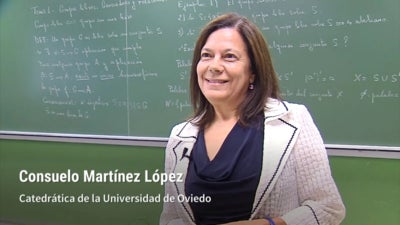
Consuelo Martínez López
The PECIEE project is a collaboration agreement under the Recovery, Transformation and Resilience Plan (Next Generation EU), which includes research, education and collaboration with industry. Its mission is to foster a culture of cybersecurity across all these areas, whilst also incorporating a social dimension focused on outreach and training, with the aim of reaching as many citizens as possible. The project is being carried out jointly by the University of Oviedo and Alfonso X el Sabio University.
In the field of research, the objective is twofold: on the one hand, to make progress on lines of research already underway in the groups involved, such as cryptography based on error-correcting codes and the development of quantum algorithms; on the other hand, to explore new possibilities and, where feasible, to launch new lines of research such as the interaction between artificial intelligence and cybersecurity, and the legal and regulatory aspects of this discipline.
Cybersecurity Research Group – Alfonso X el Sabio University
For its part, Alfonso X el Sabio University will launch a research group specialising in cybersecurity, which will develop several key areas of research to tackle the current challenges facing the digital sector:
Researchers and Contributors

Doctora en Matemáticas y catedrática de Álgebra en la Universidad de Oviedo, con una destacada trayectoria en teoría de grupos, álgebras y su aplicación en criptografía. Ha dirigido 16 tesis doctorales, publicado más de 100 trabajos científicos y colaborado con centros internacionales como Yale y MSRI. Coordina el proyecto PECIEE financiado por INCIBE y dirige la Cátedra Accenture de Inteligencia Analítica Avanzada.
Catedrático de Álgebra de la Universidad de Oviedo. Ha sido coordinador de Física y Matemáticas de la ANEP (Agencia Nacional de Evaluación y Prospectiva), miembro de la ACSUCyL (Agencia de Calidad del Sistema Universitario de Castilla y Leon) y de la Comisión de profesorado de ANECA. Director de 14 tesis doctorales y responsable de programas de matemáticas y ciberseguridad dentro del Cibercamp de INCIBE.

Doctor en Informática con más de 20 años de experiencia en educación superior y liderazgo tecnológico. Ha ocupado cargos como CIO y Vicerrector, y ha liderado proyectos en sistemas inteligentes, ciberseguridad y tecnologías aplicadas al aprendizaje, colaborando con empresas tecnológicas y publicando sobre inteligencia artificial y transformación digital.

Doctor en Informática por la Universidad de Alcalá con mención Cum Laude, experto en estrategia de ciberseguridad, protección de datos y formación especializada. Compagina su labor profesional en MovistarPlus+ con más de 20 años de experiencia docente, destacando su rol como Director del Máster de Ciberseguridad en UAX.

Licenciado en Informática por la UPM, con más de 13 años de experiencia en consultoría tecnológica en firmas como Deloitte, KPMG y EY, y desde 2012 en BBVA en funciones de seguridad y control de riesgo tecnológico. Ha dirigido el Máster en Ciberseguridad de UAX y forma parte del Centro de Investigación en Datos, Redes Complejas y Ciberseguridad de la URJC.
Ingeniero informático especializado en criptografía y seguridad, y doctorando en la UCLM en inteligencia artificial aplicada a la educación. Coordina el Máster en Ciberseguridad de UAX y dirige el área de Innovación y Analítica de Datos en el Colegio Europeo de Madrid. Colabora con el Ministerio de Educación y FECYT en proyectos de integración de IA en entornos educativos.
Doctor en Ingeniería de Seguridad, Ingeniero en Telecomunicaciones e Informática, con más de 20 años de experiencia. Certificado CISA y CISM. Especialista en ciberseguridad, digitalización, inteligencia artificial aplicada y liderazgo de proyectos internacionales. Ponente habitual en congresos, docente en UAX y autor de publicaciones sobre innovación y seguridad en tecnologías de la información.

Catedrático de Matemáticas en la Universidad de Oviedo e investigador principal del grupo GACYC. Doctorado en 2004, su investigación se centra en criptografía postcuántica, álgebra y computación cuántica. Es coordinador de la Red MatSI, cuenta con más de 50 publicaciones y ha dirigido varias tesis doctorales. Ha realizado estancias internacionales en centros como Philips Crypto e Iowa State University.

Doctora en Estadística por la Universidad Federal de Rio de Janeiro (Brasil). Experta en la aplicación de la ciencia de datos ciencia de datos , con más de 25 años de experiencia impulsando la innovación y generando resultados de negocio en diversos sectores. En DeNexus lideró el diseño e implementación de un sistema de modelos probabilísticos para la cuantificación de riesgos cibernéticos en instalaciones industriales.
Doctor en Ingeniería Informática y MBA. Ha ocupado altos cargos de responsabilidad, como Jefe de Redes del Ejército Argentino y Director del Centro de Investigación de Seguridad Informática de Argentina (CISI.ar). En la actualidad, ejerce como asesor y consultor especializado en ciberseguridad. Es autor de 5 libros sobre ciberseguridad y redes y cuenta con más de 30 años de experiencia en el campo docente.
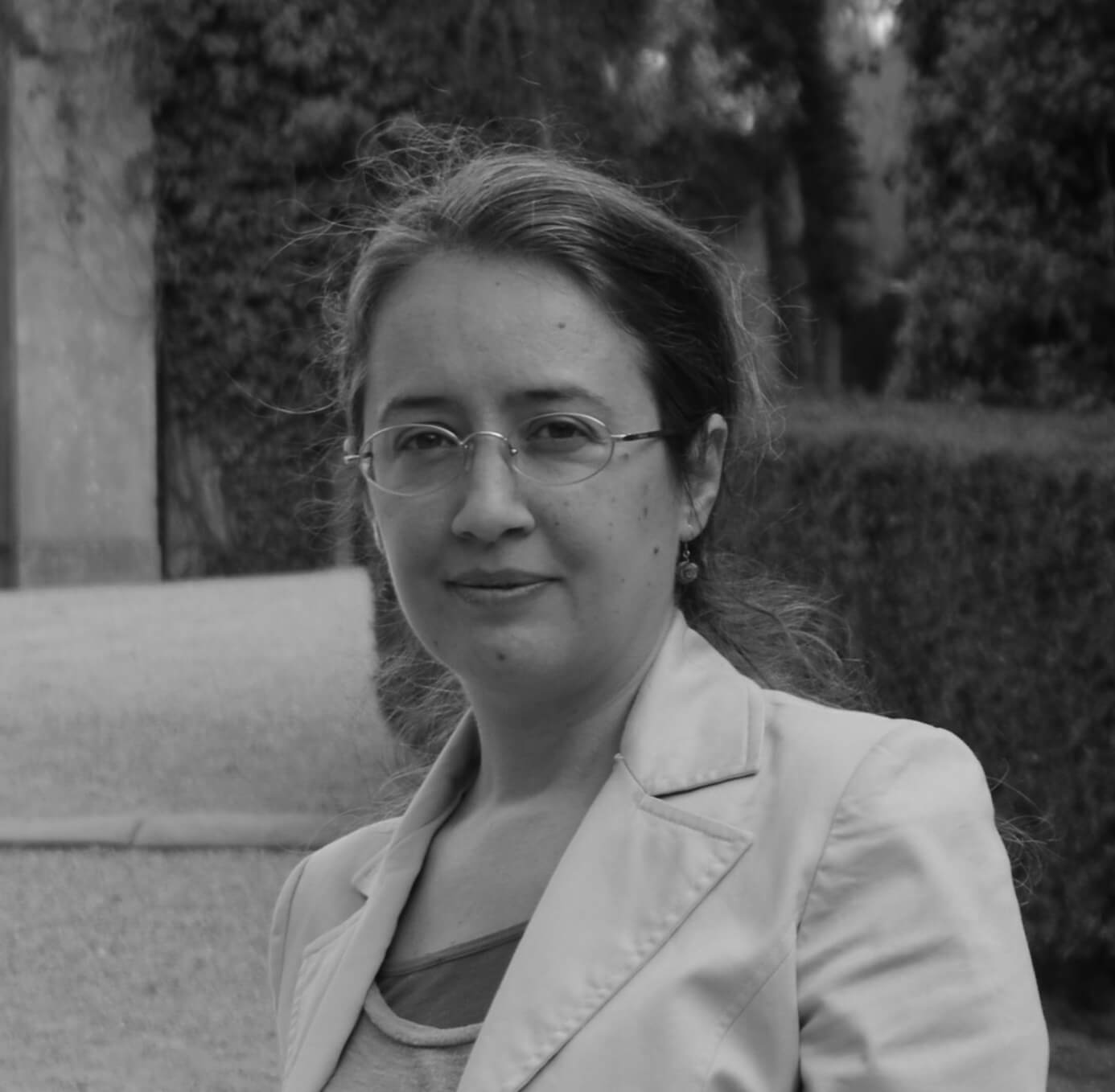
Member of the Personal Data Protection Office of the Agency for the Digital Administration of the Community of Madrid (Madrid Digital) with more than twenty years of experience as a lawyer specialising in Personal Data Protection, Administrative Law and Digital Law.
Masterclasses
Notes from each masterclass will be compiled and a report will be drawn up, aimed at all sectors, on the new threats posed by quantum computing that compromise the cryptographic schemes currently in use, with the aim of strengthening existing cryptography to ensure a secure transition to post-quantum cryptography.
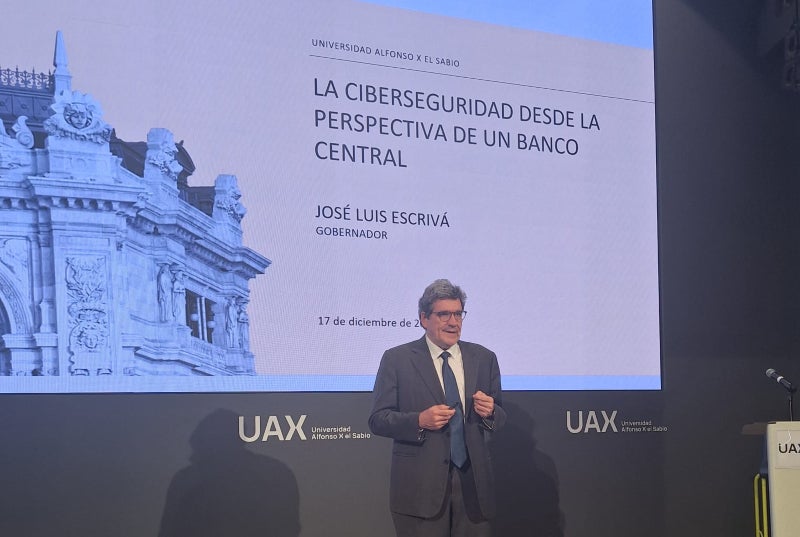
El papel estratégico de la ciberseguridad en el sector financiero, destacando la necesidad de invertir en formación especializada, reforzar la coordinación entre entidades y realizar pruebas de resistencia ante ciberataques. Se analizó cómo el contexto geopolítico y la innovación tecnológica han incrementado los riesgos, y se subrayó la importancia de contar con perfiles multidisciplinares para afrontar los desafíos actuales en la protección de servicios críticos.

El papel esencial de la criptografía en la protección de la información digital, abordando cómo garantiza la confidencialidad, integridad y autenticidad en entornos cada vez más expuestos a amenazas como el phishing o el ransomware. Se presentaron herramientas criptográficas, se analizaron las repercusiones económicas del cibercrimen y se destacó la necesidad de invertir en ciberseguridad y concienciación, con especial atención al desarrollo de criptografía post-cuántica.
El potencial transformador de la tecnología blockchain más allá de las criptomonedas, abordando su aplicación en identidad digital, ciberseguridad, comercio electrónico y gestión de credenciales. A través de casos prácticos como los Soulbound Tokens, los contratos inteligentes y las pruebas de conocimiento cero (ZKPs), se exploraron las oportunidades y desafíos de construir un ecosistema digital más seguro, descentralizado y confiable en el contexto de la Web3.

La tecnología cuántica supone un reto para la ciberseguridad, ya que un futuro ordenador cuántico con capacidades criptoanalíticas podría vulnerar las técnicas criptográficas actuales. Aunque es difícil saber cuándo ocurrirá, es necesario tomar medidas contundentes desde ya. La masterclass aborda si estas medidas se basarán en criptografía cuántica o post-cuántica, qué técnicas se verán afectadas, qué nuevos esquemas serán resistentes y por qué es clave articularlos sobre estándares.

Los smartphones son un objetivo atractivo para los ciberdelincuentes por la cantidad de información personal y sensible que almacenan, y por su conexión permanente (wifi, bluetooth, 4G, 5G), pudiendo ser una puerta de entrada a redes corporativas. La masterclass se centra en los ataques más relevantes a dispositivos móviles, cómo la IA y la computación cuántica pueden sofisticarlos, mostrando ejemplos en tiempo real y ofreciendo reglas básicas para una mayor protección.
In addition to the round-table discussions, the research team and partner companies have organised a series of workshops to complement the learning process.

Leveraging Data & AI for Cyber Risk Management

¿Qué hacemos en DFIR (Digital Forensics and Incident Response)?

The Lord of the Rings vs. Star Wars: new adventures. IAG y ciberataques

¿Puede Homer Simpson ser el nuevo rey del fraude online?

Procedimientos y herramientas para la adquisición y análisis forense

Hardening y creación de una herramienta para cumplimiento de la norma. Una historia personal
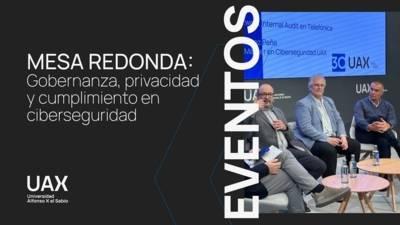
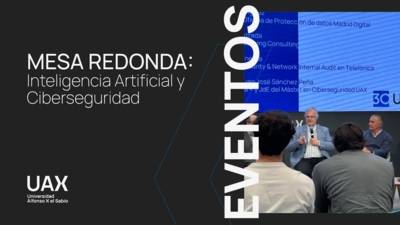
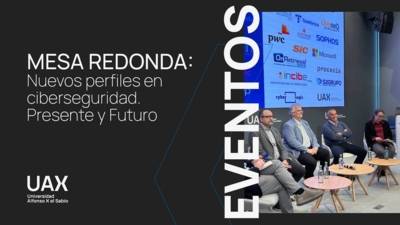
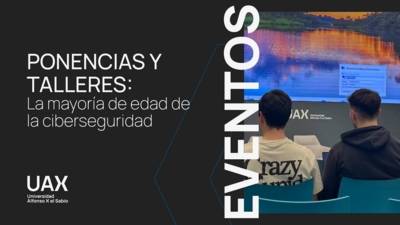
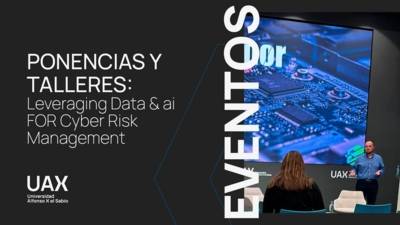
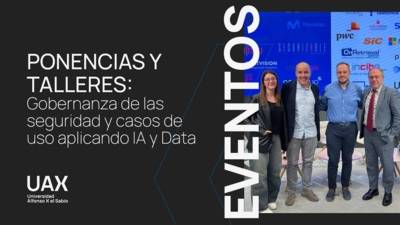
In addition to the round-table discussions, the research team and partner companies have organised a series of workshops to complement the learning process.

Quantum Computing and Cryptography

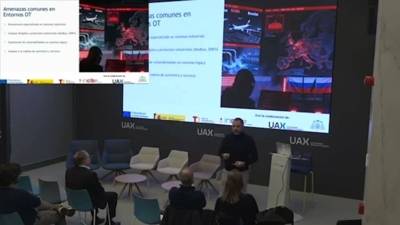
Cybersecurity in OT environments

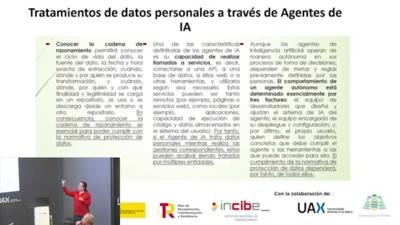
AI agentics from a data protection perspective

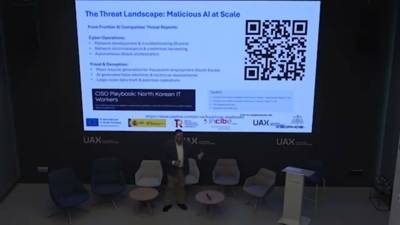
Adoption of AI in organisations and impact on cybersecurity

Disarming LLMs: Risks, Evidence and Good Governance of AI

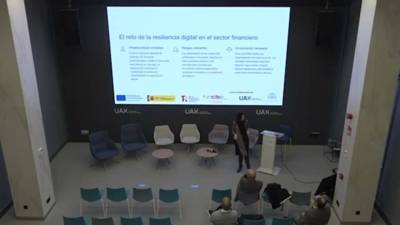
DORA: Digital Operational Resilience

Fraud on digital platforms

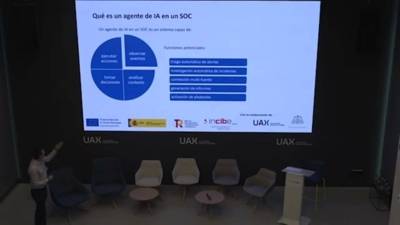
AI Agents in the SOC: Future of automation in impact management

Cybersecurity and AI in corporations
Funded by the European Union’s NextGeneration-EU programme, via INCIBE
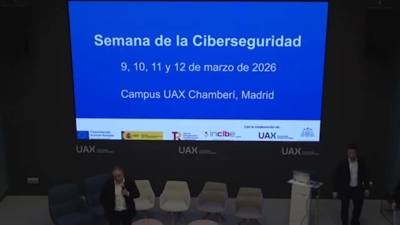
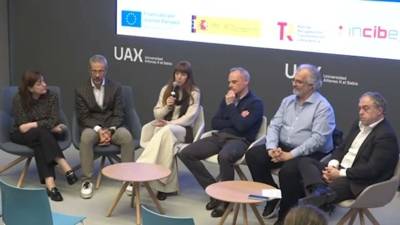
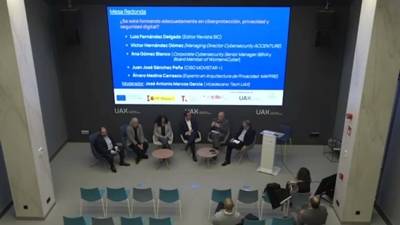
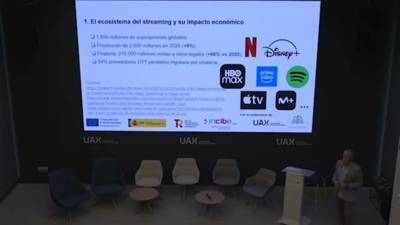
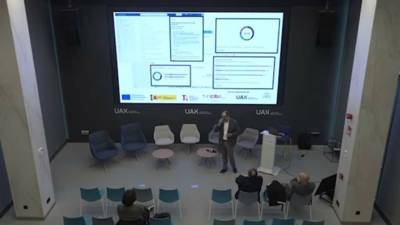
The conference will be held at the UAX headquarters in Madrid, on the Chamberí Campus, on 1, 2 and 3 October 2025. Each day of the conference will have a specific objective and set of themes, and will feature round-table discussions and presentations involving companies, professionals and researchers from the field of cybersecurity, as well as the media.
Guest of honour
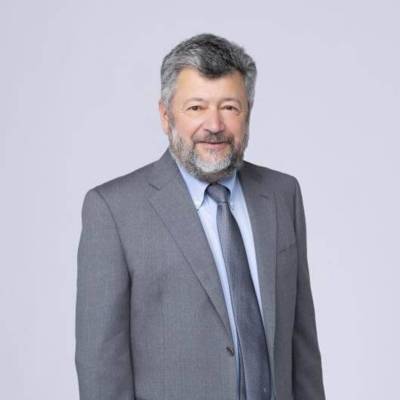
Efim Zelmanov is one of the world’s most renowned mathematicians for his contributions to algebra and its application to cryptography, a key discipline in the field of cybersecurity. His work has been fundamental to the development of Jordan algebras, which are relevant to quantum mechanics, and to the resolution of long-standing problems such as Burnside’s problem, for which he was awarded the prestigious Fields Medal in 1994, considered the Nobel Prize of mathematics.
He has taught at universities including Yale, Chicago, Wisconsin-Madison and Shanghai, and is a member of the US National Academy of Sciences and the Royal Spanish Academy of Sciences. He currently heads the Shenzhen International Centre for Mathematics (SUSTech) and, since 2022, has held an honorary doctorate from Alfonso X el Sabio University. His vision positions mathematics as an essential pillar of the technological and digital revolution.
As part of this research project, the production of scientific publications, final-year undergraduate dissertations (TFG) and final-year master’s dissertations (TFM) will be encouraged; these will form an integral part of the academic output arising from the aforementioned research areas. In addition, participation in international cybersecurity conferences and events will be facilitated in order to present the most significant advances.

En revistas de alto impacto a nivel nacional e internacional.

Nacionales e internacionales, tanto con comunicaciones orales como presentaciones de posters.

Desarrollados dentro de las líneas de investigación del proyecto, que serán evaluados y publicados en plataformas académicas.
Consultar
You can access videos, learning materials, teaching guides and short assessment tests. Take a look at the table of contents now to see the full structure of the project.
Further information