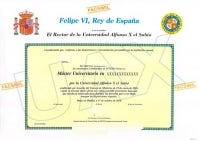
Official qualification
Online
Specialise with UAX’s Online Master’s Degree in Educational Innovation. Learn how to design, implement and evaluate educational innovation projects, incorporating active methodologies, inclusive strategies and processes to enhance learning in a variety of educational contexts.
All fields are required
The Master’s in Educational Innovation prepares you to design, develop and evaluate projects capable of improving teaching and learning processes in different educational contexts. You will learn to apply active methodologies, drive initiatives for change and respond to current challenges in education from a practical, inclusive and learner-centred perspective.
Furthermore, you will explore educational leadership, attention to diversity, universal design for learning and the evaluation of the impact of innovative proposals. All of this is aimed at promoting continuous improvement in educational institutions and creating more effective and meaningful learning experiences.
This officially recognised Master’s degree is based on a practical and flexible methodology geared towards solving real educational challenges. Through case studies, applied projects and simulation environments, you will develop the skills to identify needs, plan interventions and evaluate outcomes in diverse educational contexts.
The programme encourages collaboration, experiential learning and the immediate application of knowledge in professional practice. Thanks to the online format, you will be able to balance your studies with other commitments whilst developing educational innovation projects tailored to your own working environment.
You will learn to design, implement and evaluate educational innovation projects, applying active methodologies, inclusive strategies and models for improving learning to address the challenges of today’s education system.



Enhance your teaching practice by understanding learning through the lens of neuroeducation. This micro-credential equips you to analyse students’ cognitive, emotional and behavioural processes, identify potential difficulties at an early stage, and apply evidence-based inclusive teaching strategies in the classroom.

Transform the way you work with generative artificial intelligence. This micro-credential empowers you to apply tools like ChatGPT, Copilot, and Gemini to analyze information, create content, and make decisions in real-world academic contexts, integrating solutions ethically and responsibly within the educational field.

Develop your potential in education through leadership and interpersonal skills. This microcredential provides you with the keys to managing teams, communicating effectively, and solving problems in real-world educational settings, combining personal leadership techniques with practical productivity and collaboration tools.











The Online Master’s Degree in Educational Innovation is aimed at education professionals who wish to develop their skills in the design, implementation and evaluation of educational innovation projects. This programme is specifically designed for teachers seeking to incorporate active learning methodologies, drive educational improvement processes and address current challenges in teaching from an innovative and inclusive perspective.
Furthermore, as it is an officially recognised qualification, it may count towards merit in competitive examinations and other public sector recruitment processes, in accordance with the terms and conditions of each call for applications.
You will be eligible for the Master’s degree if you meet any of the following criteria:
The curriculum addresses the main challenges and trends in education today, ranging from the fundamentals of educational innovation to the management of change in schools. Throughout the programme, you will explore innovative teaching and learning methodologies, catering for diversity, teaching leadership, educational communication, artificial intelligence applied to education, and strategies to drive continuous improvement in educational processes.
Master’s Degree in Educational Innovation
First Year
FIRST FOUR-MONTH PERIOD
| Code | Subjects | Character* | ECTS |
|---|---|---|---|
| SM150400 | Educational innovation: Theories, paradigms and recent applications | OB | 6 |
| SM150401 | Innovation management in the field of education | OB | 6 |
| SM150402 | Innovative educational strategies for addressing pupils’ individual differences | OB | 6 |
| SM150403 | Innovative teaching and learning methodologies in the classroom | OB | 6 |
| SM150404 | Innovation as a driver of change for teachers | OB | 6 |
| SM150405 | Artificial Intelligence and new technologies for education | OB | 6 |
| TOTAL: | 36 | ||
SECOND FOUR-MONTH TERM
| Code | Subjects | Character* | ECTS |
|---|---|---|---|
| SM150406 | Design and evaluation of projects for innovation and educational improvement within the school | OB | 6 |
| SM150407 | Teaching leadership and assertive communication techniques | OB | 6 |
| SM150408 | External academic placements | OB | 6 |
| SM150409 | Master’s Thesis | OB | 6 |
| TOTAL: | 24 | ||
*Character: BT: Basic Training, Ob: Required, Op: Optional
Our degree is official, verified by the Council of Universities and fully valid in Spain, as well as in the European Higher Education Area.
It is recognised by the Education Systems of Latin America, being recognised and approved by the different Ministries of Education in Latin America:
Senescyt, Mescyt, Sunedu, MEN (MinEducation), SEP, among others, automatically.
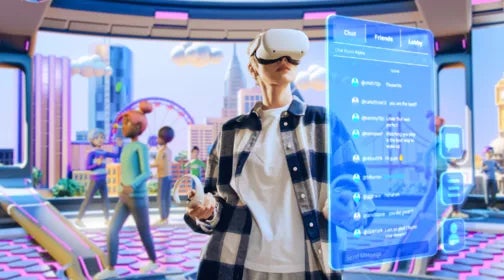
The main reason why UAX attracts students like you is the opportunity to balance your personal, professional and academic life. What sets us apart is a barrier-free approach, centred on you and your desire to learn.
What is our approach like?
In addition, you’ll have full access to our campus in Madrid to carry out administrative tasks, get answers to your questions and enjoy the facilities it has to offer.
The Master’s in Educational Innovation includes 6 ECTS credits of work placement: 150 curricular hours (105 of which are face-to-face at the centre), to be undertaken in the second four-month term. You will enjoy an immersive experience at an educational institution, where you will put what you have learnt into practice, analyse innovative initiatives, reflect on teaching practice and develop your own innovation project with guidance and feedback. Thanks to our partnerships with educational institutions, NGOs and public bodies, you will gain access to real-world settings where you can make a difference.
We have partnerships with over 700 associations and educational institutions, such as:
If you have relevant professional experience, you may be able to have your work placement recognised. Please contact our advisers for a personalised assessment of ECTS credit recognition.
The flexibility of online learning, with opportunities to connect
Take your exams online wherever you are or, if you prefer, in person at our designated centres in Spain and Latin America, subject to availability and capacity.
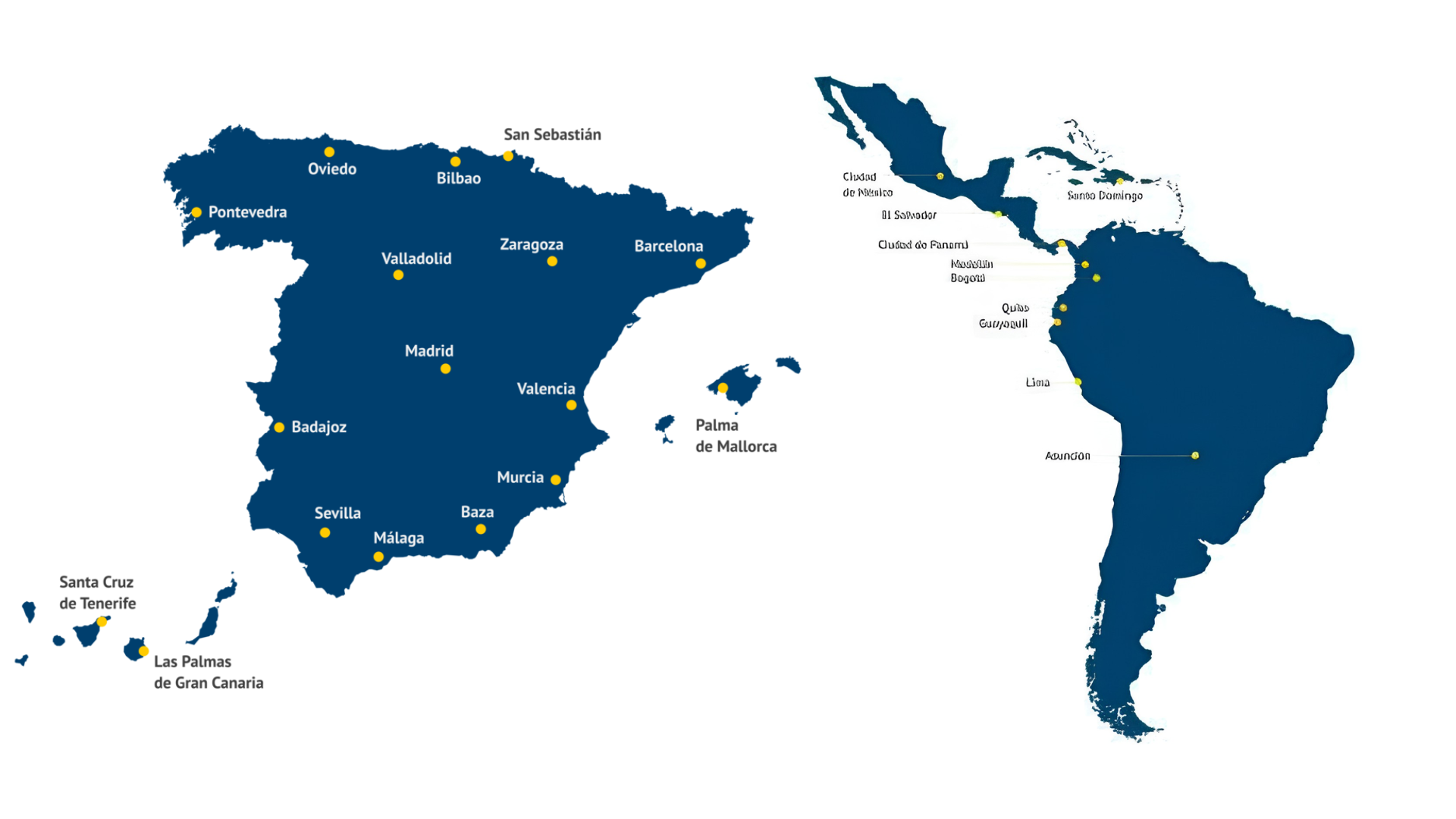
Furthermore, as a student at UAX Online, you’ll have access to our Campus Hubs, a network of exclusive physical spaces where you can study, access libraries, work in co-working areas and connect with other students. Because studying online doesn’t mean studying alone.
Campus Hubs available in: Alcobendas, Alcorcón, Valencia San Vicente, Murcia, Barcelona, Málaga, Seville and Arganda.
Access is granted with your UAX student card, subject to availability and the opening hours of each centre.









Teaching staff
Train with specialists in educational innovation, teaching leadership, active learning methodologies, inclusion and educational transformation, who have experience in school leadership, teacher training, research and the development of educational improvement projects.

He holds a PhD in Education and is the headteacher of Arturo Soria School. He has over 25 years’ experience in teaching, leadership and educational management, and has spearheaded projects focused on innovation and methodological transformation in various educational settings. His research focuses on educational innovation and the social responsibility of schools.

Early Years Coordinator at Highlands School, Los Fresnos. A specialist in educational innovation, inclusion and pedagogical leadership, she holds a Master’s degree in Augmentative and Alternative Communication and is a Microsoft Innovative Educator Expert (MIE Expert). She has been awarded the 2023 Acade Prize in recognition of her contribution to the field of education.

President of the Open Education Association and a consultant specialising in educational innovation and educational transformation. A member of the advisory board of *Cuadernos de Pedagogía*, he has extensive experience in change management and has held senior management positions at institutions such as IED and EOI.

Primary Education Coordinator at Highlands School, Los Fresnos. A specialist in educational leadership, pedagogical innovation and teacher training, she has experience in academic coordination and the development of educational projects. She has been awarded the Ángel Herrera Award for Excellence in Teaching.

Head of Digital Projects at HedIA and a university lecturer specialising in educational innovation and digital transformation. He has experience in teacher training, the development of digital skills and the application of innovative methodologies in educational settings.

PhD in Educational Sciences, awarded with distinction (Cum Laude), from the University of Alicante. Lecturer and researcher specialising in teacher training, the organisation of educational institutions and the teaching of language and literature, with a particular focus on Early Years and Primary Education.

He holds a PhD in Educational Sciences and specialises in educational innovation and teachers’ digital literacy. He has contributed to projects focusing on educational transformation and teacher training, with a particular interest in active learning methodologies and the STEAM approach.

He holds a PhD in Education and is a primary school teacher. A specialist in educational innovation, active teaching methods and digital competence for teachers, he is a Google Certified Trainer and regularly contributes to training and innovation projects for teachers.
Study wherever you like without missing out on a university experience that is accessible, practical and geared towards your professional development.

Live lessons that are always available

Flexibility to study at your own pace

Practical learning based on real-life cases

Personalised academic support

Teachers who are currently working and have links to the sector

Training aimed at improving employability
Scholarships and financial support for studying at UAX
We know that studying is an investment. That’s why we want to remove financial barriers and make things easier for you. Fill in the form and let our advisers help you discover the scholarships, agreements and personalised financial support that best suit your situation.

Community of Madrid
Financial support for students with a disability of 33 per cent or more who are studying at universities or higher education institutions specialising in the arts in the Community of Madrid.
Ministry of Education, Vocational Training and Sport
Find out about the scholarships and grants offered by the Ministry of Education, Vocational Training and Sport, categorised by type and level of education.

Attracting Pre-doctoral Research Talent
Financial support for outstanding students who wish to carry out innovative research and contribute to the advancement of knowledge in their disciplines.

If you’ve already decided to take the plunge, enrol early and benefit from a direct grant. It’s a way of rewarding your commitment and giving you a head start in planning your future.
Students from Ibero-America
This programme is aimed at Ibero-American citizens or foreign nationals legally resident in countries within the OEI’s sphere of influence. The scholarship covers a 50% discount on the total tuition fees.
Students from Ecuador
This programme is aimed at citizens with Ecuadorian nationality and/or residence who wish to study an online master’s degree in Spain. The scholarship covers a 50% discount on the total tuition fees.
2025, 2nd Edition
Grants for students on higher-level vocational training, undergraduate, postgraduate or master’s programmes enrolled at Spanish universities with a Santander agreement. A financial supplement to support you whilst undertaking your work placements.

If you graduated from UAX and are now thinking of studying for a new degree, we want to continue supporting you. That’s why we’re offering you a 10 per cent discount on tuition fees.

If you have an immediate family member (up to the second degree of kinship) enrolled at UAX, you can benefit from a 5 per cent discount on tuition fees. Because studying as a family is even better.

Studying for two degrees at the same time is a challenge, and we want to support you. If you’re already at UAX and enrol on a second degree programme, you’ll be eligible for a grant towards your booking fee and tuition fees.

If you’d like to continue your studies with us and progress from vocational training to a bachelor’s degree, from one bachelor’s degree to another, or from a bachelor’s degree to a postgraduate degree, we’re here to support you with a grant covering up to 25 per cent of your tuition fees.

If you have a strong academic record, we would like to recognise your talent with a scholarship designed for new students. (Excludes the degree in Medicine).

If you’re a high-performance athlete, at UAX we want to help you balance your passion with your studies. We offer specific grants that can cover up to 50% of your tuition fees.

Yes. The UAX Master’s Degree in Educational Innovation is an official qualification, accredited by the Council of Universities and fully recognised in Spain and within the European Higher Education Area (EHEA).
Furthermore, it is recognised in numerous Latin American countries and may be recognised or accredited by the relevant educational bodies in accordance with the regulations in force in each country. As it is an officially recognised qualification, it may also be considered as a merit in competitive examinations and other public selection processes, subject to the terms and conditions of each call for applications.
The Online Master’s Degree in Educational Innovation is aimed at teachers and professionals in the field of education who wish to update their teaching skills, incorporate innovative methodologies and lead improvement processes in their educational institutions.
It is particularly aimed at graduates in Early Years Education and Primary Education, professionals holding a Master’s in Teacher Training, and others with a background in teaching who wish to specialise in educational innovation, pedagogical leadership, inclusion and the transformation of teaching and learning processes.
The Master’s in Educational Innovation explores active methodologies that encourage student participation and improve teaching and learning processes. Throughout the programme, you will work with approaches such as project-based learning (PBL), cooperative learning, gamification, universal design for learning (UDL) and other strategies aimed at creating more inclusive and meaningful educational experiences.
In addition, you will explore trends and innovative approaches such as Educational Innovation 3.0, innovation in educational guidance, and new strategies to drive change and continuous improvement in educational institutions, adapting them to the needs of today’s society.
The Master’s in Educational Innovation addresses the main challenges and trends in today’s education system, combining pedagogical innovation, educational leadership, active methodologies, inclusion and change management in schools.
Throughout the programme, you will explore areas such as the design of innovative learning experiences, addressing diversity, the evaluation of educational projects, communication and teaching leadership, as well as the strategic use of artificial intelligence and other technologies applied to teaching. In addition, you will round off your studies with work placements and a Master’s Thesis focused on the realities of the education sector.
The Online Master’s in Educational Innovation combines flexibility with practical learning, enabling you to balance your studies with other professional or personal commitments. Throughout the programme, you will work on real-life case studies, analyse innovative practices and undertake projects relevant to the field of education.
In addition, you will have access to digital resources, academic support and collaborative spaces that will encourage the exchange of ideas and the application of innovative methodologies in real-world educational contexts.
The Master’s programme is based on hands-on learning focused on solving real-world educational challenges. Throughout the programme, you will work with methodologies such as Agile, Lean Canvas, project-based learning and gamification, applying them to real-world educational contexts.
In addition, you will develop and evaluate educational innovation projects, analyse emerging trends in education and explore the use of generative AI to personalise teaching and learning processes. All of this will be supported by lecturers and professionals specialising in educational innovation.
Yes. The Master’s programme includes External Academic Placements, designed to enable you to apply the knowledge you have acquired in real-world educational contexts and gain first-hand insight into the innovation processes taking place in educational centres and institutions.
During this period, you will have the opportunity to observe, analyse and participate in initiatives related to improving teaching and learning processes, educational leadership, inclusion and the implementation of educational innovation projects, always under the guidance of professionals in the sector.
Thanks to our partnerships with over 700 educational establishments, NGOs and public institutions, you’ll have access to real-world environments where you can make a difference.
Although both programmes share the aim of improving teaching and learning processes, their approach differs.
The Master’s in Educational Innovation focuses on the design and development of innovation projects, the application of active methodologies, educational leadership, inclusion and change management in schools. Its aim is to equip professionals to drive pedagogical improvements and educational transformation.
For its part, the Master’s in Educational Technology focuses on the integration of digital tools, technological skills and ICT resources into teaching processes, delving deeper into the pedagogical use of technology in the classroom.
In short, if you are looking to lead processes of innovation and educational transformation, this Master’s programme is the right choice; if your main interest lies in the application of digital technologies in education, the Master’s in Educational Technology offers a more specific specialisation in this field.
Yes. As this is an official Master’s degree, it may be recognised as a merit in competitive examinations for teaching posts, transfer competitions and other public recruitment processes, in accordance with the criteria established by each education authority.
As well as contributing to your assessment, the Master’s degree will enable you to broaden your knowledge of educational innovation, active teaching methods, pedagogical leadership and inclusion – skills that are increasingly in demand in schools and within professional development programmes for teachers.
Other related qualifications
We offer a wide range of academic programmes, so you’re sure to find one that suits you:

Master’s Degree in Educational Technology and Digital Teaching Skills – ICT (online)
In collaboration with:

Start:
October
Length:
9 months

Online Master’s Degree in Leadership and Management of Educational Institutions
In collaboration with:

Start:
October
Length:
9 months

Master’s Degree in Educational Psychology (online)
In collaboration with:

Start:
October
Length:
9 months

Master’s Degree in Supporting Diversity and Inclusive Education (Online)
In collaboration with:

Start:
October
Length:
9 months

Master’s Degree in Teacher Training
In collaboration with:


Start:
October
Length:
1 year

Master’s Degree in Educational Neuropsychology (Online)
In collaboration with:

Start:
October
Length:
9 months
Enquiries, complaints and claims
We respond to the genuine needs of our students and staff, because we believe in the continuous improvement of our results. That is why we always want to hear whatever you have to say.
If you are already part of UAX, please visit the ‘Customer Service: complaints, suggestions and compliments’ section on thevirtual campus , logging in with your username and password.
You can view the various indicators via the following links:
Employability: View
Satisfaction results: View
Rates and indicators: View
Improvement measures implemented for the degree programme during the academic year: