See all Online Master's Degrees in Health
See all Master's Degrees in Engineering
Most searched curriculums
Official Qualification
9 months / 60 ECTS
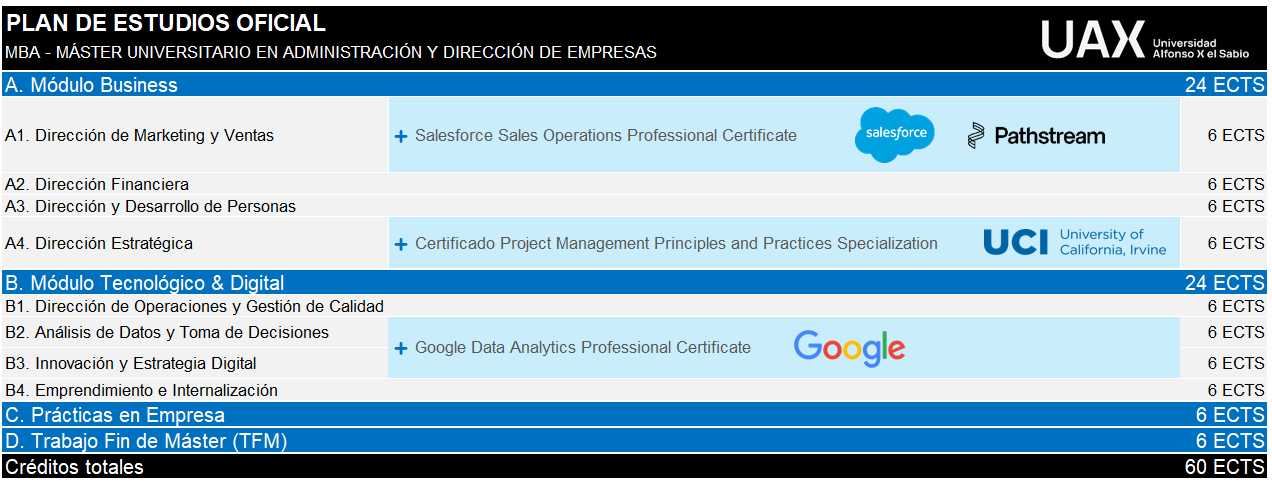
Three professional certificates included from Google, Salesforce and UC Irvine.
The UAX online MBA is designed for professionals who wish to develop a strategic business outlook and lead organisations in digital environments. It combines general management, finance, marketing, operations, human resources, data analysis, artificial intelligence applied to business and digital transformation.
Delivered entirely online, this accredited online MBA is designed to train professionals to lead organisations, drive business transformation and make strategic decisions in complex and changing environments.
Through practical training, you will work on real-world case studies, develop key soft skills such as leadership, communication and strategic thinking, and learn from professionals with extensive management experience. In addition, you’ll gain access to a network of over 8,800 partnerships with national and international companies and institutions that will help to further your professional development.
The curriculum combines the core areas of business management with the skills most in demand by today’s organisations. During the Master’s programme, you will explore in depth:
All of this through a practical approach aimed at solving the real challenges faced by companies and developing a global vision of business.
You will lead with a holistic view of the business, anticipating changes in the environment.
You will develop leadership, talent management and effective decision-making skills.
You will learn how to drive digital processes in your company from a practical perspective.
You will master tools in digital strategy, data, technology operations and AI.
You will learn from professionals and executives from leading companies such as Google, Ikea, Amazon or Inditex.
You will be able to apply your knowledge in leading companies with more than 8,800 active agreements in companies.
You will connect with experts, students and CEOs at events, classes and interactive sessions.
You will study at your own pace, with live or recorded classes and constant academic support.
Professional certificates of specialisation
Broaden your horizons with our three included certificates to boost your career in the digital sector and strengthen your professional profile. At UAX, you’ll earn professional certificates from Google, Salesforce and the University of California to complement your MBA.

Transform the way you manage sales with Salesforce. This professional certification, issued by Salesforce and Pathstream, introduces you to using key CRM tools to create reports, visual dashboards and manage leads efficiently, just as the world's most successful companies do.
Boost your career with a comprehensive view of project management. This professional certificate, issued by the University of California, Irvine, provides you with the Project Management Institute's key tools to plan, lead and execute projects efficiently and strategically.
Become an expert in data analytics with Google's professional certificate. Learn from the basics to advanced programming techniques in R, covering data collection, cleaning and analysis. Ideal for those looking to transform data into innovative strategies and make strategic decisions based on it.
Transform the way you work with generative artificial intelligence. This micro-credential enables you to apply tools such as ChatGPT, Copilot or Gemini in information analysis, content creation and decision-making, integrating innovative solutions in an ethical and responsible way in real professional environments.

Develop your professional potential through leadership and interpersonal skills. This micro-credential provides you with the keys to manage teams, communicate effectively and solve problems in real-world environments, combining personal leadership techniques with practical productivity and collaboration tools.
Master's Degree in Business Management and Administration
First Year
FIRST FOUR-MONTH PERIOD
| Code | Subjects | Character* | ECTS | ||||||||||||||||||||||||||||||||||||||||||||||||||||||||||||||||||||||||||||||||||||||||||||||
|---|---|---|---|---|---|---|---|---|---|---|---|---|---|---|---|---|---|---|---|---|---|---|---|---|---|---|---|---|---|---|---|---|---|---|---|---|---|---|---|---|---|---|---|---|---|---|---|---|---|---|---|---|---|---|---|---|---|---|---|---|---|---|---|---|---|---|---|---|---|---|---|---|---|---|---|---|---|---|---|---|---|---|---|---|---|---|---|---|---|---|---|---|---|---|---|---|---|
| SM121400 | Data analysis and decision-making | OB | 6 | ||||||||||||||||||||||||||||||||||||||||||||||||||||||||||||||||||||||||||||||||||||||||||||||
Data analysis and decision-makingCódigo: SM121400 Imprimir Course 1: First-semester module. Compulsory. 6 credits. Profesores
Objectives The objectives of the Master’s degree are: CB6 – To possess and understand knowledge that provides a basis or opportunity for originality in the development and/or application of ideas, often in a research context CB7 – For students to be able to apply the knowledge they have acquired and their problem-solving skills in new or unfamiliar settings within broader (or multidisciplinary) contexts related to their field of study CB8 – For students to be able to integrate knowledge and tackle the complexity of making judgements based on information which, whilst incomplete or limited, includes reflections on the social and ethical responsibilities associated with the application of their knowledge and judgements CB9 - Students should be able to communicate their conclusions and the underlying knowledge and reasoning to specialist and non-specialist audiences in a clear and unambiguous manner CB10 - Students should possess the learning skills that enable them to continue their studies in a way that will be largely self-directed or autonomous Specifically, the main objective of this module is: The course aims to equip students with an understanding of the various applications of data analysis techniques in a business context and how this aids decision-making to achieve the organisation’s objectives. Prerequisites There are no prerequisites. Competencies CB6 – Possess and understand knowledge that provides a basis or opportunity for originality in the development and/or application of ideas, often in a research context CB7 – Students should be able to apply the knowledge they have acquired and their problem-solving skills in new or unfamiliar settings within broader (or multidisciplinary) contexts related to their field of study CB8 – Students should be able to integrate knowledge and address the complexity of making judgements based on information which, whilst incomplete or limited, includes reflections on the social and ethical responsibilities associated with the application of their knowledge and judgements CB9 - Students should be able to communicate their conclusions and the underlying knowledge and reasoning to specialist and non-specialist audiences in a clear and unambiguous manner CB10 - Students should possess the learning skills that enable them to continue their studies in a way that will be largely self-directed or autonomous Learning outcomes Knowledge: RK1. To be familiar with the data analysis techniques to be applied, in order to establish the criteria to be taken into account in each situation when making business decisions. Skills: RS5. Make decisions on business matters based on the knowledge acquired. Competence: RC0. Acquire an in-depth understanding of the discipline, enabling students to synthesise and apply this knowledge critically to specific business situations. RC15. Analyse data and information to produce an assessment that supports the organisation’s decision-making. Course content description 1. Data and decision-making 2. Data exploration 3. Data prediction 4. Data integration and analysis 5. Data visualisation 6. Tools and methods for decision-making Training activities Lectures Interactive classes Assignments and case studies Independent study, case studies or problem-solving, literature reviews Tutorials Knowledge tests Assessment system and criteria Your final mark will be based on the following assessment system: 60 per cent of your final mark will be based on your continuous assessment. The following will be taken into account: • the assessment of the three feedback exercises completed throughout the term, which will be weighted (20% of the final mark). • Active participation in forums, contributing your views, knowledge and experiences (10% of the final mark). • Project submission: 30 per cent of the final mark. The final exam for the module will account for: 40 per cent of the final mark. Timetable Click on this link to view the detailed timetable in Excel
Bibliography Essential: 1. Berenson, M. L., Levine, D. M., & Szabat, K. A. Basic Business Statistics: Concepts and Applications Pearson. 2022. ISBN: 9780137400119 2. Hair, J. F., Black, W. C., Babin, B. J., & Anderson, R. E. Multivariate Data Analysis ed. Pearson. 2019. ISBN: 129202190X 3. Kahneman, D. Thinking, Fast and Slow Farrar, Straus and Giroux. 2011. ISBN: 9780374275631 4. Provost, F., & Fawcett, T. Data Science for Business: What You Need to Know about Data Mining and Data-Analytic Thinking O’Reilly Media. 2013. ISBN: 1449361323 5. Shmueli, G., Bruce, P. C., Gedeck, P., & Patel, N. R. Data Mining for Business Analytics: Concepts, Techniques, and Applications in Python Wiley. 2020. ISBN: 9781119549864 |
|||||||||||||||||||||||||||||||||||||||||||||||||||||||||||||||||||||||||||||||||||||||||||||||||
| SM121401 | Marketing and Sales Department | OB | 6 | ||||||||||||||||||||||||||||||||||||||||||||||||||||||||||||||||||||||||||||||||||||||||||||||
Marketing and Sales DepartmentCódigo: SM121401 Imprimir Course 1: First-semester module. Compulsory. 6 credits. Profesores
Objectives The objectives of the Master’s degree are: CB6 – To possess and understand knowledge that provides a basis or opportunity for originality in the development and/or application of ideas, often in a research context CB7 – For students to be able to apply the knowledge they have acquired and their problem-solving skills in new or unfamiliar settings within broader (or multidisciplinary) contexts related to their field of study CB8 – For students to be able to integrate knowledge and tackle the complexity of making judgements based on information which, whilst incomplete or limited, includes reflections on the social and ethical responsibilities associated with the application of their knowledge and judgements CB9 - Students should be able to communicate their conclusions and the underlying knowledge and reasoning to specialist and non-specialist audiences in a clear and unambiguous manner CB10 - Students should possess the learning skills that enable them to continue their studies in a way that will be largely self-directed or autonomous Specifically, the main objective of this module is: The course aims to equip students with a broad understanding of activities related to the fields of marketing and sales, with a primary focus on understanding, analysing, evaluating and optimising the marketing and sales strategies of an organisation operating nationally and internationally. Prerequisites Candidates for whom this is stipulated must complete the following supplementary modules: - Management - Introduction to Business Law Competencies CB6 – Possess and understand knowledge that provides a basis or opportunity for originality in the development and/or application of ideas, often within a research context CB7 - Students should be able to apply the knowledge they have acquired and their problem-solving skills in new or unfamiliar settings within broader (or multidisciplinary) contexts related to their field of study CB8 – Students should be able to integrate knowledge and address the complexity of making judgements based on information which, whilst incomplete or limited, includes reflections on the social and ethical responsibilities associated with the application of their knowledge and judgements CB9 - Students should be able to communicate their conclusions and the underlying knowledge and reasoning to specialist and non-specialist audiences in a clear and unambiguous manner CB10 - Students should possess the learning skills that enable them to continue their studies in a manner that will be largely self-directed or autonomous Learning outcomes Knowledge: RK0. To acquire in-depth knowledge of the discipline, enabling them to synthesise and apply it critically to specific business situations. Skills: RS2. To improve commercial policies by using the knowledge acquired and applying the appropriate tools. Competence: RC5. Assess the international marketing environment and the international marketing mix in order to position products or services appropriately. RC13. Critically analyse the company’s various commercial policies with a view to improving them. Description of the content 1. The global marketing mix and the international market 2. Product decisions 3. Pricing decisions 4. Advertising decisions 5. Distribution decisions 6. The sales force and its management Training activities Lectures Interactive classes Assignments and case studies Independent study, case studies or problem-solving, literature reviews Tutorials Knowledge tests Assessment system and criteria Your final mark will be based on the following assessment system: 60 per cent of your final mark will be based on your continuous assessment. The following will be taken into account: • the assessment of the three feedback exercises completed throughout the term, which will be weighted (20% of the final mark). • Active participation in forums, contributing your views, knowledge and experiences (10% of the final mark). • Project submission: 30 per cent of the final mark. The final exam for the module will account for: 40 per cent of the final mark. Timetable Click on this link to view the detailed timetable in Excel
Bibliography Essential: 1. Armstrong, G., & Kotler, P. Principles of Marketing Pearson. 2021. ISBN: 978-129234113 2. Chaffey, D., & Ellis-Chadwick, F. Digital Marketing: Strategy, Implementation and Practice Pearson. 2022. ISBN: 978-027374610 3. Hutt, M. D., & Speh, T. W. Business Marketing Management: B2B Cengage Learning. 2021. ISBN: 9780357718230 4. Jobber, D., & Ellis-Chadwick, F. Principles and Practice of Marketing McGraw-Hill Education. 2020. ISBN: 9781526849533 5. Kotler, P., Kartajaya, H., & Setiawan, I. Marketing 5.0: Technology for Humanity Wiley. 2021. ISBN: 978-111966851 6. Kotler, P., Keller, K. L. Marketing Management Pearson. 2022. ISBN: 9781292404813 7. Moncrief, W. C., Marshall, G. W., & Lassk, F. G. Sales Management: Analysis and Decision Making Routledge. 2022. ISBN: 978-113885802 |
|||||||||||||||||||||||||||||||||||||||||||||||||||||||||||||||||||||||||||||||||||||||||||||||||
| SM121402 | Operations and Quality Management | OB | 6 | ||||||||||||||||||||||||||||||||||||||||||||||||||||||||||||||||||||||||||||||||||||||||||||||
Operations and Quality ManagementCódigo: SM121402 Imprimir Course 1: First-semester module. Compulsory. 6 credits. Profesores
Objectives The objectives of the Master’s degree are: CB6 – To possess and understand knowledge that provides a basis or opportunity for originality in the development and/or application of ideas, often in a research context CB7 – For students to be able to apply the knowledge they have acquired and their problem-solving skills in new or unfamiliar settings within broader (or multidisciplinary) contexts related to their field of study CB8 – For students to be able to integrate knowledge and tackle the complexity of making judgements based on information which, whilst incomplete or limited, includes reflections on the social and ethical responsibilities associated with the application of their knowledge and judgements CB9 - Students should be able to communicate their conclusions and the underlying knowledge and reasoning to specialist and non-specialist audiences in a clear and unambiguous manner CB10 - Students should possess the learning skills that enable them to continue their studies in a way that will be largely self-directed or autonomous Specifically, the main objective of this module is: The course aims to provide students with a broad overview of supply chain activities, focusing primarily on understanding, analysing, evaluating and optimising the key elements that will enable operations to be carried out effectively, in accordance with the necessary quality guidelines and using the relevant technological resources. Prerequisites Depending on the candidate’s profile, the prerequisites are to have completed the following supplementary modules: - Management - Introduction to Business Law Competencies CB6 – Possess and understand knowledge that provides a basis or opportunity for originality in the development and/or application of ideas, often within a research context CB7 - Students should be able to apply the knowledge they have acquired and their problem-solving skills in new or unfamiliar settings within broader (or multidisciplinary) contexts related to their field of study CB8 – Students should be able to integrate knowledge and address the complexity of making judgements based on information which, whilst incomplete or limited, includes reflections on the social and ethical responsibilities associated with the application of their knowledge and judgements CB9 - Students should be able to communicate their conclusions and the underlying knowledge and reasoning to specialist and non-specialist audiences in a clear and unambiguous manner CB10 - Students should possess the learning skills that enable them to continue their studies in a manner that will be largely self-directed or autonomous Learning outcomes Knowledge: RK0. To acquire in-depth knowledge of the discipline, enabling them to synthesise and apply it critically to specific business situations. Skills: RS3. Improve supply chain management by applying the knowledge acquired. Competence: RC1. Students discuss, argue and propose sound solutions to complex business problems. RC6. Distinguish the role of operations management in the planning, organisation and management of the resources required to produce a company’s products and services. C14. Analyse supply chain operations and strategies to ensure they are aligned with the organisation’s overall strategic vision. Course content 1. Product design and personnel selection 2. Quality management 3. Facility and workstation design 4. Supply chain management 5. Process re-engineering 6. Technology applied to operations management Training activities Lectures Interactive classes Assignments and case studies Independent study, case studies or problem-solving, literature reviews Tutorials Knowledge tests Assessment system and criteria Your final mark will be based on the following assessment system: 60 per cent of your final mark will be based on your continuous assessment. The following will be taken into account: • the assessment of the three feedback exercises completed throughout the term, which will be weighted (20% of the final mark). • Active participation in forums, contributing your views, knowledge and experiences (10% of the final mark). • Project submission: 30 per cent of the final mark. The final exam for the module will account for: 40 per cent of the final mark. Timetable Click on this link to view the detailed timetable in Excel
Bibliography Essential: 1. Chase, R. B., Jacobs, F. R., & Aquilano, N. J. Operations and Supply Chain Management McGraw-Hill Education. 2021. ISBN: 9781265071271 2.- Heizer, J., Render, B., & Munson, C. Operations Management: Sustainability and Supply Chain Management (13th ed.) Pearson. 2020. ISBN: 9780135662083 3. Slack, N., & Brandon-Jones, A. Operations Management (9th ed.) Pearson. 2019. ISBN: 978-129225396 Supplementary: 4.- George, M. L., Rowlands, D., Price, M., & Maxey, J. The Lean Six Sigma Pocket Toolbook: A Quick Reference Guide to 100 Tools for Improving Quality and Speed. McGraw-Hill Education. 2021. ISBN: 0071441190 5.- Liker, J. K. The Toyota Way: 14 Management Principles from the World’s Greatest Manufacturer McGraw-Hill. 2004. ISBN: 0071392319 6. Simchi-Levi, D., Kaminsky, P., & Simchi-Levi, E. Designing and Managing the Supply Chain: Concepts, Strategies, and Case Studies (4th ed.) McGraw-Hill Education. 2021. ISBN: 9781264206629 |
|||||||||||||||||||||||||||||||||||||||||||||||||||||||||||||||||||||||||||||||||||||||||||||||||
| SM121404 | Finance Department | OB | 6 | ||||||||||||||||||||||||||||||||||||||||||||||||||||||||||||||||||||||||||||||||||||||||||||||
Finance DepartmentCódigo: SM121404 Imprimir Course 1: First-semester module. Compulsory. 6 credits. Profesores
Objectives The objectives of the Master’s degree are: CB6 – To possess and understand knowledge that provides a basis or opportunity for originality in the development and/or application of ideas, often in a research context CB7 – For students to be able to apply the knowledge they have acquired and their problem-solving skills in new or unfamiliar settings within broader (or multidisciplinary) contexts related to their field of study CB8 – For students to be able to integrate knowledge and tackle the complexity of making judgements based on information which, whilst incomplete or limited, includes reflections on the social and ethical responsibilities associated with the application of their knowledge and judgements CB9 - Students should be able to communicate their conclusions and the underlying knowledge and reasoning to specialist and non-specialist audiences in a clear and unambiguous manner CB10 - Students should possess the learning skills that enable them to continue their studies in a way that will be largely self-directed or autonomous Specifically, the main objective of this module is: The course aims to provide a critical understanding of a company’s financial statements, as well as other aspects of profitability, management and financing, with a view to addressing a company’s financial decision-making, whilst recognising the consequences these may have within the context of the market, the company and its wider ecosystem. Prerequisites As a prerequisite, students must have completed the supplementary module on ‘Fundamentals of Accounting and Finance’ before taking this course. Students required to undertake this supplementary module are those with qualifications related to the following degrees or similar courses: 1. Diploma in Management and Public Administration. 2. Technical Engineering. 3. Diploma in Labour Relations. 4. Bachelor’s degrees other than those in Business Administration, Management or business-related fields. Competencies CB6 – Possess and understand knowledge that provides a basis or opportunity for originality in the development and/or application of ideas, often within a research context CB7 – Students should be able to apply the knowledge they have acquired and their problem-solving skills in new or unfamiliar settings within broader (or multidisciplinary) contexts related to their field of study CB8 – Students should be able to integrate knowledge and address the complexity of making judgements based on information which, whilst incomplete or limited, includes reflections on the social and ethical responsibilities associated with the application of their knowledge and judgements CB9 - Students should be able to communicate their conclusions and the underlying knowledge and reasoning to specialist and non-specialist audiences in a clear and unambiguous manner CB10 - Students should possess the learning skills that enable them to continue their studies in a manner that will be largely self-directed or autonomous Learning outcomes Knowledge: RK0. To acquire in-depth knowledge of the discipline, enabling them to synthesise and apply it critically to specific business situations. Skills: RS4. Analyse how and why organisations make specific decisions in the financial sphere. Competence: RC1. Students discuss, argue and propose sound solutions to complex business problems. RC7. To evaluate investment plans, financial analysis, and financial planning and control in order to make the necessary decisions. Course content description 1. Financial Statements and Cash Flow 2. Analysis of financial statements 3. Sources of capital and their valuation 4. Risk and return 5. Cost management 6. Corporate finance Training activities Lectures Interactive classes Assignments and case studies Independent study, case studies or problem-solving, literature reviews Tutorials Knowledge tests Assessment system and criteria Your final mark will be based on the following assessment system: 60 per cent of your final mark will be based on your continuous assessment. The following will be taken into account: • the assessment of the three feedback exercises completed throughout the term, which will be weighted (20% of the final mark). • Active participation in forums, contributing your views, knowledge and experiences (10% of the final mark). • Project submission: 30 per cent of the final mark. The final exam for the module will account for: 40 per cent of the final mark. Timetable Click on this link to view the detailed timetable in Excel
Bibliography Essential: 1. Amat, Oriol and Soldevila, Pilar Accounting and Cost Management Profit Editorial. 2024. ISBN: 978-849295629 2. Fernández, Pablo Business Valuation Gestión 2000. 2005. ISBN: 9788480883092 3. Martinez Abascal, Eduardo Finance for Managers McGraw Hill. 2012. ISBN: 9788448175351 4. Stanley Myint & Fabrice Famery The Handbook of Corporate Financial Risk Management Risk Books. 2012. ISBN: 9781906348922 |
|||||||||||||||||||||||||||||||||||||||||||||||||||||||||||||||||||||||||||||||||||||||||||||||||
| SM121405 | Leadership and people development | OB | 6 | ||||||||||||||||||||||||||||||||||||||||||||||||||||||||||||||||||||||||||||||||||||||||||||||
Leadership and people developmentCódigo: SM121405 Imprimir Course 1: First-semester module. Compulsory. 6 credits. Profesores
Objectives The objectives of the Master’s degree are: CB6 – To possess and understand knowledge that provides a basis or opportunity for originality in the development and/or application of ideas, often in a research context CB7 – For students to be able to apply the knowledge they have acquired and their problem-solving skills in new or unfamiliar settings within broader (or multidisciplinary) contexts related to their field of study CB8 – For students to be able to integrate knowledge and tackle the complexity of making judgements based on information which, whilst incomplete or limited, includes reflections on the social and ethical responsibilities associated with the application of their knowledge and judgements CB9 - Students should be able to communicate their conclusions and the underlying knowledge and reasoning to specialist and non-specialist audiences in a clear and unambiguous manner CB10 - Students should possess the learning skills that enable them to continue their studies in a way that will be largely self-directed or autonomous Specifically, the main objective of this module is: The module trains students in organisational and human resources management with the aim of analysing the complexities and challenges of human resources management, in order to align the company’s objectives with the latest practices and trends that optimise such management. Prerequisites There are no prerequisites Competencies CB6 – Possess and understand knowledge that provides a basis or opportunity for originality in the development and/or application of ideas, often within a research context CB7 – Students should be able to apply the knowledge they have acquired and their problem-solving skills in new or unfamiliar settings within broader (or multidisciplinary) contexts related to their field of study CB8 – Students should be able to integrate knowledge and address the complexity of making judgements based on information which, whilst incomplete or limited, includes reflections on the social and ethical responsibilities associated with the application of their knowledge and judgements CB9 - Students should be able to communicate their conclusions and the underlying knowledge and reasoning to specialist and non-specialist audiences in a clear and unambiguous manner CB10 - Students should possess the learning skills that enable them to continue their studies in a manner that will be largely self-directed or autonomous Learning outcomes Lectures Interactive classes Assignment work and case studies Independent study, case or problem-solving, literature reviews Tutorials Assessments Course content 1. Strategic HR management 2. HR planning 3. HR Recruitment and Training 4. HR performance and appraisal 5. HR Representation and Protection 6. Trends, challenges and an international perspective Training activities Lectures Interactive classes Assignments and case studies Independent study, case studies or problem-solving, literature reviews Tutorials Knowledge tests Assessment system and criteria Your final mark will be based on the following assessment system: 60 per cent of your final mark will be based on your continuous assessment. The following will be taken into account: • the assessment of the three feedback exercises completed throughout the term, which will be weighted (20% of the final mark). • Active participation in forums, contributing your views, knowledge and experiences (10% of the final mark). • Project submission: 30 per cent of the final mark. The final exam for the module will account for: 40 per cent of the final mark. Timetable Click on this link to view the detailed timetable in Excel
Bibliography Essential: 1. C.H. Besseyre des Horts Strategic Human Resource Management Deusto Publishers. 1989. ISBN: 978-842340810 2. Federico Tarazona Llácer (ed.) Strategic Audit of the Human Resources Function Tirant le Blanch Publishers. 2016. ISBN: 9788491194354 3. Manuel Peña Baztán Personnel Management: Organisation and Techniques ESDE Collection. 1986. ISBN: 9788425506192 4. Marco Vázquez Esteban Human Resources and Corporate Social Responsibility (2nd Edition) Síntesis Publishers. 2020. ISBN: 9788491711643 |
|||||||||||||||||||||||||||||||||||||||||||||||||||||||||||||||||||||||||||||||||||||||||||||||||
| TOTAL: | 30 | ||||||||||||||||||||||||||||||||||||||||||||||||||||||||||||||||||||||||||||||||||||||||||||||||
SECOND FOUR-MONTH PERIOD
| Code | Subjects | Character* | ECTS | ||||||||||||||||||||||||||||||||||||||||||||||||||||||||||||||||||||||||||||||||||||||||||||||
|---|---|---|---|---|---|---|---|---|---|---|---|---|---|---|---|---|---|---|---|---|---|---|---|---|---|---|---|---|---|---|---|---|---|---|---|---|---|---|---|---|---|---|---|---|---|---|---|---|---|---|---|---|---|---|---|---|---|---|---|---|---|---|---|---|---|---|---|---|---|---|---|---|---|---|---|---|---|---|---|---|---|---|---|---|---|---|---|---|---|---|---|---|---|---|---|---|---|
| SM121406 | Strategic direction | OB | 6 | ||||||||||||||||||||||||||||||||||||||||||||||||||||||||||||||||||||||||||||||||||||||||||||||
Strategic directionCódigo: SM121406 Imprimir Course 1. Second-term module. Compulsory. 6 credits. Profesores
Objectives The objectives of the Master’s degree are: CB6 – To possess and understand knowledge that provides a basis or opportunity for originality in the development and/or application of ideas, often in a research context CB7 – For students to be able to apply the knowledge they have acquired and their problem-solving skills in new or unfamiliar settings within broader (or multidisciplinary) contexts related to their field of study CB8 – For students to be able to integrate knowledge and tackle the complexity of forming judgements based on information which, whilst incomplete or limited, includes reflections on the social and ethical responsibilities associated with the application of their knowledge and judgements CB9 - Students should be able to communicate their conclusions and the underlying knowledge and reasoning to specialist and non-specialist audiences in a clear and unambiguous manner CB10 - Students should possess the learning skills that enable them to continue their studies in a way that will be largely self-directed or autonomous Specifically, the main objective of this module is: The course aims to integrate all the knowledge acquired throughout the Master’s programme to formulate strategy within an organisation, as well as to develop a holistic and multifunctional perspective that incorporates the ethical, governance and sustainability principles essential in the business contexts evolving at national and international levels. Prerequisites There are no prerequisites Competencies CB6 – Possess and understand knowledge that provides a basis or opportunity for originality in the development and/or application of ideas, often in a research context CB7 – Students should be able to apply the knowledge they have acquired and their problem-solving skills in new or unfamiliar settings within broader (or multidisciplinary) contexts related to their field of study CB8 – Students should be able to integrate knowledge and address the complexity of making judgements based on information which, whilst incomplete or limited, includes reflections on the social and ethical responsibilities associated with the application of their knowledge and judgements CB9 - Students should be able to communicate their conclusions and the underlying knowledge and reasoning to specialist and non-specialist audiences in a clear and unambiguous manner CB10 - Students should possess the learning skills that enable them to continue their studies in a manner that will be largely self-directed or autonomous Learning outcomes Knowledge: RK0. To acquire in-depth knowledge of the discipline, enabling them to synthesise and apply it critically to specific business situations. Competence: RODS. Develop effective communication, teamwork, analytical thinking, creativity and ethical leadership from a cross-disciplinary perspective, clearly inspired by democratic principles and values, as well as the Sustainable Development Goals, in order to operate with integrity in a professional environment. RC10. Integrate the knowledge acquired in previous modules to formulate and implement strategy from holistic and multifunctional perspectives. Skill: RS8. Analyse real-life business situations to develop creative solutions from a strategic management perspective Course content description 1. Business unit strategy. 2. Corporate strategies 3. International market strategies 4. Tools for strategic decision-making 5. Corporate governance 6. Business ethics Training activities Lectures Interactive classes Assignments and case studies Independent study, case studies or problem-solving, literature reviews Tutorials Knowledge tests Assessment system and criteria Your final mark will be based on the following assessment system: 60 per cent of your final mark will be based on your continuous assessment. The following will be taken into account: • the assessment of the three feedback exercises completed throughout the term, which will be weighted (20% of the final mark). • Active participation in forums, contributing your views, knowledge and experiences (10% of the final mark). • Project submission: 30 per cent of the final mark. The final exam for the module will account for: 40 per cent of the final mark. Timetable Click on this link to view the detailed timetable in Excel
Bibliography Essential: 1. Bartlett, C. A., & Beamish, P. W. Transnational management Cambridge University Press. 2018. ISBN: 9781108422437 2. Johnson, G., Scholes, K., & Whittington, R. Strategic Management (Vol. 5, pp. 53–61) Prentice Hall. 2006. ISBN: 978-842054618 3. Porter, M. E. Competitive Advantage: Creating and Sustaining Superior Performance Patria Publishing Group. 2016. ISBN: 9788436823219 4. Rodrik, D. The Paradox of Globalisation Antoni Bosch, editor. 2012. ISBN: 978-849534861 5. Tovstiga, G. Strategy in Practice: The Professional Guide to Strategic Thinking Ediciones Granica. 2013. ISBN: 9789506416331 |
|||||||||||||||||||||||||||||||||||||||||||||||||||||||||||||||||||||||||||||||||||||||||||||||||
| SM121407 | Entrepreneurship and internationalisation | OB | 6 | ||||||||||||||||||||||||||||||||||||||||||||||||||||||||||||||||||||||||||||||||||||||||||||||
Entrepreneurship and internationalisationCódigo: SM121407 Imprimir Course 1. Second-term module. Compulsory. 6 credits. Profesores
Objectives The objectives of the Master’s degree are: CB6 – To possess and understand knowledge that provides a basis or opportunity for originality in the development and/or application of ideas, often in a research context CB7 – For students to be able to apply the knowledge they have acquired and their problem-solving skills in new or unfamiliar settings within broader (or multidisciplinary) contexts related to their field of study CB8 – For students to be able to integrate knowledge and tackle the complexity of making judgements based on information which, whilst incomplete or limited, includes reflections on the social and ethical responsibilities associated with the application of their knowledge and judgements CB9 - Students should be able to communicate their conclusions and the underlying knowledge and reasoning to specialist and non-specialist audiences in a clear and unambiguous manner CB10 - Students should possess the learning skills that enable them to continue their studies in a way that will be largely self-directed or autonomous Specifically, the main objective of this module is: The main objective of the module is to understand the different business models in order to identify business opportunities that generate competitive advantages from an international perspective. Prerequisites There are no prerequisites Competencies CB6 – Possess and understand knowledge that provides a basis or opportunity for originality in the development and/or application of ideas, often within a research context CB7 – Students should be able to apply the knowledge they have acquired and their problem-solving skills in new or unfamiliar settings within broader (or multidisciplinary) contexts related to their field of study CB8 – Students should be able to integrate knowledge and address the complexity of making judgements based on information which, whilst incomplete or limited, includes reflections on the social and ethical responsibilities associated with the application of their knowledge and judgements CB9 - Students should be able to communicate their conclusions and the underlying knowledge and reasoning to specialist and non-specialist audiences in a clear and unambiguous manner CB10 - Students should possess the learning skills that enable them to continue their studies in a manner that will be largely self-directed or autonomous Learning outcomes Knowledge: RK2 Identify the best method for internationalising the business and its effects on the company’s departments. Skills: RS6 Draw up a business plan and effectively communicate and pitch new business concepts to potential investors. RS0 Students apply an international perspective to organisational management in order to respond to the challenges of globalisation. Competence: RC1 Students discuss, argue and propose sound solutions to complex business problems. Course content description 1. The business model 2. Business Plan 3. Raising finance 4. Emerging businesses 5. Ways of internationalising 6. The impact of internationalisation on different departments Training activities Lectures Interactive classes Assignments and case studies Independent study, case studies or problem-solving, literature reviews Tutorials Knowledge tests Assessment system and criteria Your final mark will be based on the following assessment system: 60 per cent of your final mark will be based on your continuous assessment. The following will be taken into account: • the assessment of the three feedback exercises completed throughout the term, which will be weighted (20% of the final mark). • Active participation in forums, contributing your views, knowledge and experiences (10% of the final mark). • Project submission: 30 per cent of the final mark. The final exam for the module will account for: 40 per cent of the final mark. Timetable Click on this link to view the detailed timetable in Excel
Bibliography Essential: 1. Aulet, B. The Discipline of Entrepreneurship LID Editorial Empresarial. 2015. ISBN: 978-848356406 2. Barringer, R. and Duane Ireland, R. Entrepreneurship: Successfully Launching New Ventures Pearson Education Limited. 2022. ISBN: 978-935306649 3. Blank, S. The Four Steps to the Epiphany: Successful Strategies for Products that Win K&S Ranch Press. 2005. ISBN: 9780989200509 4. Brown, T. Designing Change: How Design Thinking Transforms Organisations and Inspires Innovation. Knowledge Management Empresa Activa. 2020. ISBN: 978-841699726 5. Calvo, N.; Fernández-Laviada, A.; Monje-Amor, A. and Atrio, Y. Global Entrepreneurship Monitor. GEM Spain Report 2023–2024. University of Cantabria. 2024. ISBN: 0000000000 https://doi.org/10.22429/Euc2024.000 6.- Cremades, A. The Art of Start-up Fundraising: Pitching Investors, Negotiating the Deal, and Everything Else Entrepreneurs Need to Know. Wiley. 2016. ISBN: 978-111919183 7. Maurya, A. Running Lean: Iterate from Plan A to a Plan That Works O’Reilly Media. Cambridge. 2012. ISBN: 9781449305178 8. Osterwalder, A. and Pigneur, Y. Business Model Generation John Wiley & Sons, Inc. New Jersey. 2011. ISBN: 978-842342799 9. Ries, E The Road to the Lean Startup Deusto. 2018. ISBN: 9788423429196 10. Ries, E. The Lean Startup Method: How to Build Successful Companies Using Continuous Innovation Deusto. 2013. ISBN: 9788423409495 11. Trías de Bes, F. and Kotler, P. Innovate to Win. The A-F Model Ediciones Urano. 2011. ISBN: 9788492452743 12. Trías de Bes, F. The Entrepreneur’s Black Book: Don’t Say You Weren’t Warned. Empresa Activa. 2007. ISBN: 9788416997886 13.- Viki, T. and Pohl, H. N. Pirates in the Navy: How Innovators Lead Transformation Benneli Jacobs. 2022. ISBN: 978-173979850 |
|||||||||||||||||||||||||||||||||||||||||||||||||||||||||||||||||||||||||||||||||||||||||||||||||
| SM121408 | Innovation and digital strategy | OB | 6 | ||||||||||||||||||||||||||||||||||||||||||||||||||||||||||||||||||||||||||||||||||||||||||||||
Innovation and digital strategyCódigo: SM121408 Imprimir Course 1. Second-term module. Compulsory. 6 credits. Profesores
Objectives The objectives of the Master’s degree are: CB6 – To possess and understand knowledge that provides a basis or opportunity for originality in the development and/or application of ideas, often in a research context CB7 – For students to be able to apply the knowledge they have acquired and their problem-solving skills in new or unfamiliar settings within broader (or multidisciplinary) contexts related to their field of study CB8 – For students to be able to integrate knowledge and tackle the complexity of making judgements based on information which, whilst incomplete or limited, includes reflections on the social and ethical responsibilities associated with the application of their knowledge and judgements CB9 - Students should be able to communicate their conclusions and the underlying knowledge and reasoning to specialist and non-specialist audiences in a clear and unambiguous manner CB10 - Students should possess the learning skills that enable them to continue their studies in a way that will be largely self-directed or autonomous Specifically, the main objective of this module is: Prerequisites There are no prerequisites Competencies CB6 – Possess and understand knowledge that provides a basis or opportunity for originality in the development and/or application of ideas, often within a research context CB7 – Students should be able to apply the knowledge they have acquired and their problem-solving skills in new or unfamiliar settings within broader (or multidisciplinary) contexts related to their field of study CB8 – Students should be able to integrate knowledge and address the complexity of making judgements based on information which, whilst incomplete or limited, includes reflections on the social and ethical responsibilities associated with the application of their knowledge and judgements CB9 - Students should be able to communicate their conclusions and the underlying knowledge and reasoning to specialist and non-specialist audiences in a clear and unambiguous manner CB10 - Students should possess the learning skills that enable them to continue their studies in a manner that will be largely self-directed or autonomous Learning outcomes Knowledge: RK0. To acquire in-depth knowledge of the discipline, enabling them to synthesise and apply it critically to specific business situations. Competence: RC0. Students evaluate contemporary issues and/or different points of view, creatively and systematically, to decide whether or not to apply them. RC8. Analyse the importance of IT within an organisation and the strategies that can be applied to create a competitive advantage. RC9. Reflect on the information systems currently used by companies to improve their operations and decision-making. Skill: RS9. Select the appropriate IT tool for each specific situation. Course content 1. Challenges of the digital age 2. Necessary technological infrastructure 3. Technology security 4. E-business 5. E-commerce 6. Innovation, IT and decision-making Training activities Lectures Interactive classes Assignments and case studies Independent study, case studies or problem-solving, literature reviews Tutorials Knowledge tests Assessment system and criteria Your final mark will be based on the following assessment system: 60 per cent of your final mark will be based on your continuous assessment. The following will be taken into account: • the assessment of the three feedback exercises completed throughout the term, which will be weighted (20% of the final mark). • Active participation in forums, contributing your views, knowledge and experiences (10% of the final mark). • Project submission: 30 per cent of the final mark. The final exam for the module will account for: 40 per cent of the final mark. Timetable Click on this link to view the detailed timetable in Excel
Bibliography Essential: 1. Castells The Information Age: Economy, Society and Culture. Alianza Editorial. 2020. ISBN: 978-84-206-94 2. Laudon, K. C., & Laudon, J. P. Management Information Systems Pearson Education. 2021. ISBN: 978-84-8322-9 3. Turban, E., King, D., Lee, J., Liang, T.-P., & Turban, D E-commerce and Online Business Pearson Education. 2018. ISBN: 978-84-8322-9 |
|||||||||||||||||||||||||||||||||||||||||||||||||||||||||||||||||||||||||||||||||||||||||||||||||
| SM121409 | Work placements | OB | 6 | ||||||||||||||||||||||||||||||||||||||||||||||||||||||||||||||||||||||||||||||||||||||||||||||
Work placementsCódigo: SM121409 Imprimir Course 1. Second-term module. Compulsory. 6 credits. Profesores
Objectives The programme aims to train highly qualified professionals in business leadership and management. The programme will provide students with training that offers a comprehensive, strategic and global perspective on the different areas of a business and how they interrelate, equipping them with the critical analysis skills needed to describe, analyse and propose solutions to specific business contexts. Furthermore, it is worth noting that Alfonso X El Sabio University educates all its graduates through an educational approach that emphasises effective communication, teamwork, analytical thinking, creativity and ethical leadership, whilst promoting the goals of sustainable development. All of this takes place within the framework of democratic values and respect for human rights and the social inclusion of all people, regardless of their race, gender or functional diversity. This approach is based on the acquisition of cross-cutting skills that are essential for 21st-century professionals and which are geared towards fulfilling the objectives for university education set out in Article 4 of Royal Decree 822/2021 and paragraphs 1 and 2 of Article 35 of Law 7/2021 of 20 May on climate change and the energy transition. Specifically, the main objective of the work placement is: The placement is intended to serve as a bridge for the student between their student experience and that of working in a company, and as a practical setting for applying the knowledge acquired and for observing in real-life situations how that knowledge is applied by far more experienced professionals. Prerequisites The conditions for admission to this degree programme are determined in accordance with the provisions of Article 18 of Royal Decree 822/2021 of 29 September, which establishes the organisation of university education and the procedure for ensuring its quality. Competencies CB6 – Possess and understand knowledge that provides a basis or opportunity for originality in the development and/or application of ideas, often in a research context CB7 – Students should be able to apply the knowledge they have acquired and their problem-solving skills in new or unfamiliar settings within broader (or multidisciplinary) contexts related to their field of study CB8 – Students should be able to integrate knowledge and address the complexity of making judgements based on information which, whilst incomplete or limited, includes reflections on the social and ethical responsibilities associated with the application of their knowledge and judgements CB9 - Students should be able to communicate their conclusions and the underlying knowledge and reasoning to specialist and non-specialist audiences clearly and unambiguously CB10 – Students should possess the learning skills that will enable them to continue their studies in a manner that will be largely self-directed or autonomous Learning outcomes Knowledge: RK3. To be familiar with the working methodology of the professional environment in which they will operate. Competence: RC3. Students demonstrate the acquisition and application of transferable skills for employability, such as teamwork, and managing change. RC11. Gain practical experience that facilitates entry into the labour market and enhances future employability. Description of the content The content will depend on the job description set by the company where the work placement will take place; these placements will be supervised by both the company and the University. Training activities Lecture Simulation environments Service-learning Collaborative learning Assessment system and criteria Report from the external placement tutor 40% Report by the academic supervisor of the external placement 30% External placement report 30% |
|||||||||||||||||||||||||||||||||||||||||||||||||||||||||||||||||||||||||||||||||||||||||||||||||
| SM121410 | Master’s Thesis | OB | 6 | ||||||||||||||||||||||||||||||||||||||||||||||||||||||||||||||||||||||||||||||||||||||||||||||
Master’s ThesisCódigo: SM121410 Imprimir Course 1. Second-term module. Compulsory. 6 credits. Profesores
Objectives The programme aims to train highly qualified professionals in business leadership and management. The programme will provide students with training that offers a comprehensive, strategic and global perspective on the different areas of a business and how they interrelate, equipping them with the critical analysis skills needed to describe, analyse and propose solutions to specific business contexts. Furthermore, it is worth noting that Alfonso X El Sabio University educates all its graduates through an educational approach that emphasises effective communication, teamwork, analytical thinking, creativity and ethical leadership, whilst promoting the goals of sustainable development. All of this takes place within the framework of democratic values and respect for human rights and the social inclusion of all people, regardless of their race, gender or functional diversity. This approach is based on the acquisition of cross-cutting skills that are essential for 21st-century professionals and which are geared towards fulfilling the objectives for university education set out in Article 4 of Royal Decree 822/2021 and paragraphs 1 and 2 of Article 35 of Law 7/2021 of 20 May on climate change and the energy transition. Specifically, the Master’s Thesis aims to integrate all the knowledge and skills developed across all modules of the degree programme, thereby helping students to achieve a skills profile consistent with the objectives of the Master’s degree. Entry requirements The conditions for admission to this degree programme are determined in accordance with the provisions of Article 18 of Royal Decree 822/2021 of 29 September, which establishes the organisation of university education and the procedure for ensuring its quality. There are no prerequisites for commencing the Master’s Thesis (TFM), but students must have passed all their credits in order to proceed to the defence of the TFM. Learning outcomes Knowledge: RK0. To acquire in-depth knowledge of the discipline, enabling them to synthesise and apply this knowledge critically to specific situations Skills: RS0. Students apply an international perspective to organisational management in order to respond to the challenges of globalisation. RS7. Apply an appropriate methodology to address a problem related to a business topic and/or their professional practice. Competence: RODS. Develop effective communication, teamwork, analytical thinking, creativity and ethical leadership from a cross-disciplinary perspective and clearly inspired by democratic principles and values, as well as the Sustainable Development Goals, in order to function with integrity in a professional environment. RC0. Students evaluate contemporary issues and/or different points of view, creatively and systematically, to decide whether or not to apply them. RC1. Students discuss, argue and propose sound solutions to complex business problems. RC2. Students demonstrate the ability to communicate orally and in writing to persuade specialist and non-specialist audiences. RC3. Students demonstrate the acquisition and application of transferable skills for employability, such as teamwork, and change management. RC12. Demonstrate independent critical thinking in the evaluation and synthesis of information related to the discipline and/or its practice. Course description The Master’s Thesis aims to integrate all the knowledge and skills developed across all modules of the degree programme in order to help students achieve a skills profile consistent with the objectives of the Master’s degree. Specific information sessions will be held at the start of the Master’s programme to outline the main milestones of the Master’s Thesis, as well as the topics that may be presented as the main focus of the thesis. Teaching activities Lecture Preparation of the Master’s Thesis Public oral defence of the Master’s Thesis Tutorials Assessment system and criteria Master’s Thesis Report 70% Defence and presentation of the Master’s Thesis before the assessment panel 30% |
|||||||||||||||||||||||||||||||||||||||||||||||||||||||||||||||||||||||||||||||||||||||||||||||||
| TOTAL: | 30 | ||||||||||||||||||||||||||||||||||||||||||||||||||||||||||||||||||||||||||||||||||||||||||||||||
*Character: BT: Basic Training, Ob: Required, Op: Optional
The main reason why UAX attracts students like you is the opportunity to balance your personal, professional and academic life. What sets us apart is our barrier-free approach, centred on you and your desire to learn.
What is our approach like?
This master's degree is verified by the Council of Universities and is fully valid in Spain, as well as in the European Higher Education Area. It is also recognised by the Education Systems of Latin America, being recognised and approved by the different Ministries of Education in Latin America: SENESCYT, MEN (Ministry of National Education of Colombia), MESCyT, SUNEDU, SEP, among others.

The flexibility of online learning, with opportunities to connect
Take your exams online wherever you are or, if you prefer, in person at our designated centres in Spain and Latin America, subject to availability and capacity.
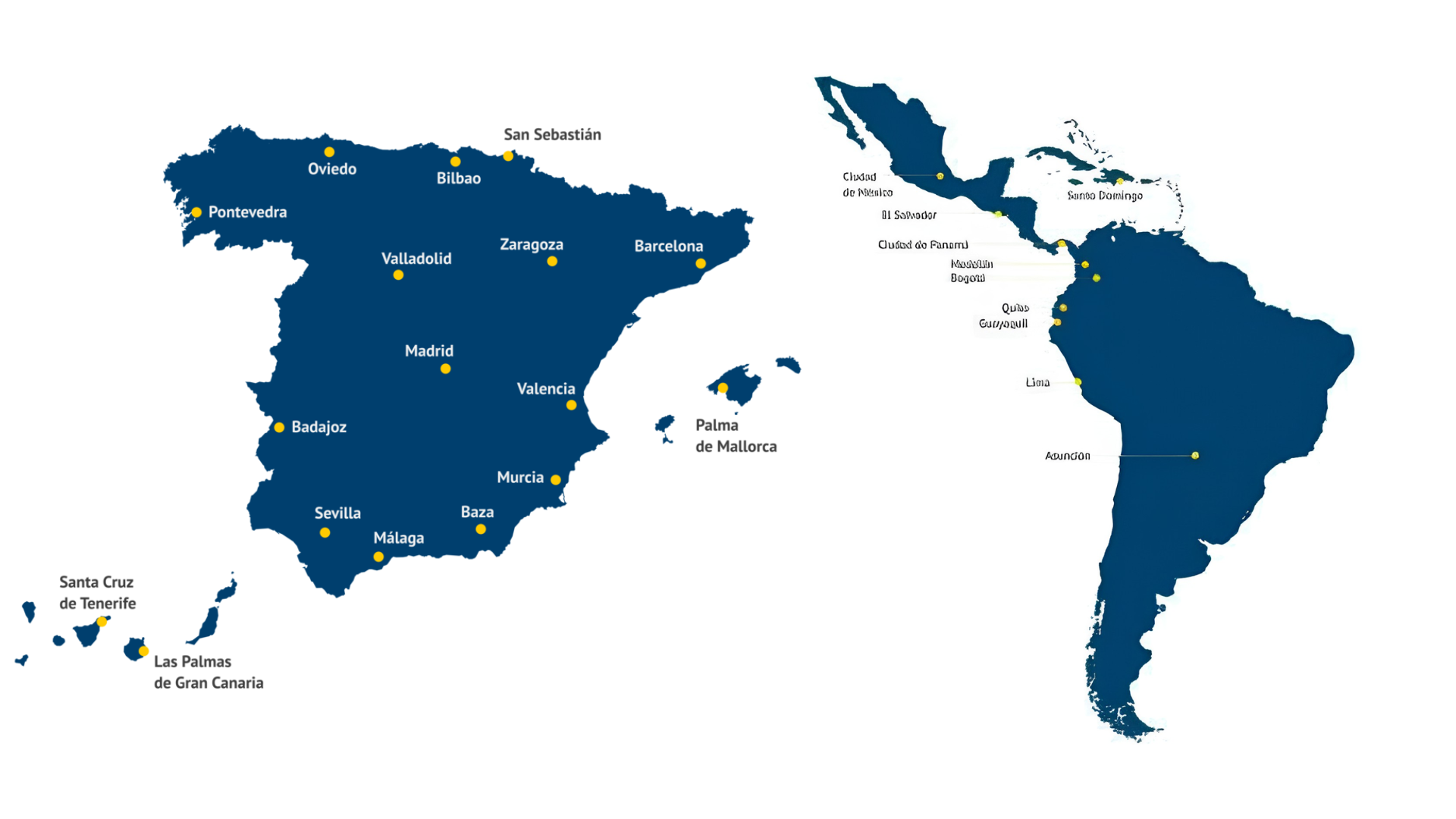
What’s more, as a student at UAX Online, you’ll have access to our Campus Hubs – a network of exclusive physical spaces where you can study, access libraries, work in co-working areas and connect with other students. Because studying online doesn’t mean studying alone.
Campus Hubs available in: Alcobendas, Alcorcón, Valencia San Vicente, Murcia, Barcelona, Málaga, Seville and Arganda.
Access is via your UAX student card, subject to availability and the opening hours of each centre.
This MBA is aimed at professionals, entrepreneurs and graduates looking to accelerate their career towards management positions, acquire a global vision of business and master the tools of digital transformation.
Direct access is open to graduates with a degree in:
Additional training may be required, depending on the type and content of the courses taken, for persons holding the following degrees:
You can access the MBA Online if you have a related university degree. To start the admission process you will need to provide the following documents:
In addition, if you already have previous professional experience related to the competences inherent to this degree, it may be recognised in the form of credits. The recognition of ECTS credits will require a personalised study. Contact our advisors and they will inform you personally.
At UAX, you’ll feel connected to the industry from day one, through seminars, workshops, lectures and complementary face-to-face activities.

That’s what the rankings say
Alfonso X el Sabio University (UAX) is ranked amongst the best universities in Spain according to the leading rankings.
As a member of AACSB, the world’s leading business education network, UAX offers programmes that meet the highest international standards. This is an advantage that boosts your employability, international mobility and the value of your professional profile.
UAX obtains the highest rating of 5 stars and the overall "Excellent" badge for Employability, Teaching, Academic Development, Facilities, Online Teaching and Good Governance in the prestigious international QS Stars rating.
Forbes ranks UAX as the private university with the most graduates working in its area (nearly 90%), thanks to a unique educational model firmly linked to the labour market through more than 8,800 agreements with companies.
According to the Forbes 2025 List, UAX is positioned in the TOP 2 Spanish Universities in the adoption of Generative AI in the training of its students, developing innovative learning tools and models aligned with technological evolution.
UAX is recognised as the second most innovative university in Spain, the only private university among the top three in the ranking. This recognition highlights our transversal commitment to AI and training in sustainability.
UAX is positioned in the TOP 3 Universities in Online Training in Spain, standing out in excellence, new technologies and offering a personalized learning experience focused on a global development of professional skills.
The prestigious ranking of the BBVA Foundation and the IVIE recognises us as the university with the best job placement in Spain in 2023, consolidating our model focused on the real employability of our graduates.
The Coordenadas Institute of Governance and Applied Economics places UAX as the private university of reference in Madrid, highlighting our practical training model aligned with the reality of the market.
According to the Online Higher Education Ranking (FSO), studying for an online MBA can increase average earnings by 33.7 per cent and significantly improve employability, with 92.7 per cent of graduates entering the labour market within just five weeks.
The Online MBA prepares you for senior roles in various areas of the organisation:
Furthermore, an MBA helps to enhance career prospects and gain access to better job opportunities and salaries, as it is one of the master’s degrees most highly valued by employers.
A panel of leading practising professionals

She holds a PhD in Economics and Business, specialising in marketing, strategy and business analytics. She has extensive experience in managing MBA and Big Data programmes, as well as in strategic consultancy for international companies.

A graduate in Business Administration, he heads up the Risk, Insurance and International Operations division at INECO. He has extensive experience in financial management, risk management, investment and international expansion, having previously worked at Bankia and PwC, and combines strategic vision with business leadership.
Global Learning Manager at Telefónica, where she leads the global learning and AI strategy for more than 100,000 employees. A specialist in digital transformation, talent development and reskilling, she combines her international experience with teaching and leading innovation and corporate learning projects.

An expert in digital transformation, agile methodologies and artificial intelligence. He is currently part of Iberdrola’s global AI programme, leading international initiatives to create value through artificial intelligence. He combines his professional work with university teaching.

A law graduate and specialist in leadership, organisational transformation and change management. A founding partner and Chief Growth Officer at PEOPLE and CHANGE, she has over 25 years’ experience advising organisations on business transformation and talent development.

CEO of Vivofácil and an expert in strategy, digital transformation and commercial management. He has extensive experience leading companies and growth initiatives, having held senior management positions at Uniteco, ADLPartner and Verisure. He combines his executive role with teaching strategy, marketing and innovation.

CEO of A04Media and adviser to the United Nations’ UN Futures Standing Committee. A specialist in strategy, digital transformation, artificial intelligence and foresight, she advises international companies and institutions and combines her professional work with teaching and outreach in the field of senior management.

She holds a degree in Law and specialises in international trade, contracts and logistics. She has over 30 years’ experience as a consultant and postgraduate lecturer, delivering training at business schools and universities.

Scholarships and financial support for studying at UAX
We know that studying is an investment. That’s why we want to remove financial barriers and make things easier for you. Fill in the form and let our advisers help you discover the scholarships, agreements and personalised financial support that best suit your situation.

Community of Madrid
Financial support for students with a disability of 33 per cent or more who are studying at universities or higher education institutions specialising in the arts in the Community of Madrid.

Ministry of Education, Vocational Training and Sport
Find out about the scholarships and grants offered by the Ministry of Education, Vocational Training and Sport, categorised by type and level of education.
Attracting Pre-doctoral Research Talent
Financial support for outstanding students who wish to carry out innovative research and contribute to the advancement of knowledge in their disciplines.
If you’ve already decided to take the plunge, enrol early and benefit from a direct grant. It’s a way of rewarding your commitment and giving you a head start in planning your future.

Students from Ibero-America
This programme is aimed at Ibero-American citizens or foreign nationals legally resident in countries within the OEI’s sphere of influence. The scholarship covers a 50% discount on the total tuition fees.

Students from Ecuador
This programme is aimed at citizens with Ecuadorian nationality and/or residence who wish to study an online master’s degree in Spain. The scholarship covers a 50% discount on the total tuition fees.
2025, 2nd Edition
Grants for students on higher-level vocational training, undergraduate, postgraduate or master’s programmes enrolled at Spanish universities with a Santander agreement. A financial supplement to support you whilst undertaking your work placements.
If you graduated from UAX and are now thinking of studying for a new degree, we want to continue supporting you. That’s why we’re offering you a 10 per cent discount on tuition fees.
If you have an immediate family member (up to the second degree of kinship) enrolled at UAX, you can benefit from a 5 per cent discount on tuition fees. Because studying as a family is even better.
Studying for two degrees at the same time is a challenge, and we want to support you. If you’re already at UAX and enrol on a second degree programme, you’ll be eligible for a grant towards your booking fee and tuition fees.
If you’d like to continue your studies with us and progress from vocational training to a bachelor’s degree, from one bachelor’s degree to another, or from a bachelor’s degree to a postgraduate degree, we’re here to support you with a grant covering up to 25 per cent of your tuition fees.
If you have a strong academic record, we would like to recognise your talent with a scholarship designed for new students. (Excludes the degree in Medicine).
If you’re a high-performance athlete, at UAX we want to help you balance your passion with your studies. We offer specific grants that can cover up to 50% of your tuition fees.
Yes. The UAX Online MBA is an official university master’s degree aligned with the European Higher Education Area (EHEA), which guarantees its academic validity and recognition within the European higher education framework.
Furthermore, as it is an official Spanish qualification, students from Latin America can benefit from its international recognition and, where necessary, undertake the processes of equivalence, validation or recognition as set out in the current regulations of each country.
An Online MBA (Master of Business Administration) is a postgraduate programme designed to develop the skills needed to manage businesses, lead teams and make strategic decisions in complex business environments.
During the UAX Online MBA, you will study key areas such as business strategy, finance, marketing, operations, data analysis, innovation, leadership and digital transformation. The programme combines a global perspective on business with practical tools that enable you to apply your knowledge to real-world business situations.
In addition to the MBA qualification, the programme includes three professional certificates from leading institutions in the business and technology sectors: the Salesforce Sales Operations Professional Certificate, the Project Management Principles and Practices Specialisation from the University of California, Irvine, and the Google Data Analytics Professional Certificate.
You will also have access to micro-credentials in Generative AI and Leadership and Soft Skills, designed to develop the skills increasingly sought after by companies. Thanks to this combination of executive training, technological specialisation and leadership skills, you will strengthen your professional profile with internationally recognised credentials.
The UAX Online MBA is designed to offer a flexible programme that is compatible with a working life. Through the virtual campus, students have access to up-to-date content, learning resources, practical activities and academic support.
Assessment combines a range of activities throughout the programme, such as case studies, projects, individual or collaborative assignments and assessment tests. This methodology promotes applied learning focused on the realities of the business world.
The typical duration of an online MBA in Business Administration and Management (MBA) is 1 year (9 months).
Yes. The programme is designed for professionals who wish to continue developing their careers whilst studying. The online format allows students to organise their learning flexibly, adapting the pace of study to their personal and professional needs.
Thanks to permanent access to the content and resources on the virtual campus, it is possible to progress through the programme without having to give up your professional activities or other personal commitments.
Yes. The UAX Online MBA includes 150 hours of external academic placements (6 ECTS), providing an opportunity to gain first-hand insight into how organisations operate and to apply the knowledge you have acquired in a real professional environment.
Furthermore, at UAX you’ll be connected to the business world from day one through seminars, workshops, presentations and complementary activities with leading companies such as IBM, Microsoft, Santander, Telefónica, Iberdrola, Repsol, McCann and the Big Four, amongst others.
Thanks to this practical approach to business, graduates can access career opportunities in areas such as business management, business development, consultancy, marketing, operations, project management and digital transformation.
No, a Master in Business Administration and an MBA are not the same thing. While both programmes focus on business administration and management, there are significant differences in their approach, objectives and target audience.
A Master of Business Administration (MBA) is a postgraduate programme that provides general training in the fundamentals of business management. It covers areas such as accounting, finance, marketing, operations, human resources and business strategy. The main objective of a master's degree in MBA is to provide students with a solid foundation of knowledge and skills to perform effectively in various roles within an organisation.
An MBA (Master of Business Administration), on the other hand, is a postgraduate programme with a more specialised focus on business management. It is aimed at professionals who already have work experience and are looking to develop their leadership and management skills to advance their career. The MBA programme focuses on areas such as strategic leadership, critical thinking, problem solving, effective communication and decision making.
In summary, an MBA is a good option for those seeking a general business education, while an MBA is ideal for experienced professionals who want to take their management skills to the next level.
To learn more about the differences between a Master in Business Administration and an MBA, I recommend you read the following article:
We summarise the main differences between a Master in Business Administration and an MBA:
| Characteristics | Master in Business Administration | MBA |
|---|---|---|
| Target audience | People with little or no work experience in business administration | Professionals with work experience in business administration |
| Focus | General training in the fundamentals of business management | Specialised focus on business management |
| Objectives | To provide students with a solid foundation of knowledge and skills to perform effectively in various roles within an organisation. | To develop the leadership and management skills of professionals to advance their careers |
| Syllabus | Covers areas such as accounting, finance, marketing, operations, human resources, and business strategy | Focuses on areas such as strategic leadership, critical thinking, problem solving, effective communication and decision making |
The UAX Online MBA lasts 9 months (60 ECTS credits), spread over the academic period set for the programme. This structure enables students to gain a comprehensive education in business administration and management whilst maintaining the flexibility inherent in the online format.
The fee may vary depending on the intake, any available study grants or the current admission requirements. To find out the up-to-date fee and the available funding options, we recommend contacting the UAX admissions team.
Other related qualifications

Online Master's Degree in Project Organisation and Management
Start:
October
Length:
9 months

Máster Universitario Online en Marketing Digital
Start:
October
Length:
9 months

Online Master's Degree in Human Resources Management and Administration
In collaboration with:

Start:
October
Length:
9 months

Online Master's Degree in Financial Management and Administration
Start:
October
Length:
9 months

MBA in Sports Management
In collaboration with:

Start:
October
Length:
9 months

Online Degree in Business Administration and Management
Start:
October
Length:
4 years

Online Master’s Degree in Artificial Intelligence
Start:
October
Length:
9 months

Online University Master's Degree in Innovation and Entrepreneurship
Start:
October
Length:
9 months
All fields are required
Enquiries, complaints and claims
We respond to the genuine needs of our students and staff, because we believe in the continuous improvement of our results. That is why we always want to hear whatever you have to say.

If you are already part of UAX, please visit the ‘Customer Service: complaints, suggestions and compliments’ section on thevirtual campus , logging in with your username and password.