See all Online Master's Degrees in Health
See all Master's Degrees in Engineering
Most searched curriculums
Accredited Master’s Degree
The Master’s Degree in Instrumental Pedagogy prepares you to acquire and develop the skills and competences required for teaching your instrument. Study at your own pace and enhance your professional profile! Choose your course based on your specialism: strings, woodwinds, brass, piano, classical guitar, percussion or singing. Places are limited.
The Master’s Degree in Instrumental Pedagogy (Online) is specifically designed for practising musicians and holders of a higher degree in music; this officially recognised master’s programme transforms your artistic talent into a teaching vocation.
The programme offers specialised teaching training across eight instrumental streams: strings, woodwinds, brass, piano, classical guitar, percussion and voice.With a 100% practical and applied approach, you will learn to design effective lessons, correct instrumental technique and motivate students of all levels.
Become a well-rounded music educator with a Master’s degree that opens doors to conservatoires, music schools and the state education system. This officially recognised qualification not only allows you to progress to a PhD, but also awards you 1 point in competitive examinations for general and arts teaching posts. You will learn using innovative methodologies through masterclasses led by leading educators and the analysis of real-life case studies.
You will acquire advanced teaching skills and innovative techniques for music education.
It deepens the organisation, analysis and management of classes with a solid theoretical basis.
Apply modern techniques such as gamification and flipped classroom to the teaching of your instrument.
Develop international training to work in multicultural contexts.
Enrich your classes with the analysis of masterclasses and the use of specialised industry forums.
Access to doctoral programmes with a research-intensive master's programme
Obtain 1 additional point in the General and Artistic Education examinations.
Our master's degree in music education offers a unique and focused curriculum for symphonic string, woodwind, brass, guitar and piano players, through independent specialisation pathways.
*The string instrument track includes two subjects specifically for stringed instruments and two for piano.
The specific subjects of each branch are:
- String Didactics/ Wind Didactics/ Piano Didactics.
- Pedagogy of the string repertoire/ Pedagogy of the wind repertoire/ Pedagogy of the piano repertoire.
Master's Degree in Instrumental Pedagogy
First Year
ANNUAL SUBJECTS
| Code | Subjects | Character* | ECTS | ||
|---|---|---|---|---|---|
| M1804001 | Master’s Thesis | OB | 6 | ||
Master’s ThesisCódigo: M1804001 Imprimir Year 1. Annual module. Compulsory. 6 credits. Profesores
Objectives The Master’s Thesis is a module in which you will learn how to produce an academic paper. Undertaking the Master’s Thesis will involve putting into practice a range of skills that will enable you to continue developing as an instrumental teacher. These skills begin with the development of critical thinking, which allows you to question both the ideas of others and your own, whilst accepting the possibility that you may be wrong and reconsidering your initial beliefs. You will need to develop your command of academic language, in which clarity and accuracy are paramount. You will also need to know how to structure your ideas logically, so that the reader feels comfortably guided throughout the thesis. When drawing your conclusions, you must exercise caution, acknowledging the limitations you have faced whilst writing your Master’s thesis, highlighting your contribution to our understanding of the subject under study, and pointing towards new lines of research that will enable other researchers to continue your work. Learning outcomes RC1 Demonstrate a proactive commitment to promoting equality between men and women through music education, in accordance with the values inherent in a culture of peace and democratic values Competencies RC3 Plan instrumental lessons in a balanced manner, designing objectives, content and assessment methods appropriate to each teaching context, taking into account the available resources and the characteristics of the students. Competencies RC4 Develop critical thinking skills that enable students to question reality on a scientific basis. Competencies RC5 Critically analyse the various parameters (economic, social, artistic, educational) surrounding the phenomenon of music education, with a view to developing teaching strategies tailored to the diverse needs of the student body. Competencies RC6 To produce, present and defend an original academic piece of work in instrumental pedagogy, integrating the theory and experience acquired during the Master’s programme. Competencies RK10 To be familiar with the main innovative methods specific to the psychology of music and music education, enabling graduates to update their pedagogical knowledge on a scientific basis. Knowledge or content RK2 To be familiar with the methodologies and resources required to carry out academic work in the field of instrumental pedagogy. Knowledge or content RK3 To understand and appropriately use the terminology associated with instrumental pedagogy Knowledge or content RODS Develop cross-cutting strategies for analysis, communication and leadership inspired by the Sustainable Development Goals and democratic principles and values, in order to conduct oneself with integrity in the professional sphere. Competences RS2 Use pedagogical tools to improve teaching performance in the field of music pedagogy independently. Skills or competences RS3 Use new technologies applied to instrumental pedagogy. Skills or competences Description of the content The Master’s final project must relate to instrumental pedagogy, drawing on the knowledge acquired throughout the course, and its results must represent a clear contribution to scientific knowledge. This dissertation will be supervised, through tutorial sessions, by a supervisor who will guide the student through the various stages of the project’s development. The dissertation will seek to address real-life situations that may arise in instrumental pedagogy, and the student must demonstrate of academic writing, as well as the relevant research techniques. Once completed, the thesis will be presented to an examination board in a public defence. The student must demonstrate coherence and clarity when structuring and communicating their ideas orally, providing reasoned answers to any questions posed by the members of the examination board. Learning activities AF4. Student study. 137 hours AF5. Individual or group tutorials. 12 hours AF9. Presentation and defence of the Master’s Thesis. 1 hour Assessment system and criteria · 20 per cent of the final mark will be based on the continuous assessment carried out by the tutor. The following will be taken into account: • Compliance with the tutor’s instructions. • The student’s consistency in their work. • The tutor’s assessment of the quality of the work produced. 60 per cent of the final mark will be based on the examination board’s assessment of the written work submitted. 20 per cent of the final mark will be based on the examination board’s assessment of the student’s presentation and defence of the Master’s Thesis given by the student before the relevant examination board. |
|||||
| TOTAL: | 6 | ||||
FIRST FOUR-MONTH PERIOD
| Code | Subjects | Character* | ECTS | ||||
|---|---|---|---|---|---|---|---|
| 80991 | Supplementary Course in Musical Architecture | N/A | 0 | ||||
Supplementary Course in Musical ArchitectureCódigo: 80991 Imprimir Course 1: First-term module. Non-assessed. Credits. Profesores
|
|||||||
| M1804011 | Musical Architecture and Expression | OB | 3 | ||||
Musical Architecture and ExpressionCódigo: M1804011 Imprimir Course 1: First-semester module. Compulsory. 3 credits. Profesores
Objectives 1. To explore in depth the principles and foundations of the musical analysis of the structure of a musical work 2. To become familiar with some basic analytical tools for the study of a monophonic instrumental repertoire 3. To explore the pedagogical potential of musical analysis as applied to the teaching of musical instruments. 4. To explore formal, rhythmic, melodic, dynamic and timbral aspects in depth with a view to designing practical learning activities. 5. To approach the study of an orchestral repertoire through the analysis of different musical parameters, placing particular emphasis on musical texture. 6. To offer reflections on the implications of musical analysis for both musical performance and the teaching of music. Prerequisites No prerequisites have been established. Learning outcomes LC1 Demonstrate a proactive commitment to promoting equality between men and women through music education, in accordance with the values inherent in a culture of peace and democratic values Competences RC2 Adapt teaching approaches in music lessons, taking into account the context and individual characteristics of each student. Competencies RC3 Plan instrumental lessons in a balanced manner, designing objectives, content and assessment methods appropriate to each teaching environment, taking into account the available resources and the characteristics of the pupils. Competences RC4 To develop critical thinking, enabling students to question reality on a scientific basis. Competencies RC5 Critically analyse the various parameters (economic, social, artistic, educational) surrounding the phenomenon of music education, with a view to developing teaching strategies tailored to the diverse needs of the pupils. Competencies RK3 Understand and appropriately use the terminology associated with instrumental pedagogy Knowledge or content RK8 To deepen their understanding of the metacognitive aspects of instrumental teaching processes so that they can self-regulate their own development. Knowledge or content RK9 To deepen their understanding of the structural principles and compositional aspects that characterise all musical works, so that they can make musical decisions based on well-founded pedagogical criteria. Knowledge or content RS2 To use pedagogical tools to improve their teaching practice in the field of music pedagogy independently. Skills or competences RS3 To use new technologies applied to instrumental teaching. Skills or competences Description of the content Block I. Sound through the ages, with an emphasis on how composers have explored the sound spectrum in all its forms and have expressed it in their works throughout history through dynamic, structuring archetypes. Block II. Gesture and texture. The focus of study will be on small- and medium-scale compositional structures that organically interweave a musical composition. Module III. Polyphony and structure. Structural interrelationships between the vertical and horizontal dimensions of musical discourse on a medium and large scale. The emergence and development of archetypal compositional forms throughout history. Block IV. Metastructures: Sound architecture and structuring multidimensionality in opera, oratorio, musical theatre, multimedia creation and sound installations. New challenges for musical creation. This will be covered in the following teaching units: Unit 1: Introduction to musical analysis and analytical techniques Unit 2: Educational applications of musical analysis Unit 3: Musical analysis applied to the orchestral repertoire Learning activities AF1 Lectures using synchronous communication tools. 9 hours TA2. Seminars and practical classes. 9 hours TA3: Synchronous guided learning sessions. 17 hours AF4. Student study. 35 hours AF5. Individual or group tutorials. 2 hours AF6. Learning forums. 1 hour AF7. Continuous assessment tests: 1 hour AF8. Assessment (final exam). 1 hour Assessment system and criteria In the course/module’s virtual classroom, you will be able to view details of the activities you are required to complete, as well as submission deadlines and assessment criteria. The final mark will be based on the following assessment system: 40% of your mark will be based on your continuous assessment. The following will be taken into account: Active participation in the forum, contributing your views, knowledge and experiences: 10% of the final mark. Individual and/or group activities (one individual and one group): 30% of the final mark. The final exam for the course/module will account for: 60 per cent of the final mark. This exam will consist of one essay question worth 3 marks and between 6 and 10 multiple-choice questions of varying marks, the total of which will account for 60 per cent of the weighted final mark. Incorrect or wrong multiple-choice answers will incur a 33 per cent penalty. All assignments and activities must be uploaded to the relevant folder and will be checked using Turnitin to verify the level of plagiarism, which must not exceed 30 per cent. If this percentage is exceeded, the assignment or activity will automatically be marked as a fail. Exams are held online using Lockdown Browser and Proctoring. Regular examination session To pass the module in the ordinary examination period, you must achieve a mark of 5.0 or above out of 10.0 in the final mark (weighted average) for the module. Supplementary examination To pass the module in the supplementary sitting, you must achieve a mark of 5.0 or higher out of 10.0 in the final mark for the module. To pass the module in this sitting, you will sit an exam comprising 2 essay questions worth 2.5 marks each and between 3 and 5 multiple-choice questions of varying marks, the total of which accounts for 100 per cent of the mark. Incorrect or wrongly answered multiple-choice questions will incur a 33 per cent penalty. |
|||||||
| M1804021 | Rhythmic Education in Motion | OB | 6 | ||||
Rhythmic Education in MotionCódigo: M1804021 Imprimir Course 1: First-semester module. Compulsory. 6 credits. Profesores
Objectives Rhythmic Education through Movement is a 6 ECTS module scheduled for the first term. In this course, we will learn to design activities for music education through movement – rhythmics – based on content drawn from a musical work, with the aim of facilitating its understanding and interpretation, as well as exploring technical aspects that can be addressed independently of the instrument through the development of genuine body awareness and mastery of movement. As teachers, we will enhance our inner ear, body awareness, reaction time and expressiveness. This module will involve working on rhythmic activities and musical works, always progressing from practical application to pedagogical reflection, for instrumental initiation, performance at a higher level, chamber music, combos or small orchestras, alternating between genres and styles ranging from classical music, jazz and musicals… to more contemporary formats such as soundtracks or music for audiovisual media. Prerequisites None specified. Learning outcomes RC1 Demonstrate a proactive commitment to promoting equality between men and women through music education, in accordance with the values inherent in a culture of peace and democratic values Competencies RC2 Adapt teaching approaches in music lessons, taking into account the context and individual characteristics of each pupil. Competencies RC3 Plan instrumental lessons in a balanced manner, designing objectives, content and assessment methods appropriate to each teaching environment, taking into account the available resources and the characteristics of the pupils. Competences RC4 To develop critical thinking, enabling students to question reality on a scientific basis. Competencies RC5 Critically analyse the various parameters (economic, social, artistic, educational) surrounding the phenomenon of music education, with a view to developing teaching strategies tailored to the diverse needs of the student body. Competencies RC6 To produce, present and defend an original academic piece of work in instrumental pedagogy, integrating the theory and experience acquired during the Master’s programme. Competencies RK1 To have an in-depth understanding of the didactics of the instrument in order to optimise the development of the student’s instrumental technique. Knowledge or content RK3 To understand and use appropriately the terminology associated with instrumental pedagogy Knowledge or content RK6 To understand the principles of aural and rhythmic training, as fundamental elements of music education, in order to integrate them into instrument lessons. Knowledge or content RK8 To deepen one’s understanding of the metacognitive aspects of instrumental teaching processes so as to be able to self-regulate one’s own development. Knowledge or content RS2 Use pedagogical tools to improve teaching practice in the field of music pedagogy independently. Skills or competences RS3 Use new technologies applied to instrumental teaching. Skills or competences RS4 Master the methods and techniques related to instrumental teaching, with the aim of developing a well-founded teaching style of one’s own. Skills or competences Description of the content • Module I. Practical application and analysis of the rhythmic elements that give meaning to a musical work or an improvised performance. • Module II. Understanding and applying the main educational methodologies and performance disciplines that have survived to the present day, as well as adapting them to current social needs. • Module III. Development and application of the procedures and resources used in rhythm training to achieve technical and expressive improvements in instrumental practice. • Module IV. Design and implementation of creative activities that form part of a programme of individual or group instrumental performance. Comments This module aims to use experimentation, research and practice as a starting point to achieve musical analysis and understanding through movement at both artistic and educational levels; it encourages students to develop their aesthetic perception, expressive potential, technical knowledge, process-based learning, educational discovery and creative abilities. Furthermore, assessment is integrated from the outset as an integral part of the learning process. Learning activities AF1 Masterclasses using synchronous communication tools. 18 hours AF2. Seminars and practical classes. 18 hours AF3. Synchronous guided learning sessions. 34 hours AF4. Self-study. 70 hours AF5. Individual or group tutorials. 4 hours AF6. Learning forums. 2 hours AF7. Continuous assessment tests: 2 hours AF8. Assessment (final exam). 2 hours Assessment system and criteria In the course/module’s virtual classroom, you will be able to view in detail the activities you are required to complete, as well as the submission dates and assessment criteria. The final mark will be based on the following assessment system: 40% of your mark will be based on your continuous assessment. The following will be taken into account: Active participation in the forum, contributing your views, knowledge and experiences: 10% of the final mark. Individual and/or group activities (two individual and one group): 30 per cent of the final mark. The final exam for the course/module will account for: 60 per cent of the final mark. This exam will consist of one essay question worth 3 marks and between 6 and 10 multiple-choice questions of varying marks, the total of which will account for 60 per cent of the weighted final mark. Incorrect or wrong multiple-choice answers will incur a 33% penalty. All assignments and activities must be uploaded to the relevant folder and will be checked using Turnitin to verify the level of plagiarism, which must not exceed 30 per cent. If this percentage is exceeded, the assignment or activity will automatically be marked as a fail. Exams are held online using Lockdown Browser and Proctoring. Regular examination session To pass the module in the ordinary examination period, you must achieve a mark of 5.0 or higher out of 10.0 in the final mark (weighted average) for the module. Supplementary examination To pass the module in the supplementary sitting, you must achieve a mark of 5.0 or higher out of 10.0 in the final mark for the module. To pass the module in this sitting, you will sit an exam comprising 2 essay-type questions worth 2.5 marks each and between 3 and 5 multiple-choice questions of varying marks, the total of which accounts for 100 per cent of the mark. Incorrect or wrongly answered multiple-choice questions will incur a 33 per cent penalty. |
|||||||
| M1804031 | Training the Musical Ear | OB | 6 | ||||
Training the Musical EarCódigo: M1804031 Imprimir Course 1: First-semester module. Compulsory. 6 credits. Profesores
Objectives The course ‘Musical Ear Training’ will provide an up-to-date and innovative overview of various methodologies aimed at the comprehensive training of the musical ear of students at music schools and conservatoires. This will be achieved through a variety of well-founded, active strategies, contextualised within a diverse range of musical literature spanning different styles and periods, based on the necessary cross-curricular integration between the various subjects in the curriculum, not only amongst the more theoretical subjects but also across the different specialisms and instrumental groups. Prerequisites None have been set. Learning outcomes RC3 To plan instrumental lessons in a balanced manner, designing objectives, content and assessment methods appropriate to each teaching context, taking into account the available resources and the characteristics of the students. Competences RC4 Develop critical thinking skills that enable students to question reality on a scientific basis. Competences RC5 Critically analyse the various parameters (economic, social, artistic, educational) surrounding the phenomenon of music education, with a view to developing teaching strategies tailored to the diverse needs of the student body. Competences RK2 Be familiar with the methodologies and resources required to carry out academic work in the field of instrumental pedagogy. Knowledge or content RK6 To be familiar with the principles of aural and rhythmic training, as fundamental elements of music education, in order to integrate them into instrument lessons. Knowledge or content RK7 To understand the psychological processes involved in music education, with the aim of optimising learning processes. Knowledge or content RS1 Apply the principles of musical psychopedagogy to instrumental lessons as a tool to optimise communication between the teacher and the learner Skills or competences RS2 Use pedagogical tools to improve teaching practice in the field of music pedagogy independently. Skills or competences RS3 Use new technologies applied to instrumental teaching. Skills or competences RS4 Master the methods and techniques related to instrumental teaching, with the aim of developing one’s own well-founded teaching style. Skills or competences Course content description · Module I. Types of musical ear. Fundamental characteristics, similarities and differences. · Module II. Strategies for personal musical ear training. · Module III. Study of the various methodologies, systems, programmes and exercises used in teaching practice for aural training. Training activities AF1 Lectures using synchronous communication tools. 18 hours AF2. Seminars and practical classes. 18 hours AF3. Synchronous guided learning sessions. 34 hours AF4. Self-study. 70 hours AF5. Individual or group tutorials. 4 hours AF6. Learning forums. 2 hours AF7. Continuous assessment tests: 2 hours AF8. Assessment (final exam). 2 hours Assessment system and criteria In the course/module’s virtual classroom, you will be able to view in detail the activities you are required to complete, as well as the submission dates and assessment criteria. The final mark will be based on the following assessment system: 40% of your mark will be based on your continuous assessment. The following will be taken into account: Active participation in the forum, contributing your views, knowledge and experiences: 10% of the final mark. Individual and/or group activities (two individual and one group): 30 per cent of the final mark. The final exam for the course/module will account for: 60 per cent of the final mark. This exam will consist of one essay question worth 3 marks and between 6 and 10 multiple-choice questions of varying marks, the total of which will account for 60 per cent of the weighted final mark. Incorrect or wrong multiple-choice answers will incur a 33 per cent penalty. All assignments and activities must be uploaded to the relevant folder and will be checked using Turnitin to verify the level of plagiarism, which must not exceed 30 per cent. If this percentage is exceeded, the assignment or activity will automatically be marked as a fail. Exams are held online using Lockdown Browser and Proctoring. Regular examination session To pass the module in the ordinary examination period, you must achieve a mark of 5.0 or above out of 10.0 in the final mark (weighted average) for the module. Supplementary examination To pass the module in the supplementary sitting, you must achieve a mark of 5.0 or higher out of 10.0 in the final mark for the module. To pass the module in this sitting, you will sit an exam consisting of 2 essay-type questions worth 2.5 marks each and between 3 and 5 multiple-choice questions of varying marks, the total of which accounts for 100 per cent of the mark. Incorrect or wrongly answered multiple-choice questions will incur a 33 per cent penalty. |
|||||||
| M1804041 | Psychology of Music Education | OB | 6 | ||||
Psychology of Music EducationCódigo: M1804041 Imprimir Course 1: First-semester module. Compulsory. 6 credits. Profesores
Objectives Welcome to the course in Psychology of Music Education, which is worth 6 ECTS credits and is taught in the first semester. This module will help you understand the factors that lead to the development of an expert musician, the difficulties and obstacles in this process, and how a teacher can support optimal musical development. This module will be important in helping you to develop a teaching practice grounded in scientific evidence, rather than solely in the teacher–pupil tradition that has underpinned much of instrumental teaching and learning. Prerequisites None have been set. Competencies BASIC AND GENERAL CG2 – Apply the principles of music pedagogy to instrumental lessons, as a tool to optimise communication between the teacher and the learner. CG4 – Adapt teaching approaches in music lessons, taking into account the context and the characteristics of each student. CG5 – Use pedagogical tools to enhance teaching practice in the field of in an independent manner. CG6 – Demonstrate a proactive commitment to promoting equality between men and women through , in accordance with the values inherent in a culture of peace and democratic principles. CB7 - Students should be able to apply the knowledge they have acquired and their problem-solving skills in new or unfamiliar settings within broader (or multidisciplinary) contexts related to their field of study CB9 - Students should be able to communicate their conclusions and the underlying knowledge and reasoning to specialist and non-specialist audiences in a clear and unambiguous manner CB10 - Students should possess the learning skills that enable them to continue their studies in a way that will be largely self-directed or autonomous. CROSS-CURRICULAR CT1 – To use new technologies applied to the field of study. CT2 – To strive for excellence in the performance of their work, as the basis of professionalism. CT3 – Demonstrate ethical principles in decision-making, upholding human rights, rejecting any form of discrimination and respecting diversity. CT4 – Understand and use appropriately the terminology associated with the field of study. CT5 - Recognise the importance of lifelong learning as a means of continuing to develop in response to the changes inherent in contemporary societies. CT6 - Develop critical thinking, enabling students to question reality on a scientific basis. SPECIFIC CE1 – Master the methods and techniques related to subject-specific teaching, with the aim of developing a well-founded teaching style of one’s own. CE4 – Plan instrumental lessons in a balanced manner, designing objectives, content and assessment systems appropriate each teaching context, taking into account the available resources and the characteristics of the pupils. CE6 – Be able to critically analyse the various parameters (economic, social, artistic, educational) surrounding the phenomenon of music education, in order to adapt to the context in which teaching takes place. CE11 – To deepen understanding of the metacognitive aspects of instrumental teaching processes so that students can self-regulate their own development. Learning outcomes LR1 Recognises evidence of musical development from early childhood through to adolescence and beyond. LR2 Recognises the theoretical framework surrounding the definition of musical ‘skills’ and their assessment LA3 Identifies the psychological aspects of musical performance. RA4 Recognises sociocultural perspectives on musical cognition and perception. LA5 Is familiar with the main bibliographical resources relating to the psychology of music education. RA6 Recognises research approaches in the psychology of music education RA7 Recognises and distinguishes between the requirements of different situations arising from different pedagogical contexts. RA8 Develops the ability to reflect critically and shape their own professional practice in light of the above findings. Course content Module I. The ontogenesis of musical behaviour. Module II. Musical development in childhood and adolescence. Module III. Motivation and musical identity. Module IV. Musical learning and culture. Module V. Musical ‘skills’ and their assessment. Module VI. Musical performance: optimisation and subjectivity. Section VII. Composition and improvisation. Block VIII. Music Learning: The Role of the Teacher. Training activities - Masterclasses using synchronous communication tools -Seminars and practical classes -Asynchronous guided learning sessions -Self-study -Individual or group tutorials -Learning forums -Continuous assessment tests -Final assessment Assessment system and criteria In the course/module’s virtual classroom, you will be able to view details of the activities you are required to complete, as well as submission deadlines and assessment criteria. The final mark will be based on the following assessment system: 40 per cent of your mark will be based on your continuous assessment. The following will be taken into account: Active participation in the forum, contributing your views, knowledge and experiences: 10% of the final mark. Individual and/or group activities (two individual and one group): 30 per cent of the final mark. The final exam for the course/module will account for: 60 per cent of the final mark. This exam will consist of one essay question worth 3 marks and between 6 and 10 multiple-choice questions of varying marks, the total of which will account for 60 per cent of the weighted final mark. Incorrect or wrong multiple-choice answers will incur a 33 per cent penalty. All assignments and activities must be uploaded to the relevant folder and will be checked using Turnitin to verify the level of plagiarism, which must not exceed 30 per cent. If this percentage is exceeded, the assignment or activity will automatically be marked as a fail. Exams are held online using Lockdown Browser and Proctoring. Regular examination session To pass the module in the ordinary examination period, you must achieve a mark of 5.0 or above out of 10.0 in the final mark (weighted average) for the module. Supplementary examination To pass the module in the supplementary sitting, you must achieve a mark of 5.0 or higher out of 10.0 in the final mark for the module. To pass the module in this sitting, you will sit an exam comprising 2 essay-type questions worth 2.5 marks each and between 3 and 5 multiple-choice questions of varying marks, the total of which accounts for 100 per cent of the mark. Incorrect or wrongly answered multiple-choice questions will incur a 33 per cent penalty. |
|||||||
| M1804051 | Educational Innovation in Instrumental Pedagogy | OB | 9 | ||||
Educational Innovation in Instrumental PedagogyCódigo: M1804051 Imprimir Course 1: First-semester module. Compulsory. 9 credits. Profesores
Objectives This module on Educational Innovation in Instrumental Pedagogy aims to help you enhance your knowledge and skills as a teacher capable of innovating, of critically evaluating innovation and research projects in your field, and of conducting your own research. Teachers must be more than mere transmitters of content and reproducers of techniques often learnt through their own experience as music students. The world of music education – and more specifically that of music pedagogy – as well as society and culture, are changing and evolving rapidly, and we cannot assume that what worked 50, 30 or even 10 years ago will necessarily work now. Therefore, this module is designed to equip you with the knowledge and skills necessary to become a teacher-researcher, capable of learning from your own practice and shared experiences, and capable of conducting research within your area of specialism. Prerequisites None have been set. Learning outcomes "List the learning outcomes set out in the RUCT: RC3 Plan practical lessons in a balanced manner, designing objectives, content and assessment methods appropriate to each teaching context, taking into account the available resources and the characteristics of the students. Competencies RC4 Develop critical thinking, enabling students to question reality on a scientific basis. Competences RC5 Critically analyse the various parameters (economic, social, artistic, educational) surrounding the phenomenon of music education, with a view to developing teaching strategies tailored to the diverse needs of the student body. Competencies RC6 To produce, present and defend an original academic piece of work in instrumental pedagogy, integrating the theory and experience gained during the Master’s programme. Competencies RK10 To be familiar with the main innovative methods specific to the psychology of music and music education, enabling graduates to update their pedagogical knowledge on a scientific basis. Knowledge or content RK2 To be familiar with the methodologies and resources required to carry out academic work in the field of instrumental pedagogy. Knowledge or content RK3 To understand and use appropriately the terminology associated with instrumental pedagogy Knowledge or content RK7 To understand the psychological processes involved in music education, with the aim of optimising learning processes. Knowledge or content RK8 To deepen one’s understanding of the metacognitive aspects of instrumental pedagogy processes so as to be able to self-regulate one’s own development. Knowledge or content RODS Develop cross-cutting strategies for analysis, communication and leadership inspired by the Sustainable Development Goals and democratic principles and values, in order to conduct oneself with integrity in the professional sphere. Competences RS1 Apply the principles of music psychopedagogy to instrumental lessons as a tool to optimise communication between teacher and learner Skills or abilities RS2 Use pedagogical tools to improve teaching performance in the field of music education independently. Skills or competences RS3 Use new technologies applied to instrumental teaching. Skills or competences " Course content description · Module I. Introduction to innovation in instrumental pedagogy · Module II. Definition of the problem or subject of study and review of the literature. · Module III. Methods of innovation in psychology and music education. · Module IV. Development of a proposal for educational innovation in instrumental teaching. Training activities AF1 Lectures using synchronous communication tools. 27 hours AF2. Seminars and practical classes. 27 hours AF3. Synchronous guided learning sessions. 51 hours AF4. Self-study. 105 hours AF5. Individual or group tutorials. 6 hours AF6. Learning forums. 4 hours AF7. Continuous assessment tests. 2 hours AF8. Assessment (final exam). 2 hours Assessment system and criteria In the course/module’s virtual classroom, you will be able to view details of the activities you are required to complete, as well as submission dates and assessment criteria. The final mark will be based on the following assessment system: 40% of your mark will be based on your continuous assessment. The following will be taken into account: Active participation in the forum, contributing your views, knowledge and experiences: 10% of the final mark. Individual and/or group activities (two individual and one group): 30 per cent of the final mark. The final exam for the course/module will account for: 60 per cent of the final mark. This exam will consist of one essay question worth 3 marks and between 6 and 10 multiple-choice questions of varying marks, the total of which will account for 60 per cent of the weighted final mark. Incorrect or wrong multiple-choice answers will incur a 33 per cent penalty. All assignments and activities must be uploaded to the relevant folder and will be checked using Turnitin to verify the level of plagiarism, which must not exceed 30 per cent. If this percentage is exceeded, the assignment or activity will automatically be marked as a fail. Exams are held online using Lockdown Browser and Proctoring. Regular examination session To pass the module in the ordinary examination period, you must achieve a mark of 5.0 or higher out of 10.0 in the final mark (weighted average) for the module. Supplementary examination To pass the module in the supplementary sitting, you must achieve a mark of 5.0 or higher out of 10.0 in the final mark for the module. To pass the module in this sitting, you will sit an exam comprising 2 essay-type questions worth 2.5 marks each and between 3 and 5 multiple-choice questions of varying marks, the total of which accounts for 100 per cent of the mark. Incorrect or wrongly answered multiple-choice questions will incur a 33 per cent penalty. |
|||||||
| TOTAL: | 30 | ||||||
SECOND FOUR-MONTH PERIOD
| Code | Subjects | Character* | ECTS | ||
|---|---|---|---|---|---|
| M1804061 | Fundamentals of Management | OB | 3 | ||
Fundamentals of ManagementCódigo: M1804061 Imprimir Course 1. Second-term module. Compulsory. 3 credits. Profesores
Objectives • To understand the origins of orchestral conducting, its resources and potential for effective application in the classroom. • To appreciate the importance of correct gestural technique in leading an instrumental or vocal ensemble. • To promote analytical conducting as an indispensable tool for decision-making in musical performance. • To effectively apply the technical and conducting resources required to achieve an optimal performance of the work or repertoire in question. Prerequisites None specified. Learning outcomes RC3 Plan instrumental lessons in a balanced manner, designing objectives, content and assessment systems appropriate to each teaching context, taking into account the available resources and the characteristics of the students. Competencies RC4 Develop critical thinking skills that enable one to question reality on a scientific basis. Competencies RC5 Critically analyse the various parameters (economic, social, artistic, educational) surrounding the phenomenon of music education, with a view to developing teaching strategies tailored to the diverse needs of the student body. Competencies RC6 To produce, present and defend an original academic piece of work in instrumental pedagogy, integrating the theory and experience gained during the Master’s programme. Competencies RK10 To be familiar with the main innovative methods specific to the psychology of music and music education, enabling graduates to update their pedagogical knowledge on a scientific basis. Knowledge or content RK2 To be familiar with the methodologies and resources required to carry out academic work in the field of instrumental pedagogy. Knowledge or content RK3 To understand and use appropriately the terminology associated with instrumental pedagogy Knowledge or content RK7 To understand the psychological processes involved in music education, with the aim of optimising learning processes. Knowledge or content RK8 To deepen one’s understanding of the metacognitive aspects of instrumental pedagogy processes so as to be able to self-regulate one’s own development. Knowledge or content RODS Develop cross-cutting strategies for analysis, communication and leadership inspired by the Sustainable Development Goals and democratic principles and values, in order to conduct oneself with integrity in the professional sphere. Competences RS1 Apply the principles of music psychopedagogy to instrumental lessons as a tool to optimise communication between teacher and learner Skills or competences RS2 Use pedagogical tools to improve teaching performance in the field of music education independently. Skills or competences RS3 Use new technologies applied to instrumental teaching. Skills or competences Course content • Module I. Principles of teaching orchestral conducting, including the analysis of technique and its teaching throughout the different stages of the learning process. • Module II. Major pedagogical trends that have endured to the present day. • Module III. Study and analysis of the most relevant literature, including both theoretical books and collections of exercises, etudes and pieces. • Module IV. Study of support materials to facilitate beginners’ progress, as well as the integration of ICT into teaching practice. Unit 1 – History of conducting. Techniques of orchestral conducting Unit 2 – Conducting analysis. Rehearsal techniques. Unit 3 – Application of conducting strategies in the classroom. Clarification of queries Training activities TA1 Masterclasses using synchronous communication tools. 27 hours TA2. Seminars and practical classes. 27 hours TA3. Synchronous guided learning sessions. 51 hours TA4. Self-study. 105 hours AF5. Individual or group tutorials. 6 hours AF6. Learning forums. 4 hours AF7. Continuous assessment tests. 2 hours AF8. Assessment (final exam). 2 hours Assessment system and criteria In the course/module’s virtual classroom, you will be able to view details of the activities you are required to complete, as well as submission dates and assessment criteria. The final mark will be based on the following assessment system: 40% of your mark will be based on your continuous assessment. The following will be taken into account: Active participation in the forum, contributing your views, knowledge and experiences: 10% of the final mark. Individual and/or group activities (two individual and one group): 30 per cent of the final mark. The final exam for the course/module will account for: 60 per cent of the final mark. This exam will consist of one essay question worth 3 marks and between 6 and 10 multiple-choice questions of varying marks, the total of which will account for 60 per cent of the weighted final mark. Incorrect or wrong multiple-choice answers will incur a 33 per cent penalty. All assignments and activities must be uploaded to the relevant folder and will be checked using Turnitin to verify the level of plagiarism, which must not exceed 30 per cent. If this percentage is exceeded, the assignment or activity will automatically be marked as a fail. Exams are held online using Lockdown Browser and Proctoring. Regular examination session To pass the module in the ordinary examination period, you must achieve a mark of 5.0 or above out of 10.0 in the final mark (weighted average) for the module. Supplementary examination To pass the module in the supplementary sitting, you must achieve a mark of 5.0 or higher out of 10.0 in the final mark for the module. To pass the module in this sitting, you will sit an exam comprising 2 essay questions worth 2.5 marks each and between 3 and 5 multiple-choice questions of varying marks, the total of which accounts for 100 per cent of the mark. Incorrect or wrongly answered multiple-choice questions will incur a 33 per cent penalty. |
|||||
| M1804071 | Lesson Planning and Teaching Techniques | OB | 9 | ||
Lesson Planning and Teaching TechniquesCódigo: M1804071 Imprimir Course 1. Second-term module. Compulsory. 9 credits. Profesores
Objectives The course content is organised into two main sections. The first will cover explicit elements of planning, such as lesson planning, as well as implicit elements such as motivation. It will also analyse the actions, elements and agents involved in classroom teaching, as well as the interaction between them. Finally, it will address different types and structures of lessons, as well as strategies to ensure that pupils’ practice at home is as effective as possible. In the second section, analytical studies will be carried out involving a review of the existing literature on the specific subject being taught in the classroom. The aim is to develop a critical perspective on books and articles concerning teaching theories and the lesson plans that each student will implement in their own classroom. To this end, sessions will be devoted to the comparative study of existing lesson plans. Students will be provided with tools to enable them to articulate their teaching experience in writing. To this end, the methods and techniques to be applied in instrumental teaching will be analysed. It is essential that students understand the pedagogy of the instrument for the optimal development of their teaching practice. To this end, case studies and experimental studies will be proposed with the aim of evaluating the effectiveness of the methods designed or the suggestions for improvement made by the students. Furthermore, the course will focus on academic writing and its various levels of detail. Finally, tools will be provided for the design of educational projects related to music pedagogy. Objectives: • To identify the most relevant implicit and explicit elements of lesson planning. • To learn to identify the elements that constitute a good relationship and communication between teacher and pupil • To acquire different approaches and strategies for delivering various types of lessons. • To acquire tools and strategies that enable effective home practice. • To develop an analytical and critical perspective in order to efficiently review the existing literature on teaching theory and methods. • Be able to carry out comparative studies of teaching programmes and understand the purpose of each of their sections. • To learn how to set out in writing proposals for improving the methods and techniques that have been applied in the classroom. • Acquire the ability to design case studies, experimental studies and classroom journals in order to self-evaluate teaching practice. • Understand the different levels of detail in academic writing. • Be able to devise educational projects related to music pedagogy. Prerequisites None have been set. Learning outcomes LC1 Demonstrate a proactive commitment to promoting gender equality through music education, in accordance with the values inherent in a culture of peace and democratic values Competencies RC2 Adapt teaching approaches in music lessons, taking into account the context and individual characteristics of each pupil. Competencies RC3 Plan instrumental lessons in a balanced manner, designing objectives, content and assessment methods appropriate to each teaching environment, taking into account the available resources and the characteristics of the pupils. Competencies RC4 To develop critical thinking, enabling students to question reality on a scientific basis. Competencies RC5 Critically analyse the various parameters (economic, social, artistic, educational) surrounding the phenomenon of music education, with a view to developing teaching strategies tailored to the diverse needs of the student body. Competencies RC6 To produce, present and defend an original academic piece of work in instrumental pedagogy, integrating the theory and experience gained during the Master’s programme. Competencies RK1 To have an in-depth understanding of the didactics of the instrument in order to optimise the development of the student’s instrumental technique. Knowledge or content RK3 To understand and use appropriately the terminology associated with instrumental pedagogy Knowledge or content RK8 To deepen one’s understanding of the metacognitive aspects of instrumental pedagogy processes so as to be able to self-regulate one’s own development. Knowledge or content RODS Develop cross-cutting strategies for analysis, communication and leadership, inspired by the Sustainable Development Goals and democratic principles and values, in order to conduct oneself with integrity in the professional sphere. Competencies RS2 Use pedagogical tools to improve teaching performance in the field of music pedagogy independently. Skills or abilities RS3 Use new technologies applied to instrumental pedagogy. Skills or competences RS4 Master the methods and techniques related to instrumental teaching, with the aim of developing a well-founded teaching style of one’s own. Skills or competences RS5 Master instrument class techniques, both individually and in groups, enabling the teacher to maintain control of each session. Skills or competences Description of the content · Block I. Elements constituting the organisation and didactic planning of instrumental teaching. Levels of specificity and contexts of action. · Block II. Actors in teaching and learning. The teacher and the pupil. Explicit and implicit relationships and communication. · Module III. Analytical and critical study of the most relevant literature, including both theoretical works and existing teaching programmes. · Module IV. Written teaching practice. Essential elements for its formulation and understanding. Training activities AF1 Lectures using synchronous communication tools. 27 hours AF2. Seminars and practical classes. 27 hours AF3. Synchronous guided learning sessions. 51 hours AF4. Student study. 105 hours. AF5. Individual or group tutorials. 6 hours AF6. Learning forums. 4 hours AF7. Continuous assessment tests. 2 hours AF8. Assessment (final exam). 2 hours Assessment system and criteria In the course/module’s virtual classroom, you will be able to view in detail the activities you are required to complete, as well as the submission dates and assessment criteria. The final mark will be based on the following assessment system: 40% of your mark will be based on your continuous assessment. The following will be taken into account: Active participation in the forum, contributing your views, knowledge and experiences: 10% of the final mark. Individual and/or group activities (2 individual and 1 group): 30% of the final mark. The final exam for the course/module will account for: 60 per cent of the final mark. This exam will consist of one essay question worth 3 marks and between 6 and 10 multiple-choice questions of varying marks, the total of which will account for 60 per cent of the weighted final mark. Incorrect or wrong multiple-choice answers will incur a 33 per cent penalty. All assignments and activities must be uploaded to the relevant folder and will be checked using Turnitin to verify the level of plagiarism, which must not exceed 30 per cent. If this percentage is exceeded, the assignment or activity will automatically be marked as a fail. Exams are held online using Lockdown Browser and Proctoring. Regular examination session To pass the module in the ordinary examination period, you must achieve a mark of 5.0 or above out of 10.0 in the final mark (weighted average) for the module. Supplementary examination To pass the module in the supplementary sitting, you must achieve a mark of 5.0 or higher out of 10.0 in the final mark for the module. To pass the module in this sitting, you will sit an exam comprising 2 essay questions worth 2.5 marks each and between 3 and 5 multiple-choice questions of varying marks, the total of which accounts for 100 per cent of the mark. Incorrect or wrong multiple-choice answers will incur a 33 per cent penalty. |
|||||
| TOTAL: | 12 | ||||
ELECTIVE COURSES
| Code | Subjects | Character* | ECTS |
|---|---|---|---|
| N/A | Elective | OP | 12 |
| TOTAL: | 12 | ||
List of Elective Modules
SECOND FOUR-MONTH PERIOD
| Code | Subjects | Character* | ECTS | ||||
|---|---|---|---|---|---|---|---|
| M1804301 | Teaching the Rope | OP | 6 | ||||
Teaching the RopeCódigo: M1804301 Imprimir Course 1. Second-term module. Elective. 6 credits. Profesores
Objectives This is a general module. It comprises the following three optional modules: Teaching of the Bowed String Instruments (M1804301A), Teaching of the Piano (M1804301B) and Teaching of the Guitar (M1804301C). The lecturers teaching these modules can be found on the degree programme’s website. Prerequisites None have been set. Competencies BASIC AND GENERAL CG3 – To have an in-depth understanding of the teaching methodology for the instrument in order to optimise the development of the student’s instrumental technique. CG4 - Adapt teaching approaches in music lessons, taking into account the context and individual characteristics of each student. CG5 - Use pedagogical tools to improve teaching practice in the field of music education independently. CG6 - Demonstrate a proactive commitment to promoting gender equality through music education, in accordance with the values inherent in a culture of peace and democratic principles. CB7 - Students should be able to apply the knowledge they have acquired and their problem-solving skills in new or unfamiliar environments within broader (or multidisciplinary) contexts related to their field of study CB9 - Students should be able to communicate their conclusions and the underlying knowledge and reasoning to specialist and non-specialist audiences clearly and unambiguously CB10 - Students should possess the learning skills that enable them to continue their studies in a manner that will be largely self-directed or autonomous. CROSS-CURRICULAR CT1 – To use new technologies applied to the field of study. CT2 - To strive for excellence in the performance of their work, as the basis of professionalism. CT3 – Demonstrate ethical principles in decision-making, upholding human rights, rejecting all forms of discrimination and respecting diversity. CT4 – Understand and use appropriately the terminology associated with the field of study. CT5 - Recognise the importance of lifelong learning as a means of continuing to develop in response to the changes inherent in contemporary societies. CT6 – Develop critical thinking, enabling students to question reality on a scientific basis. SPECIFIC CE1 – Master the methods and techniques related to instrumental teaching, with the aim of developing one’s own well-founded teaching style. CE3 – To master instrumental class techniques, both individually and in groups, enabling the teacher to maintain control of each session. CE4 – To plan instrumental lessons in a balanced manner, designing objectives, content and assessment systems appropriate to each teaching environment, taking into account the available resources and the characteristics of the students. CE6 - Be able to critically analyse the various parameters (economic, social, artistic, educational) surrounding the field of music education, in order to adapt to the context in which teaching takes place. CE11 – To deepen understanding of the metacognitive aspects of instrumental teaching processes so that students can self-regulate their own progress. Learning outcomes LA1 Develops autonomy in study as the basis for lifelong learning and professional development. LR2 Develops their own teaching style for the instrument. LR3 Demonstrates a thorough understanding of, and is able to teach, instrumental technique, adapting to each student’s level. LA4 Recognises the value of integrating the main schools of thought, pedagogies and methods. RA5 Is familiar with the main bibliographical resources relating to the pedagogy of string instruments. RA6 Has a command of the pedagogical elements and resources required for teaching new repertoire. RA7 Recognises and distinguishes between the needs arising from different situations caused by varying contexts. RA8 Develops the tools to draw up a balanced and functional teaching programme. RA9 Acquires the ability to teach sight-reading skills, practical didactic and structural analysis, study techniques and other tools aimed at improving students’ understanding of the score and optimising their rehearsal time. Description of the content Module I. Principles of teaching string instruments, including the analysis of technique and its teaching throughout the different stages of the learning process. Module II. The main pedagogical approaches that have endured to the present day. Module III. Study and analysis of the most relevant literature, including both theoretical books and collections of exercises, études and pieces. Module IV. Study of support materials to facilitate beginners’ progress, as well as the integration of ICT into teaching practice. Training activities - Masterclasses using synchronous communication tools -Seminars and practical classes -Asynchronous guided learning sessions -Self-study -Individual or group tutorials -Learning forums -Continuous assessment tests -Final assessment Assessment system and criteria In the course/module’s virtual classroom, you will be able to view details of the activities you are required to complete, as well as submission dates and assessment criteria. The final mark will be based on the following assessment system: 40 per cent of your mark will be based on your continuous assessment. The following will be taken into account: Active participation in the forum, contributing your views, knowledge and experiences: 10% of the final mark. Individual and/or group activities (two individual and one group): 30 per cent of the final mark. The final exam for the course/module will account for: 60 per cent of the final mark. This exam will consist of one essay question worth 3 marks and between 6 and 10 multiple-choice questions of varying marks, the total of which will account for 60 per cent of the weighted final mark. Incorrect or wrong multiple-choice questions will incur a 33 per cent penalty. Ordinary examination session To pass the course/module in the ordinary examination session, you must achieve a mark of 5.0 or higher out of 10.0 in the final mark (weighted average) for the course. Extraordinary examination session To pass the module in the supplementary sitting, you must achieve a mark of 5.0 or above out of 10.0 in the final mark for the module. To pass the module in this sitting, you will sit an examination comprising 2 essay-type questions worth 2.5 marks each and between 3 and 5 multiple-choice questions of varying marks, the total of which accounts for 100 per cent of the mark. Incorrect or wrong multiple-choice answers will incur a 33 per cent penalty. Addendum This is a general module. It comprises the following three optional modules: Teaching of the Bowed String Instruments (M1804301A), Teaching of the Piano (M1804301B) and Teaching of the Guitar (M1804301C). The lecturers teaching these modules can be found on the degree programme’s website. |
|||||||
| M1804311 | Teaching about the Wind | OP | 6 | ||||
Teaching about the WindCódigo: M1804311 Imprimir Course 1. Second-term module. Elective. 6 credits. Profesores
Objectives In this module, we will focus on the practical and educational application of all the knowledge acquired by students throughout their years of study and experience with their instrument, as well as in the other modules of this Master’s in Instrumental Pedagogy. The course aims to ensure the practical and judicious application of all the technical knowledge acquired, with a view to training teachers who are well-rounded in both instrumental and pedagogical terms, equipping them with the necessary teaching resources to enable them to make the most of their aptitudes and instrumental experience. We will analyse each student’s individual playing style and how they have adapted commonly accepted theory and technical standards to suit their personal characteristics and needs. We will also examine the best strategies for passing on this knowledge to their pupils, whilst at the same time sparking their interest in experimenting with and understanding how their instrument works, until they have mastered it comfortably and can use it as a means of artistic expression. We will also work on preparing for the practical teaching assessment in a competitive examination, in which the candidate must teach a lesson to a pupil or, where applicable, give an oral presentation on the curriculum or teaching units submitted. We will look at how to use one’s own resources to demonstrate to the examination board that one is a well-prepared and well-rounded teacher. The module comprises six ECTS credits and six teaching units. It is aimed at students with training in any wind instrument and is taught in the second term. Prerequisites None have been set. Competencies "Specify the competences, knowledge/content or skills/abilities. Add 2 to RA5.2. Those listed in the RUCT are: RA1 Develops autonomy in study as the basis for lifelong learning and professional development. Competencies RA2 Develops a personal teaching style for the instrument. Competencies RA3 Has an in-depth understanding of, and is able to teach, the technique of the instrument, adapting to each student’s level. Competencies RA4 Recognises the value of integrating the main schools of thought, pedagogies and methods. Knowledge or content RA5.2 Is familiar with the main bibliographical resources relating to the pedagogy of wind instruments. Knowledge or content RA6 Has a command of the pedagogical elements and resources required for teaching new repertoire. Skills or competences RA7 Recognises and distinguishes between the needs arising from different situations caused by different contexts. Knowledge or content RA8 Develops the tools to draw up a balanced and functional teaching programme. Skills or competences RA9 Acquires the ability to teach sight-reading skills, practical didactic and structural analysis, study techniques and other tools aimed at improving students’ understanding of the score and optimising their rehearsal time. Competences " Learning outcomes RA1—Develops autonomy in study as the basis for lifelong learning and professional development. RA2—Develops a personal teaching style for the instrument. LR3—Understands the technique of the instrument at an advanced level. RA4 – Masters the teaching methods and resources required for teaching new repertoire. LA5 – Recognises and distinguishes between the requirements of different situations arising from different contexts. RA6 – Develops the tools to create a balanced and functional teaching programme. RA7-Develops various artistic skills based on the fundamental technique, in accordance with the relevant musical style. RA8 – Knows and is able to compare the main characteristics that define the most representative musical styles through the scores of their great masters and justifies these through interpretative analysis. RA9—Acquires and develops the ability to teach sight-reading skills, practical formal and structural analysis, study techniques and other tools aimed at a better understanding of the score and greater optimisation of students’ rehearsal time. Description of the content Block I – Study and understanding of the teaching and learning practices relating to the various elements present in any lesson for wind instruments (technique, embouchure, body posture, etc.). Module II – Development of personalised teaching resources for use in the classroom. Module III: Study and practice in the development of a classroom teaching programme. Module IV – Study of the tests that form part of a competitive examination for a teaching post (music schools, conservatoires, etc.) Training activities AF1 Masterclasses using synchronous communication tools. 18 hours AF2. Seminars and practical classes. 18 hours AF3. Synchronous guided learning sessions. 34 hours AF4. Independent study. 70 hours AF5. Individual or group tutorials. 4 hours AF6. Learning forums. 2 hours AF7. Continuous assessment tests: 2 hours AF8. Assessment (final exam). 2 hours Assessment system and criteria In the course/module’s virtual classroom, you will be able to view in detail the activities you are required to complete, as well as the submission dates and assessment criteria. The final mark will be based on the following assessment system: 40% of your mark will be based on your continuous assessment. The following will be taken into account: Active participation in the forum, contributing your views, knowledge and experiences: 10% of the final mark. Individual and/or group activities (two individual and one group): 30 per cent of the final mark. The final exam for the course/module will account for: 60 per cent of the final mark. This exam will consist of one essay question worth 3 marks and between 6 and 10 multiple-choice questions of varying marks, the total of which will account for 60 per cent of the weighted final mark. Incorrect or wrong multiple-choice questions will incur a 33 per cent penalty. Ordinary examination session To pass the course/module in the ordinary examination session, you must achieve a mark of 5.0 or higher out of 10.0 in the final mark (weighted average) for the course. Extraordinary examination session To pass the module in the supplementary sitting, you must achieve a mark of 5.0 or above out of 10.0 in the final mark for the module. To pass the module in this sitting, you will sit an examination comprising 2 essay-type questions worth 2.5 marks each and between 3 and 5 multiple-choice questions of varying marks, the total of which accounts for 100 per cent of the mark. Incorrect or wrongly answered multiple-choice questions will incur a 33 per cent penalty. |
|||||||
| M1804321 | Teaching the String Repertoire | OP | 6 | ||||
Teaching the String RepertoireCódigo: M1804321 Imprimir Course 1. Second-term module. Elective. 6 credits. Profesores
Objectives This is a general module. It comprises the following three optional modules: Teaching Methods for the String Instrument Repertoire (M1804321A), Teaching Methods for the Piano Repertoire (M1804321B) and Teaching Methods for the Guitar Repertoire (M1804321C). The lecturers teaching these modules can be found on the degree programme’s website. Prerequisites None have been set. Competencies BASIC AND GENERAL CG3 – To have an in-depth understanding of the teaching methodology for the instrument in order to optimise the development of the student’s instrumental technique. CG4 - Adapt teaching approaches in music lessons, taking into account the context and individual characteristics of each student. CG5 - Use pedagogical tools to improve teaching practice in the field of music education independently. CG6 - Demonstrate a proactive commitment to promoting gender equality through music education, in accordance with the values inherent in a culture of peace and democratic principles. CB7 - Students should be able to apply the knowledge they have acquired and their problem-solving skills in new or unfamiliar environments within broader (or multidisciplinary) contexts related to their field of study CB9 - Students should be able to communicate their conclusions and the underlying knowledge and reasoning to specialist and non-specialist audiences clearly and unambiguously CB10 - Students should possess the learning skills that enable them to continue their studies in a manner that will be largely self-directed or autonomous. CROSS-CURRICULAR CT1 – To use new technologies applied to the field of study. CT2 - To strive for excellence in the performance of their work, as the basis of professionalism. CT3 – Demonstrate ethical principles in decision-making, upholding human rights, rejecting all forms of discrimination and respecting diversity. CT4 – Understand and use appropriately the terminology associated with the field of study. CT5 - Recognise the importance of lifelong learning as a means of continuing to develop in response to the changes inherent in contemporary societies. CT6 – Develop critical thinking, enabling students to question reality on a scientific basis. SPECIFIC CE1 – Master the methods and techniques related to instrumental teaching, with the aim of developing one’s own well-founded teaching style. CE4 – Plan instrumental lessons in a balanced manner, designing objectives, content and assessment systems appropriate to each teaching context, taking into account the available resources and the characteristics of the students. CE8 – Acquire an advanced understanding of the specific characteristics of technical and interpretative approaches linked to the expressive development of each instrument. CE11 – To deepen understanding of the metacognitive aspects of instrumental teaching processes so that students can self-regulate their own progress. Learning outcomes · LA1 Develops autonomy in study as the basis for lifelong learning and professional development. · LA2 Develops their own teaching style for the instrument. · LA3 Demonstrates a thorough understanding of, and is able to teach, instrumental technique, adapting to each student’s level. · LA4 Recognises the value of integrating the main schools of thought, pedagogies and methods. · LA5 Is familiar with the main bibliographical resources relating to the pedagogy of string instruments. · RA6 Has a command of the pedagogical elements and resources required for teaching new repertoire. · RA7 Recognises and distinguishes between the needs arising from different situations caused by varying contexts. · RA8 Develops the tools to draw up a balanced and functional teaching programme. · RA9 Acquires the ability to teach sight-reading skills, practical didactic and structural analysis, study techniques and other tools aimed at improving students’ understanding of the score and optimising their rehearsal time. Description of the course content · Module I. Historical introduction to the pedagogy of the string repertoire, including the study of the evolution of various instrumental genres (e.g. concerto, sonata, works for solo instrument, etc.) across different periods and compositional styles · Module II. Introduction to the evolution of performance techniques from the perspective of historical performance practice. · Module III. Study and analysis of relevant literature, including both theoretical texts and repertoire. · Module IV. Study of the practical application of the content covered and developed during the course. Training activities - Masterclasses with synchronous communication tools -Seminars and practical classes - Asynchronous guided learning sessions -Self-study -Individual or group tutorials -Learning forums -Continuous assessment tests -Final assessment Assessment system and criteria In the course/module’s virtual classroom, you will be able to view details of the activities you are required to complete, as well as submission deadlines and assessment criteria. The final mark will be based on the following assessment system: 40 per cent of your mark will be based on your continuous assessment. The following will be taken into account: Active participation in the forum, contributing your views, knowledge and experiences: 10% of the final mark. Individual and/or group activities (two individual and one group): 30 per cent of the final mark. The final exam for the course/module will account for: 60 per cent of the final mark. This exam will consist of one essay question worth 3 marks and between 6 and 10 multiple-choice questions of varying marks, the total of which will account for 60 per cent of the weighted final mark. Incorrect or wrong multiple-choice answers will incur a 33 per cent penalty. All assignments and activities must be uploaded to the relevant folder and will be checked using Turnitin to verify the level of plagiarism, which must not exceed 30 per cent. If this percentage is exceeded, the assignment or activity will automatically be marked as a fail. Exams are held online using Lockdown Browser and Proctoring. Regular examination session To pass the module in the ordinary examination period, you must achieve a mark of 5.0 or higher out of 10.0 in the final mark (weighted average) for the module. Supplementary examination To pass the module in the supplementary sitting, you must achieve a mark of 5.0 or higher out of 10.0 in the final mark for the module. To pass the module in this sitting, you will sit an exam comprising 2 essay-type questions worth 2.5 marks each and between 3 and 5 multiple-choice questions of varying marks, the total of which accounts for 100 per cent of the mark. Incorrect or wrongly answered multiple-choice questions will incur a 33 per cent penalty. |
|||||||
| M1804331 | Teaching the Wind Instrument Repertoire | OP | 6 | ||||
Teaching the Wind Instrument RepertoireCódigo: M1804331 Imprimir Course 1. Second-term module. Elective. 6 credits. Profesores
Objectives Wind Instrument Repertoire Pedagogy is one of the two 6 ECTS modules in the wind instrument stream scheduled for the second semester. The course content aims to provide a comprehensive overview of the pedagogical principles that instrument teachers need to understand in order to design engaging and productive lessons in today’s educational context. To this end, emphasis will be placed on the technical and personal skills that 21st-century teachers need to master, the psycho-developmental characteristics of pupils, the most significant teaching resources and pedagogical methods, as well as the integration of all these elements through the development of a curriculum that serves as a guide for the teacher. The module will conclude with a unit dedicated to understanding the job market for instrumental teaching and how to enter or progress within it. All this content is aimed both at experienced teachers who wish to reflect on their teaching practices and at instrumentalists who wish to pursue a career in teaching. Prerequisites None have been set. Competencies BASIC AND GENERAL CG3 – To have an in-depth understanding of the pedagogy of the instrument in order to optimise the development of the student’s instrumental technique. CG4 - Adapt teaching approaches in music lessons, taking into account the context and individual characteristics of each student. CG5 - Use pedagogical tools to improve teaching practice in the field of music education independently. CG6 - Demonstrate a proactive commitment to promoting gender equality through music education, in accordance with the values inherent in a culture of peace and democratic principles. CB7 - Students should be able to apply the knowledge they have acquired and their problem-solving skills in new or unfamiliar environments within broader (or multidisciplinary) contexts related to their field of study CB9 - Students should be able to communicate their conclusions and the underlying knowledge and reasoning to specialist and non-specialist audiences in a clear and unambiguous manner CB10 - Students should possess the learning skills that enable them to continue their studies in a manner that will be largely self-directed or autonomous. CROSS-CURRICULAR CT1 – To use new technologies applied to the field of study. CT2 - To strive for excellence in the performance of their work, as the basis of professionalism. CT3 – Demonstrate ethical principles in decision-making, upholding human rights, rejecting all forms of discrimination and respecting diversity. CT4 – Understand and use appropriately the terminology associated with the field of study. CT5 - Recognise the importance of lifelong learning as a means of continuing to develop in response to the changes inherent in contemporary societies. CT6 – Develop critical thinking, enabling students to question reality on a scientific basis. SPECIFIC CE1 – Master the methods and techniques related to instrumental teaching, with the aim of developing one’s own well-founded teaching style. CE3 – To master instrumental class techniques, both individually and in groups, enabling the teacher to maintain control of each session. CE6 – Be able to critically analyse the various parameters (economic, social, artistic, educational) surrounding the phenomenon of music education, in order to adapt to the context in which teaching takes place. CE11 – To deepen understanding of the metacognitive aspects of instrumental teaching processes so that students can self-regulate their own progress. Learning outcomes · LA1 Understands the value of the repertoire as a teaching resource. · LA2 Is able to identify the most notable technical or stylistic aspects of a piece or exercise in order to use them for a well-established teaching purpose well-defined purpose. · LA3 Plans lesson time and content in a balanced and comprehensive manner. · LA4 Is able to adapt to the specific needs of each pupil · RA5 Is aware of the technical problems that may arise during the learning process and is able to propose a variety of solutions. · RA6 Is able to utilise existing teaching resources and develop their own material for educational purposes. RA7 Is able to demonstrate their abilities to a selection panel, presenting themselves as a well-rounded teacher and highlighting their strengths Description of the content · • Study and knowledge of the instrumental repertoire – including technical, didactic and concert pieces – and its use as a teaching resource. • Use of existing works, études and exercises, and the development of one’s own resources to ensure appropriate monitoring of pupils’ progress at all levels and to address any problems that may arise during their learning. • Study of the structure of an instrumental lesson in order to cover, in a balanced way, all aspects that influence playing, both technical and musical. • Preparation for the specific teaching assessment in a teacher recruitment process, covering the organisation of content, effective use of time, and communication with the student and/or the selection panel. Training activities - Masterclasses using synchronous communication tools -Seminars and practical classes -Asynchronous guided learning sessions -Self-study -Individual or group tutorials -Learning forums -Continuous assessment tests -Final assessment Assessment system and criteria In the course/module’s virtual classroom, you will be able to view details of the activities you are required to complete, as well as submission dates and assessment criteria. The final mark will be based on the following assessment system: 40 per cent of your mark will be based on your continuous assessment. The following will be taken into account: Active participation in the forum, contributing your views, knowledge and experiences: 10% of the final mark. Individual and/or group activities (two individual and one group): 30 per cent of the final mark. The final exam for the course/module will account for: 60 per cent of the final mark. This exam will consist of one essay question worth 3 marks and between 6 and 10 multiple-choice questions of varying marks, the total of which will account for 60 per cent of the weighted final mark. Incorrect or wrong multiple-choice answers will incur a 33 per cent penalty. All assignments and activities must be uploaded to the relevant folder and will be checked using Turnitin to verify the level of plagiarism, which must not exceed 30 per cent. If this percentage is exceeded, the assignment or activity will automatically be marked as a fail. Exams are held online using Lockdown Browser and Proctoring. Regular examination session To pass the module in the ordinary examination session, you must achieve a mark of 5.0 or higher out of 10.0 in the final mark (weighted average) for the module. Supplementary examination To pass the module in the supplementary sitting, you must achieve a mark of 5.0 or higher out of 10.0 in the final mark for the module. To pass the module in this sitting, you will sit an exam comprising 2 essay questions worth 2.5 marks each and between 3 and 5 multiple-choice questions of varying marks, the total of which accounts for 100 per cent of the mark. Incorrect or wrongly answered multiple-choice questions will incur a 33 per cent penalty. |
|||||||
| M1804341 | Teaching Percussion | OP | 6 | ||||
Teaching PercussionCódigo: M1804341 Imprimir Course 1. Second-term module. Elective. 6 credits. Profesores
Objectives In the module ‘Percussion Pedagogy’, students are expected to acquire a set of fundamental skills essential to their development as percussion teachers. These include, in particular, the ability to master and apply a range of instrumental teaching methodologies and techniques, enabling them to develop their own teaching style adapted to different educational settings. Furthermore, they must be able to manage both individual and group lessons, maintaining a balanced and effective dynamic (CE1, CE3). A key aspect will be the proper planning of lessons, setting clear objectives and designing assessment systems that are tailored to the needs of the students and the available resources (CE4). Students will need to learn to reflect critically on the environment in which they carry out their work, analysing social, economic and educational factors, in order to adapt their teaching flexibly (CE6). Furthermore, the development of conscious self-regulation regarding their pedagogical progress is encouraged, which will contribute to continuous improvement in their performance (CE11). All of this must be accompanied by the ability to adapt teaching approaches according to the characteristics of the pupils (CG4), using advanced tools to refine their teaching practice independently (CG5) and promoting values of equality and a culture of peace through music education (CG6). The nature of the course requires students not merely to meet the minimum requirements, but to make the most of this opportunity to deepen their training as teachers. Particular value will be placed on a willingness to actively apply the skills acquired, both in classroom dynamics and in personal and professional development. The lecturer will provide constant support and guidance throughout the process, encouraging independent and reflective learning; however, it is essential that students demonstrate their own initiative and commitment to their educational development. Learning outcomes LA1 Develops autonomy in study as the basis for lifelong learning and professional development. Skills LA2 Develops a personal teaching style for the instrument. Skills LA3 Demonstrates an in-depth understanding of, and is able to teach, instrumental technique, adapting to each student’s level. Competences LA4 Recognises the value of integrating the main schools of thought, pedagogies and methods. Knowledge or content RA5.3 Is familiar with the main bibliographical resources relating to the pedagogy of percussion instruments. Knowledge or content RA6 Has a command of the pedagogical elements and resources required for teaching new repertoire. Skills or abilities RA7 Recognises and distinguishes between the needs arising from different situations caused by different contexts. Knowledge or content RA8 Develops the tools to draw up a balanced and functional teaching programme. Skills or competences RA9 Acquires the ability to teach sight-reading skills, practical didactic and structural analysis, study techniques and other tools aimed at improving students’ understanding of the score and optimising their rehearsal time. Competences Description of the content • Module I – Study and understanding of the teaching and learning practices relating to the various elements present in any percussion instrument class (technical resources, instrumental resources, correct postural training, and instrumental interaction and collaboration). • Module II: Development of one’s own teaching resources for use in the classroom. • Module III: Study and practice in the development of a classroom teaching programme. • Module IV: Study of the tests that form part of a competitive examination for a teaching post (music schools, conservatoires, etc.) Training activities AF1 Masterclasses using synchronous communication tools. 18 hours AF2. Seminars and practical classes. 18 hours AF3. Synchronous guided learning sessions. 34 hours AF4. Self-study. 70 hours AF5. Individual or group tutorials. 4 hours AF6. Learning forums. 2 hours AF7. Continuous assessment tests: 2 hours AF8. Assessment (final exam). 2 hours Assessment system and criteria In the course/module’s virtual classroom, you will be able to view in detail the activities you are required to complete, as well as the submission dates and assessment criteria. The final mark will be based on the following assessment system: 40% of your mark will be based on your continuous assessment. The following will be taken into account: Active participation in the forum, contributing your views, knowledge and experiences: 10% of the final mark. Individual and/or group activities (two individual and one group): 30 per cent of the final mark. The final exam for the course/module will account for: 60 per cent of the final mark. This exam will consist of one essay question worth 3 marks and between 6 and 10 multiple-choice questions of varying marks, the total of which will account for 60 per cent of the weighted final mark. Incorrect or wrong multiple-choice answers will incur a 33 per cent penalty. All assignments and activities must be uploaded to the relevant folder and will be checked using Turnitin to verify the level of plagiarism, which must not exceed 30 per cent. If this percentage is exceeded, the assignment or activity will automatically be marked as a fail. Exams are held online using Lockdown Browser and Proctoring. Regular examination session To pass the module in the ordinary examination period, you must achieve a mark of 5.0 or above out of 10.0 in the final mark (weighted average) for the module. Supplementary examination To pass the module in the supplementary sitting, you must achieve a mark of 5.0 or higher out of 10.0 in the final mark for the module. To pass the module in this sitting, you will sit an exam comprising 2 essay questions worth 2.5 marks each and between 3 and 5 multiple-choice questions of varying marks, the total of which accounts for 100 per cent of the mark. Incorrect or wrongly answered multiple-choice questions will incur a 33 per cent penalty. |
|||||||
| M1804351 | Teaching Methods for the Percussion Repertoire | OP | 6 | ||||
Teaching Methods for the Percussion RepertoireCódigo: M1804351 Imprimir Course 1. Second-term module. Elective. 6 credits. Profesores
Objectives In the module ‘Pedagogy of the Percussion Repertoire’, students are expected to acquire a set of fundamental skills essential to their development as percussion teachers. These include, in particular, the ability to master and apply a range of instrumental teaching methodologies and techniques, enabling them to develop their own teaching style adapted to different educational settings. Furthermore, they must be able to manage both individual and group lessons, maintaining a balanced and effective dynamic (CE1, CE3). A key aspect will be the proper planning of lessons, setting clear objectives and designing assessment systems that are tailored to the needs of the students and the available resources (CE4). Students will need to learn to reflect critically on the environment in which they carry out their work, analysing social, economic and educational factors, in order to adapt their teaching flexibly (CE6). Furthermore, the development of conscious self-regulation regarding their pedagogical progress is encouraged, which will contribute to continuous improvement in their performance (CE11). All of this must be accompanied by the ability to adapt teaching approaches to the characteristics of the pupils (CG4), using advanced tools to refine their teaching practice independently (CG5) and promoting values of equality and a culture of peace through music education (CG6). The nature of the course requires students not merely to meet the minimum requirements, but to make the most of this opportunity to deepen their training as teachers. Particular value will be placed on a willingness to actively apply the skills acquired, both in classroom dynamics and in personal and professional development. The lecturer will provide constant support and guidance throughout the process, encouraging independent and reflective learning; however, it is essential that students demonstrate their own initiative and commitment to their educational development. Learning outcomes LA1 Develops autonomy in study as the basis for lifelong learning and professional development. Skills LA2 Develops a personal teaching style for the instrument. Competencies LA3 Demonstrates an in-depth understanding of, and is able to teach, instrumental technique, adapting to each student’s level. Skills LA4 Recognises the value of integrating the main schools of thought, pedagogies and methods. Knowledge or content RA5.3 Is familiar with the main bibliographical resources relating to the pedagogy of percussion instruments. Knowledge or content RA6 Has a command of the pedagogical elements and resources required for teaching new repertoire. Skills or competences RA7 Recognises and distinguishes between the needs arising from different situations caused by different contexts. Knowledge or content RA8 Develops the tools to draw up a balanced and functional teaching programme. Skills or competences RA9 Acquires the ability to teach sight-reading skills, practical didactic and structural analysis, study techniques and other tools aimed at improving students’ understanding of the score and optimising their rehearsal time. Competences Description of the content • Study and knowledge of the instrumental repertoire – including technical, didactic and concert pieces – and its use as a teaching resource. • Use of existing works, études and exercises, and the development of one’s own teaching resources to ensure appropriate monitoring of pupils’ progress at all levels and to address any issues that may arise during their learning. • Study of the structure of an instrumental lesson in order to cover, in a balanced way, all aspects that influence playing, both technical and musical. • Preparation for the specific teaching assessment in a teacher recruitment process, covering the organisation of content, effective use of time, and communication with the student and/or the selection panel. Training activities AF1 Masterclasses using synchronous communication tools. 18 hours AF2. Seminars and practical classes. 18 hours AF3. Synchronous guided learning sessions. 34 hours AF4. Self-study. 70 hours AF5. Individual or group tutorials. 4 hours AF6. Learning forums. 2 hours AF7. Continuous assessment tests: 2 hours AF8. Assessment (final exam). 2 hours Assessment system and criteria In the course/module’s virtual classroom, you will be able to view in detail the activities you are required to complete, as well as the submission dates and assessment criteria. The final mark will be based on the following assessment system: 40% of your mark will be based on your continuous assessment. The following will be taken into account: Active participation in the forum, contributing your views, knowledge and experiences: 10% of the final mark. Individual and/or group activities (two individual and one group): 30 per cent of the final mark. The final exam for the course/module will account for: 60 per cent of the final mark. This exam will consist of one essay question worth 3 marks and between 6 and 10 multiple-choice questions of varying marks, the total of which will account for 60 per cent of the weighted final mark. Incorrect multiple-choice answers will incur a 33 per cent penalty. All assignments and activities must be uploaded to the relevant folder and will be checked using Turnitin to verify the level of plagiarism, which must not exceed 30 per cent. If this percentage is exceeded, the assignment or activity will automatically be marked as a fail. Exams are held online using Lockdown Browser and Proctoring. Regular examination session To pass the module in the ordinary examination period, you must achieve a mark of 5.0 or above out of 10.0 in the final mark (weighted average) for the module. Supplementary examination To pass the module in the supplementary examination period, you must achieve a mark of 5.0 out of 10.0 or higher in the final mark for the module. To pass the module in this sitting, you will sit an exam comprising 2 essay questions worth 2.5 marks each and between 3 and 5 multiple-choice questions of varying marks, the total of which accounts for 100 per cent of the mark. Incorrect or wrongly answered multiple-choice questions will incur a 33 per cent penalty. |
|||||||
| M1804361 | Teaching Singing | OP | 6 | ||||
Teaching SingingCódigo: M1804361 Imprimir Course 1. Second-term module. Elective. 6 credits. Profesores
Objectives In the ‘Singing Pedagogy’ module, students are expected to acquire a set of fundamental skills essential to their development as singing teachers. These include, in particular, the ability to master and apply a range of vocal teaching methodologies and techniques, enabling them to develop their own teaching style adapted to different educational settings. Furthermore, they must be able to manage both individual and group lessons, maintaining a balanced and effective dynamic (CE1, CE3). A key aspect will be the proper planning of lessons, setting clear objectives and designing assessment systems that are tailored to the needs of the students and the available resources (CE4). Students will need to learn to reflect critically on the environment in which they carry out their work, analysing social, economic and educational factors in order to adapt their teaching flexibly (CE6). Furthermore, the development of conscious self-regulation regarding their pedagogical progress is encouraged, which will contribute to continuous improvement in their performance (CE11). All of this must be accompanied by the ability to adapt teaching approaches to the characteristics of the pupils (CG4), using advanced tools to refine their teaching practice independently (CG5) and promoting values of equality and a culture of peace through music education (CG6). The nature of the course requires students not merely to meet the minimum requirements, but to make the most of this opportunity to deepen their training as teachers. Particular value will be placed on a willingness to actively apply the skills acquired, both in classroom dynamics and in personal and professional development. The lecturer will provide constant support and guidance throughout the process, encouraging independent and reflective learning; however, it is essential that students demonstrate their own initiative and commitment to their educational development. Learning outcomes LA1 Develops autonomy in study as the basis for lifelong learning and professional development. Skills LA2 Develops a personal teaching style for the instrument. Competencies LA3 Demonstrates an in-depth understanding of, and is able to teach, instrumental technique, adapting to each student’s level. Competences LA4 Recognises the value of integrating the main schools of thought, pedagogies and methods. Knowledge or content RA5.4 Is familiar with the main bibliographical resources relating to the pedagogy of solo and choral singing. Knowledge or content RA6 Has a command of the pedagogical elements and resources required for teaching new repertoire. Skills or competences RA7 Recognises and distinguishes between the needs arising from different situations caused by varying contexts. Knowledge or content RA8 Develops the tools to draw up a balanced and functional teaching programme. Skills or competences RA9 Acquires the ability to teach sight-reading skills, practical didactic and structural analysis, study techniques and other tools aimed at improving students’ understanding of the score and optimising their rehearsal time. Competencies Description of the content • Module I – Study and understanding of the teaching and learning practices relating to the various elements present in any individual or choral singing lesson (vocal technique, linguistic fundamentals and phonetics, breathing, body posture, vocal groupings, etc.). • Module II: Development of one’s own teaching resources for use in the classroom. • Module III: Study and practice in the development of a classroom teaching programme. • Module IV: Study of the tests that form part of a competitive examination for a teaching post (music schools, conservatoires, etc.) Training activities AF1 Masterclasses using synchronous communication tools. 18 hours AF2. Seminars and practical classes. 18 hours AF3. Synchronous guided learning sessions. 34 hours AF4. Self-study. 70 hours AF5. Individual or group tutorials. 4 hours AF6. Learning forums. 2 hours AF7. Continuous assessment tests: 2 hours AF8. Assessment (final exam). 2 hours Assessment system and criteria In the course/module’s virtual classroom, you will be able to view in detail the activities you are required to complete, as well as the submission dates and assessment criteria. The final mark will be based on the following assessment system: 40% of your mark will be based on your continuous assessment. The following will be taken into account: Active participation in the forum, contributing your views, knowledge and experiences: 10% of the final mark. Individual and/or group activities (two individual and one group): 30 per cent of the final mark. The final exam for the course/module will account for: 60 per cent of the final mark. This exam will consist of one essay question worth 3 marks and between 6 and 10 multiple-choice questions of varying marks, the total of which will account for 60 per cent of the weighted final mark. Incorrect or wrong multiple-choice answers will incur a 33 per cent penalty. All assignments and activities must be uploaded to the relevant folder and will be checked using Turnitin to verify the level of plagiarism, which must not exceed 30 per cent. If this percentage is exceeded, the assignment or activity will automatically be marked as a fail. Exams are held online using Lockdown Browser and Proctoring. Regular examination session To pass the module in the ordinary examination period, you must achieve a mark of 5.0 or higher out of 10.0 in the final mark (weighted average) for the module. Supplementary examination To pass the module in the supplementary sitting, you must achieve a mark of 5.0 or higher out of 10.0 in the final mark for the module. To pass the module in this sitting, you will sit an exam comprising 2 essay questions worth 2.5 marks each and between 3 and 5 multiple-choice questions of varying marks, the total of which accounts for 100 per cent of the mark. Incorrect or wrongly answered multiple-choice questions will incur a 33 per cent penalty. |
|||||||
| M1804371 | Teaching Methods for the Vocal Repertoire | OP | 6 | ||||
Teaching Methods for the Vocal RepertoireCódigo: M1804371 Imprimir Course 1. Second-term module. Elective. 6 credits. Profesores
Objectives In the module ‘Pedagogy of the Vocal Repertoire’, students are expected to acquire a set of fundamental skills essential to their development as singing teachers. These include, in particular, the ability to master and apply a range of instrumental teaching methodologies and techniques, enabling them to develop their own teaching style adapted to different educational settings. Furthermore, they must be able to manage both individual and group lessons, maintaining a balanced and effective dynamic (CE1, CE3). A key aspect will be the proper planning of lessons, setting clear objectives and designing assessment systems that are tailored to the needs of the students and the available resources (CE4). Students will need to learn to reflect critically on the environment in which they carry out their work, analysing social, economic and educational factors, in order to adapt their teaching flexibly (CE6). Furthermore, the development of conscious self-regulation regarding their pedagogical progress is encouraged, which will contribute to continuous improvement in their performance (CE11). All of this must be accompanied by the ability to adapt teaching approaches according to the characteristics of the pupils (CG4), using advanced tools to refine their teaching practice independently (CG5) and promoting values of equality and a culture of peace through music education (CG6). The nature of the course requires students not merely to meet the minimum requirements, but to make the most of this opportunity to deepen their training as teachers. Particular value will be placed on a willingness to actively apply the skills acquired, both in classroom dynamics and in personal and professional development. The lecturer will provide constant support and guidance throughout the process, encouraging independent and reflective learning; however, it is essential that students demonstrate their own initiative and commitment to their educational development. Learning outcomes LA1 Develops autonomy in study as the basis for lifelong learning and professional development. Skills LA2 Develops a personal teaching style for the instrument. Competencies LA3 Demonstrates an in-depth understanding of, and is able to teach, instrumental technique, adapting to each student’s level. Skills LA4 Recognises the value of integrating the main schools of thought, pedagogies and methods. Knowledge or content RA5.4 Is familiar with the main bibliographical resources relating to the pedagogy of solo and choral singing. Knowledge or content RA6 Has a command of the pedagogical elements and resources required for teaching new repertoire. Skills or competences RA7 Recognises and distinguishes between the needs arising from different situations caused by varying contexts. Knowledge or content RA8 Develops the tools to draw up a balanced and functional teaching programme. Skills or competences RA9 Acquires the ability to teach sight-reading skills, practical didactic and structural analysis, study techniques and other tools aimed at improving students’ understanding of the score and optimising their rehearsal time. Competencies Description of the content • Study and knowledge of the vocal and choral repertoire – including technical, teaching and concert repertoire – and its use as a pedagogical resource. • Use of existing works, studies and exercises, and the development of one’s own resources to ensure proper monitoring of pupils’ progress at all levels and to address any issues that may arise during their learning. • Study of the structure of an individual singing lesson and a choir rehearsal, in order to cover, in a balanced manner, all aspects that influence performance, both technical and musical. • Preparation for the specific teaching assessment in a teacher recruitment process, covering the organisation of content, effective use of time and communication with the student and/or the selection panel. Training activities AF1 Masterclasses using synchronous communication tools. 18 hours AF2. Seminars and practical classes. 18h AF3. Synchronous guided learning sessions. 34 hours AF4. Self-study. 70 hours AF5. Individual or group tutorials. 4 hours AF6. Learning forums. 2 hours AF7. Continuous assessment tests: 2 hours AF8. Assessment (final exam). 2 hours Assessment system and criteria In the course/module’s virtual classroom, you will be able to view in detail the activities you are required to complete, as well as the submission dates and assessment criteria. The final mark will be based on the following assessment system: 40% of your mark will be based on your continuous assessment. The following will be taken into account: Active participation in the forum, contributing your views, knowledge and experiences: 10 per cent of the final mark. Individual and/or group activities (two individual and one group): 30 per cent of the final mark. The final exam for the course/module will account for: 60 per cent of the final mark. This exam will consist of one essay question worth 3 marks and between 6 and 10 multiple-choice questions of varying marks, the total of which will account for 60 per cent of the weighted final mark. Incorrect or wrong multiple-choice answers will incur a 33 per cent penalty. All assignments and activities must be uploaded to the relevant folder and will be checked using Turnitin to verify the level of plagiarism, which must not exceed 30 per cent. If this percentage is exceeded, the assignment or activity will automatically be marked as a fail. Exams are held online using Lockdown Browser and Proctoring. Regular examination session To pass the module in the ordinary examination period, you must achieve a mark of 5.0 or higher out of 10.0 in the final mark (weighted average) for the module. Supplementary examination To pass the module in the supplementary sitting, you must achieve a mark of 5.0 or higher out of 10.0 in the final mark for the module. To pass the module in this sitting, you will sit an exam comprising 2 essay-type questions worth 2.5 marks each and between 3 and 5 multiple-choice questions of varying marks, the total of which accounts for 100 per cent of the mark. Incorrect or wrongly answered multiple-choice questions will incur a 33 per cent penalty. |
|||||||
| TOTAL: | 48 | ||||||
*Character: BT: Basic Training, Ob: Required, Op: Optional
The main reason why at UAX there are students like you is the possibility of making your personal, professional and academic life compatible. Our differential value is a methodology without barriers, focused on you and your desire to learn.
How is our methodology?
In addition, you will have the full availability of our campus in Madrid, to carry out your formalities, solve your doubts and enjoy the facilities it offers you.
Alfonso X el Sabio University, in addition to its campuses in Villanueva de la Cañada and Madrid, offers all its students the opportunity to study at its centres in various Latin American countries.
At UAX, compulsory exams are held in person, so students can choose the city in which they wish to sit their exams, either in Spain or at any of the international centres.
In addition to the examination centres, the university has partnership agreements with more than 160 leading universities in Latin America.
Number of places for new students: 100 places
Entry requirements:
The entry requirements will be determined in accordance with the provisions of Royal Decree 822/2021 of 28 September, which regulates access to and admission to official Master’s degree programmes, as set out in Article 18.
Entry requirements:
To be eligible for admission to the Master’s programme, applicants must hold a university degree corresponding to:
For qualifications that require a minimum level of professional training in musical performance, such as musicology, a Master’s in Primary Education or Pedagogy, you must submit one of the following documents:
Admission Criteria and Tests:
The following criteria will be taken into account for the admission of candidates; these will apply only in the event that demand exceeds places available:
Admission scoring:
Alfonso X El Sabio University has approved and published regulations brought into line with Royal Decree 822/2021 to address the transfer and recognition of credits.
https://www.uax.com/download/9959/file/Normativa-TRC.pdf
The Master’s Degree in Instrumental Pedagogy provides for the recognition of up to 9 ECTS credits based on accredited work and professional experience in the field. Consequently, the modules eligible for recognition are Musical Ear Training (6 ECTS) and Musical Structure and Expression (3 ECTS)
The recognition of credits for professional experience will require a personalised and detailed assessment to advise the student on which activities within the workplace ensure the acquisition of the set of competences specific to the degree; this assessment will be carried out by the degree’s credit recognition committee and the UAX admissions department.
The flexibility of online learning, with opportunities to connect
Take your exams online wherever you are or, if you prefer, in person at our designated centres in Spain and Latin America, subject to availability and capacity.
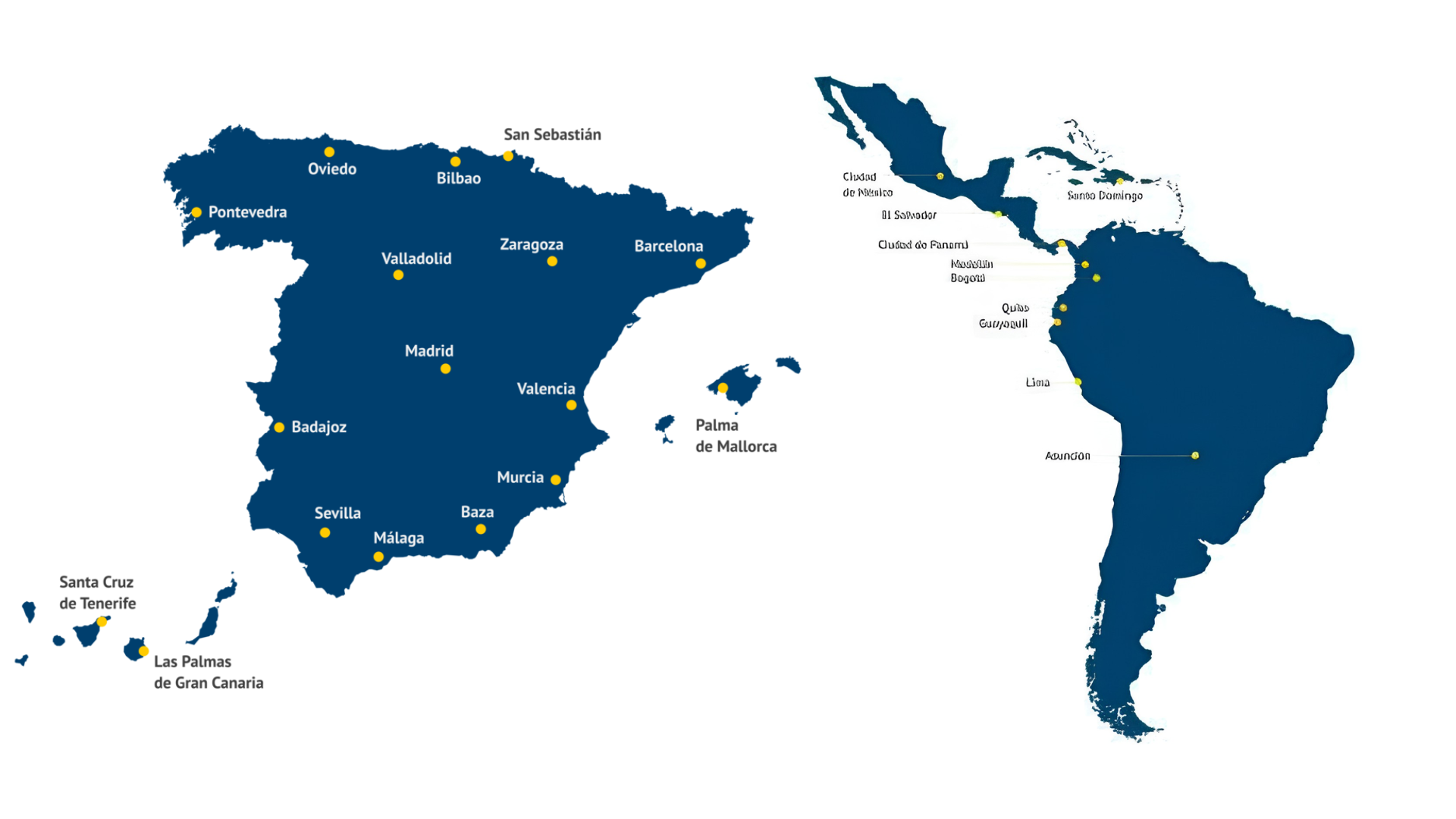
What’s more, as a student at UAX Online, you’ll have access to our Campus Hubs – a network of exclusive physical spaces where you can study, access libraries, work in co-working areas and connect with other students. Because studying online doesn’t mean studying alone.
Campus Hubs available in: Alcobendas, Alcorcón, Valencia San Vicente, Murcia, Barcelona, Málaga, Seville and Arganda.
Access is via your UAX student card, subject to availability and the opening hours of each centre.
You will be able to choose the itinerary, depending on your instrument or speciality, between:
Senate
Train in Instrumental Pedagogy alongside the best professionals.

Doctor Cum Laude en Patrimonio. Profesor Superior de Tuba y Máster en Gestión del Patrimonio. Artista-Embajador de Tubas Wessex y Mercer&Barker. Titulado en Canto Lírico (barítono) y en CAP, con formación en Pedagogía Musical Activa y Gestión Cultural. Autor del libro “Tubas y yo vengo…” —el primero sobre la tuba en habla hispana— y creador del blog inBBflat.
Doctor "Cum Laude" and Extraordinary Prize from the UNED. Master's Degree in Guitar Performance from the UEX. Higher Degree in Music Pedagogy, Higher Degree in Guitar, Higher Degree in Guitar Pedagogy from the RCSMM. Certificate in Jacques-Dalcroze Rhythmic recognised by the Jaques-Dalcroze Institute of Geneva.
Master's Degree in Music Research and Performance from the VIU. He has studied the Suzuki Method, Rolland Pedagogy, Dalcroze Rhythmic and Music Mind Games. He has participated as a teacher and given training courses in: Spain, France, England, among other parts of Europe. Since 2005 he has been teaching at the CPM "Torrejón y Velasco" in Albacete.

Developer of musical educational projects, with extensive training and experience in piano didactics. Teacher in piano teacher training courses, creativity and pedagogy. He teaches on classical and jazz courses in Spain, the UK and throughout Europe.
PhD in Music-Ethnomusicology. She holds a Master's Degree in Music-Musicology, a Higher Degree in Violin and a Bachelor's Degree in History and Science of Music. Her musical and professional career has been developed in several European and American countries in the fields of classical music, folk music, music research and music pedagogy.
PhD in Psychology applied to musical performance from the UCO. Master's Degree in Management and Direction of Educational Centres from the UNIR. Graduate in Piano and Chamber Music. Professor of Piano at the CSM in Cordoba and concert performer. Author of several scientific and informative articles. Member of the Spanish Association of Artistic and Performative Research.

Flutist and Pedagogue, specialist in High Performance and Emotional Intelligence. Master in Performance and Pedagogy of the transverse flute. Creator of the High Performance Programme for Musicians. Diploma in Music Education from the UCM and accredited teacher of the Yamaha Class Band Method for teaching wind instruments.

Performance Diploma from Indiana University and Extraordinary Doctorate Award in Pedagogy. He has worked as a music educator in different fields (conservatories, compulsory education and universities).

Teacher specialising in Music Education (UGR), Master's degree in Spanish and Latin American Music (UAM) and PhD in Musicology (UCM) with international mention. Editor of the Revista de Musicología (SEdeM). Specialist in early music, medieval codicology and musical palaeography.
Graduate in Musicology (RCSMM) and Master in Spanish and Hispano-American Music (UCM). He has focused his research on the study of Spanish music from the 17th and 19th centuries, with special attention to zarzuela, symphonic music and religious music, from multiple perspectives (genre, analysis, history, culture, iconography).
Guitarist and pedagogue specialising in contemporary and multidisciplinary music. She has premiered works by numerous composers and has collaborated with leading international ensembles and festivals. She is president of the Asociación Mujeres en la Música (Women in Music Association) and carries out intense teaching and research work.
PhD in Art History and Musicology. Master in Direction and Management of Cultural and Creative Industries (Extraordinary Prize). He has studied conducting at Indiana University and Conservatorium Amsterdam. VIII UPV-Orfeón Donostiarra Music Research Award and British Library Edison Fellow 2008. Translator of texts on music history and theory for Akal and Siglo XXI Editores.

Master's Degree in Music Teaching and Master's Degree in Opera Performance. She has a degree in Singing and a Diploma in Music Education. She has been a guest teacher at international institutions such as the Prague Conservatory of Music and the Karol Szymanowski High Performance Music Centre in Warsaw. Winner of prestigious international competitions.

Percussionist and musicologist, with an outstanding career focused on orchestral performance during the last five years. He has collaborated with prestigious orchestras such as the Orquesta Sinfónica de Castilla y León, the Orquesta Sinfónica de Bilbao, the Swedish Radio Orchestra, the Norrlandsoperan Symphoniorkester, the Västeras Sinfonietta and the Orquesta Sinfónica del Estado de São Paulo.

Doctor "Cum Laude" in Musicology, Master in Musical Research and Professor of Percussion. Coordinator of the Analysis and Composition Course "Cátedra Manuel de Falla", editor of the magazine Espacio Sonoro and organiser of the Festival Encuentros Sonoros. Member of the contemporary music ensemble Taller Sonoro and the Municipal Symphonic Band of Seville.
At UAX we know that studying is an investment, that's why we provide you with the facilities you need to access our degrees. Find out about some of our scholarships and grants to study the Master's Degree in Instrumental Pedagogy:
Con el Máster Universitario Online en Pedagogía Instrumental obtendrás todos los conocimientos necesarios para aportar al aula toda tu experiencia en el mundo musical. Tras este máster podrás desarrollar tu carrera profesional en diferentes puestos de educación musical, como por ejemplo:
¿No lo tienes claro?
Te ayudamos a ver qué programa se adapta a tu perfil.
In Spain, the Master’s in Music Education and the Master’s in Instrumental Pedagogy are separate academic programmes, although they share elements relating to music education.
To be admitted to the Master's Degree in Music Pedagogy you must meet one of the following requirements:
- Hold a degree in Music Performance.
- Hold a degree in Musicology, with a minimum of professional training in music performance.
- Hold a diploma/graduate degree in Primary Education with a major in music and a vocational training in Music Performance.
- Hold a degree/graduate degree in Pedagogy with a major in music and a VET in Music Performance
Si, el máster en Pedagogía Instrumental cuenta con becas de organismos oficiales de la Comunidad de Madrid y del Ministerio de Educación, y con ayudas al estudio por parte de UAX, a la Excelencia, para familiares de estudiantes de la universidad, por continuidad de estudios en UAX o para deportistas de élite, además de contar con unos planes de financiación para facilitar el pago de la universidad.
With this qualification, you will be eligible for career opportunities in the field of music education, such as:
This master's degree is designed to provide interpreters with theoretical knowledge that will allow them to delve deeper into the teaching profession, as well as tools that they can put into practice in the classroom and that will allow them to evolve on a solid foundation.
All fields are required
Other related qualifications
We offer a wide range of courses, so you’re sure to find a programme that suits you.
Master’s Degree in Teacher Training for Compulsory Secondary Education and Sixth Form
In collaboration with:
Start:
October
Length:
1 year

Master's Degree in Psychopedagogy (online)
In collaboration with:
Start:
October
Length:
9 months

Degree in Musicology (online)
Start:
October
Length:
4 years

MBA Music Business
In collaboration with:

Start:
October
Length:
9 months
Master’s Degree in Live Music Management
In collaboration with:

Start:
October
Length:
9 months

Degree in Composition and Applied Music Creation (Online)
In collaboration with:

Start:
October
Length:
4 years
Master in Music for Development
In collaboration with:

Start:
October
Length:
1 year
Access to regulations: https://www.uax.com/portal-de-transparencia/normativa
UAX promotes a culture of quality within the university community through the UAX Quality System (SIUAX), for which the University Management bears ultimate responsibility, ensuring that the system’s planning is implemented to effectively meet quality objectives and satisfy the needs, requirements and expectations of customers and stakeholders.
The bodies responsible are:
The Degree Programme Monitoring and Improvement Committee for the 2025–26 academic year is composed of:
Enquiries, complaints and claims
We respond to the genuine needs of our students and staff, because we believe in the continuous improvement of our results. That is why we always want to hear whatever you have to say.
If you are already part of UAX, please visit the ‘Customer Service: complaints, suggestions and compliments’ section on thevirtual campus , logging in with your username and password.
You can view the various indicators via the following links:
Employability: View
Satisfaction results: View
Rates and indicators: View
Improvement measures implemented for the degree programme during the academic year:
In accordance with Royal Decree 822/2021 (Article 34), this degree programme must undergo the accreditation renewal process. During the process, an evaluation team from the Madrimasd Knowledge Foundation will meet with various stakeholders associated with the degree programme. In addition, they have provided aform so that anyone interested can highlight to the Foundation any aspects they consider relevant to the development of this programme.