
See all Online Master's Degrees in Health
See all Master's Degrees in Engineering
Most searched curriculums
Qualify as an Administrative Manager without the need to take the entrance exam. In collaboration with the Official Association of Administrative Managers of Madrid. In order to access this official master's degree, it is essential to have a degree in Economics and Business Studies, Political Science or Law. Last places.
In collaboration with:

The UAX Online Master’s Degree in Administrative Management is a qualifying qualification that enables you to practise as an Administrative Manager without having to sit the official entrance examinations. Developed in exclusive collaboration with the Official Association of Administrative Managers of Madrid, this programme equips you to represent clients before all public authorities and to provide advice on legal, employment, tax and commercial matters from day one.
Get your career off to a flying start by completing 225 hours of in-person work placement within an exclusive network of 40 partner agencies, where you will apply your knowledge to real-world cases. With a combination of our academic staff and practising professionals, alongside a flexible online learning approach, you will be prepared to register with any professional body in Spain without any additional formalities.
UAX is a member of AACSB, the world’s largest global alliance for business education. This affiliation with leading institutions in over 100 countries guarantees degrees of excellence that are internationally recognised and offer high employability.

You will develop the skills needed to work in all areas of administrative management.
Represents clients in all public administration offices
Advises citizens and companies on legal, labour and tax issues.
Processes and manages complex administrative files
Handles formalities at notary's offices, land registry and commercial registry.
General accounting and treasury management for companies
Advisor in company formation and commercial law
Transform the way you work with generative artificial intelligence. This micro-credential enables you to apply tools such as ChatGPT, Copilot or Gemini in information analysis, content creation and decision-making, integrating innovative solutions in an ethical and responsible way in real professional environments.

Develop your professional potential through leadership and interpersonal skills. This micro-credential provides you with the keys to manage teams, communicate effectively and solve problems in real-world environments, combining personal leadership techniques with practical productivity and collaboration tools.
All teachers include in their timetable one hour of tutoring per week. Interested students should request a meeting date in advance.
Master's Degree in Administrative Management
First Year
FIRST FOUR-MONTH PERIOD
| Code | Subjects | Character* | ECTS | ||||
|---|---|---|---|---|---|---|---|
| M120900 | Civil administration | OB | 6 | ||||
Civil administrationCódigo: M120900 Imprimir Course 1: First-semester module. Compulsory. 6 credits. Profesores
Objectives To equip students with the ability to professionally manage third-party files relating to civil law matters at public registers and offices; to professionally manage the legally required documentation for private associations and foundations; to professionally manage the documentation required by law under the legal framework governing nationality and immigration, and for any type of civil contract. Prerequisites None Competencies CB-6, CG1, CG2, CG3, CG4, CG5, CG6, CT1, CT4, CE3, CE5, CE6, CE7, CE8, CE9 CB-6. Possess and understand knowledge that provides a basis or opportunity for originality in the development and/or application of ideas, often within a research context. CG 1. Ability to handle and streamline processes arising from the legal or economic relations of third parties with public authorities. CG 2. Ability to inform, advise and produce reports arising from clients’ dealings with public authorities. CG 3. Ability to use information and communication technologies in dealings with public authorities. CG 4. Ability to work as part of a team in specific and interdisciplinary fields CG 5. Ability to make appropriate decisions when faced with complex problems or situations. CG 6. Ability to express and communicate, eloquently and clearly, the conclusions drawn from all matters entrusted to them by their clients. CT-1. Students should be able to use information and communication technologies effectively in achieving the learning outcomes of the Master’s programme CT-4. Students should be able to assess the social and environmental impact of their decisions and commit to defending and promoting a systemic approach to sustainability. CE-3. Students should be able to master the operational processes designed by the Association of Administrative Managers (SIGA) for carrying out administrative procedures with public registers and offices on behalf of third parties. CE 5. Students should be able to use the information and communication technologies developed by the Association of Administrative Managers (SIGA) to carry out the administrative tasks agreed with public authorities. CE 6. The ability to design and plan processes and strategies, taking into account the specialisms and requirements of the various areas of specific professional practice. CE 7. Students should be able to apply various conventional conflict resolution techniques in matters relating to the professional practice of administrative management, as an alternative to judicial proceedings. CE 8. Students should be able to propose various alternatives to a legal or economic problem, prioritise them and make decisions to reach a solution appropriate to the client’s needs. Learning Outcome 9. Students should be able to identify and carry out the relevant administrative, notarial and registration procedures within the fields specific to the profession of administrative manager. Learning Outcomes 1. Ability to professionally manage third-party files relating to civil law matters before registers and public offices. 2. Ability to professionally manage the documentation required by law for private associations and foundations. 3. Ability to professionally handle the documentation required by law under the legal framework governing nationality and immigration. 4. Ability to professionally handle any type of civil contract. Course content 1. The right of representation as the legal basis for the profession of Administrative Agent. Legal and doctrinal framework. Types of representation and related concepts. 2. Professional administrative management in relation to the Civil Registry: organisation, publicity, regulations, procedures and purposes. Particular attention will be paid to procedures relating to matrimonial property regimes, succession and the regime governing flat ownership. 3. Professional administrative management in relation to the Land Registry: organisation, registrable rights, stages of the registration procedure, types of registry entries, publicity regime, and effects of registry entries. 4. Professional administrative procedures at the notary’s office: notarisation of private documents and notarial deeds, and at the land registry office. Mortgage administration 5. Professional administrative management of private associations and foundations: incorporation, registration, documentation and advice. 6. Nationality and immigration: special provisions concerning foreign nationals in Spain and the European Union. The legal framework governing visas and residence and work permits. Civil and regional residence. 7. Civil contract templates. Electronic signatures. Training activities AF.1. Theoretical classes AF.2. Practical classes AF.3. Forums AF.4. Individual assignments AF.7. Assessment activities Assessment system and criteria Regular assessment period: EV.1. Assessment system for theoretical content 60% EV.2. Assessment system for practical content 30% EV.3. Assessment system for forums and tutorials 10%. Students are required to make two contributions to the forum set up by the lecturer or to submit at least two queries during the term Supplementary assessment: 100% Exam. Bibliography Core: 1. Ana Fernandez Perez Immigration Law Tirant Lo Blanch. 2023. ISBN: 9788411699518 2.- Eduardo García De Enterría and Tomás-Ramón Fernández Rodríguez Course on Administrative Law I Aranzadi. 2024. ISBN: 978-84-10296- 3. Juan Pablo Murga Fernández and Diego Vigil de Quiñones Otero Handbook of Property and Land Registry Law Aranzadi La Ley. 2024. ISBN: 978-84-9090-7 4.- Luis Díez-Picazo and Antonio Gullón System of Civil Law. Rights in Rem in General. Possession. Ownership. The Land Registry. Tecnos. 2024. ISBN: 9788430976942 |
|||||||
| M120901 | Professional Services Management | OB | 6 | ||||
Professional Services ManagementCódigo: M120901 Imprimir Course 1: First-semester module. Compulsory. 6 credits. Profesores
Objectives To provide students with an understanding of the legal framework governing the free provision of professional services within the European Union; the professional code of conduct for administrative managers; and the organisation and functioning of the professional association of administrative managers. Prerequisites None Competencies CB-8, CG1, CG2, CG3, CG4, CT1, CT2, CT3, CE1, CE8 CB-8. Students should be able to integrate knowledge and tackle the complexity of forming judgements based on information which, whilst incomplete or limited, includes reflections on the social and ethical responsibilities associated with the application of their knowledge and judgements. CG 1. Ability to process and streamline procedures arising from the legal or economic relations of third parties with public authorities. CG 2. Ability to inform, advise and produce reports arising from their clients’ dealings with public authorities. CG 3. Ability to use information and communication technologies in dealings with public authorities. CG 4. Ability to work as part of a team in specific and interdisciplinary fields CT-1. Students should be able to use information and communication technologies effectively in achieving the learning outcomes of the Master’s programme CT-2. Students should be able to integrate into organisations whilst respecting the organisational cultures of their environment and contributing ideas for improvement and innovation. CT-3. Students should be able to learn to base their approaches on a code of professional ethics that incorporates respect for equal opportunities for all and the social responsibility of organisations. CE 1. The ability to develop interpersonal skills and competences that facilitate the practice of the profession of administrative manager. Students should be able to propose various alternatives in response to a legal or economic problem, prioritise them and make decisions to arrive at a solution appropriate to the client’s needs. Learning outcomes 1. Knowledge of the legal framework within which the free provision of professional services takes place within the European Union 2. Knowledge of the professional code of conduct for administrative managers, their rights and duties, and the ethical principles governing their professional practice. 3. Knowledge of the organisation and functioning of the professional association system for Administrative Managers. 4. Ability to use the association’s IT platforms for the administrative management of public functions entrusted by public authorities to the Official Associations of Administrative Managers. Description of the course content 1. The legal framework for the provision of professional services in Spain and the European Union. 2. The legal regime governing professional associations in Spain: the national legal framework and regional legislative and administrative provisions. 3. The profession of Administrative Manager: legal status; professional title – definition and functions – rights and obligations; the professional code of ethics for Administrative Managers. The independent practice of the profession and the employment regime for Administrative Managers. 4. The official associations of administrative managers: the public body; organisational structure and operation of the association; internal regulations; membership and types of registration; infringements and sanctions; suspension and removal from the profession; honours and awards. 5. The regional organisation of the Association of Administrative Managers and its national coordination. The General Council of the Official Associations of Administrative Managers and the Regional Councils of Associations: constitution and operation. The creation, dissolution or merger of associations. 6. The legal mechanisms for professional collaboration with public administrations: agreements with the state tax authorities, the traffic authorities and the Social Security authorities. Agreements with regional and local authorities. 1. The legal framework for the provision of professional services in Spain and the European Union. 2. The legal regime governing professional associations in Spain: the national legal framework and regional legislative and administrative provisions. 3. The profession of Administrative Manager: legal status; professional qualification; definition and functions; rights and obligations; the professional code of ethics for Administrative Managers. The independent practice of the profession and the employment regime for Administrative Managers. 4. The official associations of administrative managers: the public body; organisational structure and operation of the association; internal regulations; membership and types of registration; infringements and sanctions; suspension and removal from the profession; honours and awards. 5. The regional organisation of the Association of Administrative Managers and its national coordination. The General Council of the Official Associations of Administrative Managers and the Regional Councils of Associations: constitution and operation. The creation, dissolution or merger of associations. 6. The legal mechanisms for professional collaboration with public administrations: agreements with the state tax authorities, the traffic authorities and the Social Security authorities. Agreements with regional and local authorities. Training activities AF.1. Theoretical classes AF.2. Practical classes AF.3. Forums AF.4. Individual assignments AF.7. Assessment activities Assessment system and criteria Regular assessment period EV.1. Assessment system for theoretical content 60% EV.2. Assessment system for practical content 30% EV.3. Assessment system for forums and tutorials 10% To achieve this mark, students must participate at least twice in the forum organised by the lecturer on a specific topic or submit at least two queries during the term Supplementary assessment: 100% Exam. Bibliography Core: 1. Francis Lefebvre Ethics and Professional Responsibility of Administrative Managers Lefebvre. 2023. ISBN: 978-84-19896- |
|||||||
| M120902 | Tax management | OB | 6 | ||||
Tax managementCódigo: M120902 Imprimir Course 1: First-semester module. Compulsory. 6 credits. Profesores
Objectives To equip students with the ability to professionally manage the common rules governing tax enforcement procedures; the powers of the administrative officer within the framework of the various tax administration procedures; the powers of the administrative officer within the framework of the audit procedure, and the ability to identify the avenues for reviewing the administrative tax decisions applicable to the specific case and the legal consequences for the taxpayer client. Prerequisites None Competencies CB-10, CT1, CG1, CG2, CG3, CG4, CG5, CG6, CE3, CE5, CE6, CE7, CE9 CB-10. Students should possess the learning skills that enable them to continue their studies in a manner that will, to a large extent, be self-directed or independent. CT-1. Students should be able to use information and communication technologies effectively in achieving the learning outcomes of the Master’s programme CG 1. Ability to process and streamline procedures arising from the legal or economic dealings of third parties with public authorities. CG 2. Ability to provide information, advice and reports arising from their clients’ dealings with public authorities. CG 3. Ability to use information and communication technologies in dealings with public authorities. CG 4. Ability to work as part of a team in specific and interdisciplinary fields. CG 5. Ability to make appropriate decisions when faced with complex problems or situations. CG 6. Ability to express and communicate, eloquently and clearly, the conclusions drawn from all matters entrusted to them by their clients. CE-3. Students should be able to master the operational processes designed by the Association of Administrative Managers to carry out procedures at public registers and offices regarding third-party files. CE 5. Students should be able to use the information and communication technologies developed by the Association of Administrative Managers (SIGA) to carry out the administrative tasks agreed with public authorities. CE 6. The ability to design and plan processes and strategies, taking into account the specialisms and requirements of the various areas of specific professional practice. CE 7. Students should be able to apply the various conventional conflict resolution techniques in matters relating to the professional practice of administrative management, as an alternative to judicial proceedings. CE 9. Students should be able to identify and carry out the relevant administrative, notarial and registration procedures within the fields specific to the profession of administrative manager. Learning outcomes 1. Ability to professionally manage the common rules governing tax enforcement procedures 2. Ability to professionally exercise the powers of an administrative manager within the framework of the various tax management procedures. 3. Ability to professionally exercise the powers of an administrative manager within the framework of the tax inspection procedure. 4. Ability to identify the avenues for reviewing tax administrative acts applicable to a specific case and the legal consequences for the taxpayer client. Course content 1. Tax procedures. Common rules governing tax enforcement procedures (obligation to issue a decision, time limits and consequences of non-compliance; notifications; legal requirements for entry onto the premises of those liable for tax). 2. Administrative procedures. General aspects and powers of the tax agent within the framework of the various tax administration procedures (refund procedure, procedure initiated by a tax return, data verification procedure, limited audit procedure and valuation audit procedure). 3. Audit procedure. General aspects and powers of the administrative officer within the framework of the audit procedure. 4. Tax collection procedure. Collection during the voluntary period and enforced collection. Consequences and effects for the taxpayer. 5. Tax penalty proceedings. Criteria for classifying offences and tax consequences. Relevant practical aspects of penalty proceedings. 6. Review of administrative tax decisions. Administrative review and economic-administrative appeals. Identification of the avenues for reviewing the administrative tax decisions applicable to the specific case and the legal consequences for the taxpayer client. Training activities AF.1. Theoretical classes AF.2. Practical sessions AF.3. Forums AF.4. Individual assignments AF.7. Assessment activities Assessment system and criteria Regular assessment period: EV.1. Assessment system for theoretical content 60% EV.2. Assessment system for practical content 30% EV.3. Assessment system for forums and tutorials 10%. Students are required to make two contributions to the forum set up by the lecturer or to submit at least two queries during the term Supplementary assessment: 100% Exam. Bibliography Core: 1. Carlos David Delgado Sancho Tax Penalties Step by Step Colex. 2024. ISBN: 9788411945806 2.- CLuis Chico Aragón A Practical Guide to Tax Management Aranzadi La Ley. 2023. ISBN: 978-84-9954-8 3. Isaac Merino Jara Tax Procedures Aranzadi La Ley. 2024. ISBN: 9788410292024 4. M. Luz Rodríguez Rodríguez Handbook of Tax Administration and Collection Procedures Aranzadi La Ley. 2016. ISBN: 978-84-7052-7 |
|||||||
| M120903 | Business management | OB | 6 | ||||
Business managementCódigo: M120903 Imprimir Course 1: First-semester module. Compulsory. 6 credits. Profesores
Objectives To equip students with the ability to manage, professionally and judiciously, all administrative processes relating to corporate commercial transactions; ‘submit the required company documentation relating to commercial law to registers and public offices’; provide professional management and advice to third parties on compliance with obligations arising from commercial activities, particularly those involving import and export documentation. To assist in the administration of insolvency proceedings involving natural or legal persons in connection with the professional practice as an administrative manager. Prerequisites None Competencies CB-6, CG1, CG2, CG3, CG4, CG5, CG6, CT1, CT-4, CE3, CE5, CE6, CE7, CE8, CE9 CB-6. Possess and understand knowledge that provides a basis or opportunity for originality in the development and/or application of ideas, often within a research context. CG 1. Ability to handle and streamline processes arising from the legal or economic relations of third parties with public authorities. CG 2. Ability to inform, advise and produce reports arising from clients’ dealings with public authorities. CG 3. Ability to use information and communication technologies in dealings with public authorities. CG 4. Ability to work as part of a team in specific and interdisciplinary fields CG 5. Ability to make appropriate decisions when faced with complex problems or situations. CG 6. Ability to express and communicate, eloquently and clearly, the conclusions drawn from all matters entrusted to them by their clients. CT-1. Students should be able to use information and communication technologies effectively in achieving the learning outcomes of the Master’s programme CT-4. Students should be able to assess the social and environmental impact of their decisions and commit to defending and promoting a systemic approach to sustainability. CE-3. Students should be able to master the operational processes designed by the Association of Administrative Managers (SIGA) for carrying out administrative procedures with public registers and offices on behalf of third parties. CE 5. Students should be able to use the information and communication technologies developed by the Association of Administrative Managers (SIGA) to carry out the administrative tasks agreed with public authorities. CE 6. The ability to design and plan processes and strategies, taking into account the specialisms and requirements of the various areas of specific professional practice. CE 7. Students should be able to apply various conventional conflict resolution techniques in matters relating to the professional practice of administrative management, as an alternative to judicial proceedings. CE 8. Students should be able to propose various alternatives to a legal or economic problem, prioritise them and make decisions to reach a solution appropriate to the client’s needs. Learning Outcome 9. Students should be able to identify and carry out the relevant administrative, notarial and registration procedures within the fields specific to the profession of administrative manager. Learning Outcomes 1. Ability to manage, professionally and judiciously, all administrative processes relating to corporate and commercial activities. 2. Ability to professionally handle mandatory company files required for companies within the field of commercial law. 3. The ability to professionally manage and advise third parties on compliance with obligations arising from commercial activities, particularly those involving import and export documentation. 4. Ability to collaborate effectively in the insolvency administration process for natural or legal persons in connection with the professional practice as an administrative manager. Course content description 1. Commercial companies: distinguishing features of their legal forms and criteria for matching them to the profiles of potential clients and the needs of their economic activities. 2. The professional administrative management of commercial companies: incorporation procedures, amendments to the articles of association, management arrangements, capital increases and reductions, conversion, mergers and demergers, and winding up. 3. Professional administrative management in relation to the Commercial Register: the registration obligations of commercial companies, registrations, procedures, copies of entries, certificates, legalisation of accounts, filing of financial statements, and publication. 4. Professional administrative management of co-operatives, temporary joint ventures, economic interest groupings and joint venture agreements. Agricultural Processing Companies. 5. Professional administrative management of commercial activities, in particular the procedures governing the export and import of goods. 6. Professional administrative management in insolvency proceedings Training activities AF.1. Theoretical classes AF.2. Practical classes AF.3. Seminars AF.4. Individual assignments AF.7. Assessment activities Assessment system and criteria Regular assessment period: EV.1. Assessment system for theoretical content 60% EV.2. Assessment system for practical content 30% EV.3. Assessment system for forums and tutorials 10%. Students are required to make two contributions to the forum set up by the lecturer or to submit at least two queries during the term Supplementary assessment: 100% Exam. Reading list Supplementary: 1. Fernando Sánchez Calero and Juan Sánchez-Calero Guilarte. Principles of Commercial Law, Volume I Aranzadi. 2024. ISBN: 9788410783281 2.- Various authors Memento: Commercial Companies 2025 Lefebvre. 2025. ISBN: 978-84-10128- Others: 3.- FARIAS BATLLE, MERCEDES HANDBOOK OF COMMERCIAL LAW FOR BUSINESS ADMINISTRATION AND MANAGEMENT (ADE) AND RELATED DEGREES Atelier. 2023. ISBN: 9788419773333 |
|||||||
| M120904 | The administrative legal framework applicable to administrative management | OB | 6 | ||||
The administrative legal framework applicable to administrative managementCódigo: M120904 Imprimir Course 1: First-semester module. Compulsory. 6 credits. Profesores
Objectives To equip students with the ability to professionally manage third-party administrative files relating to ‘the fields of transport, vehicles and traffic; hunting and fishing activities; and agricultural and livestock activities’ the commencement of economic activities in general, and of industrial facilities and activities that are disruptive, harmful, unsanitary or dangerous in particular; and: administrative files relating to third parties linked to the legal framework for the protection of health and consumer rights, and in particular those relating to tourism activities. Prerequisites None Competences CB-6 CG1, CG2, CG3, CG4, CE5, CE6, CE7, CT1, CE2 CB-6. Possess and understand knowledge that provides a basis or opportunity for originality in the development and/or application of ideas, often within a research context. CG 1. Ability to handle and streamline processes arising from the legal or economic relations of third parties with public authorities. CG 2. Ability to inform, advise and produce reports arising from clients’ dealings with public authorities. CG 3. Ability to use information and communication technologies in dealings with public authorities. CG 4. Ability to work as part of a team in specific and interdisciplinary fields CE 5. Students should be able to use the information and communication technologies developed by the Association of Administrative Managers (SIGA) to carry out the management tasks agreed with public authorities. CE 6. Ability to design and plan processes and strategies, taking into account the specialisms and requirements of the various areas of specific professional practice. LE 7. Students should be able to apply the various conventional conflict resolution techniques in matters specific to the profession CT-1. Students should be able to use information and communication technologies effectively in achieving the learning outcomes of the Master’s degree CE 2: Students should be able to manage administrative files relating to third parties in connection with their economic activities, particularly those procedures and sectors of activity specifically linked to the regulated profession of Administrative Manager. Learning outcomes 1. Ability to professionally manage third-party administrative files relating to the fields of transport, vehicles and road traffic. 2. Ability to professionally manage third-party administrative files relating to hunting and fishing activities, and to agricultural and livestock farming activities. 3. The ability to professionally manage administrative files relating to the commencement of economic activities in general, and to industrial facilities and activities that are disruptive, harmful, unsanitary or dangerous in particular. 4. Ability to professionally manage administrative files relating to third parties within the legal framework for the protection of health and consumer rights, particularly those relating to tourism activities. Course content 1. The legal framework governing land transport and ancillary activities in Spain and the European Union: administrative management of urban, inter-city and international passenger transport services, and of land transport services for ordinary, dangerous and special goods. 2. The legal framework for vehicles, road use and traffic in Spain and the European Union: administrative management of vehicles: administrative requirements for road use and driving, registration, transfer of ownership, modifications, roadworthiness tests, deregistration, special-purpose vehicles (agricultural, mining, etc.); and of road traffic: administrative requirements for driving vehicles; driving licences; categories; international driving permits; driving restrictions; traffic offences. 3. The legal framework governing hunting and professional and recreational fishing: administrative management, including, amongst other things, hunting reserves, closed seasons and other protective measures; types of hunting and fishing licences; hunting and fishing enforcement; crimes, misdemeanours and administrative offences relating to hunting and fishing. Legalisation of the possession and use of firearms. 4. The legal framework governing agricultural and livestock activities in Spain and the European Union: administrative management, including, amongst other things, authorisations and permits for agricultural and livestock companies, 5. agricultural analysis certificates and files relating to agricultural and livestock subsidies. 6. The administrative legal framework for economic activities in general: administrative management of files relating to the setting up of businesses, the granting and suspension of licences, planning permissions, etc.; and the administrative management of files relating to industrial facilities and, in particular, activities that are disruptive, harmful, unsanitary and dangerous. 7. The administrative legal framework for consumer protection: administrative management of cases relating to consumer affairs, public health and health registers; and the legal framework for tourism;—management of cases concerning the opening of businesses and subsidies for protected tourism activities. Training activities AF.1. Theoretical classes AF.2. Practical classes AF.3. Seminars AF.4. Individual assignments AF.7. Assessment activities Assessment system and criteria Regular assessment period: EV.1. Assessment system for theoretical content 60% EV.2. Assessment system for practical content 30% EV.3. Assessment system for forums and tutorials 10%. Students are required to make two contributions to the forum set up by the lecturer or to submit at least two queries during the term Supplementary assessment: 100% Exam. Bibliography Core: 1. Esther Muñiz Espada and Pablo Amat Llombart Treatise on Agricultural Law Aranzadi La Ley. 2017. ISBN: 978-84-9020-6 2. Francisco Velasco Caballero and M. Mercè Darnaculleta Gardella (eds.) Handbook of Administrative Law Marcial Pons. 2023. ISBN: 978-84-1381-6 3. Lérida Navarro, Carlos Sánchez Gutiérrez, Juan Ignacio Fundamentals of Transport Civitas. 2023. ISBN: 9788411259378 4. Rafael Martinez Niza Traffic Penalties and Visual Evidence Collection Devices Aranzadi La Ley. 2024. ISBN: 978-84-7052-9 |
|||||||
| TOTAL: | 30 | ||||||
SECOND FOUR-MONTH PERIOD
| Code | Subjects | Character* | ECTS | ||||
|---|---|---|---|---|---|---|---|
| M120905 | Corporate accounting management | OB | 6 | ||||
Corporate accounting managementCódigo: M120905 Imprimir Course 1. Second-term module. Compulsory. 6 credits. Profesores
Objectives To equip students with the ability to identify the direct taxes subject to the ‘formal accounting obligation’; to professionally manage accounting obligations in the areas of personal income tax and corporation tax; corporate annual accounts and their registration obligations; and; the ability to professionally manage a company’s tax and accounting year-end procedures and propose tax planning strategies. Prerequisites None Competencies CB-8, CG1, CG2, CG3, CG4, CG5, CG6, CT1, CE4, CE5, CE6, CE7 CB-8. Students should be able to integrate knowledge and tackle the complexity of forming judgements based on information which, whilst incomplete or limited, includes reflections on the social and ethical responsibilities associated with the application of their knowledge and judgements. CG 1. Ability to process and streamline procedures arising from the legal or economic relations of third parties with public authorities. CG 2. Ability to inform, advise and produce reports arising from their clients’ dealings with public authorities. CG 3. Ability to use information and communication technologies in dealings with public authorities. CG 4. Ability to work as part of a team in specific and interdisciplinary fields. CG 5. Ability to make appropriate decisions when faced with complex problems or situations. CG 6. Ability to express and communicate, eloquently and clearly, the conclusions drawn from all matters entrusted to them by their clients. CE-4. Students should be able to manage all the procedures associated with the routine accounting obligations of a commercial company. CT-1. Students should be able to use information and communication technologies effectively in achieving the learning outcomes of the Master’s programme CE 5. Students should be able to use the information and communication technologies developed by the Association of Administrative Managers (SIGA) to carry out the management tasks agreed with public authorities. CE 6. Ability to design and plan processes and strategies, taking into account the specialisms and requirements of the various areas of specific professional practice. Learning Outcome 7. Students should be able to apply various conventional conflict resolution techniques in matters relating to the professional practice of administrative management, as an alternative to judicial proceedings. Learning outcomes 1. Ability to identify the direct taxes subject to formal accounting obligations 2. Ability to professionally manage accounting obligations in the field of personal income tax and corporation tax. 3. Ability to professionally manage a company’s annual accounts and its registration obligations. 4. Ability to professionally manage a company’s tax and accounting year-end procedures and propose its tax planning. Course content 1. Accounting for commercial companies. The General Chart of Accounts. The simplified accounting regime 2. Direct taxes on business income. Identification of the direct taxes subject to formal accounting obligations. 3. Tax accounting. Concept. Accounting obligations in relation to personal income tax and corporation tax: content and legal framework. 4. Annual accounts. Commercial and accounting concepts. Balance sheet. Profit and loss account. Notes to the financial statements: tax aspects. Registration obligations. 5. Tax and accounting year-end. Procedure, content and calculation. 6. Tax planning. Analysis of the legal and economic alternatives for effective tax planning. Training activities AF.1. Theoretical classes AF.2. Practical sessions AF.3. Forums AF.4. Individual assignments AF.7. Assessment activities Assessment system and criteria Regular assessment period: EV.1. Assessment system for theoretical content 60% EV.2. Assessment system for practical content 30% EV.3. Assessment system for forums and tutorials 10%. Students are required to make two contributions to the forum set up by the lecturer or to submit at least two queries during the term Supplementary assessment: 100% exam. Bibliography Core: 1. Agustín Mora Lavandera Corporate Accounting Aranzadi. 2022. ISBN: 9788413912127 2.- Ignacio Agular Jara, Gregorio Labatut Serer Accounting for Corporate Transactions. Presentation of Financial Instruments and Other Commercial Transactions Francis Lefebvre. 2020. ISBN: 978-84-18190- 3. María José Rivero Menéndez and Mª Carmen Tejada Ximénez de Olaso Accounting Treatment of Major Corporate Transactions Wolters Kluwer. 2020. ISBN: 978-84-9954-2 4.- Francis Lefebvre Practical Guide Accounting Handbook Lefebvre. 2025. ISBN: 978-84-10128- |
|||||||
| M120906 | Employment management | OB | 6 | ||||
Employment managementCódigo: M120906 Imprimir Course 1. Second-term module. Compulsory. 6 credits. Profesores
Objectives To equip students with the ability to professionally manage all administrative procedures relating to employment contracts; ‘to professionally manage all administrative procedures relating to self-employed workers’; to professionally manage all a company’s administrative procedures in dealings with the labour authorities, the Labour Inspectorate and Social Security. Finally, to equip students with the ability to professionally manage administrative procedures relating to unemployment and social services, as well as to participate in labour proceedings with a view to reaching a settlement. Prerequisites None Competencies CB-10, CG1, CG2, CG3, CG4, CG5, CG6, CT-1, CT-3, CE5, CE6, CE7, CE8, CE9, CB-10. Students must possess the learning skills that enable them to continue their studies in a manner that will, to a large extent, be self-directed or independent. CG 1. Ability to handle and expedite procedures arising from the legal or economic dealings of third parties with public authorities. CG 2. Ability to provide information, advice and reports arising from their clients’ dealings with public authorities. CG 3. Ability to use information and communication technologies in dealings with public authorities. CG 4. Ability to work as part of a team in specific and interdisciplinary fields CG 5. Ability to make appropriate decisions when faced with complex problems or situations. CG 6. Ability to express and communicate, eloquently and clearly, the conclusions drawn from all matters entrusted to them by their clients. CT-1. Students should be able to use information and communication technologies effectively in achieving the learning outcomes of the Master’s programme. CT-3. Students should be able to learn to base their approaches on a code of professional ethics that incorporates respect for equal opportunities for all and the social responsibility of organisations. CE 5. Students should be able to use the information and communication technologies developed by the Association of Administrative Managers (SIGA) to carry out the management tasks agreed with public administrations. CE 6. The ability to design and plan processes and strategies, taking into account the specialisms and requirements of the various areas of specific professional practice. CE 7. Students should be able to apply various conventional conflict resolution techniques in matters relating to the professional practice of administrative management, as an alternative to judicial proceedings. CE 8. Students should be able to propose various alternatives to a legal or economic problem, prioritise them and make decisions to reach a solution appropriate to the client’s needs. LE 9. Students should be able to identify and carry out the relevant administrative, notarial and registration procedures within the fields specific to the profession of administrative manager. Learning outcomes 1. Ability to professionally manage all administrative procedures relating to employment contracts. 2. Ability to professionally manage all administrative procedures relating to self-employed workers. 3. Ability to professionally manage all administrative procedures for a company in dealings with labour authorities, the Labour and Social Security Inspectorate Labour Inspectorate and Social Security. 4. Ability to professionally manage administrative procedures relating to unemployment and social services, as well as to participate in labour proceedings with a view to reaching a settlement. Course content 1. Labour relations: the special nature of their legal framework. The Workers’ Statute; the rights and duties of employers and employees; worker representation and participation within the company; ‘collective bargaining’; ‘collective agreements and company pacts’; ‘resolution of collective disputes: mediation, arbitration and conciliation’. 2. The professional administrative management of the administrative process relating to employment contracts: types, formal requirements, suspension and termination of the employment contract, amendments, dismissals. 3. The professional administrative management of the administrative process relating to the status of the traditional self-employed worker and the economically dependent self-employed worker. 4. Professional administrative management in dealings with labour authorities and the Labour Inspectorate: infringements and penalties, appeals. The various administrative labour procedures. 5. Professional administrative management in dealings with the Social Security administration and its managing bodies within the Social Security System, and with the authorities responsible for social services and employment. 6. Professional administrative management in relation to proceedings before the labour courts, particularly in conciliation proceedings aimed at avoiding litigation. Training activities AF.1. Theoretical classes AF.2. Practical classes AF.3. Seminars AF.4. Individual assignments AF.7. Assessment activities Assessment system and criteria Regular assessment period: EV.1. Assessment system for theoretical content 60% EV.2. Assessment system for practical content 30% EV.3. Assessment system for forums and tutorials 10%. Students are required to make two contributions to the forum set up by the lecturer or to submit at least two queries during the term Supplementary assessment: 100% Exam. Bibliography Core: 1.- : Joaquín García Murcia Vasco Torres de León Collective Bargaining and the Resolution of Labour Disputes Tirant Lo Blanch. 2024. ISBN: 9788410716452 2.- Alberto Novoa Mendoza Employment Contracts in the Public Sector, 1st ed. Aranzadi La Ley. 2023. ISBN: 978-84-1163-4 3. Francisco Javier Fernández Orrico Labour and Social Security Law in a Digital Environment Aranzadi La Ley. 2024. ISBN: 9788411639903 4. Juan M. Ramírez Martínez Basic Course in Labour and Social Security Law, 20th Edition Tirant Lo Blanch. 2024. ISBN: 9788410715752 |
|||||||
| M120907 | Work placements | OB | 9 | ||||
Work placementsCódigo: M120907 Imprimir Course 1. Second-term module. Compulsory. 9 credits. Profesores
Objectives Student participation in the management of cases across all areas (administrative, civil, commercial, employment or tax) that routinely arise at the relevant administrative agency, in accordance with the timetables and deadlines set for each area and process, as well as the information technology and tools used for this purpose. Prerequisites Second semester Learning Outcomes CB-7, CT2, CG1, CG2, CG3, CG3, CT3, CE5, CE6, CE8, CE10 CB7. Students should be able to apply the knowledge they have acquired and their problem-solving skills in new or unfamiliar environments within broader (or multidisciplinary) contexts related to their field of study. CT-2. Students should be able to integrate into organisations whilst respecting the organisational cultures of the environment and contributing ideas for improvement and innovation CG 1. Ability to process and streamline procedures arising from the legal or economic relations of third parties with public authorities. CG 2. Ability to inform, advise and produce reports arising from their clients’ dealings with public authorities. CG 3. Ability to use information and communication technologies in dealings with public authorities. CT-3. Students should be able to learn to base their approaches on a code of professional ethics that incorporates respect for equal opportunities for all and the social responsibility of organisations. CE 5. Students should be able to use the information and communication technologies developed by the Association of Administrative Managers (SIGA) to carry out the management tasks agreed with public administrations. CE. 6. The ability to design and plan strategies appropriate to each of the management tasks entrusted to them. CE 8. Students should be able to propose various alternatives in response to a legal or economic problem, prioritise them and make decisions to arrive at a solution appropriate to the client’s needs. CE 9. Students should be able to identify and carry out the relevant administrative, notarial and registration procedures within the scope of the profession of administrative manager. . Learning outcomes 1. Practical knowledge of the public management functions entrusted by public authorities to the Association of Administrative Managers 2. Ability to professionally manage the processing of third-party files via the Association of Administrative Managers’ IT management platforms. Course Content Students must participate in the management of cases across all areas (administrative, civil, commercial, employment or tax) that routinely arise in the relevant administrative agency, adhering to the timetables and deadlines set for each area and process, as well as the information technology and tools used for this purpose. Training activities AF. 6. Work placement: 225 hours Assessment system and criteria Assessment of the work placement: 100 per cent - Student’s final report: 25% - Company tutorial report: 60% - Placement tutor’s report: 15%. |
|||||||
| M120908 | Master’s Thesis | OB | 9 | ||||
Master’s ThesisCódigo: M120908 Imprimir Course 1. Second-term module. Compulsory. 9 credits. Profesores
Objectives The aim is for students to produce a Master’s Thesis consisting of: The Master’s Thesis consists of the submission of a written report, which may take one of the following forms: 1. Analytical and monographic study: An analytical study on a topic of interest within the field of administrative consultancy. Examples of this format could include: Contractual forms: content and effects; legislative and case-law developments on a specific topic; etc. 2. Comparative analytical study: A study whose main objective is to compare two aspects of interest to the profession. Examples: Inheritance and gifts in the various Autonomous Communities; the incorporation of companies in different countries; the legal framework for administrative authorisations in the various Autonomous Communities; etc. 3. Applied cross-disciplinary project: Carrying out a project applied to professional practice, such as setting up a business, providing advice on a specific issue, or establishing an administrative consultancy, etc. 4. Corporate studies and analysis: Carrying out work on aspects directly related to the profession of Administrative Manager or of interest to the profession, such as the study of the rights and duties arising from the profession. Prerequisites Second semester Competencies CB-6, CB7, CB8, CB9, CB10, CG1, CG2, CG3, CG4, CG5, CG6, CT1, CT2, CT3, CT4, CG1, CG2, CG3, CG4, CE6, CE7, CE8 CB-6. Possess and understand knowledge that provides a basis or opportunity for originality in the development and/or application of ideas, often within a research context. CB7. Students should be able to apply the knowledge they have acquired and their problem-solving skills in new or unfamiliar environments within broader (or multidisciplinary) contexts related to their field of study. CB-8. Students should be able to integrate knowledge and address the complexity of making judgements based on information which, whilst incomplete or limited, includes reflections on the social and ethical responsibilities associated with the application of their knowledge and judgements. CB-9. Students should be able to communicate their conclusions and the underlying knowledge and reasoning to specialist and non-specialist audiences clearly and unambiguously. CB-10. Students should possess the learning skills that enable them to continue their studies in a manner that will, to a large extent, be self-directed or autonomous. CG 1. Ability to process and expedite procedures arising from the legal or economic relations of third parties with public authorities. CG 2. Ability to provide information, advice and reports arising from their clients’ dealings with public authorities. CG 3. Ability to use information and communication technologies in dealings with public authorities. CG 4. Ability to work as part of a team in specific and interdisciplinary fields. CG 5. Ability to make appropriate decisions when faced with complex problems or situations. CG 6. Ability to express and communicate, eloquently and clearly, the conclusions drawn from all matters entrusted to them by their clients. CT-1. Students should be able to use information and communication technologies effectively in achieving the learning outcomes of the Master’s programme CT-2. Students should be able to integrate into organisations whilst respecting the organisational cultures of their environment and contributing ideas for improvement and innovation. CT-3. Students should be able to learn to base their approaches on a code of professional ethics that incorporates respect for equal opportunities for all and the social responsibility of organisations. CT-4. Students should be able to assess the social and environmental impact of their decisions and commit to defending and promoting a systemic approach to sustainability. CE. 6. Ability to design and plan strategies appropriate to each of the management tasks entrusted to them. CE 7. Students should be able to apply various conventional conflict resolution techniques in areas specific to the professional practice of administrative management, as an alternative to judicial proceedings. CE 8. Students should be able to propose various alternatives to a legal or economic problem, prioritise them and make decisions to reach a solution that meets the client’s needs. Learning outcomes 1. Justification, design and planning of an applied management improvement project or a scientific and innovative research project 2. Correct and convincing completion of each of the fundamental stages in the development of the work (selecting sources of information; integrating knowledge to construct the theoretical framework; collecting, interpreting and analysing the data obtained; expressing oneself correctly in writing, making appropriate use of technical or scientific language). 3. Correct and structured presentation of the work and defence before an expert audience. 4. Critical, constructive and evaluative reflection on all progress reports, self-assessment matrices and the assessment matrices for the oral defence. Description of the content The Master’s Thesis consists of the submission of a written report which may take one of the following forms: 1. Analytical and monographic study: An analytical study on a topic of interest within the field of Administrative Management. Examples of this format could include: Contractual forms: content and effects; Legislative and case-law developments on a specific topic; etc. 2. Comparative analytical study: A study whose main objective is to compare two aspects of interest to the profession. Examples: Inheritance and gifts in the various Autonomous Communities; the incorporation of companies in different countries; the legal framework for administrative authorisations in the various Autonomous Communities; etc. 3. Applied cross-disciplinary project: Carrying out a project applied to professional practice, such as setting up a business, providing advice on a specific issue, or establishing an administrative consultancy, etc. 4. Corporate studies and analysis: Carrying out work on aspects directly related to the profession of Administrative Manager or of interest to the profession, such as the study of the rights and duties arising from the profession. Training activities AF. 4. Individual assignments AF. 7. Assessment activities. Assessment system and criteria EV.6. Assessment of the Final Year Project - 20% is based on the Master’s Thesis Supervisor’s Report - 80% from the student’s thesis, including the public defence. The public defence takes place in person. |
|||||||
| TOTAL: | 30 | ||||||
*Character: BT: Basic Training, Ob: Required, Op: Optional
The main reason why at UAX there are students like you is the possibility of making your personal, professional and academic life compatible. Our differential value is a methodology without barriers, focused on you and your desire to learn.
What is our methodology like?
In addition, you will have the full availability of our campus in Madrid, to carry out your formalities, solve your doubts and enjoy the facilities it offers.
The Colegio Oficial de Gestores Administrativos de Madrid, offers students an annual offer of 40 administrative agencies distributed by the different provinces, such as, Ávila, Segovia, Ciudad Real, Madrid, Guadalajara and Cuenca.

You can also take part in international internships, meet new colleagues from all over the world and boost your career in the international sector. For more information you can contact the international relations office.
Discover the official status of your degree and official recognition in your country:
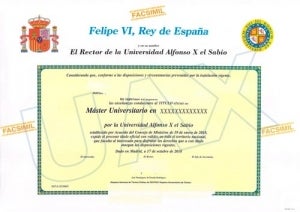
Once you have completed your studies in the Online Master's Degree in Administrative Management, you will receive your official European degree issued by the Alfonso X el Sabio University, the first private university in Spain with more than 30 years of experience. Its official programmes are degrees verified by the Council of Universities and fully valid in Spain, as well as in the European Higher Education Area. It is recognised by the Education Systems of Latin America, being recognised and approved by the different Ministries of Education in Latin America:
SENESCYT, MEN (MinEducation), SEP, Mescyt, among others, automatically.
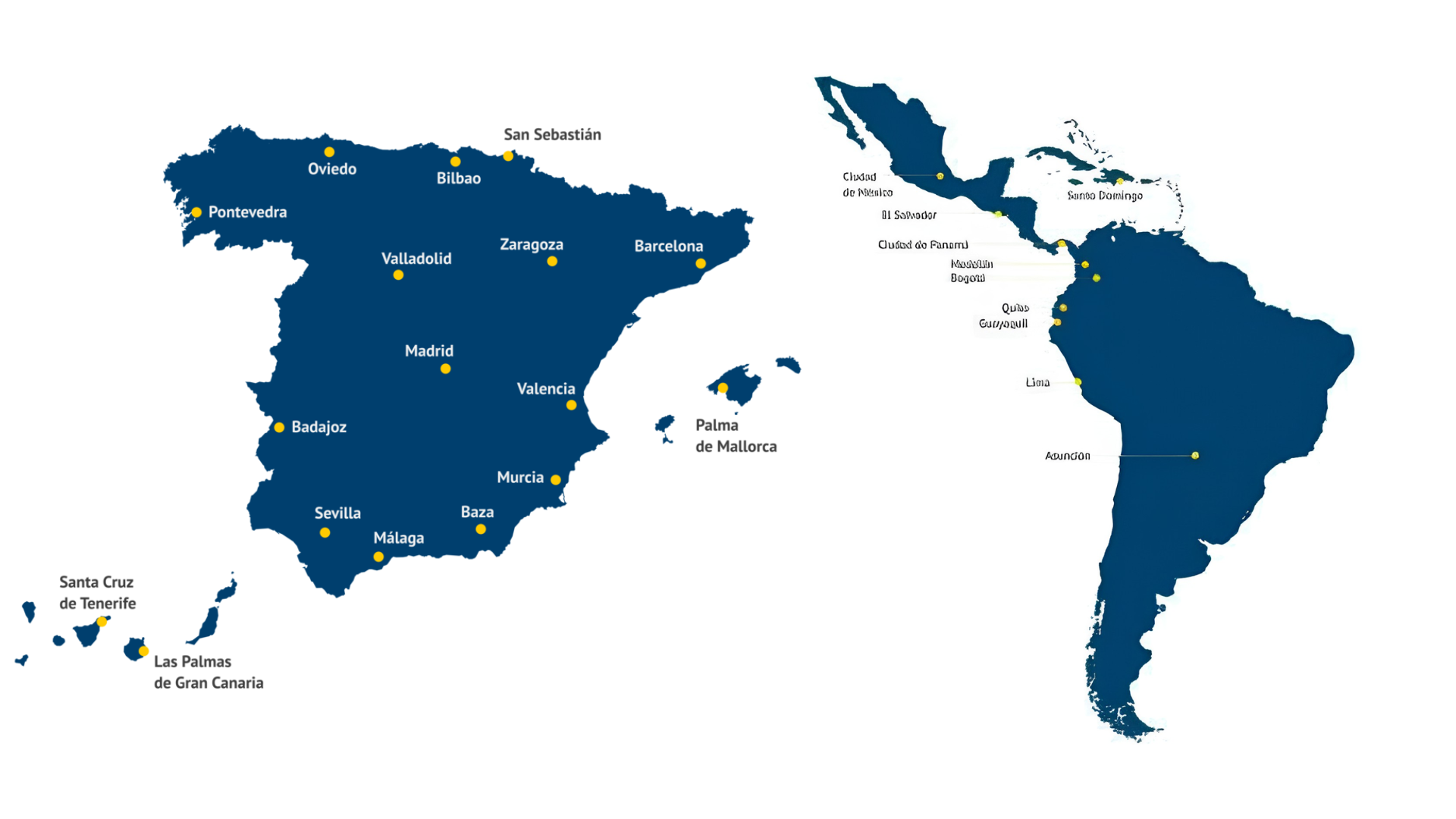
A network of exam centres and spaces to enhance your university experience
Take your in-person exams at our designated centres in Spain and Latin America, so you can choose the location that best suits your needs. Centres are subject to availability and capacity.
Furthermore, as a student at UAX Online, you’ll have access to our Campus Hubs – a network of exclusive physical spaces where you can study, access libraries, work in co-working areas and connect with other students. Because studying online doesn’t mean studying alone.
Campus Hubs available in: Alcobendas, Alcorcón, Valencia San Vicente, Murcia, Barcelona, Málaga, Seville and Arganda.
Access is granted with your UAX student card, subject to availability and the opening hours of each centre.
Teaching staff
Train in Administrative Management alongside the best professionals.
Practising lawyer specialising in financial and tax law. University lecturer specialising in tax law.
Doctor in Law, specialising in Commercial Law, Private International Law and Alternative Dispute Resolution. Researcher in Commercial Law.
PhD in Law from the University of Valencia. Specialist in Professional Services and Procedural Law. Lawyer. University lecturer specialising in collegiate management.
PhD in Law, specialising in Civil Law. University lecturer and researcher in civil law and sports law.
To access an official university master's degree in Spain, it is necessary to meet at least one of the following requirements (as stipulated in article 18 of Royal Decree 822/2021):
Likewise, in compliance with the provisions of the aforementioned Royal Decree, the UAX will reserve 5% of the places offered in official university Master's degrees for students with a recognised degree of disability equal to or greater than 33%, as well as for students with permanent educational support needs associated with personal circumstances of disability, who in their previous studies have required resources and support for their full educational inclusion. In the event that the reserve places have not been demanded in the period foreseen for the reservation of places on the degree, this number of places may be filled by any other applicant who fulfils the conditions for access and admission to the degree.
The Master's Degree in Administrative Management is aimed exclusively at graduates of those degrees that, in accordance with the Organic Statute of the profession of Administrative Manager (Decree 424/1963, of 1 March), have recognised their right to access this profession, namely: Degrees in Economics and Business Studies, Political Science and Law, as well as those degrees that replaced them under the LRU and the corresponding university degrees adapted to the European Higher Education Area.
Admission to the UAX will depend on the places offered and available in the Master's Degree, on the fulfilment of the requirements for access to the University as set out in current legislation and, only in the event that the demand exceeds the places offered, the following aspects will be assessed:
Number of new admission places offered: 70
Complete our form, give us a call or request a visit to UAX. We’re excited to show you everything we’ve prepared for you.
A professional from our university will offer guidance and help you select the path that aligns best with your interests.
Enrol in your courses, meet the deadlines and follow the payment procedures to secure your place and fulfil the legal admission requirements.
You’re now part of UAX! Prepare to embark on a unique educational journey where you’ll take centre stage. Welcome to your university!
We need to know a little bit about you so that we can provide you with a personalised service.
All fields are required
At UAX we know that studying is an investment, which is why we give you the resources to access our qualifications. Learn about some of our scholarships and grants:
You will be able to carry out your future career in different fields, such as:
Other related qualifications
We offer a wide range of courses, so you’re sure to find a programme that suits you.
Online Master's Degree in Human Resources Management and Administration
In collaboration with:

Start:
October
Length:
9 months

Master's Degree in Occupational Risk Prevention (online)
In collaboration with:

Start:
October
Length:
9 months

Máster Universitario Online en Marketing Digital
Start:
October
Length:
9 months

Máster Universitario en Sistemas Integrados de Gestión - SIG (online)
In collaboration with:
Start:
October
Length:
9 months

Online Master's Degree in Criminology Applied to Security Management and Crime Prevention
In collaboration with:

Start:
October
Length:
9 months

Online Master’s Degree in Artificial Intelligence
Start:
October
Length:
9 months

Online University Master's Degree in Big Data for Business
Start:
October
Length:
9 months

Online Master’s Degree in Law and Legal Practice + Bar Exam Preparation Course
In collaboration with:

Start:
October
Length:
1½ years
Online Master's Degree in Business Management and Administration (MBA)
Start:
October
Length:
9 months

Online Master's Degree in Project Organisation and Management
Start:
October
Length:
9 months

Online Master's Degree in Financial Management and Administration
Start:
October
Length:
9 months
The UAX promotes the culture of quality among the university community through the UAX Quality System (SIUAX), for which the University Management is ultimately responsible, ensuring that the planning of the system is implemented to effectively meet the quality objectives, the satisfaction of needs, requirements and expectations of customers and interested parties.
The responsible bodies are:
This organisational structure channels a bidirectional communication of the different improvement actions that allow and ensure the construction of the quality culture in the University.
This degree, according to RD 822/2021 (art. 34) must undergo the process of accreditation renewal. During the development of the process, an evaluation team of the Foundation for Knowledge Madrimasd will meet with different stakeholders of the degree. In addition, they provide us with a form so that any interested party can indicate to the Foundation those aspects they consider relevant to the development of this programme.