See all Online Master's Degrees in Health
See all Master's Degrees in Engineering
Most searched curriculums
Official Qualification
9 months / 60 ECTS
Specialise with UAX’s Online Master’s Degree in Educational Psychology, an officially recognised qualification focused on assessment, counselling and educational psychology intervention. You will acquire the necessary skills to cater for diversity, promote educational inclusion and design support strategies tailored to different individuals and contexts.
Two specialisation pathways: Hospital Educational Psychology and Educational Psychology Support for Older People.
In collaboration with:
3000 students
every year who enter the teaching profession or improve their chances of finding the job they are looking for.
83% Employability
thanks to practical training, connected to the reality of the classroom and oriented to your incorporation in the educational environment.
1000 training centres
where you will connect with your future professional environment and participate in real projects with educational institutions.
The online Master’s Degree in Educational Psychology prepares you to understand, assess and support learning processes from an inclusive and personalised perspective. Throughout the programme, you will develop the skills to identify educational needs, design psychopedagogical intervention plans and support people of different ages and backgrounds in their academic, personal and social development.
The programme delves into areas such as educational guidance, psycho-pedagogical assessment and diagnosis, support for diversity, neuroeducation and learning difficulties. Furthermore, you will learn to collaborate with teachers, families and other professionals to promote more inclusive educational environments and foster the holistic development of each individual.
You will be able to complete your training by choosing one of the programme’s two specialisations: Hospital Psychopedagogy or Psychopedagogical Care for Older People – two areas of specialisation with growing professional demand.
You will also undertake work placements in over 1,000 educational establishments, specialist centres, hospitals and care homes for the elderly, applying the knowledge you have acquired in real-world professional contexts.
In Catalonia, this Master’s degree is equivalent to the Guidance specialism within the Master’s in Teaching, provided you hold the required qualification.
As this is an official university Master’s degree, you will earn specific credits that will add points to your score in the competitive examinations for primary and secondary school teaching posts.
Throughout the online Master’s in Psychopedagogy, you will develop the skills needed to understand, assess and intervene in learning processes from an inclusive and personalised perspective. You will gain in-depth knowledge of areas such as educational guidance, psychopedagogical assessment, supporting diversity, neuroeducation and intervention in various educational and social contexts.
Learn how to identify educational needs, carry out psycho-educational assessments and design intervention plans tailored to each situation.
It designs strategies and resources to promote learning, educational inclusion and the holistic development of individuals.
It participates in educational inclusion projects with the NGO Achalay, promoting the integration of people with intellectual disabilities into the labour market and training.
It develops personalised educational solutions tailored to different profiles and needs, promoting inclusive learning environments.
Choose between the specialisations in Psychopedagogical Care for the Elderly or Hospital Psychopedagogy to shape your career path.
Build up your academic credentials with an official qualification that may be taken into account in competitive examinations and other public recruitment processes, in accordance with the terms and conditions of each call for applications.
Enhance your teaching practice by understanding learning through the lens of neuroeducation. This micro-credential equips you to analyse students’ cognitive, emotional and behavioural processes, identify potential difficulties at an early stage, and apply evidence-based inclusive teaching strategies in the classroom.
Transform the way you work with generative artificial intelligence. This micro-credential empowers you to apply tools like ChatGPT, Copilot, and Gemini to analyze information, create content, and make decisions in real-world academic contexts, integrating solutions ethically and responsibly within the educational field.
Develop your potential in education through leadership and interpersonal skills. This microcredential provides you with the keys to managing teams, communicating effectively, and solving problems in real-world educational settings, combining personal leadership techniques with practical productivity and collaboration tools.
The programme covers areas such as psycho-educational assessment, educational guidance, support for diversity, psycho-educational intervention and neuroeducation. The course is complemented by external placements, a Master’s dissertation and two specialisation pathways: Hospital Psychopedagogy and Psychopedagogical Care for Older People.
All lecturers set aside one hour per week in their timetable for tutorial sessions. Students who are interested should book a date for the session in advance.
Master's Degree in Psychopedagogy
First Year
FIRST FOUR-MONTH PERIOD
| Code | Subjects | Character* | ECTS | ||||
|---|---|---|---|---|---|---|---|
| M121000 | Psychoeducational support for diversity and inclusion in education | OB | 6 | ||||
Psychoeducational support for diversity and inclusion in educationCódigo: M121000 Imprimir Course 1: First-semester module. Compulsory. 6 credits. Profesores
Objectives To learn and correctly apply the course content To be able to diagnose cases Respond to the diversity of the student body from a psycho-educational perspective Prerequisites No prior requirements have been established, apart from those set out in current legislation governing access to postgraduate studies. Competencies N/A Learning outcomes RS2. Apply tools for effective psycho-pedagogical intervention, taking into account the needs of inclusive education. RODS. Develop effective communication, teamwork, analytical thinking, creativity and ethical leadership from a cross-cutting perspective, clearly inspired by democratic principles and values, as well as the Sustainable Development Goals, in order to operate with integrity in the professional sphere. RC1. Develop a psycho-pedagogical response to educational diversity and inclusion, and know how to foster the various multiple intelligences in their pupils RC3. Design educational inclusion programmes within the school and the child’s social environment to promote their integration Description of the content "1. Inclusion and addressing diversity in schools. Objectives of psycho-pedagogy and the needs of educational inclusion 2. Regulatory framework for addressing diversity 3. Intervention models in educational guidance and support for diversity. 4. Assessment and psycho-educational diagnosis of pupils with special educational needs. 5. Psycho-educational support for special educational needs in the school context (Intervention models in educational guidance and support for diversity). 6. Specific psycho-pedagogical intervention programmes. Pupils with high abilities and those requiring late entry into education system" Training activities Lectures 15 hours Interactive lectures 12 hours Critical analysis sessions 6 hours Case studies and/or projects 10 hours Oral presentations, discussions and/or debates (face-to-face) 6 hours. Independent study, case or problem-solving, literature review. Independent work 91 hours. Synchronous/asynchronous virtual tutorials: 7 hours. Completion of knowledge assessments 3 hours. Assessment system and criteria "SE1. Practical activities: Min 15% and Max 25% Assessment of the level of achievement of the learning outcomes (in terms of knowledge, skills and attitude) attained through the completion of individual and group practical activities (case studies, problem-solving and challenges, project work, oral presentations, debates, etc.) based on assessment rubrics and observation tools previously designed and published by the lecturer. SE2. Final knowledge assessments: Min 50% and Max 60% Objective knowledge assessments. These may be written or oral, open-ended, short-answer or multiple-choice, etc. An online exam will be held to assess the student’s ability to relate and apply the main content, abilities and skills acquired through the module. To safeguard students’ rights regarding the protection of biometric data, the final examination may be taken in person provided the student requests this. The protocol for conducting the final examination online or via remote means complies with the provisions of Annex VIII: guidelines on assessment systems including remote examinations, from the guide for the verification and modification of official bachelor’s and master’s degrees (June 2023), which can be viewed via the following link: Protocol for Online Assessment SE3. Portfolio: Min. 20% and Max. 30%. Evaluation is based on evidence of the student’s learning (in terms of knowledge, performance or output) compiled in a dossier, folder or portfolio throughout the course, with the aim of explaining and reflecting on the learning that has taken place.” Bibliography Essential: 1. Sir Ken Robinson Creative Schools: The Revolution That Is Transforming Education Vintage Español. 2015. ISBN: 1101910801 2. MANUEL MONTANERO FERNANDEZ MODELS OF GUIDANCE AND PSYCHOPEDAGOGICAL INTERVENTION UNIVERSITY OF EXTREMADURA SERVICE. 2019. ISBN: 9788477 3. MANUEL SANCHEZ-CANO PSYCHOPEDAGOGICAL ASSESSMENT Graó. 2018. ISBN: ISBN: 9788478 4. Santana Educational Guidance and Psychopedagogical Intervention Pirámide. 2015. ISBN: 9788436833713 Supplementary: 5.- Diz-Casal, Javier Violence and exclusion in educational contexts: keys to the ‘integration’ of the non-normative. In Delgado, J. J. (ed.). Intervention with populations vulnerable to violence and exclusion. Dykinson. 2024. ISBN: 9788411708708 6.- FRANCISCO MORA NEUROEDUCATION: YOU CAN ONLY LEARN WHAT YOU LOVE ALIANZA EDITORIAL. 2017. ISBN: 9788491047803 7. MANUEL MONTANERO FERNÁNDEZ MODELS OF GUIDANCE AND PSYCHOPEDAGOGICAL INTERVENTION UNIVERSITY OF EXTREMADURA PUBLISHING SERVICE. 2008. ISBN: 9788477238515 8. MANUEL SANCHEZ-CANO PSYCHOPEDAGOGICAL ASSESSMENT GRAO. 2005. ISBN: 9788478273669 |
|||||||
| M121001 | Psycho-educational support for specific educational support needs | OB | 6 | ||||
Psycho-educational support for specific educational support needsCódigo: M121001 Imprimir Course 1: First-semester module. Compulsory. 6 credits. Profesores
Objectives To understand the culture of diversity Fostering collaborative attitudes and practices To recognise learning difficulties To design accessible learning environments and materials Prerequisites No prior requirements have been established, apart from those set out in current legislation governing access to postgraduate studies. Competencies N/A Learning outcomes RC1. Develop a psycho-pedagogical approach to educational diversity and inclusion, and know how to foster the various multiple intelligences in their pupils RC7. To assess and address pupils’ diverse educational needs in order to design educational inclusion programmes within the school and the child’s social environment, thereby promoting their integration RK6. Acquire knowledge of the most common specific educational support needs in the school context. Course content 1. Psychopedagogical intervention for pupils with visual or hearing impairment 2. Psychopedagogical intervention for pupils with motor disabilities 3. Psychopedagogical intervention for pupils with an intellectual disability 4. Psychopedagogical intervention for pupils with attention deficit (ADHD) 5. Intervention for pupils with specific learning difficulties 6. Psychopedagogical intervention for pupils with autism spectrum (ASD) Training activities Lecture sessions 15 hours Interactive lectures 12 hours Critical analysis sessions 6 hours. Practical case studies and/or projects 10 hours Oral presentations, discussions and/or debates (face-to-face) 6 hours. Independent study, case or problem-solving, literature review. Independent work 91 hours. Synchronous/asynchronous virtual tutorials: 7 hours. Completion of knowledge assessments 3 hours. Assessment system and criteria "SE1. Practical activities: Min 15% and Max 25% Assessment of the level of achievement of the learning outcomes (in terms of knowledge, skills and attitude) attained through the completion of individual and group practical activities (case studies, problem-solving and challenges, project work, oral presentations, debates, etc.) based on assessment rubrics and observation tools previously designed and published by the lecturer. SE2. Final knowledge assessments: Min 50% and Max 60% Objective knowledge assessments. These may be written or oral, open-ended, short-answer or multiple-choice, etc. An online exam will be held to ensure that students are able to relate and apply the main content, abilities and skills they have acquired through the module. To safeguard students’ rights regarding the protection of biometric data, the final examination may be taken in person provided the student requests this. The protocol for conducting the final examination online or via remote means complies with the provisions of Annex VIII: guidelines on assessment systems including remote examinations, from the guide for the verification and modification of official bachelor’s and master’s degrees (June 2023), which can be viewed via the following link: Protocol for Online Assessment SE3. Portfolio: Min. 20% and Max. 30%. Evaluation is based on evidence of the student’s learning (in terms of knowledge, performance or output) compiled in a dossier, folder or portfolio throughout the course, with the aim of explaining and reflecting on the learning that has taken place.” Bibliography Essential: 1. Sir Ken Robinson Creative Schools: The Revolution That Is Transforming Education Vintage Español. 2015. ISBN: 1101910801 2. MANUEL MONTANERO FERNANDEZ MODELS OF GUIDANCE AND PSYCHOPEDAGOGICAL INTERVENTION UNIVERSITY OF EXTREMADURA SERVICE. 2019. ISBN: 9788477 3. MANUEL SANCHEZ-CANO PSYCHOPEDAGOGICAL ASSESSMENT Graó. 2018. ISBN: ISBN: 9788478 4. Santana Educational Guidance and Psychopedagogical Intervention Pirámide. 2015. ISBN: 9788436833713 Supplementary: 5.- FRANCISCO MORA NEUROEDUCATION: YOU CAN ONLY LEARN WHAT YOU LOVE ALIANZA EDITORIAL. 2017. ISBN: 9788491047803 6. MANUEL MONTANERO FERNÁNDEZ MODELS OF GUIDANCE AND PSYCHOPEDAGOGICAL INTERVENTION UNIVERSITY OF EXTREMADURA PUBLISHING SERVICE. 2008. ISBN: 9788477238515 7. MANUEL SANCHEZ-CANO PSYCHOPEDAGOGICAL ASSESSMENT GRAO. 2005. ISBN: 9788478273669 |
|||||||
| M121002 | Strategies and resources for psycho-educational intervention at different stages of education | OB | 6 | ||||
Strategies and resources for psycho-educational intervention at different stages of educationCódigo: M121002 Imprimir Course 1: First-semester module. Compulsory. 6 credits. Profesores
Objectives • To identify issues in the learning process • To provide information and educational solutions within the educational environment. • To analyse educational interventions • Propose solutions aimed at the continuous improvement of the educational process. • To provide information on learning processes across all stages of education. • Collaborate in the process of identifying and assessing pupils • To identify and assist in the assessment of pupils experiencing difficulties in the learning process • Design teaching programmes tailored to specific circumstances Prerequisites No prerequisites have been established, apart from those set out in current legislation governing access to postgraduate studies. Competencies N/A Learning outcomes RK1. Understand the principles and functions of psycho-pedagogical intervention in order to apply the appropriate intervention RODS. To develop effective communication, teamwork, analytical thinking, creativity and ethical leadership from a cross-cutting perspective, clearly inspired by democratic principles and values, as well as the Sustainable Development Goals, in order to operate with integrity in the professional sphere. RC0. Identify learning difficulties and design appropriate interventions to address different situations RC2. Design observation guidelines and analyse psycho-educational assessments to improve psycho-educational intervention Description of the content "1. Conceptualisation, principles and functions of guidance and psycho-educational intervention 2. The concept of a model for psycho-educational guidance and intervention 3. Models of psycho-educational guidance and intervention I 4. Models of psycho-educational guidance and intervention II 5. Areas of psycho-educational guidance and intervention 6. Institutional models of " Training activities Lectures 15 hours Interactive lectures 12 hours Critical analysis sessions 6 hours. Practical case studies and/or projects 10 hours Oral presentations, discussions and/or debates (face-to-face) 6 hours. Independent study, case or problem-solving, literature review. Independent work 91 hours. Synchronous/asynchronous virtual tutorials: 7 hours. Completion of knowledge assessments 3 hours. Assessment system and criteria "SE1. Practical activities: Min 15% and Max 25% Assessment of the level of achievement of the learning outcomes (in terms of knowledge, skills and attitude) attained through the completion of individual and group practical activities (case studies, problem-solving and challenges, project work, oral presentations, debates, etc.) based on assessment rubrics and observation tools previously designed and published by the lecturer. SE2. Final knowledge assessments: Min 50% and Max 60% Objective knowledge assessments. These may be written or oral, open-ended, short-answer or multiple-choice, etc. An online exam will be held to ensure that students are able to relate and apply the main content, abilities and skills they have acquired through the module. To safeguard students’ rights regarding the protection of biometric data, the final examination may be taken in person provided the student requests this. The protocol for conducting the final examination online or via remote means complies with the provisions of Annex VIII: guidelines on assessment systems that include remote examinations, as set out in the guide for the verification and modification of official bachelor’s and master’s degrees (June 2023), which can be viewed via the following link: Protocol for Online Assessment SE3. Portfolio: Min. 20% and Max. 30%. Evaluation is based on evidence of the student’s learning (in terms of knowledge, performance or output) compiled in a dossier, folder or portfolio throughout the course, with the aim of explaining and reflecting on the learning that has taken place.” Bibliography Essential: 1. Sir Ken Robinson Creative Schools: The Revolution That Is Transforming Education Vintage Español. 2015. ISBN: 1101910801 2. MANUEL MONTANERO FERNANDEZ MODELS OF GUIDANCE AND PSYCHOPEDAGOGICAL INTERVENTION UNIVERSITY OF EXTREMADURA SERVICE. 2019. ISBN: 9788477 3. MANUEL SANCHEZ-CANO PSYCHOPEDAGOGICAL ASSESSMENT Graó. 2018. ISBN: ISBN: 9788478 4. Santana Educational Guidance and Psychopedagogical Intervention Pirámide. 2015. ISBN: 9788436833713 Supplementary: 5.- FRANCISCO MORA NEUROEDUCATION: YOU CAN ONLY LEARN WHAT YOU LOVE ALIANZA EDITORIAL. 2017. ISBN: 9788491047803 6. MANUEL MONTANERO FERNÁNDEZ MODELS OF GUIDANCE AND PSYCHOPEDAGOGICAL INTERVENTION UNIVERSITY OF EXTREMADURA PUBLISHING SERVICE. 2008. ISBN: 9788477238515 7. MANUEL SANCHEZ-CANO PSYCHOPEDAGOGICAL ASSESSMENT GRAO. 2005. ISBN: 9788478273669 |
|||||||
| M121003 | Psycho-educational Assessment, Diagnosis and Guidance | OB | 6 | ||||
Psycho-educational Assessment, Diagnosis and GuidanceCódigo: M121003 Imprimir Course 1: First-semester module. Compulsory. 6 credits. Profesores
Objectives • To master the key concepts of psycho-educational intervention • To provide psycho-educational guidance based on the diagnosis • Be able to interpret an assessment correctly • To distinguish between the different models of vocational and career guidance, etc. • Use specific software for problem-solving • Demonstrate an interest in the quality of one’s own work. Prerequisites No prior requirements have been established, apart from those set out in current legislation governing access to postgraduate studies. Competencies N/A Learning outcomes RK5. To learn the assessment, diagnostic and guidance procedures in educational psychology in order to carry out continuous monitoring of students RS0. Apply appropriate methods and resources to enhance the learning process and provide comprehensive guidance to students RC6. Assess individuals’ educational psychology needs, taking into account the specific characteristics of the context Course content 1. Psychopedagogical assessment 2. Assessment tools 3. Diagnosis in education 4. Feedback on the report and follow-up 5. The psycho-educational report 6. Psychopedagogical counselling" Training activities Lecture sessions 15 hours Interactive lectures 12 hours Critical analysis sessions 6 hours Practical case studies and/or projects 10 hours Oral presentations, discussions and/or debates (face-to-face) 6 hours. Independent study, case or problem-solving, literature review. Independent work 91 hours. Synchronous/asynchronous virtual tutorials: 7 hours. Completion of knowledge assessments 3 hours. Assessment system and criteria SE1. Practical activities: Min. 15% and Max. 25% Assessment of the level of achievement of the learning outcomes (in terms of knowledge, skills and attitude) attained through the completion of individual and group practical activities (case studies, problem-solving and challenges, project work, oral presentations, debates, etc.) based on assessment rubrics and observation tools previously designed and published by the lecturer. SE2. Final knowledge assessments: Min 50% and Max 60% Objective knowledge assessments. These may be written or oral, open-ended, short-answer or multiple-choice, etc. An online exam will be held to ensure that students are able to relate and apply the main content, abilities and skills they have acquired through the module. To safeguard students’ rights regarding the protection of biometric data, the final examination may be taken in person provided the student requests this. The protocol for conducting the final examination online or via remote means complies with the provisions of Annex VIII: guidelines on assessment systems including remote examinations, from the guide for the verification and modification of official bachelor’s and master’s degrees (June 2023), which can be viewed via the following link: Protocol for Online Assessment SE3. Portfolio: Min. 20% and Max. 30%. Evaluation is based on evidence of the student’s learning (in terms of knowledge, performance or output) compiled in a dossier, folder or portfolio throughout the course, with the aim of explaining and reflecting on the learning that has taken place.” Bibliography Essential: 1. Sir Ken Robinson Creative Schools: The Revolution That Is Transforming Education Vintage Español. 2015. ISBN: 1101910801 2. MANUEL MONTANERO FERNANDEZ MODELS OF GUIDANCE AND PSYCHOPEDAGOGICAL INTERVENTION UNIVERSITY OF EXTREMADURA SERVICE. 2019. ISBN: 9788477 3. MANUEL SANCHEZ-CANO PSYCHOPEDAGOGICAL ASSESSMENT Graó. 2018. ISBN: ISBN: 9788478 4. Santana Educational Guidance and Psychopedagogical Intervention Pirámide. 2015. ISBN: 9788436833713 Supplementary: 5.- FRANCISCO MORA NEUROEDUCATION: YOU CAN ONLY LEARN WHAT YOU LOVE ALIANZA EDITORIAL. 2017. ISBN: 9788491047803 6. MANUEL MONTANERO FERNÁNDEZ MODELS OF GUIDANCE AND PSYCHOPEDAGOGICAL INTERVENTION UNIVERSITY OF EXTREMADURA PUBLISHING SERVICE. 2008. ISBN: 9788477238515 7. MANUEL SANCHEZ-CANO PSYCHOPEDAGOGICAL ASSESSMENT GRAO. 2005. ISBN: 9788478273669 |
|||||||
| M121004 | Neuroeducation and learning | OB | 6 | ||||
Neuroeducation and learningCódigo: M121004 Imprimir Course 1: First-semester module. Compulsory. 6 credits. Profesores
Entry requirements No prerequisites have been established, apart from those set out in current legislation governing admission to postgraduate studies. Competencies N/A Learning outcomes RK2. Understand the brain mechanisms that influence learning in order to improve the learning process in a personalised way. RS0. Apply appropriate methods and resources to improve the learning process, as well as provide comprehensive guidance to students RS1. Identify the nature of learning difficulties in order to address pupils’ different educational needs through the use of key neurodidactic strategies Course description 1. Introduction to Neuroeducation. Differences between neuroscience and neuropsychology. 2. Cognitive development and plasticity. Models and theories of cognitive development and brain plasticity 3. Brain mechanisms of learning. 4. Neurolearning and Neurodidactics 5. Emotional neuroeducation 6. Classroom intervention from the perspective of neuroeducation Training activities Lecture sessions 15 hours Interactive lectures 12 hours Critical analysis sessions 6 hours Practical case studies and/or projects 10 hours Oral presentations, discussions and/or debates (face-to-face) 6 hours. Independent study, case or problem-solving, literature review. Independent work 91 hours. Synchronous/asynchronous virtual tutorials: 7 hours. Completion of knowledge assessments 3 hours. Assessment system and criteria "SE1. Practical activities: Min 15% and Max 25% Assessment of the level of achievement of the learning outcomes (in terms of knowledge, skills and attitude) attained through the completion of individual and group practical activities (case studies, problem-solving and challenges, project work, oral presentations, debates, etc.) based on assessment rubrics and observation tools previously designed and published by the lecturer. SE2. Final knowledge assessments: Min 50% and Max 60% Objective knowledge assessments. These may be written or oral, open-ended, short-answer or multiple-choice, etc. An online exam will be held to ensure that students are able to relate and apply the main content, abilities and skills they have acquired through the module. To safeguard students’ rights regarding the protection of biometric data, the final examination may be taken in person provided the student requests this. The protocol for conducting the final examination online or via remote means complies with the provisions of Annex VIII: guidelines on assessment systems including remote examinations, from the guide for the verification and modification of official bachelor’s and master’s degrees (June 2023), which can be viewed via the following link: Protocol for Online Assessment SE3. Portfolio: Min. 20% and Max. 30%. Evaluation is based on evidence of the student’s learning (in terms of knowledge, performance or output) compiled in a dossier, folder or portfolio throughout the course, with the aim of explaining and reflecting on the learning that has taken place.” Bibliography Essential: 1. Sir Ken Robinson Creative Schools: The Revolution That Is Transforming Education Vintage Español. 2015. ISBN: 1101910801 2. MANUEL MONTANERO FERNANDEZ MODELS OF GUIDANCE AND PSYCHOPEDAGOGICAL INTERVENTION UNIVERSITY OF EXTREMADURA SERVICE. 2019. ISBN: 9788477 3. MANUEL SANCHEZ-CANO PSYCHOPEDAGOGICAL ASSESSMENT Graó. 2018. ISBN: ISBN: 9788478 4. Santana Educational Guidance and Psychopedagogical Intervention Pirámide. 2015. ISBN: 9788436833713 Supplementary: 5.- FRANCISCO MORA NEUROEDUCATION: YOU CAN ONLY LEARN WHAT YOU LOVE ALIANZA EDITORIAL. 2017. ISBN: 9788491047803 6. MANUEL MONTANERO FERNÁNDEZ MODELS OF GUIDANCE AND PSYCHOPEDAGOGICAL INTERVENTION UNIVERSITY OF EXTREMADURA PUBLISHING SERVICE. 2008. ISBN: 9788477238515 7. MANUEL SANCHEZ-CANO PSYCHOPEDAGOGICAL ASSESSMENT GRAO. 2005. ISBN: 9788478273669 |
|||||||
| TOTAL: | 30 | ||||||
SECOND FOUR-MONTH PERIOD
| Code | Subjects | Character* | ECTS | ||||||||||||||||||||||||||||||
|---|---|---|---|---|---|---|---|---|---|---|---|---|---|---|---|---|---|---|---|---|---|---|---|---|---|---|---|---|---|---|---|---|---|
| M121005 | Tutoring and family guidance | OB | 6 | ||||||||||||||||||||||||||||||
Tutoring and family guidanceCódigo: M121005 Imprimir Course 1. Second-term module. Compulsory. 6 credits. Profesores
Entry requirements No prerequisites have been established, apart from those set out in current legislation governing admission to postgraduate studies. Competencies N/A Learning outcomes RK7. Identify advanced techniques for counselling and guiding families RS0. Apply appropriate methods and resources to enhance the learning process and provide comprehensive guidance to students RC4. Understand tutoring as a process of support aimed at providing personalised care. Course description 1. Tutoring in schools. The inclusive school. 2. The profile of the tutor teacher. 3. The guidance and tutoring action plan. 4. Tutoring planning and assessment. Family, school and new Technologies. 5. Family educational guidance. Problems and associated with the family environment. 6. Family support and relationships. School and family mediation." Training activities Synchronous theoretical and practical classes. Presentation of case studies. Reading of supplementary material. Completion of individual and group assignments. Reading of scientific documents, viewing of MOOCs and consultation of legislation and relevant links. Assessment system and criteria "SE1. Practical activities: Min 15% and Max 25% Assessment of the level of achievement of the learning outcomes (in terms of knowledge, skills and attitude) attained through the completion of individual and group practical activities (case studies, problem-solving and challenges, project work, oral presentations, debates, etc.) based on assessment rubrics and observation tools previously designed and published by the lecturer. SE2. Final knowledge assessments: Min 50% and Max 60% Objective knowledge assessments. These may be written or oral, open-ended, short-answer or multiple-choice, etc. An online exam will be held to ensure that students are able to relate and apply the main content, abilities and skills they have acquired through the module. To safeguard students’ rights regarding the protection of biometric data, the final examination may be taken in person provided the student requests this. The protocol for conducting the final examination online or via remote means complies with the provisions of Annex VIII: guidelines on assessment systems including remote examinations, from the guide for the verification and modification of official bachelor’s and master’s degrees (June 2023), which can be viewed via the following link: Protocol for Online Assessment SE3. Portfolio: Min. 20% and Max. 30%. Evaluation is based on evidence of the student’s learning (in terms of knowledge, performance or output) compiled in a dossier, folder or portfolio throughout the course, with the aim of explaining and reflecting on the learning that has taken place.” Bibliography Essential: 1. Sir Ken Robinson Creative Schools: The Revolution That Is Transforming Education Vintage Español. 2015. ISBN: 1101910801 2. FRANCISCO MORA NEUROEDUCATION: YOU CAN ONLY LEARN WHAT YOU LOVE ALIANZA EDITORIAL. 2017. ISBN: 9788491047803 3. MANUEL MONTANERO FERNÁNDEZ MODELS OF PSYCHOPEDAGOGICAL GUIDANCE AND INTERVENTION UNIVERSITY OF EXTREMADURA SERVICE. 2019. ISBN: 9788477 4. MANUEL SANCHEZ-CANO PSYCHOPEDAGOGICAL ASSESSMENT Graó. 2018. ISBN: ISBN: 9788478 5. Santana Educational Guidance and Psychopedagogical Intervention Pirámide. 2015. ISBN: 9788436833713 |
|||||||||||||||||||||||||||||||||
| M121007 | Master’s Thesis | OB | 6 | ||||||||||||||||||||||||||||||
Master’s ThesisCódigo: M121007 Imprimir Course 1. Second-term module. Compulsory. 6 credits. Profesores
Prerequisites In order to defend their Master’s Thesis before an assessment panel, students must have passed the 60 credits relating to the modules and external placements on the programme. Furthermore, they must have received approval from their supervisor, who must consider that their thesis has met the necessary criteria to be defended and to complete their postgraduate studies. Competencies N/A Learning Outcomes RS0. Apply appropriate methods and resources to enhance the learning process, as well as provide comprehensive guidance to students RODS. Develop effective communication, teamwork, analytical thinking, creativity and ethical leadership from a cross-cutting perspective, clearly inspired by democratic principles and values, as well as the Sustainable Development Goals, in order to conduct oneself with integrity in the professional sphere. RC11. Design proposals for psycho-pedagogical interventions in different settings RC12. Develop methodologies to enhance learning, taking into account the student’s holistic development, through an academic project to be defended before a specialist panel. Description of the course content The Master’s Final Project (TFM) consists of applying the content learnt in the theoretical and practical modules and during the external academic placements undertaken as part of the programme. In the MTh, the student must demonstrate that they have carried out the entire process characteristic of research into a psycho-pedagogical intervention project, under the supervision of a tutor who will guide their work. They must submit a high-quality piece of work that meets the necessary requirements for a literature review, the setting of objectives, the planning of the intervention and the action plan, and the formulation of hypotheses, as well as an analysis of results and a proposal for intervention, which will be defended through a public oral presentation before a panel qualified to assess it. Training activities Introductory session for the Master’s Thesis The general elements and significance of a Master’s Thesis of this nature are explained. Reading material in the virtual classroom (Master’s Thesis) This section includes supplementary study materials, such as additional documentation, legislation, articles and links of interest, examples from experts, videos, etc., which enable students to delve deeper into the subject matter and facilitate the achievement of the proposed objectives. Training seminars The lecturer will propose topics for debate and discussion, as well as training activities designed to encourage participation from all students. The training seminars cover aspects such as developing skills for writing a scientific article, knowing how to cite sources, understanding and applying APA style guidelines, delivering oral presentations, and everything related to the preparation of a Master’s Thesis. Individual and group tutorials The Master’s Thesis supervisor will monitor the student’s progress by reviewing each draft of the thesis together with them. Group sessions will also be held to provide general guidance. Preparation of the Master’s Thesis This involves the student producing the dissertation, which is ultimately assessed by an assessment panel. Assessment system and criteria 1. Master’s Thesis Report: 40% Assessment of the student’s written work based on a previously designed and published assessment rubric. The Master’s Final Project is an individual or group exercise on a topic chosen by each student, which may be theoretical, experimental or practical in nature. The aim of this project is to demonstrate a certain level of maturity in independently addressing a topic relevant to the degree programme. The dissertation must be carried out under the supervision of an academic tutor from the University. The assessment concludes with an evaluation of the level of learning achieved by the student and is expressed as numerical marks, in accordance with current legislation. The following aspects will be taken into account when assessing the Master’s Final Project report: - Overall assessment of the project: coherence between objectives, methodology, development and results. Originality and innovation. - Review of the current state of the art and theoretical framework. - Methodology employed: suitability in relation to the objectives and results. - Development of the work: suitability of the methodologies and justification of the decisions taken. - Formal aspects: appropriate clarity, precision and organisation. - Impact of the Master’s Thesis: results suitable for publication in a journal or conference. 2. Defence and presentation of the Master’s Thesis before the assessment panel: 60% Assessment of the oral presentation of the Master’s Thesis prepared by each student, as well as their responses to and explanations of questions or clarifications raised by the examination board, based on a previously designed and published assessment rubric. This thesis will be presented and defended individually, orally and in public, before a University Examination Board. Lecturers from other disciplines, degree programmes and schools within the same university, or from other universities, may be invited. The defence of the Master’s Thesis may take place via videoconference on the educational platform chosen by the course coordinator, provided that: 1) A representative of the university verifies the student’s identity in person at the location where the defence is taking place and accompanies the student throughout the defence; 2) The defence is public, either where the student is present or where the examination board is present; 3) There is the possibility of synchronous interaction between the student and the examination board. The criteria to be considered when assessing the public defence of the Master’s Thesis are: - Clarity of the presentation. - Use of presentation technologies. - Adherence to the time limit set for the presentation. - Interaction with the examination board and the communication skills demonstrated during the discussion with the board. The Master’s Thesis defence may be conducted via videoconference. In this case: - A representative from UAX will be present in person to verify the student’s identity at the venue where the Master’s Thesis defence takes place and will accompany the student throughout the defence. - The defence must be open to the public, with attendees granted access to the venue where the examination board is present. - The student and the examination board may interact, whilst ensuring that the discussion between the student and the examination board, which is mandatory, takes place." |
|||||||||||||||||||||||||||||||||
| M121008 | The theory of multiple intelligences from the perspective of educational psychology counselling in the educational context | OB | 6 | ||||||||||||||||||||||||||||||
The theory of multiple intelligences from the perspective of educational psychology counselling in the educational contextCódigo: M121008 Imprimir Course 1. Second-term module. Compulsory. 6 credits. Profesores
Entry requirements No prerequisites have been established, apart from those set out in current legislation governing admission to postgraduate studies. Competencies N/A Learning outcomes RK4. Understand the different types of multiple intelligences and learn how to develop them in the classroom in a personalised way RC1. Develop a psycho-pedagogical approach to educational diversity and inclusion, and know how to foster the various types of multiple intelligences in their students RC5. Assess the psycho-pedagogical needs of groups or organisations, taking into account the specific characteristics of the context Course content 1. Intelligence: concept, definition and historical development of the construct. Main theories 2. The theory of multiple intelligences and an introduction to emotional intelligence 3. Intellectual development, emotional intelligence and human diversity 4. Factors influencing intelligence 5. Multiple intelligences in the classroom. Psychopedagogical counselling; theory and practice of education 6. An inclusive approach and motivation in the classroom from the perspective of ‘ Training activities Lecture sessions 15 hours Interactive lectures 12 hours Critical analysis sessions 6 hours. Case studies and/or projects 10 hours. Oral presentations, discussions and/or debates (face-to-face) 6 hours. Independent study, case or problem-solving, literature review. Independent work 91 hours. Synchronous/asynchronous virtual tutorials: 7 hours. Completion of knowledge assessments 3 hours. Assessment system and criteria "SE1. Practical activities: Min 15% and Max 25% Assessment of the level of achievement of the learning outcomes (in terms of knowledge, skills and attitude) attained through the completion of individual and group practical activities (case studies, problem-solving and challenges, project work, oral presentations, debates, etc.) based on assessment rubrics and observation tools previously designed and published by the lecturer. SE2. Final knowledge assessments: Min 50% and Max 60% Objective knowledge assessments. These may be written or oral, open-ended, short-answer or multiple-choice, etc. An online exam will be held to ensure that students are able to relate and apply the key content, abilities and skills they have acquired through the module. To safeguard students’ rights regarding the protection of biometric data, the final examination may be taken in person provided the student requests this. The protocol for conducting the final examination online or via remote means complies with the provisions of Annex VIII: guidelines on assessment systems including remote examinations, from the guide for the verification and modification of official bachelor’s and master’s degrees (June 2023), which can be viewed via the following link: Protocol for Online Assessment SE3. Portfolio: Min. 20% and Max. 30%. Evaluation is based on evidence of the student’s learning (in terms of knowledge, performance or output) compiled in a dossier, folder or portfolio throughout the course, with the aim of explaining and reflecting on the learning that has taken place.” |
|||||||||||||||||||||||||||||||||
| M121009 | Practicum | OB | 6 | ||||||||||||||||||||||||||||||
PracticumCódigo: M121009 Imprimir Course 1. Second-term module. Compulsory. 6 credits. Profesores
Objectives To apply the theoretical knowledge acquired in the classroom to practical situations within the professional field of educational psychology. To develop practical skills relevant to professional practice in educational and clinical contexts. To gain practical experience in educational psychology assessment, diagnosis and intervention with various population groups (children, adolescents, adults) and in various settings (schools, early intervention centres, private practices, etc.). To collaborate with other education and health professionals in the design and implementation of educational psychology intervention plans. Prerequisites In order to undertake the external placements, it is an essential requirement to have enrolled in all modules for the first term. Competencies N/A Learning outcomes RS0. Apply appropriate methods and resources to enhance the learning process and provide comprehensive guidance to students RODS. Develop effective communication, teamwork, analytical thinking, creativity and ethical leadership from a cross-disciplinary perspective, clearly inspired by democratic principles and values, as well as the Sustainable Development Goals, in order to conduct oneself with integrity in the professional sphere. RC9. Design, implement and evaluate specific educational support measures in the practice of educational psychology within educational and professional contexts RC10. Integrate educational psychology practice into a real-world setting, encompassing diagnosis, assessment and intervention. Description of the content "Carrying out activities typical of the practice of an educational psychologist, both in educational establishments and specialised centres, under the guidance of an academic tutor and a tutor at the placement centre” Training activities Placement Seminars Individual and group tutorials Independent study Assessment system and criteria "1. Report from the external placement supervisor: Min. 40% and Max. 45% The supervisor at the organisation (company, hospital, centre, etc.) carries out an objective assessment of the student’s performance at the placement centre, following an assessment rubric that has been previously designed and published. 2. Report from the academic placement tutor: Min 30% and Max 40% The academic supervisor for the external placement carries out an assessment of the student’s performance during the external placement. 3. – External placement report: Min 20% and Max 25% A report which the student must write and submit to their academic tutor once they have completed their placement period at a specific organisation (company, hospital, centre, etc.). Writing this report allows the student to reflect on what they have learnt and serves as evidence of how they have utilised their training hours. The academic tutor carries out an objective assessment of the student’s placement report using an assessment rubric that has been previously designed and published." |
|||||||||||||||||||||||||||||||||
| TOTAL: | 24 | ||||||||||||||||||||||||||||||||
ELECTIVE COURSES
| Code | Subjects | Character* | ECTS |
|---|---|---|---|
| N/A | Elective | OP | 6 |
| TOTAL: | 6 | ||
List of Elective Modules
SECOND FOUR-MONTH PERIOD
| Code | Subjects | Character* | ECTS | ||||||
|---|---|---|---|---|---|---|---|---|---|
| M121030 | Psycho-educational support for older people | OP | 6 | ||||||
Psycho-educational support for older peopleCódigo: M121030 Imprimir Course 1. Second-term module. Elective. 6 credits. Profesores
Entry requirements No prerequisites have been established, apart from those set out in current legislation governing admission to postgraduate studies. Competencies N/A Learning outcomes RS0. Apply appropriate methods and resources to enhance the learning process and provide comprehensive guidance to students RC8. Assess individuals’ psycho-educational needs, taking into account the specific characteristics of the context Course content 1. Basic concepts. Ageing within the educational life cycle 2. Physical and cognitive changes and intelligence in old age 3. Holistic assessment in ageing 4. Designing socio-educational programmes for older people 5. Cognitive intervention for older people 6. Promoting active ageing" Training activities Lecture sessions 15 hours Interactive lectures 12 hours Critical analysis sessions 6 hours Case studies and/or projects 10 hours Oral presentations, discussions and/or debates (face-to-face) 6 hours. Independent study, case or problem-solving, literature review. Independent work 91 hours. Synchronous/asynchronous virtual tutorials: 7 hours. Completion of knowledge assessments 3 hours. Assessment system and criteria "SE1. Practical activities: Min 15% and Max 25% Assessment of the level of achievement of the learning outcomes (in terms of knowledge, skills and attitude) attained through the completion of individual and group practical activities (case studies, problem-solving and challenges, project work, oral presentations, debates, etc.) based on assessment rubrics and observation tools previously designed and published by the lecturer. SE2. Final knowledge assessments: Min 50% and Max 60% Objective knowledge assessments. These may be written or oral, open-ended, short-answer or multiple-choice, etc. An online exam will be held to ensure that students are able to relate and apply the key content, abilities and skills they have acquired through the module. To safeguard students’ rights regarding the protection of biometric data, the final examination may be taken in person provided the student requests this. The protocol for conducting the final examination online or via remote means complies with the provisions of Annex VIII: guidelines on assessment systems including remote examinations, from the guide for the verification and modification of official bachelor’s and master’s degrees (June 2023), which can be viewed via the following link: Protocol for Online Assessment SE3. Portfolio: Min. 20% and Max. 30%. Evaluation is based on evidence of the student’s learning (in terms of knowledge, performance or output) compiled in a dossier, folder or portfolio throughout the course, with the aim of explaining and reflecting on the learning that has taken place.” Bibliography Essential: 1. Sir Ken Robinson Creative Schools: The Revolution That Is Transforming Education Vintage Español. 2015. ISBN: 1101910801 2. FRANCISCO MORA NEUROEDUCATION: YOU CAN ONLY LEARN WHAT YOU LOVE ALIANZA EDITORIAL. 2017. ISBN: 9788491047803 3. MANUEL MONTANERO FERNÁNDEZ MODELS OF PSYCHOPEDAGOGICAL GUIDANCE AND INTERVENTION UNIVERSITY OF EXTREMADURA PUBLISHING SERVICE. 2019. ISBN: 9788477 4. MANUEL SANCHEZ-CANO PSYCHOPEDAGOGICAL ASSESSMENT Graó. 2018. ISBN: ISBN: 9788478 5. Santana Educational Guidance and Psychopedagogical Intervention Pirámide. 2015. ISBN: 9788436833713 |
|||||||||
| M121031 | Health education and hospital educational psychology | OP | 6 | ||||||
Health education and hospital educational psychologyCódigo: M121031 Imprimir Course 1. Second-term module. Elective. 6 credits. Profesores
Entry requirements No prerequisites have been established, apart from those set out in current legislation governing admission to postgraduate studies. Competencies N/A Learning outcomes RK3. To learn concepts such as health promotion and disease prevention. RS0. Apply appropriate methods and resources to enhance the learning process, as well as to provide comprehensive guidance to students Course content 1. Health promotion and disease prevention. 2. Lifestyles and health. 3. Psychopedagogy of illness 4. Educational and psychopedagogical intervention in the context of illness 5. Residential care, the community and education: social support and health. 6. Psychopedagogical aspects associated with hospitalisation. Schooling in hospital. Training activities Lecture sessions 15 hours. Interactive lectures 12 hours. Critical analysis sessions 6 hours. Practical case studies and/or projects 10 hours Oral presentations, discussions and/or debates (face-to-face) 6 hours. Independent study, case or problem-solving, literature review. Independent work 91 hours. Synchronous/asynchronous virtual tutorials: 7 hours. Completion of knowledge assessments 3 hours. Assessment system and criteria "SE1. Practical activities: Min 15% and Max 25% Assessment of the level of achievement of the learning outcomes (in terms of knowledge, skills and attitude) attained through the completion of individual and group practical activities (case studies, problem-solving and challenges, project work, oral presentations, debates, etc.) based on assessment rubrics and observation tools previously designed and published by the lecturer. SE2. Final knowledge assessments: Min 50% and Max 60% Objective knowledge assessments. These may be written or oral, open-ended, short-answer or multiple-choice, etc. An online exam will be held to ensure that students are able to relate and apply the main content, abilities and skills they have acquired through the module. To safeguard students’ rights regarding the protection of biometric data, the final examination may be taken in person provided the student requests this. The protocol for conducting the final examination online or via remote means complies with the provisions of Annex VIII: guidelines on assessment systems including remote examinations, from the guide for the verification and modification of official bachelor’s and master’s degrees (June 2023), which can be viewed via the following link: Protocol for Online Assessment SE3. Portfolio: Min. 20% and Max. 30%. Evaluation is based on evidence of the student’s learning (in terms of knowledge, performance or output) compiled in a dossier, folder or portfolio throughout the course, with the aim of explaining and reflecting on the learning that has taken place.” Bibliography Essential: 1. Sir Ken Robinson Creative Schools: The Revolution That Is Transforming Education Vintage Español. 2015. ISBN: 1101910801 2. FRANCISCO MORA NEUROEDUCATION: YOU CAN ONLY LEARN WHAT YOU LOVE ALIANZA EDITORIAL. 2017. ISBN: 9788491047803 3. MANUEL MONTANERO FERNÁNDEZ MODELS OF PSYCHOPEDAGOGICAL GUIDANCE AND INTERVENTION UNIVERSITY OF EXTREMADURA PUBLISHING SERVICE. 2019. ISBN: 9788477 4. MANUEL SANCHEZ-CANO PSYCHOPEDAGOGICAL ASSESSMENT Graó. 2018. ISBN: ISBN: 9788478 5. Santana Educational Guidance and Psychopedagogical Intervention Pirámide. 2015. ISBN: 9788436833713 |
|||||||||
| TOTAL: | 12 | ||||||||
*Character: BT: Basic Training, Ob: Required, Op: Optional
The main reason why at UAX there are students like you is the possibility of making your personal, professional and academic life compatible. Our differential value is a methodology without barriers, focused on you and your desire to learn.
How is our methodology?
In addition, you will have the complete availability of our campus in Madrid, to carry out your formalities, solve your doubts and enjoy the facilities it offers.
Our degree is official, verified by the Council of Universities and fully valid in Spain, as well as in the European Higher Education Area.
It is recognised by the Education Systems of Latin America, being recognised and approved by the different Ministries of Education in Latin America:
SENESCYT, MEN (MinEducation), SEP, Mescyt, among others, automatically.
The external academic placements on the Master’s Degree in Psychopedagogy will enable you to apply the knowledge you have acquired in assessment, guidance and psychopedagogical intervention in real-world professional settings. During this experience, you will take part in activities relating to supporting diversity, psychopedagogical assessment, educational counselling and the design of support strategies tailored to different needs and contexts.
You will be able to undertake your placements in over 1,000 public, private and state-subsidised schools, as well as in educational psychology practices, hospitals and specialist centres, developing professional skills alongside multidisciplinary teams and practising professionals.
Furthermore, you will have the opportunity to focus your practical experience on areas linked to the programme’s two specialisations: Hospital Psychopedagogy and Psychopedagogical Care for the Elderly.
Furthermore, you can have your work placement recognised (6 ECTS) by providing evidence of demonstrable professional experience in the field.
Some of the organisations where you can undertake your placements include:
| CENTRE | NETWORK AFFILIATION – PROFILE |
| ARQUISOCIAL – Wellbeing Specialist | Arquisocial, an organisation dedicated to the development of social services and the comprehensive management and delivery of training programmes. It has two main offices, one in Zaragoza and the other in Madrid. It operates in 24 Spanish provinces with over 60 branches across Spain |
| AUTISM GRANADA | The Autismo Granada Association is made up of parents of children, as well as adults with ASD, in our province. |
| Albanta Speech Therapy and Psychology | A company comprising a multidisciplinary team of psychologists, speech and language therapists, special needs teachers… |
| ATEMPRA SUR, S.L. | Atempra Sur is a family support centre offering services from speech and language therapists, neuropsychologists, physiotherapists, emotional therapy and yoga |
| FONEMAS: speech and language therapy, psychology, education. | Phoniatric Rehabilitation and Speech and Language Therapy Service. Jaén, Linares and Úbeda Hospital Complex. Specialist in Myofunctional Therapy. Voice Specialist. Specific Language Impairment. Official Master’s Degree in Speech and Language Therapy Research into Degenerative Disorders and Brain Injury. |
| Aspercamp – Asperger’s and ASD Association of Camp de Tarragona | An association made up of people with Asperger’s Syndrome. Aspercamp is an active member of the FEDERACIÓ ESPECTRE AUTISTA – ASPERGER DE CATALUNYA |
| SE EAP B-34 Sabadell | Psycho-educational Assessment and Guidance Team |
| Jara Innovación S.L | An innovative school promoting active, enjoyable learning through the Helix model, from pre-school through to the Science and Arts streams of the Sixth Form, and vocational training. |
| Walu | Comprehensive Centre for Development and Learning Support |
| Isabel Ecker Cerdá | GOPEL Psychopedagogical Practice. |
| Montserrat Suárez Alonso | Samaya Psychology Centre |
You can view the full list here.
You can undertake international placements, meet new colleagues from all over the world and boost your career in the international sector. For further information, please contact the International Relations Office.
The Master’s Degree in Educational Psychology is aimed at professionals interested in educational guidance, supporting diversity, educational psychology assessment and intervention in various educational and social contexts. It is particularly suited to teachers, counsellors, educationalists and professionals who wish to specialise in the field of educational psychology.
You will be eligible for the Master’s programme if you hold one of the following qualifications:
Students whose mother tongue is not Spanish must demonstrate a B2 level of Spanish in accordance with the Common European Framework of Reference for Languages (CEFR).
If you have professional experience relating to psycho-educational intervention, you may apply for recognition of up to 6 ECTS credits corresponding to the Practicum (External Academic Placements).
To do so, you will need to provide evidence of more than 24 months’ professional experience in areas related to:
Credit recognition will require a case-by-case assessment by the University. To find out which options apply to your situation, please contact our admissions team.
The flexibility of online learning, with opportunities to connect
Take your exams online wherever you are or, if you prefer, in person at our designated centres in Spain and Latin America, subject to availability and capacity.
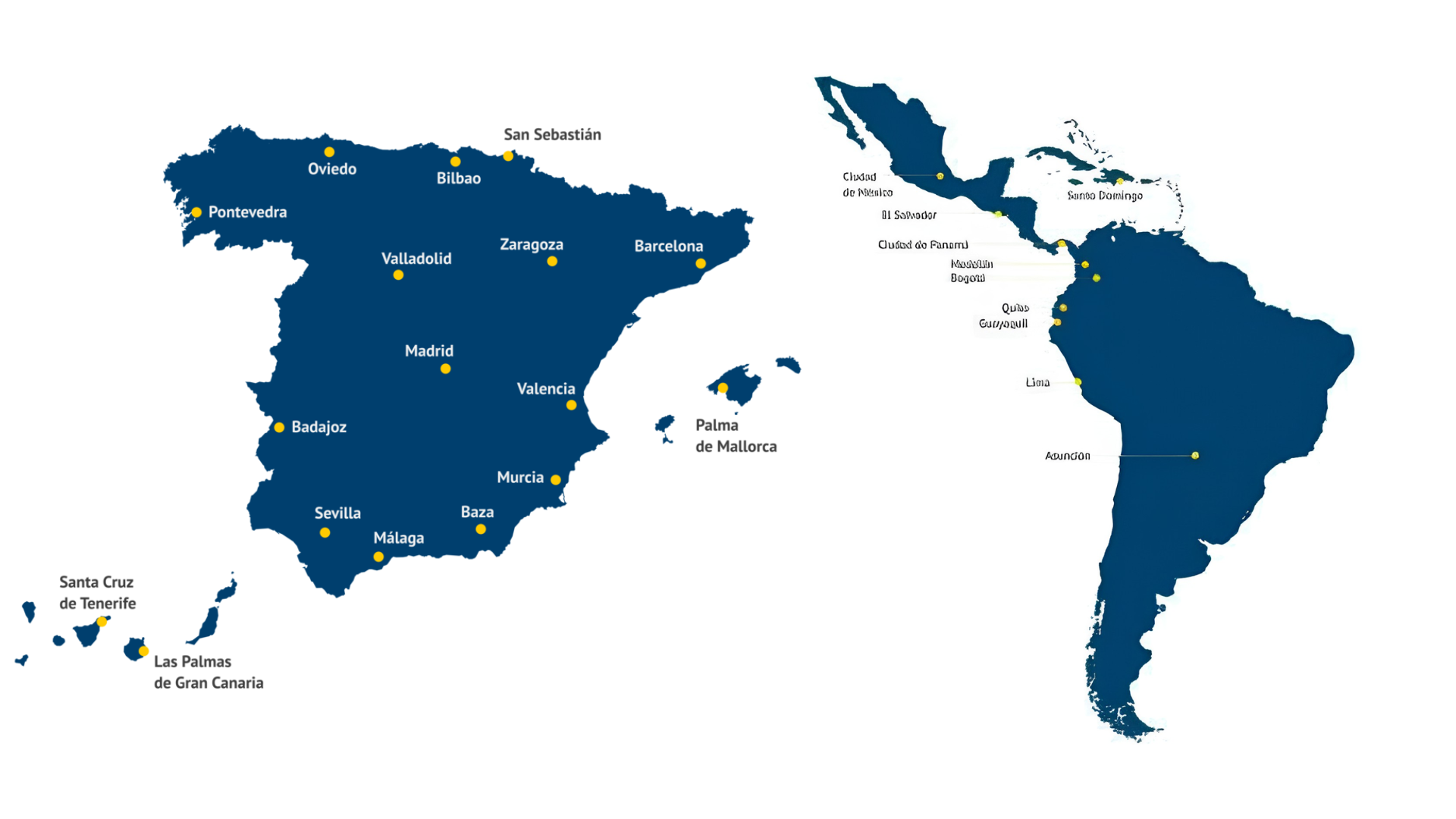
What’s more, as a student at UAX Online, you’ll have access to our Campus Hubs – a network of exclusive physical spaces where you can study, access libraries, work in co-working areas and connect with other students. Because studying online doesn’t mean studying alone.
Campus Hubs available in: Alcobendas, Alcorcón, Valencia San Vicente, Murcia, Barcelona, Málaga, Seville and Arganda.
Access is via your UAX student card, subject to availability and the opening hours of each centre.

In addition to the core training in psycho-educational guidance and intervention, the Master’s degree allows you to tailor your professional development through one of its two specialisations, adapting your profile to fields with specific needs for intervention and support.
Boost your career with the skills the job market demands
Master Microsoft 365 Copilot and boost your productivity with AI. Learn how to automate tasks, create content, analyse data and optimise your work in Word, Excel, PowerPoint, Outlook and Teams to work more efficiently with this official Microsoft certification.
Meet the teaching staff of the Master’s degree in Educational Psychology
Learn alongside lecturers, researchers and practising professionals specialising in educational guidance, psycho-paedagogical intervention, neuropsychology and supporting diversity.

PhD in Psychology, specialising in Neuroscience. A specialist in learning difficulties, neurodevelopment and educational neuropsychology, she combines university teaching with research in the fields of psychology and education. She has spent part of her research career at the 12 de Octubre University Hospital.

She holds a PhD in Education and a degree in Educational Psychology. With over 20 years’ experience in higher education, she has directed various specialist master’s programmes in Educational Psychology, Educational Neuropsychology and Educational Technology. Her research focuses on neurotechnology applied to learning.

A psychologist and educational counsellor, specialising in the neuropsychology of learning and neurodevelopmental disorders. She has experience in psycho-educational assessment and intervention, educational counselling, and supporting pupils, families and teachers in various educational and clinical settings.

She holds a PhD in Psychology and a Master’s degree in Gerontology. She has extensive experience in university teaching and in training professionals in the fields of education and psychology. Her research focuses on learning difficulties, support for diversity, psychological wellbeing and educational processes at different stages of life.

A neuropsychologist and optician-optometrist, specialising in neuropsychology applied to learning. She runs the Acu-Visión centre and combines her professional work with university teaching and the training of specialists in neuropsychology and education. She is the author of publications on neuropsychological assessment and educational intervention.

PhD in School and Developmental Psychology. A specialist in educational intervention and child and adolescent development, she has experience of university-level teaching in Psychology, Educational Psychology and Criminology. Her research focuses on behaviour in schools, juvenile delinquency and families.

She holds a PhD in Social Psychology and a degree in Educational Psychology. She has experience in career guidance, educational psychology interventions and university teaching. She is involved in international research projects and has published works in the fields of Psychology, Neuropsychology, Educational Psychology and Education.
El Máster Universitario en Psicopedagogía te prepara para desarrollar funciones de evaluación, orientación, asesoramiento e intervención psicopedagógica en diferentes contextos educativos, sociales y asistenciales. Podrás desarrollar tu carrera profesional en ámbitos como:
Undertake your work placement within an extensive network of educational institutions, educational psychology centres, hospitals and specialist organisations, applying the knowledge you have acquired in real-world contexts of educational psychology counselling and intervention.

Co-creation space for educational excellence based on the UNESCO report, promoting the joint work of the educational community through experiential learning and debate on the axes of transformation.
Sports day to promote social inclusion and healthy lifestyle habits among students with intellectual disabilities, organised by CAFYD and Psychopedagogy students, raising awareness among the university community about their inclusion in the workplace.
Training experience in dentistry with a psycho-pedagogical approach, where university students design practical exercises and evaluation activities for first year high school students to learn clinical procedures.
Practical training and qualifications to boost your career
You will carry out internships in leading educational centres such as Colegio El Valle, Brains, Liceo Europeo or Los Sauces, and you will collaborate on projects with organisations such as UNESCO, Fundación SM, Fundación Princesa de Girona, UNICEF and Achalay, designing real educational solutions together with students from other disciplines.
You will strengthen your analytical and critical thinking to make strategic pedagogical decisions based on data, integrating ethics and social responsibility in your teaching work. You will boost your creativity and disruptive thinking to lead educational innovation, mastering effective communication and working with agile methodologies in diverse teams.
You will complement your training by participating in educational innovation projects with leading institutions, as well as in meetings and events in the sector where you will explore the latest pedagogical and technological trends, preparing you to transform the classroom from a current and disruptive perspective.
We need to know a bit about you so that we can provide you with a personalised service.
All fields are required
Scholarships and financial aid for studying at UAX
We know that studying is an investment. That’s why we want to remove financial barriers and make things easier for you. Fill in the form and let our advisers help you discover the scholarships, agreements and personalised financial support that best suit your situation.

Community of Madrid
Financial support for students with a disability of 33 per cent or more who are studying at universities or higher education institutions specialising in the arts in the Community of Madrid.

Ministry of Education, Vocational Training and Sport
Find out about the scholarships and grants offered by the Ministry of Education, Vocational Training and Sport, categorised by type and level of education.

Attracting Pre-doctoral Research Talent
Financial support for outstanding students who wish to carry out innovative research and contribute to the advancement of knowledge in their disciplines.
If you have a strong academic record, we would like to recognise your talent with a scholarship designed for new students. (Excludes the degree in Medicine).
If you’ve already decided to take the plunge, enrol early and benefit from a direct grant. It’s a way of rewarding your commitment and giving you a head start in planning your future.
Students from Ibero-America
This programme is aimed at Ibero-American citizens or foreign nationals legally resident in countries within the OEI’s sphere of influence. The scholarship covers a 50% discount on the total tuition fees.
Students from Ecuador
This programme is aimed at citizens with Ecuadorian nationality and/or residence who wish to study an online master’s degree in Spain. The scholarship covers a 50% discount on the total tuition fees.

2025, 2nd Edition
Grants for students on higher-level vocational training, undergraduate, postgraduate or master’s programmes enrolled at Spanish universities with a Santander agreement. A financial supplement to support you whilst undertaking your work placements.
If you graduated from UAX and are now thinking of studying for a new degree, we want to continue supporting you. That’s why we’re offering you a 10 per cent discount on tuition fees.
If you have an immediate family member (up to the second degree of kinship) enrolled at UAX, you can benefit from a 5 per cent discount on tuition fees. Because studying as a family is even better.
Studying for two degrees at the same time is a challenge, and we want to support you. If you’re already at UAX and enrol on a second degree programme, you’ll be eligible for a grant towards your booking fee and tuition fees.
If you’d like to continue your studies with us and progress from vocational training to a bachelor’s degree, from one bachelor’s degree to another, or from a bachelor’s degree to a postgraduate degree, we’re here to support you with a grant covering up to 25 per cent of your tuition fees.
If you’re a high-performance athlete, at UAX we want to help you balance your passion with your studies. We offer specific grants that can cover up to 50% of your tuition fees.
That’s what the rankings say
Alfonso X el Sabio University (UAX) is among the best universities in Spain according to the leading rankings.

UAX obtains the highest rating of 5 stars and the overall "Excellent" badge for Employability, Teaching, Academic Development, Facilities, Online Teaching and Good Governance in the prestigious international QS Stars rating.
Forbes ranks UAX as the private university with the most graduates working in its area (nearly 90%), thanks to a unique educational model firmly linked to the labour market through more than 8,800 agreements with companies.

According to the Forbes 2025 List, UAX is positioned in the TOP 2 Spanish Universities in the adoption of Generative AI in the training of its students, developing innovative learning tools and models aligned with technological evolution.

UAX is recognised as the second most innovative university in Spain, the only private university among the top three in the ranking. This recognition highlights our transversal commitment to AI and training in sustainability.
The 16th edition of these awards has thus recognised the work of the teaching teams and more than 500 students of the degrees in Dentistry and Veterinary Medicine and the Master's Degree in Educational Psychopedagogy of UAX who have been involved.

UAX is positioned in the TOP 3 Universities in Online Training in Spain, standing out in excellence, new technologies and offering a personalized learning experience focused on a global development of professional skills.
The prestigious ranking of the BBVA Foundation and the IVIE recognises us as the university with the best job placement in Spain in 2023, consolidating our model focused on the real employability of our graduates.

Yes. The UAX online Master’s Degree in Educational Psychology is an official qualification worth 60 ECTS credits, recognised in Spain and within the European Higher Education Area (EHEA).
As it is an officially recognised master’s degree, it provides access to doctoral studies once the requirements set out in current regulations have been met. Furthermore, it may be recognised or accredited by the relevant authorities in different countries in accordance with their applicable legislation.
The Master’s Degree in Educational Psychology combines training in educational psychology assessment and diagnosis, educational guidance, supporting diversity, neuroeducation and educational psychology intervention. You will learn to identify educational needs, analyse the factors involved in teaching and learning processes, and design support strategies tailored to different individuals and contexts.
In addition, you will gain in-depth knowledge of areas such as learning difficulties, educational inclusion, academic and career guidance, counselling for teachers and families, and the development of psychopedagogical intervention programmes. You will be able to complete your training by specialising in one of the programme’s two specialisations: Hospital Educational Psychology or Educational Psychology Support for Older People. the classroom, and prepare teachers to face the challenges of education in the digital age.
If you’d like to find out more, you can read on to discover what an educational psychologist does.
To be eligible for the Master’s Degree in Educational Psychology, applicants must hold an official university degree. The programme is primarily aimed at graduates in Early Years Education, Primary Education, Pedagogy, Psychology, Educational Psychology, Speech and Language Therapy, Social Work, Social Education and Teacher Training.
Furthermore, students whose mother tongue is not Spanish must demonstrate a B2 level of Spanish in accordance with the Common European Framework of Reference for Languages (CEFR).
Admission is based on an assessment of factors such as academic record, CV and a personal interview, in accordance with the criteria established by the university.
The online Master’s Degree in Educational Psychology lasts 9 months and comprises 60 ECTS credits.
Throughout the programme, you will develop skills in psychopedagogical assessment and diagnosis, educational guidance, supporting diversity, neuroeducation and psychopedagogical intervention, combining theoretical study, practical activities, external placements and the Master’s Thesis.
In addition, you will be able to specialise your profile through one of the programme’s two specialisations: Hospital Educational Psychology or Educational Psychology Support for Older People.
The work placements for the Master’s Degree in Educational Psychology take place in over 700 public, private and state-subsidised schools, as well as in educational psychology practices, hospitals and care homes for the elderly.
During this period, you will have the opportunity to take part in activities relating to psychopedagogical assessment and guidance, supporting diversity, designing educational interventions and providing support to people with different learning needs.
The placements are supervised by a professional tutor from the institution and an academic tutor from the university, facilitating the application of the knowledge acquired in real-life contexts of educational psychology intervention.
The Master’s Degree in Educational Psychology prepares you to carry out assessment, guidance, counselling and educational psychology interventions in a range of educational, social and care settings.
Key professional areas include:
This programme will enable you to work alongside pupils, families, teachers and other professionals to promote learning, educational inclusion and the wellbeing of people at different stages of life.
Yes. As this is an official Master’s degree worth 60 ECTS credits, it may be recognised as a merit in competitive examinations for teaching posts, transfer competitions and other public selection processes relating to the education sector.
However, the specific assessment and scoring will always depend on the terms and criteria set out in each call for applications, as well as the regulations applicable in each education authority.
In addition to its potential value in scoring procedures, the Master’s programme provides specialisation in assessment, guidance and psycho-pedagogical intervention, support for diversity and neuroeducation – skills that are increasingly in demand in the field of education.
Other related degree programmes
We offer a wide range of academic programmes; you’re sure to find one that suits you.

Master’s Degree in Supporting Diversity and Inclusive Education (Online)
In collaboration with:

Start:
October
Length:
9 months

Master’s Degree in Educational Neuropsychology (Online)
In collaboration with:

Start:
October
Length:
9 months

Online Master's Degree in Emotional Education and Pedagogical Accompaniment
Start:
October
Length:
9 months

Online Master’s Degree in Educational Innovation
Start:
October
Length:
9 months

Master’s Degree in Teacher Training
In collaboration with:

Start:
October
Length:
1 year

Online Master's Degree in Conflict Prevention and Mediation in Educational Settings
Start:
October
Length:
9 months
Master's Degree in Educational Technology and Digital Competences for Teachers - ICT (online)
In collaboration with:
Start:
October
Length:
9 months

Online Master’s Degree in Leadership and Management of Educational Institutions
In collaboration with:

Start:

October
Length:
9 months
You can consult the academic calendar and timetables at the following link.
The UAX promotes the culture of quality among the university community through the UAX Quality System (SIUAX), for which the University Management is ultimately responsible, ensuring that the planning of the system is implemented to effectively meet the quality objectives, the satisfaction of needs, requirements and expectations of customers and interested parties.
The responsible bodies are:
This organisational structure channels a bidirectional communication of the different improvement actions that allow and ensure the construction of the quality culture in the University.
Enquiries, complaints and claims
We respond to the genuine needs of our students and staff, because we believe in the continuous improvement of our results. That is why we are always keen to hear anything you wish to tell us.
If you’re already part of UAX, please visit the ‘Customer Service: complaints, suggestions and compliments’ section on thevirtual campus , logging in with your username and password.
This degree, according to RD 822/2021 (art. 34) must undergo the process of accreditation renewal. During the development of the process, an evaluation team of the Foundation for Knowledge Madrimasd will meet with different stakeholders of the degree. In addition, they provide us with a form so that any interested party can indicate to the Foundation those aspects they consider relevant to the development of this programme.
You can view the various indicators via the following links:
Employability: View
Satisfaction results: View
Rates and indicators: View
Improvement measures implemented for the degree programme during the academic year: