See all Online Master's Degrees in Health
See all Master's Degrees in Engineering
Most searched curriculums
Official qualification
Complete your training with the official certificate of pedagogical and didactic training that qualifies you to work as a VET teacher with the best guarantees. Official course.
The Pedagogical and Didactic Training Course for Vocational Training Teachers prepares you to enter a sector that requires more than 200,000 new professionals, providing you with the official qualification to work as a teacher in vocational training centres. With 10 different specialisms to choose from, this programme allows you to combine your professional experience with a passion for teaching, meeting the growing need for teachers specialising in vocational education and training.
Check the qualifying qualifications via this link.
Develop teaching skills in pedagogy applied to vocational training whilst specialising in areas such as Cooking and Pastry Making, Vehicle Maintenance, Beauty Therapy or Welding. Discover an exam-free assessment system, based on continuous support and experiential learning that measures your actual progress
Learn from a team of practising professionals using innovative methodologies such as gamification and agile learning, and gain access to over 700 partner centres for work placements. With a 100% online programme and personalised support, you’ll be able to balance your studies with your current professional commitments.
You’ll acquire the essential pedagogical and teaching skills required for teaching in vocational education and training.
Learn how to apply specific pedagogical methods for vocational education and training.
Encourage personalised learning and the development of your students' personalities.
Incorporate research and new methodologies such as gamification in the VET classroom.
Develops skills in counselling students and advising families
With a formative assessment model that prioritises your progress over a final test.
Enhance your teaching practice by understanding learning through the lens of neuroeducation. This micro-credential equips you to analyse students’ cognitive, emotional and behavioural processes, identify potential difficulties at an early stage, and apply evidence-based inclusive teaching strategies in the classroom.
Transform the way you work with generative artificial intelligence. This micro-credential empowers you to apply tools like ChatGPT, Copilot, and Gemini to analyze information, create content, and make decisions in real-world academic contexts, integrating solutions ethically and responsibly within the educational field.
Develop your potential in education through leadership and interpersonal skills. This microcredential provides you with the keys to managing teams, communicating effectively, and solving problems in real-world educational settings, combining personal leadership techniques with practical productivity and collaboration tools.
Curso de Formación Pedagógica y Didáctica equivalente a la formación pedagógica y didáctica
First Year
ANNUAL SUBJECTS
| Code | Subjects | Character* | ECTS | ||||||||||||||
|---|---|---|---|---|---|---|---|---|---|---|---|---|---|---|---|---|---|
| 80083 | Learning and personality development | OB | 5 | ||||||||||||||
Learning and personality developmentCódigo: 80083 Imprimir Year 1. Annual module. Compulsory. 5 credits. Profesores
Objectives This module has sought to provide the following basic knowledge for all teachers: Definition of concepts. Historical overview Cognitive development. Personal and social development The teaching–learning process. Information and Communication Technologies in Learning. Other educational needs. Assessment Criteria The assessment process for the CFPD qualification is designed as a continuous support mechanism that promotes active student participation, reflection on one’s own learning (metacognition) and constant feedback to identify progress, difficulties and opportunities for improvement. The model combines three types of activities (individual, collaborative and objective) which complement one another to foster the holistic development of students’ cognitive, social and professional skills. Teaching Methodology This module is divided into 4 teaching units. To study each one, you must read, study and successfully complete all the materials it comprises, which are: • THEORETICAL CONTENT: In each teaching unit, you will find more theoretical content (enriched with links, a bibliography and videos) where the tutor will explain and clarify specific parts of the syllabus. Interwoven with the theoretical content, you will find forums and podcasts that will help you consolidate your knowledge by applying it in practice. • INDIVIDUAL ASSIGNMENT: One individual assignment is scheduled for this module. You must complete it and submit it to the lecturer via the assignment submission box provided in the module’s virtual classroom, so that they can mark it and provide you with personalised feedback. This assignment will count towards your final mark. • FORUM PARTICIPATION: In this module, you must actively participate in the discussions proposed by the lecturer. Your active participation and the content of your contributions will count towards your final mark for the module. • VIRTUAL CLASSES: This course comprises 5 virtual classes which will take place synchronously on the dates and at the times published by the lecturer, using the virtual classroom’s video-conferencing tool. Although the classes are recorded and can be viewed asynchronously, attendance is recommended as these are interactive and participatory sessions that will help you understand and apply the course concepts. • Once you have completed the course content, but before sitting the final exam, you must complete the self-assessment and revision test, which will serve as a mock final exam. • You must pass the final exam for the module. Course Schedule The main objective of the course ‘Learning and Personality Development’ will focus on achieving the competences set out for it in Order EDU/2645/2011 of 23 September, which establishes the training equivalent to the pedagogical and didactic training required for those who, whilst holding a qualification declared equivalent for teaching purposes, are unable to undertake the Master’s degree programmes listed below: • To understand the characteristics of students, their social contexts and motivations. • To understand students’ personality development and the potential difficulties that affect learning. • To develop proposals based on the acquisition of knowledge, skills and intellectual and emotional aptitudes. • To identify and plan solutions to educational situations affecting students with different abilities and different learning paces. Prerequisites B1 level in English and a vocational training qualification. Requirements Attendance at classes is not compulsory, but it is recommended that you watch the sessions, which are recorded. Assessment To achieve the objectives of this module, as set out in the syllabus, you will need to: • Not only read the theoretical material, but also complete all the assignments and practical activities set for you. • Be able to apply the content you learn here to everyday situations. • You participate actively and collaborate in all the activities set, whether individual or group-based. • Be proactive in your learning process, making suggestions, collaborating and working together with your classmates. • Contact me as soon as any doubts arise that prevent you from continuing with the programme, without delay. • Attend the online sessions as scheduled. Bibliography Core: 1. Fernández, I. Guide to Classroom Interaction Wolters Kluwer. 2006. ISBN: 8471978709 2. Goleman, Daniel Emotional Intelligence Kairós. 2008. ISBN: 9788472453715 3. Ortega, Rosario and Del Rey, Rosario School Violence: Prevention Strategies Graó. 2003. ISBN: 8478273042 Supplementary: 4.- Bizquerra Alzina, Rafael Emotional Education: 10 Key Ideas Graó. 2016. ISBN: 9788499807133 5. Colmenero Ruiz, María José Perceptions of Inclusion in Initial Teacher Training for Secondary Education Complutense Journal of Education. 2015. 6. Extremera Pacheco, Natalio Emotional intelligence and education: Psychology Primento Digital Publishing. 2016. ISBN: 9788494482120 7. José M. Salguero, Pablo Fernández-Berrocal, Desireé Ruiz-Aranda, Ruth Castillo and Raquel Palomera. Emotional Intelligence and Psychosocial Adjustment in Adolescence: The Role of Emotional Perception European Journal of Education and Psychology. 2011. ISBN: 1888-8992 8. José Manuel Muñoz Sánchez et al An approach to the study of social thinking attitudes and strategies and their relationship with disruptive behaviour in the secondary school classroom Annals of Psychology. 2004. ISBN: 0212-9728 |
|||||||||||||||||
| 80084 | Educational processes and contexts | OB | 5 | ||||||||||||||
Educational processes and contextsCódigo: 80084 Imprimir Year 1. Annual module. Compulsory. 5 credits. Profesores
Objectives In this module, we will cover all the aspects necessary to understand the processes and mechanisms involved in educational processes and contexts. This module is essential for understanding the Spanish education system, including its applicable regulations, from a general perspective and in terms of its evolution over time. It then focuses on the most relevant aspects of vocational training, both in terms of its place within the education system and its social context. Finally, the module presents the basic structure of educational institutions, as well as their key documents: - basic guidelines for tutoring, - the school’s educational project, before concluding by focusing on learning difficulties - and support for diversity, a fundamental element of the inclusive approach adopted by all education systems. You will understand the ultimate purpose of vocational education within the education system, as well as the basic organisation of the system and of educational institutions, in terms of both their organisational and functional structures. This will facilitate your transition into the role of a teacher and help you find your feet in your teaching practice from day one, knowing from the outset the legal and pedagogical framework applicable to our work as teachers. The topics you will cover are: - A brief historical overview of Spanish legislation, with a particular focus on all matters relating to vocational education and training. • How educational establishments and integrated vocational training centres operate. • Staff and bodies within the centres, their roles and characteristics. School council, Parents’ Association (AMPA). ▪ Tutoring in the learning process and in career guidance. Communication between educational stakeholders and within the classroom. Difficulties and problems that may arise. • The school’s educational project. Activities and initiatives undertaken by schools to improve quality, address learning and socialisation issues, and cater for diversity Assessment Criteria The assessment process for the CFPD qualification is designed as a continuous support mechanism that promotes active student participation, reflection on one’s own learning (metacognition) and constant feedback to identify progress, difficulties and opportunities for improvement. The model combines three types of activities (individual, collaborative and objective) which complement one another to foster the holistic development of students’ cognitive, social and professional skills. Teaching Methodology This module is divided into 4 teaching units. To study each one, you must read, study and successfully complete all the materials it comprises. These are as follows: • THEORETICAL CONTENT AND SELF-ASSESSMENT EXERCISES: In this module, you will find a single dossier containing the theoretical content for the four teaching units (enriched with links, a bibliography and videos), which explain and clarify specific parts of the syllabus. In each unit, you will also find a podcast explaining the content. Finally, you will be able to take a course review test to check whether you have achieved the expected level of knowledge. • INDIVIDUAL AND/OR GROUP ACTIVITIES: Several individual and/or group activities are planned for this course/module. Firstly, you will need to complete a feedback exercise, which takes place over several weeks. You must complete this and submit it to the lecturer via the assignment submission box provided in the course’s virtual classroom, so that they can mark it and provide you with personalised feedback. These activities will count towards your final mark. • FORUM PARTICIPATION: In this module, you must actively participate in the discussions proposed by the lecturer. Your active participation and the content of your contributions will count towards your final mark for the module. In this module, we will hold two forums on topics of interest within the course. • VIRTUAL CLASSES: This course/module comprises five virtual classes, which will take place synchronously on the dates and at the times published by the lecturer, using the virtual classroom’s video-conferencing tool. Although the classes are recorded and can be viewed asynchronously, attendance is recommended as these are interactive and participatory sessions that will help you understand and apply the concepts of the course/module; this will allow you to raise any queries that may arise quickly and spontaneously. • You must pass the final module exam. We recommend that, for each teaching unit, you begin with a calm and reflective reading of the unit’s content before the virtual class takes place. Following this initial reading, it is a good idea to undertake a second, more detailed reading, during which you can absorb certain concepts and note down any queries that may arise. Once you have completed this initial analysis, it is advisable to listen to the unit’s podcast, which will round out your understanding of the material. Once you have completed these steps, attend the online class and ask any questions you may still have, and send your tutor any queries that may arise later. After completing all these steps, you will be ready to tackle the feedback exercise and participate in the forums. Calendar Contents Once you have passed the module, you will be able to: • Understand the historical development of the education system in our country. • Understand the basic regulations governing the education system. • Understand and apply resources and strategies for information provision, tutoring, and academic and career guidance. • Promote initiatives in emotional education, values and citizenship education. • Participate in defining the educational project and in the school’s general activities, taking into account criteria for quality improvement, attention to diversity, and the prevention of learning difficulties and social issues. Prerequisites B1 level in English and a Vocational Training (FP) qualification Requirements Attendance at classes is not compulsory, but it is advisable to review the recordings afterwards. We recommend making use of the tutorials to clarify any queries students may have or difficulties they may encounter in following the lessons. Assessment To achieve the objectives of this module, we need you to take part in the discussions we propose, as this will ensure a more comprehensive and enriching learning experience. We do not want passive students who simply receive and process information; we want students with their own opinions who are keen to learn and contribute different perspectives. To this end, we expect you to: • That you participate actively in the forums, sharing your knowledge and experiences. • That you do not merely read the theoretical content provided, but that you work on the activities we set and submit them within the estimated timeframe. • That you are able to appreciate the importance of the family as an educational influence. • That you understand the importance of a good family-school relationship and how we can improve this relationship. • That you seek any clarification you need to fully understand all the content in this module. • Be able to apply the content you learn here to everyday situations. • To be active and collaborative in all the activities set, whether individual or group-based. • To be proactive in your learning process, making suggestions, collaborating and working together with your classmates. Bibliography Core: 1. Pedro Rio Aparicio Decalogues for Education – Resources for Values Education CSS. 2015. ISBN: 9788490232347 2. Ricardo Tejeiro Salguero; Jorge Luis Gómez Vallecillo The Spanish Education System: Structure and Functioning : El Gato Rojo. 2012. ISBN: 9788493867331 3. Xus Martín García; Josep M. Puig Rovira THE SEVEN BASIC COMPETENCIES FOR TEACHING VALUES Graó. 2007. ISBN: 9788478275090 Supplementary: 4.- José Javier Vila; María José Chisvert Highlights and Challenges of Dual Vocational Training in the Spanish Education System Tirant Humanidades. 2018. ISBN: 9788417203238 5. Xavier Mergareto Thank You, Finland: What We Can Learn from the World’s Most Successful Education System Plataforma. 2013. ISBN: 9788415880400 |

|||||||||||||||||
| 80085 | Society, Family and Education | OB | 6 | ||||||||||||||
Society, Family and EducationCódigo: 80085 Imprimir Year 1. Annual module. Compulsory. 6 credits. Profesores
Objectives The module ‘Society, Family and Education’ consists of five teaching units, in which we will examine aspects relating to the importance of the family in education and the need to coordinate the family, school and society to create a new educational model. We will begin by exploring the role of the family as a fundamental driving force in early childhood education, before moving on to analyse the need for collaboration and the ways in which schools can engage. We will also discuss the new inclusive model based on tolerance and respect for diversity, and we will explore how, from within the classroom, we can work to improve the environment by acting as agents of social transformation through education. As future education professionals, it is essential to recognise the importance of our work, our capacity for influence and social transformation, but also the difficulties we will encounter in our day-to-day work. In this regard, we will provide basic guidelines to facilitate communication with families, the school and the pupils themselves. Assessment Criteria The assessment process for the CFPD qualification is designed as a continuous support mechanism that promotes active student participation, reflection on one’s own learning (metacognition) and constant feedback to identify progress, difficulties and opportunities for improvement. The model combines three types of activities (individual, collaborative and objective) which complement one another to foster the holistic development of students’ cognitive, social and professional skills. Teaching Methodology This module is divided into 5 teaching units. To complete each unit, you must read, study and successfully complete all the materials it comprises. These are as follows: Theoretical content and podcasts: In each teaching unit, you will find more theoretical content (enriched with links, a bibliography and videos) in which the tutor will explain and clarify specific parts of the syllabus. Interwoven with the theoretical content, you will find podcasts and supplementary information that will help you consolidate your knowledge by applying it in practice. Feedback activity: An individual feedback activity is planned for this module. You must complete it and submit it to the lecturer via the assignment submission box provided in the module’s virtual classroom so that they can assess it and provide you with personalised feedback. This activity will count towards your final mark. Forum participation: In this module, you must actively participate in the two forums proposed by the lecturer. Your active participation and the content you contribute will count towards your final module mark. Online classes: This module comprises 6 hours of classes, which will take place synchronously on the dates and at the times published by the lecturer, using the virtual classroom’s video-conferencing tool. Although the classes are recorded and can be viewed asynchronously, attendance is recommended as these are interactive and participatory sessions that will help you understand and apply the course concepts. You must pass the final module exam. Calendar Contents - To relate education to its context and understand the educational role of the family and society, both in the acquisition of skills and knowledge and in education regarding respect for rights and freedoms, equal rights and opportunities between men and women, and equal treatment and non-discrimination towards people with disabilities. Understand the historical evolution of the family, its different types, and the impact of the family and social contexts on education. Recognise the importance of education for environmental protection and the building of a sustainable future. To acquire social skills relating to family relationships and guidance. To understand the social functions of education and society’s expectations of the education system. Prerequisites B1 level in English and a Vocational Training (FP) qualification Assessment To achieve the objectives of this module, we need you to take part in the discussions we propose, as this will ensure a more comprehensive and enriching learning experience. We do not want passive students who simply receive and process information; we want students with their own opinions who are keen to learn and contribute different perspectives. To this end, we expect: That you participate actively in the forums, contributing your knowledge and experiences. That you work on the activities we set and submit them within the estimated timeframe. That you recognise the importance of the family as an educational influence. That you understand the importance of a good family-school relationship and how we can improve this relationship. That you seek any clarification you need to fully understand all the content covered in this module. |
|||||||||||||||||
| 80086 | Career guidance | OB | 9 | ||||||||||||||
Career guidanceCódigo: 80086 Imprimir Year 1. Annual module. Compulsory. 9 credits. Profesores
Objectives The ‘Career Guidance’ module consists of five teaching units, in which we will explore aspects related to career guidance. We will begin by exploring concepts such as career guidance and vocational guidance. To do this, we will need to understand both concepts, their characteristics, objectives and principles. We will also look at the Guidance Department and the role of the tutor as a career adviser. As our aim is to provide students with career guidance, we will explore the stages involved in delivering such guidance, as well as the skills currently sought after by employers. As future teachers in Vocational Education and Training, you will need to be familiar with the government bodies responsible for career guidance and the current labour market. Assessment Criteria The assessment process for the CFPD qualification is designed as a continuous support mechanism that promotes active student participation, reflection on one’s own learning (metacognition) and constant feedback to identify progress, difficulties and opportunities for improvement. The model combines three types of activities (individual, collaborative and objective) which complement one another to foster the holistic development of students’ cognitive, social and professional skills. Teaching Methodology This module includes the following resource: Learning Guide. Introductory online lesson: This is an online lesson where you will be introduced to the course. I will outline the approach I have adopted for this course to provide context for the content I am presenting. This module comprises 5 teaching units. To study each one, you will need to read, study and successfully complete all the materials it contains, which are as follows: Theoretical content: In this section, you will find links, a bibliography and a podcast in which the tutor will explain and clarify specific parts of the syllabus. Interspersed with the theoretical content, you will find forums and assignments that will help you consolidate your knowledge by applying it in practice. Individual activities: Only one activity is scheduled for this module. You must complete it and submit it to the tutor so that they can mark it and provide you with personalised feedback. This activity will count towards your final mark. Forum participation: In this module, you must actively participate in two discussions proposed by the lecturer. Your active participation and the content of your contributions will count towards your final module mark. You must pass the final module exam. Prerequisites B1 level in English and a Vocational Training (FP) qualification Requirements Attendance at classes is not compulsory, but it is recommended that you watch the sessions synchronously using the recording available on the campus platform. Assessment To achieve the objectives of this module, we need you to take part in the discussions we propose, as this will ensure a more enriching learning experience. We do not wish to be mere conveyors of content for you to simply process; we want students who have their own opinions and are keen to learn from other perspectives. To this end, we expect: ► That you participate effectively in the forums, contributing your knowledge and experiences. ► That you work on the activities we set and submit them on time. ► That you will be able to understand the basic functioning of the Guidance Department and the role of the tutor, as well as the various roles within the administration. ► That you understand the fundamental role that education plays in guiding pupils. ► That you seek any clarification you need to fully understand all the content covered in this module. |
|||||||||||||||||
| 80087 | Learning and teaching | OB | 7 | ||||||||||||||
Learning and teachingCódigo: 80087 Imprimir Year 1. Annual module. Compulsory. 7 credits. Profesores
Objectives The ‘Teaching and Learning’ module will help us to internalise and understand concepts and ways of working with pupils, with the aim of facilitating their learning throughout their school years. We will study the set of logically organised techniques that synthesise and direct learning towards the achievement of specific objectives, thereby giving meaning to teaching practice, the work of the teacher, and the teaching-learning experience. We will reflect on the organisation of teaching activities to ensure the correct implementation of teaching practices, with planning that takes into account both the nature of the content and the individual characteristics of the learner. We will address the teaching programme, an essential tool upon which teaching activity hinges, and which provides a clearer view of the teaching and learning process, as well as enabling a better analysis of results as they are obtained. We will highlight the importance of the classroom environment in ensuring the optimal development of pupils’ teaching and learning processes. Assessment Criteria The assessment process for the CFPD qualification is designed as a continuous support mechanism that promotes active student participation, reflection on one’s own learning (metacognition) and constant feedback to identify progress, difficulties and opportunities for improvement. The model combines three types of activities (individual, collaborative and objective) which complement one another to foster the holistic development of students’ cognitive, social and professional skills. Teaching Methodology This module includes the following resource: Learning Guide. Introductory online lesson: This is an online lesson where you will be introduced to the course. I will outline the approach I have adopted for this course to provide context for the content I am presenting. This module comprises 5 teaching units. To study each one, you will need to read, study and successfully complete all the materials it contains, which are as follows: Theoretical content: In this section, you will find links, a bibliography and a podcast in which the tutor will explain and clarify specific parts of the syllabus. Interspersed with the theoretical content, you will find forums and assignments that will help you consolidate your knowledge by applying it in practice. Individual activities: Only one activity is scheduled for this module. You must complete it and submit it to the tutor so that they can mark it and provide you with personalised feedback. This activity will count towards your final mark. Forum participation: In this module, you must actively participate in two discussions set by the lecturer. Your active participation and the content of your contributions will count towards your final mark for the module. You must pass the final module exam. Prerequisites B1 level in English and a Vocational Training (FP) qualification Requirements Class attendance is not compulsory, but it is recommended that you watch the recorded sessions available on the campus platform. Assessment To achieve the objectives of this module, we need you to take part in the discussions we propose, as this will ensure a more enriching learning experience. We do not wish to be mere conveyors of content for you to simply process; we want students who have their own opinions and are keen to learn from other perspectives. To this end, we expect: ► That you participate effectively in the forums, contributing your knowledge and experiences. ► That you work on the activities we set and submit them on time. ► That you will be able to understand the basic functioning of the Guidance Department and the role of the tutor, as well as the various roles within the administration. ► That you understand the fundamental role that education plays in guiding pupils. ► That you seek any clarification you need to fully understand all the content covered in this module. |
|||||||||||||||||
| 80088 | Innovation in teaching and an introduction to educational research | OB | 6 | ||||||||||||||
Innovation in teaching and an introduction to educational researchCódigo: 80088 Imprimir Year 1. Annual module. Compulsory. 6 credits. Profesores
Objectives In this module, you will learn about educational research and teaching innovation in sports education. You will discover why teachers need to conduct research in the classroom and gather information, which we will then use to design educational innovations that will enable us to deliver a high-quality teaching and learning process. You will also learn about the main methodologies for innovation, equipping you with tools that you can then use in your own classroom. Assessment Criteria The assessment process for the CFPD qualification is designed as a continuous support mechanism that promotes active student participation, reflection on one’s own learning (metacognition) and constant feedback to identify progress, difficulties and opportunities for improvement. The model combines three types of activities (individual, collaborative and objective) which complement one another to foster the holistic development of students’ cognitive, social and professional skills. Teaching Methodology This module includes the following resource: Learning Guide. Introductory online lesson: This is an online lesson where you will be introduced to the subject. I will outline the approach I have adopted for this course to provide context for the content I am presenting. This module comprises 5 teaching units. To complete each unit, you will need to read, study and successfully complete all the materials it contains, which are as follows: Theoretical content: In these sections, you will find links, a bibliography and a podcast in which the lecturer will explain and clarify specific parts of the syllabus. Interspersed with the theoretical content, you will find forums and assignments that will help you consolidate your knowledge by applying it in practice. Individual activities: Only one activity is scheduled for this module. You must complete it and submit it to the tutor so that they can mark it and provide you with personalised feedback. This activity will count towards your final mark. Forum participation: In this module, you must actively participate in two discussions proposed by the lecturer. Your active participation and the content of your contributions will count towards your final mark for the module. You must pass the final module exam. Calendar Contents - To understand and apply innovative teaching approaches within the various specialisms of Vocational Training. - To apply basic educational research and assessment methodologies and techniques to Vocational Training. - To design and develop research, innovation and assessment projects in the teaching of Vocational Education and Training. - Apply the knowledge acquired and problem-solving skills in educational contexts within the specialism. - Communicate conclusions and knowledge in a structured and reasoned manner. - Develop skills that enable them to continue with independent, lifelong learning. - Design learning environments with particular attention to the specific needs of learners. Prerequisites B1 level in English and a degree in Vocational Education and Training Requirements Class attendance is not compulsory, but it is recommended that students watch the recorded sessions on the campus afterwards. |
|||||||||||||||||
| 80089 | Practicum | OB | 16 | ||||||||||||||
PracticumCódigo: 80089 Imprimir Year 1. Annual module. Compulsory. 16 credits. Profesores
Objectives The work placements are carried out in accordance with the provisions of: o Order EDU/2645/2011, of 23 September, establishing training equivalent to the pedagogical and didactic training required for those who, whilst holding a qualification declared equivalent for teaching purposes, are unable to undertake a Master’s degree. o Order ECD/1058/2013, of 7 June, amending Order EDU/2645/2011, of 23 September, which establishes the training equivalent to the pedagogical and didactic training required for those who, whilst holding a qualification declared equivalent for teaching purposes, are unable to undertake a master’s degree. Ways of thinking and decision-making that foster personal autonomy, confidence and initiative. h) Understand the processes of interaction and communication, master the social skills and abilities necessary to promote learning and harmonious coexistence, and address issues of discipline and conflict resolution. i) To design and carry out formal and non-formal activities that contribute to making the centre a place of participation and culture within its local community; to carry out student tutoring and guidance functions in a collaborative and coordinated manner; participate in the evaluation, research and innovation of teaching and learning processes. j) To be familiar with the regulations and institutional organisation of the education system, as well as quality improvement models applicable to educational institutions. k) To understand and analyse the historical characteristics of the teaching profession, its current situation, prospects and interrelationship with the social reality of each era. l) To inform and advise students on their teaching and learning process and on personal, academic and career guidance, or, where appropriate, to their families. m) To identify and be able to respond to the needs of pupils with disabilities, through the incorporation and application of measures and resources appropriate to each case. The competences that students must acquire during these studies are as follows: a) To be familiar with the curriculum content of the modules relating to the relevant teaching specialisation, as well as the body of knowledge concerning the respective teaching and learning processes, and to understand the professional world. b) To plan, develop and evaluate the teaching and learning process, promoting educational approaches that facilitate the acquisition of the competences specific to the respective courses, taking into account the students’ level and prior learning as well as their educational needs, both individually and in collaboration with other teachers and professionals at the school. c) To seek out, obtain, process and communicate information; to transform it into knowledge; and to apply it in the teaching and learning processes within the modules or subjects specific to the specialisation being studied. d) To be familiar with and utilise the various teaching resources available, particularly those provided by information and communication technologies. e) To finalise the curriculum to be implemented in an educational institution by participating in its collective planning; to develop and apply both group-based and personalised teaching methodologies, adapted to the diversity of the students. f) Design and develop learning environments with particular attention to equity, emotional and values-based education, equal rights and opportunities between men and women, citizenship education, equal opportunities and non-discrimination on the grounds of disability, universal accessibility and design for all, and respect for human rights that facilitate life in society, decision-making and the building of a sustainable future. g) Acquire strategies to encourage pupils’ efforts and promote their ability to learn independently and with others, and to develop skills in Assessment Criteria Format for submitting assignments, deadlines and scope of group and/or individual work: • Assessment for the various modules will be carried out online via virtual questionnaires. • At the end of each module, students will complete a questionnaire which will serve as an assessment, alongside the completion of tasks set by the tutor. • All modules have a deadline, set from the start of the module. Assessment: Several continuous assessment tasks are to be submitted, and a multiple-choice exam is also set; these will account for 40 per cent and 60 per cent of the final mark respectively, and students must pass both separately with an average mark of 5. Final mark: Students will receive a PASS / FAIL mark, as applicable. No numerical mark is set for the award of this qualification. It is important to bear this in mind throughout all stages of the course, as the assessment is structured accordingly. Assessment tests: To pass the work placement, students must: · Regular attendance and completion of the required contact hours. · A favourable report from the centre’s tutor assessing the student’s performance in key areas. · A positive assessment of the placement report, which must be submitted to the University by the deadlines set out in the academic calendar. · The interest shown by the student will be taken into account. This includes individual and group work carried out to design, coordinate and deliver teaching units and other classroom activities. · Personal performance in the classroom: presentation of curriculum content, use of teaching materials, motivating pupils to engage with educational tasks, assessment of outcomes, proposals for improvement, conduct, and relationships with pupils and teachers. The final mark for the Practicum will be calculated as follows: o 60% of the final mark: Assessment by the tutor at the placement centre. o 40% of the final mark: Assessment of the report prepared by the student. Students have two assessment opportunities (regular and supplementary). The assessment criteria are the same for both. Teaching Methodology Delivery and structure: • Each module is divided into modules. Each module is organised into different teaching units depending on its workload, with each unit being taught over the course of one week. • At the end of each teaching unit, an assessment test will be set, with a grace period of a further week to sit the test after the end of the initial teaching period, to allow for flexibility in students’ progress. Calendar Contents Competencies to be acquired in the specialisation’s Practicum: · Gain experience in planning, teaching and assessing the modules or subjects corresponding to the specialisation. · Demonstrate a good command of oral and written expression in teaching practice. · Master the social skills and abilities necessary to foster an environment that facilitates learning and harmonious coexistence. · Contribute to proposals for improvement in various areas of practice, based on reflection grounded in practical experience. · To understand the types of business structures found in the various productive sectors and to comprehend the most common organisational systems within companies. Prerequisites Organisation of the Practicum: • The placement consists of: - A period of on-site work placement in educational institutions, equivalent to 10 ECTS credits (250 hours). The work placement will last approximately 7 weeks. - Completion of the corresponding placement report at the end of the above period. This report must be submitted in person or online for assessment. • The placement will take place at official vocational training centres during school hours (normally from 9.00 am to 5.00 pm, Monday to Friday). Evening placements will be very limited to the number of places available each year, unless the student provides the contact details for the educational centre. • To pass this module, attendance is compulsory and students must receive a positive assessment from the centre’s tutor, in addition to completing the work placement report, which will be assessed by a tutor from the University. • Students must provide details of the centre where they will undertake their work placement. They must complete the centre registration form with the details of the institution to which they have been admitted for the work placement. • If a student has teaching experience in Vocational Training (FP) or Dual Vocational Training (FP Dual) totalling more than 250 hours in their area of specialisation, they may be granted a full exemption from the in-person placement period. If the period is shorter, a partial exemption may be granted. In such cases, for the assessment of the Practicum, they need only submit the relevant placement report. • To apply for an exemption, the student must submit a certificate of employment history and a certificate from the employer detailing the duties performed and the hours spent on them. • In all cases, students will be required to complete the work placement report. • As a general rule, this is to be completed from February 2021 onwards. Requirements Organisation of the Practicum: The work placement will take place at official vocational training or dual vocational training centres. The practical placement consists of: · A period of face-to-face work placement at educational centres, equivalent to 10 ECTS credits (250 hours). This training period will be organised into the following phases: o Guided observation phase: Guided observation and analysis of the centre’s educational planning, the educational centre as a communicative organisation, the educational community (teachers, pupils, parents, administrative and support staff, etc.), the classroom context, lesson plans, pupils, processes, products, etc. o Phase of initial supervised teaching experiences: Pre-teaching (planning, preparation), communicative (interaction, continuous assessment) and post-teaching (continuous and final assessment, planning, preparation). Classroom research processes, innovation and change. o Phase of independent teaching: Independent day-to-day work (pre-teaching, communicative and post-teaching), self-assessment of teaching, and proposals for change and improvement to one’s own teaching. · Completion of the corresponding placement report, detailing the skills acquired during the face-to-face placement, equivalent to 6 ECTS credits. The following support will be provided: o The placement tutor at the school: supports and guides the student in their daily classroom placement, participates in organising the content of courses, seminars and practical sessions, and assesses the student’s work at the placement school. o The university’s academic tutor: monitors the placement and supervises the student, and assesses the placement report. Assessment REGIONS WITH PLACEMENT AGREEMENTS Regions with agreements (Madrid, Catalonia, the Canary Islands, Castile-La Mancha, La Rioja, Navarre, Murcia, the Basque Country and the Balearic Islands): the process is carried out via platforms or lists provided by the various regional education departments, with dates set by each region for PUBLIC AND PRIVATE/SUBSIDISED CENTRES. Regions without an agreement (Asturias, Galicia, Aragon, Andalusia, Valencia, Cantabria, Ceuta and Melilla): the university must enter into private agreements with the institutions, meaning that placements can only be undertaken at PRIVATE/SUBSIDISED institutions. Exceptions (Extremadura and Castile and León): placements can be carried out in both PUBLIC and PRIVATE/SUBSIDISED schools, but there may be some exceptions depending on the school and the province. Course training activities: · Virtual classes: online activities consisting of: o Explanation of the concepts related to the modules that make up each subject. o Completing practical exercises and solving case studies that enable students to learn how to apply the concepts from each module. · Independent study activities. · Activities on virtual platforms, which will consist of: o Online tutorials. o Links to files and websites. o Completing assessment tests. o Participation in forums. o Completing assignments. o Solving case studies. o Virtual meetings. · Personalised monitoring of the Practicum to enable effective guidance of the student by both the external tutor and the academic tutor, so that the objectives set at the start of the Practicum are met. · Independent work and professional development as a teacher at the placement centre, where the student’s performance will be assessed, along with their level of engagement and contributions made. · Preparation of a report on the work carried out at the placement centre, which must include, as a minimum, an analysis of the centre, the objectives of the placement, a log of activities undertaken and conclusions accompanied by personal reflections. |
|||||||||||||||||
| 80090 | Final-year project | OB | 6 | ||||||||||||||
Final-year projectCódigo: 80090 Imprimir Year 1. Annual module. Compulsory. 6 credits. Profesores
Calendar Contents Final Project Submissions: Students must have successfully completed all modules (including the work placement) before they can submit their Final Project. Submissions will be made online. All students will receive a guide to help them organise the preparation and development of their project. By signing this document, the student declares that they have been duly informed and accept the details regarding the course’s organisation and planning set out in the points above. |
|||||||||||||||||
| 80101 | Career guidance in sports education | OB | 9 | ||||||||||||||
Career guidance in sports educationCódigo: 80101 Imprimir Year 1. Annual module. Compulsory. 9 credits. Profesores
Objectives The Career Guidance module for sports education comprises six teaching units, throughout which we aim to provide answers to all those questions that can help a sports coach master the framework of specialised sports education and other related coaching qualifications. We will also delve deeply into the challenges teachers face in the classroom or educational centre, such as catering for the diversity of the student body and the management of work placements, whilst not overlooking the various types of sports organisations that exist in our country. Furthermore, we will pay particular attention to the career guidance and professional integration of sports coaches. Assessment Criteria The assessment process for the CFPD qualification is designed as a continuous support mechanism that promotes active student participation, reflection on one’s own learning (metacognition) and constant feedback to identify progress, difficulties and opportunities for improvement. The model combines three types of activities (individual, collaborative and objective) which complement one another to foster the comprehensive development of students’ cognitive, social and professional skills. Teaching Methodology This module includes the following resource: Learning Guide. Introductory online lesson: This is an online lesson where you will be introduced to the course. I will outline the approach I have adopted for this course to provide context for the content I am presenting. This module comprises 5 teaching units. To study each one, you will need to read, study and successfully complete all the materials it contains, which are as follows: Theoretical content: In this section, you will find links, a bibliography and a podcast in which the tutor will explain and clarify specific parts of the syllabus. Interspersed with the theoretical content, you will find forums and assignments that will help you consolidate your knowledge by applying it in practice. Individual activities: Only one activity is scheduled for this module. You must complete it and submit it to the tutor so that they can mark it and provide you with personalised feedback. This activity will count towards your final mark. Forum participation: In this module, you must actively participate in two discussions proposed by the lecturer. Your active participation and the content of your contributions will count towards your final module mark. You must pass the final module exam. Prerequisites B1 level in English, and a Vocational Training (FP) qualification Requirements Class attendance is not compulsory, but you must watch the recorded sessions available on the campus platform. Assessment To achieve the objectives of this module, we need you to take part in the discussions we propose, as this will ensure a more enriching learning experience. We do not wish to be mere conveyors of content for you to simply process; we want students who have their own opinions and are keen to learn from other perspectives. To this end, we expect: ► That you participate effectively in the forums, contributing your knowledge and experiences. ► That you work on the activities we set and submit them on time. ► That you will be able to understand the basic functioning of the Guidance Department and the role of the tutor, as well as the various roles within the administration. ► That you understand the fundamental role that education plays in guiding pupils. ► That you seek any clarification you need to fully understand all the content covered in this module. |
|||||||||||||||||
| 80102 | Learning and teaching in sports education | OB | 7 | ||||||||||||||
Learning and teaching in sports educationCódigo: 80102 Imprimir Year 1. Annual module. Compulsory. 7 credits. Profesores
Objectives The ‘Learning and Teaching in Sports’ module consists of five teaching units, throughout which we will seek to provide answers to all those questions that can help a sports coach master the art of teaching, taking into account the various learning models and mechanisms. We will learn how to use ICT as a tool in the teaching of sporting activities. We will discover how to plan, programme, design and develop teaching units. We will also focus on the preparation and supervision of sporting activities. Finally, we will explore the process of assessing sports teaching. Assessment Criteria The assessment process for the CFPD qualification is designed as a continuous support mechanism that promotes active student participation, reflection on one’s own learning (metacognition) and constant feedback to identify progress, difficulties and opportunities for improvement. The model combines three types of activities (individual, collaborative and objective) which complement one another to foster the holistic development of students’ cognitive, social and professional skills. Teaching Methodology This module includes the following resource: Learning Guide. Introductory online lesson: This is an online lesson where you will be introduced to the course. I will outline the approach I have adopted for this course to provide context for the content I am presenting. This module comprises 5 teaching units. To study each one, you will need to read, study and successfully complete all the materials it contains, which are as follows: Theoretical content: In this section, you will find links, a bibliography and a podcast in which the lecturer will explain and clarify specific parts of the syllabus. Interspersed with the theoretical content, you will find forums and assignments that will help you consolidate your knowledge by applying it in practice. Individual activities: Only one activity is scheduled for this module. You must complete it and submit it to the tutor so that they can mark it and provide you with personalised feedback. This activity will count towards your final mark. Forum participation: In this module, you must actively participate in two discussions proposed by the lecturer. Your active participation and the content of your contributions will count towards your final module mark. You must pass the final module exam. Prerequisites B1 level in English and a Vocational Training qualification Assessment To achieve the objectives of this module, we need you to take part in the discussions we propose, as this will ensure a more enriching learning experience. We do not wish to be mere conveyors of content for you simply to process; we want students who have their own opinions and are keen to learn from other points of view. To this end, we expect: ► That you participate effectively in the forums, contributing your knowledge and experiences. ► That you work on the activities we set and submit them on time. ► That you will be able to understand the basic functioning of the Guidance Department and the role of the tutor, as well as the various roles within the administration. ► That you understand the fundamental role that education plays in guiding pupils. ► That you seek any clarification you need to fully understand all the content covered in this module. |
|||||||||||||||||
| 80103 | Innovation in teaching and an introduction to educational research (sports education) | OB | 6 | ||||||||||||||
Innovation in teaching and an introduction to educational research (sports education)Código: 80103 Imprimir Year 1. Annual module. Compulsory. 6 credits. Profesores
Objectives In this module, you will learn about educational research and teaching innovation in sports education. You will discover why teachers need to conduct research in the classroom and gather information, which we will then use to design educational innovations that will enable us to deliver a high-quality teaching and learning process. You will also learn about the main methodologies for innovation, equipping you with tools that you can then use in your own classroom. Assessment Criteria The assessment process for the CFPD qualification is designed as a continuous support mechanism that promotes active student participation, reflection on one’s own learning (metacognition) and constant feedback to identify progress, difficulties and opportunities for improvement. The model combines three types of activities (individual, collaborative and objective) which complement one another to foster the holistic development of students’ cognitive, social and professional skills. Teaching Methodology This module includes the following resource: Learning Guide. Introductory online lesson: This is an online lesson where you will be introduced to the course. I will outline the approach I have adopted for this course to provide context for the content I am presenting. This module comprises 5 teaching units. To study each one, you will need to read, study and successfully complete all the materials it contains, which are as follows: Theoretical content: In this section, you will find links, a bibliography and a podcast in which the tutor will explain and clarify specific parts of the syllabus. Interspersed with the theoretical content, you will find forums and assignments that will help you consolidate your knowledge by applying it in practice. Individual activities: Only one activity is scheduled for this module. You must complete it and submit it to the tutor so that they can mark it and provide you with personalised feedback. This activity will count towards your final mark. Forum participation: In this module, you must actively participate in two discussions set by the lecturer. Your active participation and the content of your contributions will count towards your final mark for the module. You must pass the final module exam Course Schedule Once you have passed the module, you will be prepared to: - Understand and apply innovative teaching approaches within the various specialisms of Vocational Education and Training. -- Apply basic educational research and assessment methodologies and techniques to Vocational Education and Training. - Design and develop research, innovation and evaluation projects in Vocational Training. - Apply the knowledge acquired and your problem-solving skills in educational contexts within the specialism. - Communicate your conclusions and knowledge in a structured and reasoned manner. - Develop skills that will enable them to continue their independent learning throughout their lives. - Design learning environments with particular attention to the specific needs of learners. Prerequisites B1 level in English and a Vocational Training (FP) qualification Requirements Class attendance is not compulsory, but students must watch the recorded lessons, which are available on the campus platform. |
|||||||||||||||||
| TOTAL: | 82 | ||||||||||||||||
*Character: BT: Basic Training, Ob: Required, Op: Optional
The main reason why there are students like you at UAX is the possibility of making your personal, professional and academic life compatible. Our differential value is a methodology without barriers, focused on you and your desire to learn.
How is our methodology?
By training with us, you will be a student of the Universidad Alfonso X el Sabio, an institution with more than 30 years of experience training professionals. In addition, even if you study online, you will have our campus in Madrid at your complete disposal to carry out formalities, resolve doubts in person or enjoy all its facilities.
This qualification, endorsed by the Consejería de Educación, Juventud y Deporte de la Comunidad de Madrid, will give you the Official Certificate of Pedagogical and Didactic Training for Vocational Training Teachers, which qualifies you to be a Vocational Training teacher in Spain and allows you to specialise on the basis of more than 10 different itineraries covering all types of disciplines.
To access, it is necessary to hold a Higher Technician or Specialist Technician qualification in the areas of knowledge related to cooking and pastry making, aesthetics, manufacture and installation of carpentry and furniture, vehicle maintenance, machining and machine maintenance, pattern making and dressmaking, hairdressing, graphic arts production, catering services or welding.
Consult the qualifications with access in this link: Access and specialisations of the Online Expert Course in Pedagogical and Didactic Training for Vocational Training Teachers.
You will also need a certificate certifying that you have passed level B1 in a foreign language in compliance with the criteria established in Order ECI/3858/2007 of 27 December. If you are not in a position to accredit this level of knowledge of a foreign language, the University will call an English language test in which you must obtain a level of B1 as a requirement for access to the course.
You can access the pedagogical training course by following the steps below:
The flexibility of online learning, with opportunities to connect
Take your exams online wherever you are or, if you prefer, in person at our designated centres in Spain and Latin America, subject to availability and capacity.
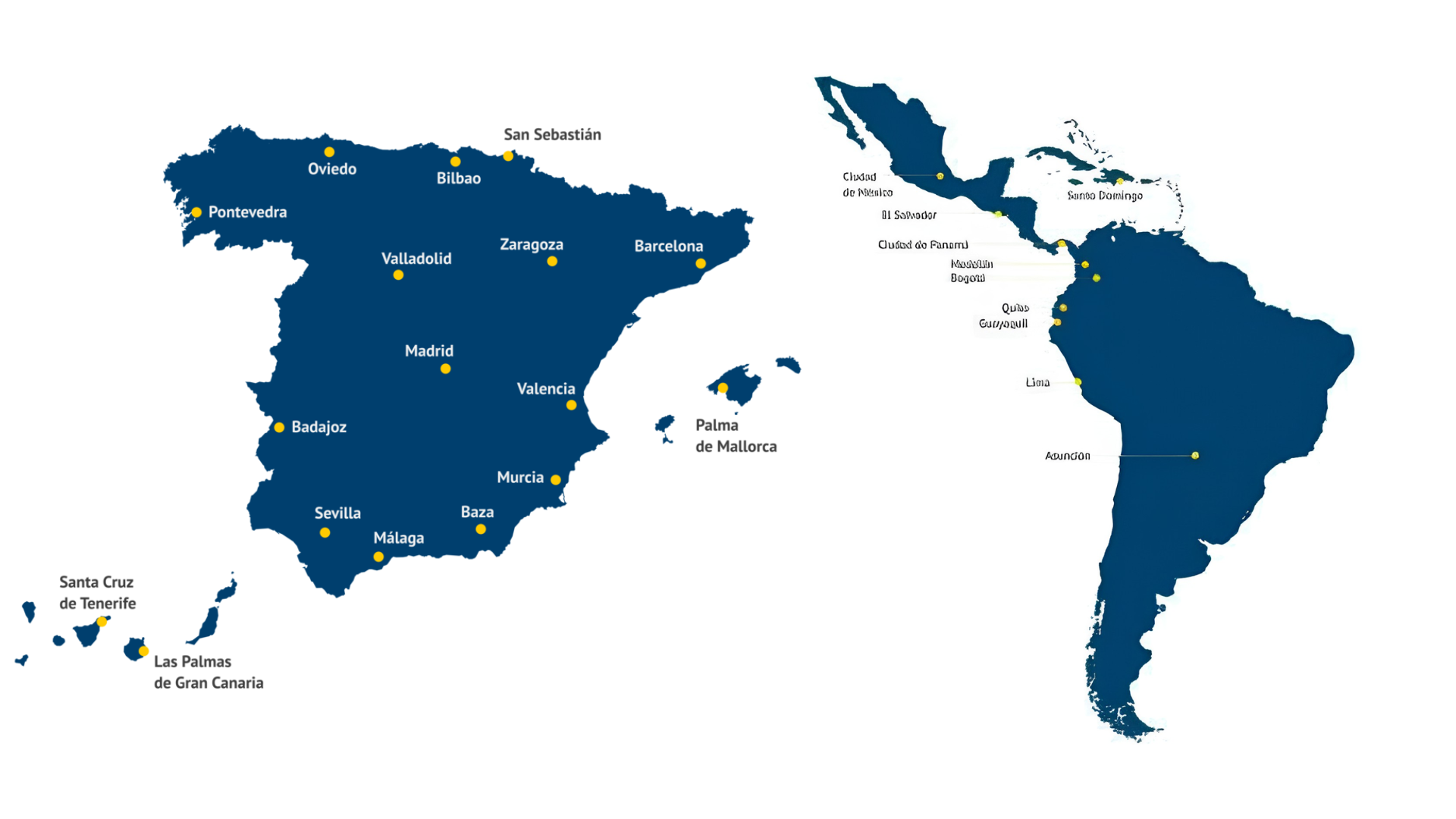
What’s more, as a student at UAX Online, you’ll have access to our Campus Hubs – a network of exclusive physical spaces where you can study, access libraries, work in co-working areas and connect with other students. Because studying online doesn’t mean studying alone.

Campus Hubs available in: Alcobendas, Alcorcón, Valencia San Vicente, Murcia, Barcelona, Málaga, Seville and Arganda.
Access is via your UAX student card, subject to availability and the opening hours of each centre.
The official certificate of pedagogical and didactic training online is a qualification with which you will be able to work as a teacher of Vocational Training qualifications in the following specialities:
Not sure? We'll help you find the right programme for you.
At UAX, we understand that education is an investment, which is why we offer opportunities for you to access our courses. Here are some of our scholarships and grants:
The acronym COFPYD refers to the Official Certificate of Pedagogical and Didactic Training for Vocational Training Teachers. The COFPYD is a qualification that is valid throughout Spain and which will qualify you to teach on Vocational Training qualifications.
The VET Teacher Course or Course of Didactic Specialisation (COFPYD) lasts 9 months and is an official qualification with 60 ECTS credits.
To take this course and obtain the Official Certificate of Pedagogical and Didactic Training, you must meet these requirements:
You must have one of the qualifications specified in this document.
In addition, people with a university degree or bachelor's degree will not be able to take the qualification.
No, el Certificado Oficial de Formación Pedagógica y Didáctica (COFPYD) no es un máster. Este certificado está diseñado para aquellos que desean ejercer como profesores de Formación Profesional pero no pueden acceder al Máster Universitario de Formación del Profesorado
El COFPYD es una alternativa que permite adquirir las competencias pedagógicas necesarias para la docencia en Formación Profesional.
Sin embargo, para enseñar en Educación Secundaria Obligatoria, Bachillerato, Formación Profesional y Enseñanza de Idiomas, se requiere el Máster Universitario de Formación del Profesorado.
Other related degree programmes
Master’s Degree in Teacher Training for Compulsory Secondary Education and Sixth Form
In collaboration with:
Start:
October
Length:
1 year
Online Degree in Pedagogy
Start:
October
Length:
4 courses
Online Degree in Early Childhood Education
Start:
October
Length:
4 years
Online Degree in Primary Education
Start:
October
Length:
4 years
We need to know a little bit about you so that we can provide you with a personalised service.
All fields are required
Enquiries, complaints and claims
We respond to the genuine needs of our students and staff, because we believe in the continuous improvement of our results. That is why we always want to hear whatever you have to say.
If you are already part of UAX, please visit the ‘Customer Service: complaints, suggestions and compliments’ section on thevirtual campus , logging in with your username and password.