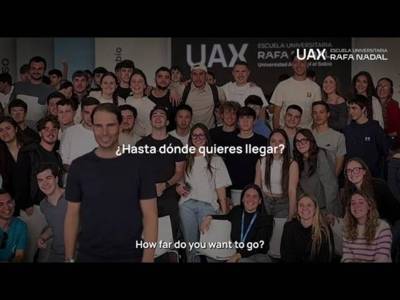
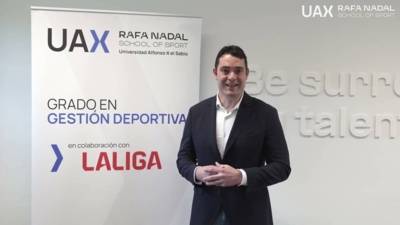
Study Sports Management at the UAX Rafa Nadal University School, through a programme developed in collaboration with LALIGA, which offers comprehensive training in business administration and management within the sports industry, as well as optional work placements at leading institutions and clubs. All of this is delivered online using a flexible approach that fits in with your personal and professional life.
Study at Spain’s No. 1 university for employability (U-Ranking 2023, BBVA Foundation).
Become one of the future leaders in the sports industry with the distance-learning Bachelor’s degree in Sports Management
Tackle the challenges posed by the sports management job market from a global perspective, covering the public, private, tourism, federation and competitive sectors, as well as the social and recreational sectors, with the Bachelor’s Degree in Sports Management from the UAX Rafa Nadal University School and LALIGA. Boost your professional career in the sector by studying flexibly and undertaking optional work placements at top-tier sports organisations.
What will you learn?
The online Bachelor’s Degree in Sports Management combines knowledge of business administration, sports science and law, taking a multi-sport approach (tennis, football, basketball, Formula 1, golf, eSports, etc.), thereby providing a comprehensive overview of the industry.
It will provide you with in-depth training in areas such as the administration of sports facilities, the financial management of sports organisations, effective decision-making in the sports environment, the organisation of sporting events, sports marketing, team management and strategic planning in this field.
It will foster the development of practical and critical skills in leadership, decision-making, communication and problem-solving – essential skills for interacting with athletes, staff, sponsors and the wider community.
You will use digital tools and new technologies applied to sports management, thereby adapting to the demands of the sports industry.
The programme incorporates democratic principles and values, as well as the promotion of the Sustainable Development Goals, fostering ethical and responsible sports management.
A unique ecosystem to transform the sports industry
Collaboration with LALIGA
University School UAX Rafa Nadal | LALIGA
LALIGA has supervised the content of the programme, contributes teachers from the Institution itself and its Associated Clubs to master classes, seminars and lectures, and participates in the UAX #maker model. In addition, the best academic records will be able to carry out internships at LALIGA and associated sports entities and properties.
International Recognition
AACSB – Business Education Alliance
As a member of AACSB, the world’s leading business education network, UAX offers programmes that meet the highest international standards. This is an advantage that boosts your employability, international mobility and the value of your professional profile.
Training in values
with Rafa Nadal and his team
Exclusive online training programme based on the values that have made Rafa Nadal successful: effort, cooperation, empathy, leadership, professional ethics, resilience, work discipline, among others.
Internships in reference institutions
Top-level sports organisations
Rafa Nadal Academy (Mallorca), LALIGA, Altafit, Club Atlético de Madrid, Club Estudiantes de Baloncesto, 2Playbook, Comité Olímpico Español, GoFit, Decathlon, Joma Sports, KPMG Asesores, Quirónsalud, Your First, etc.
A degree that fits in with your work and personal life, designed to take your career to the next level
You’ll study wherever and whenever you like, with flexible timetables and 24/7 access to the Virtual Campus. You’ll be able to watch your online classes live or on demand, and contact your lecturers via various channels at any time of day.
Furthermore, you can request, with no obligation, a free assessment of your credits and their recognition, relating to previous qualifications – including both undergraduate degrees and higher-level vocational training qualifications – in a straightforward manner and without having to pay for the recognised credits.
Information on the online Bachelor’s Degree in Sports Management
Find out all the details below about the online Bachelor’s degree in Sports Management offered by the UAX Rafa Nadal University School, in partnership with LALIGA.
Modules on the online Bachelor’s degree in Sports Management
PhD in Physical Education and Sport; Accredited Contracted Doctor and Lecturer at a private university by ANECA; two six-year periods recognised by CENAI.
Lecturer for 10 years at the Pontifical Catholic University of Valparaíso (Chile), and a 2-year postdoctoral contract at the University of Castilla-La Mancha. Professional experience at the Chilean Ministry of Sport and as Head of the University Sports Service.
Over 80 publications in journals indexed in mainstream databases; experience working on European project teams.
Objectives
The module ‘Structure and Organisation of the Sports System’ is designed to provide students with a comprehensive understanding of how sports systems are structured and operate at local, national and international levels. This course examines the various bodies that make up the sports system, including government organisations, sports federations, clubs, associations and private organisations, analysing their interrelationships and the role they play in the development and promotion of sport.
Students will learn about the sporting framework and context, policies for promoting and supporting sport, and the structures of competitions and events. Emphasis is placed on the strategic and operational management of sports organisations. The aim is for students to develop a critical and strategic perspective to manage and lead effectively within the sport sector, recognising the challenges and opportunities for improving participation, performance and integrity in sport.
Upon completion of the course, students will be prepared to apply this knowledge to sports management, contributing to the advancement and professionalisation of sport in various contexts.
Prerequisites
There are no prerequisites.
Competencies
This qualification complies with Royal Decree 822/2021 of 28 September, which sets out the organisation of university education and the procedure for ensuring its quality.
Learning outcomes
RK2 – Understand the principles and theories of sports management within public and/or private sector service organisations, clubs and federations.
RK8 – To describe developments, new trends and technological advances in sport, as well as their social and economic impact.
RK10 – Understand the organisation, regulation and structure of sport at local, national and international levels, and the contextualisation of the various sporting subsystems.
RC4 – Analyse the factors within the social and economic environment that influence the development of sports services or events.
Description of the course content
1. Context and scope of sport.
2. Basic principles of the structure and organisation of sport at national and international level.
3. Distribution of responsibilities within sport and its management.
4. Governing bodies and relationships between the different levels.
5. The Spanish sports system: public, federated, university and recreational.
6. The present and future of the sports model in Spain.
Training activities
V1. Lectures.
V2. Interactive classes.
V4a. Self-guided exercises.
V4b. Course forum.
V5. Independent study, case studies, problem-solving and literature review.
V6. Synchronous tutoring.
AV7. Knowledge tests.
Assessment system and criteria
REGULAR EXAM SESSION
SE2. Portfolio documenting online activities: 40%
SE3. Final knowledge assessment: 60%.
EXTRA SESSION
100% of the mark will be based on the official examination, the date of which will be published by the University.
Presentation and interactive lecture: Teaching Unit 1. Contextualisation and scope of sport.
2
ASSIGNMENT
Participatory lecture: Teaching Unit 1. Context and scope of sport.
3
SESSION
Participatory lecture: Teaching Unit 1. Context and scope of sport.
4
ASSIGNMENT
Participatory lecture: Teaching Unit 1. Context and scope of sport.
5
SESSION
Participatory lecture: Teaching Unit 2. Basic principles of the structure and organisation of sport at national and international level.
6
ASSIGNMENT
Participatory lecture: Teaching Unit 2. Basic principles of the structure and organisation of sport at national and international level. / Asynchronous learning activity 1
0.1
7
SESSION
Participatory lecture: Teaching Unit 2. Basic principles of the structure and organisation of sport at national and international level.
8
ASSIGNMENT
Participatory lecture: Teaching Unit 2. Basic principles of the structure and organisation of sport at national and international level.
9
SESSION
Participatory lecture: Teaching Unit 3. Distribution of responsibilities in sport and its management.
10
ASSIGNMENT
Participatory lecture: Teaching Unit 3. The distribution of responsibilities in sport and its management.
11
SESSION
Participatory lecture: Teaching Unit 3. The distribution of responsibilities in sport and its management.
12
ASSIGNMENT
Participatory lecture: Teaching Unit 3. Distribution of responsibilities in sport and its management.
13
SESSION
Participatory lecture: Teaching Unit 4. Refereeing bodies and relations between the different levels.
14
ASSIGNMENT
Participatory lecture: Teaching Unit 4. Arbitration bodies and relationships between the different levels. / Asynchronous learning activity 2
0.15
15
SESSION
Participatory lecture: Teaching Unit 4. Arbitration bodies and relations between the different levels.
16
ASSIGNMENT
Participatory lecture: Teaching Unit 4. Arbitration bodies and relations between the different levels.
17
SESSION
Participatory lecture: Teaching Unit 5. The Spanish sports system: public, federated, university and recreational.
18
ASSIGNMENT
Participatory lecture: Teaching Unit 5. The Spanish sports system: public, federated, university and recreational.
19
SESSION
Participatory lecture: Teaching Unit 5. The Spanish sports system: public, federated, university and recreational.
20
ASSIGNMENT
Participatory lecture: Teaching Unit 6. The present and future of the sports model in Spain.
21
SESSION
Participatory lecture: Teaching Unit 6. The present and future of the sports model in Spain.
22
ASSIGNMENT
Participatory lecture: Teaching Unit 6. The present and future of the sports model in Spain. / Asynchronous learning activity 3
0.15
23
ASSIGNMENT
Regular Examination
0.6
Bibliography
Core:
1. Blanco, E., Burriel, J., Camps, A., Carretero, J., Landaberea, J. and Montes, V.
Holds a Bachelor’s degree in Information Sciences, specialising in Journalism, from the Complutense University of Madrid. Journalist, contributor and director at national and regional media outlets, such as the daily newspaper ABC and the weekly magazine ‘Al Cabo de la Calle’, based in Alcorcón. Head of press offices for the local councils of Arroyomolinos and Campo Real. Trainer in distribution channel tools at Hewlett Packard. Lecturer in Spanish for foreign students, communication skills, and information and documentation at Alfonso X El Sabio University since 2009.
Objectives
The ‘Communication Skills’ module focuses on strengthening students’ oral and written communication skills, which are essential for their academic and professional success. Through a practical approach, the module focuses on articulating ideas clearly and effectively, constructing sound arguments, and practising active listening.
This module covers a range of topics, from interpersonal communication to public speaking, including academic and professional writing. Particular emphasis is placed on building confidence and the ability to adapt one’s message to different contexts and audiences. The objectives include improving students’ ability to work in teams, resolve conflicts through constructive dialogue, and present their ideas persuasively. Furthermore, the course aims to help students develop a critical understanding of the media and its influence on society, thereby enhancing their media literacy.
By the end of the course, students will have acquired versatile communication skills, applicable both in their personal lives and in the workplace, enabling them to lead with empathy and responsibility in an increasingly interconnected world.
Prerequisites
There are no prerequisites.
Competencies
This degree programme complies with Royal Decree 822/2021 of 28 September, which sets out the organisation of university education and the procedures for ensuring its quality.
Learning outcomes
RK7 – Understand the techniques of oral and written communication in a business context and their importance in team coordination and in relations with the wider environment.
RS3 - Apply the main tools for developing marketing and communication strategies.
RODS – Develop effective communication, teamwork, analytical thinking, creativity and ethical leadership from a cross-disciplinary perspective, clearly inspired by democratic principles and values, as well as the Sustainable Development Goals, in order to conduct oneself with integrity in the professional sphere.
Description of the content
1. Language: acquisition, development and proficiency in the communication process.
2. Introduction to and theories of both oral and written communication.
3. Learning processes and strategies for the development of communication skills.
4. Personal and professional skills in corporate communication.
5. Communication techniques in diverse contexts and business environments.
6. Corporate communication strategies and projects.
Training activities
P1. Lectures.
P2. Interactive classes.
P4. Assignment work and problem-solving.
P5. Independent study, case studies or problem-solving, and literature reviews.
P6. Tutoring.
P7. Knowledge assessments.
Assessment system and criteria
REGULAR EXAM SESSION
S1. Learning activities. Portfolio: 40 per cent.
S2. Final knowledge assessments. Final exam (as part of the University’s official examination session): 60%.
EXTRAORDINARY EXAMINATION SESSION
100 per cent of the mark will be based on the official exam, the date of which will be published by the University.
Alejandro Martínez holds a PhD in Cognitive Neuroscience and a degree in English Language and Literature, with teaching experience at university level and in English language teaching. His academic background combines the study of language, cognition and learning processes.
He has experience in teaching English, working with students of different levels and academic backgrounds, and in designing and adapting materials and activities aimed at developing communicative skills in English. His profile combines a solid linguistic background with a practical and pedagogical approach to language teaching and learning.
Objectives
The ‘Business English’ module is designed to equip students with advanced language skills specifically tailored to the global business context. This course focuses on developing fluency and accuracy in the use of English across a wide range of contexts related to sports management, such as negotiations, presentations, report writing and email communications.
Through the study of specialised vocabulary, idiomatic expressions and relevant grammatical structures, students learn to communicate effectively and professionally in an international setting. The aim is for students to gain the confidence needed to interact in English, thereby enhancing their career prospects and enabling organisations to operate successfully in international markets.
The course also emphasises cultural understanding, preparing students to navigate the complexities of intercultural communication in business. Upon completion, students will be better equipped to tackle communication challenges in multilingual and multicultural business environments, which are essential for success in an increasingly globalised sector.
Prerequisites
There are no prerequisites.
Learning Outcomes
Qualification in accordance with Royal Decree 822/2021 of 28 September, which establishes the organisation of university education and the procedure for ensuring its quality.
Learning outcomes
RK11 – Understand the technical language in English and the specific characteristics of oral and written expression within business organisations.
RODS - Develops effective communication, teamwork, analytical thinking, creativity and ethical leadership from a cross-cutting perspective and with clear inspiration drawn from democratic principles and values, as well as the Sustainable Development Goals, to operate with integrity in the professional environment / Develops effective communication, teamwork, analytical thinking, creativity and ethical leadership from a cross-cutting perspective and with clear inspiration drawn from democratic principles and values, as well as the Sustainable Development Goals, to perform with integrity in the professional environment.
Course content
1. Grammar, morphosyntax and phonetics of the foreign language.
2. Basic knowledge of the culture of the foreign language.
3. Oral and written expression in the foreign language.
4. General, academic and professional vocabulary relating to the degree programme’s field of study / General, academic and professional vocabulary relating to the degree programme’s field of study.
5. Reading texts in a foreign language.
Teaching activities
P1. Lectures.
P2. Interactive classes.
P4. Completing assignments and solving challenges or problems.
P5. Independent study, case studies or problem-solving, and literature reviews.
P6. Tutoring.
P7. Knowledge assessments.
Assessment system and criteria
REGULAR EXAM SESSION
SE2. Portfolio documenting online activities: 40%
SE3. Final knowledge assessment: 60%.
EXTRAORDINARY EXAMINATION SESSION
100 per cent of the mark will be based on the exam, the date of which will be published by the University.
Presentation and participatory lecture: Teaching Unit 1. Grammar, morphosyntax and phonetics of the foreign language.
2
ASSIGNMENT
Participatory lecture: Teaching Unit 1. Grammar, morphosyntax and phonetics of the foreign language.
3
SESSION
Participatory lecture: Teaching Unit 1. Grammar, morphosyntax and phonetics of the foreign language.
4
ASSIGNMENT
Participatory lecture: Teaching Unit 1. Grammar, morphosyntax and phonetics of the foreign language.
5
SESSION
Participatory lecture: Teaching Unit 1. Grammar, morphosyntax and phonetics of the foreign language.
6
ASSIGNMENT
Participatory lecture: Teaching Unit 2. Basic knowledge of the culture of the foreign language / Basic knowledge of the culture of the foreign language. / Asynchronous learning activity 1
0.1
7
SESSION
Participatory lecture: Teaching Unit 2. Basic knowledge of the culture of the foreign language.
8
ASSIGNMENT
Participatory lecture: Teaching Unit 2. Basic knowledge of the culture of the foreign language.
9
SESSION
Participatory lecture: Teaching Unit 2. Basic knowledge of the culture of the foreign language.
10
ASSIGNMENT
Participatory lecture: Teaching Unit 3. Oral and written expression in the foreign language.
11
SESSION
Participatory lecture: Teaching Unit 3. Oral and written expression in the foreign language.
12
ASSIGNMENT
Participatory lecture: Teaching Unit 3. Oral and written expression in the foreign language.
13
SESSION
Participatory lecture: Teaching Unit 3. Oral and written expression in the foreign language.
14
ASSIGNMENT
Participatory lecture: Teaching Unit 4. General, academic and professional vocabulary within the degree programme’s field of study / Learning Activity 2 – Part
0.15
15
SESSION
Participatory lecture: Teaching Unit 4. General, academic and professional vocabulary of the degree programme’s field of knowledge / General, academic and professional vocabulary of the degree programme’s field of knowledge.
16
ASSIGNMENT
Participatory lecture: Teaching Unit 4. General, academic and professional vocabulary within the degree programme’s field of knowledge.
17
SESSION
Participatory lecture: Teaching Unit 4. General, academic and professional vocabulary of the degree programme’s field of knowledge.
18
ASSIGNMENT
Participatory lecture: Teaching Unit 5. Reading texts in a foreign language.
19
SESSION
Participatory lecture: Teaching Unit 5. Reading texts in a foreign language.
20
ASSIGNMENT
Participatory lecture: Teaching Unit 5. Reading texts in a foreign language.
21
SESSION
Participatory lecture: Teaching Unit 5. Reading texts in a foreign language.
22
ASSIGNMENT
Participatory lecture: Teaching Unit 5. Reading texts in a foreign language. / Asynchronous learning activity 3
0.15
23
ASSIGNMENT
Ordinary Examination
0.6
Bibliography
Core:
1. Dignen, B., Dubicka, I., & Hogan, M.
Business Partner C1 Coursebook & eBook with MyEnglishLab & Digital Resources
PhD in Sports Organisation Management, accredited as a Doctoral-level Lecturer by ANECA and AVAP, and as a Private University Lecturer by ANECA. He has six years of research recognised by the CNEAI and a university teaching career spanning more than twelve academic years and over 2,000 hours across undergraduate and official master’s programmes, in areas related to sports science, sports management, event organisation, business, education and research methodology.
His professional experience combines public administration, business and the federation sector. For eight years, he served as Director of Sporting Events for Orihuela through the concessionary company, taking charge of strategic planning, project development, negotiations with sponsors and suppliers, the evaluation of performance indicators and process improvement. He has been involved in events such as La Vuelta, the Vuelta Ciclista a la Comunitat Valenciana, the Spanish Adapted Sports Cup and various Spanish Championships. He has also worked for the Royal Spanish Handball Federation and currently works as a freelance consultant and director of the registered trademark Revolution 1920.
His research and knowledge transfer activities focus on sports management, sporting performance and event organisation. He has taken part in competitive national and European projects, undertaken various placements at national and international universities, and been involved in applied projects relating to the planning, evaluation and innovation of sporting events, with an impact on public administrations, federations and professional bodies. Of particular note is his authorship of scientific articles and manuals on community-based sporting events, aimed at transferring academic knowledge to the professional sphere.
Objectives
The module ‘Business Organisation and Management’ focuses on equipping students with the theoretical and practical foundations necessary for the efficient management of organisations. Throughout the course, we explore organisational structure, strategic planning, decision-making, leadership, management control, and the various departments and functions within an organisation.
The aim is to prepare students to tackle the challenges of the modern business environment, fostering a deep understanding of how businesses operate and how they can be steered towards success. Emphasis is placed on applying management theories in real-world contexts, preparing students to analyse business situations, develop innovative strategies and lead teams effectively.
Upon completion, students will be equipped to contribute to the development and growth of organisations, applying management practices that promote sustainability and corporate social responsibility.
Prerequisites
There are no prerequisites.
Learning Outcomes
Qualification in accordance with Royal Decree 822/2021 of 28 September, which establishes the organisation of university education and the procedure for ensuring its quality.
Learning outcomes
RK1 – Identify the basic principles of the sports industry and their applications within sports management.
RC4 – Analyse the factors within the social and economic environment that influence the development of sports services or events.
RODS – Develop effective communication, teamwork, analytical thinking, creativity and ethical leadership from a cross-disciplinary perspective, clearly inspired by democratic principles and values, as well as the Sustainable Development Goals, in order to conduct oneself with integrity in the professional sphere.
Course content description
1. Fundamental aspects of business organisation and coordination mechanisms.
2. Corporate administration, management and strategy.
3. Key aspects of financial, commercial and human resources management.
4. Business ethics and corporate social responsibility.
5. Analysis and functioning of sports organisations.
6. Departments and functions within a sports organisation.
Training activities
V1. Lectures.
V2. Interactive classes.
V4a. Self-guided exercises.
V4b. Course forum.
V5. Independent study, case studies, problem-solving and literature review.
V6. Synchronous tutoring.
AV7. Knowledge tests.
Assessment system and criteria
REGULAR EXAM SESSION
SE2. Portfolio documenting online activities: 40%
SE3. Final knowledge assessment: 60%.
EXTRA SESSION
100% of the mark will be based on the official examination, the date of which will be published by the University.
Course 1: First-semester module. Foundation course. 6 credits.
Profesores
Juan José
Palos
Pérez
- Coordinador
Objectives
The course ‘Theory, History and Evolution of Sport’ aims to provide students with a comprehensive overview of the transformation of sport throughout history and its impact on society. This module explores the origins and development of sporting activities, examining how they have become embedded in various cultures and how they have evolved into today’s organised structures.
Through the analysis of key theories and the exploration of historical contexts, students gain a critical understanding of the economic, social and political factors that have shaped sport. Furthermore, the course emphasises the importance of understanding sport as a cultural phenomenon that reflects and influences social values and norms.
The aim is that, by the end of the course, future sports managers will have the necessary tools to apply this knowledge to the planning, development and effective management of sports organisations, thereby contributing to the advancement of the sports sector in an ethical and sustainable manner.
Prerequisites
There are no prerequisites.
Competencies
Qualification in accordance with Royal Decree 822/2021 of 28 September, which establishes the organisation of university education and the procedure for ensuring its quality.
Learning outcomes
RK2 – Understand the principles and theories of sports management within public and/or private sector service organisations, clubs and federations.
RK8 – Describe developments, new trends and technological advances in sport, as well as their social and economic impact.
RODS – Develop effective communication, teamwork, analytical thinking, creativity and ethical leadership from a cross-disciplinary perspective, clearly inspired by democratic principles and values, as well as the Sustainable Development Goals, in order to conduct oneself with integrity in the professional sphere.
Course content
1. History of sport, epistemology and theories on the origins of physical activity.
2. Physical activity in different cultures: Classical, Greek, Roman, the Middle Ages, the Renaissance and pre-Columbian.
3. Sport in the 19th and 20th centuries: from the origins of modern sport to professionalisation and technological advances.
4. The Olympic Movement and the modern Olympic Games: values, diversification and global impact.
5. Physical Education and its evolution in the training of professionals.
6. Trends, changes in sporting practice and current challenges facing sport.
Training activities
P1. Lectures.
P2. Interactive classes.
P4. Completing assignments and solving challenges or problems.
P5. Independent study, case studies or problem-solving, and literature reviews.
P6. Tutoring.
P7. Knowledge assessments.
Assessment system and criteria
REGULAR EXAM SESSION
SE2. Portfolio documenting online activities: 40 per cent.
SE3. Final knowledge assessment: 60 per cent.
EXTRA SESSION
100 per cent of the mark will be based on the exam, the date of which will be published by the University.
Presentation and interactive lecture: Teaching Unit 1. History of sport, epistemology and theories on the origins of physical activity.
2
ASSIGNMENT
Participatory lecture: Teaching Unit 1. History of sport, epistemology and theories on the origins of physical activity.
3
SESSION
Participatory lecture: Teaching Unit 1. History of sport, epistemology and theories on the origins of physical activity.
4
ASSIGNMENT
Participatory lecture: Teaching Unit 1. History of sport, epistemology and theories on the origins of physical activity.
5
SESSION
Participatory lecture: Teaching Unit 2. Physical activity in different cultures: Classical, Greek, Roman, Medieval, Renaissance and Pre-Columbian.
6
ASSIGNMENT
Participatory lecture: Teaching Unit 2. Physical activity in different cultures: Classical, Greek, Roman, the Middle Ages, the Renaissance and pre-Columbian./ Asynchronous learning activity 1
0.1
7
SESSION
Participatory lecture: Teaching Unit 2. Physical activity in different cultures: Classical, Greek, Roman, the Middle Ages, the Renaissance and pre-Columbian.
8
ASSIGNMENT
Participatory lecture: Teaching Unit 2. Physical activity in different cultures: Classical, Greek, Roman, the Middle Ages, the Renaissance and pre-Columbian.
9
SESSION
Participatory lecture: Teaching Unit 3. Sport in the 19th and 20th centuries: from the origins of modern sport to professionalisation and technological advances.
10
ASSIGNMENT
Participatory lecture: Teaching Unit 3. Sport in the 19th and 20th centuries: from the origins of modern sport to professionalisation and technological advances.
11
SESSION
Participatory lecture: Teaching Unit 3. Sport in the 19th and 20th centuries: from the origins of modern sport to professionalisation and technological advances.
12
ASSIGNMENT
Participatory lecture: Teaching Unit 3. Sport in the 19th and 20th centuries: from the origins of modern sport to professionalisation and technological advances.
13
SESSION
Participatory lecture: Teaching Unit 4. The Olympic Movement and the modern Olympic Games: values, diversification and global impact.
14
ASSIGNMENT
Participatory lecture: Teaching Unit 4. The Olympic Movement and the Modern Olympic Games: values, diversification and global impact. / Asynchronous learning activity 2
0.15
15
SESSION
Participatory lecture: Teaching Unit 4. The Olympic Movement and the Modern Olympic Games: values, diversification and global impact.
16
ASSIGNMENT
Participatory lecture: Teaching Unit 4. The Olympic Movement and the Modern Olympic Games: values, diversification and global impact.
17
SESSION
Participatory lecture: Teaching Unit 5. Physical Education and its evolution in the training of professionals.
18
ASSIGNMENT
Participatory lecture: Teaching Unit 5. Physical Education and its evolution in professional training.
19
SESSION
Participatory lecture: Teaching Unit 5. Physical Education and its evolution in professional training.
20
ASSIGNMENT
Participatory lecture: Teaching Unit 6. Trends, changes in sporting practice and current challenges in sport.
21
SESSION
Participatory lecture: Teaching Unit 6. Trends, changes in sporting practice and current challenges in sport.
22
ASSIGNMENT
Participatory lecture: Teaching Unit 6. Trends, changes in sporting practice and current challenges in sport. / Asynchronous learning activity 3
PhD in Sports Organisation Management, accredited as a Doctoral Lecturer by ANECA and AVAP, and as a Private University Lecturer by ANECA. He has six years of research recognised by the CNEAI and a university teaching career spanning more than twelve academic years and over 2,000 hours across undergraduate and official master’s programmes, in areas related to sports science, sports management, event organisation, business, education and research methodology.
His professional experience combines public administration, business and the federation sector. For eight years, he served as Director of Sporting Events for Orihuela through the concessionary company, taking charge of strategic planning, project development, negotiations with sponsors and suppliers, the evaluation of performance indicators and process improvement. He has been involved in events such as La Vuelta, the Vuelta Ciclista a la Comunitat Valenciana, the Spanish Adapted Sports Cup and various Spanish Championships. He has also worked for the Royal Spanish Handball Federation and currently works as a freelance consultant and director of the registered trademark Revolution 1920.
His research and knowledge transfer activities focus on sports management, sporting performance and event organisation. He has taken part in competitive national and European projects, undertaken various placements at national and international universities, and worked on applied projects involving the planning, evaluation and innovation of sporting events, with an impact on public administrations, federations and professional bodies. Of particular note is his authorship of scientific articles and manuals on community-based sporting events, aimed at transferring academic knowledge to the professional sphere.
Objectives
The course ‘Economic Foundations of Organisations’ is designed to introduce students to the fundamental principles of economics as applied to the sports sector. The aim is to provide a thorough understanding of how economic concepts impact management and decision-making within sports organisations.
Through the study of economic models, the analysis of market structures and the exploration of financial strategies, students will develop essential skills for tackling economic challenges in the sporting sector. Emphasis is placed on the ability to analyse problems, plan financially and make decisions based on rigorous economic analysis.
This module is essential for those seeking to lead sports organisations, providing the tools necessary for effective management and the resolution of economic problems in a competitive environment.
Prerequisites
There are no prerequisites.
Learning Outcomes
Degree programme adapted to Royal Decree 822/2021 of 28 September, which establishes the organisation of university education and the procedure for ensuring its quality.
Learning outcomes
RK3 – To understand the fundamental elements of economics and economic and financial management as applied to the context of sports organisations.
RK9 – Understand the social and economic factors that influence the design of a business plan.
RK12 – Demonstrate knowledge of fundamental economic principles in the development of strategies and financial planning, and in the economic analysis of sports organisations.
RODS – Develop effective communication, teamwork, analytical thinking, creativity and ethical leadership from a cross-disciplinary perspective, clearly inspired by democratic principles and values, as well as the Sustainable Development Goals, in order to conduct oneself with integrity in the professional sphere.
Course content description
1. The global economic environment and fundamental economic principles in decision-making.
2. Fundamentals of business financial management for sustainability and long-term success.
3. The organisation: classifications, organisation and culture.
4. Economic and financial management of a sports organisation: from financial planning to the management and control of income and expenditure.
5. Instruments and tools for financial management in sport and organisations.
6. Regulatory and tax compliance through record-keeping, financial reporting and fulfilment of tax obligations.
Training activities
P1. Lectures.
P2. Interactive classes.
P4. Completing assignments and solving challenges or problems.
P5. Independent study, case studies or problem-solving, and literature reviews.
P6. Tutoring.
P7. Knowledge assessments.
Assessment system and criteria
REGULAR EXAM SESSION
SE2. Portfolio documenting online activities: 40 per cent.
SE3. Final knowledge assessment: 60 per cent.
SUPPLEMENTARY EXAMINATION SESSION
100 per cent of the mark will be based on the official examination, the date of which will be published by the University.
Presentation and interactive lecture: Teaching Unit 1. The global economic environment and fundamental economic principles in decision-making.
2
ASSIGNMENT
Participatory lecture: Teaching Unit 1. The global economic environment and fundamental economic principles in decision-making.
3
SESSION
Interactive lecture: Teaching Unit 1. The global economic environment and fundamental economic principles in decision-making.
4
ASSIGNMENT
Interactive lecture: Teaching Unit 1. The global economic environment and fundamental economic principles in decision-making.
5
SESSION
Interactive lecture: Teaching Unit 2. Fundamentals of business management for sustainability and long-term success.
6
ASSIGNMENT
Participatory lecture: Teaching Unit 2. Fundamentals of business financial management for sustainability and long-term success./ Asynchronous learning activity 1
0.1
7
SESSION
Participatory lecture: Teaching Unit 2. Fundamentals of business financial management for sustainability and long-term success.
8
ASSIGNMENT
Participatory lecture: Teaching Unit 2. Fundamentals of business financial management for sustainability and long-term success.
9
SESSION
Participatory lecture: Teaching Unit 3. The organisation: classifications, organisation and culture.
10
ASSIGNMENT
Participatory lecture: Teaching Unit 3. The organisation: classifications, organisation and culture.
11
SESSION
Participatory lecture: Teaching Unit 3. The organisation: classifications, organisation and culture.
12
ASSIGNMENT
Participatory lecture: Teaching Unit 3. The organisation: classifications, organisation and culture.
13
SESSION
Participatory lecture: Teaching Unit 4. Economic and financial management of a sports organisation: from financial planning to the management and control of income and expenditure.
14
ASSIGNMENT
Participatory lecture: Teaching Unit 4. Economic and financial management of a sports organisation: from financial planning to the management and control of income and expenditure. / Asynchronous learning activity 2
0.15
15
SESSION
Participatory lecture: Teaching Unit 4. Economic and financial management of a sports organisation: from financial planning to the management and control of income and expenditure.
16
ASSIGNMENT
Interactive lecture: Teaching Unit 4. Economic and financial management of a sports organisation: from financial planning to the management and control of income and expenditure.
17
SESSION
Participatory lecture: Teaching Unit 5. Instruments and tools for financial management in sport and organisations.
18
ASSIGNMENT
Participatory lecture: Teaching Unit 5. Instruments and tools for financial management in sport and organisations.
19
SESSION
Participatory lecture: Teaching Unit 5. Instruments and tools for financial management in sport and organisations.
20
ASSIGNMENT
Participatory lecture: Teaching Unit 6. Regulatory and tax compliance through the preparation of records, financial reports and the fulfilment of tax obligations.
21
SESSION
Participatory lecture: Teaching Unit 6. Regulatory and tax compliance through the preparation of records, financial reports and the fulfilment of tax obligations.
22
ASSIGNMENT
Participatory lecture: Teaching Unit 6. Regulatory and tax compliance through the preparation of records, financial reports and the fulfilment of tax obligations. / Asynchronous learning activity 3
0.15
23
ASSIGNMENT
Regular Examination
0.6
Bibliography
Core:
1. Chiavenato, I.
Introduction to General Management Theory (7th ed.)
Doctor of Law, solicitor, national and international mediator, specialising in preventive mediation applied to the sporting sector, governance and integrated conflict management systems. Founder of the law firm ‘M&S Conflict Managers’, specialising in legal consultancy, the design of dispute resolution structures, the implementation of SIRCOMED models, and a strategic, preventative and multidisciplinary approach. Chair and founding member of the Spanish Institute for Sports Mediation and Reconciliation, a driving force behind the culture of mediation, reconciliation and organisational innovation within the sporting sector.
International mediator for FIFA; mediator for the Spanish Olympic Committee, the Madrid Bar Association, the Spanish Arbitration Society, the Signum Foundation and the Royal Spanish Handball Federation. Member of the regulatory compliance body of the Football League. Proven track record in managing complex conflicts, negotiation, facilitating sustainable agreements, and providing institutional advice.
Director of the IEMEDEP expert sports mediation programme; project lead for ‘Espacio Media’ at the Águilas Moratalaz youth academy (Madrid) since 2014, a practical laboratory for applied mediation. Specialises in designing training programmes aimed at athletes, families, coaches and managers, with a focus on communication, prevention and conflict transformation.
Teaching at national and international universities: Alfonso X el Sabio University, Real Madrid University School–European University, Complutense University, University of Navarra, Rey Juan Carlos University, amongst others. Speaker at international conferences, author of scientific publications, projects on innovation in sports mediation, institutional recognition for promoting mediation, a culture of peace, and the development of a theoretical framework for Ibero-America.
Objectives
The main aim of the module ‘Law and Legislation in Sport’ is to provide students with a thorough understanding of the legal frameworks governing the sporting sector, at both national and international levels. It focuses on familiarising students with the regulatory frameworks applicable to the management and administration of sports organisations, ensuring a solid foundation in areas such as contracts, civil liability and image rights.
Furthermore, the course aims to help students develop critical analysis skills to understand how legislation impacts different stakeholders within the sports sector. This critical analysis is vital for assessing legal situations affecting athletes, coaches and other organisations, preparing students to tackle legal challenges and make informed decisions in their professional practice.
Finally, the module seeks to strengthen skills in effective communication and legal argumentation, which are key competencies for negotiation and mediation in sports disputes. The course also emphasises the importance of ethics and social responsibility in sports management, preparing students to act ethically within the context of sports law.
Prerequisites
There are no prerequisites.
Competencies
Degree programme adapted to Royal Decree 822/2021 of 28 September, which establishes the organisation of university education and the procedure for ensuring its quality.
Learning outcomes
RK2 – Understand the principles and theories of sports management within public and/or private sector service organisations, clubs and federations.
RK8 – To describe developments, new trends and technological advances in sport, as well as their social and economic impact.
RK10 – Understand the organisation, regulation and structure of sport at local, national and international levels, and the contextualisation of the various sporting subsystems.
RC4 – Analyse the factors within the social and economic environment that influence the development of sports services or events.
RODS – Develops effective communication, teamwork, analytical thinking, creativity and ethical leadership from a cross-disciplinary perspective, clearly inspired by democratic principles and values, as well as the Sustainable Development Goals, in order to operate with integrity in the professional sphere.
Course content description
1. History of international and Spanish sports law.
2. Regulatory framework in sport and key aspects of sports management.
3. Conflict resolution in sport: alternative methods and ordinary jurisdiction.
4. Constitution and structure of sports organisations to ensure compliance with specific legal requirements.
5. Training of sports professionals and the regulation of their practice.
6. Legal liability and obligations of professionals in sports management.
Training activities
P1. Lectures.
P2. Interactive classes.
P4. Completing assignments and solving challenges or problems.
P5. Independent study, case studies or problem-solving, and literature reviews.
P6. Tutoring.
P7. Knowledge assessments.
Assessment system and criteria
REGULAR EXAM SESSION
SE2. Portfolio documenting online activities: 40 per cent.
SE3. Final knowledge assessment: 60 per cent.
SUPPLEMENTARY EXAMINATION SESSION
100% of the mark will be based on the official examination, the date of which will be published by the University.
Presentation and interactive lecture: Teaching Unit 1. History of sports law internationally and in Spain.
2
ASSIGNMENT
Participatory lecture: Teaching Unit 1. History of sports law internationally and in Spain.
3
SESSION
Interactive lecture: Teaching Unit 1. History of sports law internationally and in Spain.
4
ASSIGNMENT
Interactive lecture: Teaching Unit 1. History of sports law internationally and in Spain.
5
SESSION
Interactive lecture: Teaching Unit 2. Regulatory framework in sport and key aspects of sports management.
6
ASSIGNMENT
Participatory lecture: Teaching Unit 2. Regulatory context in sport and key aspects of sport management./ Asynchronous learning activity 1
0.1
7
SESSION
Participatory lecture: Teaching Unit 2. Regulatory context in sport and key aspects of sports management.
8
ASSIGNMENT
Participatory lecture: Teaching Unit 2. Regulatory context in sport and key aspects of sports management.
9
SESSION
Participatory lecture: Teaching Unit 3. Conflict resolution in sport: alternative methods and ordinary jurisdiction.
10
ASSIGNMENT
Participatory lecture: Teaching Unit 3. Conflict resolution in sport: alternative methods and ordinary jurisdiction.
11
SESSION
Participatory lecture: Teaching Unit 3. Conflict resolution in sport: alternative methods and ordinary jurisdiction.
12
ASSIGNMENT
Participatory lecture: Teaching Unit 3. Conflict resolution in sport: alternative methods and ordinary jurisdiction.
13
SESSION
Participatory lecture: Teaching Unit 4. Constitution and structure of sports organisations to ensure compliance with specific legal requirements.
14
ASSIGNMENT
Participatory lecture: Teaching Unit 4. Constitution and list of sports organisations to ensure compliance with specific legal requirements. / Asynchronous Learning Activity 2
0.15
15
SESSION
Participatory lecture: Teaching Unit 4. Constitution and list of sports organisations to ensure compliance with specific legal requirements.
16
ASSIGNMENT
Participatory lecture: Teaching Unit 4. Constitution and structure of sports organisations to ensure compliance with specific legal requirements.
17
SESSION
Participatory lecture: Teaching Unit 5. Training of sports professionals and the regulation of their practice.
18
ASSIGNMENT
Participatory lecture: Teaching Unit 5. Training of sports professionals and the regulation of their practice.
19
SESSION
Participatory lecture: Teaching Unit 5. Training of sports professionals and the regulation of their practice.
20
ASSIGNMENT
Participatory lecture: Teaching Unit 6. Legal liability and obligations of professionals in sports management.
21
SESSION
Participatory lecture: Teaching Unit 6. Legal liability and obligations of professionals in sports management.
22
ASSIGNMENT
Participatory lecture: Teaching Unit 6. Legal liability and obligations of professionals in sports management. / Asynchronous learning activity 3
0.15
23
ASSIGNMENT
Ordinary Examination
0.6
Supplementary
Supplementary:
1. Alberto Palomar Olmeda
Sports Law: Legislation, Commentaries and Case Law
Tirant Lo Blanch. 2022.
ISBN: 9788411137003
2. Alberto Palomar Olmeda and Miguel García Caba
Football Law. The Sport’s Own Legal Regulatory Framework
Aranzadi La Ley. 2018.
ISBN: 978-84-9020-7
3. Pérez Triviño, José Luis. Edited by Latorre Martínez, Javier. Edited by García Solanas, Mónica. Edited by Pérez Rocamora, Miguel. Edited by
- International Certification in Values-Based Coaching.
- Expert in digitalisation, innovation and technology skills within the sports ecosystem, ADESP and Rey Juan Carlos University.
- Member of the Social and Educational Research Group on Physical Activity and Sport (GISEAFE).
- Legal adviser to the European Association of Traditional Games and Sports.
- Referee at the Catalan Sports Arbitration Tribunal.
- Sports mediator.
- Member of the Competition Committee of the Royal Spanish Athletics Federation.
- Sole Disciplinary and Competition Judge for the Catalan University Championships.
- Author of over 150 articles on sports management and law, and a speaker at numerous training forums.
He has served as:
- Chief Executive of Club Lleida Esportiu.
- Member of the Jurisdictional Committee of the Royal Spanish Football Federation.
- Corporate Director of the Tarragona 2017 Mediterranean Games Foundation.
- Owner of TotalFit Wellness Centre.
- Member of the Competition Committee and Sole Appeals Judge for the Royal Spanish Field Hockey Federation.
- Manager of the Baldiri Aleu Sports Complex (Sant Boi de Llobregat).
- Chief Executive of the Madrid Sports Foundation.
- Manager of the Almería 2005 Association (bid for the 15th Mediterranean Games in 2005).
- Manager of the Handball Players’ Association.
- Manager of Unicaja Almería Club.
- Professional handball player.
Objectives
The main objective of the module ‘Fundamentals of Marketing and Communication’ is to equip students with a robust and practical understanding of marketing techniques and communication strategies applied to the sports sector. The aim is for students to acquire knowledge on how to develop, implement and evaluate marketing campaigns that effectively promote sporting events, teams and brands. This includes studying the sports market, the consumer and the strategic use of various digital and traditional marketing channels.
Secondly, the module seeks to develop skills in the planning and execution of effective communication strategies that can support and amplify marketing initiatives. Students will learn to create coherent and engaging messages, manage the public image of sports organisations, and use social media platforms to interact with supporters and grow the fan base. The ability to communicate clearly and persuade diverse audiences is fundamental to this module.
Finally, the module fosters the development of critical and creative thinking, preparing students to tackle and solve marketing and communication problems in sport in an innovative and ethical manner. Emphasis is placed on the importance of social responsibility and ethics in marketing and communication campaigns, ensuring that future professionals promote practices that respect both individuals and the wider community.
Prerequisites
There are no prerequisites.
Learning Outcomes
Qualification in accordance with Royal Decree 822/2021 of 28 September, which establishes the organisation of university education and the procedure for ensuring its quality.
Learning outcomes
RK6 – Understand the characteristics of different sports business models, the specific regulations governing different sports organisations, and customer management tools.
RK7 – Understand oral and written communication techniques in a business context and their importance in team coordination and in relations with the wider environment.
RS3 – Apply the main tools for developing marketing and communication strategies.
RS8 – Apply a marketing and communication plan using the tools of the marketing mix and digital media.
Course content
1. Introduction to marketing and communication, their evolution and current trends.
2. Introduction to communication: theories and processes.
3. Media planning within integrated marketing communication.
4. Advertising and promotion strategies using traditional and digital media.
5. The marketing mix from the perspective of the 4Ps, 4Cs, 4Vs and the SIVA model.
6. The marketing plan process: design, development, monitoring and evaluation.
Training activities
P1. Lectures.
P2. Interactive classes.
P4. Completing assignments and solving challenges or problems.
P5. Independent study, case studies or problem-solving, and literature reviews.
P6. Tutoring.
P7. Knowledge assessments.
Assessment system and criteria
REGULAR EXAM SESSION
SE2. Portfolio documenting online activities: 40 per cent.
SE3. Final knowledge assessment: 60%.
SUPPLEMENTARY EXAMINATION SESSION
100 per cent of the mark will be based on the official examination, the date of which will be published by the University.
Course 1. Second-term module. Foundation course. 6 credits.
Profesores
María
Amarilla
Ávila
- Coordinador
Objectives
The module ‘The Sports Industry and its Social and Economic Impact’ is designed to provide students with a detailed understanding of how the sports industry influences and is influenced by social and economic factors. The aim is for students to analyse and understand the economic dynamics of sport, including revenue generation, employment and the economic development it fosters at local and global levels. The course will also address the implications of investment in sports infrastructure and large-scale events.
Furthermore, this module enables students to explore the role of sport as a tool for social development and its capacity to influence social inclusion, education and community cohesion. Case studies will be examined where sports policies have had a significant impact on communities, promoting integration and social wellbeing. Students will learn to identify and design sports initiatives that maximise these social benefits.
Finally, emphasis will be placed on developing analytical and evaluation skills so that students are able to carry out critical analyses of the economic and social impact of sport. They will study how to measure and communicate the social and economic benefits of sport, preparing them to lead and manage sports projects that contribute to economic and social development in a sustainable and ethical manner.
Prerequisites
There are no prerequisites.
Competencies
Degree programme adapted to Royal Decree 822/2021 of 28 September, which establishes the organisation of university education and the procedure for ensuring its quality.
Learning outcomes
RK1 – Identify the basic principles of the sport industry and their applications within sport management.
RK8 – Describe developments, new trends and technological advances in sport, as well as their social and economic impact.
RC4 – Analyse the factors within the social and economic environment that influence the development of sports services or events.
Course description
1. The sports industry: introduction, historical development and current trends.
2. Characteristics of the sports industry; its social and economic importance.
3. Analysis of the sports sector and the sports industry in the current context.
4. Analysis of developments in the management of sports organisations.
5. Current trends and innovation strategies in the sports industry.
6. New markets and opportunities in the sports industry.
Training activities
RK1 – Identify the basic principles of the sports industry and their applications within sports management.
RK8 – Describe the evolution, new trends and technological advances in sport, as well as their social and economic impact.
RC4 – Analyse the factors within the social and economic environment that influence the development of sports services or events.
Assessment system and criteria
REGULAR EXAM SESSION
SE2. Portfolio documenting online activities: 40 per cent.
SE3. – Final knowledge assessment: 60%.
EXTRAORDINARY EXAMINATION PERIOD
100 per cent of the mark will be based on the official examination, the date of which will be published by the University.
Presentation and interactive lecture: Teaching Unit 1. The sports industry: introduction, historical development and current trends.
2
ASSIGNMENT
Participatory lecture: Teaching Unit 1. The sports industry: introduction, historical development and current trends.
3
SESSION
Interactive lecture: Teaching Unit 1. The sports industry: introduction, historical development and current trends.
4
ASSIGNMENT
Participatory lecture: Teaching Unit 1. The sports industry: introduction, historical development and current trends.
5
SESSION
Participatory lecture: Teaching Unit 2. Characteristics of the sports industry; social and economic importance.
6
ASSIGNMENT
Participatory lecture: Teaching Unit 2. Characteristics of the sports industry, social and economic importance. / Asynchronous learning activity 1
0.1
7
SESSION
Participatory lecture: Teaching Unit 2. Characteristics of the sports industry, social and economic importance.
8
ASSIGNMENT
Participatory lecture: Teaching Unit 2. Characteristics of the sports industry, social and economic importance.
9
SESSION
Participatory lecture: Teaching Unit 3. Analysis of the sports sector and the sports industry in the current context.
10
ASSIGNMENT
Participatory lecture: Teaching Unit 3. Analysis of the sports sector and the sports industry in the current context.
11
SESSION
Participatory lecture: Teaching Unit 3. Analysis of the sports sector and the sports industry in the current context.
12
ASSIGNMENT
Participatory lecture: Teaching Unit 3. Analysis of the sports sector and the sports industry in the current context.
13
SESSION
Participatory lecture: Teaching Unit 4. Analysis of developments in the management of sports organisations.
14
ASSIGNMENT
Participatory lecture: Teaching Unit 4. Analysis of developments in the management of sports organisations./ Asynchronous learning activity 2
0.15
15
SESSION
Participatory lecture: Teaching Unit 4. Analysis of the evolution of sports organisation management.
16
ASSIGNMENT
Participatory lecture: Teaching Unit 4. Analysis of the evolution of sports organisation management.
17
SESSION
Participatory lecture: Teaching Unit 5. Current trends and innovation strategies in the sports industry.
18
ASSIGNMENT
Interactive lecture: Teaching Unit 5. Current trends and innovation strategies in the sports industry.
19
SESSION
Participatory lecture: Teaching Unit 5. Current trends and innovation strategies in the sports industry.
20
ASSIGNMENT
Interactive lecture: Teaching Unit 6. New markets and opportunities in the sports industry.
21
SESSION
Participatory lecture: Teaching Unit 6. New markets and opportunities in the sports industry.
22
ASSIGNMENT
Participatory lecture: Teaching Unit 6. New markets and opportunities in the sports industry. / Asynchronous learning activity 3
0.15
23
ASSIGNMENT
Regular Examination
0.6
Bibliography
Core:
1. Cepeda Carrión, A. & Martelo Landroguez, S.
Administration and Management of Sports Organisations
Ediciones Pirámide. 2018.
ISBN: 9788436839135
2. Sobrino, J.
Sport: An Economic Sector. Structuring One of the Sectors with the Greatest Potential. Javier Sobrino. Pontifical University of Comillas (Publications) –
Comillas Pontifical University (Publications). 2013.
Maira Ulloa Hernández holds a PhD in Physical Activity and Sport from the University of Lleida, a Master’s degree in Sport Management and a Bachelor’s degree in Physical Activity and Sport Sciences. Her research focuses on sustainability and sporting events in natural environments. She is currently a lecturer and researcher, participating in international projects on sustainable sport management.
Objectives
The module ‘Business Models and Services in Sport’ aims to provide students with a thorough understanding of the various business models operating within the sports industry. The main objective is for students to understand the organisational structures, funding strategies and operations that underpin sports organisations, from local clubs to global franchises. The course will explore how these models can be adapted and optimised to meet the challenges of the current and future market.
This programme also aims to equip students with the skills to develop and manage effective sports services that meet the needs of consumers and stakeholders. Best practices in the creation and marketing of sports services will be examined, including event management, sports facilities and training programmes. Furthermore, the programme will discuss how innovation and technology are transforming the range of services on offer in sport.
Finally, students’ capacity for strategic analysis and data-driven decision-making will be fostered. They will learn to evaluate the performance of different business models and services in sport, using analytical tools to identify opportunities for improvement and growth. A critical and ethical approach to the development and management of sports businesses and services will be promoted, preparing students to lead responsibly within the sports industry.
Prerequisites
There are no prerequisites.
Competencies
This degree programme complies with Royal Decree 822/2021 of 28 September, which sets out the organisation of university education and the procedure for ensuring its quality.
Learning outcomes
RK6 – Understand the characteristics of different sports business models, the specific regulations governing different sports organisations, and customer management tools.
RS2 – Apply management tools and strategies in accordance with the nature of different sports organisation models.
RODS – Develop effective communication, teamwork, analytical thinking, creativity and ethical leadership from a cross-disciplinary perspective, clearly inspired by democratic principles and values, as well as the Sustainable Development Goals, in order to conduct oneself with integrity in the professional sphere.
Course content description
1. Concept and types of business models in sport.
2. Sports services, customer service and the service experience.
3. Direct, indirect and mixed management in sports organisations.
4. Business strategy and the development of a value proposition in sports organisations and services.
5. The ecosystem of sports service companies and emerging models.
6. Examples of business models in the commercial sports sector.
Training activities
P1. Lectures.
P2. Interactive classes.
P4. Completing assignments and solving challenges or problems.
P5. Independent study, case studies or problem-solving, and literature reviews.
P6. Tutoring.
P7. Knowledge assessments.
Assessment system and criteria
REGULAR EXAM SESSION
SE2. Portfolio documenting online activities: 40 per cent.
SE3. Final knowledge assessment: 60 per cent.
SUPPLEMENTARY EXAMINATION SESSION
100 per cent of the mark will be based on the official examination, the date of which will be published by the University.
Presentation and interactive lecture: Teaching Unit 1. Concept and types of business models in sport.
2
ASSIGNMENT
Participatory lecture: Teaching Unit 1. Concept and types of business models in sport.
3
SESSION
Participatory lecture: Teaching Unit 1. Concept and types of business models in sport.
4
ASSIGNMENT
Participatory lecture: Teaching Unit 1. Concept and types of business models in sport.
5
SESSION
Participatory lecture: Teaching Unit 2. Sports services, customer service and service experience.
6
ASSIGNMENT
Participatory lecture: Teaching Unit 2. Sports services, customer service and service experience. / Asynchronous learning activity 1
0.1
7
SESSION
Participatory lecture: Teaching Unit 2. Sports services, customer service and service experience.
8
ASSIGNMENT
Participatory lecture: Teaching Unit 2. Sports services, customer service and service experience.
9
SESSION
Participatory lecture: Teaching Unit 3. Direct, indirect and mixed management in sports organisations.
10
ASSIGNMENT
Participatory lecture: Teaching Unit 3. Direct, indirect and mixed management in sports organisations.
11
SESSION
Participatory lecture: Teaching Unit 3. Direct, indirect and mixed management in sports organisations.
12
ASSIGNMENT
Participatory lecture: Teaching Unit 3. Direct, indirect and mixed management in sports organisations.
13
SESSION
Participatory lecture: Teaching Unit 4. Business strategy and the development of a value proposition in sports organisations and services.
14
ASSIGNMENT
Participatory lecture: Teaching Unit 4. Business strategy and the development of a value proposition in sports organisations and services./ Asynchronous learning activity 2
0.15
15
SESSION
Participatory lecture: Teaching Unit 4. Business strategy and the development of a value proposition in sports organisations and services.
16
ASSIGNMENT
Participatory lecture: Teaching Unit 4. Business strategy and the development of a value proposition in sports organisations and services.
17
SESSION
Participatory lecture: Teaching Unit 5. The ecosystem of sports service companies and emerging models.
18
ASSIGNMENT
Participatory lecture: Teaching Unit 5. The ecosystem of sports services companies and emerging models.
19
SESSION
Participatory lecture: Teaching Unit 5. The ecosystem of sports service companies and emerging models.
20
ASSIGNMENT
Interactive lecture: Teaching Unit 6. Examples of business models in the commercial sports sector.
21
SESSION
Participatory lecture: Teaching Unit 6. Examples of business models in the commercial sports sector.
22
ASSIGNMENT
Participatory lecture: Teaching Unit 6. Examples of business models in the commercial sports sector. / Asynchronous learning activity 3
0.15
23
ASSIGNMENT
Regular Examination
0.6
Bibliography
Core:
1. Osterwalder, A., & Pigneur, Y.
Business Model Generation
Deusto Editions. 2011.
ISBN: 9788423427994
2. Ries, E.
The Lean Startup Method: How to Build Successful Companies Using Continuous Innovation
PhD in Physical Activity and Sport Sciences. My academic and professional career has always been strongly focused on sports leadership and management. My doctoral thesis focused specifically on analysing the profile of sports managers in local authorities in the Region of Murcia; I also received the Cagigal scholarship to analyse sports managers in Spanish municipalities with more than 100,000 inhabitants. To consolidate this specialisation, I completed an International Master’s in the Leadership and Management of Sports Organisations and a Master’s in Sports Marketing.
Professionally, I have experience in the administration and management of organisations. I am currently the Academic Lead on the COLEF Council for the REDes project and Head of Studies at the Xtart Institute of Vocational Training, roles in which I lead coordination, strategic planning and resource management. I have been a member of the board of directors of the Association of Sports Managers of the Region of Murcia (AGESDE) since 2016 and have held the position of Secretary at Club La Palestra since 2015.
Furthermore, I have combined my management practice with writing, having authored books on setting up sports clubs in accordance with the Murcia Region’s Sports Act and on the planning of sports schools. I bring solid managerial skills (leadership, administrative management, budget management and regulatory knowledge) to ensure digitalisation, viability, development and maximum efficiency in any sports organisation or body.
Objectives
The ‘Consumer Behaviour’ module focuses on equipping students with an in-depth understanding of the key theories and concepts that explain consumer behaviour in the marketplace. The main objective is for students to understand the psychological, social, cultural and economic factors that influence individuals’ purchasing decisions. This understanding is crucial for the development of effective marketing strategies that can attract and retain customers across various sectors, including the sports sector.
Throughout the course, students will learn to analyse and predict consumption patterns by studying market trends and purchasing behaviour. Topics such as consumer perception, attitudes and brand loyalty, the influence of social factors on purchasing decisions, and the impact of technology on consumer behaviour will be covered. In addition, market research methods will be taught to enable students to collect and analyse consumer data ethically and effectively.
Finally, students will be encouraged to apply this knowledge in developing marketing strategies that meet consumers’ needs and desires, thereby enhancing the competitiveness of businesses in the sports sector. It is expected that, upon completion of the module, students will be able to design and implement marketing tactics based on a sound and critical understanding of consumer behaviour.
Prerequisites
No prerequisites are required.
Learning Outcomes
Degree programme adapted to Royal Decree 822/2021 of 28 September, which establishes the organisation of university education and the procedure for ensuring its quality.
Learning outcomes
RK8 – Describe developments, new trends and technological advances in sport, as well as their social and economic impact.
RC4 - Analyse the factors within the social and economic environment that influence the development of sports services or events.
RS4 – Use various technological tools for customer management, such as HubSpot, Service Hub, Aktive or T-Innova.
Course content
1. Fundamentals of consumer behaviour and explanatory models.
2. The consumer decision-making process and its stages.
PhD in Sports Organisation Management, accredited as a Tenured Lecturer by ANECA and AVAP, and as a Lecturer at a private university by ANECA. He has six years of research recognised by the CNEAI and a university teaching career spanning more than twelve academic years and over 2,000 hours across undergraduate and official master’s programmes, in areas related to sports science, sports management, event organisation, business, education and research methodology.
His professional experience combines public administration, business and the federation sector. For eight years, he served as Director of Sporting Events for Orihuela through the concessionary company, taking charge of strategic planning, project development, negotiations with sponsors and suppliers, the evaluation of performance indicators and process improvement. He has been involved in events such as La Vuelta, the Vuelta Ciclista a la Comunitat Valenciana, the Spanish Adapted Sports Cup and various Spanish Championships. He has also worked for the Royal Spanish Handball Federation and currently works as a freelance consultant and director of the registered trademark Revolution 1920.
His research and knowledge transfer activities focus on sports management, sporting performance and event organisation. He has taken part in competitive national and European projects, undertaken various placements at national and international universities, and worked on applied projects involving the planning, evaluation and innovation of sporting events, with an impact on public administrations, federations and professional bodies. Of particular note is his authorship of scientific articles and manuals on community-based sporting events, aimed at transferring academic knowledge to the professional sphere.
Objectives
The module ‘Sport, Health and Wellbeing’ is designed to equip students with a thorough understanding of how sport can be used strategically to improve overall health and wellbeing. The main objective is for students to learn how sports programmes can effectively contribute to the physical, mental and social health of various demographic groups.
Emphasis will be placed on the importance of designing policies and programmes that actively promote healthy lifestyles through sport, taking into account aspects such as safety, inclusion and accessibility. Students will learn to integrate various areas such as sports nutrition, exercise psychology and stress management techniques into their proposals, thereby maximising the health benefits for participants and the community.
Finally, students are expected to acquire key skills in the evaluation and continuous improvement of health and wellbeing projects. They will learn to use performance indicators and data analysis to monitor the effectiveness of their initiatives, adjusting them as necessary to respond to participants’ changing needs and achieve long-term health objectives. This analytical and adaptive capacity is essential for successful leadership in the sports industry, ensuring that programmes are not only effective but also sustainable and ethical.
Prerequisites
There are no prerequisites.
Competencies
Qualification in accordance with Royal Decree 822/2021 of 28 September, which establishes the organisation of university education and the procedure for ensuring its quality.
Learning Outcomes
LR8 – Implement a marketing and communication plan using the tools of the marketing mix and digital media.
RC1 – Plan sports service programmes tailored to the characteristics of the population (age range, gender, specific needs) and types of trends.
RODS – Develop effective communication, teamwork, analytical thinking, creativity and ethical leadership from a cross-cutting perspective, clearly inspired by democratic principles and values, as well as the Sustainable Development Goals, in order to conduct oneself with integrity in the professional sphere.
Description of the course content
1. Theoretical foundations: links between physical activity, exercise and health benefits.
2. Study and analysis of new trends and their impact on physical activity, health and wellbeing.
3. Methods and tests for assessing physical, mental and nutritional fitness.
4. Design of training programmes tailored to individual and group needs.
5. Types of activities for developing physical fitness and their impact on different population groups.
6. Practical application of different training methods to improve physical fitness.
Training activities
P1. Lectures.
P2. Interactive classes.
P4. Completing assignments and solving challenges or problems.
P5. Independent study, case studies or problem-solving, and literature reviews.
P6. Tutoring.
P7. Knowledge assessments.
Assessment system and criteria
REGULAR EXAM SESSION
SE2. Portfolio documenting online activities: 40 per cent.
SE3. Final knowledge assessment: 60 per cent.
SUPPLEMENTARY EXAMINATION SESSION
100 per cent of the mark will be based on the official examination, the date of which will be published by the University.
Cristian Gregori Faus is a professional in the field of physical activity and sport, with a career spanning sports management, university teaching and specialised research.
He holds a degree in Physical Activity and Sport Sciences from the University of Valencia and a PhD in Physical Activity and Sport, with an international distinction and a grade of ‘Outstanding Cum Laude’; he has
built his career by linking the management of sports organisations and events with quality, sustainability and the user experience. His professional background combines the academic sphere with significant practical experience in the sports sector. At the Valencian Community Hockey Federation, he served as sports coordinator, taking on responsibilities for the management of sports schools, the fitness centre, events and, in particular, the area of sports tourism, where he coordinated logistical, financial, organisational and planning aspects.
Since 2023, he has been working at the University of Valencia, combining teaching with research. His teaching experience focuses particularly on
the management and organisation of sports organisations and events, sports facilities and equipment, and sustainable development. He has also participated as a guest lecturer on
postgraduate programmes, teaching content in English on quality, sustainability and
business strategies in the sports sector.
Objectives
The course ‘Statistics and Sampling Techniques’ is designed to equip students with the skills required to apply statistical methods and sampling techniques in sports management. The main objective is for students to gain a solid understanding of basic statistical principles and how these are applied to collect, analyse and interpret data in a sporting context. This includes learning about probability distributions, statistical inference, regression and correlation.
The module also focuses on teaching students how to design and carry out effective sampling studies, which is essential for collecting accurate and representative data in sports-related research. Future sports managers and administrators will learn to determine the appropriate sample size and to select the most suitable sampling techniques for different types of data and research objectives. These skills are fundamental to making evidence-based decisions that can improve organisational outcomes and the satisfaction of participants and fans.
Finally, students are expected to develop the ability to apply this knowledge in practice, using statistical software to analyse data and produce useful reports. The ability to interpret and communicate statistical results clearly and effectively is crucial for sports management, enabling managers to present data-driven findings and recommendations to stakeholders and to make informed strategic decisions that have a positive impact on their organisations.
Prerequisites
There are no prerequisites.
Competencies
Qualification in accordance with Royal Decree 822/2021 of 28 September, which establishes the organisation of university education and the procedure for ensuring its quality.
Learning outcomes
RK5 – Understand the fundamentals of descriptive statistics and sampling methods, and their importance in evaluation, planning, decision-making and organisational efficiency.
RS9 - Apply statistical and probabilistic models to the analysis and interpretation of results.
Course content
1. Descriptive statistics: data analysis using summary statistics and graphs.
2. Experimental design applied to sport: use of experimental methods to evaluate actions and strategies.
3. Regression models: using regression analysis to understand relationships between variables in sport.
4. Inferential statistics: hypothesis testing and the construction of confidence intervals to support informed decision-making.
5. Sampling techniques: understanding methods for collecting representative data and calculating sample size.
6. Practical application of statistics to sports management through the analysis and study of real-life case studies.
Training activities
P1. Lectures.
P2. Interactive classes.
P4. Completing assignments and solving challenges or problems.
P5. Independent study, solving case studies or problems, and literature reviews.
P6. Tutoring.
P7. Knowledge assessments.
Assessment system and criteria
REGULAR EXAM SESSION
SE2. Portfolio documenting online activities: 40 per cent.
SE3. Final knowledge assessment: 60 per cent.
SUPPLEMENTARY EXAMINATION SESSION
100% of the mark will be based on the official examination, the date of which will be published by the University.
Maira Ulloa Hernández holds a PhD in Physical Activity and Sport from the University of Lleida, a Master’s degree in Sport Management and a degree in Physical Activity and Sport Sciences. Her research focuses on sustainability and sporting events in natural environments. She is currently a lecturer and researcher, participating in international projects on sustainable sport management.
Objectives
The course ‘Ethics, Sustainability and Corporate Social Responsibility’ aims to equip students with the principles and practices of business ethics, environmental sustainability and social responsibility within the context of sports management. The main objective is to foster a deep understanding of how decisions and actions within sports organisations impact society and the environment. Students are expected to learn to identify and resolve ethical dilemmas, promoting practices that enhance both the well-being of communities and the health of the planet.
This module is also designed to teach students how to integrate sustainability into the business strategies of sports organisations, recognising the importance of adopting practices that ensure the long-term viability of natural and human resources. Future sports managers will explore business models that balance financial gains with social and environmental commitments, developing the skills to lead initiatives that foster a positive and sustainable impact.
Furthermore, students are expected to develop the ability to implement and manage corporate social responsibility programmes that reflect the ethical and sustainable values of their organisations. They will learn to build and maintain relationships of trust with stakeholders, and to communicate effectively on social responsibility and sustainability practices and achievements, ensuring transparent and ethical management within the sporting sector.
Prerequisites
There are no prerequisites.
Competencies
Qualification in accordance with Royal Decree 822/2021 of 28 September, which establishes the organisation of university education and the procedure for ensuring its quality.
Learning outcomes
RK10 – Understand the organisation, regulation and structure of sport at local, national and international levels, and the contextualisation of the various sporting subsystems.
RODS – Develops effective communication, teamwork, analytical thinking, creativity and ethical leadership from a cross-cutting perspective, clearly inspired by democratic principles and values, as well as the Sustainable Development Goals, in order to operate with integrity in the professional sphere.
Course content description
1. Fundamentals of business ethics and corporate values.
2. Sustainability in sport and environmental, social and economic management practices.
3. Corporate social responsibility (CSR) and strategies for community wellbeing.
4. Ethics in organisational decision-making and the resolution of dilemmas.
5. Measuring and communicating the impact of ethical and CSR practices.
6. International regulations and standards influencing corporate decision-making.
Training activities
P1. Lectures.
P2. Interactive classes.
P4. Completing assignments and solving challenges or problems.
P5. Independent study, case studies or problem-solving, and literature reviews.
P6. Tutoring.
P7. Knowledge assessments.
Assessment system and criteria
REGULAR EXAM SESSION
SE2. Portfolio documenting online activities: 40 per cent.
SE3. Final knowledge assessment: 60 per cent.
SUPPLEMENTARY EXAMINATION SESSION
100% of the mark will be based on the official examination, the date of which will be published by the University.
PhD (Cum Laude) with an International Distinction in Social and Health Research and Physical Activity from the University of Castilla-La Mancha. I hold a degree in Physical Activity and Sport Sciences and in Physiotherapy from Camilo José Cela University, with postgraduate training in Methodological Management in Youth Football (UCLM and RFFM) and in Physiotherapy and Sports Rehabilitation (UCJC).
I was awarded a pre-doctoral and post-doctoral FPI fellowship at the University of Castilla-La Mancha within the IGOID Group. I have worked at various sports clubs and schools as a physiotherapist and sports rehabilitation specialist.
I have participated in national and international projects funded by the EU and other institutions, addressing topics such as the sustainability of sports surfaces, transparency in sport and sporting performance. To date, I have published four scientific articles in high-impact journals indexed in the JCR and participated in numerous international conferences, receiving the Extraordinary Postgraduate Award in 2020.
Objectives
The module ‘Safety and Accessibility in Sports Services’ is designed to equip students with the essential knowledge and skills to ensure that sports facilities and services are safe and accessible to everyone. The main objective is to explore in depth the regulations and best practices governing safety and accessibility in sports venues, teaching how to implement measures that protect users’ physical well-being and facilitate their inclusion, regardless of their physical abilities or circumstances.
This module also aims to equip future sports managers to design and manage sports venues that comply with accessibility and safety standards. Emphasis will be placed on the importance of risk assessment, safety management at sporting events, and the implementation of innovative technologies and designs that enhance the sporting experience for all users.
Furthermore, students are expected to develop a critical and proactive perspective on accessibility and safety management, learning to anticipate and respond effectively to the diverse needs of participants in sporting activities. Through an inclusive and ethical approach, the course will encourage the creation of sporting environments that not only comply with current legislation but also promote equitable and safe participation for all.
Prerequisites
There are no prerequisites.
Competencies
Qualification in accordance with Royal Decree 822/2021 of 28 September, which establishes the organisation of university education and the procedure for ensuring its quality.
Learning outcomes
RK2 – To assess, draw up reports and propose alternatives to both various organisational problems and business management processes.
RK10 – Understand the organisation, regulation and structure of sport at local, national and international levels, and the contextualisation of the various sporting subsystems.
RC1 – Plan sports service programmes tailored to the characteristics of the population (age range, gender, specific needs) and the nature of trends.
RC2 – To assess, draw up reports and propose alternatives to both various organisational problems and business management processes.
Course content description
1. Fundamentals of safety management in sports facilities.
2. Legislation and regulations relating to safety in sports services.
3. Planning safe and accessible sporting activities and events.
4. Maintenance of sports facilities.
5. Access and usage control at sports facilities and events.
6. Risk prevention at sports facilities and events.
Training activities
P1. Lectures.
P2. Interactive classes.
P4. Completing assignments and solving challenges or problems.
P5. Independent study, case studies or problem-solving, and literature reviews.
P6. Tutoring.
P7. Knowledge assessments.
Assessment system and criteria
REGULAR EXAM SESSION
SE2. Portfolio documenting online activities: 40 per cent.
SE3. Final knowledge assessment: 60 per cent.
SUPPLEMENTARY EXAMINATION SESSION
100 per cent of the mark will be based on the official examination, the date of which will be published by the University.
Year 2 Course. Second term module. Compulsory. 6 credits.
Objectives
The module ‘Environmental Analysis and Market Research’ aims to teach students how to collect and analyse data, identify trends and assess the viability of projects in the sports sector.
It focuses on developing skills to apply economic and marketing theories to sport, such as competitor analysis and market segmentation. Students will also learn to devise effective strategies through case studies and practical projects.
Finally, it seeks to provide a comprehensive understanding of the sporting environment, integrating knowledge of regulations and economic, social and technological impacts, thereby preparing students to design sustainable and ethically responsible market strategies within various sporting organisations.
Prerequisites
There are no prerequisites.
Competencies
Qualification in accordance with Royal Decree 822/2021 of 28 September, which establishes the organisation of university education and the procedure for ensuring its quality.
Learning outcomes
RK5 – Assess the suitability of technological solutions for optimising various management and control processes within sports organisations.
RC4 - Analyse the factors within the social and economic environment that influence the development of sports services or events.
Course content
1. Introduction to market research in organisations.
2. Analysis of the economic and social environment, including the study of competitors, consumers and suppliers.
3. Identification of primary and secondary sources of information.
4. Market segmentation and selection of target segments.
5. Application of research techniques, data processing and analysis.
6. Design, preparation and presentation of a research report, and definition of research objectives.
Training activities
P1. Lectures.
P2. Interactive classes.
P4. Completing assignments and solving challenges or problems.
P5. Independent study, case studies or problem-solving, and literature reviews.
P6. Tutoring.
P7. Knowledge assessments.
Assessment system and criteria
REGULAR EXAM SESSION
SE2. Portfolio documenting online activities: 40 per cent.
SE3. Final knowledge assessment: 60 per cent.
SUPPLEMENTARY EXAMINATION SESSION
100% of the mark will be based on the official examination, the date of which will be published by the University.
Year 2 Course. Second term module. Compulsory. 6 credits.
Objectives
The ‘Financial Accounting’ module equips students with the fundamentals of accounting and financial management, which are essential for the analysis and interpretation of financial statements in sports organisations.
This module also teaches students how to apply accounting principles to make informed financial decisions, including tax planning and the management of costs and budgets.
Finally, it focuses on developing the skills needed to assess the financial health of sports organisations, fostering a critical understanding of financial strategies and their impact on the organisation’s performance and sustainability.
Prerequisites
There are no prerequisites.
Competencies
Degree programme adapted to Royal Decree 822/2021 of 28 September, which establishes the organisation of university education and the procedure for ensuring its quality.
Learning outcomes
RK3 – Understand the fundamental elements of economics and economic and financial management as applied to the context of sports organisations.
RS7 - Be able to use accounting tools and software applicable to the management of sports organisations, such as Contasol, Sage or Anfix.
Course content
1. Accounting standardisation: Legal framework and regulatory principles of accounting.
2. Study and application of the functioning of accounting accounts.
3. The accounting cycle: Processing and recording business activity during the financial year.
4. Study and interpretation of the specific financial statements within an organisation’s annual accounts.
5. Analysis and interpretation of accounting information to assess the financial performance and health of a sports organisation.
6. Practical and effective knowledge of the use of specialised accounting tools applied to organisations.
Training activities
P1. Lectures.
P2. Interactive classes.
P4. Completing assignments and solving challenges or problems.
P5. Independent study, case studies or problem-solving, and literature reviews.
P6. Tutoring.
P7. Knowledge assessments.
Assessment system and criteria
REGULAR EXAM SESSION
SE2. Portfolio documenting online activities: 40 per cent.
SE3. Final knowledge assessment: 60 per cent.
SUPPLEMENTARY EXAMINATION SESSION
100 per cent of the mark will be based on the official examination, the date of which will be published by the University.
Year 2 Course. Second term module. Compulsory. 6 credits.
Objectives
The module ‘Human Resource Management and Management Processes’ aims to prepare students to manage human capital effectively in sporting environments. It focuses on techniques for the recruitment, selection, training and development of employees, which are key to organisational success.
It also provides knowledge on leadership and team management, teaching students how to motivate and lead staff to achieve the organisation’s objectives, whilst emphasising the importance of organisational culture and working environment.
Furthermore, the module integrates concepts of ethics and social responsibility into personnel management, preparing students to address ethical challenges and promote fair and sustainable labour practices within the sports industry.
Prerequisites
There are no prerequisites.
Learning Outcomes
Qualification in accordance with Royal Decree 822/2021 of 28 September, which establishes the organisation of university education and the procedure for ensuring its quality.
Learning outcomes
RK4 – Recognise the essential aspects of planning, project leadership and resource management in projects related to sports services and events.
RK7 – Understand oral and written communication techniques in a business context and their importance in team coordination and in relations with the wider environment.
RS6 – Identify strategies for human resources management and teamwork applicable in sports organisations.
RC3 – Demonstrate knowledge of supervisory techniques and managerial skills focused on work teams for the management of sports services or events.
Course content description
1. Models of people management and corporate culture.
2. Design of organisational structures for effective human resources management.
3. Description of ADPT: Job analysis and development for an organisation.
4. Techniques and processes for selecting candidates for job roles.
5. Performance management, professional development and staff appraisal.
6. Ethical culture in people management and the creation of a sustainable working environment.
Training activities
P1. Lectures.
P2. Interactive classes.
P4. Completing assignments and solving challenges or problems.
P5. Independent study, case studies or problem-solving, and literature reviews.
P6. Tutoring.
P7. Knowledge assessments.
Assessment system and criteria
REGULAR EXAM SESSION
SE2. Portfolio documenting online activities: 40 per cent.
SE3. Final knowledge assessment: 60 per cent.
SUPPLEMENTARY EXAMINATION SESSION
100 per cent of the mark will be based on the official examination, the date of which will be published by the University.
S0221708
Innovation in the design and planning of sports services
OB
6
Innovation in the design and planning of sports services
The module ‘Innovation in the Design and Planning of Sports Services’ aims to equip undergraduate students with the tools to innovate and improve services within the sports industry. It focuses on the creative design of programmes and services that respond to the changing needs of consumers and market trends.
Students will learn to apply project management techniques for the effective implementation of sports services, including strategic planning and the evaluation of outcomes.
Finally, the course promotes the integration of advanced technologies and sustainable methods into service design, preparing students to take a leading role in creating innovative and environmentally responsible sports offerings.
Prerequisites
There are no prerequisites.
Competencies
This degree programme complies with Royal Decree 822/2021 of 28 September, which sets out the organisation of university education and the procedure for ensuring its quality.
Learning outcomes
RK2 – Understand the principles and theories of sports management within public and/or private sector service organisations, clubs and federations.
RK8 – Describe developments, new trends and technological advances in sport, as well as their social and economic impact.
RS2 – Apply management tools and strategies in accordance with the nature of different sports organisation models.
RC6 – Plan advertising, distribution, promotion and communication strategies for the organisation of marketing plans in sports organisations or events.
Course content
1. Fundamental concepts of innovation in service design.
2. Exploration of methodologies for the design and planning of sports services.
3. Innovative processes and protocols in the development of sports services.
4. Application of innovative strategies to optimise the user experience of sports services.
5. Communication and dissemination techniques tailored to sports services.
6. New trends applied to cutting-edge sports services.
Training activities
P1. Lectures.
P2. Interactive classes.
P4. Completing assignments and solving challenges or problems.
P5. Independent study, case studies or problem-solving, and literature reviews.
P6. Tutoring.
P7. Knowledge assessments.
Assessment system and criteria
REGULAR EXAM SESSION
SE2. Portfolio documenting online activities: 40 per cent.
SE3. Final knowledge assessment: 60 per cent.
SUPPLEMENTARY EXAMINATION SESSION
100 per cent of the mark will be based on the official examination, the date of which will be published by the University.
Year 2 Course. Second term module. Compulsory. 6 credits.
Objectives
The module ‘Technology and Digitalisation in Sports Management’ introduces students to the strategic use of technology to optimise operations and experiences within the sports sector. It focuses on the application of digital tools for data collection, analysis and process improvement across the entire sports sector, as well as their practical implementation.
This module also explores how digital platforms and social media can be used for marketing and engagement with users and fans, as well as for the management of sporting activities and services, ensuring a broad understanding of their impact on communication and promotion.
Furthermore, it fosters an understanding of how data works and data privacy in digital environments, preparing students to tackle challenges relating to information security and data protection within the sports industry.
Prerequisites
There are no prerequisites.
Competencies
Qualification in accordance with Royal Decree 822/2021 of 28 September, which establishes the organisation of university education and the procedure for ensuring its quality.
Learning outcomes
LO4 – Use various technological tools for customer management, such as HubSpot, Service Hub, Aktive or T-Innova.
LR5 – Use various technological tools in the analysis of data and financial statements.
RC5 – Assess the suitability of technological solutions for optimising various management and control processes within sports organisations.
Course content
1. Fundamentals of the technological revolution and its social impact.
2. Digital transformation and technology applied to sport.
3. Technology-based sports management tools and systems.
4. Technological elements applied to sports services and training.
5. Uses and applicability of digital marketing in the sporting sector.
6. Developments and emerging trends in technology in sport.
Training activities
P1. Lectures.
P2. Interactive classes.
P4. Completing assignments and solving challenges or problems.
P5. Independent study, case studies or problem-solving, and literature reviews.
P6. Tutoring.
P7. Knowledge assessments.
Assessment system and criteria
REGULAR EXAM SESSION
SE2. Portfolio documenting online activities: 40 per cent.
SE3. Final knowledge assessment: 60 per cent.
SUPPLEMENTARY EXAMINATION SESSION
100% of the mark will be based on the official examination, the date of which will be published by the University.
The course ‘Data Analysis and its Application to Management’ aims to equip students with the skills required to interpret and apply data in strategic decision-making. It focuses on statistical methods and analytical tools for evaluating performance and forecasting trends in the sports sector.
This module also teaches students how to use data analysis and visualisation software to transform large volumes of information into actionable insights that improve the planning and operation of sports organisations and bodies.
Furthermore, it aims to develop critical skills for integrating data analysis into business strategies, ensuring that students can lead evidence- and data-driven improvement projects within sports settings.
Prerequisites
There are no prerequisites.
Competencies
Qualification in accordance with Royal Decree 822/2021 of 28 September, which establishes the organisation of university education and the procedure for ensuring its quality.
Learning outcomes
RK5 – Understand the fundamentals of descriptive statistics and sampling methods, and their importance in evaluation, planning, decision-making and organisational efficiency.
RS5 – Use various technological tools in the analysis of data and financial statements.
RC5 – Assess the suitability of technological solutions for optimising various management and control processes in sports organisations.
Course description
1. Introduction to the fundamentals and key concepts in data analysis.
2. Use of statistical methods, descriptive statistics, predictive and inferential modelling / Use of statistical methods, descriptive statistics, predictive and inferential modelling.
3. Tools and techniques for data analysis, with an emphasis on software and data visualisation / Tools and techniques for data analysis, with an emphasis on software and data visualisation.
4. Teaching techniques for visually representing complex data through charts and tables.
5. Application of data analysis to decision-making in sports management contexts / Application of data analysis in decision-making in sports management environments.
6. Fundamentals of security, privacy and ethics in the use and analysis of data.
Training activities
P1. Lectures.
P2. Interactive classes.
P4. Completing assignments and solving challenges or problems.
P5. Independent study, case studies or problem-solving, and literature reviews.
P6. Tutoring.
P7. Knowledge assessments.
Assessment system and criteria
REGULAR EXAM SESSION
SE2. Portfolio documenting online activities: 40 per cent.
SE3. Final knowledge assessment: 60 per cent.
SUPPLEMENTARY EXAMINATION SESSION
100 per cent of the mark will be based on the official examination, the date of which will be published by the University.
The ‘Social and Recreational Sport’ module aims to teach students how to understand and manage sports programmes that promote social inclusion and community wellbeing. It focuses on the development of accessible and engaging sporting activities for diverse population groups.
This course also addresses the importance of collaborating with various types of organisations and local authorities to maximise the social impact of sports programmes, thereby fostering civic participation and community development.
Finally, it emphasises the assessment of the social impact and sustainability of recreational sports projects, preparing students to implement and lead initiatives that contribute significantly to social wellbeing through sport.
Prerequisites
There are no prerequisites.
Competencies
Qualification in accordance with Royal Decree 822/2021 of 28 September, which establishes the organisation of university education and the procedure for ensuring its quality.
Learning outcomes
RK4 – Recognise the essential aspects of planning, project leadership and resource management in projects related to sports services and events.
RS1 – Apply strategic planning tools to sports management projects.
RC1 – Plan sports services programmes tailored to the characteristics of the population (age range, gender, specific needs) and types of trends.
Course content
1. Concepts and theories of leisure and social and recreational sport, and their influence on society.
2. The impact of recreational sporting activities and their relationship with sports and social welfare policies.
3. Planning and organisation of recreational and leisure physical activities.
4. Specific elements and equipment to be used for the delivery of leisure and recreational activities.
5. Participation in sport and diversity, addressing inclusion and gender equality.
6. Physical education and the promotion of active lifestyles, particularly in school settings.
Training activities
P1. Lectures.
P2. Interactive classes.
P4. Project work and problem-solving.
P5. Independent study, case studies or problem-solving, and literature reviews.
P6. Tutoring.
P7. Knowledge assessments.
Assessment system and criteria
REGULAR EXAM SESSION
SE2. Portfolio documenting online activities: 40 per cent.
SE3. Final knowledge assessment: 60 per cent.
SUPPLEMENTARY EXAMINATION SESSION
100% of the mark will be based on the official examination, the date of which will be published by the University.
The ‘Team Management and Leadership’ module focuses on developing the skills required to lead and manage teams within various sports organisations. Students will learn techniques for motivation, effective communication and conflict resolution.
This module also teaches students how to implement adaptive and collaborative leadership strategies, which are essential for fostering team cohesion and commitment, thereby improving collective performance within the sports industry.
Finally, the course addresses the importance of ethical leadership and responsible decision-making, preparing students to take on leadership roles that promote an environment of respect and excellence within sports organisations.
Prerequisites
There are no prerequisites.
Learning Outcomes
Qualification in accordance with Royal Decree 822/2021 of 28 September, which establishes the organisation of university education and the procedure for ensuring its quality.
Learning outcomes
RK7 – To understand oral and written communication techniques in a business context.
RS6 – Identify strategies for human resources management and teamwork applicable in sports organisations.
RODS - Develop effective communication, teamwork, analytical thinking, creativity and ethical leadership from a cross-disciplinary perspective, clearly inspired by democratic principles and values, as well as the Sustainable Development Goals, in order to conduct oneself with integrity in the professional sphere.
Course description
1. Fundamentals of leadership, including leadership theories and styles.
2. Characterisation and typology of teams within the organisation.
3. Design and composition of teams within organisations.
4. Development of leadership skills, covering communication and decision-making.
5. Motivation and team performance management, with an emphasis on feedback and conflict management.
6. Application of leadership in specific contexts within sport, taking into account the challenges and opportunities in each area.
Training activities
P1. Lectures.
P2. Interactive classes.
P4. Completing assignments and solving challenges or problems.
P5. Independent study, case studies or problem-solving, and literature reviews.
P6. Tutoring.
P7. Knowledge assessments.
Assessment system and criteria
REGULAR EXAM SESSION
SE2. Portfolio documenting online activities: 40 per cent.
SE3. Final knowledge assessment: 60 per cent.
SUPPLEMENTARY EXAMINATION SESSION
100% of the mark will be based on the official examination, the date of which will be published by the University.
The ‘Financial Management’ module equips students with the skills to use the financial resources of sports organisations efficiently. It focuses on financial planning, control and analysis to support strategic decision-making.
This module also teaches students how to apply financial tools and techniques, such as budget preparation, cost management and investment analysis, to maximise the financial performance of sports organisations.
Finally, it promotes an understanding of the principles of financial sustainability and ethical management, preparing students to tackle financial challenges and contribute to the long-term success of sports organisations.
Prerequisites
There are no prerequisites.
Learning Outcomes
Qualification in accordance with Royal Decree 822/2021 of 28 September, which establishes the organisation of university education and the procedure for ensuring its quality.
Learning outcomes
RK3 – Understand the fundamental elements of economics and economic and financial management as applied to the context of sports organisations.
RS5 – Use various technological tools in the analysis of data and financial statements.
RC4 - Analyse the factors shaping the social and economic environment in the development of sports services or events.
Course description
1. Fundamentals of an organisation’s financial management and its impact on decision-making and profitability.
2. Analysis of organisations’ capital structure and its implications for cost and risk.
3. Methods for valuing investments and assessing the viability of specific projects and organisations in the sports sector.
4. Operational efficiency: optimisation of the cost structure and allocation of financial resources within the organisation.
5. Analysis of dividend policy and how the distribution of profits to shareholders is determined.
6. Case studies of financial strategies applied to sports organisations and events: budgets, financing and return on investment.
Training activities
P1. Lectures.
P2. Interactive classes.
P4. Completing assignments and solving challenges or problems.
P5. Independent study, case studies or problem-solving, and literature reviews.
P6. Tutoring.
P7. Knowledge assessments.
Assessment system and criteria
REGULAR EXAM SESSION
SE2. Portfolio tracking online activities: 40 per cent.
SE3. Final knowledge assessment: 60 per cent.
SUPPLEMENTARY EXAMINATION SESSION
100 per cent of the mark will be based on the official examination, the date of which will be published by the University.
The course ‘Marketing Mix and Marketing Plan’ aims to teach students how to develop comprehensive marketing strategies applied to the sports sector. It is based on the four elements of the marketing mix: product, price, place and promotion, adapting to new trends and strategic marketing approaches.
This module also covers the creation and execution of effective marketing plans, ranging from market analysis to the implementation and evaluation of campaigns, tailored to the specific needs of sport.
Finally, it fosters the ability to design innovative and sustainable marketing strategies, preparing students to enhance the competitiveness and market positioning of sports organisations.
Prerequisites
There are no prerequisites.
Learning Outcomes
This degree programme complies with Royal Decree 822/2021 of 28 September, which sets out the organisation of university education and the procedure for ensuring its quality.
Learning outcomes
RK6 – Understand the characteristics of different sports business models, the specific regulations governing different sports organisations, and customer management tools.
RS8 – Apply a marketing and communication plan using the tools of the marketing mix and digital media.
RS3 – Apply the main tools for developing marketing and communication strategies.
RC6 – Plan advertising, distribution, promotion and communication strategies for the organisation of marketing plans within sports organisations or events.
Course content description
1. Basic principles of marketing, segmentation, positioning and value creation.
2. Product and service strategies, and life cycle management.
3. Pricing strategies and price setting.
4. Distribution strategies and marketing channels.
5. Marketing communication and promotional strategies.
6. Marketing planning and the development of a comprehensive marketing plan.
Training activities
P1. Lectures.
P2. Interactive classes.
P4. Completing assignments and solving challenges or problems.
P5. Independent study, case studies or problem-solving, and literature reviews.
P6. Tutoring.
P7. Knowledge assessments.
Assessment system and criteria
REGULAR EXAM SESSION
SE2. Portfolio documenting online activities: 40 per cent.
SE3. Final knowledge assessment: 60 per cent.
SUPPLEMENTARY EXAMINATION SESSION
100% of the mark will be based on the official examination, the date of which will be published by the University.
The module ‘Management of Sports Clubs and Federations’ aims to prepare students to manage sports organisations linked to the federation sector effectively. It focuses on organisational structure, governance and the management of human and financial resources.
This module also teaches students how to develop strategies to improve the operational management and performance of clubs and federations, including event planning, facilities management and securing sponsorship.
Finally, it promotes an understanding of sports legislation and ethics in management, ensuring that students are prepared to lead sports organisations in a professional and responsible manner.
Prerequisites
There are no prerequisites.
Learning Outcomes
Qualification in accordance with Royal Decree 822/2021 of 28 September, which establishes the organisation of university education and the procedure for ensuring its quality.
Learning outcomes
RK2 – Understand the principles and theories of sports management within public and/or private sector service organisations, clubs and federations.
RS2 – Apply management tools and strategies in accordance with the nature of different sports organisation models.
RC1 – Plan sports service programmes tailored to the characteristics of the population (age range, gender, specific needs) and the nature of trends.
RC4 – Analyse the social and economic factors influencing the development of sports services or events.
Course content
1. Introduction to the associative and federated context of Spanish sport.
2. Structure and organisation of sports clubs and federations.
3. Management and administration of sports clubs and federations.
4. Funding and economic development of sports clubs.
5. Funding and budget management of sports federations.
6. Development and growth strategies in the associative and federated sports sector.
Training activities
P1. Lectures.
P2. Interactive classes.
P4. Completing assignments and solving challenges or problems.
P5. Independent study, case studies or problem-solving, and literature reviews.
P6. Tutoring.
P7. Knowledge assessments.
Assessment system and criteria
REGULAR EXAM SESSION
SE2. Portfolio documenting online activities: 40 per cent.
SE3. Final knowledge assessment: 60 per cent.
SUPPLEMENTARY EXAMINATION SESSION
100 per cent of the mark will be based on the official examination, the date of which will be published by the University.
S0321706
Customer management: business processes and sales techniques
OB
6
Customer management: business processes and sales techniques
The course ‘Customer Management: Commercial Process and Sales Techniques’ aims to train students to identify and meet the needs of customers in the sports sector. It focuses on developing the skills required to manage effective commercial relationships.
This module also teaches sales and negotiation techniques, covering everything from prospecting for clients to closing sales, ensuring a customer-centred and results-oriented approach.
Finally, it promotes the application of customer loyalty and customer service strategies, preparing students to build lasting relationships and maximise value for sports organisations.
Prerequisites
There are no prerequisites.
Competencies
Qualification in accordance with Royal Decree 822/2021 of 28 September, which establishes the organisation of university education and the procedure for ensuring its quality.
Learning outcomes
RK6 – Understand the characteristics of different sports business models, the specific regulations governing different sports organisations, and customer management tools.
RK7 – Understand oral and written communication techniques in a business context and their importance in team coordination and in relations with the wider environment.
RS4 – Be able to use various technological tools for customer management, such as HubSpot, Service Hub, Aktive or T-Innova.
RC2 – Assess, draw up reports and propose alternatives to both organisational problems and business management processes.
Course content description
1. The customer management process and the development of the commercial structure.
2. Sales and persuasion techniques with clients, identifying needs and closing sales.
3. Effective communication in customer management and the sales cycle.
4. Marketing strategies applied to building customer loyalty.
5. Use of systems and tools such as CRM systems for customer management.
6. Ethics and responsibility in business relations and customer contact.
Training activities
P1. Lectures.
P2. Interactive classes.
P4. Completing assignments and solving challenges or problems.
P5. Independent study, case studies or problem-solving, and literature reviews.
P6. Tutoring.
P7. Knowledge assessments.
Assessment system and criteria
REGULAR EXAM SESSION
SE2. Portfolio documenting online activities: 40 per cent.
SE3. Final knowledge assessment: 60 per cent.
SUPPLEMENTARY EXAMINATION SESSION
100 per cent of the mark will be based on the official examination, the date of which will be published by the University.
The module ‘Public and Private Sports Management’ aims to prepare students for the administration and management of organisations in both the public and private sectors, by understanding their differences and similarities and exploring areas of common ground and collaboration.
This module also teaches students how to develop and implement sports policies, as well as how to manage resources, facilities and staff, adapting strategies according to the type of organisation.
Finally, it promotes an understanding of sports legislation and regulation, as well as ethical management, ensuring that students can lead effectively and responsibly in a variety of sports settings.
Prerequisites
There are no prerequisites.
Learning Outcomes
Qualification in accordance with Royal Decree 822/2021 of 28 September, which establishes the organisation of university education and the procedure for ensuring its quality.
Learning outcomes
RK2 – Understand the principles and theories of sports management within public and/or private sector service organisations, clubs and federations.
RS2 - Apply management tools and strategies in accordance with the nature of different sports organisation models.
RC2 – To assess, draw up reports and propose alternatives to both various organisational problems and business management processes.
Course description
1. Fundamentals of sports management in the public and private sectors.
2. Organisation and structure of public sports management and its relationship with the private sector.
3. Sports management in the public and private sectors: models and profitability.
4. Public policies and legislation applicable to the sporting context.
5. Development and management of sports facilities through public-private partnerships.
6. Comparative analysis and challenges between public and private sports management.
Training activities
P1. Lectures.
P2. Interactive classes.
P4. Completing assignments and solving challenges or problems.
P5. Independent study, case studies or problem-solving, and literature reviews.
P6. Tutoring.
P7. Knowledge assessments.
Assessment system and criteria
REGULAR EXAM SESSION
SE2. Portfolio documenting online activities: 40 per cent.
SE3. Final knowledge assessment: 60 per cent.
SUPPLEMENTARY EXAMINATION SESSION
100 per cent of the mark will be based on the official examination, the date of which will be published by the University.
The course ‘Planning and Organisation of Sporting Events’ aims to equip students with the skills required for the comprehensive management of sporting events. It focuses on strategic planning, from the conceptualisation through to the execution and evaluation of the event.
This module also teaches the logistics, marketing and resource management techniques required to organise successful events, ensuring a positive experience for participants, attendees and spectators alike.
Finally, it promotes an understanding of sustainability and social responsibility in event organisation, preparing students to lead sports projects that are responsible and sustainable.
Prerequisites
No prerequisites are required.
Learning Outcomes
Qualification in accordance with Royal Decree 822/2021 of 28 September, which establishes the organisation of university education and the procedure for ensuring its quality.
Learning outcomes
RK4 – Recognise the essential aspects of planning, project leadership and resource management in projects related to sports services and events.
RS1 – Apply strategic planning tools to sports management projects.
RC1 – Plan sports services programmes tailored to the characteristics of the population (age range, gender, specific needs) and types of trends.
RC3 – Demonstrate knowledge of supervision techniques and leadership skills focused on work teams for the management of sports services or events.
Course content
1. Concept, classification and typology of sporting events.
2. Structure of sporting events and applicable regulations / Structure of sporting events and applicable regulations.
3. Analysis of the financial management of sporting events: budget and funding / Analysis of economic management in sporting events: budget and financing.
4. Assessing the feasibility and impact of organising sporting events / Assessing the feasibility and impact of the development of sporting events.
5. The process of organising sporting events: planning, execution and closure / The process of organising sporting events: planning, execution and closure.
6. Case studies of sporting events.
Training activities
P1. Lectures.
P2. Interactive classes.
P4. Completing assignments and solving challenges or problems.
P5. Independent study, case studies or problem-solving, and literature reviews.
P6. Tutoring.
P7. Knowledge assessments
Assessment system and criteria
REGULAR EXAM SESSION
SE2. Portfolio documenting online activities: 40 per cent.
SE3. Final knowledge assessment: 60%.
EXTRAORDINARY EXAMINATION SESSION
100 per cent of the mark will be based on the official examination, the date of which will be published by the University.
The course ‘Procedures in Labour Management’ aims to train students in the effective management of labour relations. It focuses on knowledge of labour legislation and current regulations.
This module also teaches students how to manage contracts, payroll and benefits, as well as how to handle disciplinary procedures and conflict resolution within the context of labour relations in the sports sector.
Furthermore, it promotes an understanding of workplace ethics and social responsibility, preparing students to implement fair labour practices and comply with regulations within sports organisations.
Prerequisites
There are no prerequisites.
Competencies
Qualification in accordance with Royal Decree 822/2021 of 28 September, which establishes the organisation of university education and the procedure for ensuring its quality.
Learning outcomes
RK7 – To understand the techniques of oral and written communication in the business environment and their importance in team coordination and in relations with the wider environment.
RK10 – Understand the organisation, regulation and structure of sport at local, national and international levels, and the contextualisation of the various sporting subsystems.
RS6 – Identify strategies for human resources management and teamwork applicable to sports organisations.
RC3 – Demonstrate knowledge of supervisory techniques and managerial skills focused on work teams for the management of sports services or events.
Course content
1. Introduction to the current legal and regulatory framework governing labour relations.
2. Procedures for recruitment, drafting and administration of employment contracts.
3. Payroll administration and employee benefits.
4. Development of the employee induction plan and the professional development plan.
5. Management of workplace conflicts and dispute resolution, seeking the most effective solution.
6. Health and safety at work, accident prevention and occupational risk management.
Training activities
P1. Lectures.
P2. Interactive classes.
P4. Completing assignments and solving challenges or problems.
P5. Independent study, case studies or problem-solving, and literature reviews.
P6. Tutoring.
P7. Knowledge assessments.
Assessment system and criteria
REGULAR EXAM SESSION
SE2. Portfolio documenting online activities: 40 per cent.
SE3. Final knowledge assessment: 60 per cent.
SUPPLEMENTARY EXAMINATION SESSION
100 per cent of the mark will be based on the official examination, the date of which will be published by the University.
Course 4. Subject. First term. Compulsory. 6 credits.
Objectives
The ‘Financial Control’ module aims to teach students how to monitor and analyse the financial health of sports organisations. It focuses on the implementation of control systems and internal audit procedures.
This module also teaches students how to use tools and techniques for budget management, cost assessment and the optimisation of sports organisations’ financial resources.
Furthermore, it promotes an understanding of financial sustainability and ethical management, preparing students to make informed and responsible decisions that contribute to the long-term financial success of sports organisations.
Prerequisites
There are no prerequisites.
Learning Outcomes
This degree programme complies with Royal Decree 822/2021 of 28 September, which sets out the organisation of university education and the procedure for ensuring its quality.
Learning outcomes
RK12 – Demonstrate knowledge of fundamental economic principles in the development of strategies and financial planning, and in the economic analysis of sports organisations.
RS5 – Use various technological tools in the analysis of data and financial statements.
RC5 – Assess the suitability of technological solutions for optimising various management and control processes within sports organisations.
Course description
1. Fundamentals of economic control: an exploration of its principles and theories.
2. Tools and techniques for financial analysis to evaluate and analyse financial statements / Tools and techniques for financial analysis to evaluate and analyse financial statements.
3. Budgeting in the process of financial control and financial planning / Budgeting in the process of financial control and financial planning.
4. Cost control and financial management in organisations.
5. Study of the structure and functions of accounting information systems / Study of the structure and functions of accounting information systems.
6. Assessment of financial performance through key indicators and metrics / Assessment of financial performance through key indicators and metrics.
Training activities
P1. Lectures.
P2. Interactive classes.
P4. Completing assignments and solving challenges or problems.
P5. Independent study, case studies or problem-solving, and literature reviews.
P6. Tutoring.
P7. Knowledge assessments.
Assessment system and criteria
REGULAR EXAM SESSION
SE2. Portfolio documenting online activities: 40 per cent.
SE3. Final knowledge exam: 60 per cent.
SUPPLEMENTARY EXAMINATION SESSION
100 per cent of the mark will be based on the official examination, the date of which will be published by the University.
The course ‘Entrepreneurship and Business Creation’ aims to train students in the development of innovative ideas and the creation of businesses in the sports sector. It focuses on the entrepreneurial process, from identifying opportunities to implementing business plans.
This module also teaches techniques for market analysis, financing and resource management, which are essential for the launch and growth of new sports-related businesses.
Furthermore, it promotes the development of leadership skills and strategic thinking, preparing students to tackle business challenges and foster the sustainable success of their ventures within the sports sector.
Prerequisites
There are no prerequisites.
Learning Outcomes
This degree programme complies with Royal Decree 822/2021 of 28 September, which sets out the organisation of university education and the procedure for ensuring its quality.
Learning outcomes
RK9 – Understand the social and economic factors that influence the design of a business plan.
RS1 – Apply strategic planning tools to sports management projects.
RODS – Develop effective communication, teamwork, analytical thinking, creativity and ethical leadership from a cross-disciplinary perspective, clearly inspired by democratic principles and values, as well as the Sustainable Development Goals, in order to conduct oneself with integrity in the professional sphere.
Course content description
1. Entrepreneurship and the entrepreneur’s profile.
2. Factors influencing business creation and the entrepreneurial process.
3. The business idea and the definition of the business model.
4. Resources in the entrepreneurial process and factors contributing to success or failure / Resources in the entrepreneurship process and their success or failure factors.
5. Business plan development.
6. Presentation and evaluation of the business plan.
Training activities
P1. Lectures.
P2. Interactive classes.
P4. Completing assignments and solving challenges or problems.
P5. Independent study, case studies or problem-solving, and literature reviews.
P6. Tutoring.
P7. Knowledge assessments.
Assessment system and criteria
REGULAR EXAM SESSION
SE2. Portfolio documenting online activities: 40 per cent.
SE3. Final knowledge assessment: 60 per cent.
SUPPLEMENTARY EXAMINATION SESSION
100 per cent of the mark will be based on the official examination, the date of which will be published by the University.
The module ‘Quality Management in Sports Organisations’ aims to educate students in the implementation of quality systems within the sports sector. It focuses on the application of norms and standards to improve efficiency and customer satisfaction.
This module also teaches techniques for evaluation and continuous improvement, including quality audits and process management, to ensure high levels of performance within sports organisations.
Furthermore, it promotes an understanding of the importance of quality in competitiveness and organisational success, preparing students to lead quality initiatives that strengthen the reputation and performance of sports organisations.
Prerequisites
There are no prerequisites.
Learning Outcomes
Qualification in accordance with Royal Decree 822/2021 of 28 September, which establishes the organisation of university education and the procedure for ensuring its quality.
Learning outcomes
RK6 – To understand the characteristics of different sports business models, the specific regulations governing different sports organisations, and customer management tools.
RK10 – Understand the organisation, regulation and structure of sport at local, national and international levels, and the contextualisation of the various sports subsystems.
RS2 – Apply management tools and strategies in accordance with the nature of different sports organisation models.
RC2 – To assess, draw up reports and propose alternatives to both various organisational problems and business management processes.
RC4 – Analyse the factors within the social and economic environment that influence the development of sports services or events.
Course content
1. Fundamentals of quality management in the sports context.
2. Regulations and quality standards applied to sports services.
3. Implementation of quality management systems in sports organisations / Implementation of quality management systems in sports organisations.
4. Quality assessment in sports facilities and services / Evaluation of quality in sports facilities and services.
5. Planning and quality control in sports events.
6. Success stories in the sports sector focusing on quality and the pursuit of excellence / Success stories in the sports sector focusing on quality and the pursuit of excellence.
Training activities
P1. Lectures.
P2. Interactive classes.
P4. Assignment work and problem-solving.
P5. Independent study, case studies or problem-solving, and literature reviews.
P6. Tutoring.
P7. Knowledge assessments.
Assessment system and criteria
REGULAR EXAM SESSION
SE2. Portfolio documenting online activities: 40 per cent.
SE3. Final knowledge assessment: 60 per cent.
SUPPLEMENTARY EXAMINATION SESSION
100 per cent of the mark will be based on the official examination, the date of which will be published by the University.
The course ‘Organisation and Management of Sports Tourism’ aims to equip students with the skills to plan and manage sporting activities and events that attract tourists and sports enthusiasts. It focuses on designing sporting experiences that promote tourism and local economic development.
This module also covers marketing and destination management techniques, as well as the coordination of the services and resources required to deliver a high-quality sports tourism offering.
Furthermore, it promotes an understanding of the sustainability and social impact of sports tourism, preparing students to create and manage projects that benefit communities and the environment.
Prerequisites
There are no prerequisites.
Learning Outcomes
This degree programme complies with Royal Decree 822/2021 of 28 September, which sets out the organisation of university education and the procedure for ensuring its quality.
Learning outcomes
RK5 – To understand the fundamentals of descriptive statistics and sampling methods, and their importance in evaluation, planning, decision-making and organisational efficiency.
RK11 – Understand technical English terminology and the specific features of oral and written communication within business organisations.
RS1 – Apply strategic planning tools to sports management projects.
RC3 – Demonstrate knowledge of supervisory techniques and managerial skills focused on work teams for the management of sports services or events.
Course content description
1. Theoretical and practical foundations of sports tourism
2. Analysis of sports tourism: supply and demand, socio-economic impact on the region, socio-cultural impact / Analysis of sports tourism: supply and demand, socio-economic impact on the region, socio-cultural impact.
3. Types of active and passive sports tourism and their impact on the region / Types of active and passive sports tourism and their impact on the region.
4. Strategies for the planning and organisation of sporting activities and events aimed at tourism / Strategies for the planning and organisation of sporting activities and events aimed at tourism.
5. Requirements for the organisation of activities related to sports tourism / Requirements for the organisation of activities related to sports tourism.
6. Communication strategies and marketing tools for the promotion of events.
Training activities
P1. Lectures.
P2. Interactive classes.
P4. Completing assignments and solving challenges or problems.
P5. Independent study, case studies or problem-solving, and literature reviews.
P6. Tutoring.
P7. Knowledge assessments.
Assessment system and criteria
REGULAR EXAM SESSION
SE2. Portfolio documenting online activities: 40 per cent.
SE3. Final knowledge assessment: 60 per cent.
SUPPLEMENTARY EXAMINATION SESSION
100% of the mark will be based on the official examination, the date of which will be published by the University.
Course 4. Subject: First term. Compulsory. 6 credits.
Objectives
The course ‘Strategic Planning and Management’ aims to equip students with the skills to formulate and implement strategic plans for sports organisations. It focuses on analysing the external environment and identifying opportunities and threats.
This module also teaches students how to develop long-term objectives and strategies, as well as how to implement and monitor action plans that align the organisation’s resources and capabilities with its goals.
Furthermore, it promotes the development of leadership and strategic decision-making skills, preparing students to lead sports organisations effectively and competitively.
Prerequisites
There are no prerequisites.
Learning Outcomes
Qualification in accordance with Royal Decree 822/2021 of 28 September, which establishes the organisation of university education and the procedure for ensuring its quality.
Learning outcomes
RK4 – Recognise the essential aspects of planning, project leadership and resource management in projects related to sports services and events.
RK8 – Describe developments, new trends and technological advances in sport, as well as their social and economic impact.
RS1 – Apply strategic planning tools to sports management projects.
RC4 – Analyse the factors within the social and economic environment that influence the development of sports services or events projects.
Course content
1. Sports organisations from an administrative and organisational perspective.
2. Conceptual framework of planning in sports organisations.
3. Analysis of the current situation: general and specific context / Analysis of the current situation: general and specific context.
4. Strategic management and leadership in sports organisations.
5. Tools for the management of sports organisations (strategic plan, process map, balanced scorecard, etc.) / Tools for the management of sports organisations (strategic plan, process map, balanced scorecard).
6. Designing strategic plans in sports organisations.
Training activities
P1. Lectures.
P2. Interactive classes.
P4. Completing assignments and solving challenges or problems.
P5. Independent study, case studies or problem-solving, and literature reviews.
P6. Tutoring.
P7. Knowledge assessments.
Assessment system and criteria
REGULAR EXAM SESSION
SE2. Portfolio documenting online activities: 40 per cent.
SE3. Final knowledge assessment: 60 per cent.
SUPPLEMENTARY EXAMINATION SESSION
100% of the mark will be based on the official examination, the date of which will be published by the University.
The aim of the ‘Digital Marketing’ module is to train students in the use of digital tools and strategies to promote sports organisations. It focuses on social media management, online advertising, email marketing and digital content, amongst other topics.
This module also teaches data analysis techniques and digital metrics to measure the effectiveness of campaigns and optimise audience reach and engagement.
Furthermore, it promotes an understanding of emerging trends and innovation in digital marketing, preparing students to create and manage successful campaigns that boost the presence and growth of sports organisations in the digital environment.
Prerequisites
There are no prerequisites.
Learning Outcomes
Qualification in accordance with Royal Decree 822/2021 of 28 September, which establishes the organisation of university education and the procedure for ensuring its quality.
Learning outcomes
RK6 – Understand the characteristics of different sports business models, the specific regulations governing different sports organisations, and customer management tools.
RS8 - Apply a marketing and communication plan using the tools of the marketing mix and digital media.
RS3 – Apply the main tools for developing marketing and communication strategies.
RC6 – Plan advertising, distribution, promotion and communication strategies for the organisation of marketing plans within sports organisations or events.
Course description
1. Fundamentals of digital marketing, key concepts and strategies in the digital environment.
2. Understanding content marketing and SEO positioning.
3. Basic strategies for online advertising and digital media.
4. Basic aspects of social media and its management.
5. Analytics and measurement of actions and ROI in digital marketing.
6. Multichannel marketing strategies and digital planning.
Training activities
P1. Lectures.
P2. Interactive classes.
P4. Assignment work and problem-solving.
P5. Independent study, case studies or problem-solving, and literature reviews.
P6. Tutoring.
P7. Knowledge assessments.
Assessment system and criteria
REGULAR EXAM SESSION
SE2. Portfolio documenting online activities: 40 per cent.
SE3. Final knowledge assessment: 60 per cent.
SUPPLEMENTARY EXAMINATION SESSION
100% of the mark will be based on the official examination, the date of which will be published by the University.
The ‘External Work Placements’ module provides students with practical experience in the sports sector. It focuses on applying the theoretical knowledge acquired to real-world work situations.
This module also enables students to develop professional skills and build a network of contacts within the sports industry, whilst working in organisations such as sports centres, clubs, leagues, federations, management and events companies, etc.
Furthermore, it encourages reflection on practical experience and its integration with academic training, preparing students for a successful transition into the world of work and enhancing their employability within the sports sector.
Prerequisites
There are no prerequisites.
Competencies
Qualification in accordance with Royal Decree 822/2021 of 28 September, which establishes the organisation of university education and the procedure for ensuring its quality.
Learning outcomes
RK2 – Understand the principles and theories of sports management within public and/or private sector service organisations, clubs and federations.
RK4 – Recognise the essential aspects of planning, project leadership and resource management in projects related to sports services and events.
RS2 – Apply management tools and strategies in accordance with the nature of different sports organisation models.
RC1 – Plan sports service programmes tailored to the characteristics of the population (age range, gender, specific needs) and types of trends.
RC2 – Assess, draw up reports and propose alternatives to both various organisational problems and business management processes.
RC5 – Assess the suitability of technological solutions for optimising various management and control processes within sports organisations.
RC6 – Plan advertising, distribution, promotion and communication strategies for the organisation of marketing plans within sports organisations or events.
RODS – Develops effective communication, teamwork, analytical thinking, creativity and ethical leadership from a cross-disciplinary perspective, clearly inspired by democratic principles and values, as well as the Sustainable Development Goals, in order to conduct oneself with integrity in the professional sphere.
Description of the content
1. The content of the external work placement to be undertaken by the student will be based on work experience within the Human Resources department of an organisation that is already linked to the University through an agreement which expressly sets out the external work placement activities to be carried out at that organisation.
2. The placement will be finalised before the student begins their placement and will relate to the various professional aspects carried out in the business departments covered throughout the degree programme.
Training activities
P2. Interactive classes.
P5b. Independent study, literature review, preparation of the final dissertation.
P6. Tutoring.
P10. Placement at the work placement centre.
Assessment system and criteria
SE7. Report from the external academic placement supervisor. Maximum weighting: 40%
SE8. Report by the academic supervisor of the external work placement. Maximum weighting: 40%
SE9. External academic placement report. Maximum percentage: 20%
In accordance with the aims and content set out in the compulsory and core modules, students are required, where applicable, to defend and present a dissertation.
This dissertation must involve the application and integration of the knowledge acquired through the course content, which is based
on fundamental generic competences developed throughout the course of study.
Furthermore, students are expected to develop the skills and abilities inherent to a professional in this field of study.
Prerequisites
There are no prerequisites.
Competencies
This degree programme complies with Royal Decree 822/2021 of 28 September, which sets out the organisation of university education and the procedure for ensuring its quality.
Learning Outcomes
Final Year Project (FYP) – Independently carries out, presents and defends a business project that synthesises and integrates the knowledge, skills and competences covered by the degree programme.
Course description
In accordance with the objectives and content set out in the compulsory and core modules, students are required, where applicable, to present and defend a final dissertation.
This dissertation must involve the application and integration of the knowledge acquired through the course content, which is based
on fundamental generic competences developed throughout the course of study.
Furthermore, students are expected to develop the skills and abilities inherent to a professional in this field of study.
Learning activities
P4. Project development and problem-solving.
P6b. Supervision or guidance on the Final Year Project.
AP8. Preparation of the final-year project.
AP9. Public oral defence of the final-year project.
Assessment system and criteria
SE5. Final Year Project report. Maximum weighting: 70%
SE6. Defence and presentation of the Final Year Project before the assessment panel. Maximum percentage: 30%
Qualification in accordance with Royal Decree 822/2021 of 28 September, which establishes the organisation of university education and the procedure for ensuring its quality.
Learning outcomes
- To understand the legislation applicable to data protection, security, telecommunications and users.
- Understand the key elements of customer communication and cybersecurity.
- To draw up an internal and external communication plan in compliance with the relevant legal requirements.
- To promote and raise awareness of a culture of cybersecurity within the business environment.
Course content
1. Fundamentals of communication and effective customer service.
2. Introduction to cybersecurity and data protection, considering threats and measures to protect customer information.
3. Relevant regulations and legislation on data protection, privacy and customer communication.
4. Customer data management: collection, storage and protection of information.
5. Multi-channel and omni-channel customer communication via digital media and strategies.
6. Digital communication and the use of social media to interact with customers.
Degree programme in accordance with Royal Decree 822/2021 of 28 September, which establishes the organisation of university education and the procedure for ensuring its quality.
Learning outcomes
- To understand the regulatory framework and specific legislation applicable to federated sport.
- Apply the fundamental principles and legal aspects of the management of federated sport.
- Analyse the relevant legislation in the field of federated sport.
Course content
1. Introduction to the legal framework and regulations governing federated sport.
2. Grants and funding in sport: sources and management of funds.
3. Intellectual property in sport: rights, licences and protection.
4. Taxation and legal aspects in organised sport.
5. Requirements and procedures for licences and competition management.
6. Regulatory compliance, ethics and integrity in federated sport.
Training activities
To be confirmed.
Assessment system and criteria
REGULAR SESSION
SE2. Portfolio documenting online activities: 40 per cent.
SE3. – Final knowledge assessment: 60%.
EXTRAORDINARY EXAMINATION SESSION
100% of the mark will be based on the official examination, the date of which will be published by the University.
The ‘External Work Placements’ module provides students with practical experience in the sports sector. It focuses on applying the theoretical knowledge acquired to real-world work situations.
This module also enables students to develop professional skills and build a network of contacts within the sports industry, whilst working in organisations such as sports centres, clubs, leagues, federations, management and events companies, etc.
Furthermore, it encourages reflection on practical experience and its integration with academic training, preparing students for a successful transition into the world of work and enhancing their employability within the sports sector.
Prerequisites
There are no prerequisites.
Competencies
Qualification in accordance with Royal Decree 822/2021 of 28 September, which establishes the organisation of university education and the procedure for ensuring its quality.
Learning outcomes
RK2 – Understand the principles and theories of sports management within public and/or private sector service organisations, clubs and federations.
RK4 – Recognise the essential aspects of planning, project leadership and resource management in projects related to sports services and events.
RS2 – Apply management tools and strategies in accordance with the nature of different sports organisation models.
RC1 – Plan sports services programmes tailored to the characteristics of the population (age range, gender, specific needs) and types of trends.
RC2 – Assess, draw up reports and propose alternatives to both various organisational problems and business management processes.
RC5 – Assess the suitability of technological solutions for optimising various management and control processes within sports organisations.
RC6 – Plan advertising, distribution, promotion and communication strategies for the organisation of marketing plans within sports organisations or events.
RODS – Develops effective communication, teamwork, analytical thinking, creativity and ethical leadership from a cross-disciplinary perspective, clearly inspired by democratic principles and values, as well as the Sustainable Development Goals, in order to conduct oneself with integrity in the professional sphere.
Description of the content
1. The content of the external work placement to be undertaken by the student will be based on work experience within a centre’s Human Resources department, which must already be affiliated with the University through an agreement that expressly sets out the external work placement activities to be carried out at that centre.
2. The placement will be finalised before the student’s placement begins and will relate to the various professional aspects carried out in the business departments covered throughout the degree programme.
Training activities
P2. Interactive classes.
P5b. Independent study, literature review, preparation of the final dissertation.
P6. Tutoring.
P10. Placement at the work placement centre.
Assessment system and criteria
SE7. Report from the external academic placement supervisor. Maximum weighting: 40%
SE8. Report by the academic supervisor of the external work placement. Maximum weighting: 40%
SE9. External academic placement report. Maximum percentage: 20%
Values training programme with Rafa Nadal and his team
In your study programme you will have exclusive online training content in which Rafa Nadal and his entire team have worked first-hand, sharing their experiences and revealing the secrets that have led them to success: Toni Nadal, Carlos Moyá, Ángel Ruiz Cotorro, Rafael Maymó, Carlos Costa, Benito Pérez-Barbadillo, Gemma Bes and Maribel Nadal.
You will have access to unique content that will help you to train the qualities that the job market demands today: effort, cooperation and empathy, leadership, professional ethics, responsibility and commitment, humility and confidence, resilience, discipline and hard work.
Work placements and links with industry
With UAX and the UAX Rafa Nadal University School, you’ll be connected to the sports industry and the real business world right from the start, taking part in innovation projects with companies and attending talks, presentations and workshops related to the sector. Your training will be tailored to the needs of the business world, and you’ll enter the job market fully confident in your potential.
What’s more, you’ll be able to undertake optional work placements at leading companies and benefit from the university’ s network of over 8,000 partnership agreements.
Discover some of the companies where you can undertake your work placements:
PARTNER ORGANISATION
2PLAYBOOK
ALTAFIT GRUPO DE GESTIÓN SL
Boone Fitness & Sport
BH Fitness (EXERCYCLE)
CAP GEMINI ESPAÑA, S. L
TEKNON TENNIS CLINIC
Club Atlético de Madrid SAD
CLUB ESTUDIANTES DE BALONCESTO
LAS ENCINAS BOADILLA CLUB
LAS ROZAS SWIMMING CLUB
TALAVERA SWIMMING CLUB
Alcarbendas Rugby Club
CHAMARTÍN TENNIS CLUB
SPANISH OLYMPIC COMMITTEE
HIGH COUNCIL FOR SPORT
GO FIT LIFE SCIENCE AND TECHNOLOGY SA
DECATHLON
HOLMES PLACE SPAIN
Madrid Exhibition Centre
JOMA SPORT
KPMG Asesores, S.L.
LALIGA
Media Producción S.L.U.
METROPOLITAN
OCTAGON MARKETING S.L.
OEOE MARKETING SL
OWQLO
PORTEROMANÍA SL
PricewaterhouseCoopers Auditors, S.L.
QUIRÓNSALUD
RAFA NADAL ACADEMY (MANACOR SPORTS CENTRE)
RC RECREATIVO DE HUELVA
REAL BETIS FOOTBALL CLUB
REAL MURCIA CF SAD
REAL RACING CLUB SANTANDER
REAL SPORTING DE GIJÓN
Sony Interactive Entertainment Spain, S.A.U.
SPSG CONSULTING AND INVESTIMENTS SL
TECHNOGYMTRADINGS.A
The Cocktail
THE INTERNATIONAL OLYMPIC COMMITTEE (IOC)
WORLD FOOTBALL SUMMIT
YOU FIRST
Online degree methodology
The main reason why at UAX there are students like you is the possibility of making your personal, professional and academic life compatible. Our differential value is a methodology without barriers, focused on you and your desire to learn.
How is our methodology?
Online: from the first day, you will have academic advisors who will guide your training and who will always be at your side so that you never feel alone in front of the screen. In addition, you will have at your disposal a study plan and a Virtual Campus with numerous tools such as documents, virtual classes or forums that will help you in your day-to-day work.
Flexible: you will be able to study wherever and whenever you want, with free timetables and 24/7 access to the Virtual Campus. You will be able to watch your virtual classes live or recorded, and contact your teachers by various means and at any time of the day.
You will also have the complete availability of our campus in Madrid, to carry out your formalities, solve your doubts and enjoy the facilities it offers you.
Academic Staff for the Online Bachelor’s Degree in Sports Management
Head of Studies:
Daniel Michel Duclos Bastías: PhD in Physical Education and Sport, accredited PhD in Sports Science; tenured lecturer and professor at a private university, having completed two six-year terms, with academic experience at the PUCV and roles in research and community engagement. Consultant to sports organisations and member of the Chilean Olympic Academy, Panam Sports and the Ministry of Sport
Teaching Staff:
Óscar Rebollo Pulido: Extensive experience in public and private media. Lecturer in Spanish for foreign students, English and communication skills.
Juan Antonio Sánchez Sáez: Accredited PhD in Sports Science, tenured lecturer and professor at a private university, recognised for one six-year term of research and with various published works in the field. Professionally, he has over 15 years’ experience in sports management across various areas of the sector.
Maira Ulloa Hernández: A Physical Education teacher and holder of a PhD in Physical Activity and Sport Sciences, she is an expert in sustainability in the management of sporting events.
María Amarilla: Holder of a Bachelor’s degree in Physical Education Teaching and a Master’s degree in Management of Organisations and Facilities for Physical Activity and Sport; she is currently Director of Business Development at Volapük Sports Events.
Juan José Palos: He holds a degree in Physical Activity and Sport Sciences and a Master’s degree in Physical Activity and Health from the University of Minnesota, both obtained thanks to the prestigious Fulbright scholarship. He has participated in international conferences and in studies such as the National Fitness Trends Survey, and is the author of the book *El humano cuantificable*.
Cristian Gregori: PhD in Physical Activity and Sport from the University of Valencia. With an outstanding track record in sports management and sustainability, he has a solid record of scientific publications in journals and at conferences, registered intellectual property (EPSID), and is involved in research across multiple R&D&I projects and technology transfer contracts within the sector.
Gemma Martínez: PhD (Cum Laude) in Social and Health Research and Physical Activity with an international distinction; a graduate in Physical Activity and Sport Sciences and Physiotherapy; and a pre-doctoral research fellow. Clinical experience as a physiotherapist and rehabilitation specialist at the Spanish Footballers’ Association, the Royal Spanish Football Federation and Madrid Women’s Football Club.
José de Calazan: PhD in Physical Activity and Sport Sciences, specialising in Sport Management; Bachelor’s degree in Physical Activity and Sport Sciences. He has extensive experience as an academic coordinator, head of studies and university lecturer. He is a director at the Murcia Association of Sport Managers.
María Luisa Santana: Doctor of Law specialising in preventive mediation in sport, a solicitor and founder of M&S Conflict Managers. She has university teaching experience on postgraduate courses at UAX, Real Madrid-UE and UCM. She is president of IEMEDEP, an international FIFA mediator and a member of Liga F’s regulatory compliance body.
Vicente Javaloyes: Doctor of Law, holder of a Bachelor’s degree in Law and a Master’s degree in Sports Law. Senior Lecturer at the INEFC with one research module accredited by AQU Catalunya and three teaching modules. He has extensive experience in management roles within sports organisations, as well as serving as a referee, legal adviser and co-director of the Sport Business Symposium.
Admission process
Pathway and entry requirements:
Recommended profile.
This Degree in Online Sports Management is aimed at students who show an interest in the business world in general and the sports industry in particular, with a desire to have a positive influence on society through sport and to promote the creation of businesses focused on sport, as well as applying technology and digital transformation to the industry.
Thus, you must have the skills to lead people and manage human resources, the capacity for analysis and data-based decision-making, and a clear entrepreneurial vocation. You should also show a capacity for study, a willingness to work and a vocation for the future profession.
UAX has designed an online validation platform that allows students coming from other universities or from Higher Degree courses to apply for the recognition of credits in a convenient, fast and totally free way.
If you want to validate credits from a University Degree doclick here
If you want to validate credits from a Higher Level Training Cycle write toinfo@uax. es or call918 109 999
Official qualification
This degree is verified by the Council of Universities and is fully valid in Spain, as well as in the European Higher Education Area.
It is recognised by the Education Systems of Latin America, being automatically recognised and approved by the different Ministries of Education in Latin America: SENESCYT, MEN, SEP, Mescyt and the Colombian Ministry of National Education, among others.
Optional work placements at leading companies in the sports industry
Faculty of practising professionals
Daniel Duclos
Head of Studies for the Online Bachelor’s Degree in Sports Management
Director of the Chilean Olympic Academy. Postdoctoral Researcher at the IGOID Group.
Óscar Rebollo
Teacher
Extensive experience in public and private media. Teacher of Spanish for foreign learners, English, and communication skills.
María Amarilla
Teacher
Director of Business Development at Volapük Sports Events.
Juan Antonio Sánchez Sáez
Teacher
Accredited PhD in Sports Science; Research Fellow and Lecturer at a private university. Over 15 years’ experience in sports management across various areas of the sector.
Maira Ulloa Hernández
Profesor
Profesora de Educación Física y Doctora en Ciencias de la Actividad Física y del Deporte, experta en sostenibilidad en la gestión de eventos deportivos.
María Luisa Santana
Teacher
She holds a PhD in Law, specialising in preventive mediation in sport, and is a lawyer and founder of M&S Gestores del Conflicto. She has experience as a university lecturer on postgraduate courses at UAX, Real Madrid-UE and UCM. She is president of IEMEDEP, an international FIFA mediator and a member of Liga F’s regulatory compliance body.
Cristian Gregori
Teacher
He holds a PhD in Physical Activity and Sport from the University of Valencia. With an outstanding track record in sports management and sustainability, he has a solid record of scientific publications in journals and at conferences, registered intellectual property (EPSID), and is involved in research across numerous R&D&I projects and technology transfer contracts within the sector.
Vicente Javaloyes
Teacher
Doctor of Law, Bachelor of Laws and Master’s in Sports Law. Senior Lecturer at the INEFC with one research level accredited by AQU Catalunya and three teaching levels. He has extensive experience in management roles within sports organisations, as well as serving as a referee, legal adviser and co-director of the Sport Business Symposium.
Juan José Palos
Profesor
Graduado en Ciencias de la Actividad Física y del Deporte por la y Máster en Actividad Física y Salud por la Universidad de Minnesota. Ha participado en ponencias internacionales, en estudios como la Encuesta Nacional de Tendencias del Fitness.
José de Calazan
Teacher
He holds a PhD in Physical Activity and Sport Sciences, specialising in Sport Management, and a Bachelor’s degree in Physical Activity and Sport Sciences. He has extensive experience as an academic coordinator, head of studies and university lecturer. He is a board member of the Murcia Association of Sport Managers.
Gemma Martínez Torremocha
Teacher
PhD in Social and Health Research and Physical Activity; holds a degree in Sports Science and Physical Education and a degree in Physiotherapy. Her research focuses on sporting performance and health, and she has published internationally and undertaken international projects.
Boost your career development with micro-credentials included in your programme
BOOST YOUR TALENT WITH GENERATIVE AI
LEADERSHIP AND SOFT SKILLS
Boost your talent with Generative AI
Transform the way you work with generative artificial intelligence. This micro-credential enables you to apply tools such as ChatGPT, Copilot or Gemini in information analysis, content creation and decision-making, integrating innovative solutions in an ethical and responsible way in real professional environments.
Leadership and Soft Skills
Develop your professional potential through leadership and interpersonal skills. This micro-credential provides you with the keys to manage teams, communicate effectively and solve problems in real-world environments, combining personal leadership techniques with practical productivity and collaboration tools.
Practical training and qualifications to boost your career
Internships in top-level institutions
At UAX you will work on real challenges with students and you will have access to top level internships such as: Rafa Nadal Academy, Quirón Salud, Atlético de Madrid, Hospital de la Princesa, Dazn, Clínica Cemtro, and many more.
Leading certifications
Enrol on specialist certification courses within the Faculty of Biomedical and Health Sciences:
Diploma in Emergency Medicine, Urgent Care and Critical Care
NSCA and iAltitud Certification (Sport)
NESA Technology (Physiotherapy)
IBM Data Science Certificate
The sports management sector generates, globally, 700,000 million dollars each year – 1 per cent of global GDP – offering enormous employment opportunities in both Europe and the US.
One Degree, multiple job opportunities
Interest and participation in sporting activities is constantly growing, creating an increasing demand for professionals trained in sport management.
Find out about the career opportunities for the Bachelor's Degree in Sports Management:
Administration in sports facilities, clubs or sports federations.
Innovation or product manager in the sports industry.
Director or Head of section, service or area in different types of companies.
Manager or director of sports tourism.
Manager of sponsorship and sport alliances.
Sports business consultant.
Sports management advisor.
Manager or Director of sports facilities or clubs.
Entrepreneurship in the sports sector.
Manager of sporting events and/or sponsorships.
Responsible for marketing and/or sports communication.
Sports data analyst.
Agent or representative of sportsmen and sportswomen.
A model of success
We train professionals under the guidance of experts who are already transforming the world of healthcare and the sports industry, drawing on UAX’s ethos and Rafa Nadal’s working model.
Admissions process
01
We inform and advise you
The first step is to contact our team of advisers to determine the best way to start your professional career with us, you can also arrange a personal visit from Monday to Saturday and get to know UAX first hand.
Next step
02
Have you made your mind up?
Help us get to know you a little better by starting the admission process. You will need to upload the documents required for the application to our portal.
Previous stepNext step
03
A little challenge to get things started
You will take several tests, including a language test, a knowledge test and a video in which you will answer two short questions. We also need some additional information to complete the registration.
Previous stepNext step
04
You are already a student of the University School UAX Rafa Nadal
A student who does not wait for someone to offer solutions, but takes the initiative to research, learn and create on their own. Welcome!
Our examination centres across the country and abroad
We know how important the venue is when sitting your exams.
* Exam centres are subject to maximum capacity and availability.
Sedes ES
SEDES LATAM
SEDE CAMPUS CHAMBERI
Sedes ES
SEDES LATAM
SEDE CAMPUS CHAMBERI
Online Teaching Methodology for the Bachelor’s Degree in Sports Management
Study from wherever you like without missing out on a university experience that is accessible, practical and geared towards your professional development.
Teachers who are currently working and have links to the sector
Training aimed at improving employability
Study grants
At UAX we know that studying is an investment. That's why we provide you with the facilities you need to access our degrees. Find out about some of our scholarships and grants to study the Degree in Sports Management Online:
Scholarships of excellence Escuela Universitaria UAX Rafa Nadal University School
Company scholarships
UAX talent study grants
Study grants for family members of UAX students
Study grants for continuity of studies UAX
Study grants for simultaneous studies UAX
Study grants for elite athletes UAX
UAX financing plans
Content relating to the Bachelor’s Degree in Sports Management
23 / 09 / 2026
Qué aprenderás en el Grado online en Gestión Deportiva: descubre sus asignaturas
21 / 05 / 2026
La figura del gestor deportivo, sus funciones y requisitos para serlo
08 / 06 / 2026
Tecnología deportiva: Innovación que transforma el rendimiento deportivo
30 / 09 / 2026
The Impact of Marketing on Sport: Benefits and Key Trends
30 / 09 / 2026
Sponsorship and marketing strategies in sport
30 / 09 / 2026
Sports-related careers: What should you study if you love sport?
Other related qualifications
Madrid
40% of enrollment 09/10
Bachelor’s Degree in Sports Management
+ Certificate in Technology for Driving Transformation