Prepare yourself with an official online Master’s degree in cyber security and develop skills in cyber security, SOC, ethical hacking and threat intelligence. A practical, employability-focused programme, offering access to work placements and career opportunities in a constantly growing sector.
Top 3 Best Master’s Degrees in Cybersecurity in Spain (Mundo Postgrado, 2026)
Up to 30 per cent towards study costs before 30/11
The cybersecurity sector is growing at an unstoppable rate and faces a real skills shortage, which translates into a constant demand for specialised professionals. This official university master’s degree prepares you with a practical and up-to-date approach, setting itself apart from courses, boot camps and non-official qualifications, with a clear objective: your entry into the job market, backed by a model with a 100 per cent employability rate.
Through a 360° training programme combining strategy, operations and technology, you will acquire the skills needed to protect digital assets and manage cybersecurity, IT security and information security in organisations across all sectors.
You will learn to design security architectures, manage incidents, operate in SOC (Security Operations Centre) environments, apply cyber intelligence methodologies (Threat Intelligence) and carry out ethical hacking projects, working with real-world tools and case studies aligned with market needs.
Its professional focus will enable you both to enter a sector with high employability right from the start and to progress from IT roles into specialised cybersecurity roles, broadening your career opportunities.
Curriculum geared towards professional practice
This Master’s programme offers comprehensive, practical training in cybersecurity, with a holistic approach ranging from ethical hacking and vulnerability detection to defence, monitoring and response to security incidents.
Thanks to its 100% online and flexible format, you will be able to progress at your own pace whilst developing skills in network security, cryptography, privacy, data protection, regulation and compliance, as well as in risk management and supply chain security.
In addition, it includes 150 hours of external work placements and access to over 8,800 partnership agreements with leading companies, strengthening your professional experience and preparing you to enter the job market.
What will you learn on the Master’s in Cybersecurity?
You will acquire the technical and strategic skills needed to protect organisations from cyber threats.
Strategy and Architecture
Defines security strategies and communicates risks to senior management in compliance with sectoral regulations.
SOC Operations
Manages Security Operation Centres and executes cyber-attack response plans
Ethical Hacking
Master the hacking tools most commonly used by Red Team experts.
Cyberintelligence
Apply Threat Intelligence methodologies to identify cybersecurity risks and trends
Integral Protection
Protects information and technology platforms from various types of cyber-attacks
Security auditing
It assesses security levels, proposes corrective measures and ensures regulatory compliance
Boost your professional profile with micro-credentials
BOOST YOUR TALENT WITH GENERATIVE AI
LEADERSHIP AND SOFT SKILLS
Boost your talent with Generative AI
Transform the way you work with generative artificial intelligence. This micro-credential enables you to apply tools such as ChatGPT, Copilot or Gemini in information analysis, content creation and decision-making, integrating innovative solutions in an ethical and responsible way in real professional environments.
Leadership and Soft Skills
Develop your professional potential through leadership and interpersonal skills. This micro-credential provides you with the keys to manage teams, communicate effectively and solve problems in real-world environments, combining personal leadership techniques with practical productivity and collaboration tools.
Information on the Online Master’s Degree in Cybersecurity
PhD in Computer Science, Master’s in Software Engineering and AI, and ANECA-accredited University Senior Lecturer, with two six-year periods of research and a well-established academic career in the field of Software Engineering and digital technologies. He currently carries out his main work at the International University of La Rioja (UNIR), School of Engineering and Technology, in the Software Engineering department, and collaborates with Alfonso X el Sabio University (UAX), Faculty of Business & Tech. His profile combines university teaching, academic leadership and degree programme management in software engineering, DevOps, cloud computing, cybersecurity, agile methodologies, IoT, fog-edge computing, smart cities and digital marketing.
He has over two decades of professional, academic and research experience. He has built his career at institutions such as the University of Málaga, holding various teaching and research positions; the Andalusian Centre for Innovation and Information and Communications Technologies (CITIC), as a technologist on the Torres Quevedo Programme; and the Research Foundation of the State University of New York (SUNY), in the United States, as a Research Support Specialist; as well as stints at University College London (UCL) and the University of Pisa. She has also collaborated with companies and organisations such as Atos, Siemens, Nurogames and Cloudsoft, as well as public administrations and local councils, in the field of technology transfer.
His research experience includes over 25 R&D and technology transfer projects and contracts, over 30 articles in indexed journals and conference proceedings, over 60 publications at international conferences, 1 edited book, 4 book chapters, 2 six-year research periods, over 1,125 citations, an h-index of 19 and an i10-index of 28.
Objectives
To understand the main methodologies used to analyse the cybersecurity risks affecting organisations and the strategies for managing them.
Prerequisites
None
Skills
To understand the context of cybersecurity within a company’s business operations, with the aim of designing an organisational structure, policies and cybersecurity plans that are appropriate to the needs and requirements of the company’s management.
Apply methodologies and tools for analysing and assessing cybersecurity risks to draw up management plans suited to an organisation’s risk profile.
Design a cybersecurity operations centre with the necessary capabilities for the prevention, detection and response to cybersecurity incidents.
Assess software development processes by identifying opportunities for improvement in the application of secure programming principles, as well as identifying cybersecurity vulnerabilities present in executable code.
Learning outcomes
RA4. Applies analysis techniques to cybersecurity risks that may affect the organisation, identifying the current situation and analysing the gap between this and the desired situation, whilst being able to organise the various action plans to be implemented to bridge this gap.
RA5. Gains an in-depth understanding of the principles of life-cycle management for various assets, including systems and software developments, and is able to develop an optimal strategy for asset protection and techniques to ensure the use of appropriate security controls in accordance with different scenarios.
Description of the content
Methods for identifying and quantifying threats and vulnerabilities
Methods for quantifying the impact of a potential cybersecurity incident
Computer Science Engineer (Bachelor’s degree and currently studying for a Master’s degree at the University of Seville and the UAM). He is currently Head of IT Production at Movistar Plus+, managing critical services, service continuity and the coordination of incidents and changes in production.
He has been an Associate Lecturer at Alfonso X el Sabio University since September 2025, teaching Cybersecurity Risk Management and covering control frameworks such as ISO/IEC 27001, NIST CSF and COBIT.
Previously, he worked as a Cybersecurity Engineer at Movistar Plus+ and as a Security Analyst at Línea Directa Aseguradora, where he carried out tasks relating to the implementation of controls, penetration testing, automation and vulnerability management. He is proficient in tools such as SIEM (Splunk), PAM (CyberArk), EDR and proxy (Zscaler), and has a C1 level of English.
Objectives
To understand how the defined control models work to ensure that everything within the organisation operates in accordance with its requirements, and how they apply to cybersecurity.
Prerequisites
None
Competencies
To understand the context of cybersecurity within a company’s business operations, with the aim of designing the organisational structure, policies and cybersecurity plans appropriate to the needs and requirements of the company’s management.
Apply methodologies and tools for analysing and assessing cybersecurity risks to draw up management plans suited to an organisation’s risk profile.
Design a cybersecurity operations centre with the necessary capabilities for the prevention, detection and response to cybersecurity incidents.
Analyse the cybersecurity aspects of supplier-customer relationships and design an appropriate cybersecurity model within that context.
Analyse the applicable rules, regulations and standards in the field of cybersecurity, ensuring and demonstrating compliance within an organisation.
Learning outcomes
LA9. Implements within the organisation the various technological controls or specific processes relating to asset management, technological risk and the implications of intrinsic, extrinsic or legacy risks within the organisation, developing and implementing the corresponding processes to ensure the full lifecycle of cybersecurity risk management.
RA10. Defines and implements a specific control model to keep the risks arising from relationships with third parties within the organisation’s tolerable risk limits.
Description of the content
Definition and adaptation of control models in the field of cybersecurity.
Main control models used in the field of cybersecurity
Definition of a control model based on multiple lines of defence
Monitoring cybersecurity risks through the internal control model
Monitoring cybersecurity risks through the internal and external audit functions
PhD in Security Engineering from Alfonso X el Sabio University; a graduate in Telecommunications Engineering and Computer Systems Engineering, with over 25 years’ professional experience at the Telefónica Group and 20 years’ teaching experience at the UAX Group.
CISA and CISM certified. Specialist in cybersecurity, digitalisation, artificial intelligence applied to cybersecurity, and international project leadership.
A regular speaker at conferences on cybersecurity and artificial intelligence, a lecturer at UAX and the author of three books and various publications on innovation and security in information technology.
Researcher at the Cybersecurity Research Group at Alfonso X el Sabio University, as part of the Strategic Project on Cybersecurity, Research, Education and Business (PECIEE) developed by the University of Oviedo and Alfonso X el Sabio University, in collaboration with INCIBE.
Objectives
To understand the aspects relating to the organisation and management of a cybersecurity team
Prerequisites
None
Skills
To understand the context of cybersecurity within a company’s business operations, with the aim of designing an organisational structure, policies and cybersecurity plans that are appropriate to the needs and requirements of the company’s management.
Apply methodologies and tools for analysing and assessing cybersecurity risks to draw up management plans suited to an organisation’s risk profile.
Design a cybersecurity operations centre with the necessary capabilities for the prevention, detection and response to cybersecurity incidents.
Learning outcomes
LA1. Gain an in-depth understanding of the different cybersecurity approaches used in the main cybersecurity frameworks, understanding the process from start to finish, as well as the causes and effects of the strategies to be implemented in line with the organisation’s strategy.
LA2. Define a cybersecurity organisation tailored to the organisation’s needs.
LA3. Understand and utilise the available sources of information to identify and assess relevant threats that require protection and monitoring measures.
Course content description
Definition of the objectives of the cybersecurity function within an organisation.
Internal functioning and organisation of a Cybersecurity Department.
Definition of cybersecurity policies, standards and procedures.
The relationship between cybersecurity and the rest of the organisation.
Juan José Sánchez Peña holds a PhD in Computer Science from the University of Alcalá, awarded with distinction (Cum Laude). He completed a Master’s degree in Cybersecurity, achieving First Class Honours for his Master’s thesis.
He is a specialist in cybersecurity, information security and data protection, with a professional career combining executive, technical and academic experience. Since 2018, he has held the position of Head of Cybersecurity and Data Protection Officer (DPO) at Movistar+, where he leads the definition, implementation and evaluation of the cybersecurity strategy in line with business objectives.
Prior to this, he spent more than fifteen years working in project engineering within the same organisation, following an initial period as an analyst/programmer and project engineer in the technology and telecommunications sector. In the academic sphere, he has served as an associate lecturer and consultant at various universities and, since 2024, has been the academic director of the Master’s degree in Cybersecurity at Alfonso X el Sabio University.
His academic and professional profile reflects a solid combination of applied knowledge, leadership skills and a commitment to teaching, with a particular focus on cybersecurity governance and regulatory compliance in complex digital environments.
Objectives
To understand the tools and procedures used to characterise all relevant aspects of the cyber security threats affecting an organisation.
Prerequisites
None
Competencies
To understand the context of cybersecurity within a company’s business operations, with the aim of designing an organisational structure, policies and cybersecurity plans that are appropriate to the needs and requirements of the company’s management.
Apply methodologies and tools for analysing and assessing cybersecurity risks to draw up management plans suited to an organisation’s risk profile.
Design a cybersecurity operations centre with the necessary capabilities for the prevention, detection and response to cybersecurity incidents.
Learning outcomes
LA1. Gain an in-depth understanding of the different cybersecurity approaches used in the main cybersecurity frameworks, understanding the process from start to finish, as well as the causes and effects of the strategies to be implemented in line with the organisation’s strategy.
LA2. Define a cybersecurity organisation tailored to the organisation’s needs.
LA3. Understand and utilise the available sources of information to identify and assess relevant threats that require protection and monitoring measures.
Course content description
Cybercrime
Classification and analysis of attack methods
Methodologies for gathering information on threats from public sources
She holds a degree in Law from the Complutense University of Madrid and is certified as a Data Protection Officer in accordance with the AEPD scheme. She is currently a Management Consultant at the Data Protection Office of the Agency for Digital Administration of the Community of Madrid (Madrid Digital).
At Alfonso X el Sabio University, she is a lecturer on the Master’s Degree in Cybersecurity (teaching the ‘Regulatory Framework’ module in the 2025/2026 academic year and the ‘Privacy’ module in the 2026/2027 academic year), and on the Bachelor’s Degree in AI and Computing (teaching the module ‘Regulation and Ethics of Artificial Intelligence’ from 2025 to the present), as well as a member of the Research Group on Emerging Technologies, Cybersecurity and Digital Trust.
She served as Data Protection Officer (2018–2023) and lectured on ‘Introduction to Digital Law’ on the Bachelor’s Degree in Cybersecurity Management (2020–2022) at Francisco de Vitoria University and a member of the CRUE-Spanish Universities Data Protection Officers’ Working Group. She has also taught at other institutions such as the UNED and the Madrid Bar Association.
She is co-author of the “Guide to Personal Data Protection in the University Sector during the COVID-19 Pandemic”. She publishes specialist opinion pieces on personal data protection in media outlets such as *La Ley Privacidad* and *El Confidencial*, and has presented various papers at conferences on personal data protection and artificial intelligence.
She holds a degree in Law from the Complutense University of Madrid and is certified as a Data Protection Officer in accordance with the AEPD scheme. She is currently a Management Consultant at the Data Protection Office of the Agency for Digital Administration of the Community of Madrid (Madrid Digital).
At Alfonso X el Sabio University, she is a lecturer on the Master’s Degree in Cybersecurity (teaching the ‘Regulatory Framework’ module in the 2025/2026 academic year and the ‘Privacy’ module in the 2026/2027 academic year), and on the Bachelor’s Degree in AI and Computing (teaching the module ‘Regulation and Ethics of Artificial Intelligence’ from 2025 to the present), as well as a member of the Research Group on Emerging Technologies, Cybersecurity and Digital Trust.
She served as Data Protection Officer (2018–2023) and lectured on ‘Introduction to Digital Law’ on the Bachelor’s Degree in Cybersecurity Management (2020–2022) at Francisco de Vitoria University and a member of the CRUE-Spanish Universities Data Protection Officers’ Working Group. She has also taught at other institutions such as the UNED and the Madrid Bar Association.
She is co-author of the “Guide to Personal Data Protection in the University Sector during the COVID-19 Pandemic”. She publishes specialist opinion pieces on personal data protection in media outlets such as *La Ley Privacidad* and *El Confidencial*, and has presented various papers at conferences on personal data protection and artificial intelligence.
Objectives
To understand the fundamentals of the laws and regulations affecting cybersecurity
Prerequisites
None
Skills
To understand the context of cybersecurity within a company’s business operations, with the aim of designing an organisational structure, policies and cybersecurity plans that are appropriate to the needs and requirements of the company’s management.
Apply methodologies and tools for analysing and assessing cybersecurity risks to draw up management plans suited to an organisation’s risk profile.
Design a cybersecurity operations centre with the necessary capabilities for the prevention, detection and response to cybersecurity incidents.
Analyse the applicable rules, regulations and standards in the field of cybersecurity, ensuring and demonstrating compliance within an organisation.
Learning outcomes
RA6. Understands the various regulations applicable to their organisation in the field of cybersecurity and is able to define and implement a strategy to ensure compliance.
RA7. Understands and applies the specific principles of privacy within their organisation, and the impact on the various information systems, applying the corresponding measures and/or controls to ensure compliance, as well as establishing processes that guarantee that such compliance is maintained over time.
RA8. Analyses the various audit activities within a regulatory and legal framework, distinguishing the scope of each and identifying the systems and groups responsible. This is based on frameworks both external to and internal to the company and the sector.
Description of the content
General structure of the regulatory framework applicable to an organisation
Types of regulations relating to cybersecurity management in organisations
Cybersecurity obligations imposed by regulations
Methods for ensuring compliance with cybersecurity regulations
Ways of demonstrating compliance with cybersecurity regulations
She holds a degree in Law from the Complutense University of Madrid and is certified as a Data Protection Officer in accordance with the AEPD scheme. She is currently a Management Consultant at the Data Protection Office of the Agency for Digital Administration of the Community of Madrid (Madrid Digital).
At Alfonso X el Sabio University, she is a lecturer on the Master’s Degree in Cybersecurity (teaching the ‘Regulatory Framework’ module in the 2025/2026 academic year and the ‘Privacy’ module in the 2026/2027 academic year), and on the Bachelor’s Degree in AI and Computing (teaching the module ‘Regulation and Ethics of Artificial Intelligence’ from 2025 to the present), as well as a member of the Research Group on Emerging Technologies, Cybersecurity and Digital Trust.
She served as Data Protection Officer (2018–2023) and lectured on ‘Introduction to Digital Law’ on the Bachelor’s Degree in Cybersecurity Management (2020–2022) at Francisco de Vitoria University and a member of the CRUE-Spanish Universities Data Protection Officers’ Working Group. She has also taught at other institutions such as the UNED and the Madrid Bar Association.
She is co-author of the “Guide to Personal Data Protection in the University Sector during the COVID-19 Pandemic”. She publishes specialist opinion pieces on personal data protection in media outlets such as *La Ley Privacidad* and *El Confidencial*, and has presented various papers at conferences on personal data protection and artificial intelligence.
Objectives
To understand the concept of privacy, its relationship with cybersecurity, and the applicable laws and regulations
Prerequisites
None
Skills
To understand the context of cybersecurity within a company’s business operations, with the aim of designing an organisational structure, policies and cybersecurity plans that are appropriate to the needs and requirements of the company’s management.
Apply methodologies and tools for analysing and assessing cybersecurity risks to draw up management plans suited to an organisation’s risk profile.
Design a cybersecurity operations centre with the necessary capabilities for the prevention, detection and response to cybersecurity incidents.
Analyse the applicable rules, regulations and standards in the field of cybersecurity, ensuring and demonstrating compliance within an organisation.
Learning outcomes
RA6. Understands the various regulations applicable to their organisation in the field of cybersecurity and is able to define and implement a strategy to ensure compliance.
RA7. Understands and applies the specific principles of privacy within their organisation, and the impact on the various information systems, applying the corresponding measures and/or controls to ensure compliance, as well as establishing processes that guarantee that such compliance is maintained over time.
RA8. Analyses the various audit activities within a regulatory and legal framework, distinguishing the scope of each and the systems and groups responsible. This is based on frameworks both external to and internal to the company and the sector.
Description of the content
Regulations aimed at ensuring the protection of personal data
Compliance with privacy regulations in international contexts
She holds a Law degree from Cardenal Herrera-CEU University and an Executive MBA from EDEM, with over 20 years’ professional experience. She is currently a partner at SECURIZABLE, an insurance brokerage and consultancy specialising in technology risk management and cyber insurance.
At Alfonso X el Sabio University, she is a lecturer on the Master’s Degree in Cybersecurity (2024–2026). She has also been a tutor and lecturer at San Jorge University on cybersecurity and blockchain programmes, and at the Centre for Professional Studies as co-author of the specialisation course in cybersecurity.
She has delivered numerous presentations on cybersecurity, cyber risk governance and cyber insurance policies for business associations, universities and professional bodies. She has undertaken training in cyberlaw, international compliance and a cybersecurity bootcamp.
Objectives
To understand the cybersecurity implications of an organisation’s relationships with third parties
Prerequisites
None
Competencies
To understand the cybersecurity context for a company’s business, with the aim of designing the organisational structure, policies and cybersecurity plans appropriate to the needs and requirements of the company’s management.
Apply methodologies and tools for analysing and assessing cybersecurity risks to draw up management plans suited to an organisation’s risk profile.
Design a cybersecurity operations centre with the necessary capabilities for the prevention, detection and response to cybersecurity incidents.
Analyse the cybersecurity aspects of supplier-customer relationships and design a cybersecurity model appropriate to that context.
Analyse the applicable rules, regulations and standards in the field of cybersecurity, ensuring and demonstrating compliance within an organisation.
Learning outcomes
LA9. Implements within the organisation the various technological controls or specific processes relating to asset management, technological risk and the implications of intrinsic, extrinsic or legacy risks within the organisation, developing and implementing the corresponding processes to ensure the full lifecycle of cybersecurity risk management.
RA10. Defines and implements a specific control model to keep the risks arising from relationships with third parties within the organisation’s tolerable risk limits.
A computer engineer with a Master’s degree in Cybersecurity, she has over 12 years’ international experience in banking, payments and insurtech. She is currently Cybersecurity Manager, acting as CISO, at Atradius SA.
She has been a lecturer at Alfonso X el Sabio University since September 2025 on the Master’s in Cybersecurity programme, teaching the module ‘Security in Technological Environments’, designing course content and supervising Master’s dissertations.
She has worked at Clavius Systems on SecDevOps and observability engineering, as well as on secure software development. She is certified in ISO 27001, NIST, GDPR and DORA. She is the founder of Rails Girls Venezuela and an advocate for diversity initiatives in technology. She has received recognition for mitigating 186 vulnerabilities in legacy systems.
A computer engineer with a Master’s degree in Cybersecurity, she has over 12 years’ international experience in banking, payments and insurtech. She is currently Cybersecurity Manager, acting as CISO, at Atradius SA.
She has been a lecturer at Alfonso X el Sabio University since September 2025 on the Master’s in Cybersecurity programme, teaching the module ‘Security in Technological Environments’, designing course content and supervising Master’s dissertations.
She has worked at Clavius Systems on SecDevOps and observability engineering, as well as on secure software development. She is certified in ISO 27001, NIST, GDPR and DORA. She is the founder of Rails Girls Venezuela and an advocate for diversity initiatives in technology. She has received recognition for mitigating 186 vulnerabilities in legacy systems.
Objectives
To understand the security implications that must be taken into account in technology management processes
Prerequisites
None
Competencies
To understand the context of cybersecurity within a company’s business operations, with the aim of designing an organisational structure, policies and cybersecurity plans that are appropriate to the needs and requirements of the company’s management.
Apply methodologies and tools for analysing and assessing cybersecurity risks to draw up management plans suited to an organisation’s risk profile.
Design a cybersecurity operations centre with the necessary capabilities for the prevention, detection and response to cybersecurity incidents.
Assess software development processes by identifying opportunities for improvement in the application of secure programming principles, as well as identifying cybersecurity weaknesses present in executable code.
Learning outcomes
RA4. Applies analysis techniques to cybersecurity risks that may affect the organisation, identifying the current situation and analysing the gap between this and the desired situation, whilst being able to organise the various action plans to be implemented to bridge this gap.
RA5. Gains an in-depth understanding of the principles of life-cycle management for various assets, including systems and software developments, and is able to develop an optimal strategy for protecting assets and techniques to ensure the use of appropriate security controls in accordance with different scenarios.
Description of the content
Cybersecurity functions to be considered in the operational processes of software development and procurement
Cybersecurity functions to be considered in the operational processes of information and communications technologies
Officer in the Argentine Army. Computer Engineer. MBA. PhD in Computer Engineering.
Director of the company “DarFe Learning & Consulting S.L.”
Author of the books: Security by Levels, Network Security, Cybersecurity: An IT/Military Strategy, The Resilience Handbook, Learning Cybersecurity Step by Step (Volume 1), Learning Cybersecurity Step by Step (Volume 2), Cybersecurity and AI
Objectives
To understand the basic principles that define an organisation’s cybersecurity framework
Prerequisites
Introduction to information technology
Introduction to communications networks
Skills
To analyse the design techniques for a secure network, as well as its monitoring for the detection, investigation and response to cybersecurity attacks.
Analyse the cybersecurity features inherent in modern operating systems in order to design a security system suited to the requirements of functionality and information protection.
Learning Outcomes
RA11. Identifies the various security technologies, and the principles of design and construction of security architectures, with the aim of enabling the various protection mechanisms within the organisation’s business or technological processes, following industry-standard principles or developing bespoke ones tailored to the business.
RA12. Understands and implements an appropriate strategy for protecting communications networks based on the available architecture, clearly identifying the role of each protection technology used in specific cases in order to achieve protection consistent with business needs.
Description of the content
Factors to consider when defining the cybersecurity strategy and general guidelines
Standard cybersecurity architectures, including their characteristics, advantages and disadvantages
Definition of a cybersecurity strategy based on architectures
PhD in Mathematics and Statistics from the University of Oviedo (Cum Laude, 2024), Master’s degree in Mathematics from the University of Bonn (Germany) and a degree in Mathematics from Sergio Arboleda University (Colombia). He is currently a Senior Lecturer at the University of Oviedo.
He has been a lecturer at Alfonso X el Sabio University since December 2024 on the Online Master’s Programme in Cybersecurity, where he applies his knowledge of quantum computing to cybersecurity.
He has published articles in journals such as *Quantum Information Processing* on quantum algorithms for algebraic structures and cryptography. He has been a postdoctoral researcher in computational algebra and quantum optimisation, and has participated in international conferences in Spain, Colombia and Portugal. His research combines mathematics, cybersecurity and quantum computing.
Objectives
To understand the mechanisms used to control access to information
Prerequisites
Introduction to information technology
Introduction to communications networks
Skills
To analyse techniques for designing a secure network, as well as its monitoring for the detection, investigation and response to cyber-security attacks.
Analyse the cybersecurity features inherent in modern operating systems in order to design a security system suited to the requirements of functionality and information protection.
Analyse cryptosystems and cryptographic algorithms commonly used in the industry, selecting and correctly applying those best suited to each circumstance.
Learning Outcomes
RA13. Gain an in-depth understanding of the specific security elements in different operating systems and databases to support the overall security strategy within the architecture, ensuring that these complement the principles established by the various policies and regulations in place.
RA14. Gains an in-depth understanding of the various cryptographic mechanisms and techniques to be used in different scenarios, depending on the specific use case, to ensure the confidentiality of information.
RA15. Understand the principles and techniques of identity and access management in order to support the organisation’s overall cybersecurity and business strategy.
Description of the content
Mechanisms available for controlling access to information assets.
Cryptographic systems and processes.
Processes and technologies for user identification and authentication.
Processes and technologies for authorising user access to information and its processing systems.
Juan José Sánchez Peña holds a PhD in Computer Science from the University of Alcalá, awarded with distinction (Cum Laude). He completed a Master’s degree in Cybersecurity, achieving First Class Honours for his Master’s thesis.
He is a specialist in cybersecurity, information security and data protection, with a professional career that combines executive, technical and academic experience. Since 2018, he has held the position of Head of Cybersecurity and Data Protection Officer (DPO) at Movistar+, where he leads the definition, implementation and evaluation of the cybersecurity strategy in line with business objectives.
Prior to this, he spent more than fifteen years working in project engineering within the same organisation, following an initial period as an analyst/programmer and project engineer in the technology and telecommunications sector. In the academic sphere, he has served as an associate lecturer and consultant at various universities and, since 2024, has been the academic director of the Master’s degree in Cybersecurity at Alfonso X el Sabio University.
His academic and professional profile reflects a solid combination of applied knowledge, leadership skills and a commitment to teaching, with a particular focus on cybersecurity governance and regulatory compliance in complex digital environments.
Objectives
To acquire the knowledge of communications networks necessary to understand and make the most of the course content.
Prerequisites
None
Competencies
To recognise and identify the various components of a networking and communications system, as well as how they function.
Understand the purpose and operation of current operating systems.
To outline the principles of computer architecture, explaining how each of its constituent elements works.
Learning outcomes
Understands the structure and operation of modern operating systems.
Understands the different components of computer architecture.
Gain an in-depth understanding of the various components and technologies used in communications networks.
Course content
General concepts of communications:
- WAN and LAN networks
- Network characteristics: Bandwidth, capacity and latency
- Circuit-switched and packet-switched networks
- Message-oriented and connection-oriented protocols
- Network topologies
- OSI protocol stack
- TCP/IP protocol stack
Physical layer:
- Signal transmission media: wired and wireless network technologies
Juan José Sánchez Peña holds a PhD in Computer Science from the University of Alcalá, awarded with distinction (Cum Laude). He completed a Master’s degree in Cybersecurity, achieving First Class Honours for his Master’s thesis.
He is a specialist in cybersecurity, information security and data protection, with a professional career that combines executive, technical and academic experience. Since 2018, he has held the position of Head of Cybersecurity and Data Protection Officer (DPO) at Movistar+, where he leads the definition, implementation and evaluation of the cybersecurity strategy in line with business objectives.
Prior to this, he spent more than fifteen years working in project engineering within the same organisation, following an initial period as an analyst/programmer and project engineer in the technology and telecommunications sector. In the academic sphere, he has served as an associate lecturer and consultant at various universities and, since 2024, has been the academic director of the Master’s degree in Cybersecurity at Alfonso X el Sabio University.
His academic and professional profile reflects a solid combination of applied knowledge, leadership skills and a commitment to teaching, with a particular focus on cybersecurity governance and regulatory compliance in complex digital environments.
Objectives
To acquire the basic knowledge of information systems required to understand and make the most of the course content.
Prerequisites
None
Competencies
To recognise and identify the various components of a networking and communications system, as well as how they function.
Understand the purpose and operation of current operating systems.
To outline the principles of computer architecture, explaining how each of its constituent elements works.
Learning outcomes
Understands the structure and operation of modern operating systems.
Understands the different components of computer architecture.
Gain an in-depth understanding of the various components and technologies used in communications networks.
Course content
Elements of computer architecture: processor, memory, bus, peripherals.
Functions of the operating system.
Structure of the operating system.
Current overview of operating systems:
- Server operating systems
- Client operating systems
- Operating systems for embedded systems
Microsoft Windows:
- Windows editions
- General structure of the Windows operating system
He holds a PhD in Information and Communications Technology from Rey Juan Carlos University (2024) and is currently a Senior Lecturer at the same university. He has a Master’s in Research in Artificial Intelligence and a dual degree in Computer Science and Engineering.
His research focuses on metaheuristics, graph optimisation, influence problems in social networks and cybersecurity. He has published in the *European Journal of Operational Research*, *Knowledge-Based Systems* and *Expert Systems with Applications*, with an H-index of 7 (Google Scholar). He has supervised numerous undergraduate and postgraduate dissertations and has participated in R&D&I projects on cybersecurity and optimisation. He has been a pre-doctoral and post-doctoral researcher at the URJC, and has undertaken research stays at the University of Antwerp (Belgium). He has received the Extraordinary Doctoral Award and first prize in the MAEB optimisation competition.
Objectives
To understand the security strategy and measures to be applied to systems deployed across different types of cloud.
Prerequisites
Introduction to information technology
Introduction to communications networks
Skills
Analyse techniques for designing a secure network, as well as its monitoring for the detection, investigation and response to cyber-security attacks.
Analyse the cybersecurity features inherent in modern operating systems in order to design a security system suited to the requirements of functionality and information protection.
Learning Outcomes
RA16. Develops and extends the various specific mechanisms in public, private and hybrid cloud environments in accordance with the technology strategy, delving deeper into the different mechanisms to enable coexistence with traditional environments by making use of available technologies or managed services that enable protection in such environments.
RA17. Analyses new technological models with the aim of incorporating the mitigation of any new risks that may arise into the overall cybersecurity strategy, utilising current protection standards and frameworks based on specific technologies and the appropriate processes for the purpose of each element.
Description of the content
Classification of the different types of cloud service provision and their implications for cybersecurity
Application of cybersecurity principles in cloud-based technological environments
Specific technologies for the protection of cloud environments
Allocation of cybersecurity responsibilities in the provision of cloud services
He holds a Technical Degree in Management Information Technology and a Master’s Degree in Computer Engineering from the University of Burgos, having undertaken study periods at the Università Ca’ Foscari in Venice. He holds OSCP, GMOB, CISA and CEH certifications.
He has been a lecturer at Alfonso X el Sabio University since February 2025, teaching the module ‘Ethical Hacking’ on the online Master’s in Cybersecurity. He has also been an adjunct lecturer at Carlos III University in Madrid on the Master’s in Cybersecurity.
He is currently a member of Telefónica España’s RedTeam, carrying out penetration testing, audits and code reviews. He has received the Extraordinary Graduation Awards in Technical Engineering and in the Master’s in Computer Science. He has published *Advanced Encryption Attacks*.
Objectives
To understand the processes and tools used to identify vulnerabilities in information systems that could be exploited by an attacker.
Prerequisites
Introduction to information technology
Introduction to communications networks
Skills
Design a cybersecurity operations centre with the necessary capabilities for the prevention, detection and response to cybersecurity incidents.
Design the methods, practices and technologies for cybersecurity forensic auditing, ensuring compliance with applicable regulations.
Assess the techniques used to carry out cyber-attacks in order to analyse and design security measures capable of stopping them.
Learning Outcomes
RA18. Explores and understands the various techniques used to carry out technology audits in accordance with current risk frameworks for these specific areas, understanding the different threats and their technical analysis in order to make appropriate decisions within the organisation to mitigate the various threats and identify the actors involved.
RA19. Defines and implements the set of methodologies, processes and technologies required to identify and analyse anomalies that may indicate the existence of a cyber incident, as well as the subsequent response, investigation and recovery should a breach be confirmed.
Description of the content
Cyber-attack strategies
Techniques, tactics and procedures applied during the various phases of a cyberattack
Isabel Sánchez Sánchez holds an MBA and is currently studying for a PhD in Climate Risk and Sustainable Finance at ICADE. She is Head of Non-Financial Risks and BCM at Volkswagen Bank, with extensive experience in operational risk management, outsourcing, ESG and business continuity.
In the academic sphere, she is Director of the Bachelor’s degree in Business Administration at Carlemany University, Director of the International Executive MBA at OBS Business School, an associate lecturer at ICEA and a speaker at ESADE, TEDx and numerous other organisations. She has also lectured at Alfonso X el Sabio University.
She previously worked at Banco Santander and Banco Popular in risk control and compliance, and as a senior consultant at KPMG. She specialises in risk appetite frameworks, ICAAP, ILAAP and EBA regulations. She is fluent in English and French.
Objectives
To apply the knowledge acquired during the Master’s programme in a real-world work environment
Prerequisites
To have successfully completed 50% of the Master’s programme
Skills
Apply the cybersecurity knowledge acquired in a real business environment.
Learning outcomes
RA20. Applies and integrates the knowledge and skills acquired on the Master’s programme within the context of a business activity.
Course description
Apply the concepts learnt on the programme in a real-world setting. Students will join a real-world cybersecurity team and have the opportunity to apply their knowledge in that real-world setting.
Learning Activities
AV1 Online class
AV4 Independent study
AV5 Online tutorial
AV9 External work placement
Assessment system and criteria
SE5 External placement tutor’s report
SE6 Report by the academic supervisor of the external work placement
He holds a PhD in Information and Communications Technology from Rey Juan Carlos University (2023, First Class Honours, 10) and is currently a Senior Lecturer at URJC. He holds a Master’s degree in ICT Security and a dual degree in Computer Engineering and Software Engineering.
He teaches on the Bachelor’s degree programme in Cybersecurity Engineering, covering subjects such as Secure Web Development, Malware and Targeted Threats, Penetration Testing, Protection of Critical Infrastructure and Hacking Techniques. His research focuses on the automatic generation of metaheuristics, combinatorial optimisation and cybersecurity. He has published in *Evolutionary Computation*, the *European Journal of Operational Research* and *Computers & Industrial Engineering*, and has developed the MORK framework for the automatic generation of algorithms. He has undertaken research visits to the University of Manchester (United Kingdom) and the Université Libre de Bruxelles (Belgium).
Objectives
To understand the procedures used by an organisation to detect cyberattacks and respond in order to defend itself.
Prerequisites
Introduction to information technology
Introduction to communications networks
Skills
Design a cybersecurity operations centre with the necessary capabilities for the prevention, detection and response to cybersecurity incidents.
Design the methods, practices and technologies for cybersecurity forensic auditing, ensuring compliance with applicable regulations.
Assess the techniques used to carry out cyber-attacks in order to analyse and design security measures capable of stopping them.
Learning Outcomes
RA18. Explores and understands the various techniques used to carry out technology audits in accordance with the current risk frameworks for these specific areas, understanding the different threats and their technical analysis in order to make appropriate decisions within the organisation to mitigate the various threats and identify the actors involved.
RA19. Defines and implements the set of methodologies, processes and technologies required to identify and analyse anomalies that may indicate the existence of a cyber incident, as well as the subsequent response, investigation and recovery should a breach be confirmed.
Description of the content
Processes and mechanisms required to detect and analyse anomalies that may indicate the occurrence of a cyber incident
Response methods available to minimise the impact of a cyber incident on the organisation.
Organisation of the incident response
Coordination and support bodies for incident response
PhD candidate in Computer Engineering at the University of Salamanca (thesis on smart networks for quantum key distribution) and holder of a Master’s degree in Cybersecurity from UNIR.
He has been a lecturer at Alfonso X el Sabio University since March 2025 (UAX Business & Tech), teaching courses on Network Security, Risk Analysis, Cloud Infrastructure and Services, and Cryptography and Cybersecurity. He has also been an adjunct lecturer at the University of Valladolid since 2020, where he teaches Operating Systems, Distributed Systems and Network Architecture.
Professionally, he works as a DevOps Engineer at Mobile Lean, with experience in cloud deployments (AWS), automation using Ansible and Jenkins, and monitoring. He has previously worked at Divisa IT, Tuenti and Telefónica on IPTV platforms and support.
Objectives
To understand the strategy and security measures for protecting an organisation’s communications network.
Prerequisites
Introduction to information technology
Introduction to communications networks
Skills
To analyse the design techniques for a secure network, as well as its monitoring for the detection, investigation and response to cyber-security attacks.
Analyse the cybersecurity features inherent in modern operating systems in order to design a security system suited to the requirements of functionality and information protection.
Learning Outcomes
RA11. Identifies the various security technologies, and the principles of design and construction of security architectures, with the aim of enabling the various protection mechanisms within the organisation’s business or technological processes, following industry-standard principles or developing bespoke ones tailored to the business.
RA12. Understands and implements an appropriate strategy for protecting communications networks based on the available architecture, clearly identifying the role of each protection technology used in specific cases in order to achieve protection consistent with business needs.
Description of the content
Security threats in an organisation’s network environment
Network architectures for cybersecurity
Deployment of security measures within the network environment
She holds a Higher Degree in Telecommunications Engineering (Ramón Llull University) and a Technical Degree in Telecommunications Engineering (CEU). She is currently Head of Operations within the Information Technology and Security Department at the Official College of Pharmacists of Madrid.
She has been a lecturer at Alfonso X el Sabio University since 2015 on the Master’s in Cybersecurity programme, teaching the module on Security in Wireless, Mobile, OT and IoT Systems, and supervising Master’s final-year projects.
She has worked at Amper on the implementation of Intelligent Network services for Telefónica Móviles, and at Landata Ingeniería in project management. She is the author of four publications on operating systems, databases and programming. She has training in ITIL, information security management and project management.
Objectives
To understand the strategy and security measures for protecting domestic and industrial information systems
Prerequisites
Introduction to information technology
Introduction to communications networks
Skills
Analyse techniques for designing a secure network, as well as its monitoring for the detection, investigation and response to cyber-security attacks.
Analyse the cybersecurity features inherent in modern operating systems in order to design a security system suited to the requirements of functionality and information protection.
Learning Outcomes
RA16. Develops and extends the various specific mechanisms in public, private and hybrid cloud environments in accordance with the technology strategy, delving deeper into the different mechanisms to enable coexistence with traditional environments by making use of available technologies or managed services that enable protection in such environments.
RA17. Analyses new technological models with the aim of incorporating the mitigation of any new risks that may arise into the overall cybersecurity strategy, utilising current protection standards and frameworks based on specific technologies and the appropriate processes for the purpose of each element.
Description of the content
Cybersecurity implications of deploying ‘Internet of Things’ devices
Security strategies for the protection of ‘Internet of Things’ devices
Protection of industrial control devices
Security in personal and domestic communications networks
Telecommunications Engineer. He is currently Sophos’s Pre-Sales Director for Spain and Portugal. He has over 20 years’ professional experience in cybersecurity, which he combines with teaching on executive programmes and speaking at conferences and specialist industry events,
Academic background: Bachelor’s degree in Computer Science from the Polytechnic University of Madrid.
Professional experience in the field of cybersecurity auditing and consultancy and technology risk management: Arthur Andersen / Deloitte (4 years), KPMG (7 years), EY (2 years), BBVA (13 years)
Research experience: Currently undertaking a PhD programme
Objectives
To understand the strategy and security measures for protecting data processing systems
Prerequisites
Introduction to information technology
Introduction to communications networks
Skills
Analyse techniques for designing a secure network, as well as monitoring it to detect, investigate and respond to cyber-security attacks.
Analyse the cybersecurity features inherent in modern operating systems in order to design a security system suited to the requirements of functionality and information protection.
Analyse cryptosystems and cryptographic algorithms commonly used in the industry, selecting and correctly applying those best suited to each circumstance.
Learning Outcomes
RA13. Gain an in-depth understanding of the specific security elements in different operating systems and databases to support the overall security strategy within the architecture, ensuring that these complement the principles established by the various policies and regulations in place.
RA14. Gains an in-depth understanding of the various cryptographic mechanisms and techniques to be used in different scenarios, depending on the specific use case, to ensure the confidentiality of information.
RA15. Understand the principles and techniques of identity and access management in order to support the organisation’s overall cybersecurity and business strategy.
Course content
Security threats to information processing and storage equipment
Implementation of security measures on information processing and storage equipment
Juan José Sánchez Peña holds a PhD in Computer Science from the University of Alcalá, awarded with distinction (Cum Laude). He completed a Master’s degree in Cybersecurity, achieving First Class Honours for his Master’s thesis.
He is a specialist in cybersecurity, information security and data protection, with a professional career that combines executive, technical and academic experience. Since 2018, he has held the position of Head of Cybersecurity and Data Protection Officer (DPO) at Movistar+, where he leads the definition, implementation and evaluation of the cybersecurity strategy in line with business objectives.
Prior to this, he spent more than fifteen years working in project engineering within the same organisation, following an initial period as an analyst/programmer and project engineer in the technology and telecommunications sector. In the academic sphere, he has served as an associate lecturer and consultant at various universities and, since 2024, has been the academic director of the Master’s degree in Cybersecurity at Alfonso X el Sabio University.
His academic and professional profile reflects a solid combination of applied knowledge, leadership skills and a commitment to teaching, with a particular focus on cybersecurity governance and regulatory compliance in complex digital environments.
Objectives
To produce an original piece of work on one of the topics covered in the Master’s programme
Prerequisites
Successful completion of all other modules on the Master’s programme
Skills
To produce, present and defend an original piece of work that synthesises the cybersecurity skills acquired during the programme.
Learning outcomes
LA21. Documents and presents to an examination board an original piece of work relating to part of the content covered in the various modules of the programme.
Course content
To produce a piece of work on a specific topic related to the degree programme and to present it to an examination panel.
Learning Activities
AV2 Virtual seminar
AV5 Online tutorial
AV7 Preparation of the Master’s Thesis
AV8 Public oral defence of the Master’s Thesis
Assessment system and criteria
SE 5 Master’s Thesis Report
SE 6 Defence and presentation of the Master’s Thesis before the Assessment Panel
The main reason why UAX attracts students like you is the opportunity to balance your personal, professional and academic life. What sets us apart is a barrier-free approach, centred on you and your desire to learn.
What is our approach like?
Online: from day one, you’ll have academic advisers to guide your studies, who’ll always be there for you so you never feel alone in front of the screen. You’ll also have access to a study plan and a Virtual Campus with a range of tools, such as documents, online classes and forums, to help you in your day-to-day studies.
Flexible: you can study wherever and whenever you like, with flexible timetables and 24/7 access to the Virtual Campus. You can watch your online classes live or on demand, and contact your lecturers via various channels at any time of day.
Alfonso X el Sabio University: you’ll be a student at a prestigious university with over 30 years’ experience.
Online and/or face-to-face exams: In each exam session, you can choose to sit your exams online, from the comfort of your own home without having to travel, or at the face-to-face exam centres provided by UAX.
In addition, you’ll have full access to our campus in Madrid to carry out administrative tasks, get answers to your questions and enjoy the facilities it has to offer.
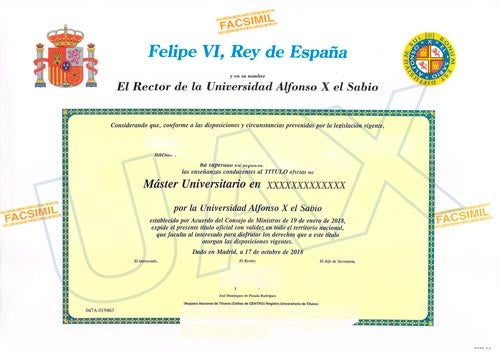
Official qualification
Our degree is official, verified by the Council of Universities and fully valid in Spain, as well as in the European Higher Education Area.
It is recognised by the Education Systems of Latin America, being recognised and approved by the different Ministries of Education in Latin America:
SENESCYT, MEN (MinEducation), SEP, Mescyt, among others, automatically.
Admission and recognition of prior learning
Recommended profile for the Master’s in Cybersecurity
The Online Master’s Degree in Cybersecurity is an officially recognised master’s programme, so you will be eligible to enrol if you have:
Graduates or engineers in Computer Science, Telecommunications and Computing
A bachelor’s degree or engineering qualification in other fields within the disciplines of Engineering and Architecture, Sciences, and Social and Legal Sciences, with at least two years’ demonstrable professional experience in the field of information technology.
Admissions process
To begin the process, you must provide the following documentation:
CV
Copy of your National Identity Card or passport.
A copy of your most recent academic qualifications related to the degree programmes mentioned above.
Postgraduate application form.
Internships and company connection
By studying Cybersecurity at the UAX you will do 150 hours of work experience in companies and you can benefit from more than 8,800 agreements between the university and major technology companies such as IBM, Microsoft, Hispasat and Telefónica, among many others.
Professionals with one year of experience in cybersecurity-related positions can validate their internships.
In addition, you will receive personalised support from professional advisors, who will help you make the most of your time and studies.
Online exams and access to Campus Hubs
The flexibility of online learning, with opportunities to connect
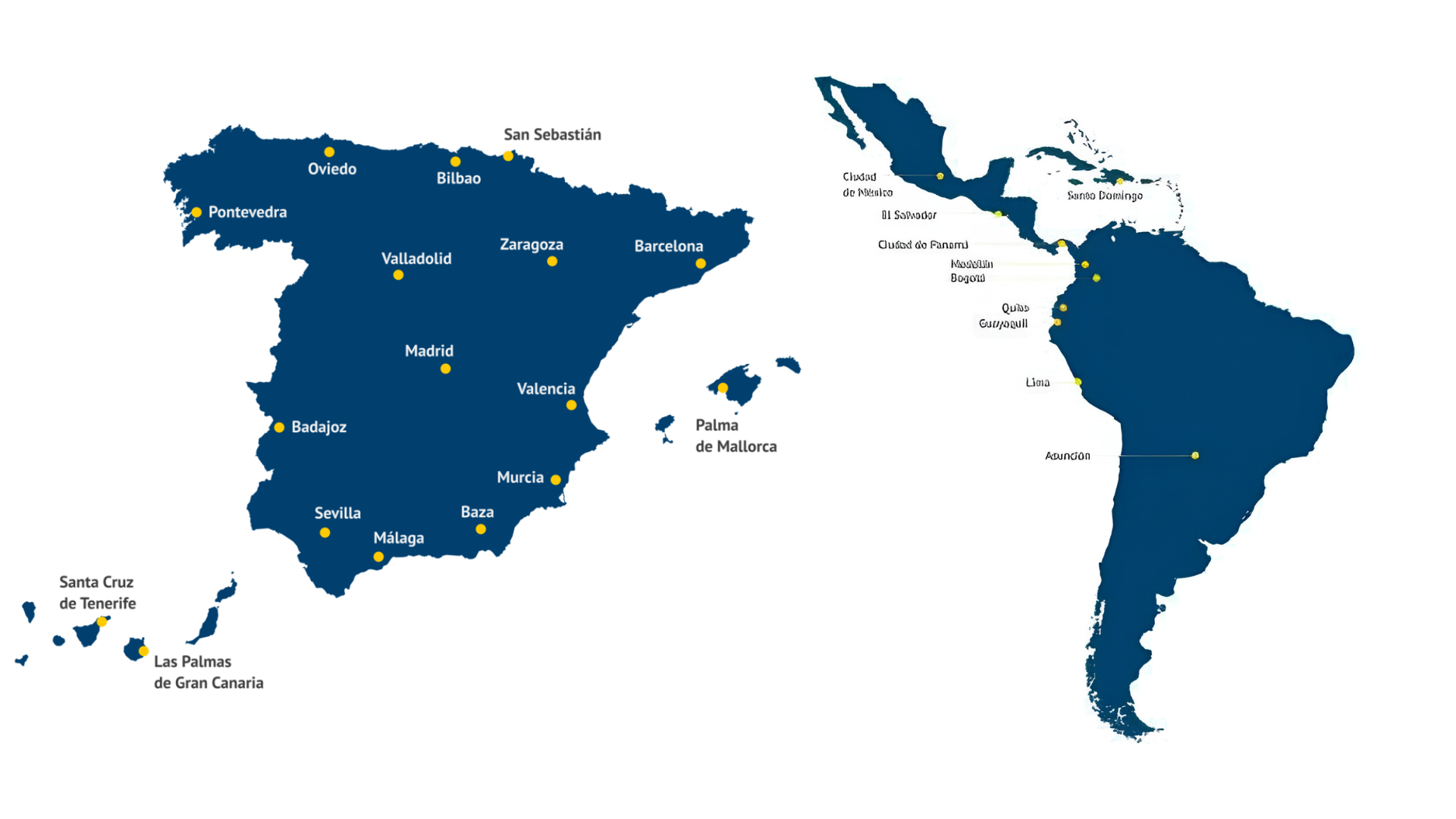
Take your exams online wherever you are or, if you prefer, in person at our designated centres in Spain and Latin America, subject to availability and capacity.
Furthermore, as a student at UAX Online, you’ll have access to our Campus Hubs, a network of exclusive physical spaces where you can study, access libraries, work in co-working areas and connect with other students. Because studying online doesn’t mean studying alone.
Campus Hubs available in: Alcobendas, Alcorcón, Valencia San Vicente, Murcia, Barcelona, Málaga, Seville and Arganda.
Access is granted with your UAX student card, subject to availability and the opening hours of each centre.
Companies that support your training
Boost your career in cybersecurity with networking skills
Cisco CCNA 200-301: The Complete Guide to Becoming Certified
Gain knowledge of networks, infrastructure and communication protocols to design and secure IT environments with this Packt certification, which is designed to prepare you for the Cisco CCNA certification.
PECIEE International Cybersecurity Conference
As a key feature of our Master’s in Cybersecurity, our students take part in the International Cybersecurity Conference: Business, Research and Society, an initiative launched as part of the European PECIEE project and organised in collaboration with INCIBE, one of Spain’s leading organisations in the field of cybersecurity.
A real-world immersion in the cybersecurity ecosystem:
Leading companies in the sector: meetings and round-table discussions with professionals from organisations such as Telefónica, BBVA, Microsoft and INCIBE, addressing the main challenges in digital security.
Applied research: access to the latest trends in artificial intelligence applied to cybersecurity, threat detection and new protection technologies.
Technologies of the future: exploring advances in post-quantum cryptography, one of the areas set to have the greatest impact on information security in the coming years.
International leaders: participation by internationally renowned experts and researchers, such as the mathematician Dr Efim Zelmanov, winner of the 1994 Fields Medal.
This experience reflects the Master’s programme’s approach: to bridge the gap between cybersecurity, research and industry, introducing students to the challenges, technologies and opportunities that will shape the sector’s future.
Study alongside a teaching staff comprising PhD holders, researchers and professionals who work for leading organisations such as Telefónica, Movistar+, MAPFRE, BBVA, Volkswagen Bank and Atradius.
Juan José Sánchez Peña
Head of Studies and Lecturer in Threat Intelligence
Head of Cybersecurity and Data Protection at Movistar+, with over 25 years’ experience in engineering, information security and IT governance. A PhD holder in Computer Engineering and a university lecturer, he combines a strong professional background with research and teaching in cybersecurity and data science.
Isabel Sánchez Sánchez
Master’s Programme Coordinator
Specialist in risk management, operational resilience and business continuity. He currently heads up Operational Risk, ESG Risk and DORA management at Volkswagen Financial Services, having previously built his career at organisations such as Banco Santander, Banco Popular and KPMG. He combines his professional work with teaching at business schools and international universities.
Gonzalo Martínez Ginesta
Lecturer in Cybersecurity Governance
Senior Manager of Internal Technology and AI Audit at Telefónica, where he leads audits on artificial intelligence governance, cybersecurity and technology risk at an international level. He holds a PhD in Information Security and is a leading expert in technology audit, business continuity, fraud and regulatory compliance in complex digital environments.
Iván García Cobo
Lecturer in Communications Network Security
DevOps Engineer at mlean, specialising in automation, deployments and cloud infrastructure. He has experience in Linux system administration and high-availability platforms, including projects for Telefónica. PhD candidate in Computer Engineering, specialising in quantum cryptography and information security.
Beatriz Carratalá Lleó
Lecturer in Supply Chain Security
Partner and Head of Legal at SECURIZABLE, specialising in cybersecurity, cyber risks, privacy and regulatory compliance. A lawyer specialising in cyber law, with extensive experience in technology risk management, cyber insurance and data protection. Member of the Board of Women4cyber.
Juan Manuel Matalobos
Lecturer in Operating System and Database Security
Head of Human Risk at BBVA, where he leads human risk management in cybersecurity. A Computer Engineer with over 25 years’ experience in cybersecurity, auditing and risk management, having built his career at firms such as EY, KPMG, Deloitte and Arthur Andersen. He holds leading international certifications such as CISSP, CISM, CISA, CRISC and GCIH.
David Herrero de la Peña
Lecturer in Ethical Hacking
Specialist in offensive cybersecurity and ethical hacking. He is currently a member of Telefónica España’s Red Team, where he carries out penetration testing, security audits and code reviews to identify vulnerabilities and strengthen system security. He holds leading certifications such as OSCP, CEH, CISA and GIAC GMOB.
Ana Vázquez Meco
Lecturer in Security for Wireless Systems, Mobile Networks, OT and IoT
Senior Telecommunications Engineer responsible for Electronic Prescriptions at the Official College of Pharmacists of Madrid. In charge of the engineering, development, security and oversight of projects relating to special protection services within the healthcare sector and communications networks for the dispensing of medicines in the Community of Madrid.
Miguel Hernández Cáceres
Lecturer in Information Access Control: Cryptography and the Management of Identities, Credentials and Access
A postdoctoral researcher specialising in post-quantum cryptography, quantum algorithms and computational algebra. He holds a PhD in Mathematics and Statistics and combines his research work with university teaching, bringing expertise in quantum computing, data science and cybersecurity.
Alejandro Corletti Estrada
Lecturer in Cybersecurity Architectures
PhD in Computer Engineering and an expert in cybersecurity with over 30 years’ experience. He is currently CEO of DarFe Learning Consulting, where he advises and audits large companies on cybersecurity. He is the author of several specialist books, a university lecturer and an ENAC expert auditor for the ISO 27001 and ISO 27701 standards.
Betsabeth Torres
Lecturer in Technology Process Safety
Computer Engineer and holder of a Master’s degree in Cybersecurity. She is currently Cybersecurity Manager at Atradius, where she leads the cybersecurity strategy for several international units, driving governance, risk management and compliance with standards. She has extensive experience in secure development, DevSecOps and application security.
Alberto Sánchez Abad
Lecturer in Cybersecurity Risk Management
Head of Systems Production at Movistar Plus+, where he oversees the operation and security of the technological infrastructure. Previously, he worked as a cybersecurity engineer and analyst at Movistar Plus+ and Línea Directa Aseguradora, gaining experience in systems protection, incident management and IT security.
Raquel Sánchez Rodríguez
Lecturer in Privacy
A lawyer specialising in data protection, digital law and cybersecurity. She is currently a management consultant at the Data Protection Office of Madrid Digital. She has built her career as a data protection officer, GDPR consultant and university lecturer, with extensive experience in privacy, regulatory compliance and information security.
Alberto Ruíz Rodas
Lecturer in Operating System and Database Security
Telecommunications Engineer. He is currently Sophos’s Pre-Sales Director for Spain and Portugal. He has over 20 years’ professional experience in cybersecurity, which he combines with teaching on executive programmes and speaking at conferences and specialist industry events.
Mar de las Heras Muñoz
Lecturer in Regulatory Framework
She holds a PhD in Constitutional Law and specialises in new technologies, cybersecurity and digital transformation. She is currently Director of Operations and General Counsel at Procesia, where she leads projects relating to cybersecurity governance, AI and innovation in public administration. In 2025, she was recognised by ABC as one of the 100 most outstanding executives in Spanish SMEs.
Ana Gómez Blanco
Lecturer in Safety in Technological Processes
Currently Senior Cybersecurity Manager at BBVA. Specialising in cybersecurity strategy and technology risk management at an international level, she leads critical initiatives for the financial sector. She also combines her corporate leadership role with an outstanding teaching career as a university academic coordinator.
Any questions? Don’t keep them to yourself – just ask us
We need to know a little bit about you so that we can provide you with a personalised service.
All fields are required
Scholarships and Grants
At UAX we know that studying is an investment, that's why we provide you with the facilities you need to access our degrees. Find out about some of our scholarships and grants:
Grants from official bodies: Community of Madrid and Ministry of Education.
Study aid for UAX excellence
Study grants for family members of UAX students
Study grants for continuity of studies UAX
Study grants for elite sportsmen and women UAX
UAX financing plans: with payment facilities in up to 10 instalments.
Teachers who are currently working and have links to the sector
Training aimed at improving employability
Cybersecurity FAQs
What are the entry requirements for the Master’s in Cybersecurity?
The Online Master’s Degree in Cybersecurity is aimed at university graduates who meet any of the following requirements:
Graduates or engineers in Computer Science, Telecommunications or Computing.
Graduates or engineers who have studied subjects related to information and communications technology, such as networks, operating systems or computer architecture.
Graduates from other fields within the Sciences, Social Sciences and Law, Engineering or Architecture who can demonstrate at least two years’ professional experience in information technology (IT).
If you have any queries regarding your eligibility, the UAX admissions team will be able to advise you and assess your application on an individual basis.
Is the UAX Master’s in Cybersecurity an officially recognised qualification?
Yes. The UAX Master’s Degree in Cybersecurity is an official qualification, accredited by the Spanish Council of Universities and fully recognised in Spain and within the European Higher Education Area (EHEA).
Furthermore, it is recognised in numerous Latin American countries and may be recognised or accredited by the relevant educational bodies in accordance with the regulations in force in each country. Its official status gives it a distinct advantage over non-official courses, certifications or qualifications, both in terms of professional development and international prospects.
What career opportunities are available to graduates of the Master’s in Cybersecurity?
The Online Master’s Degree in Cybersecurity prepares you for some of the most sought-after roles in the sector, both within technical teams and in the areas of governance, risk and compliance.
Key career opportunities include:
Cybersecurity Analyst (SOC)
Incident Response Specialist
Pentester or Ethical Hacking Specialist
Cybersecurity Architect
Cybersecurity Consultant
Risk and Compliance Manager (GRC)
Data Protection and Privacy Specialist
Security Auditor
ICT Security Director
Thanks to its practical approach and the growing demand for specialists in IT security and information protection, the Master’s programme facilitates access to career opportunities in companies across all sectors.
Is the UAX Master’s in Cybersecurity an online programme?
Yes. The UAX Master’s in Cybersecurity is delivered 100% online, allowing you to balance your studies with your professional commitments and study from anywhere.
Through a flexible teaching approach, you’ll have access to up-to-date content, practical activities and specialist academic support, developing skills in areas such as IT security, SOC, ethical hacking, cyber intelligence, data protection and incident management.
Content related to the Master’s in Cybersecurity
27 / 10 / 2026
What is cybersecurity and why should you study it?
20 / 10 / 2026
What subjects are studied in cybersecurity?
20 / 10 / 2026
What career opportunities are there for those who study cyber security?
21 / 10 / 2026
How much does a cybersecurity expert earn?
21 / 10 / 2026
What is the difference between cybersecurity and IT security?
20 / 10 / 2026
Cybersecurity exploits: What they are, types, examples and how to protect yourself
30 / 09 / 2026
Cybersecurity and Resilience: New Paradigms in Information Security
Other related qualifications
We offer a wide range of academic programmes, so you’re sure to find one that suits you.
Online
Up to 35 per cent towards study costs before 30/11
We respond to the genuine needs of our students and staff, because we believe in the continuous improvement of our results. That is why we always want to hear whatever you have to say.
If you are already part of UAX, please visit the ‘Customer Service: complaints, suggestions and compliments’ section on thevirtual campus , logging in with your username and password.
Information on the main findings of the study
You can view the various indicators via the following links: