See all Online Master's Degrees in Health
See all Master's Degrees in Engineering
Most searched curriculums
Make the leap and become part of the profession that you always dreamed about. You will carry out practices in the best aerospace and aeronautical industry companies in Spain. Enrolment open
Because it equips you to design, develop and manage aeronautical and space systems, combining advanced engineering, innovation and applied technology in a strategic and constantly evolving sector.
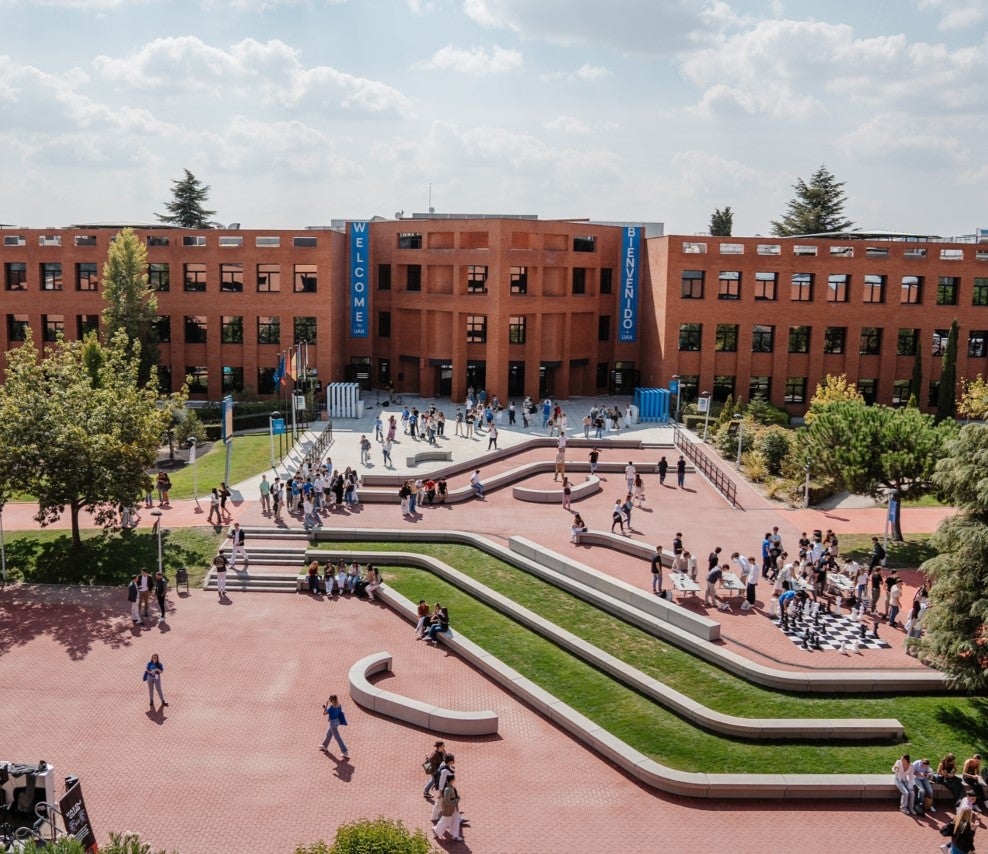
25,000 M² from actual installations
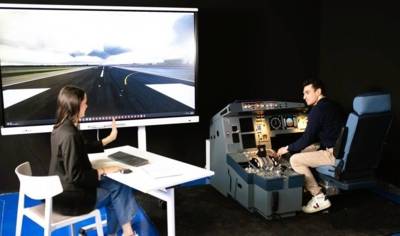
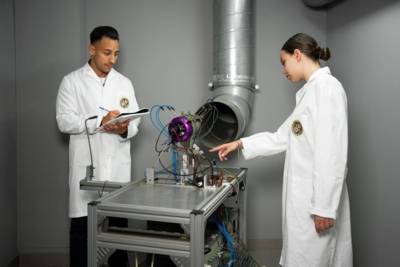
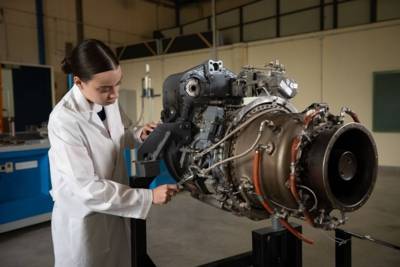
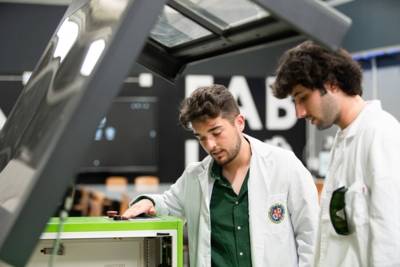
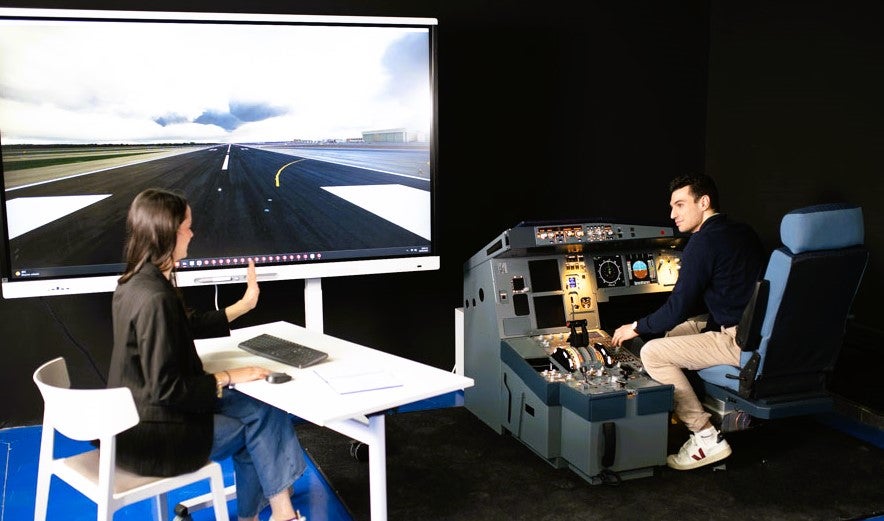
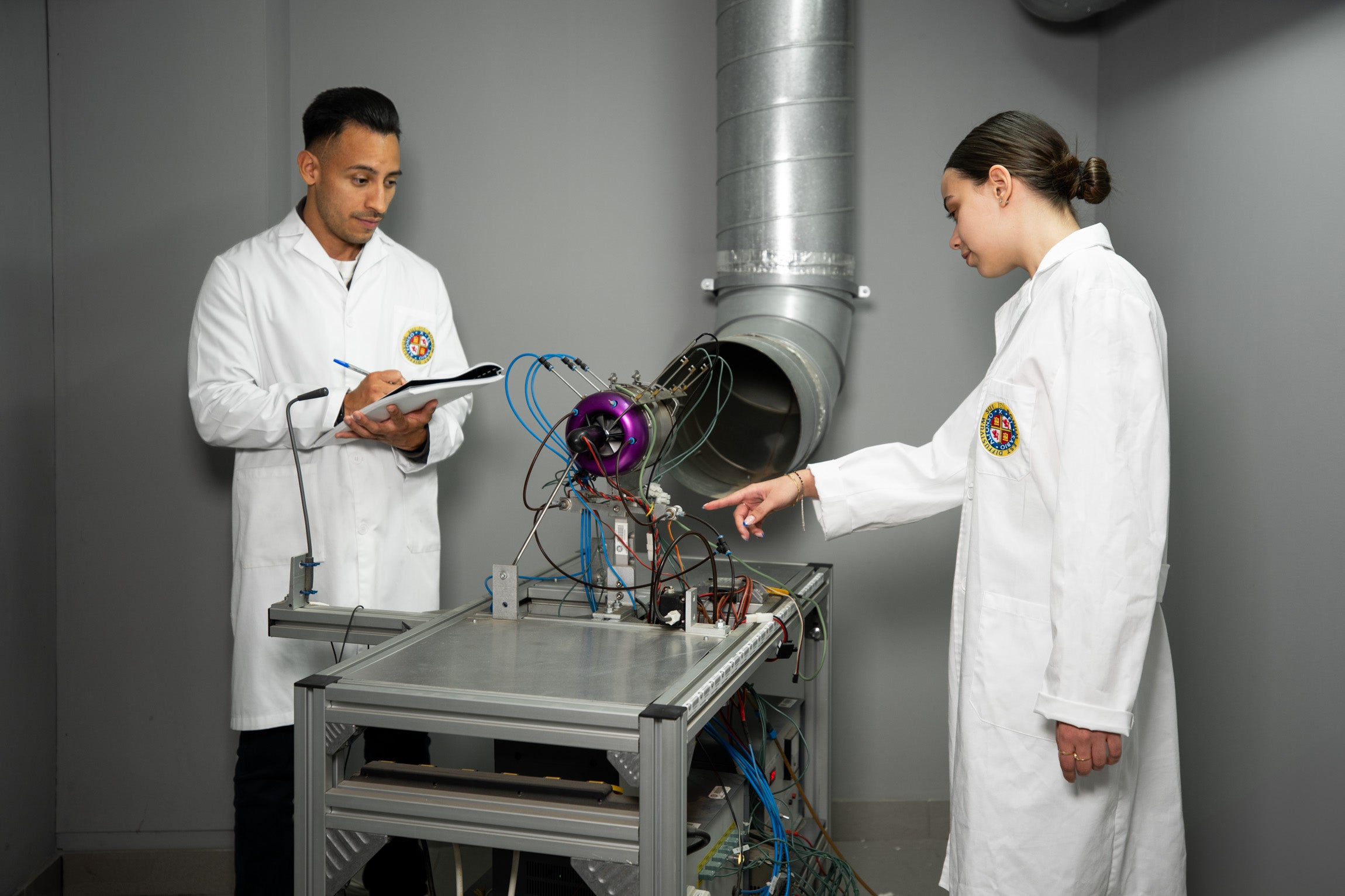
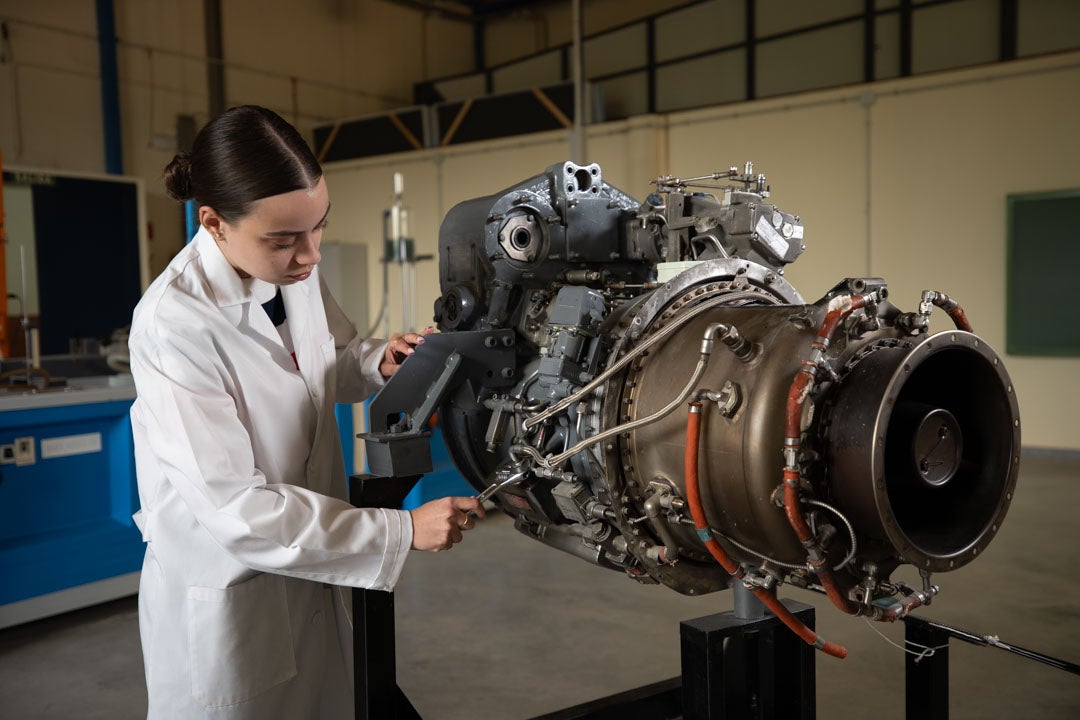
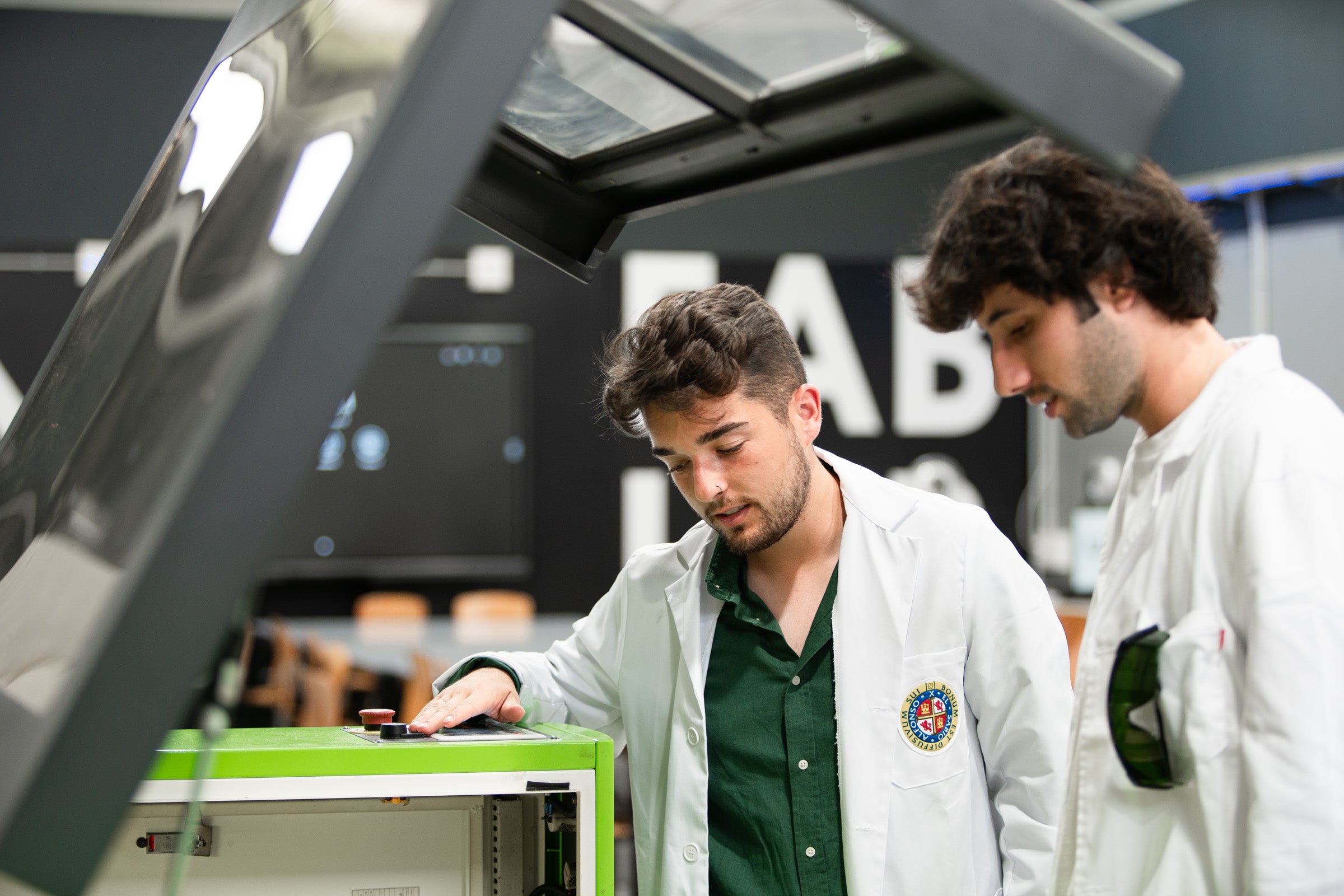
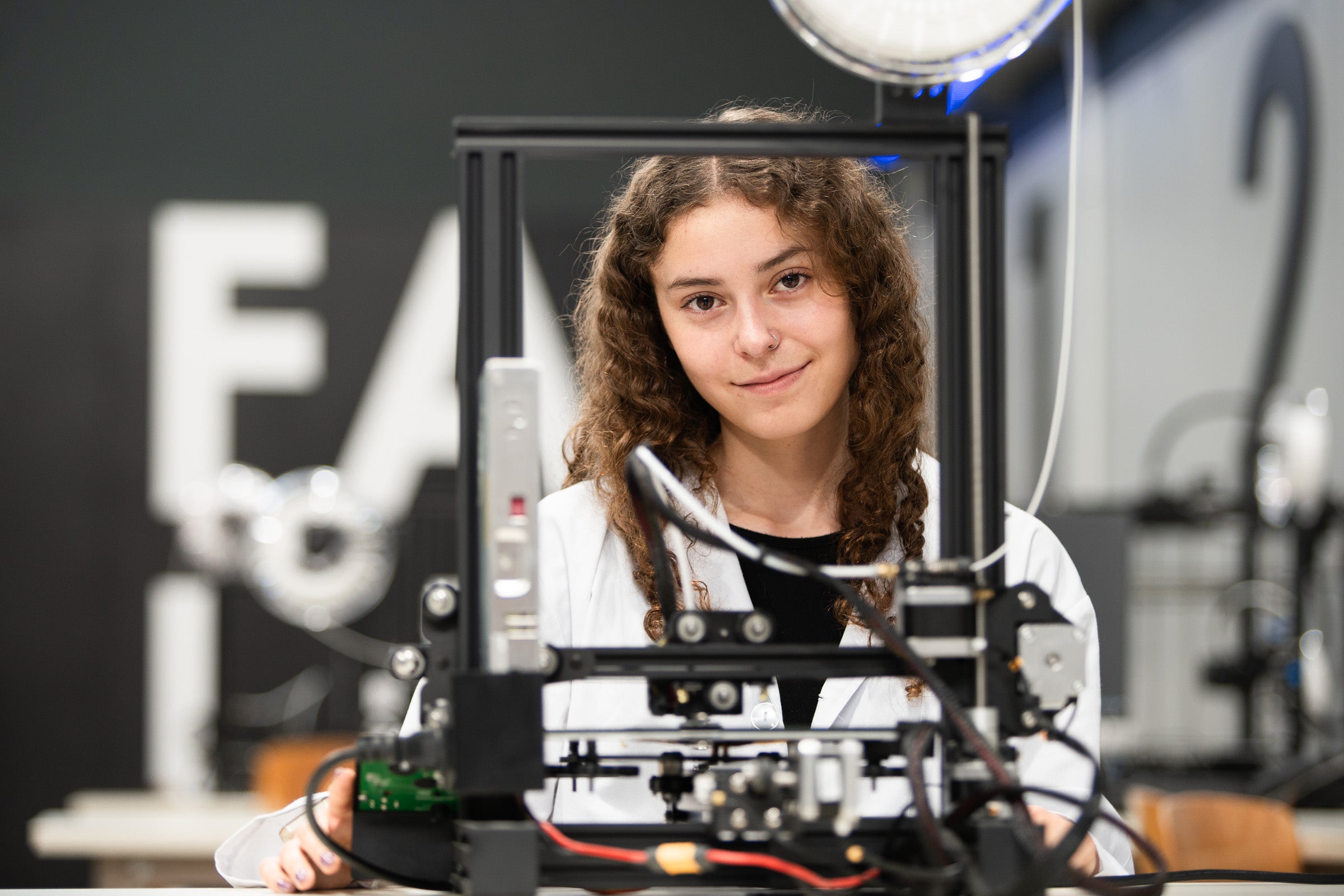
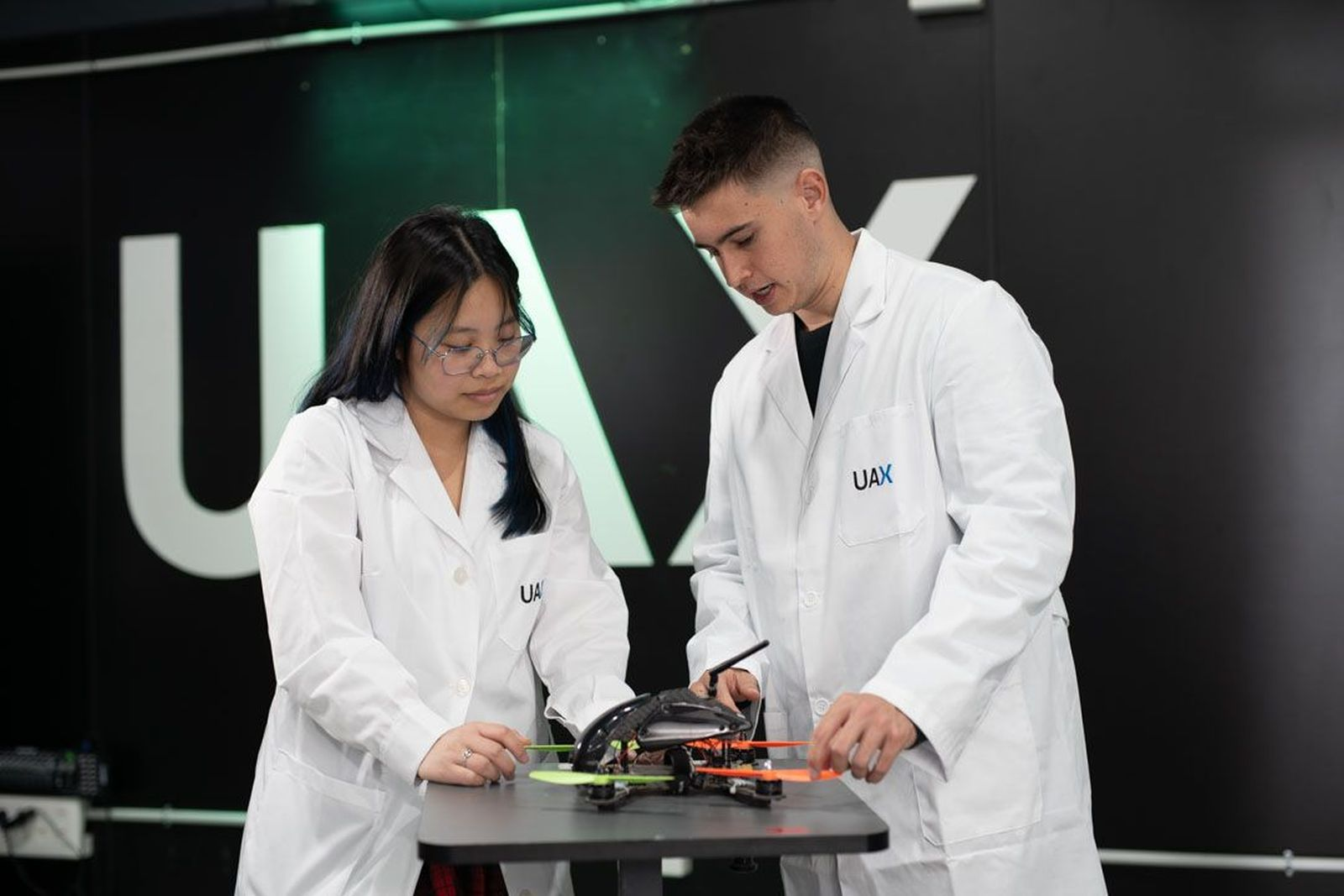
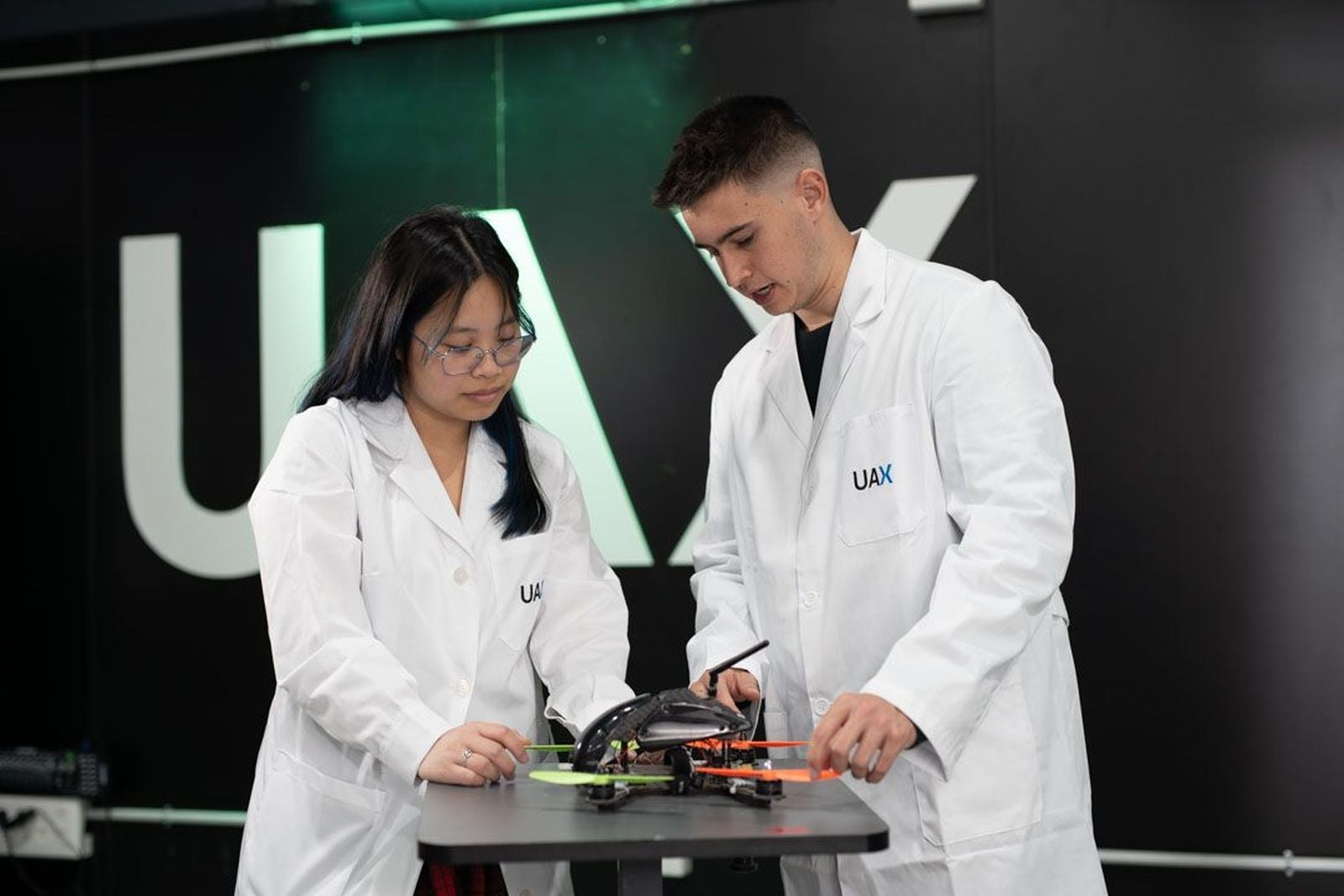
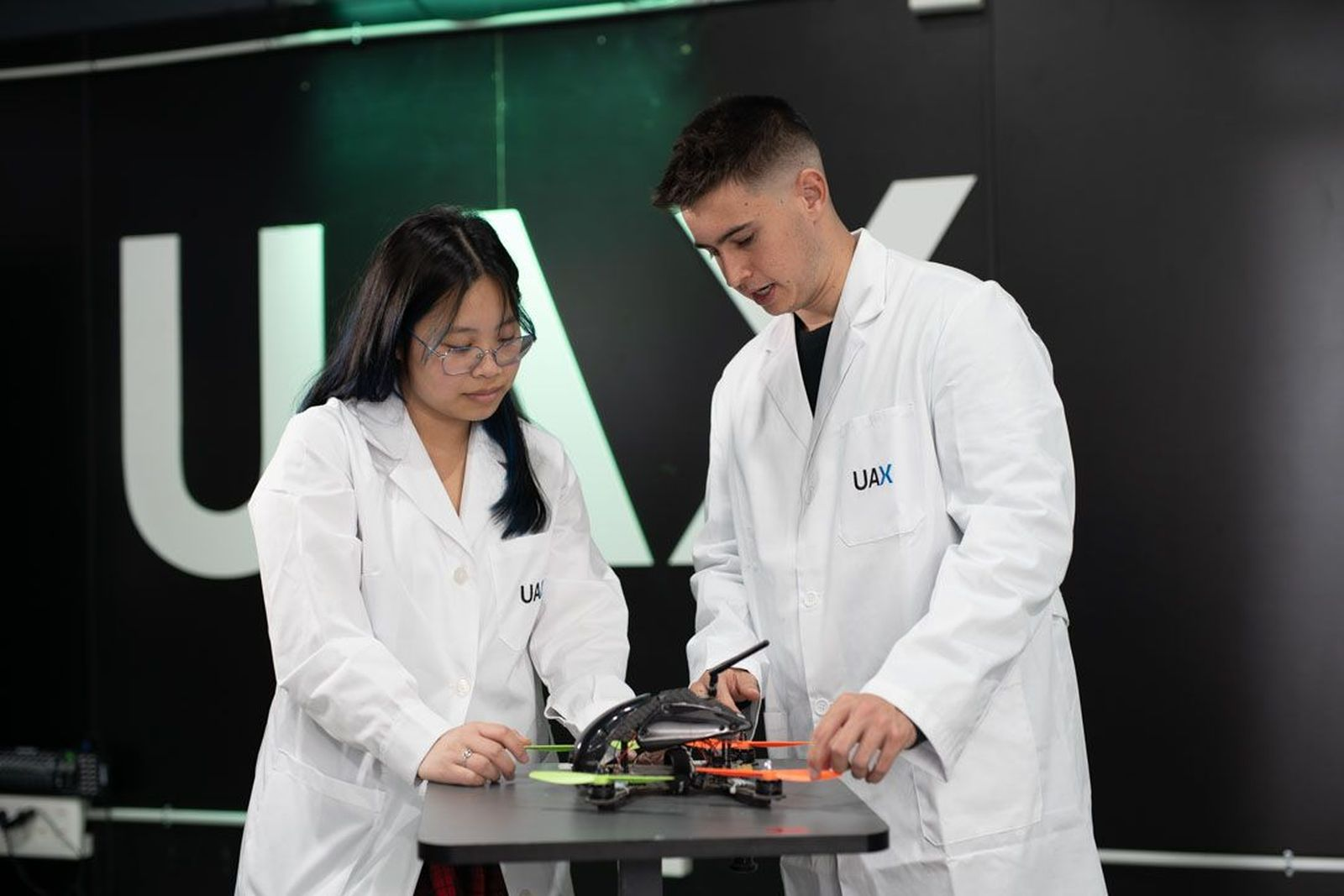
A wind tunnel, a turbojet test rig, an Airbus A320 flight simulator, AeroLab and a FABLAB equipped with 3D printing, laser cutting and robotic arms.
99 % EMPLOYABILITY
99 per cent of our students are in employment upon graduation
TOP 1 Qualifications on your CV
Altair professional software (HyperWorks, OptiStruct, MotionSolve), Google digital certifications and training in leadership, communication and negotiation (UAX Skill School).
+ 100 REAL PROJECTS
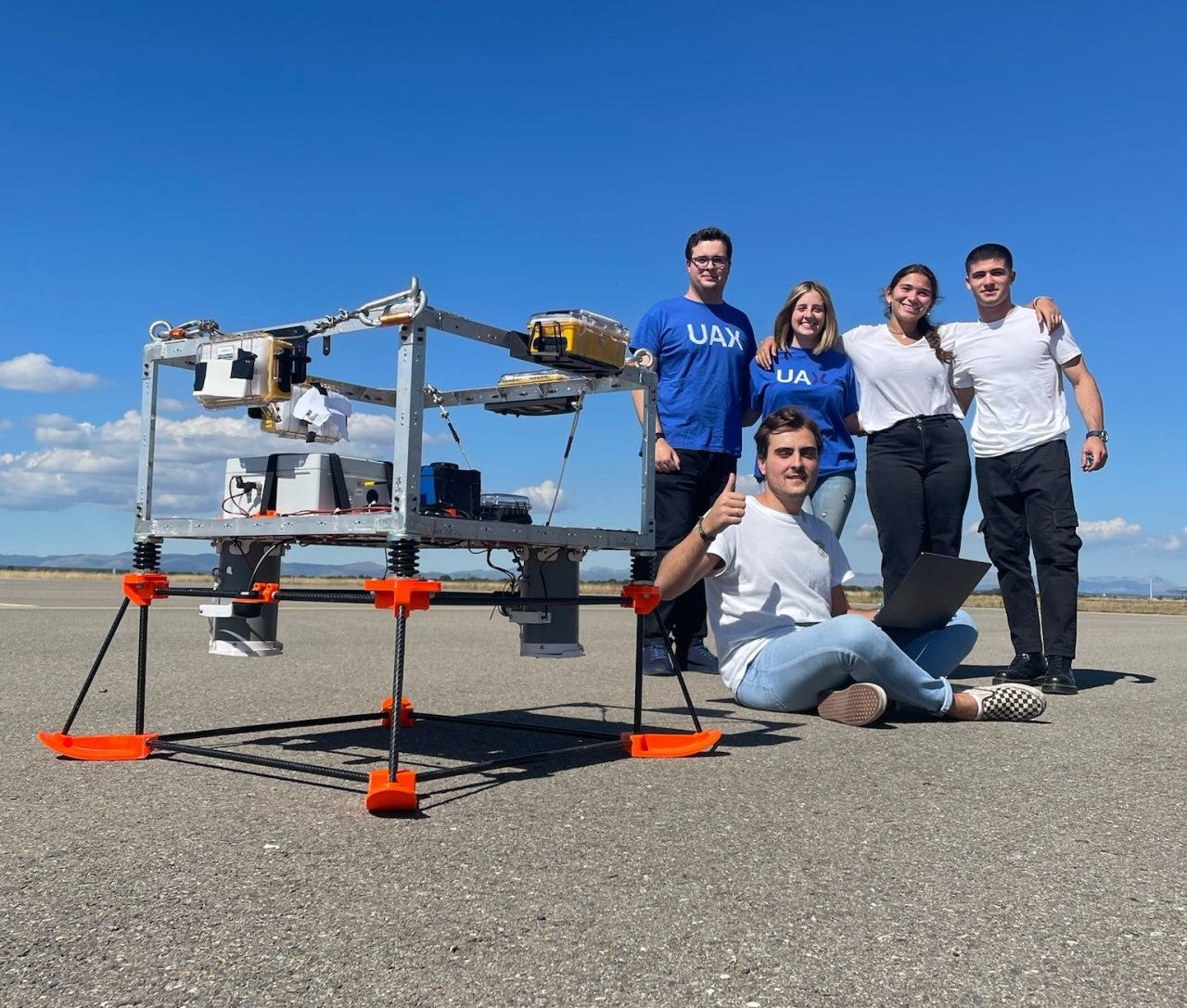
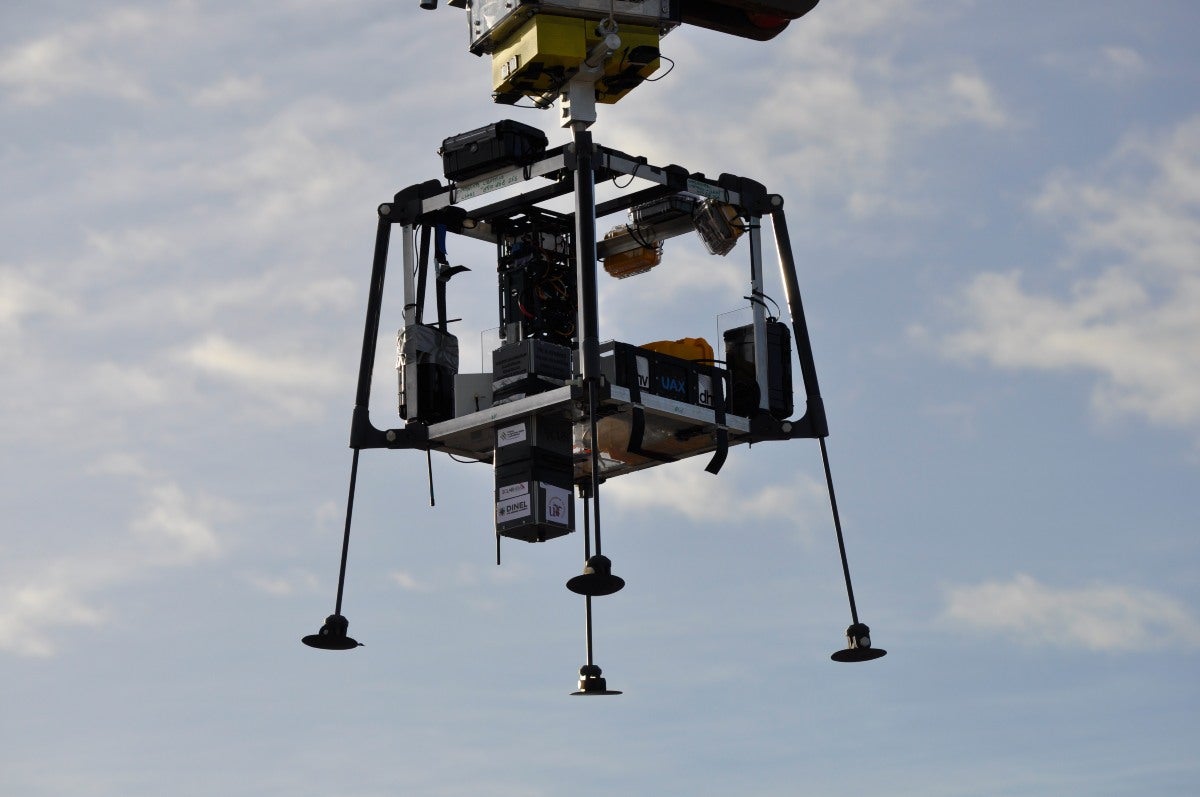
Take part in the development and actual launch of a microsatellite alongside the aerospace company B2Space, as part of the UAX FABLAB Makers programme.
1000 AGREEMENTS
Airbus Defence & Space, Iberia, Hispasat, Indra, Thales Alenia Space, INECO, Sacyr, Accenture, Capgemini, GMV, Swiftair, Air Europa and ELA Aviación, amongst others
90 % ACTIVE TEACHERS
This offers the student a training that is closer to professional reality.
A programme updated in 2025 and featuring the new UAX ELAb laboratory, based on the real needs of the aerospace sector.
You’ll learn to design, manufacture and integrate the systems that make flight possible: from aircraft and satellites to rocket engines and gas turbines. But at UAX, you won’t just stick to theory: you’ll apply this knowledge to real-world projects, working alongside companies and engineers in the sector, right from the first year.
By the end of the degree, you will have mastered the following:
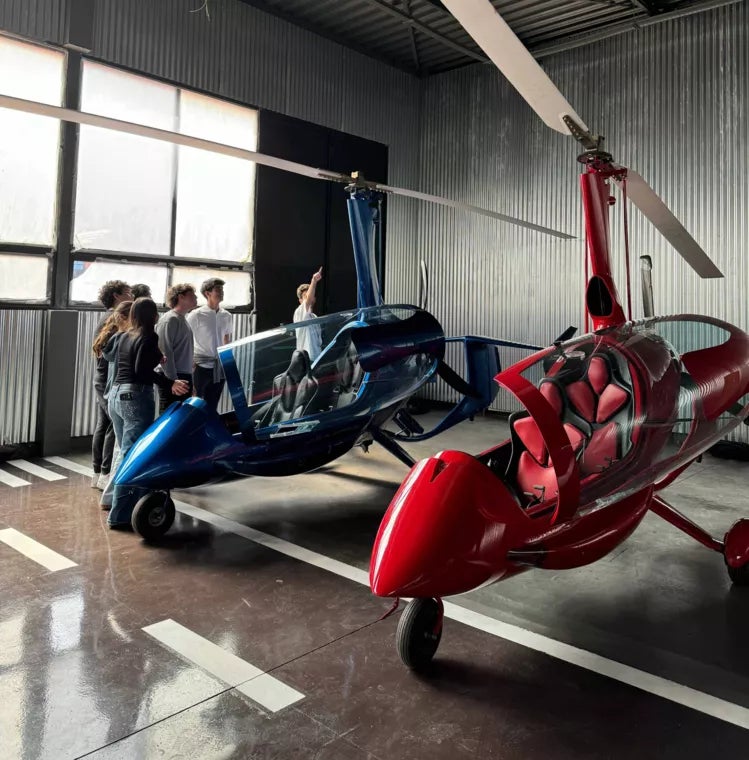
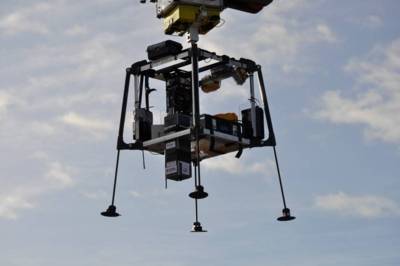
And all this, without having to wait until your final year. At the UAX ELAb, our new aeronautical innovation laboratory developed in partnership with ELA Aviación, you’ll already be working on real-world projects such as an autonomous air taxi, a next-generation autogyro or a hybrid fixed-wing VTOL. You’ll combine this with over 25,000 m² of specialised facilities: a wind tunnel, a full-scale Airbus A320 flight simulator and a FabLab where you’ll collaborate on projects such as the launch of a microsatellite alongside B2Space.
Studying Aerospace Engineering at UAX means one thing: by the time you graduate, you will have already achieved what others will only have studied.
Enjoy a unique experience in aerospace engineering
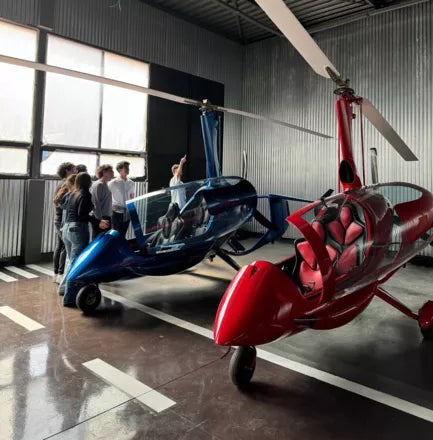
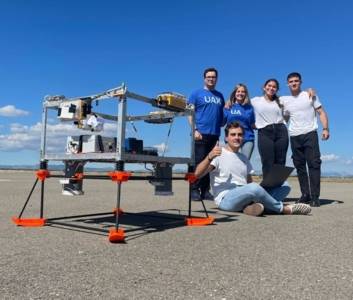
Through the UAX Makers ecosystem and the UAX ELAb, you will work on real-world technical challenges alongside industry professionals, taking part in the design, prototyping and validation of advanced aircraft such as air taxis, autogyros and hybrid VTOL systems, applying your knowledge in innovation environments that have a direct impact on the industry.
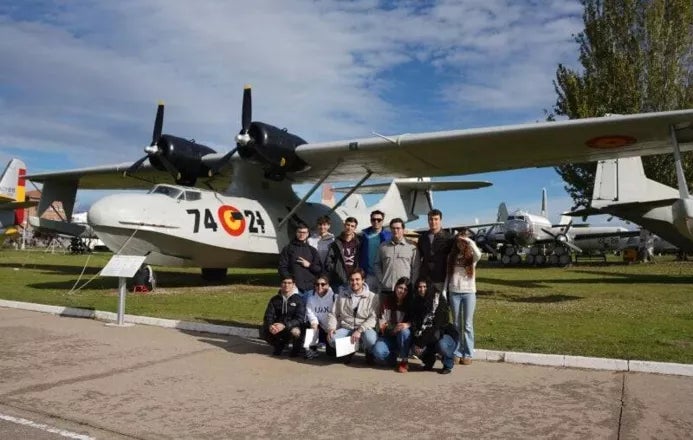
Build a professional portfolio by participating in real-world developments such as the launch of a microsatellite or the integration of flight systems.

Thanks to the partnership with 72 Motorsport, you will be able to work with real technology used in demanding environments such as JuniorGP, applying your aerospace skills to racing vehicles.
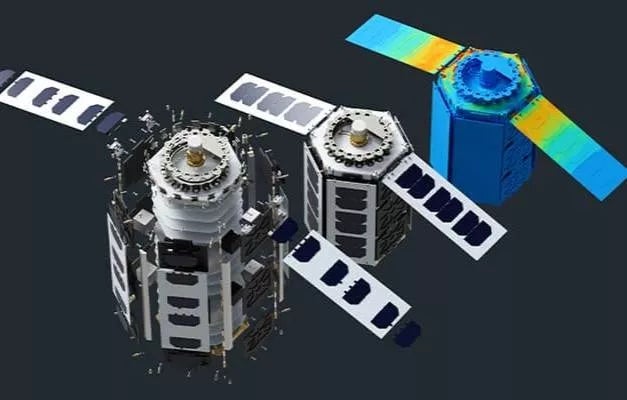
Get certified in ALTAIR HyperWorks, Google Digital Tools and other key simulation and engineering tools.
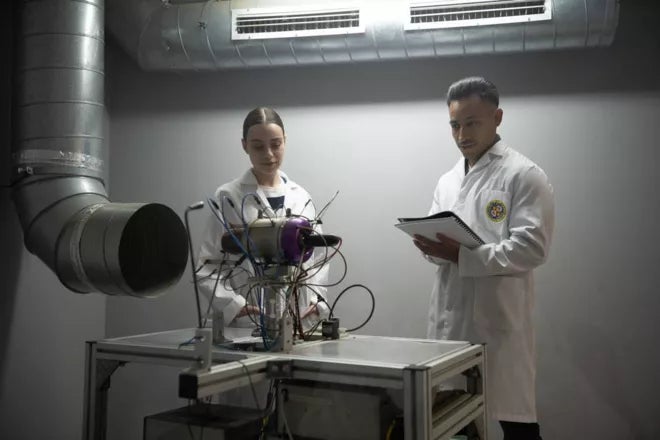
More than 25,000 m² of laboratories with wind tunnel, Airbus A320 simulator and turbojet bench.
You will have personalised monitoring by tutors who combine teaching with their employment activity, and so they will offer you up-to-date and practical teaching.
Moreover, you have various areas of specialisation in order to develop your future professional career.
Itinerary I: Aircraft
Itinerary II: Aircraft engines
Itinerary III: Aeronautics
Itinerary IV: Airports
Degree in Aerospace Engineering
FIRST YEAR
ANNUAL
| Code | Subjects | Character* | ECTS | ||||||||||||||||||||||||||||||||||||||||||||||||||||||||||||||||||||||||||||||||||||||||||||||||||||||||||||||||||||||||||||||||||||||||||||||||||||||||||||||||||||||||||||||||||||||||||||||||||||||||||||||||||||||||||||||||||||||||||||||||||||||||||||||||||||||||||||||||||||||||||||||||||||||||||||||||||||||||||||||||||||||||||||||||||||||||||||||||||||||||||||||||||||||||||||||||||||||||||||||||||||||||||||||||||||||||||||||||||||||||||||||||||||||||||||||||||
|---|---|---|---|---|---|---|---|---|---|---|---|---|---|---|---|---|---|---|---|---|---|---|---|---|---|---|---|---|---|---|---|---|---|---|---|---|---|---|---|---|---|---|---|---|---|---|---|---|---|---|---|---|---|---|---|---|---|---|---|---|---|---|---|---|---|---|---|---|---|---|---|---|---|---|---|---|---|---|---|---|---|---|---|---|---|---|---|---|---|---|---|---|---|---|---|---|---|---|---|---|---|---|---|---|---|---|---|---|---|---|---|---|---|---|---|---|---|---|---|---|---|---|---|---|---|---|---|---|---|---|---|---|---|---|---|---|---|---|---|---|---|---|---|---|---|---|---|---|---|---|---|---|---|---|---|---|---|---|---|---|---|---|---|---|---|---|---|---|---|---|---|---|---|---|---|---|---|---|---|---|---|---|---|---|---|---|---|---|---|---|---|---|---|---|---|---|---|---|---|---|---|---|---|---|---|---|---|---|---|---|---|---|---|---|---|---|---|---|---|---|---|---|---|---|---|---|---|---|---|---|---|---|---|---|---|---|---|---|---|---|---|---|---|---|---|---|---|---|---|---|---|---|---|---|---|---|---|---|---|---|---|---|---|---|---|---|---|---|---|---|---|---|---|---|---|---|---|---|---|---|---|---|---|---|---|---|---|---|---|---|---|---|---|---|---|---|---|---|---|---|---|---|---|---|---|---|---|---|---|---|---|---|---|---|---|---|---|---|---|---|---|---|---|---|---|---|---|---|---|---|---|---|---|---|---|---|---|---|---|---|---|---|---|---|---|---|---|---|---|---|---|---|---|---|---|---|---|---|---|---|---|---|---|---|---|---|---|---|---|---|---|---|---|---|---|---|---|---|---|---|---|---|---|---|---|---|---|---|---|---|---|---|---|---|---|---|---|---|---|---|---|---|---|---|---|---|---|---|---|---|---|---|---|---|---|---|---|---|---|---|---|---|---|---|---|---|---|---|---|---|---|---|---|---|---|---|---|---|---|---|---|---|---|---|---|---|---|---|---|---|---|---|---|---|---|---|---|---|---|---|---|---|---|---|---|---|---|---|---|
| 0140401 | Linear Algebra | FB | 9 | ||||||||||||||||||||||||||||||||||||||||||||||||||||||||||||||||||||||||||||||||||||||||||||||||||||||||||||||||||||||||||||||||||||||||||||||||||||||||||||||||||||||||||||||||||||||||||||||||||||||||||||||||||||||||||||||||||||||||||||||||||||||||||||||||||||||||||||||||||||||||||||||||||||||||||||||||||||||||||||||||||||||||||||||||||||||||||||||||||||||||||||||||||||||||||||||||||||||||||||||||||||||||||||||||||||||||||||||||||||||||||||||||||||||||||||||||||
Linear AlgebraCódigo: 0140401 Imprimir Year 1. Annual module. Foundation course. 9 credits. Profesores
Objectives To gain an understanding of the potential of Linear Algebra as a useful mathematical tool in professional practice, as well as its relationship with Infinitesimal Calculus. To develop the ability to solve real-world mathematical problems. Furthermore, to develop the capacity for abstract reasoning and logical and algorithmic thinking. Course content Vector Spaces, Linear Applications and Matrices, Determinants and Systems of Linear Equations, Quadratic Forms, Scalar Product, Eigenvalues and Matrix Reduction, Singular Value Decomposition and Least Squares, Euclidean Affine Space, A Detailed Study of Conics and Quadric Surfaces, Introduction to Curves and Surfaces. SYLLABUS Topic 1: Rank of vectors and matrices Topic 2: Operations on matrices Topic 3: Determinants Topic 4: Systems of linear equations Topic 5: Vector spaces Topic 6: Linear applications Topic 7: Quadratic forms Topic 8: Euclidean vector spaces Topic 9: Eigenvalues Topic 10: Points, lines and planes Topic 11: Conic sections Topic 12: Quadric curves Learning activities Classroom presentations on concepts related to the subject and problem-solving exercises to help students understand how to tackle them, as well as other face-to-face group sessions such as discussion classes, group work, etc. Carrying out work in small groups outside the classroom. Independent study, report writing, practical work, etc., carried out by individual students or groups of students. Sitting examinations and assessment tests. Assessment system and criteria Without prejudice to any other requirements that may be set out in the relevant course syllabus, as a general rule, failure to attend more than 60 per cent of the course’s teaching activities—which require the student’s physical or virtual presence—will result in the loss of the right to continuous assessment during the standard examination period. In this case, the examination to be held during the official period set by the University will be the sole assessment criterion, with the weighting specified in the course syllabus. ---- CONTINUOUS ASSESSMENT: Assignment 1: 5% Test 1: 10% Lab 1: 5% Assignment 2: 5% Test 2: 15% Lab 2: 10% Assignment 3: 5% Test 3: 10% Lab 3: 5% Assignment 4: 5% Test 4: 15% Lab 4: 10% In order for these percentages to apply, all marks for tests and laboratory work must be 3 marks out of 10 or higher REGULAR EXAM SESSION: The laboratory mark will be the mark achieved throughout the course and will account for 30% of the final mark. The remaining 70% will be based on questions set in the exam. RE-SIT EXAM: The laboratory mark will be the one obtained throughout the academic year and will account for 30% of the final mark. The remaining 70% will be based on exercises set in the exam. In accordance with the instructions from the Head of Studies, the minimum attendance rate required to be eligible for continuous assessment for degree programmes at the School of Engineering, Architecture and Design (EIAD) is 60 per cent. Timetable Click on this link to view the detailed timetable in Excel
Reading list Core: 1. Burgos Román, Juan de Linear Algebra: Definitions, Theorems and Results Madrid: García-Maroto, 2007. 2007. ISBN: 8493527165 2. Eugenio Hernández Linear Algebra and Geometry Anaya General Publications Group. 2012. ISBN: 9788478291298 Supplementary: 3.- Merino, Luis M Linear Algebra with Elementary Methods Thomson. 2006. ISBN: 8497324811 |
|||||||||||||||||||||||||||||||||||||||||||||||||||||||||||||||||||||||||||||||||||||||||||||||||||||||||||||||||||||||||||||||||||||||||||||||||||||||||||||||||||||||||||||||||||||||||||||||||||||||||||||||||||||||||||||||||||||||||||||||||||||||||||||||||||||||||||||||||||||||||||||||||||||||||||||||||||||||||||||||||||||||||||||||||||||||||||||||||||||||||||||||||||||||||||||||||||||||||||||||||||||||||||||||||||||||||||||||||||||||||||||||||||||||||||||||||||||
| 0140402 | Infinitesimal Calculus | FB | 9 | ||||||||||||||||||||||||||||||||||||||||||||||||||||||||||||||||||||||||||||||||||||||||||||||||||||||||||||||||||||||||||||||||||||||||||||||||||||||||||||||||||||||||||||||||||||||||||||||||||||||||||||||||||||||||||||||||||||||||||||||||||||||||||||||||||||||||||||||||||||||||||||||||||||||||||||||||||||||||||||||||||||||||||||||||||||||||||||||||||||||||||||||||||||||||||||||||||||||||||||||||||||||||||||||||||||||||||||||||||||||||||||||||||||||||||||||||||
Infinitesimal CalculusCódigo: 0140402 Imprimir Year 1. Annual module. Foundation course. 9 credits. Profesores
Objectives The aim of this module is to provide the necessary mathematical foundations to enable students on the Bachelor’s Degree in Aerospace Engineering to interpret, select, evaluate and develop new concepts, theories, applications and technological developments relating to the aerospace sector. Prerequisites No prerequisites have been set Competencies Ability to solve mathematical problems that may arise in engineering. Ability to apply knowledge of: linear algebra; geometry; differential geometry; differential and integral calculus; differential and partial differential equations; numerical methods; numerical algorithms; statistics and optimisation. Students must have demonstrated that they possess and understand knowledge in their field of study, building on the foundations of general secondary education; this is typically at a level which, whilst drawing on advanced textbooks, also includes certain aspects requiring knowledge from the cutting edge of their field of study. Students should be able to apply their knowledge to their work or profession in a professional manner and possess the skills typically demonstrated through the development and defence of arguments and the resolution of problems within their field of study. Students should have the ability to gather and interpret relevant data (usually within their field of study) in order to form judgements that include reflection on relevant social, scientific or ethical issues. Students should be able to communicate information, ideas, problems and solutions to both specialist and non-specialist audiences. Students should have developed the learning skills necessary to undertake further study with a high degree of autonomy. Learning outcomes Ability to apply acquired knowledge to the resolution of real-world problems. Ability to engage in abstract reasoning and logical and algorithmic thinking. Ability to solve highly complex mathematical problems. Teamwork within small groups. Course content The System of Real Numbers and Limits of Sequences, Continuous Functions of a Real Variable, Differentiable Functions of a Real Variable, Simple Integrals, Series, N-Dimensional Euclidean Space, Limits and Continuity of Functions of Several Variables, Derivation and Differentiation of Functions of Several Variables, Applications of Derivatives, Multiple Integrals. Teaching activities Classroom presentation of concepts relating to the topics comprising each subject and the solving of problems to enable students to understand how to approach them, as well as other face-to-face group sessions such as discussion classes, group work, etc. Carrying out work in small groups outside the classroom. Independent study, report writing, practical work, etc., carried out by individual students or groups of students. Sitting examinations and assessment tests. Assessment system and criteria Without prejudice to any other requirements that may be specified in the relevant course syllabus, as a general rule, failure to attend more than 60 per cent of the course’s teaching activities—which require the student’s physical or virtual presence—will result in the loss of the right to continuous assessment during the standard examination period. In this case, the examination to be held during the official period set by the University will be the sole assessment criterion, with the weighting specified in the course syllabus. The assessment process will consist of verifying and evaluating the student’s acquisition of the learning outcomes. To this end, the following assessment activities will be used to determine the extent to which each of the listed learning outcomes has been mastered, and these will consist of: - Carrying out a project through problem-solving activities, assignments, small-group presentations and the development of case studies. - Written examinations covering the content covered in the classroom-based learning activities. Students’ results in the modules will be graded according to the following numerical scale from 0 to 10, expressed to one decimal place, to which a corresponding qualitative grade may be added: a. 0–4.9: Fail (SS). b. 5.0–6.9: Pass (AP). c. 7.0–8.9: Good (NT). d. 9.0–10: Distinction (SB). The distinction ‘Honours’ shall be awarded to students who have obtained a mark of 9.0 or higher. The number of students awarded this distinction may not exceed five per cent of those enrolled on the course in the relevant academic year, unless the number of enrolled students is fewer than 20, in which case only one ‘First Class Honours’ may be awarded. CONTINUOUS ASSESSMENT Four mid-term examinations will be held, two in each term, in which students’ competencies will be assessed in a way that reflects the learning activities undertaken. In addition, a series of assessments (assignments, questionnaires, activities, projects) will be set throughout the two terms to be completed individually and/or in groups. The final mark for continuous assessment will be calculated by applying the percentage weights to all the continuous assessment tasks carried out during the course, as set out in the timetable. The marks for the four mid-term exams will account for 80% (4 mid-term exams × 20% each) of the continuous assessment mark, whilst the mark for the assessments (assignments, questionnaires, activities, project) will account for 20% (4 assessments × 5% each). The module may be passed BY CONTINUOUS ASSESSMENT if a mark of 5 out of 10 or higher is achieved. Students who pass via continuous assessment will not sit the exam in the ordinary examination session. REGULAR JUNE EXAM SESSION: This examination, which will assess students’ competencies in line with the learning activities undertaken, will consist of two parts, one for each of the two terms: the first part covering mid-term exams 1 and 2 of the first term, and the second part covering mid-term exams 3 and 4 of the second term. Students who have failed the continuous assessment but have a mark of four or above in either of the two terms may choose to sit the entire exam or just one part of the exam (one of the two terms) if they wish to retain the continuous assessment mark obtained in the other part (the other of the two terms). Students who have failed on the basis of continuous assessment and who do not have a mark of four or above in either of the two terms must sit the full examination for the module, and the mark recorded in the academic transcript will be that obtained in the examination, as continuous assessment will not be taken into account. Under no circumstances will any part of the course be exempted for the July sitting; if a student fails in the ordinary sitting, the entire course remains outstanding for the supplementary sitting. JULY EXTRAORDINARY EXAMINATION PERIOD: A single examination covering the entire syllabus will be held, in which students’ competencies will be assessed in a manner that reflects the learning activities undertaken. The mark obtained in this examination will be the one recorded in the academic records. Addendum Recommended reading and basic resources: ▪ Esther Guervos Sánchez et al., Introduction to Calculus. García Maroto Editores (Available in the physical library and online) ▪ Esther Guervos Sánchez and Ana Pastor Regidor, Fundamentals of Mathematics. Bellisco. (Available in the physical library and online) ▪ Online calculation and problem-solving programmes. ▪ AI tools. Note: (Unless otherwise specified, no reference materials, online resources or AI tools will be permitted during examinations or for coursework.) Timetable Click on this link to view the detailed timetable in Excel
Reading List Core: 1. Guervós Sánchez, Esther; Pastor Regidor, Ana. Fundamentals of Mathematics: Theoretical Concepts and Solved Problems Bellisco. 2002. ISBN: 84-96486-14-1 2. Guervós Sánchez, Esther Introduction to Calculus García-Maroto Editores. 2008. ISBN: 9788493629984 3. Pedro de Mingo Calculus Madrid: Bellisco. 2006. ISBN: 8496486370 Supplementary: 4.- Pedro de Mingo García Mathematics Bellisco. 2005. ISBN: 84-95279-90-8 5. J. Rey Pastor, P. Pi Calleja, C.A. Trejo Mathematical Analysis. Volumes 1, 2 and 3 Kapelusz. 1985. ISBN: 9501333019 6. Jon Rogawski Calculus Reverte. 2012. ISBN: 9788429151664 7. Larson / Hostetler / Edwards Calculus (Vol. 1 and 2). McGraw-Hill. 2010. ISBN: 978-607-15-02 8. Pedro de Mingo Exercises in Integral Calculus Bellisco. 2005. ISBN: 8485198816 9. Puig Adam Integral Calculus. Mathematical Library. 2005. ISBN: 847029007X |
|||||||||||||||||||||||||||||||||||||||||||||||||||||||||||||||||||||||||||||||||||||||||||||||||||||||||||||||||||||||||||||||||||||||||||||||||||||||||||||||||||||||||||||||||||||||||||||||||||||||||||||||||||||||||||||||||||||||||||||||||||||||||||||||||||||||||||||||||||||||||||||||||||||||||||||||||||||||||||||||||||||||||||||||||||||||||||||||||||||||||||||||||||||||||||||||||||||||||||||||||||||||||||||||||||||||||||||||||||||||||||||||||||||||||||||||||||||
| 0140403 | Physics | FB | 9 | ||||||||||||||||||||||||||||||||||||||||||||||||||||||||||||||||||||||||||||||||||||||||||||||||||||||||||||||||||||||||||||||||||||||||||||||||||||||||||||||||||||||||||||||||||||||||||||||||||||||||||||||||||||||||||||||||||||||||||||||||||||||||||||||||||||||||||||||||||||||||||||||||||||||||||||||||||||||||||||||||||||||||||||||||||||||||||||||||||||||||||||||||||||||||||||||||||||||||||||||||||||||||||||||||||||||||||||||||||||||||||||||||||||||||||||||||||
PhysicsCódigo: 0140403 Imprimir Year 1. Annual module. Foundation course. 9 credits. Profesores
Objectives To identify and explain the fundamental concepts of mechanics, thermodynamics, fields, waves and electromagnetism; apply the general laws of physics to solve engineering problems through logical and mathematical reasoning; analyse physical phenomena using theoretical and practical models; solve real-world problems requiring the integrated application of knowledge of fields and waves; and demonstrate conceptual and technical mastery in formulating solutions based on fundamental physical principles. To achieve these objectives, the following TEACHING METHODOLOGIES are implemented - Problem-based learning - Lecture - Workshop-based teaching and practical skills training Prerequisites No prerequisites have been set. Learning outcomes RD 822/2021 RK1 Understanding and mastery of the basic concepts relating to the general laws of mechanics, thermodynamics, fields and waves, and electromagnetism, and their application to solving engineering problems Course description Introduction: The Method of Physics, Basic and Phenomenological Laws, Measurement of Physical Quantities. Basic Mechanics: Scalar and Vector Fields, Reference Frames, Particle Kinematics, Kinematic behaviour of a rigid body, Newton’s second and third laws, Hooke’s law, fluid statics. Basic Thermodynamics: Irreversible Behaviour of Macroscopic Systems, Thermodynamic Equilibrium , Balance of Internal Energy, Heat, the First and Second Laws of Thermodynamics, the Equation of State, Thermodynamic Functions and their Derivatives, Thermodynamic Processes, Cyclic Heat Engines, Steady-State Motion of a Fluid, Conservation Equations, Waves in Fluids. Basic Electromagnetism: Electrostatics, Magnetostatics, Electrostatics of continuous media, Circuit Theory, Propagation of Electromagnetic Waves in a Vacuum. Teaching activities 1. Lectures: 30 hours of face-to-face teaching 2. Participatory classes: 30 hours of face-to-face teaching 3. Workshops/Laboratories: 15 hours of face-to-face teaching 4. Self-study: 145 hours of independent study 5 Knowledge tests: 5 hours of face-to-face teaching Assessment system and criteria "The format of the assessment tests may include multiple-choice questions, short-answer questions, essay questions, problem-solving exercises, case studies, laboratory tests or workshops, or the design of prototypes, products or models, to be completed in writing or orally. Where applicable, the course coordinator will provide details of the assessment format to be used prior to the assessments taking place.” Without prejudice to any other requirements that may be specified in the relevant course syllabus, as a general rule, failure to attend more than 60 per cent of the course’s teaching activities—which require the student’s physical or virtual presence—will result in the loss of the right to continuous assessment during the standard examination period. In this case, the examination to be held during the official period set by the University shall be the sole assessment criterion, with the weighting specified in the course syllabus. ---- In accordance with this guideline, the minimum attendance percentage required to be eligible for continuous assessment for degree programmes at the School of Engineering, Architecture and Design (EIAD) shall be 60 per cent. SE1. Assessment of practical activities: 10 min – 30 max SE2. Final knowledge assessments: 40 min – 60 max SE3. Laboratory practical logbook: 10 min – 30 max To obtain the credits for the module, students must pass the corresponding assessment. The level of learning achieved by students will be expressed as numerical marks on a scale of 0 to 10. The module may be passed either through continuous assessment or through a final examination (in the event that the student has not passed via continuous assessment). CONTINUOUS ASSESSMENT: The final mark for continuous assessment will be based on the marks obtained in the various assessed tasks carried out during the course. The weightings are set out in the Timetable. REGULAR EXAM SESSION In the ordinary examination session, the entire syllabus of the module will be assessed, with the final mark being that obtained in the examination (weighting 100%). The examination will cover all the course content. If students have passed either the first or second term, they may be exempt from that part of the assessment in the ordinary examination session. SUPPLEMENTARY EXAMINATION PERIOD: In the supplementary examination, the entire syllabus of the module will be assessed, with the final mark being that obtained in the examination (accounting for 100% of the mark). The examination will cover all course content Timetable Click on this link to view the detailed timetable in Excel
Bibliography Core: 1. Magro, R., Abad, L., et al. Physical Fundamentals of Engineering I 1st ed. Garcia Maroto publishers. 2007. ISBN: 9788493527150 2. Magro, R., Abad, L., et al. Physical Fundamentals of Engineering II 1st ed. Garcia Maroto Publishers. 2008. ISBN: 9788493601867 Supplementary: 3.- Laura Abad Toribio, Ana Isabel Velasco Fernández, Alicia Chocarro Marcesse, Hussein Zeaiter Zeaiter Physics FTC – PHYSICS (Technical and Scientific Formulary) Bellisco. 2007. ISBN: 978-849648656 4. Laura Abad Toribio, Laura Mª Iglesias Gómez Solved Problems in General Physics Bellisco. 2006. ISBN: 9788496486270 |
|||||||||||||||||||||||||||||||||||||||||||||||||||||||||||||||||||||||||||||||||||||||||||||||||||||||||||||||||||||||||||||||||||||||||||||||||||||||||||||||||||||||||||||||||||||||||||||||||||||||||||||||||||||||||||||||||||||||||||||||||||||||||||||||||||||||||||||||||||||||||||||||||||||||||||||||||||||||||||||||||||||||||||||||||||||||||||||||||||||||||||||||||||||||||||||||||||||||||||||||||||||||||||||||||||||||||||||||||||||||||||||||||||||||||||||||||||||
| TOTAL: | 27 | ||||||||||||||||||||||||||||||||||||||||||||||||||||||||||||||||||||||||||||||||||||||||||||||||||||||||||||||||||||||||||||||||||||||||||||||||||||||||||||||||||||||||||||||||||||||||||||||||||||||||||||||||||||||||||||||||||||||||||||||||||||||||||||||||||||||||||||||||||||||||||||||||||||||||||||||||||||||||||||||||||||||||||||||||||||||||||||||||||||||||||||||||||||||||||||||||||||||||||||||||||||||||||||||||||||||||||||||||||||||||||||||||||||||||||||||||||||
FIRST FOUR-MONTH PERIOD
| Code | Subjects | Character* | ECTS | ||||||||||||||||||||||||||||||||||||||||||||||||||||||||||||||||||||||||||||||||||||||||||||||||||||||||||||||||||||||||||||||||||||||||||||||||||||||||||||||||||||||||||||||||||||||||||||||||||||||||||||||||||||||||||||||||||||||||||||||||||||||||||||
|---|---|---|---|---|---|---|---|---|---|---|---|---|---|---|---|---|---|---|---|---|---|---|---|---|---|---|---|---|---|---|---|---|---|---|---|---|---|---|---|---|---|---|---|---|---|---|---|---|---|---|---|---|---|---|---|---|---|---|---|---|---|---|---|---|---|---|---|---|---|---|---|---|---|---|---|---|---|---|---|---|---|---|---|---|---|---|---|---|---|---|---|---|---|---|---|---|---|---|---|---|---|---|---|---|---|---|---|---|---|---|---|---|---|---|---|---|---|---|---|---|---|---|---|---|---|---|---|---|---|---|---|---|---|---|---|---|---|---|---|---|---|---|---|---|---|---|---|---|---|---|---|---|---|---|---|---|---|---|---|---|---|---|---|---|---|---|---|---|---|---|---|---|---|---|---|---|---|---|---|---|---|---|---|---|---|---|---|---|---|---|---|---|---|---|---|---|---|---|---|---|---|---|---|---|---|---|---|---|---|---|---|---|---|---|---|---|---|---|---|---|---|---|---|---|---|---|---|---|---|---|---|---|---|---|---|---|---|---|---|---|---|---|---|---|---|---|---|---|---|---|---|---|---|---|---|
| 0140404 | Computer Science | FB | 6 | ||||||||||||||||||||||||||||||||||||||||||||||||||||||||||||||||||||||||||||||||||||||||||||||||||||||||||||||||||||||||||||||||||||||||||||||||||||||||||||||||||||||||||||||||||||||||||||||||||||||||||||||||||||||||||||||||||||||||||||||||||||||||||||
Computer ScienceCódigo: 0140404 Imprimir Course 1: First-term module. Foundation course. 6 credits. Profesores
Objectives • To build a foundation of knowledge and skills based on the optimal use of IT resources and tools designed for academic, educational and professional purposes. • To foster information and knowledge management skills. • To establish a useful foundation for management and learning based on independent research using IT tools. • The ability to apply general knowledge of office automation and new information technologies in current practice and in future professional contexts. Prerequisites No prerequisites have been established Competencies Basic knowledge of the use and programming of computers, operating systems, databases and software applications relevant to engineering. Students must have demonstrated that they possess and understand knowledge in their field of study, building on the foundations of general secondary education; this is typically at a level which, whilst drawing on advanced textbooks, also includes certain aspects requiring knowledge from the cutting edge of their field of study. Students should be able to apply their knowledge to their work or profession in a professional manner and possess the skills typically demonstrated through the development and defence of arguments and the resolution of problems within their field of study. Students should have the ability to gather and interpret relevant data (usually within their field of study) in order to form judgements that include reflection on relevant social, scientific or ethical issues. Students should be able to communicate information, ideas, problems and solutions to both specialist and non-specialist audiences. Students should have developed the learning skills necessary to undertake further study with a high degree of autonomy. Learning outcomes Ability to apply acquired knowledge to the resolution of real-world problems. Ability to engage in abstract reasoning and logical and algorithmic thinking. Proficiency in computer systems at user level and the ability to programme solutions to specific problems using standard programming languages. Teamwork within small groups. Course description The module covers the following topics: Basic Concepts of Information and Communication Technologies: Concepts and technological elements for the digital representation of information, its storage in modern computer systems and transmission via telecommunications networks. Computers and their use: Functional architecture of computer systems and their main components. Use of Existing Software, primarily the Microsoft Office suite and, within this, applications for spreadsheet management (Microsoft Excel) and word processing (Microsoft Word). Programming Methodology, programming languages. The course covers the development of basic programming elements using structured and modular programming techniques. It also examines the Object-Oriented Programming (OOP) paradigm, given its widespread use in the development of computer applications. Teaching activities Classroom presentations on concepts related to the course and problem-solving exercises designed to help students understand how to tackle these concepts, as well as other face-to-face group sessions such as discussion classes, group work, etc. Carrying out group work in small groups outside the classroom. Independent study, report writing, practical work, etc., carried out by individual students or groups of students. Assessment system and criteria Without prejudice to any other requirements that may be set out in the relevant course syllabus, as a general rule, failure to attend more than 70 per cent of the course’s teaching activities—which require the student’s physical or virtual presence—will result in the loss of the right to continuous assessment during the regular examination period. In this case, the examination to be held during the official period set by the University will be the sole assessment criterion, with the weighting specified in the course syllabus. ---- The assessment process will consist of verifying and evaluating the student’s acquisition of the learning outcomes. To this end, the following assessment activities will be used to determine the extent to which each of the listed learning outcomes has been mastered, and these will consist of: Solving set problems, submitting and presenting group projects. Completing practical case studies. For competences involving knowledge of subject content, a series of written examinations will be set, covering the content covered in the classroom-based learning activities. Continuous assessment: For the continuous assessment of the Computer Science module, various computer-based exercises and practical case studies will be carried out; a class attendance rate of over 70 per cent will be required; and the following practical examinations will be held (for which a minimum mark of 4 is required): - Applied Computing (40 per cent): Spreadsheets using Excel (20 per cent) and Word processing using Word (20 per cent) (relating to competences CB3, CBMG2, CBMG3, CBMG4) - Programming (50%): Basic programming (20%) and object-oriented programming (30%) (relating to competences CB3, CBMG1, CBMG2, CBMG5) - UAX Skill School (10%) For students who meet the attendance and minimum mark requirements, the percentages indicated for each component will be applied to calculate the final mark for the course. Students who ultimately achieve a mark of 5 or above in the continuous assessment will have passed the course and will not be required to sit the final exam in the ordinary examination session. Ordinary Examination Session: Students who have not passed the course will be required to sit the final exam in the ordinary examination session, for which there are two options: - Students who, having met the continuous assessment requirements, have not passed the course, may sit an exam in only one of the course’s components – Applied Computing or Programming – in which they must achieve a minimum mark of 4. The mark obtained in the part examined during the ordinary examination period will be given the same weighting as in the continuous assessment when calculating the final mark. - Students who do not fall into the above category will have to sit an exam covering the full syllabus of the module during the supplementary examination period. Extraordinary examination session: In the supplementary examination session, students must be examined on the full syllabus of the module. Bibliography Essential: 1. Antonio González Mangas and Miguel Mora Vallina Excel 2010 Quick Guide Paraninfo. 2012. ISBN: 9788428333146 2. Casas Luengo, Julián Access 2010: The Essential Manual Anaya. 2010. ISBN: 9788441527812 3. Felicidad Marqués Excel 2010: In Depth RC Libros. 2011. ISBN: 9788493776992 4. Francisco Charte Ojeda Essential Guide to Microsoft Office Word 2010 Anaya. 2010. ISBN: 9788441527805 5. Francisco Javier Sánchez-Bote del Rosario and Manuela González Barbero Microsoft Office Word 2010 Paraninfo. 2012. ISBN: 9788428309769 6. Gonzalez Paz, Francisco PowerPoint 2010: The Essential Guide Anaya. 2010. ISBN: 9788441527942 7. Manuela González Barbero and Francisco Javier Sánchez-Bote del Rosario Microsoft Office Excel 2010 Paraninfo. 2012. ISBN: 9788428309752 8. Pérez, M. Access 2010 in Depth RC Libros. 2010. ISBN: 9788493831202 9. Rosario Peña Word 2010: All About Practice RC Libros. 2011. ISBN: 9788493831219 10. Sánchez Programming in Java Madrid [etc.]: McGraw-Hill, 2009. 2009. ISBN: 9788448161071 11. Sánchez Allende, Jesús, et al. Programming in Java 2 1st ed. McGraw-Hill. Madrid. 2005. ISBN: 8448145917 |
|||||||||||||||||||||||||||||||||||||||||||||||||||||||||||||||||||||||||||||||||||||||||||||||||||||||||||||||||||||||||||||||||||||||||||||||||||||||||||||||||||||||||||||||||||||||||||||||||||||||||||||||||||||||||||||||||||||||||||||||||||||||||||||||
| 0140405 | Representation Systems and Techniques | FB | 6 | ||||||||||||||||||||||||||||||||||||||||||||||||||||||||||||||||||||||||||||||||||||||||||||||||||||||||||||||||||||||||||||||||||||||||||||||||||||||||||||||||||||||||||||||||||||||||||||||||||||||||||||||||||||||||||||||||||||||||||||||||||||||||||||
Representation Systems and TechniquesCódigo: 0140405 Imprimir Course 1: First-term module. Basic training. 6 credits. Profesores
Objectives The most significant features of the course in Metric Technical Drawing are its educational nature and the body of knowledge it provides, designed to develop a mental framework which, together with Mathematics and Physics, enables students to tackle the technological subjects of the degree programme with a solid foundation. Furthermore, it provides students with the basic knowledge required to define any geometric element or interpret any representation of such an element, in accordance with existing standards and using the drafting tools employed in industry. Through this course, students will be able to: - Build a knowledge base founded on spatial concepts and constructions. - Enhance their reasoning skills. - Improve their spatial visualisation skills. - Facilitate the calculation of areas and volumes of all types of shapes. Prerequisites No prerequisites have been set. Skills Spatial visualisation skills and knowledge of graphic representation techniques, both through traditional methods of metric and descriptive geometry, and through computer-aided design applications. Students must have demonstrated that they possess and understand knowledge in their field of study, building on the foundations of general secondary education; this is typically at a level which, whilst drawing on advanced textbooks, also includes certain aspects requiring knowledge from the cutting edge of their field of study. Students should be able to apply their knowledge to their work or profession in a professional manner and possess the skills typically demonstrated through the development and defence of arguments and the resolution of problems within their field of study. Students should have the ability to gather and interpret relevant data (usually within their field of study) in order to form judgements that include reflection on relevant social, scientific or ethical issues. Students should be able to communicate information, ideas, problems and solutions to both specialist and non-specialist audiences. Students should have developed the learning skills necessary to undertake further study with a high degree of autonomy. Learning outcomes Ability to apply acquired knowledge to the resolution of real-world problems. Development of spatial visualisation and mastery of representation systems. Course content Basic Design Geometry, Visualisation, Representation Methods, Dihedral System, Sections, Perspectives and Shading, Plane Geometry, Movements in the Plane, Transformations. 1. INTRODUCTION TO REPRESENTATION SYSTEMS (Representation Methods, Basic Design Geometry). BLOCK A: DIEDRIC SYSTEM 2. DIEDRIC SYSTEM: - Point. - Line. - Plane. - Intersections. - Projections. - Parallelism and perpendicularity. - Distance. - Polyhedra. - Prisms. BLOCK B: NORMALISATION AND VISUALISATION. 3. STANDARDISATION. - Standardised formats. - Scales. - Standardised views. - Projection methods. - Sections. 4. AXONOMETRIC SYSTEM (Perspectives and Shadows). 5. DIMENSIONING. BLOCK C: COMPUTER-AIDED DRAWING. 6. COMPUTER-AIDED DESIGN: Catia software. Training activities Classroom-based presentation of concepts relating to the topics covered in each subject and problem-solving exercises designed to enable students to understand how to tackle these topics, as well as other face-to-face group sessions such as discussion classes, group work, etc. Laboratory activities of increasing difficulty, enabling students to gradually develop the ability to solve problems independently. Carrying out projects in small groups outside the classroom. Independent study, report writing, practical work, etc., carried out by individual students or groups of students. Exams and assessment tests. Assessment system and criteria Without prejudice to any other requirements that may be set out in the relevant course syllabus, as a general rule, failure to attend more than 60 per cent of the course’s teaching activities—which require the student’s physical or virtual presence—will result in the loss of the right to continuous assessment during the standard examination period. In this case, the examination to be held during the official period set by the University will be the sole assessment criterion, with the weighting specified in the course syllabus. ---- The assessment process will consist of verifying and evaluating the student’s acquisition of the learning outcomes. To this end, the following assessment activities will be used to determine the extent to which each of the listed learning outcomes has been mastered, and these will consist of: For competences involving laboratory skills, students will be assessed on the basis of their performance in practical sessions, the preparation of reports on the work carried out, the dedication and interest shown whilst carrying out the work, as well as written tests relating to the experimental work. Solving set problems, submitting and presenting group projects. Preparing case studies. For the competences involving knowledge of the subject matter, a series of practical examinations will be set, covering the content covered in the classroom-based learning activities. Assessment Tests The format of the assessment tests may include multiple-choice questions, short-answer questions, essay questions, problem-solving tasks, practical case studies, laboratory tests or workshops, or the design of prototypes, products or models, to be completed in writing or orally. Where applicable, the coordinator will provide details of the type of assessment to be undertaken prior to the assessments taking place. Students’ results in the modules will be graded according to the following numerical scale from 0 to 10, expressed to one decimal place, to which the corresponding qualitative grade may be added: a. 0–4.9: Fail (SS). b. 5.0–6.9: Pass (AP). c. 7.0–8.9: Good (NT). d. 9.0–10: Distinction (SB). The distinction of ‘Honours’ shall be awarded to students who have obtained a mark of 9.0 or higher. The number of students awarded this distinction may not exceed five per cent of those enrolled on the course in the relevant academic year, unless the number of enrolled students is fewer than 20, in which case only one ‘First Class Honours’ may be awarded. CONTINUOUS ASSESSMENT: To calculate the student’s mark during continuous assessment, each block will be weighted as follows: 40% BLOCK A: DIHEDRAL SYSTEM: 15% FIRST DIEDRIC MID-TERM EXAM. 20% SECOND DIEDRIC MID-TERM EXAM. 5% SUBMISSION OF EXERCISES. 40% BLOCK B: NORMALISATION AND VISUALISATION. 15% FIRST NORMALISATION MID-TERM EXAM. 20% SECOND MID-TERM EXAM ON STANDARDISATION. 5% SUBMISSION OF EXERCISES. 20% BLOCK C: COMPUTER-AIDED DRAWING. 15% CATIA ASSESSMENT. 5% SUBMISSION OF ASSIGNMENTS AND PUBLIC PRESENTATION. In order to calculate an average across the different blocks and pass via continuous assessment, students must achieve a mark of at least 3.5 in each block. If the mark obtained through this process is 5 or above, the student will have passed the module through continuous assessment. REGULAR EXAMINATION PERIOD: In the ordinary examination session, students have the following options available to them: A. They may retain the marks for the modules in which they have achieved a mark of 5 or above through continuous assessment and sit an examination in the subject(s) from the modules in which they have achieved a mark below 5. In order to calculate an average across the different modules and pass in the ordinary examination period, students must achieve at least a 3.5 in each module. B. Sit the examination for the entire subject; in this case, no minimum mark is required in any of the blocks to pass the subject. To calculate the mark for the ordinary examination session, each block will be weighted as follows: 40% BLOCK A: DIEDRIC SYSTEM. 40% SECTION B: STANDARDISATION AND VISUALISATION. 20% SECTION C: COMPUTER-AIDED REPRESENTATION. EXTRAORDINARY EXAMINATION SESSION: In the ordinary examination session, students have the following options: A. They may retain the marks for those Blocks in which they have achieved a mark of 5 or above in continuous assessment and sit the examination for the subject(s) in the Blocks in which they have achieved a mark below 5. In order to average the marks across the different blocks and pass in the ordinary examination session, students must obtain at least a 3.5 in each of the blocks. B. Sit the examination for the entire subject; in this case, no minimum mark is required in any of the blocks to pass the subject. To calculate the mark for the supplementary examination, each block will be weighted as follows: 40% BLOCK A: DIEDRIC SYSTEM. 40% SECTION B: STANDARDISATION AND VISUALISATION. 20% SECTION C: COMPUTER-AIDED REPRESENTATION. Timetable Click on this link to view the detailed timetable in Excel
Bibliography Core: 1. AENOR Technical Drawing. Basic Standards AENOR. 2000. ISBN: 8481432717 2. Félez, Jesús Industrial Drawing Madrid: Sintesis, 1999. 1999. ISBN: 8477383316 3. Gonzalo Gonzalo, Joaquín Practical Technical Drawing San Sebastián: Donostiarra, 1992. 1992. ISBN: 8470631225 |
|||||||||||||||||||||||||||||||||||||||||||||||||||||||||||||||||||||||||||||||||||||||||||||||||||||||||||||||||||||||||||||||||||||||||||||||||||||||||||||||||||||||||||||||||||||||||||||||||||||||||||||||||||||||||||||||||||||||||||||||||||||||||||||||
| 0140406 | Aerospace Technology | OB | 4,5 | ||||||||||||||||||||||||||||||||||||||||||||||||||||||||||||||||||||||||||||||||||||||||||||||||||||||||||||||||||||||||||||||||||||||||||||||||||||||||||||||||||||||||||||||||||||||||||||||||||||||||||||||||||||||||||||||||||||||||||||||||||||||||||||
Aerospace TechnologyCódigo: 0140406 Imprimir Course 1: First-semester module. Compulsory. 4.5 credits. Profesores
Objectives For students to acquire a basic and general understanding of all aspects of engineering relating to the aeronautical sector. To learn about the types of aircraft currently in use, their configurations, components, the materials they are made of, the control systems and how they operate. To understand airports, their design, construction and commercial management, the navigation systems that enable air traffic, and the mechanisms governing the commercial operation of air transport. Prerequisites There are no prerequisites. Learning Outcomes To understand the air navigation system as a whole and the complexity of air traffic. To understand how aerodynamic forces determine flight dynamics and the role of the various variables involved in the phenomenon of flight. Understand the unique nature of airport infrastructure, buildings and operations. Understand the air transport system and its coordination with other modes of transport. Adequate and applied knowledge of the engineering aspects of: the fundamental elements of the various types of aircraft; the functional elements of the air navigation system and the associated electrical and electronic installations; the fundamentals of the design and construction of airports and their various components. Adequate and applied knowledge of engineering relating to: the fundamentals of fluid mechanics; the basic principles of flight control and automation; the main characteristics and physical and mechanical properties of materials. Applied knowledge of: materials science and technology; mechanics and thermodynamics; fluid mechanics; aerodynamics and flight mechanics; navigation and air traffic control systems; aerospace technology; structural theory; air transport; economics and production; project management; environmental impact. Students should have demonstrated that they possess and understand knowledge in their field of study, building on the foundations of general secondary education; this is typically at a level which, whilst drawing on advanced textbooks, also includes certain aspects requiring knowledge from the cutting edge of their field of study. Students should be able to apply their knowledge to their work or profession in a professional manner and possess the skills typically demonstrated through the development and defence of arguments and the resolution of problems within their field of study. Students should have the ability to gather and interpret relevant data (usually within their field of study) in order to form judgements that include reflection on relevant social, scientific or ethical issues. Students should be able to communicate information, ideas, problems and solutions to both specialist and non-specialist audiences. Students should have developed the learning skills necessary to undertake further study with a high degree of autonomy. Learning outcomes Ability to apply knowledge to the resolution of real-world problems. Knowledge of the different existing aircraft configurations and their components. Conducting research on specific topics. Theoretical and practical knowledge of the behaviour of gases and fluids, as well as energy transfer mechanisms. Course description Overview: Aerospace Activities, Airspace. Aircraft Architecture: Aircraft Configuration, Aircraft Elements and Structural Components, Aeronautical Materials, On-board Systems and Equipment, Flight and Navigation Instruments. Fundamentals of Atmospheric Flight: Lift, High-Lift Devices, Aircraft Airfoil, Aerodynamic Drag, Control Inputs. Airport Facilities: Airport Operations, Main Characteristics and Functions of Airports, Airport Management. Air Navigation and Transport: Air Navigation Systems and Associated Infrastructure; Air Transport: Characteristics, Management and Operations. Teaching Activities Classroom presentation of concepts related to the topics comprising each subject and problem-solving exercises to enable students to understand how to tackle them, as well as other face-to-face group sessions such as discussion classes, group work, etc. Carrying out work in small groups outside the classroom. Independent study, report writing, practical work, etc., carried out by individual students or groups of students. Sitting examinations and assessment tests. Assessment system and criteria Without prejudice to any other requirements that may be specified in the relevant course syllabus, as a general rule, failure to attend more than 60 per cent of the course’s teaching activities—which require the student’s physical or virtual presence—will result in the loss of the right to continuous assessment during the standard examination period. In this case, the examination to be held during the official period set by the University will be the sole assessment criterion, with the weighting specified in the course syllabus. ---- The assessment process will consist of verifying and evaluating the student’s acquisition of the learning outcomes. To this end, the following assessment activities will be used to determine the extent to which each of the listed learning outcomes has been mastered, and these will consist of: The format of the assessment tests may include multiple-choice questions, short-answer questions, essay questions, problem-solving tasks, case studies, laboratory tests or workshops, or the design of prototypes, products or models, to be completed in writing or orally. Where applicable, the coordinator will provide details of the assessment methods to be used prior to the assessments taking place. For competences involving knowledge of subject content, a set of written examinations will be set, covering the content covered in the classroom-based training activities. All content will be assessed on a scale of 0 to 10. The assessment of practical content will account for 70 per cent of the final mark, and that of theoretical content for 30 per cent. There will be two overall continuous assessment marks which will determine whether the student has passed the module without having to sit the standard final exam in February. For an average to be calculated between the two marks, each must be higher than 3.5. For the average of the two marks to constitute a pass via continuous assessment, it must be 5.0 or higher. In the final examinations – the ordinary February exam and the supplementary July exam – the same weightings will apply to theoretical and practical content, with the final mark being one of the following: a. 0–4.9: Fail (SS). b. 5.0–6.9: Pass (AP). c. 7.0–8.9: Good (NT). d. 9.0–10: Distinction (SB). The distinction of ‘Honours’ will be awarded to students who have achieved a mark of 9.0 or above. However, the number of students awarded this distinction may not exceed five per cent of those enrolled on the course in the relevant academic year, unless the number of enrolled students is fewer than 20, in which case only one ‘First Class Honours’ may be awarded. Bibliography Supplementary: 1.- Esteban Oñate, Antonio Aircraft Knowledge Madrid: Thomson Paraninfo, 2007. 2007. ISBN: 9788428329514 2. Franchini, Sebastián Introduction to Aerospace Engineering Madrid: University Institute of Microgravity. 2008. ISBN: 9788493535018 3. Isidoro Carmona, Anibal Aerodynamics and Aircraft Performance Madrid: Thomson-Paraninfo, 2004. 2004. ISBN: 9788428328883 Links SPANISH AIRPORTS AND AIR NAVIGATION – A public enterprise responsible for managing Spanish airports as well as air navigation facilities and infrastructure in the civil sector. NATIONAL AERONAUTICS AND SPACE ADMINISTRATION – Multimedia – NASA website offering the public images, videos and other public domain resources relating to space, space missions and space platforms. AIRLINERS.NET – A website featuring a vast collection of high-quality photographs of aircraft and aerial vehicles. NATIONAL INSTITUTE OF AEROSPACE TECHNOLOGY – An agency of the Ministry of Defence and a leading centre in Spain for aerospace technology and its industrial applications. SCHOOL OF AERONAUTICAL AND SPACE ENGINEERING – The EIAE is part of the Polytechnic University of Madrid and is a leading institution in Spain for the training of aeronautical engineers. EUROPEAN AERONAUTICS, DEFENCE AND SPACE – The first European joint venture for the development of programmes relating to the aerospace, space and defence sectors. AIRBUS – The leading European company in the manufacture and development of commercial airliners. BOEING – The leading US company in the manufacture and development of commercial aircraft. |
|||||||||||||||||||||||||||||||||||||||||||||||||||||||||||||||||||||||||||||||||||||||||||||||||||||||||||||||||||||||||||||||||||||||||||||||||||||||||||||||||||||||||||||||||||||||||||||||||||||||||||||||||||||||||||||||||||||||||||||||||||||||||||||||
| TOTAL: | 16.5 | ||||||||||||||||||||||||||||||||||||||||||||||||||||||||||||||||||||||||||||||||||||||||||||||||||||||||||||||||||||||||||||||||||||||||||||||||||||||||||||||||||||||||||||||||||||||||||||||||||||||||||||||||||||||||||||||||||||||||||||||||||||||||||||||
SECOND FOUR-MONTH PERIOD
| Code | Subjects | Character* | ECTS | ||||||||
|---|---|---|---|---|---|---|---|---|---|---|---|
| 0140407 | Economics and Business Administration | FB | 6 | ||||||||
Economics and Business AdministrationCódigo: 0140407 Imprimir Course 1. Second-term module. Foundation course. 6 credits. Profesores
Objectives The Economics and Business Administration module is an introductory course to the fundamentals of business economics, providing an introductory overview of what a business is and its functional areas, the role of business in society, how decisions are made, and how businesses position themselves in the market. The aims of this module are: To introduce students to basic economic and business concepts. To link the concept of a business with that of an institution. To understand and use the various tools that essentially measure the efficiency of a business or institution. To familiarise students with the main forms of business organisation and how they correspond to current companies and sectors. Prerequisites No prerequisites have been set. Competencies Adequate knowledge of the concept of a business, and the institutional and legal framework governing businesses. Business organisation and management. Students must have demonstrated that they possess and understand knowledge in their field of study, building on the foundations of general secondary education; this is typically at a level which, whilst drawing on advanced textbooks, also includes certain aspects requiring knowledge from the cutting edge of their field of study. Students should be able to apply their knowledge to their work or profession in a professional manner and possess the skills typically demonstrated through the development and defence of arguments and problem-solving within their field of study. Students should have the ability to gather and interpret relevant data (usually within their field of study) in order to form judgements that include reflection on relevant social, scientific or ethical issues. Students should be able to communicate information, ideas, problems and solutions to both specialist and non-specialist audiences. Students should have developed the learning skills necessary to undertake further study with a high degree of autonomy. Learning outcomes Ability to apply basic business management techniques. Understanding of the concepts of business organisation and the most common organisational structures. Course Content First Block: Teaching Units 1 to 6 (Part I) (1st mid-term exam) This block focuses on the Concept and Management of the Organisation, as well as the area of Human Resources. Through these units, students gain a solid understanding of the fundamentals of the organisation, including its definition, types, and the importance of an appropriate organisational structure. The roles of business management are studied in detail, with an emphasis on strategic decision-making, planning and the importance of effective leadership. Part I: Business Management and Decision-Making 1 – The business, the entrepreneur and their environment 2 – Management, strategies and growth 3. Designing the Organisational Structure and Communication 4. People management and human behaviour at work 5. Risk and decision-making 6- Practical techniques for planning, scheduling and control Second Block: Teaching Units 7 to 12 (Parts II, III, IV and V) (2nd mid-term exam) The second block explores Financial Management, Operations Management and Marketing in greater depth. These units are designed to provide practical and theoretical knowledge of financial management, operational strategies and marketing techniques, both traditional and digital. Students learn to apply financial concepts to decision-making, to optimise operations to improve efficiency, and to design effective marketing strategies that drive growth and competitiveness in the market. Part II: Financial Decisions 7 – Introduction to Financial Decisions 8 – Selecting investments and analysing their profitability 9 – Selection of sources of finance and analysis of their cost Part III: Production Decisions 10. Introduction to production decisions, the human factor, production capacity and logistics Part IV: Marketing Decisions 11. Introduction to marketing decisions, market research and marketing variables Part V: Supplementary Topics 12. Risk and business valuation Teaching Activities In-class presentation of concepts relating to the topics covered in each subject and problem-solving exercises to enable students to understand how to tackle them, as well as other face-to-face group sessions such as discussion classes, group work, etc. Carrying out group work in small groups outside the classroom. Independent study, report writing, practical work, etc., carried out by individual students or groups of students. Sitting examinations and assessment tests. Assessment system and criteria Continuous assessment (2 mid-term exams, 1 Skill School and 1 Business Plan): 100% of the total mark for the module Two multiple-choice exams, each comprising 20 questions with four possible answers; correct answers count as 100 per cent and incorrect answers deduct 25 per cent from the mark for that question. The first exam will cover Units 1–6 in mid-April and the second will cover Units 7–12 in mid-May (40 per cent and 40 per cent) (Mid-term exams cover specific topics) (Minimum mark required to be included in the average: 3). Completion of the Skill School course or similar (10 per cent). Final assignment (presentation of a business plan): (This may be carried out in groups (maximum 5 members) and a guide will be provided to ensure it is completed correctly). Expected submission date: end of May (10%). In-person final exam: 100% The format of the standard final exam will be identical to the two multiple-choice exams we have taken during the course, but this time covering all teaching units (TU 1–12) Supplementary exam: 100% of the total mark for the module Students who have not passed the standard final exam must sit a resit final exam covering (LU 1–12) Minimum attendance required to be eligible for continuous assessment: 60 per cent Addendum Communicative competence (CCL): By presenting in front of your classmates, you will improve your oral expression and effective communication skills. Digital competence (CD): By creating PowerPoint presentations, you will develop skills in the use of digital tools. Writing and Composition Skills (CRE): By writing an essay, you will practise structuring texts and the appropriate use of written language. Financial competence (CAF): By working with tax, social security and employment contract templates, you will gain practical knowledge of taxation, financial management and the world of work. Mathematical competence (CMM): By carrying out basic mathematical calculations, you will strengthen your skills in financial mathematics. Teamwork skills (CTE): By drawing up a business plan as a group, you will develop collaboration and teamwork skills. Entrepreneurial Competence (SIE): By creating a business plan, your entrepreneurial spirit will be fostered, enabling you to acquire skills in the creation and management of business projects. Social and civic competences (CSC): By understanding the economic organisation of society, you will develop critical thinking, autonomy and the ability to make informed decisions about the economic and social environment in which you participate. This emphasises informed decision-making, a key component of social and civic competences. Language competence (CL): We will familiarise ourselves with specific economic terms in English. Bibliography Core: 1. Bueno Campos, E Basic Course in Business Economics Pirámide. 2004. ISBN: 9788436819113 2. Eduardo Pérez Gorostegui Fundamentals of Business Economics Ramon Areces University Press. 2014. ISBN: 9788499611648 Supplementary: 3.- Alvaro Cuervo García Business Administration Cívitas. 2005. ISBN: 8436816781 4.- Bueno Campos, E. Business Organisation: Structure, Processes and Models Madrid: Pirámide, 1997. 1997. ISBN: 8436809769 5. Kotler, P. Marketing Management Prentice Hall, Madrid. 1998. ISBN: 84-8322-208-6 |
|||||||||||
| 0140408 | Production Management | OB | 4,5 | ||||||||
Production ManagementCódigo: 0140408 Imprimir Course 1. Second-term module. Compulsory. 4.5 credits. Profesores
Objectives For students to acquire a basic, general understanding of all aspects of engineering relating to production in the aeronautical and space sectors. To understand the various manufacturing and production processes used in the aeronautical and space industries. To acquire basic knowledge of process control and quality management in the aeronautical industry. Prerequisites No prerequisites have been set. Competencies Understand manufacturing processes. Applied knowledge of: materials science and technology; mechanics and thermodynamics; fluid mechanics; aerodynamics and flight mechanics; navigation and air traffic control systems; aerospace technology; structural theory; air transport; economics and production; project work; environmental impact. Students should have demonstrated that they possess and understand knowledge in their field of study, building on the foundations of general secondary education; this knowledge is typically at a level which, whilst drawing on advanced textbooks, also includes certain aspects requiring knowledge from the cutting edge of their field of study. Students should be able to apply their knowledge to their work or profession in a professional manner and possess the skills typically demonstrated through the development and defence of arguments and the resolution of problems within their field of study. Students should have the ability to gather and interpret relevant data (usually within their field of study) in order to form judgements that include reflection on relevant social, scientific or ethical issues. Students should be able to communicate information, ideas, problems and solutions to both specialist and non-specialist audiences. Students should have developed the learning skills necessary to undertake further study with a high degree of autonomy. Learning outcomes Ability to apply knowledge to the resolution of real-world problems. Conducting research on specific topics. Knowledge of the composition and main physical and chemical characteristics of materials, as well as their main mechanical properties. Course description Introduction to Manufacturing Processes and Production Systems. Metrology. Manufacturing and Production in a Business Context. Automation of manufacturing processes. Production Systems. Work Organisation. Production and Inventory Management. Advanced Production Systems. Quality Management. Teaching Activities Classroom-based presentation of concepts relating to the topics covered in each subject and problem-solving exercises designed to enable students to understand how to tackle these issues, as well as other face-to-face group sessions such as discussion classes, group work, etc. Laboratory activities of increasing difficulty, enabling students to gradually develop the ability to solve problems independently. Carrying out projects in small groups outside the classroom. Independent study, report writing, practical work, etc., carried out by individual students or groups of students. Exams and assessment tests. Assessment system and criteria Without prejudice to any other requirements that may be specified in the relevant course syllabus, as a general rule, failure to attend more than 60 per cent of the course’s teaching activities—which require the student’s physical or virtual presence—will result in the loss of the right to continuous assessment during the standard examination period. In this case, the examination to be held during the official period set by the University will be the sole assessment criterion, with the weighting specified in the course syllabus. ---- Continuous Assessment: The final mark for continuous assessment will be the average of the test results achieved during the term. The mark for a test will be the weighted average of the marks obtained up to that test in the submission of assigned assignments, laboratory practicals and face-to-face assessment of the course content, the weightings for which are set out in the Timetable. In order to have marks from the various assessments averaged and to pass via continuous assessment, students must achieve a mark of at least 3.5 in each assessment. Ordinary Examination Session: For four-month courses, if a student has not passed via continuous assessment, the ordinary examination session will cover the entire course content, with the final mark being that obtained in the in-person examination; continuous assessment will not be taken into account. For annual modules, one term may be exempted for the ordinary examination period of the module, provided that the average mark for that term is 5 or above. Extraordinary Examination Session: In the supplementary examination session, the entire syllabus of the module will be assessed, with the final mark being that obtained in the examination; continuous assessment will not be taken into account. Bibliography Essential: 1. Groover, Mikell P. Fundamentals of Modern Manufacturing: Materials, Processes and Mexico: McGraw-Hill Interamericana, 2007. 2007. ISBN: 9780471744856 2. Heizer, Jay Production Management: Strategic Decisions Madrid [etc.]: Prentice Hall, 2001. 2001. ISBN: 8420529249 Links International Standards – Organisation responsible for promoting the development of international standards for manufacturing, trade and communication across all industrial sectors except for the electrical and electronic sectors. Spanish Metrology Centre – An autonomous body responsible for defining Spain’s legal units of measurement and establishing metrological control over measuring instruments. The Spanish Association of Machine Tool Manufacturers. – The Spanish Association of Machine Tool Manufacturers brings together nearly a hundred companies representing around 92 per cent of the sector’s total production in Spain. |
|||||||||||
| 0140409 | Chemistry | FB | 6 | ||||||||
ChemistryCódigo: 0140409 Imprimir Course 1. Second-term module. Foundation course. 6 credits. Profesores
Objectives This module has two objectives: • Firstly, by undertaking a degree in engineering, students have chosen a career in which they will interact with the natural world, utilising its resources and transforming them. Understanding the basic laws of chemistry will enable them to grasp the key processes that allow us to extract these resources, convert them into materials or energy sources useful to humankind, and recognise the environmental implications that such activity may entail. Knowledge and understanding are the first steps towards applying these concepts and deriving satisfaction from professional practice. • Furthermore, many of the modules on the degree programme will build upon the skills already acquired through this course. The time spent studying chemistry should be seen as an investment that makes it easier to learn other subjects, particularly those related to materials and the environment. Prerequisites No prerequisites have been set. Competencies Basic and general competences CG3 Knowledge of basic and technological subjects, enabling students to learn new methods and theories, and equipping them with the versatility to adapt to new situations. CG4 The ability to solve problems through initiative, decision-making, creativity and critical thinking, and to communicate and convey knowledge, skills and competences in the field of Industrial Engineering. CG5 Knowledge required to carry out measurements, calculations, assessments, valuations, expert reports, studies, reports, work plans and other similar tasks. CG6 Ability to handle specifications, regulations and mandatory standards. Specific competences CE4 Ability to understand and apply the principles of basic general, organic and inorganic chemistry and their applications in engineering. Learning outcomes RA1 To understand and apply nomenclature in organic and inorganic chemistry. LA2 Identify, understand and describe the basic chemical reactions that occur in the field of industrial engineering. LO3 Understand the properties of the different states of matter and relate them to the properties of materials. LO4 Be able to carry out experimental tests in the chemistry laboratory, as well as analyse, evaluate and interpret the results obtained. RA5 Be able to work as part of a team, apply critical thinking, make decisions and communicate knowledge and conclusions in the field of industrial engineering. Course content The course content will be delivered according to the following topics: TOPIC 1: Composition of matter. TOPIC 2: Chemical bonding. TOPIC 3: Nomenclature in organic and inorganic chemistry. TOPIC 4: States of matter. TOPIC 5: Chemical reactions. TOPIC 6: Thermochemistry. TOPIC 7: Aqueous solutions: water, solubility and colligative properties. TOPIC 8: Chemical equilibrium. TOPIC 9: Acid-base equilibria. TOPIC 10: Redox equilibria. TOPIC 11: Precipitation equilibria. TOPIC 12: Industrial chemistry. There will be 5 laboratory sessions: P1: Study of different types of chemical reactions. P2: Simple distillation. Density and acid-base indicators. P3: Preparation of aqueous solutions, pH measurement and neutralisation. P4: Observation of a chemical equilibrium. P5: Redox titration. Teaching activities A1 Classroom presentation of concepts related to the topics comprising each subject and problem-solving exercises to enable students to understand how to tackle them, as well as other face-to-face group sessions such as discussion classes, group discussions, etc. A2 Laboratory activities of increasing difficulty, enabling students to gradually develop the ability to solve problems independently. A3 Carrying out work in small groups. A4 Independent study, report writing, practical work, etc., carried out by individual students or groups of students. A5 Assessment tests. A9 Tutorials. Assessment system and criteria Without prejudice to any other requirements that may be specified in the relevant course syllabus, as a general rule, failure to attend more than 60 per cent of the course’s teaching activities—which require the student’s physical or virtual presence—will result in the loss of the right to continuous assessment during the standard examination period. In this case, the examination to be held during the official period set by the University will be the sole assessment criterion, with the weighting specified in the course syllabus. ---- The assessment systems used to verify and evaluate students’ acquisition of competences can be categorised into three types: - E1: Written tests throughout the semester, to assess the technical competences associated with the module acquired through the student’s individual study. - E2: Reports on laboratory practicals to verify the acquisition of the skills developed. - E3: Problem-solving, completing assignments, drafting reports, and presenting and defending case studies or projects (either individually or in small groups). There are two official examination sessions: the ordinary and the supplementary. Ordinary examination period Students must achieve a mark of 5 points or higher. They may pass the module through continuous assessment. In this case, the final mark is the weighted average of the following assessment activities: • Mid-term Exam 1. Accounts for 35% of the final mark. A mark of 4 points or higher is required to be included in the average. • Mid-term Exam 2. This accounts for 35% of the final mark. A mark of 4 points or higher is required to be included in the average. • Class activities. These account for 15% of the final mark. They include exercises, problems, presentations and individual and group assignments. • Laboratory practicals. These account for 15% of the final mark. This percentage is broken down into 10% of the mark, corresponding to an exam (a mark of 3.5 points is required to be included in the average), and 5% from an individual report. It is essential to have completed all practical sessions in order to be eligible to sit the exam. If a student does not achieve a mark of 5 points through continuous assessment, they will have the opportunity to demonstrate that they have met the learning objectives during the designated exam week, as notified for this purpose, as follows: • The student will sit an exam covering those sections in which they have not achieved a pass (mid-term exam 1, mid-term exam 2, and/or practical exam). • The mark obtained in the course activities and the mark for the laboratory report will be retained for the calculation of the final mark. Extraordinary examination session If a student fails to pass the module during the ordinary examination period, they may do so during the supplementary examination period. The criteria will be as follows: • Students will sit an exam covering the sections they have not passed (full theory exam (which includes the content of mid-term exams 1 and 2), and/or practical exam). • To calculate the final mark, the marks obtained for coursework and the laboratory report will be retained. Bibliography Essential: 1.- Atkins, P. W. General Chemistry Barcelona: Omega, 1991. 1991. ISBN: 8428208921 2. Chang, Raymond Essential Principles of General Chemistry Madrid: McGraw-Hill, 2020. ISBN: 9788448146269 3. Chang, Raymond Chemistry / Mexico: McGraw-Hill, 2013. 2013. ISBN: 9786071509284 4. Petrucci, Ralph H. General Chemistry 8th ed.. Madrid: Pearson Educación, 2003. 2003. ISBN: 8420535338 Supplementary: 5.- Bermejo Martínez, Francisco Problems in General Chemistry and their Theoretical Foundations Madrid: Dossat, 1994. 1994. ISBN: 8423704459 6. Smith, R. Nelson Solving Problems in General Chemistry Barcelona [etc.]: Reverté, 1991. 1991. ISBN: 8429175296 7. Sorum, C. H. How to Solve Problems in General Chemistry Madrid: Paraninfo, 1998. 1998. ISBN: 8428312729 8. Various authors 1,000 Solved Problems in General Chemistry and its Fundamentals Madrid: Paraninfo, 1996. 1996. ISBN: 8428322376 9. Willis, Christopher J. Solving Problems in General Chemistry Madrid: Reverte, 1993. 1993. ISBN: 8429175261 |
|||||||||||
| TOTAL: | 16.5 | ||||||||||
SECOND YEAR
ANNUAL
| Code | Subjects | Character* | ECTS | ||||||||||||||||||||||||||||||||||||||||||||||||||||||||||||||||||||||||||||||||||||||||||||||||||||||||||||||||||||||||||||||||||||||||||||||||||||||||||||||||||||||||||||||||||||||||||||||||||||||||||||||||||||||||||||||||||||||||||||||||||||||||||||||||||||||||||||||||||||||||||||||||||||||||||||||||||||||||||||||||||||||||||||||||||||||||||||||||||||||||||||||||||||||||||||||||||||||||||||||||||||||||||
|---|---|---|---|---|---|---|---|---|---|---|---|---|---|---|---|---|---|---|---|---|---|---|---|---|---|---|---|---|---|---|---|---|---|---|---|---|---|---|---|---|---|---|---|---|---|---|---|---|---|---|---|---|---|---|---|---|---|---|---|---|---|---|---|---|---|---|---|---|---|---|---|---|---|---|---|---|---|---|---|---|---|---|---|---|---|---|---|---|---|---|---|---|---|---|---|---|---|---|---|---|---|---|---|---|---|---|---|---|---|---|---|---|---|---|---|---|---|---|---|---|---|---|---|---|---|---|---|---|---|---|---|---|---|---|---|---|---|---|---|---|---|---|---|---|---|---|---|---|---|---|---|---|---|---|---|---|---|---|---|---|---|---|---|---|---|---|---|---|---|---|---|---|---|---|---|---|---|---|---|---|---|---|---|---|---|---|---|---|---|---|---|---|---|---|---|---|---|---|---|---|---|---|---|---|---|---|---|---|---|---|---|---|---|---|---|---|---|---|---|---|---|---|---|---|---|---|---|---|---|---|---|---|---|---|---|---|---|---|---|---|---|---|---|---|---|---|---|---|---|---|---|---|---|---|---|---|---|---|---|---|---|---|---|---|---|---|---|---|---|---|---|---|---|---|---|---|---|---|---|---|---|---|---|---|---|---|---|---|---|---|---|---|---|---|---|---|---|---|---|---|---|---|---|---|---|---|---|---|---|---|---|---|---|---|---|---|---|---|---|---|---|---|---|---|---|---|---|---|---|---|---|---|---|---|---|---|---|---|---|---|---|---|---|---|---|---|---|---|---|---|---|---|---|---|---|---|---|---|---|---|---|---|---|---|---|---|---|---|---|---|---|---|---|---|---|---|---|---|---|---|---|---|---|---|---|---|---|---|---|---|---|---|---|---|---|---|---|---|---|---|---|---|---|---|---|---|---|---|---|---|---|---|---|
| 0240401 | Metal Alloys and Composite Materials | OB | 9 | ||||||||||||||||||||||||||||||||||||||||||||||||||||||||||||||||||||||||||||||||||||||||||||||||||||||||||||||||||||||||||||||||||||||||||||||||||||||||||||||||||||||||||||||||||||||||||||||||||||||||||||||||||||||||||||||||||||||||||||||||||||||||||||||||||||||||||||||||||||||||||||||||||||||||||||||||||||||||||||||||||||||||||||||||||||||||||||||||||||||||||||||||||||||||||||||||||||||||||||||||||||||||||
Metal Alloys and Composite MaterialsCódigo: 0240401 Imprimir Year 2. Annual module. Compulsory. 9 credits. Profesores
Objectives The main aim of this module is to provide students with a grounding in the core principles of Materials Science, placing particular emphasis on the interaction between a material’s composition, microstructure and inherent properties. Fundamental concepts will be covered, such as the mechanical properties of solids, the modelling of their structure—whether crystalline or amorphous—and how this structure is influenced by the various processes applied to the material, such as deformation or heat treatment. The course will then describe in detail the main categories of materials that have key applications in industry and engineering: metallic materials, polymers, ceramics and composite materials. In addition, the module will delve into a detailed study of the materials most commonly used in the aerospace industry. These include lightweight materials, such as alloys and composites, which are used in critical areas such as the fuselage, wings and stabilisers, as well as high-performance alloys that are essential in components such as turbines and landing gear. Throughout this study, emphasis will be placed on the most crucial mechanical and functional properties. The main aim of this course is to equip students with a robust set of tools that will enable them not only to select the appropriate materials for different applications but also to gain an in-depth understanding of their intrinsic characteristics, application techniques and the journey these materials undertake from manufacture to implementation in the aerospace industry. To complement this theoretical and practical learning, students will develop key skills such as: *Solving complex situations and problems. *Identifying, understanding and distinguishing essential information, enabling them to make informed decisions. *Applying a multidisciplinary approach to problem-solving. *Collaborating effectively within teams, distributing responsibilities and tasks equitably. Upon successful completion of this course, students will have developed a refined ability to collaborate, enabling them to interact with and gather information from different sources and individuals, and will possess the essential skills and knowledge required to create components for specific applications. Prerequisites No prerequisites have been set. Competencies Understand technological capabilities, techniques for optimising materials and the modification of their properties through treatments. Understand manufacturing processes. Adequate and applied knowledge of engineering relating to: the fundamentals of fluid mechanics; the basic principles of flight control and automation; the main physical and mechanical characteristics and properties of materials. Applied knowledge of: materials science and technology; mechanics and thermodynamics; fluid mechanics; aerodynamics and flight mechanics; navigation and air traffic control systems; aerospace technology; structural theory; air transport; economics and production; project work; environmental impact. Students should have demonstrated that they possess and understand knowledge in their field of study, building on the foundations of general secondary education; this is typically at a level which, whilst drawing on advanced textbooks, also includes certain aspects requiring knowledge from the cutting edge of their field of study. Students should be able to apply their knowledge to their work or profession in a professional manner and possess the skills typically demonstrated through the development and defence of arguments and the resolution of problems within their field of study. Students should have the ability to gather and interpret relevant data (usually within their field of study) in order to form judgements that include reflection on relevant social, scientific or ethical issues. Students should be able to communicate information, ideas, problems and solutions to both specialist and non-specialist audiences. Students should have developed the learning skills necessary to undertake further study with a high degree of autonomy. Learning outcomes Ability to apply knowledge to the resolution of real-world problems. Carrying out research projects on specific topics. Conducting experimental tests in laboratories specialising in materials, thermodynamics, elasticity and strength of materials, and electrical engineering. Analysing, evaluating and interpreting the results obtained from laboratory experiments through written reports. Understanding of the behaviour of continuous media and their response to different stresses. Knowledge of the composition and main physico-chemical characteristics of materials, as well as their main mechanical properties. Course content TOPIC 1 – GENERAL INTRODUCTION ****************************************************************** TOPIC 2 – ATOMIC BONDING Introduction Atomic model 2.1 Bohr’s atomic model 2.2 Atomic model of wave mechanics 2.3 Quantum numbers 2.4 Electron configurations The periodic table Binding forces and energies Primary interatomic bonds 5.1 Ionic bonding 5.2 Covalent Bond 5.3 Pure or partial bonds 5.4 Metallic bonding Secondary bond or van der Waals bond 6.1 Fluctuating induced dipole bond 6.2 Induced dipole–polar molecule bond 6.3 Bond involving permanent dipoles Molecules Mixed bonds Properties derived from bonds 9.1 Melting point, Tm 9.2 Coefficient of thermal expansion ****************************************************************** TOPIC 3 – CRYSTALLINE STRUCTURE Introduction Crystalline and non-crystalline materials Unit cell Crystal structures of metals 4.1 Simple cubic crystal structure 4.2 Face-centred cubic crystal structure 4.3 Body-centred cubic crystal structure 4.4 Hexagonal close-packed crystal structure Crystalline structures of ceramics 5.1 MX type 5.2 MX2 type 5.3 M2X3 type 5.4 M3X4 type Crystalline structures of polymers Characterisation of crystalline structures 7.1 Calculation of densities 7.2 Polymorphism and allotropy 7.3 Crystal systems 7.4 Coordination numbers 7.5 Crystallographic directions 7.6 Crystallographic planes 7.7 Anisotropy 7.8 Polycrystalline materials X-ray diffraction – determination of crystal structures 8.1 The phenomenon of diffraction 8.2 X-ray diffraction and Bragg’s law 8.3 X-ray diffractometer ****************************************************************** TOPIC 4 – DEFECTS Introduction Point defects 2.1 Vacancies and self-interstitials 2.2 Solid-State Dissolution Calculation of concentrations Line defects 4.1 Wedge dislocation 4.2 Helical dislocation 4.3 Mixed dislocations 4.4 Burgers’ vector 4.5 Dislocation motion Surface defects 5.1 External surfaces or free surfaces 5.2 Grain boundary (or edge) 5.3 Twin boundary (or edge) 5.4 Other surface defects Volumetric defects Atomic mobility and diffusion 7.1 Mobility mechanisms 7.2 Diffusional flux 7.3 Dependencies of diffusivity Importance of defects 8.1 Dislocation Slipping Control 8.2 Strain hardening 8.4 Grain-size hardening 8.3 Solid-solution hardening Microscopic observation 9.1 Optical microscopy 9.2 Electron microscopy ****************************************************************** TOPIC 5. PROPERTIES OF MATERIALS Introduction General properties 2.1 Density 2.2 Price 2.3 Environmental properties 2.4 Environmental resistance properties 2.5 Wear resistance properties 2.6 Corrosion resistance properties Thermal Properties 3.1 Thermal expansion 3.2 Thermal stresses 3.3 Heat capacity 3.4 Thermal conductivity Electrical Properties 4.1 Electric current 4.2 Electrical conductivity 4.3 Electrical classification of materials 4.4 Contributions to resistivity Mechanical properties 5.1 Stress and strain 5.2 Elastic deformation 5.3 Plastic deformation 5.4 Mechanical strength 5.5 Ductility 5.6 Resilience 5.7 Toughness 5.8 Engineering stress-strain vs actual stress-strain 5.9 Elastic recovery 5.10 Hardness 5.11 Effect of microstructure Design 6.1 Safety factors ****************************************************************** TOPIC 6 – MECHANICAL FAILURE Fatigue 1.1 Introduction 1.2 Fundamentals of fracture 1.3 Ductile Fracture 1.4 Brittle Fracture 1.5 Types of crack propagation 1.6 Examination of fracture surfaces Fracture mechanics 2.1 Introduction 2.2 Stress concentration 2.3 Fracture toughness 2.4 Design based on fracture mechanics Impact fracture testing 3.1 Impact testing techniques 3.2. Impact testing vs. fracture toughness testing 3.3. Ductile–brittle transition temperature ****************************************************************** TOPIC 7 – Fe-C ALLOYS Part One: Phase diagrams General definitions Equilibrium diagrams 2.1 Phase equilibrium: Thermodynamic principles 2.2 Eutectic point. 2.3 Peritectic and eutectoid points. Fe-C diagram 3.1 Ferrite – Fe (α) 3.2 Austenite – Fe(γ) 3.3 Cementite – Fe₃C 3.4 Development of microstructures in Fe-C alloys. 3.4.1 Transformation at the eutectoid composition: pearlite. 3.4.2 Hypoeutectoid transformation. 3.4.3 Hypereutectoid transformation. 3.5 Classification according to carbon content. 3.6 Effect of C on mechanical properties 3.7 Influence of other alloying elements. Ternary phase diagram Examples of out-of-equilibrium systems Part Two: Phase transformations Fundamental concepts Microstructural and property changes in Fe-C alloys 2.1 TTT (time–transformation–temperature) diagrams 2.1.1 Pearlite 2.1.2 Bainite 2.1.3 Spheroidite 2.1.4 Martensite 2.1.5 Effect of alloying elements 2.1.6 Summary of TTTs according to %C content 2.2 TEC diagrams (time – continuous cooling) 2.2.1 Critical speed – Temperability 2.2.2 Effect of alloying elements 2.2.3 Experimental determination of curves 2.3 Mechanical behaviour of FeC alloys 2.3.1 Pearlite 2.3.2 Spheroidite 2.3.3 Bainite 2.3.4 Martensite Part Three: Heat Treatments Introduction Heat Treatments 2.1 Annealing 2.1.1 Stress relief 2.1.2 Annealing of ferrous alloys 2.1.3 Full annealing 2.1.4 Spheroidisation or globulisation 2.2 Hardening 2.2.1 Effect of specimen size 2.2.2 Evolution of the microstructure 2.2.3 Tempering 2.2.4 Hardenability 2.2.5 Jominy test 2.2.6 Hardenability curves 2.2.7 Critical diameter Thermomechanical treatments Thermochemical treatments Surface treatments ****************************************************************** TOPIC 8: NON-FERROUS ALLOYS Part One: Dense Alloys Introduction Copper and its alloys 2.1 Brass 2.2 Bronze 2.3 Common applications of brass and bronze. 2.4 Copper-aluminium alloys 2.5 Copper-beryllium alloys Nickel and nickel-based alloys Superalloys 4.1 Introduction 4.2 Nickel-based superalloys 4.3 Co- and Fe-based superalloys 4.4 Applications Zinc, lead and tin alloys Refractory metals Other materials 7.1 Uranium 7.2 Precious metals 7.3 Amorphous metals Part Two: Light alloys Light alloys Aluminium and its alloys. 2.1 Introduction. 2.2 Improvement of properties 2.2.1 Work hardening. 2.2.2 Precipitation hardening 2.3 Designations 2.4 Classification 2.5 Protection of aluminium Magnesium and its alloys 3.1 Introduction 3.2 Corrosion 3.3 Heat treatments Titanium and its alloys 4.1 Introduction 4.2 Titanium alloys Beryllium and its alloys 5.1 Beryllium 5.2 Applications in casting ****************************************************************** TOPIC 9: CORROSION Part One: Electrochemical corrosion Classification and types of corrosion 1.1 Uniform corrosion 1.2 Non-uniform corrosion Electrochemical corrosion 2.1 Fundamentals of galvanic cells 2.2 Galvanic corrosion 2.3 Thermodynamics of electrochemical corrosion 2.4 Reference electrodes Measurement of electrochemical potentials Pourbaix diagrams Part Two: Corrosion Cells Introduction. Heterogeneities. 2.1 In the metal. 2.2 In the medium. 2.3 In physical conditions. Part Three: Corrosion kinetics Introduction Theory of mixed potential Measurements of corrosion rate 3.1 Potentiostatic method 3.2 Polarisation resistance method 3.3 Example (Pourbaix diagram + kinetics) Polarisation Part Four: High-Temperature Corrosion Introduction to high-temperature corrosion Thermodynamic aspects Basic mechanisms of oxide formation Kinetics of high-temperature corrosion Factors influencing kinetic laws High-Temperature Corrosion Protection ****************************************************************** TOPIC 10: COMPOSITE MATERIALS Introduction Particle-reinforced composite materials 10.1 Reinforced with large particles 10.2 Dispersion-reinforced Fibre-reinforced composite materials 10.3 Influence of fibre length 10.4 Influence of fibre orientation and concentration 10.5 Fibre phase 10.6 Matrix phase 10.7 Polymer matrix composites 10.7.1 PMCs with glass fibre 10.7.2 Other fibre-reinforced PMCs 10.8 Fibre-reinforced metal matrix composites 10.9 Hybrid composite materials 10.10 Forming of fibre-reinforced composite materials 10.10.1 Pultrusion 10.10.2 Prepreg 10.10.3 Filament winding Structural composite materials 10.11 Laminate composites 10.12 Self-repairing composite materials Training activities Classroom-based presentation of concepts relating to the topics covered in each subject and problem-solving exercises designed to enable students to understand how to tackle these topics, as well as other face-to-face group sessions such as discussion classes, group work, etc. Laboratory activities of increasing difficulty, enabling students to gradually develop the ability to solve problems independently. Carrying out projects in small groups outside the classroom. Independent study, report writing, practical work, etc., carried out by individual students or groups of students. Exams and assessment tests. Assessment system and criteria Without prejudice to any other requirements that may be specified in the relevant course syllabus, as a general rule, failure to attend more than 60 per cent of the course’s teaching activities—which require the student’s physical or virtual presence—will result in the loss of the right to continuous assessment during the standard examination period. In this case, the examination to be held during the official period set by the University will be the sole assessment criterion, with the weighting specified in the course syllabus. ---- The assessment systems used to verify and evaluate students’ acquisition of competences can be categorised into three types: - E1: Written tests throughout the semester, to assess the technical competences associated with the module acquired through the student’s individual study. - E2: Reports on laboratory practical work to verify the acquisition of the skills developed. - E3: Problem-solving, completing assignments, drafting reports, and presenting and defending case studies or projects (either individually or in small groups). CONTINUOUS ASSESSMENT Students may pass the course through continuous assessment; to do so, they must complete the practical sessions, with marks awarded based on the following criteria, distinguishing between the theoretical component and the experimental component carried out in the laboratory. ******Theoretical component 85%****** This is divided into 4 mid-term assessments, each accounting for 25% of the 85% allocated to the theoretical component. - First mid-term exam: 25% - Second mid-term exam: 25% - Third mid-term exam: 25% - Fourth mid-term exam: 25% Depending on how the course progresses, the fourth mid-term assessment may consist of a theoretical/practical exam, as with mid-terms 1, 2 and 3, or a group research project involving the submission of a report, as well as a presentation and defence of the project (consisting of a question-and-answer session). Both assessment methods carry the same weighting of 25 per cent of the total 85 per cent. Should the mark for a mid-term exam be below 3.5, marks from the other mid-term exams may be excluded if the mark is 5 or above. ******Laboratory sessions 15%****** Attendance is compulsory. Failure to attend means forfeiting the right to continuous assessment. The practical session syllabus will be made available via the course portal (virtual campus) well in advance and must be studied before the practical session takes place. Assessment of the practical sessions requires attendance and passing an exam. The minimum laboratory mark required to be assessed via continuous assessment is 4/10 marks; however, please note that attendance at and completion of all practical sessions are compulsory in order to pass the course. Note: To take part in the practical sessions, you must bring a lab coat, safety goggles and a non-spiral-bound lab notebook. The student’s final mark will be the weighted average of the continuous assessment and the mark for the practical laboratory course. The module will be passed via continuous assessment if the weighted average is above 5, provided that the mark for each theoretical mid-term test is higher than 3.5, the student has attended the practical sessions and has obtained a mark higher than 4/10 in the laboratory exam. REGULAR EXAMINATION SESSION (100%) In the final exam for the ordinary examination period, students are assessed on the entire course (questions and exercises from the theoretical syllabus, seminar assignments and laboratory practicals); only if the practicals have been passed will the practicals mark be retained, and it will not be necessary to sit the exam for this part during the ordinary examination period. SUPPLEMENTARY EXAM (100%) In the supplementary examination, students will be assessed on the content of the entire module: lectures, seminars and practicals. ***No part of the course is carried over to this sitting*** Bibliography Essential: 1. Ashby, Michael F. Materials Selection in Mechanical Design Amsterdam [etc.]: Elsevier Butterworth Heinemann, 2005. ISBN: 0750661682 2. Ashby, Michael F. Materials for Engineering Barcelona: Reverté, 2008. 2008. ISBN: 9788429172560 3. Callister Jr., William D. Introduction to Materials Science and Engineering Barcelona: Reverté, 1995–2001. 2020. ISBN: 8429172521 4. J.F. Shackelford Introduction to Materials Science for Engineers Pearson. 2010. ISBN: 9788483226599 5. Mouritz, Adrian P. Introduction to Aerospace Materials. / Reston, USA; Cambridge [etc.]: American Inst. 2012. ISBN: 9781600869198 |
|||||||||||||||||||||||||||||||||||||||||||||||||||||||||||||||||||||||||||||||||||||||||||||||||||||||||||||||||||||||||||||||||||||||||||||||||||||||||||||||||||||||||||||||||||||||||||||||||||||||||||||||||||||||||||||||||||||||||||||||||||||||||||||||||||||||||||||||||||||||||||||||||||||||||||||||||||||||||||||||||||||||||||||||||||||||||||||||||||||||||||||||||||||||||||||||||||||||||||||||||||||||||||||
| 0240402 | Elasticity and Strength of Materials | OB | 9 | ||||||||||||||||||||||||||||||||||||||||||||||||||||||||||||||||||||||||||||||||||||||||||||||||||||||||||||||||||||||||||||||||||||||||||||||||||||||||||||||||||||||||||||||||||||||||||||||||||||||||||||||||||||||||||||||||||||||||||||||||||||||||||||||||||||||||||||||||||||||||||||||||||||||||||||||||||||||||||||||||||||||||||||||||||||||||||||||||||||||||||||||||||||||||||||||||||||||||||||||||||||||||||
Elasticity and Strength of MaterialsCódigo: 0240402 Imprimir Year 2. Annual module. Compulsory. 9 credits. Profesores
Objectives For students to acquire a basic and general understanding of the behaviour of continuous materials used in engineering. To understand the response of deformable solids subjected to systems of forces in static equilibrium, with a view to determining the state of stresses and strains. To gain practical knowledge of the behaviour of structures through laboratory practicals. Prerequisites No prerequisites have been set. Learning Outcomes Students must have demonstrated that they possess and understand knowledge in their field of study, building on the foundations of general secondary education; this is typically at a level which, whilst drawing on advanced textbooks, also includes certain aspects requiring knowledge from the cutting edge of their field of study. Students should be able to apply the knowledge they have acquired to their work or profession in a professional manner and possess the skills typically demonstrated through the development and defence of arguments and problem-solving within their field of study. Students should have the ability to gather and interpret relevant data (usually within their field of study) in order to form judgements that include reflection on relevant social, scientific or ethical issues. Students should be able to communicate information, ideas, problems and solutions to both specialist and non-specialist audiences. Students should have developed the learning skills necessary to undertake further studies with a high degree of autonomy. To understand the behaviour of structures under loads in service conditions and in limit states. Adequate and applied knowledge of the following engineering topics: the principles of continuum mechanics and the techniques for calculating its response. Adequate and engineering-relevant knowledge of: the fundamentals of fluid mechanics; the basic principles of flight control and automation; the main physical and mechanical characteristics and properties of materials. Applied knowledge of: materials science and technology; mechanics and thermodynamics; fluid mechanics; aerodynamics and flight mechanics; navigation and air traffic control systems; aerospace technology; structural theory; air transport; economics and production; project management; environmental impact. Learning outcomes Ability to apply knowledge to solving real-world problems. Carrying out research projects on specific topics. Conducting experimental tests in laboratories specialising in thermodynamics, elasticity and strength of materials, and electrical engineering. Analysing, evaluating and interpreting the results obtained from laboratory experiments through written reports. Understanding of the behaviour of continuous media and their response to different stresses. Knowledge of the composition and main physico-chemical characteristics of materials, as well as their main mechanical properties. Course content Continuum Mechanics: Stress, Strain, Laws of Behaviour of Elastic Solids, Energy Theorems, Equations of Elasticity. Strength of Materials: The Prismatic Body, Basic Loads, Deformation of Prismatic Bodies, Isostatic Beams. Structural Analysis: Simple Open Structures, Simple Closed Structures, Trusses, Articulated Structures, Matrix Analysis of Planar Structures. Two-Dimensional Elasticity: Plane Elasticity in Cartesian Co-ordinates, Solutions Using Stress Functions, Plane Elasticity in Polar Co-ordinates, Three-Dimensional Elasticity in Solids of Revolution, Thermoelasticity, Energy Methods. Plate Theory: Rectangular and Circular Plates. Membranes: Membranes with Rotational Symmetry, Bending of Membranes with Rotational Symmetry. Plasticity: Plastic Behaviour, Plasticisation Criteria, Bending of Prismatic Members. Fracture Mechanics: Energy Approach, Stress Approach. Fatigue. Fundamentals of the Elasticity of Materials. - Concept of Stress, Equations of Equilibrium, Stress Tensor and Principal Stresses. - Plane Stress State and Mohr’s Circle. - Concept of Deformation and Deformation Tensor. - Hooke’s Law, the Principle of Superposition, the Stress-Strain Diagram and Generalised Hooke’s Law. - Ultimate Stress, Allowable Stress and Safety Factor, Equivalent Stress and Strength Criteria. Fundamentals of Strength of Materials. - Strength of Materials. - Concepts of a Component and a Structure. - Principles of Strength of Materials. - Definition of Internal Forces in a Cross-Section and the Relationship between Internal Forces and Stresses. - Boundary Conditions. - Isostatic and Hyperstatic Structures. - Stress Laws. Tension and Compression. - Stress and Strain State in a Straight Member. Uniaxial Loading. - Articulated Structures. Bending. - Pure bending. Pure bending about a single axis. Deflected pure bending. - Simple bending. - Compound bending. Compound bending about a single axis. Compound bending about two axes. - Centre of a cross-section. Shear. - Pure shear. Colignon’s theory. Solid sections; thin-walled sections: open, closed, branched and multicellular. - Deviated constant. - Centre of shear stresses. Torsion. - Coulomb’s theory. Uniform torsion without warping. - Saint-Venant’s theory. Membrane analogy. Rectangular cross-section, thin-walled rectangular cross-section and open profile, thin-walled branched cross-section, thin-walled closed cross-section and thin-walled multicellular cross-section. Elasticity equation. Navier’s formula for displacements and rotations. Buckling. Euler’s equation. Hyperstatic structures. Compatibility method. Example involving continuous beams and other structures. Introduction to Energy Methods. Fracture Mechanics. Teaching activities Classroom presentations on the concepts related to the topics covered in each subject and problem-solving exercises to enable students to understand how to tackle them, as well as other face-to-face group sessions such as discussion classes, group work, etc. Laboratory activities of increasing difficulty, enabling students to gradually develop the ability to solve problems independently. Carrying out projects in small groups outside the classroom. Independent study, report writing, practical work, etc., carried out by individual students or groups of students. Exams and assessment tests. Assessment system and criteria Without prejudice to any other requirements that may be set out in the relevant course syllabus, as a general rule, failure to attend more than 60 per cent of the course’s teaching activities—which require the student’s physical or virtual presence—will result in the loss of the right to continuous assessment during the standard examination period. In this case, the examination to be held during the official period set by the University will be the sole assessment criterion, with the weighting specified in the course syllabus. ---- For competences involving laboratory skills, students will be assessed on the basis of their performance in practical sessions, the preparation of reports on the work carried out, the dedication and interest shown whilst undertaking the work, as well as written tests relating to the experimental work. Solving set problems, submission and presentation of group work. Preparation of case studies. For skills involving knowledge of the subject content, a series of written examinations will be set, covering the content covered in the classroom-based learning activities. CONTINUOUS ASSESSMENT: To be eligible for continuous assessment, students must achieve a minimum attendance rate of 60% at the course’s teaching sessions. The final mark for continuous assessment will be the average of the test marks achieved during the term. The mark for a test will be the weighted average of the marks obtained up to that test in the submission of assigned assignments, laboratory practicals and face-to-face assessment of the course content, the weightings for which are set out in the Timetable. In order to have marks from the various assessments averaged and to pass via continuous assessment, students must achieve at least a 3.5 in each assessment. REGULAR EXAMINATION PERIOD: A term may be waived for the ordinary assessment period of the module provided that the average mark for the term is 5 or above. SUPPLEMENTARY EXAMINATION PERIOD: In the supplementary examination, the entire syllabus of the module will be assessed, with the final mark being that obtained in the examination; continuous assessment will not be taken into account. Students’ results in the modules will be graded according to the following numerical scale from 0 to 10, expressed to one decimal place, to which the corresponding qualitative grade may be added: a. 0–4.9: Fail (SS). b. 5.0–6.9: Pass (AP). c. 7.0–8.9: Good (NT). d. 9.0–10: Distinction (SB). The distinction of ‘Honours’ shall be awarded to students who have obtained a mark of 9.0 or higher. The number of students awarded this distinction may not exceed five per cent of those enrolled on the course in the relevant academic year, unless the number of students enrolled is fewer than 20, in which case only one ‘First Class Honours’ may be awarded. Timetable Click on this link to view the detailed timetable in Excel
Bibliography Essential: 1. Cervera Ruiz, Miguel Structural Mechanics, Volume 1, Strength of Materials Barcelona: Edicions UPC, 2007. 2007. ISBN: 9788483015179 2.- Ortiz Berrocal, Luis Strength of Materials Madrid [etc.]: McGraw-Hill, 2007. 2007. ISBN: 9788448156336 3. Timoshenko, S. Theory of Elasticity Bilbao: Urmo, 1978. 1978. ISBN: 8431402318 |
|||||||||||||||||||||||||||||||||||||||||||||||||||||||||||||||||||||||||||||||||||||||||||||||||||||||||||||||||||||||||||||||||||||||||||||||||||||||||||||||||||||||||||||||||||||||||||||||||||||||||||||||||||||||||||||||||||||||||||||||||||||||||||||||||||||||||||||||||||||||||||||||||||||||||||||||||||||||||||||||||||||||||||||||||||||||||||||||||||||||||||||||||||||||||||||||||||||||||||||||||||||||||||||
| 0240403 | Advanced Mathematics | FB | 9 | ||||||||||||||||||||||||||||||||||||||||||||||||||||||||||||||||||||||||||||||||||||||||||||||||||||||||||||||||||||||||||||||||||||||||||||||||||||||||||||||||||||||||||||||||||||||||||||||||||||||||||||||||||||||||||||||||||||||||||||||||||||||||||||||||||||||||||||||||||||||||||||||||||||||||||||||||||||||||||||||||||||||||||||||||||||||||||||||||||||||||||||||||||||||||||||||||||||||||||||||||||||||||||
Advanced MathematicsCódigo: 0240403 Imprimir Year 2. Annual module. Foundation course. 9 credits. Profesores
Objectives To acquire the knowledge required for application in higher education and professional life in the fields of Integration, Differential Equations, Statistics and Complex Variables. Prerequisites No prerequisites have been set. Competencies Ability to solve mathematical problems that may arise in engineering. Ability to apply knowledge of: linear algebra; geometry; differential geometry; differential and integral calculus; differential and partial differential equations; numerical methods; numerical algorithms; statistics and optimisation. Students must have demonstrated that they possess and understand knowledge in their field of study, building on the foundations of general secondary education; this knowledge is typically at a level which, whilst drawing on advanced textbooks, also includes certain aspects requiring knowledge from the cutting edge of their field of study. Students should be able to apply their knowledge to their work or profession in a professional manner and possess the skills typically demonstrated through the development and defence of arguments and the resolution of problems within their field of study. Students should have the ability to gather and interpret relevant data (usually within their field of study) in order to form judgements that include reflection on relevant social, scientific or ethical issues. Students should be able to communicate information, ideas, problems and solutions to both specialist and non-specialist audiences. Students should have developed the learning skills necessary to undertake further study with a high degree of autonomy. Learning outcomes Ability to apply acquired knowledge to the resolution of real-world problems. Ability to engage in abstract reasoning and logical and algorithmic thinking. Ability to solve highly complex mathematical problems. Teamwork within small groups. Course content Differential Equations: Introduction to Ordinary Differential Equations, Existence Theorems, Systems of Linear Equations, Solving Linear Equations by Series Expansions, Stability and Control Theory. Differential Geometry: Curves, Surfaces, Tensors, Integration along Curves and on Surfaces. Complex Variables: Algebraic Structure, Complex Plane, Complex Functions and Properties. Mathematical Methods: Analytic Functions, Functional Analysis, Generalised Functions, Orthogonality and Fourier Series, Integral Transforms, First-Order Partial Differential Equations, Variational Problems, Integral Equations. Statistics: One-Dimensional Random Variable, N-Dimensional Random Variable, Sampling Theory, Decision Theory, Regression Analysis, Statistical Quality Control. Teaching activities Classroom-based presentation of concepts relating to the topics covered in each subject and problem-solving exercises designed to enable students to understand how to tackle these concepts, as well as other face-to-face group sessions such as discussion classes, group work, etc. Carrying out work in small groups outside the classroom. Independent study, report writing, practical work, etc., carried out by individual students or groups of students. Sitting examinations and assessment tests. Assessment system and criteria Without prejudice to any other requirements that may be specified in the relevant course syllabus, as a general rule, failure to attend more than 60 per cent of the course’s teaching activities—which require the student’s physical or virtual presence—will result in the loss of the right to continuous assessment during the standard examination period. In this case, the examination to be held during the official period set by the University will be the sole assessment criterion, with the weighting specified in the course syllabus. ---- The assessment process will consist of verifying and evaluating the student’s acquisition of the learning outcomes. To this end, the following assessment activities will be used to determine the extent to which each of the listed learning outcomes has been mastered, and these will consist of: Solving set problems, submitting and presenting group projects. Completing practical case studies. For competences involving knowledge of subject content, a series of written examinations will be set, covering the content covered in the classroom-based learning activities. To obtain the credits corresponding to the module, students must pass the relevant assessment. The level of learning achieved by students will be expressed as numerical marks on a scale of 0 to 10, The module may be passed either through continuous assessment or through a final examination (in the event that the student has not passed via continuous assessment). CONTINUOUS ASSESSMENT: The final mark for continuous assessment will be the average of the tests taken during the term. The mark for a test will be the weighted average of the marks obtained up to that test in the submission of assigned work and the in-class assessment of the course content, the weightings for which are set out in the Timetable. In order to have the marks from the various assessments averaged and to pass via continuous assessment, students must achieve at least a 3.5 in each one. REGULAR EXAMINATION PERIOD: A term may be waived for the ordinary assessment period of the module provided that the average mark for the term is 5 or above. SUPPLEMENTARY EXAMINATION PERIOD: In the supplementary examination, the entire syllabus of the module will be assessed, with the final mark being that obtained in the examination; continuous assessment will not be taken into account. The level of learning achieved by students will be expressed using numerical marks. Students’ results in the modules will be graded according to the following numerical scale from 0 to 10, expressed to one decimal place, to which the corresponding qualitative grade may be added: a. 0–4.9: Fail (SS). b. 5.0–6.9: Pass (AP). c. 7.0–8.9: Good (NT). d. 9.0–10: Distinction (SB). The distinction ‘Honours’ shall be awarded to students who have obtained a mark of 9.0 or higher. The number of students awarded this distinction may not exceed five per cent of those enrolled on the course in the relevant academic year, unless the number of enrolled students is fewer than 20, in which case only one ‘First Class Honours’ may be awarded. |
|||||||||||||||||||||||||||||||||||||||||||||||||||||||||||||||||||||||||||||||||||||||||||||||||||||||||||||||||||||||||||||||||||||||||||||||||||||||||||||||||||||||||||||||||||||||||||||||||||||||||||||||||||||||||||||||||||||||||||||||||||||||||||||||||||||||||||||||||||||||||||||||||||||||||||||||||||||||||||||||||||||||||||||||||||||||||||||||||||||||||||||||||||||||||||||||||||||||||||||||||||||||||||||
| 0240404 | Rational and Analytic Mechanics | OB | 9 | ||||||||||||||||||||||||||||||||||||||||||||||||||||||||||||||||||||||||||||||||||||||||||||||||||||||||||||||||||||||||||||||||||||||||||||||||||||||||||||||||||||||||||||||||||||||||||||||||||||||||||||||||||||||||||||||||||||||||||||||||||||||||||||||||||||||||||||||||||||||||||||||||||||||||||||||||||||||||||||||||||||||||||||||||||||||||||||||||||||||||||||||||||||||||||||||||||||||||||||||||||||||||||
Rational and Analytic MechanicsCódigo: 0240404 Imprimir Year 2. Annual module. Compulsory. 9 credits. Profesores
Objectives To assimilate the concepts necessary to understand: - The fundamental quantities of particle kinematics and dynamics, and the theorems relating their values. - The kinematics and dynamics of a rigid body, with particular focus on a rigid body with a fixed (constrained) point. - The influence of friction on motion. - The fundamental principles of statics and their applications in the field of engineering. - Lagrangian mechanics and the Hamiltonian - Orbits It is also intended that students: - Acquire sufficient proficiency to answer conceptual questions on the subjects listed above. - Develop the ability to solve problems of a similar level of difficulty to those set in class. - Identify real-world systems in which the theoretical concepts learnt can be observed. Through this, students will also develop the following skills: - The ability to analyse and synthesise. - The ability to organise and plan. - Critical thinking. - Independent learning. - Bibliographic research. - Teamwork. Prerequisites No prerequisites have been set Skills Understanding how aerodynamic forces determine flight dynamics and the role of the various variables involved in the phenomenon of flight. Applied knowledge of: ‘materials science and technology’; ‘mechanics and thermodynamics’; ‘fluid mechanics’; aerodynamics and flight mechanics; navigation and air traffic control systems; aerospace technology; structural theory; air transport; economics and production; project work; environmental impact. Students should have demonstrated that they possess and understand knowledge in their field of study, building on the foundations of general secondary education; this is typically at a level which, whilst drawing on advanced textbooks, also includes certain aspects requiring knowledge from the cutting edge of their field of study. Students should be able to apply their knowledge to their work or profession in a professional manner and possess the skills typically demonstrated through the development and defence of arguments and the resolution of problems within their field of study. Students should have the ability to gather and interpret relevant data (usually within their field of study) in order to form judgements that include reflection on relevant social, scientific or ethical issues. Students should be able to communicate information, ideas, problems and solutions to both specialist and non-specialist audiences. Students should have developed the learning skills necessary to undertake further study with a high degree of autonomy. Learning outcomes Ability to apply the knowledge acquired to the resolution of real-world problems. Analysis, evaluation and interpretation of the results obtained from laboratory experiments through written reports. Carrying out research projects on specific topics. Course content Rational Mechanics: Kinematics of a Point, Kinematics of a Rigid Body, Composition of Motions, Work, Equilibrium and Stability, Geometry of Masses, General Equations, Dynamics of a Point, Rectilinear and Harmonic Motion, Orbital Mechanics, Constrained Motion, Pendulums, Relative Dynamics, Dynamics of a Rigid Body, Impacts. Analytical Mechanics: Free and Constrained Systems, Classification of Constraints and Systems, Virtual Displacements, Ideal Constraints, Principle of Virtual Work, General Equation of Statics, Equilibrium of a Holonomic System, D’Alembert’s Principle, General Equation of Dynamics, Lagrange’s Equations, Lagrangian Function, Natural Systems, Hamiltonian Mechanics. Contents Topic 1 – PARTICLE KINEMATICS AND RELATIVE MOTION - Definition of motion, velocity and acceleration - Reference frames: in the plane and in space (coordinates) - Methods for calculating velocities and accelerations: - Velocity and acceleration fields - Relative motion Topic 2 – PARTICLE DYNAMICS Fundamental theorems - Concept of a particle - Newton’s Second Law - Momentum - Angular momentum - Kinetic energy. The theorem of living forces - Central forces - Conservative forces. The theorem of conservation of energy. Topic 3 – THEORY OF OSCILLATIONS - Free oscillations - Damped oscillations - Forced damped oscillations - Forced oscillations Topic 4: KINEMATICS OF A RIGID BODY Two-dimensional motion - Translation - Rotation - General motion - Instantaneous centre of rotation - Relative movements. Three-dimensional motion - Tangential helical motion. Helical axis - Axoids - Euler angles Topic 5. – DYNAMICS OF RIGID BODIES Two-dimensional motion - Fundamental equations - Rolling Motion in three dimensions - Inertia tensor - Kinetic moment - Kinetic energy - Euler’s equations Rigid body with a fixed point - Poinsot motion - Euler’s motion Solid with a fixed axis Free solid Topic 6 – ORBITS - Gravitational orbits - Energetic definition of orbits - Kepler’s laws - Binary system - Anomalies Topic 7. LAGRANGIAN DYNAMICS - Generalised coordinates - Free coordinates - Lagrange’s equation - Equivalent Lagrangians Topic 8. – STATICS - Conditions of equilibrium - Stability of equilibrium Systems with a single variable Systems with two variables -Principle of virtual work Topic 9. – THEORY OF FLEXIBLE STRINGS -Fundamental equation. Cartesian and intrinsic coordinates -Special cases -Study of the catenary -Study of the parabola Topic 10. – HAMILTONIAN DYNAMICS -Legendre transform -Hamilton’s canonical equations Learning activities In-class presentation of concepts relating to the topics covered in each subject and problem-solving exercises to enable students to understand how to tackle them, as well as other face-to-face group sessions such as discussion classes, group work, etc. Carrying out work in small groups outside the classroom. Independent study, report writing, practical work, etc., carried out by individual students or groups of students. Sitting examinations and assessment tests. Assessment system and criteria The format of assessment tests may include multiple-choice questions, short-answer questions, essay questions, problem-solving tasks, case studies, laboratory tests or workshops, or the design of prototypes, products or models, to be completed in writing or orally. Where applicable, the coordinator will provide details of the type of assessment to be undertaken prior to the tests taking place ---- The assessment process will consist of verifying and evaluating the student’s acquisition of the competences. To this end, the following assessment activities will be used to determine the extent to which each of the listed competences has been mastered, and these will consist of: For competences involving laboratory skills, students will be assessed on the basis of their practical work, the preparation of reports on the work carried out, the dedication and interest shown whilst carrying out the work, as well as written tests relating to the experimental work. Solving set problems, submitting and presenting group projects. Preparing case studies. For the competences involving knowledge of the subject matter, a series of written examinations will be set, covering the content covered in the classroom-based learning activities. ASSESSMENT Continuous assessment One exam for each of the four modules: Exam 1 (18%) Exam 2 (18%) Exam 3 (18%) Exam 4 (18%) Assignments and coursework (28%, 7% per module) Regular examination session Students who do not pass the module during the term via continuous assessment must sit the ordinary examination session. The examination in this session will account for 100% of the mark. Students must be examined on all the course content. If students have passed either the first or second term, they may be exempt from that part in the ordinary examination session. In this case, the ordinary examination will cover the content of the term in which they failed, and the mark obtained will replace the mark for that term. Extraordinary examination session In the supplementary examination session, the exam will account for 100 per cent of the mark. Students must be examined on all course content. Timetable Click on this link to view the detailed timetable in Excel
Bibliography Essential: 1. Beer, Ferdinand P. Vector Mechanics for Engineers: Mexico: McGraw-Hill. 2010. ISBN: 9781456218317 2. Magro, Serrano, Abad Rational Mechanics García Maroto Publishers. 2007. ISBN: 97884935271 3. Spiegel, Murray R. Theory and Problems in Theoretical Mechanics Mexico: McGraw-Hill, 1994. 1994. ISBN: 8476150784 Links Moments of inertia – theorems and problems on moments of inertia |
|||||||||||||||||||||||||||||||||||||||||||||||||||||||||||||||||||||||||||||||||||||||||||||||||||||||||||||||||||||||||||||||||||||||||||||||||||||||||||||||||||||||||||||||||||||||||||||||||||||||||||||||||||||||||||||||||||||||||||||||||||||||||||||||||||||||||||||||||||||||||||||||||||||||||||||||||||||||||||||||||||||||||||||||||||||||||||||||||||||||||||||||||||||||||||||||||||||||||||||||||||||||||||||
| 0240405 | Thermodynamics and Heat Transfer | OB | 9 | ||||||||||||||||||||||||||||||||||||||||||||||||||||||||||||||||||||||||||||||||||||||||||||||||||||||||||||||||||||||||||||||||||||||||||||||||||||||||||||||||||||||||||||||||||||||||||||||||||||||||||||||||||||||||||||||||||||||||||||||||||||||||||||||||||||||||||||||||||||||||||||||||||||||||||||||||||||||||||||||||||||||||||||||||||||||||||||||||||||||||||||||||||||||||||||||||||||||||||||||||||||||||||
Thermodynamics and Heat TransferCódigo: 0240405 Imprimir Year 2. Annual module. Compulsory. 9 credits. Profesores
Objectives To quantify the influence of heat and work interactions on the properties of matter and how the conversion of one form of energy into another can be utilised, as well as to analyse its limitations. Students will be provided with a basic understanding of the variables, processes and principles governing thermodynamic processes. Furthermore, the various mechanisms of heat transfer will be analysed and, from a practical perspective, problems commonly encountered in engineering will be studied. Prerequisites A basic level of knowledge of Physics and Mathematics. Learning Outcomes To understand thermodynamic cycles that generate mechanical power and thrust. Adequate knowledge, applied to engineering, of: the concepts and laws governing energy transfer processes, fluid motion, heat transfer mechanisms and mass transfer, and their role in the analysis of the main aerospace propulsion systems. Applied knowledge of: materials science and technology; mechanics and thermodynamics; fluid mechanics; aerodynamics and flight mechanics; navigation and air traffic control systems; aerospace technology; structural theory; air transport; economics and production; project management; environmental impact. Students should have demonstrated that they possess and understand knowledge in their field of study, building on the foundations of general secondary education; this is typically at a level which, whilst drawing on advanced textbooks, also includes certain aspects requiring knowledge from the cutting edge of their field of study. Students should be able to apply their knowledge to their work or profession in a professional manner and possess the skills typically demonstrated through the development and defence of arguments and the resolution of problems within their field of study. Students should have the ability to gather and interpret relevant data (usually within their field of study) in order to form judgements that include reflection on relevant social, scientific or ethical issues. Students should be able to communicate information, ideas, problems and solutions to both specialist and non-specialist audiences. Students should have developed the learning skills necessary to undertake further study with a high degree of autonomy. Learning outcomes Ability to apply knowledge to the resolution of real-world problems. Conducting research on specific topics. Theoretical and practical knowledge of the behaviour of gases and fluids, as well as energy transfer mechanisms. Course content Thermodynamics: Concepts and Definitions, First Law of Thermodynamics, Second Law of Thermodynamics, Open Systems, Generalised Thermodynamic Relations, Homogeneous Single-Component Systems, Phase Transition, Gas Mixtures, Moist Air, Heat Engines, Refrigeration. Heat Transfer: Heat Transfer by Conduction, Heat Transfer by Natural and Forced Convection, Mass Transfer, Thermal Radiation. 1. Introduction and basic concepts 2. First Law of Thermodynamics 3. Second Law of Thermodynamics 5. Study of ideal closed systems 6. Study of open systems 7. Study of real systems 8. Thermodynamic cycles 9. Heat transfer by conduction 10. Heat transfer by convection 11. Heat transfer by radiation 12. Mass transfer Teaching activities In-class presentation of concepts relating to the topics covered in each subject and problem-solving exercises to enable students to understand how to tackle them, as well as other face-to-face group sessions such as discussion classes, group work, etc. Carrying out work in small groups outside the classroom. Independent study, report writing, practical work, etc., carried out by individual students or groups of students. Sitting examinations and assessment tests. Assessment system and criteria Without prejudice to any other requirements that may be specified in the relevant course syllabus, as a general rule, failure to attend more than 60 per cent of the course’s teaching activities—which require the student’s physical or virtual presence—will result in the loss of the right to continuous assessment during the standard examination period. In this case, the examination to be held during the official period set by the University will be the sole assessment criterion, with the weighting specified in the course syllabus. ---- The assessment process will consist of verifying and evaluating the student’s acquisition of the learning outcomes. To this end, the following assessment activities will be used to determine the extent to which each of the listed learning outcomes has been mastered, and these will consist of: Solving set problems, submitting and presenting group projects. Completing practical case studies. For competences involving knowledge of subject content, a series of written examinations will be set, covering the content covered in the classroom-based learning activities. To obtain the credits corresponding to the module, students must pass the relevant assessment. The level of learning achieved by students will be expressed as numerical marks on a scale of 0 to 10, The module may be passed either through continuous assessment or through a final examination (in the event that the student has not passed via continuous assessment). CONTINUOUS ASSESSMENT: The final mark for continuous assessment will be the average of the tests taken during the term. The mark for a test will be the weighted average of the marks obtained up to that test in the submission of assigned work and the in-class assessment of the course content, the weightings for which are set out in the Timetable. In order to have the marks from the various assessments averaged and to pass via continuous assessment, students must achieve at least a 3.5 in each one. REGULAR EXAMINATION PERIOD: A term may be waived for the ordinary assessment period of the module provided that the average mark for the term is 5 or above. SUPPLEMENTARY EXAMINATION PERIOD: In the supplementary examination, the entire syllabus of the module will be assessed; the final mark will be that obtained in the examination, and continuous assessment will not be taken into account. Bibliography Essential: 1. Cengel Thermodynamics McGraw-Hill. 2009. ISBN: 9789701072868 2. Cengel, Yunus A. Heat Transfer Mexico City: McGraw-Hill Interamericana, 2004. 2004. ISBN: 9701044843 3. Chapman, A. J. Heat Transfer 3rd ed. Madrid: Bellisco, 1990. 1990. ISBN: 8485198425 Supplementary: 4.- Fernández-Pello, A. Carlos Fundamentals of Combustion Processes Springer. 2011. ISBN: 9781441979421 |
|||||||||||||||||||||||||||||||||||||||||||||||||||||||||||||||||||||||||||||||||||||||||||||||||||||||||||||||||||||||||||||||||||||||||||||||||||||||||||||||||||||||||||||||||||||||||||||||||||||||||||||||||||||||||||||||||||||||||||||||||||||||||||||||||||||||||||||||||||||||||||||||||||||||||||||||||||||||||||||||||||||||||||||||||||||||||||||||||||||||||||||||||||||||||||||||||||||||||||||||||||||||||||||
| TOTAL: | 45 | ||||||||||||||||||||||||||||||||||||||||||||||||||||||||||||||||||||||||||||||||||||||||||||||||||||||||||||||||||||||||||||||||||||||||||||||||||||||||||||||||||||||||||||||||||||||||||||||||||||||||||||||||||||||||||||||||||||||||||||||||||||||||||||||||||||||||||||||||||||||||||||||||||||||||||||||||||||||||||||||||||||||||||||||||||||||||||||||||||||||||||||||||||||||||||||||||||||||||||||||||||||||||||||
FIRST FOUR-MONTH PERIOD
| Code | Subjects | Character* | ECTS | ||||
|---|---|---|---|---|---|---|---|
| 0240406 | Electrical Engineering | OB | 6 | ||||
Electrical EngineeringCódigo: 0240406 Imprimir Year 2 Course. First semester module. Compulsory. 6 credits. Profesores
Objectives The course aims to provide students with a basic understanding of electrical circuits (circuit components, types of circuits, circuit analysis, three-phase systems), culminating in an introduction to the aircraft’s electrical system. Prerequisites No prerequisites have been set. Competencies Adequate knowledge, applied to engineering, of: the fundamental elements of various types of aircraft; the functional elements of the air navigation system and the associated electrical and electronic installations; the fundamentals of the design and construction of airports and their various components. Students must have demonstrated that they possess and understand knowledge in their field of study which builds on the foundations of general secondary education, and is typically at a level which, whilst drawing on advanced textbooks, also includes certain aspects requiring knowledge from the cutting edge of their field of study. That students are able to apply their knowledge to their work or profession in a professional manner and possess the skills typically demonstrated through the formulation and defence of arguments and the resolution of problems within their field of study. Students should have the ability to gather and interpret relevant data (usually within their field of study) in order to form judgements that include reflection on relevant social, scientific or ethical issues. Students should be able to communicate information, ideas, problems and solutions to both specialist and non-specialist audiences. Students should have developed the learning skills necessary to undertake further study with a high degree of autonomy. Learning outcomes Ability to apply knowledge to the resolution of real-world problems. Carrying out research projects on specific topics. Conducting experimental tests in laboratories specialising in thermodynamics, elasticity and strength of materials, and electrical engineering. Analysing, evaluating and interpreting the results obtained from laboratory experiments through written reports. Acquiring knowledge of electrical phenomena and their application to electronic equipment. Course content Electricity and Magnetism: Elements, Quantities and Laws of Electrical Circuits, Transient Phenomena, Periodic Waveforms, Phasor Analysis of Circuits, Electrical Power, Circuit Analysis Techniques, Three-Phase Systems, Magnetic Circuits, Inductors and Transformers, Power Lines. Electrical Machines: General Principles, Direct Current Machines, Induction Machines, Synchronous Machines, Batteries, Electrical Protection, Power Electronics. Topic 1. Elements of electrical circuits Topic 2. Periodic waveforms Topic 3. Phasor analysis of circuits Topic 4. Electrical power Topic 5. Circuit analysis Topic 6. Three-phase systems Topic 7. Magnetic circuits Topic 8. Transformers Topic 9. Introduction to Electrical Machines Learning Activities Classroom-based presentation of concepts relating to the topics covered in each subject and problem-solving exercises designed to help students understand how to tackle these problems, as well as other face-to-face group sessions such as discussion classes, group work, etc. Laboratory activities of increasing difficulty, enabling students to gradually develop the ability to solve problems independently. Carrying out projects in small groups outside the classroom. Independent study, report writing, practical work, etc., carried out by individual students or groups of students. Exams and assessment tests. Assessment system and criteria Without prejudice to any other requirements that may be set out in the relevant course syllabus, as a general rule, failure to attend more than 60 per cent of the course’s teaching activities—which require the student’s physical or virtual presence—will result in the loss of the right to continuous assessment during the standard examination period. In this case, the examination to be held during the official period set by the University will be the sole assessment criterion, with the weighting specified in the course syllabus. ---- For competences involving laboratory skills, students will be assessed on the basis of their performance in practical sessions, the preparation of reports on the work carried out, the dedication and interest shown whilst carrying out the work, as well as written tests relating to the experimental work. Solving set problems, submission and presentation of group work. Preparation of case studies. For skills involving knowledge of the subject content, a series of written examinations will be set, covering the content covered in the classroom-based learning activities. Continuous Assessment: The final mark for continuous assessment will be the average of the tests taken during the four-month term. The mark for a test will be the weighted average of the marks obtained up to that test in the submission of assigned work, laboratory practicals and face-to-face assessment of the course content, the weightings of which are set out in the Timetable. In order to have marks from the various assessments averaged and to pass via continuous assessment, students must achieve a mark of at least 3.5 in each assessment. Ordinary Examination Session: For four-month courses, if a student has not passed via continuous assessment, the ordinary examination session will cover the entire course content, with the final mark being that obtained in the in-person examination; continuous assessment will not be taken into account. For annual modules, one term may be exempted for the ordinary examination period of the module, provided that the average mark for that term is 5 or above. Extraordinary Examination Session: In the supplementary examination session, the entire syllabus of the module will be assessed, with the final mark being that obtained in the examination; continuous assessment will not be taken into account. Bibliography Essential: 1. Sanjurjo Navarro, Rafael Electrical Circuits: Power Lines: Second Year (1st Madrid: Higher Technical School of Aeronautical Engineering. 1998. ISBN: 8448111338 2. Sanz Feito, Javier Electrical Machines Madrid: Prentice Hall, 2002. 2002. ISBN: 8420533912 Supplementary: 3.- Edminister, Joseph A. Electrical Circuits Madrid: McGraw-Hill Interamericana de España, 200. 2005. ISBN: 8448145437 4. Sanjurjo Navarro, Rafael The Electrical System of Aircraft Aena Foundation. 2001. ISBN: 8495567067 5. Sanjurjo Navarro, Rafael Electrical Machines Madrid: McGraw-Hill Interamericana de España. 2011. ISBN: 9788415214144 |
|||||||
| TOTAL: | 6 | ||||||
SECOND FOUR-MONTH PERIOD
| Code | Subjects | Character* | ECTS | ||||||
|---|---|---|---|---|---|---|---|---|---|
| 0240407 | Avionics I | OB | 3 | ||||||
Avionics ICódigo: 0240407 Imprimir Year 2 Course. Second term module. Compulsory. 3 credits. Profesores
Objectives The course aims to provide students with a basic understanding of all aspects relating to avionics equipment installed on aircraft, with particular emphasis on its theoretical principles, practical operation and certification. Students are also introduced to other closely related disciplines, such as aeronautical communications and control systems. Prerequisites No prerequisites have been set Learning Outcomes Students must have demonstrated that they possess and understand knowledge in their field of study, building on the foundations of general secondary education; this is typically at a level which, whilst drawing on advanced textbooks, also includes certain aspects requiring knowledge from the cutting edge of their field of study. Students should be able to apply the knowledge acquired to their work or profession in a professional manner and possess the skills typically demonstrated through the development and defence of arguments and the resolution of problems within their field of study. Students should have the ability to gather and interpret relevant data (usually within their field of study) in order to form judgements that include reflection on relevant social, scientific or ethical issues. Students should be able to communicate information, ideas, problems and solutions to both specialist and non-specialist audiences. Students should have developed the learning skills necessary to undertake further studies with a high degree of autonomy. To understand the overall air navigation system and the complexity of air traffic. Adequate and applied knowledge of engineering relating to: the fundamental elements of the various types of aircraft; the functional elements of the air navigation system and the associated electrical and electronic installations; the fundamentals of the design and construction of airports and their various components. Appropriate and applied knowledge of engineering relating to: the fundamentals of fluid mechanics; the basic principles of flight control and automation; the main physical and mechanical characteristics and properties of materials. Learning outcomes Ability to apply knowledge to the resolution of real-world problems. Carrying out research projects on specific topics. Analysis, evaluation and interpretation of the results obtained from laboratory tests through written reports. Acquiring knowledge of electrical phenomena and their application to electronic equipment. Knowledge of the principles and requirements applicable to avionics systems and their constituent components. Course content Concept of Avionics, Processors, Buses, Architecture and Integration, Types of Sensors, General Cockpit Systems, Introduction to Communications, Navigation, Flight Control and other Aircraft Systems, Cockpit Displays. I. Introduction to avionics Topic 1. Introduction to avionics. Topic 2. Historical development leading to the integrated aircraft. Topic 3. Data buses used in the aerospace sector. II. Basic sensor systems. Topic 4. Air data sensors. Topic 5. Inertial sensors (gyroscopes and accelerometers) Topic 6. Magnetic sensors. Topic 7. Radar sensors III. Navigation and communication systems Topic 9. Electromagnetic spectrum Topic 10. Introduction to communication systems. Topic 11. Introduction to navigation systems and their equipment (inertial navigation, radio aids, GNSS). IV. Data Display Systems Topic 12. Types of technologies and displays. V. – Other Applications of Avionics Systems Topic 13. Applications to space systems. Learning Activities Classroom-based presentation of concepts relating to the subjects comprising each module and problem-solving exercises designed to enable students to understand how to tackle these concepts, as well as other face-to-face group sessions such as discussion classes, group work, etc. Laboratory activities of increasing difficulty, enabling students to gradually develop the ability to solve problems independently. Carrying out projects in small groups outside the classroom. Independent study, report writing, practical work, etc., carried out by individual students or groups of students. Exams and assessment tests. Assessment system and criteria Without prejudice to any other requirements that may be set out in the relevant course syllabus, as a general rule, failure to attend more than 60 per cent of the course’s teaching activities—which require the student’s physical or virtual presence—will result in the loss of the right to continuous assessment during the standard examination period. In this case, the examination to be held during the official period set by the University will be the sole assessment criterion, with the weighting specified in the course syllabus. ---- For competences involving laboratory skills, students will be assessed on the basis of their performance in practical sessions, the preparation of reports on the work carried out, the dedication and interest shown whilst undertaking the work, as well as written tests relating to the experimental work. Solving set problems, submission and presentation of group work. Preparation of case studies. For skills involving knowledge of the subject content, a series of written examinations will be set, covering the content covered in the classroom-based learning activities. The results obtained by the student in the modules will be graded according to the following numerical scale from 0 to 10, expressed to one decimal place, to which the corresponding qualitative grade may be added: a. 0–4.9: Fail (SS). b. 5.0–6.9: Pass (AP). c. 7.0–8.9: Good (NT). d. 9.0–10: Distinction (SB). The distinction of ‘Honours’ shall be awarded to students who have obtained a mark of 9.0 or higher. The number of students awarded this distinction may not exceed five per cent of those enrolled on the course in the relevant academic year, unless the number of enrolled students is fewer than 20, in which case only one ‘First Class Honours’ may be awarded. Bibliography Supplementary: 1. Ian Moir and Allan Seabridge Civil Avionics Systems Wiley (Aerospace Series, 2008. ISBN: 0470029293 2. Ian Moir and Allan Seabridge Military Avionics Systems Wiley (Aerospace Series. 2008. ISBN: 0470016329 Links Avionics Today – Online magazine on avionics Military and Aerospace Electronics – Website featuring content and news on avionics equipment. |
|||||||||
| 0240408 | Fluid Mechanics I | OB | 6 | ||||||
Fluid Mechanics ICódigo: 0240408 Imprimir Year 2 Course. Second term module. Compulsory. 6 credits. Profesores
Objectives For students to acquire a basic and general understanding of the behaviour of fluids. To understand the behaviour of fluids in motion and their interaction with solids immersed in them. To gain practical knowledge of the behaviour of fluids through laboratory practicals. Prerequisites No prerequisites have been set Learning Outcomes Students must have demonstrated that they possess and understand knowledge in their field of study, building on the foundations of general secondary education; this is typically at a level which, whilst drawing on advanced textbooks, also includes certain aspects requiring knowledge from the cutting edge of their field of study. Students should be able to apply their knowledge to their work or profession in a professional manner and possess the skills typically demonstrated through the development and defence of arguments and problem-solving within their field of study. Students should have the ability to gather and interpret relevant data (usually within their field of study) in order to form judgements that include reflection on relevant social, scientific or ethical issues. Students should be able to communicate information, ideas, problems and solutions to both specialist and non-specialist audiences. Students should have developed the learning skills necessary to undertake further studies with a high degree of autonomy. Adequate and applied knowledge of engineering relating to: the concepts and laws governing energy transfer processes, the motion of fluids, heat transfer mechanisms and mass transfer, and their role in the analysis of the main aerospace propulsion systems. Adequate and applied knowledge in engineering of: the fundamentals of fluid mechanics; the basic principles of flight control and automation; the main characteristics and physical and mechanical properties of materials. Applied knowledge of: materials science and technology; mechanics and thermodynamics; fluid mechanics; aerodynamics and flight mechanics; navigation and air traffic control systems; aerospace technology; structural theory; air transport; economics and production; project management; environmental impact. Learning outcomes Ability to apply knowledge to solving real-world problems. Carrying out research projects on specific topics. Analysis, evaluation and interpretation of the results obtained from laboratory tests through written reports. Theoretical and practical knowledge of the behaviour of gases and fluids, as well as energy transfer mechanisms. Course content Fundamental Concepts, Fluid Kinematics, Kinematic Transport Coefficients, Fluid Statics, Unidirectional Flow, Lubrication, Dimensional Analysis, Similarity and Dimensionless Parameters, Motion of Ideal Fluids, Speed of Sound, Bernoulli’s Equation, Subsonic and Supersonic Flow, Irrotational Flow, Flow with Discontinuity Surfaces, Boundary Layer, Turbulent Flow. 1. Fundamental Concepts. Introduction to the study of fluids - Solids, liquids and gases - Continuum hypothesis: fluid particle - Density, velocity and internal energy - Local thermodynamic equilibrium - Thermodynamic variables and relationships of interest 2. Fluid kinematics - Coordinate systems, vectors and tensors - Specification of the fluid field. Eulerian and Lagrangian descriptions - Specific types of motion - Trajectories and paths - Derivative with respect to a particle. Substantive derivative - Acceleration - Circulation and vorticity - Irrotational flow and velocity potential - Motion in the vicinity of a point - Deformation of a cubic fluid element 3. Continuity equation - Convective flow - Reynolds’ transport theorem - Continuity equation 4. Momentum Equation - Volume forces and surface forces - Stress tensor - Navier–Poisson’s law - Force and moment on a solid - Equation of momentum - Case of ideal fluids - Equation of angular momentum 5. Energy equation - Heat transfer by conduction - Fourier’s law - Energy equation - Equations for kinetic energy and internal energy - Equations for enthalpy and entropy 6. Navier–Stokes equations - Conservation equations, equations of state and constitutive laws - Initial and boundary conditions 7. Dimensional analysis and similarity - Introduction - Dimensional analysis. - The ‘PI’ or Buckingham theorem - Dimensionless parameters - Reynolds, Euler, Mach and Froude numbers. - Model theory - Controlling dimensionless numbers in similarity analysis 8. Fluid statics and surface tension - Equilibrium of a fluid - Equipotential surfaces - Hydrostatics - Forces acting on a surface. Archimedes’ principle - Surface tension - Line and angle of contact - Interfaces between fluids at rest. 9. Unidirectional motion - Equations, initial and boundary conditions - Two-dimensional steady-state channel - Rayleigh problem - Stokes’ problem 10. Quasi-unidirectional flow in conduits - Equations, initial and boundary conditions - Poiseuille steady-state solution - Quasi-steady flow in conduits with a slowly varying cross-section - Channels of finite length - General solution for quasi-unidirectional flow in conduits 11. Fluid-dynamic lubrication theory - The wedge effect - Reynolds’ Lubrication Equation - Cylindrical bearing 12. Ideal fluids - Euler’s Equations - Euler–Bernoulli Equation - Bernoulli’s equation - Still-water conditions - Flow of ideal liquids in pipes - Flow of ideal gases in conduits - Applications and examples 13. Irrotational flow I - Equations of irrotational motion - Planar irrotational motion of incompressible fluids 14.- Introduction to Boundary Layer Theory - Characteristics of the boundary layer - Equations and boundary conditions - Thickness of the boundary layer - Boundary layer separation 15. Turbulent Flow - Reynolds equations, RANS - Turbulent heat transfer - Free-path mixing theory - Secondary pressure losses. Flow in ducts with variable cross-sections Teaching activities Classroom presentations on the concepts related to the topics covered in each subject and problem-solving exercises to enable students to learn how to tackle them, as well as other face-to-face group sessions such as discussion classes, group work, etc. Laboratory activities of increasing difficulty, enabling students to gradually develop the ability to solve problems independently. Project work in small groups outside the classroom. Independent study, report writing, practical work, etc., carried out by individual students or groups of students. Exams and assessment tests. Assessment system and criteria Without prejudice to any other requirements that may be set out in the relevant course syllabus, as a general rule, failure to attend more than 60 per cent of the course’s teaching activities—which require the student’s physical or virtual presence—will result in the loss of the right to continuous assessment during the regular examination period. In this case, the examination to be held during the official period set by the University will be the sole assessment criterion, with the weighting specified in the course syllabus. ---- For learning outcomes involving laboratory skills, students will be assessed on the basis of their performance in practical sessions, the preparation of reports on the work carried out, the dedication and interest shown whilst undertaking the work, as well as written tests relating to the experimental work. Solving set problems. Discussion of the results. For competences involving knowledge of course content, a series of written examinations will be set, covering the material covered in classroom-based learning activities. Students’ results in the modules will be graded according to the following numerical scale from 0 to 10, expressed to one decimal place, to which the corresponding qualitative grade may be added: a. 0–4.9: Fail (SS). b. 5.0–6.9: Pass (AP). c. 7.0–8.9: Good (NT). d. 9.0–10: Distinction (SB). The distinction of ‘Honours’ shall be awarded to students who have obtained a mark of 9.0 or higher. The number of students awarded this distinction may not exceed five per cent of those enrolled on the course in the relevant academic year, unless the number of enrolled students is fewer than 20, in which case only one ‘First Class Honours’ may be awarded. Bibliography Basic: 1.- Batchelor, G. K. An Introduction to Fluid Dynamics Cambridge: Cambridge University Press, 1994. 1994. ISBN: 0521098173 2. Bird, R. B., Stewart, W. E., & Lightfoot Transport Phenomena Limus Wiley. 2020. ISBN: 968-1 8-6365- 3. Costa, N. E., Calleja, G., Ovejero, G., Lucas, A., Aguado, J., & Uguina Transport Phenomena Alhambra SA. 1984. ISBN: 9788420510217 4.- Crespo Martínez, Antonio Fluid Mechanics Madrid: Thomson, 2006. 2006. ISBN: 8497322924 Supplementary: 5.- Landau, L. D. Fluid Mechanics Oxford: Butterworth-Heinemann, 1995. 1995. ISBN: 0750627670 6. White Fluid Mechanics 6th ed. McGraw Hill. 2008. ISBN: 9788448166038 |
|||||||||
| TOTAL: | 9 | ||||||||
AIRCRAFT SPECIALISATION – THIRD YEAR
ANNUAL
| Code | Subjects | Character* | ECTS | ||||||||||||||||||||||||||||||||||||||||||||||||||||||||||||||||||||||||||||||||||||||||||||||||||||||||||||||||||||||||||||||||||||||||||||||||||||||||||||||||||||||||||||||||||||||||||||||||||||||||||||||||||||||||||||||||||||||||||||||||||||||||||||||||||||||||||||||||||||||||||||||||||||||||||||||||||||||||||||||||||||||||||||||||||||||||||||||||||||||||||||||||
|---|---|---|---|---|---|---|---|---|---|---|---|---|---|---|---|---|---|---|---|---|---|---|---|---|---|---|---|---|---|---|---|---|---|---|---|---|---|---|---|---|---|---|---|---|---|---|---|---|---|---|---|---|---|---|---|---|---|---|---|---|---|---|---|---|---|---|---|---|---|---|---|---|---|---|---|---|---|---|---|---|---|---|---|---|---|---|---|---|---|---|---|---|---|---|---|---|---|---|---|---|---|---|---|---|---|---|---|---|---|---|---|---|---|---|---|---|---|---|---|---|---|---|---|---|---|---|---|---|---|---|---|---|---|---|---|---|---|---|---|---|---|---|---|---|---|---|---|---|---|---|---|---|---|---|---|---|---|---|---|---|---|---|---|---|---|---|---|---|---|---|---|---|---|---|---|---|---|---|---|---|---|---|---|---|---|---|---|---|---|---|---|---|---|---|---|---|---|---|---|---|---|---|---|---|---|---|---|---|---|---|---|---|---|---|---|---|---|---|---|---|---|---|---|---|---|---|---|---|---|---|---|---|---|---|---|---|---|---|---|---|---|---|---|---|---|---|---|---|---|---|---|---|---|---|---|---|---|---|---|---|---|---|---|---|---|---|---|---|---|---|---|---|---|---|---|---|---|---|---|---|---|---|---|---|---|---|---|---|---|---|---|---|---|---|---|---|---|---|---|---|---|---|---|---|---|---|---|---|---|---|---|---|---|---|---|---|---|---|---|---|---|---|---|---|---|---|---|---|---|---|---|---|---|---|---|---|---|---|---|---|---|---|---|---|---|---|---|---|---|---|---|---|---|---|---|---|---|---|---|---|---|---|---|---|---|---|---|---|---|---|---|
| 0340401 | Aerospace Structures | OB | 9 | ||||||||||||||||||||||||||||||||||||||||||||||||||||||||||||||||||||||||||||||||||||||||||||||||||||||||||||||||||||||||||||||||||||||||||||||||||||||||||||||||||||||||||||||||||||||||||||||||||||||||||||||||||||||||||||||||||||||||||||||||||||||||||||||||||||||||||||||||||||||||||||||||||||||||||||||||||||||||||||||||||||||||||||||||||||||||||||||||||||||||||||||||
Aerospace StructuresCódigo: 0340401 Imprimir Year 3. Annual module. Compulsory. 9 credits. Profesores
Objectives The aim of the Aerospace Structures module is to provide students with a sufficient understanding of the basic theories, methodologies and tools used in the design and sizing of aerospace structures. This module links to the second-year module ‘Elasticity and Strength of Materials’, as well as to the module ‘Software Applied to Structural Analysis’, and is expected to be consistent with the module ‘Aircraft Design’. Prerequisites No prerequisites have been established. Competencies Adequate knowledge, applied to engineering, of: the fracture mechanics of continuous media and the dynamic, fatigue, structural instability and aeroelasticity approaches. Adequate knowledge, applied to engineering, of: methods of calculation for aeronautical design and engineering; the use of aerodynamic experimentation and the most significant parameters in theoretical application; the use of experimental techniques, equipment and measuring instruments specific to the discipline; the simulation, design, analysis and interpretation of experiments and in-flight operations; aircraft maintenance and certification systems. Applied knowledge of: aerodynamics; mechanics and thermodynamics; flight mechanics; aircraft engineering (fixed-wing and rotary-wing); structural theory. Students must have demonstrated that they possess and understand knowledge in their area of study, building on the foundations of general secondary education; this is typically at a level which, whilst drawing on advanced textbooks, also includes certain aspects requiring knowledge from the cutting edge of their field of study. That students are able to apply their knowledge to their work or profession in a professional manner and possess the skills typically demonstrated through the formulation and defence of arguments and the resolution of problems within their field of study. Students should have the ability to gather and interpret relevant data (usually within their field of study) in order to form judgements that include reflection on relevant social, scientific or ethical issues. Students should be able to communicate information, ideas, problems and solutions to both specialist and non-specialist audiences. Students should have developed the learning skills necessary to undertake further study with a high degree of autonomy. Learning outcomes Knowledge of the various existing aircraft configurations and their component parts, as well as the critical ability to study new configurations. Analytical ability to study the behaviour of structures optimised for use in the aerospace sector and their failure modes. Detailed knowledge of the components required for the proper functioning of aircraft. Course content Equations of Equilibrium and Compatibility, Principles of Displacements and Virtual Forces, Unit Load Method. Gauss’s first and second theorems. Reciprocity theorem. Saint-Venant’s theorem. Energy theorems. Castigliano’s theorem and Menabrea’s principle. Superposition principle. Introduction to Thin-Walled Structures, Structural Configuration of Aerospace Components, Structural Joints, Stresses in Aerospace Structures, Thin-Walled Structures, Bending, Shear, Torsion. Frames, rings and linear buckling. Deformations and limit and ultimate stresses. Determination of allowable stresses. Extensometry and Photoelasticity. Finite Element Method. Composite Materials and Sandwich Structures: Calculation and Modelling in Nastran. Introduction to MEFI structural analysis software. Teaching Activities Classroom presentations of concepts related to the topics covered in each subject and problem-solving exercises to enable students to understand how to tackle them, as well as other face-to-face group sessions such as discussion classes, group work, etc. Laboratory activities of increasing difficulty, enabling students to gradually develop the ability to solve problems independently. Carrying out projects in small groups outside the classroom. Independent study, report writing, practical work, etc., carried out by individual students or groups of students. Exams and assessment tests. Assessment system and criteria Without prejudice to any other requirements that may be set out in the relevant course syllabus, as a general rule, failure to attend more than 60 per cent of the course’s teaching activities—which require the student’s physical or virtual presence—will result in the loss of the right to continuous assessment during the standard examination period. In this case, the examination to be held during the official period set by the University will be the sole assessment criterion, with the weighting specified in the course syllabus. ---- For competences involving laboratory skills, students will be assessed on the basis of their performance in practical sessions, the preparation of reports on the work carried out, the dedication and interest shown whilst undertaking the work, as well as written tests relating to the experimental work. Solving set problems, submission and presentation of group work. Preparation of case studies. For skills involving knowledge of the subject content, a series of written examinations will be set, covering the content covered in the classroom-based learning activities. CONTINUOUS ASSESSMENT: The final mark for continuous assessment will be the average of the test marks obtained during the four-month term. The mark for a test will be the weighted average of the marks obtained up to that test in the submission of assigned work, laboratory practicals and face-to-face assessment of the course content, the weightings for which are set out in the Timetable. In order to have marks from the various assessments averaged and to pass via continuous assessment, students must achieve a mark of at least 3.5 in each assessment. REGULAR EXAMINATION PERIOD: A term may be waived for the ordinary assessment period of the module provided that the average mark for the term is 5 or above. SUPPLEMENTARY EXAMINATION PERIOD: In the supplementary examination, the entire syllabus of the module will be assessed, with the final mark being that obtained in the examination; continuous assessment will not be taken into account. Students’ results in the modules will be graded according to the following numerical scale from 0 to 10, expressed to one decimal place, to which the corresponding qualitative grade may be added: a. 0–4.9: Fail (SS). b. 5.0–6.9: Pass (AP). c. 7.0–8.9: Good (NT). d. 9.0–10: Distinction (SB). The distinction of ‘Honours’ shall be awarded to students who have obtained a mark of 9.0 or higher. The number of students awarded this distinction may not exceed five per cent of those enrolled on the course in the relevant academic year, unless the number of students enrolled is fewer than 20, in which case only one ‘First Class Honours’ may be awarded. Timetable Click on this link to view the detailed timetable in Excel
Bibliography Basic: 1. Michael C. Y. Niu Airframe Stress Analysis and Sizing Technical Book Company. 2005. ISBN: 9627128082 Supplementary: 2.- I. H. Shames Introduction to Solid Mechanics Prentice-Hall. 1975. ISBN: 0134975030 3.- Timoshenko, Stephen P.; Woinowsky-Krieger, S. Theory of Plates and Shells McGraw-Hill Book Company. 1985. ISBN: 9780070647794 |
|||||||||||||||||||||||||||||||||||||||||||||||||||||||||||||||||||||||||||||||||||||||||||||||||||||||||||||||||||||||||||||||||||||||||||||||||||||||||||||||||||||||||||||||||||||||||||||||||||||||||||||||||||||||||||||||||||||||||||||||||||||||||||||||||||||||||||||||||||||||||||||||||||||||||||||||||||||||||||||||||||||||||||||||||||||||||||||||||||||||||||||||||||
| 0340402 | Basic Language | OB | 6 | ||||||||||||||||||||||||||||||||||||||||||||||||||||||||||||||||||||||||||||||||||||||||||||||||||||||||||||||||||||||||||||||||||||||||||||||||||||||||||||||||||||||||||||||||||||||||||||||||||||||||||||||||||||||||||||||||||||||||||||||||||||||||||||||||||||||||||||||||||||||||||||||||||||||||||||||||||||||||||||||||||||||||||||||||||||||||||||||||||||||||||||||||
Basic LanguageCódigo: 0340402 Imprimir Year 3. Annual module. Compulsory. 6 credits. Objectives To acquire the necessary skills in existing methods to reach a B1–B2 level, with particular emphasis on individual expression (spoken and written), the communicative process (speaking and listening), the correct use of spoken and written language (accuracy, coherence and appropriateness, lexical accuracy, spelling, vocabulary, pronunciation and creativity) and reading texts (reading, comprehension and critical thinking). Students will also be given an initial introduction to technical English in the field of engineering. They will be familiarised with basic technical vocabulary and introduced to B1–B2-level texts within the scope of their degree programme. Competencies Planning, drafting, project leadership and management, calculation and manufacturing in the field of aeronautical engineering, with the aim, in accordance with the knowledge acquired as set out in section 5 of Ministerial Order CIN/308/2009 of 9 February, of: Vehicles specialisation: aerospace vehicles and aerospace materials. Aerodynamic Engines Specialisation: aerospace propulsion systems and aerospace materials. Airport Specialisation: airport infrastructure. Air Navigation Stream: air navigation infrastructure and any airspace, air traffic and air transport management systems.” Ability to carry out planning, technical management, expert assessment, report drafting, the preparation of opinions, and technical consultancy in tasks relating to Technical Aeronautical Engineering, and to perform genuinely aerospace-related technical functions and roles. Knowledge, understanding and the ability to apply the necessary legislation in the practice of the profession of Technical Aeronautical Engineer. Students must have demonstrated that they possess and understand knowledge in their area of study, building on the foundations of general secondary education; this knowledge is typically at a level which, whilst drawing on advanced textbooks, also includes certain aspects requiring knowledge from the cutting edge of their field of study. Students should be able to apply their knowledge to their work or vocation in a professional manner and possess the skills typically demonstrated through the development and defence of arguments and the resolution of problems within their field of study. Students should have the ability to gather and interpret relevant data (usually within their field of study) in order to form judgements that include reflection on relevant social, scientific or ethical issues. Students should be able to communicate information, ideas, problems and solutions to both specialist and non-specialist audiences. Students should have developed the learning skills necessary to undertake further study with a high degree of autonomy. Learning outcomes Ability to understand and communicate fluently in English, both orally and in writing. Ability to correctly interpret articles and documentation in another language commonly used in technical and research contexts. Development of interpersonal and public communication skills in a professional context. Mastery of communication techniques at a basic level. Course description The content of this module is designed to enable students to acquire the skills in reading comprehension, listening comprehension, oral production and written production that will allow them to function effectively in a professional context in a foreign language, preferably English. The course will cover a combination of basic English, including the study and refinement of language use in various everyday contexts, and technical English, involving the study of vocabulary and concepts specific to different fields of specialisation. Contents: Unit 1 Systems Vocabulary / Technology 1.1: Safety equipment • telecoms 1.2: Telecoms • satellites 1.3: Instructional verbs • marine • mechanics Grammar / Discourse 1.1: Cohesion 1.2: Relative pronouns 1.3: Present simple • imperative Unit 2 Processes Vocabulary / Technology 2.1: Applications of plastics 2.2: Process verbs 2.3: Process verbs, related nouns • gerunds Grammar / Discourse 2.1: ‘will’ for predictions 2.2: Present simple passive 2.3: Phrases used to refer to a visual Unit 3 Events Vocabulary / Technology 3.1: Aerospace • mechanics 3.2: Spacecraft LAS system 3.3: Noun suffixes • semi-technical vocabulary Grammar / Discourse 3.1: Present perfect v past simple • First and second conditional 3.2: Time clauses 3.3: Sequence markers Unit 4 Careers Vocabulary / Technology 4.1: Terms used in a CV 4.2: Semi-technical vocabulary • biomedical 4.3: Employment Grammar / Discourse 4.1: Present continuous for present and future • going to 4.2: Comparative • conjunctions 4.3: Present perfect v past simple • for, since, ago Unit 5 Safety Vocabulary / Technology 5.1: Control and warning systems 5.2: Maintenance • automotive 5.3: Navigation • air traffic Grammar / Discourse 5.1: Discussion markers 5.2: Active and passive modals 5.3: unless • present participle Unit 6 Planning Vocabulary / Technology 6.1: Deadlines • energy • environment 6.2: Nouns expressing actions • causal suffixes • fuel processing 6.3: Energy • power generation Grammar / Discourse 6.1: Future modals 6.2: due to, owing to, because (of), as a result of, caused by 6.3: Section markers in a talk Unit 7 Reports Vocabulary / Technology 7.1: Reporting verbs • security 7.2: Electrical 7.3: Electrical, electronics Grammar / Discourse 7.1: Reported speech 7.2: Past continuous 7.3: Discourse markers Unit 8 Projects Vocabulary / Technology 8.1: Installation, transport, oil extraction 8.2: Construction • active / passive adjectives 8.3: General words with technical meanings • oil drilling Grammar / Discourse 8.1: Present perfect and past simple passive 8.2: Cohesion • by (means of) • (in order) to 8.3: Phrases to check understanding Unit 9 Design Vocabulary / Technology 9.1: Automotive • electrical 9.2: Shapes • architectural 9.3: Technical drawing Grammar / Discourse 9.1: Modifying comparatives 9.2: Modifying superlatives 9.3: Complex noun phrases Unit 10 Disasters Vocabulary / Technology 10.1: Damage • structural engineering 10.2: Civil engineering 10.3: Report headings Grammar / Discourse 10.1: Modals + perfect infinitive: must/may/can’t have 10.2: Third conditional • should/shouldn’t have 10.3: Grammar associated with report sections Assessment system and criteria Without prejudice to any other requirements that may be set out in the relevant course syllabus, as a general rule, failure to attend more than 60 per cent of the course’s teaching activities—which require the student’s physical or virtual presence—will result in the loss of the right to continuous assessment in the standard examination session. In this case, the examination to be held during the official period set by the University will be the sole assessment criterion, with the weighting specified in the course syllabus. The assessment process will be carried out with the aim of achieving the learning outcomes set out in the course description. The assessments carried out will evaluate the four language skills (reading comprehension, listening comprehension, written expression and oral expression). These tests will be: • Writing tests. • Written tests comprising multiple-choice questions, true or false questions, fill-in-the-blank exercises and short-answer questions. • Reading and reading comprehension exercises. • Vocabulary and grammar exercises. • Completing and presenting assignments. • Listening comprehension tests. • Oral expression tests. CONTINUOUS ASSESSMENT Students will be assessed through continuous assessment, as follows: Final Knowledge Tests (Total 60%): First term: Mid-term Exam 1 (15%) Mid-term Exam 2 (15%) Second term: Mid-term Exam 3 (15%) Mid-term Exam 4 (15%) - A mark of ≥ 4 must be obtained in the written exams in order to be included in the average. IMPORTANT NOTE: There will be no ordinary resit session in January–February to retake first-term mid-term exams in the event of a fail or non-attendance (NP). Due to the annual nature of the module, the only resit session available will be in May–June. Skills: Technical Vocabulary Reading Listening Grammar & Use of English Practical Activities (30 per cent): Speaking Test - It is essential to achieve at least 5 out of 10 in this section in order to have your mark averaged with the theory section. Portfolio (10%) - Tasks focusing on oral and written expression set by the lecturer during lessons throughout the term. NON-CONTINUOUS ASSESSMENT / REGULAR AND/OR SESSIONAL EXAM (Final) Should a student have not sat any of the mid-term tests or have failed them, the corresponding final exam will account for 100% of the mark. In this case, students will be assessed via a theoretical and practical examination, with the following weighting: Theoretical section: 60% Practical part (Speaking test): 40% - It is essential to achieve at least 5 out of 10 in the practical part in order for it to be averaged with the theoretical part. Timetable Click on this link to view the detailed timetable in Excel
Reading list Core: 1. Bonamy, David Technical English, 2nd Edition, Level 3. Coursebook and eBook. Pearson. 2022. ISBN: 978-129242448 2. Jacques, Chris Technical English, 2nd Edition, Level 3. Workbook. Pearson. 2022. ISBN: 978-129242452 Supplementary: 3.- Murphy, Raymond English Grammar in Use (B1–B2). Fifth edition. Book with answers. C.U.P. 2019. ISBN: 9781108457651 4. Murphy, Raymond English Grammar in Use (B1–B2). Fifth edition. Book with answers. C.U.P. 2019. ISBN: 9781108457651 5. Swan, Michael Practical English Usage: 4th ed. Oxford University Press. 2016. ISBN: 978-0-1942-02 |
|||||||||||||||||||||||||||||||||||||||||||||||||||||||||||||||||||||||||||||||||||||||||||||||||||||||||||||||||||||||||||||||||||||||||||||||||||||||||||||||||||||||||||||||||||||||||||||||||||||||||||||||||||||||||||||||||||||||||||||||||||||||||||||||||||||||||||||||||||||||||||||||||||||||||||||||||||||||||||||||||||||||||||||||||||||||||||||||||||||||||||||||||||
| 0340421 | Aerodynamics (AV) | OB | 9 | ||||||||||||||||||||||||||||||||||||||||||||||||||||||||||||||||||||||||||||||||||||||||||||||||||||||||||||||||||||||||||||||||||||||||||||||||||||||||||||||||||||||||||||||||||||||||||||||||||||||||||||||||||||||||||||||||||||||||||||||||||||||||||||||||||||||||||||||||||||||||||||||||||||||||||||||||||||||||||||||||||||||||||||||||||||||||||||||||||||||||||||||||
Aerodynamics (AV)Código: 0340421 Imprimir Year 3. Annual module. Compulsory. 9 credits. Profesores
Objectives To provide students with an understanding of the principles and analytical tools required to analyse and solve simple problems and to determine, or at least approximate, the forces exerted by an airflow on bodies of simple geometry. Throughout the course, the mathematical models applicable to the characteristics of the fluid flow will be presented; these will enable valid results to be obtained by applying appropriate simplifications, taking into account the different flow regimes of the incident flow. The principles underpinning modern numerical methods, such as the panel method, will also be presented. Prerequisites No prerequisites have been set. Learning Outcomes Adequate knowledge, applied to engineering, of: the fundamentals of fluid mechanics describing flow in all regimes, in order to determine pressure distributions and the forces acting on aircraft. Adequate knowledge, applied to engineering, of: methods of calculation for aeronautical design and engineering; the use of aerodynamic experimentation and the most significant parameters in theoretical application; the use of experimental techniques, equipment and measuring instruments specific to the discipline; the simulation, design, analysis and interpretation of experiments and in-flight operations; aircraft maintenance and certification systems. Applied knowledge of: aerodynamics; mechanics and thermodynamics; flight mechanics; aircraft engineering (fixed-wing and rotary-wing); structural theory. Students must have demonstrated that they possess and understand knowledge in their area of study, building on the foundations of general secondary education; this is typically at a level which, whilst drawing on advanced textbooks, also includes certain aspects requiring knowledge from the cutting edge of their field of study. That students are able to apply their knowledge to their work or profession in a professional manner and possess the skills typically demonstrated through the formulation and defence of arguments and the resolution of problems within their field of study. Students should have the ability to gather and interpret relevant data (usually within their field of study) in order to form judgements that include reflection on relevant social, scientific or ethical issues. Students should be able to communicate information, ideas, problems and solutions to both specialist and non-specialist audiences. Students should have developed the learning skills necessary to undertake further study with a high degree of autonomy. Learning outcomes Knowledge of the various existing aircraft configurations and their component parts, as well as the critical ability to study new configurations. Knowledge of the behaviour of fluids in motion around bodies immersed in them, and the ability to determine the forces produced by their interaction. Knowledge of the in-flight behaviour of aircraft in all their configurations. Course Content Two-dimensional Potential Motion of Ideal Fluids, Aerodynamic Profiles, Linearised Potential Theory, Incompressible and Compressible Regimes, Aerodynamic Profiles in the Transonic Regime, Linearised Potential Theory of Slender Bodies, Linearised Potential Theory of Wings in the Supersonic Regime, Stall and Maximum Lift Coefficient of Wings at Low Speeds, Methods for Predicting Aerodynamics. Teaching activities Classroom presentations of concepts related to the course and problem-solving exercises designed to enable students to understand how to tackle these concepts, as well as other face-to-face group sessions such as discussion classes, group work, etc. Laboratory activities of increasing difficulty, enabling students to gradually develop the ability to solve problems independently. Carrying out projects in small groups outside the classroom. Independent study, report writing, practical work, etc., carried out by individual students or groups of students. Exams and assessment tests. Assessment system and criteria Without prejudice to any other requirements that may be specified in the relevant course syllabus, as a general rule, failure to attend more than 60 per cent of the course’s teaching activities—which require the student’s physical or virtual presence—will result in the loss of the right to continuous assessment during the standard examination period. In this case, the examination to be held during the official period set by the University will be the sole assessment criterion, with the weighting specified in the course syllabus. ---- For competences involving laboratory skills, students will be assessed on the basis of their performance in practical sessions, the preparation of reports on the work carried out, the dedication and interest shown whilst undertaking the work, as well as written tests relating to the experimental work. Solving set problems, submission and presentation of group work. Preparation of case studies. For skills involving knowledge of the subject content, a series of written examinations will be set, covering the content covered in the classroom-based learning activities. CONTINUOUS ASSESSMENT: The final mark for continuous assessment will be the average of the test marks obtained during the four-month term. The mark for a test will be the weighted average of the marks obtained up to that test in the submission of assigned work, laboratory practicals and face-to-face assessment of the course content, the weightings for which are set out in the Timetable. In order to have marks from the various assessments averaged and to pass via continuous assessment, students must achieve a mark of at least 3.5 in each assessment. REGULAR EXAMINATION PERIOD: A term may be waived for the ordinary assessment period of the module provided that the average mark for the term is 5 or above. SUPPLEMENTARY EXAMINATION PERIOD: In the supplementary examination, the entire syllabus of the module will be assessed, with the final mark being that obtained in the examination; continuous assessment will not be taken into account. Students’ results in the modules will be graded according to the following numerical scale from 0 to 10, expressed to one decimal place, to which the corresponding qualitative grade may be added: a. 0–4.9: Fail (SS). b. 5.0–6.9: Pass (AP). c. 7.0–8.9: Good (NT). d. 9.0–10: Distinction (SB). The distinction of ‘Honours’ shall be awarded to students who have obtained a mark of 9.0 or higher. The number of students awarded this distinction may not exceed five per cent of those enrolled on the course in the relevant academic year, unless the number of enrolled students is fewer than 20, in which case only one ‘First Class Honours’ may be awarded. Timetable Click on this link to view the detailed timetable in Excel
Bibliography Core: 1. José Meseguer / Ángel Sanz Basic Aerodynamics Garceta. 2010. ISBN: 9788492812714 Supplementary: 2.- José Meseguer / Antonio Barrero High-Speed Aerodynamics Garceta. 2011. ISBN: 9788492812943 3.- J. Katz, A. Plotkin Low-Speed Aerodynamics Cambridge University Press. 2001. ISBN: 0521665523 4. John D. Anderson Jr Fundamentals of Aerodynamics McGraw Hill. 2005. 5. John J. Bertin Aerodynamics for Engineers Prentice Hall. 1998. ISBN: 0135763568 |
|||||||||||||||||||||||||||||||||||||||||||||||||||||||||||||||||||||||||||||||||||||||||||||||||||||||||||||||||||||||||||||||||||||||||||||||||||||||||||||||||||||||||||||||||||||||||||||||||||||||||||||||||||||||||||||||||||||||||||||||||||||||||||||||||||||||||||||||||||||||||||||||||||||||||||||||||||||||||||||||||||||||||||||||||||||||||||||||||||||||||||||||||||
| 0340422 | Powered transport | OB | 9 | ||||||||||||||||||||||||||||||||||||||||||||||||||||||||||||||||||||||||||||||||||||||||||||||||||||||||||||||||||||||||||||||||||||||||||||||||||||||||||||||||||||||||||||||||||||||||||||||||||||||||||||||||||||||||||||||||||||||||||||||||||||||||||||||||||||||||||||||||||||||||||||||||||||||||||||||||||||||||||||||||||||||||||||||||||||||||||||||||||||||||||||||||
Powered transportCódigo: 0340422 Imprimir Year 3. Annual module. Compulsory. 9 credits. Profesores
Objectives The aim is for students to acquire a basic understanding of the design criteria for reciprocating engines and jet engines, their capabilities and limitations, as well as the main parameters that affect their performance. Prerequisites No prerequisites have been set. Competencies Adequate and applied knowledge of the following engineering topics: the fundamentals of fluid mechanics describing flow in all regimes, in order to determine pressure distributions and the forces acting on aircraft. Adequate and applied knowledge in engineering of: methods of calculation for aeronautical design and engineering; the use of aerodynamic experimentation and the most significant parameters in theoretical application; the use of experimental techniques, equipment and measuring instruments specific to the discipline; the simulation, design, analysis and interpretation of experiments and in-flight operations; aircraft maintenance and certification systems. Applied knowledge of: aerodynamics; mechanics and thermodynamics; flight mechanics; aircraft engineering (fixed-wing and rotary-wing); structural theory. Students must have demonstrated that they possess and understand knowledge in their area of study, building on the foundations of general secondary education; this is typically at a level which, whilst drawing on advanced textbooks, also includes certain aspects requiring knowledge from the cutting edge of their field of study. Students should be able to apply their knowledge to their work or profession in a professional manner and possess the skills typically demonstrated through the formulation and defence of arguments and the resolution of problems within their field of study. Students should have the ability to gather and interpret relevant data (usually within their field of study) in order to form judgements that include reflection on relevant social, scientific or ethical issues. Students should be able to communicate information, ideas, problems and solutions to both specialist and non-specialist audiences. Students should have developed the learning skills necessary to undertake further study with a high degree of autonomy. Learning outcomes Knowledge of the various existing aircraft configurations and their component parts, as well as the critical ability to study new configurations. Acquiring advanced knowledge for aircraft calculations. Detailed knowledge of the components required for the proper functioning of aircraft. Course content RECIPROCATING ENGINES: Air-fuel cycle, mixture requirements, charge renewal, combustion in spark-ignition engines, abnormal combustion processes, combustion in compression-ignition engines, mechanical efficiency, performance of naturally aspirated and supercharged engines. Engine systems: Lubrication and cooling. Kinematics and dynamics of the reciprocating engine. Load calculations and adaptation to the aircraft. Propellers. Emissions. JET ENGINES AND GAS TURBINES: Application of integral equations in fluid mechanics; engine and propulsion behaviour; gas generators; turboprops; turbofans; gas turbines. Dimensionless behaviour. Through-flow and turbomachinery theory. Components: compressors, combustors, turbines, nozzles. Thrust-incrementing systems; steady-state and transient performance of jet engines; environmental issues. Teaching activities Classroom-based presentation of concepts related to the topics comprising each subject and problem-solving exercises that enable students to learn how to tackle these concepts, as well as other face-to-face group sessions such as discussion classes, group work, etc. Laboratory activities of increasing difficulty, enabling students to gradually develop the ability to solve problems independently. Carrying out projects in small groups outside the classroom. Independent study, report writing, practical work, etc., carried out by individual students or groups of students. Exams and assessment tests. Assessment system and criteria Without prejudice to any other requirements that may be set out in the relevant course syllabus, as a general rule, failure to attend more than 60 per cent of the course’s teaching activities—which require the student’s physical or virtual presence—will result in the loss of the right to continuous assessment during the standard examination period. In this case, the examination to be held during the official period set by the University will be the sole assessment criterion, with the weighting specified in the course syllabus. ---- For competences involving laboratory skills, students will be assessed on the basis of their performance in practical sessions, the preparation of reports on the work carried out, the dedication and interest shown whilst carrying out the work, as well as written tests relating to the experimental work. Solving set problems, submission and presentation of group work. Preparation of case studies. For skills involving knowledge of the subject content, a series of written examinations will be set, covering the content covered in the classroom-based learning activities. CONTINUOUS ASSESSMENT: The final mark for continuous assessment will be the average of the test marks obtained during the four-month term. The mark for a test will be the weighted average of the marks obtained up to that test in the submission of assigned work, laboratory practicals and face-to-face assessment of the course content, the weightings for which are set out in the Timetable. REGULAR EXAM SESSION: Students may be exempted from the ordinary assessment period for the course provided they achieve an average mark of 5 or above for the term. SUPPLEMENTARY EXAMINATION PERIOD: In the supplementary assessment, the entire syllabus of the module will be assessed, with the final mark being that obtained in the examination; continuous assessment will not be taken into account. Students’ results in the modules will be graded according to the following numerical scale from 0 to 10, expressed to one decimal place, to which the corresponding qualitative grade may be added: a. 0–4.9: Fail (SS). b. 5.0–6.9: Pass (AP). c. 7.0–8.9: Good (NT). d. 9.0–10: Very Good (SB). The distinction of ‘Honours’ shall be awarded to students who have obtained a mark of 9.0 or higher. The number of students awarded this distinction may not exceed five per cent of those enrolled on the course in the relevant academic year, unless the number of enrolled students is fewer than 20, in which case only one ‘First Class Honours’ may be awarded. Bibliography Essential: 1.- A. García Design of Commercial Aircraft Engines AENA. 2008. ISBN: 9788492499090 2. F. Payri Alternative Internal Combustion Engines REVERTE. 2011. ISBN: 9788429148022 3. P. Walsh Gas Turbine Performance. Blackwell Publishing. 2004. ISBN: 063206434X Supplementary: 4. Gordon Oates Aerothermodynamics of Aircraft Engine Components American Institute of Aeronautics and Astronautics. 1985. ISBN: 0-915928-97-3 5. Jack Mattingly Elements of Gas Turbine Propulsion American Institute of Aeronautics and Astronautics. 1996. ISBN: 1563477793 |
|||||||||||||||||||||||||||||||||||||||||||||||||||||||||||||||||||||||||||||||||||||||||||||||||||||||||||||||||||||||||||||||||||||||||||||||||||||||||||||||||||||||||||||||||||||||||||||||||||||||||||||||||||||||||||||||||||||||||||||||||||||||||||||||||||||||||||||||||||||||||||||||||||||||||||||||||||||||||||||||||||||||||||||||||||||||||||||||||||||||||||||||||||
| TOTAL: | 33 | ||||||||||||||||||||||||||||||||||||||||||||||||||||||||||||||||||||||||||||||||||||||||||||||||||||||||||||||||||||||||||||||||||||||||||||||||||||||||||||||||||||||||||||||||||||||||||||||||||||||||||||||||||||||||||||||||||||||||||||||||||||||||||||||||||||||||||||||||||||||||||||||||||||||||||||||||||||||||||||||||||||||||||||||||||||||||||||||||||||||||||||||||||
FIRST FOUR-MONTH PERIOD
| Code | Subjects | Character* | ECTS | ||||||||||||||||||||||||||||||||||||||||||||||||||||||||||||||||||||||||||||||||||||||||||||||||||||||||||||||||||||||||||||||||||||||||||||||||||||||||||||||||||||||||||||||||||||||||||||||||||||||||||||||||||||||||||||||||||||||||||||||||||||||||||||||
|---|---|---|---|---|---|---|---|---|---|---|---|---|---|---|---|---|---|---|---|---|---|---|---|---|---|---|---|---|---|---|---|---|---|---|---|---|---|---|---|---|---|---|---|---|---|---|---|---|---|---|---|---|---|---|---|---|---|---|---|---|---|---|---|---|---|---|---|---|---|---|---|---|---|---|---|---|---|---|---|---|---|---|---|---|---|---|---|---|---|---|---|---|---|---|---|---|---|---|---|---|---|---|---|---|---|---|---|---|---|---|---|---|---|---|---|---|---|---|---|---|---|---|---|---|---|---|---|---|---|---|---|---|---|---|---|---|---|---|---|---|---|---|---|---|---|---|---|---|---|---|---|---|---|---|---|---|---|---|---|---|---|---|---|---|---|---|---|---|---|---|---|---|---|---|---|---|---|---|---|---|---|---|---|---|---|---|---|---|---|---|---|---|---|---|---|---|---|---|---|---|---|---|---|---|---|---|---|---|---|---|---|---|---|---|---|---|---|---|---|---|---|---|---|---|---|---|---|---|---|---|---|---|---|---|---|---|---|---|---|---|---|---|---|---|---|---|---|---|---|---|---|---|---|---|---|---|---|
| 0340404 | Fluid Mechanics II | OB | 3 | ||||||||||||||||||||||||||||||||||||||||||||||||||||||||||||||||||||||||||||||||||||||||||||||||||||||||||||||||||||||||||||||||||||||||||||||||||||||||||||||||||||||||||||||||||||||||||||||||||||||||||||||||||||||||||||||||||||||||||||||||||||||||||||||
Fluid Mechanics IICódigo: 0340404 Imprimir Course 3. First-semester module. Compulsory. 3 credits. Profesores
Objectives For students to acquire a basic and general understanding of the behaviour of fluids. To understand the behaviour of fluids in motion and their interaction with solids immersed in them. To gain practical knowledge of the behaviour of fluids Prerequisites No prerequisites have been set. Competencies Adequate knowledge, applied to engineering, of: the fundamentals of fluid mechanics describing flow in all regimes, in order to determine pressure distributions and the forces acting on aircraft. Adequate knowledge, applied to engineering, of: methods of calculation for aeronautical design and engineering; the use of aerodynamic experimentation and the most significant parameters in theoretical application; the use of experimental techniques, equipment and measuring instruments specific to the discipline; the simulation, design, analysis and interpretation of experiments and in-flight operations; aircraft maintenance and certification systems. Applied knowledge of: aerodynamics; mechanics and thermodynamics; flight mechanics; aircraft engineering (fixed-wing and rotary-wing); structural theory. Students must have demonstrated that they possess and understand knowledge in their area of study, building on the foundations of general secondary education; this knowledge is typically at a level which, whilst drawing on advanced textbooks, also includes certain aspects requiring knowledge from the cutting edge of their field of study. Students should be able to apply their knowledge to their work or profession in a professional manner and possess the skills typically demonstrated through the formulation and defence of arguments and the resolution of problems within their field of study. Students should have the ability to gather and interpret relevant data (usually within their field of study) in order to form judgements that include reflection on relevant social, scientific or ethical issues. Students should be able to communicate information, ideas, problems and solutions to both specialist and non-specialist audiences. Students should have developed the learning skills necessary to undertake further study with a high degree of autonomy. Learning outcomes Knowledge of the behaviour of fluids in motion around bodies immersed in them, and the ability to determine the forces produced by their interaction. Course content Flow with dominant viscosity or heat transfer, irrotational flow, kinematic and thermal laminar boundary layers, experimental techniques in fluid mechanics, shock waves: 1. Methods for calculating the boundary layer Characteristics of the boundary layer Equations and boundary conditions Thickness of the boundary layer Boundary layer separation Blasius’s solution Von Karman integral equation Karman–Pohlhausen method Thwaites’ method Thermal boundary layer 2. General flow in ducts with variable cross-sections. Steady-state flow of a liquid Variation of the Mach number along a duct Steady-state flow of a gas in a thermally insulated pipe of constant cross-section Steady-state flow of a gas in a constant-cross-section pipe with no friction and with heat addition 3. Flow with discontinuous surfaces. Shock waves Conservation equations across a discontinuity. Normal shock waves Oblique shock waves Attached and detached shock waves 4. Irrotational motion II Irrotational motion of gases. Prandtl–Meyer flow Three-dimensional and axisymmetric flows Study of flow around a cylinder Kutta–Joukowski profile theory Conformal transformation 5. Experimental techniques in fluid mechanics Teaching activities Classroom presentations on the concepts related to the topics covered in each subject and problem-solving exercises designed to help students understand how to tackle these problems, as well as other face-to-face group sessions such as discussion classes, group work, etc. Laboratory activities of increasing difficulty, enabling students to gradually develop the ability to solve problems independently. Carrying out work in small groups outside the classroom. Independent study, report writing, practical work, etc., carried out by individual students or groups of students. Exams and assessment tests. Assessment system and criteria Without prejudice to any other requirements that may be set out in the relevant course syllabus, as a general rule, failure to attend more than 60 per cent of the course’s teaching activities—which require the student’s physical or virtual presence—will result in the loss of the right to continuous assessment during the standard examination period. In this case, the examination to be held during the official period set by the University will be the sole assessment criterion, with the weighting specified in the course syllabus. ---- For competences involving laboratory skills, students will be assessed on the basis of their performance in practical sessions, the preparation of reports on the work carried out, the dedication and interest shown whilst carrying out the work, as well as written tests relating to the experimental work. Solving set problems, submission and presentation of group work. Preparation of case studies. For skills involving knowledge of the subject content, a series of written examinations will be set, covering the content covered in the classroom-based learning activities. CONTINUOUS ASSESSMENT: The final mark for continuous assessment will be calculated as follows: CF = 0.45 × P1 + 0.45 × P2 + 0.1 × LAB Where CF = Final Mark, P1 and P2 correspond to the marks for the first and second mid-term exams, respectively, and LAB is the mark for the laboratory practical report. In order to have the marks from the various assessments averaged and to pass via continuous assessment, students must achieve at least a 3.5 in each of them. REGULAR EXAMINATION PERIOD: If a student has not passed via continuous assessment, the ordinary examination will cover the entire course content, with the final mark being that obtained in the face-to-face examination; continuous assessment will not be taken into account. Any student with a mark of 5.00 or higher in any of the mid-term exams may choose not to sit that part of the ordinary exam. If they choose to sit that part of the exam, the mark used for that half of the final mark will be the one that is most favourable to them between the mark for the mid-term exam and that for the corresponding part of the ordinary exam. EXTRAORDINARY EXAMINATION SESSION: In the supplementary examination, the entire syllabus for the module will be assessed, with the final mark being that obtained in the examination; continuous assessment will not be taken into account. Students’ results in the modules will be graded according to the following numerical scale from 0 to 10, expressed to one decimal place, to which the corresponding qualitative grade may be added: a. 0–4.9: Fail (SS). b. 5.0–6.9: Pass (AP). c. 7.0–8.9: Good (NT). d. 9.0–10: Distinction (SB). The distinction of ‘Honours’ shall be awarded to students who have obtained a mark of 9.0 or higher. The number of students awarded this distinction may not exceed five per cent of those enrolled on the course in the relevant academic year, unless the number of students enrolled is fewer than 20, in which case only one ‘First Class Honours’ may be awarded. Timetable Click on this link to view the detailed timetable in Excel
Bibliography Essential: 1. Crespo, A. Fluid Mechanics Madrid: E.T.S. de Ingenieros Industriales, University, 1994. 2.- Potter, Merle C., Wiggert, David C. Fluid Mechanics Thomson Editors. 203. ISBN: 9706862056 3. White, F.M. Fluid Mechanics McGraw-Hill. ISBN: 9684515812 |
|||||||||||||||||||||||||||||||||||||||||||||||||||||||||||||||||||||||||||||||||||||||||||||||||||||||||||||||||||||||||||||||||||||||||||||||||||||||||||||||||||||||||||||||||||||||||||||||||||||||||||||||||||||||||||||||||||||||||||||||||||||||||||||||||
| 0340406 | Software for Structural Analysis (AV-AM) | OB | 3 | ||||||||||||||||||||||||||||||||||||||||||||||||||||||||||||||||||||||||||||||||||||||||||||||||||||||||||||||||||||||||||||||||||||||||||||||||||||||||||||||||||||||||||||||||||||||||||||||||||||||||||||||||||||||||||||||||||||||||||||||||||||||||||||||
Software for Structural Analysis (AV-AM)Código: 0340406 Imprimir Course 3. First-term module. Compulsory. 3 credits. Profesores
Objectives The aim of the module ‘Software Applied to Structural Analysis’ is to provide students with a sufficient understanding of the theory of finite elements and its practical application using the NASTRAN&PATRAN and Hyperview/Hypermesh programmes. This module links to the ‘Elasticity and Strength of Materials’ module in the second year, as well as to the ‘Aerospace Structures’ module in the third year. Prerequisites No prerequisites have been set. Learning Outcomes Adequate knowledge, applied to engineering, of: fracture mechanics in the continuous medium and the dynamic, fatigue, structural instability and aeroelasticity approaches. Adequate knowledge, applied to engineering, of: methods of calculation for aeronautical design and engineering; the use of aerodynamic experimentation and the most significant parameters in theoretical application; the use of experimental techniques, equipment and measuring instruments specific to the discipline; the simulation, design, analysis and interpretation of experiments and in-flight operations; aircraft maintenance and certification systems. Applied knowledge of: aerodynamics; mechanics and thermodynamics; flight mechanics; aircraft engineering (fixed-wing and rotary-wing); structural theory. Students must have demonstrated that they possess and understand knowledge in their area of study, building on the foundations of general secondary education; this is typically at a level which, whilst drawing on advanced textbooks, also includes certain aspects requiring knowledge from the cutting edge of their field of study. That students are able to apply their knowledge to their work or profession in a professional manner and possess the skills typically demonstrated through the development and defence of arguments and the resolution of problems within their field of study. Students should have the ability to gather and interpret relevant data (usually within their field of study) in order to form judgements that include reflection on relevant social, scientific or ethical issues. Students should be able to communicate information, ideas, problems and solutions to both specialist and non-specialist audiences. Students should have developed the learning skills necessary to undertake further study with a high degree of autonomy. Learning outcomes Analytical ability to study the behaviour of structures optimised for use in the aerospace sector and their modes of failure. Understanding the dynamic behaviour of structures and being able to characterise them dynamically. Course content Basic knowledge of numerical analysis, modelling, meshing, post-processing, interpretation of results and practical application. The module consists of two blocks. These are essentially: 1. Introduction to the Finite Element Method 2. Introduction to the NASTRAN and PATRAN programmes. 3. Introduction to the HYPERMESH/HYPERVIEW programmes 4. Introduction to the Siemens NX Nastran software This syllabus will be accompanied by problems and exercises to help participants understand the theory and the software covered. Training activities Classroom-based presentation of concepts relating to the topics covered in each subject and problem-solving exercises to enable students to learn how to tackle these problems, as well as other face-to-face group sessions such as discussion classes, group work, etc. Carrying out work in small groups outside the classroom. Independent study, report writing, practical work, etc., carried out by individual students or groups of students. Completion of examinations and assessment tests. Assessment system and criteria Without prejudice to any other requirements that may be specified in the relevant course syllabus, as a general rule, failure to attend more than 60 per cent of the course’s teaching activities—which require the student’s physical or virtual presence—will result in the loss of the right to continuous assessment during the standard examination period. In this case, the examination to be held during the official period set by the University will be the sole assessment criterion, with the weighting specified in the course syllabus. ---- Solving set problems, submission and presentation of group work. Preparation of case studies. For learning outcomes involving knowledge of subject content, a series of written examinations will be set, covering the content covered in the classroom-based learning activities. CONTINUOUS ASSESSMENT: The final mark for continuous assessment will be the average of the test marks obtained during the four-month term. The mark for a test will be the weighted average of the marks obtained up to that test in the submission of assigned work, laboratory practicals and face-to-face assessment of the course content, the weightings of which are set out in the Timetable. In order to have marks from the various assessments averaged and to pass via continuous assessment, students must achieve a mark of at least 3.5 in each assessment. REGULAR EXAM SESSION: If you have not passed via continuous assessment, the ordinary examination session will cover the entire course content, with the final mark being that obtained in the in-person examination; continuous assessment will not be taken into account. SPECIAL EXAMINATION PERIOD: In the supplementary examination, the entire syllabus of the module will be assessed, with the final mark being that obtained in the examination; continuous assessment will not be taken into account. Students’ results in the modules will be graded according to the following numerical scale from 0 to 10, expressed to one decimal place, to which the corresponding qualitative grade may be added: a. 0–4.9: Fail (SS). b. 5.0–6.9: Pass (AP). c. 7.0–8.9: Good (NT). d. 9.0–10: Distinction (SB). The distinction of ‘Honours’ shall be awarded to students who have obtained a mark of 9.0 or higher. The number of students awarded this distinction may not exceed five per cent of those enrolled on the course in the relevant academic year, unless the number of students enrolled is fewer than 20, in which case only one ‘First Class Honours’ may be awarded. Timetable Click on this link to view the detailed timetable in Excel
Bibliography Core: 1. Michael C. Y. Niu Airframe Stress Analysis and Sizing Technical Book Company. 2005. ISBN: 9627128082 Supplementary: 2.- I. H. Shames Introduction to Solid Mechanics Prentice-Hall. 1975. ISBN: 0134975030 3.- O.C. Zienkiewicz, R. L. Taylor The Finite Element Method CIMNE. 2004. ISBN: 8495999528 4. Oñate Ibañez de Navarra, Eugenio Structural Analysis Using the Finite Element Method: 2nd ed. Barcelona: International Centre for Numerical Methods. 2004. ISBN: 8487867006 5.- Timoshenko, Stephen P.; Woinowsky-Krieger, S. Theory of Plates and Shells McGraw-Hill Book Company. 1985. ISBN: 9780070647794 |
|||||||||||||||||||||||||||||||||||||||||||||||||||||||||||||||||||||||||||||||||||||||||||||||||||||||||||||||||||||||||||||||||||||||||||||||||||||||||||||||||||||||||||||||||||||||||||||||||||||||||||||||||||||||||||||||||||||||||||||||||||||||||||||||||
| 0340407 | Vibrations and Acoustics (AV-AM) | OB | 6 | ||||||||||||||||||||||||||||||||||||||||||||||||||||||||||||||||||||||||||||||||||||||||||||||||||||||||||||||||||||||||||||||||||||||||||||||||||||||||||||||||||||||||||||||||||||||||||||||||||||||||||||||||||||||||||||||||||||||||||||||||||||||||||||||
Vibrations and Acoustics (AV-AM)Código: 0340407 Imprimir Course 3. First-semester module. Compulsory. 6 credits. Profesores
Objectives The study of mechanical vibrations and the propagation of acoustic waves through an introduction to aeroacoustics and vibroacoustics, which will provide future engineers with a modern tool for understanding a wide range of phenomena in the vibrational physics of systems applied to aircraft, at an analytical level and within a single formal framework. A further objective is to equip students with the knowledge and skills required to use the relevant test and measurement equipment. Prerequisites No prerequisites have been set. Competencies Adequate knowledge, applied to engineering, of: fracture mechanics in continuous media and the dynamic, fatigue, structural instability and aeroelasticity approaches. Adequate knowledge, applied to engineering, of: methods of calculation for aeronautical design and engineering; the use of aerodynamic experimentation and the most significant parameters in theoretical application; the use of experimental techniques, equipment and measuring instruments specific to the discipline; the simulation, design, analysis and interpretation of experiments and in-flight operations; aircraft maintenance and certification systems. Applied knowledge of: aerodynamics; mechanics and thermodynamics; flight mechanics; aircraft engineering (fixed-wing and rotary-wing); structural theory. Students must have demonstrated that they possess and understand knowledge in their area of study, building on the foundations of general secondary education; this is typically at a level which, whilst drawing on advanced textbooks, also includes certain aspects requiring knowledge from the cutting edge of their field of study. That students are able to apply their knowledge to their work or profession in a professional manner and possess the skills typically demonstrated through the formulation and defence of arguments and the resolution of problems within their field of study. Students should have the ability to gather and interpret relevant data (usually within their field of study) in order to form judgements that include reflection on relevant social, scientific or ethical issues. Students should be able to communicate information, ideas, problems and solutions to both specialist and non-specialist audiences. Students should have developed the learning skills necessary to undertake further study with a high degree of autonomy. Learning outcomes To understand the dynamic behaviour of structures and be able to characterise them dynamically. Adequate knowledge of noise generation and its behaviour, propagation and attenuation. Course content Vibrations: Overview of Vibrating Systems, Single-Degree-of-Freedom Systems, Multi-Degree-of-Freedom Systems, Continuous Systems, Experimental Techniques, Dynamic Characterisation of Structures, Vibration Testing. Acoustics: Basic Equations, Propagation, Systems for Attenuation and Mitigation of Acoustic Impact. Vibrations -Description and general principles of vibrating systems. Definition of Lagrange’s equations for holonomic systems. -Small vibrations about a stable equilibrium position. Linearisation of the problem and derivation of solutions. -Single-degree-of-freedom systems: 1. Response to a static load followed by rapid release. 2. Response to a step load. 3. Response to an impact load. 4. Response to a harmonic load. Formulation of the general problem of a vibrating system. Free response. Forced response (with zero initial conditions). Forced response of a single-degree-of-freedom system: load expressed as a series or Fourier integral. Definition of the experimental determination of the coefficients J, F and K. -Linear systems with g degrees of freedom. Free vibrations for conservative systems. Approximate methods for determining natural frequencies. Determination of forced vibrations in conservative systems. Structural damping. Hysteresis cycle for single-degree-of-freedom systems. Introduction to the vibrations of non-conservative systems with g degrees of freedom. -Description and general principles of continuous vibrating systems. Application of Hamilton’s principle. The eigenvalue problem. Vibration of beams under torsion and tension-compression. Vibrational bending. Forced vibrations of continuous systems. Approximate methods for solving continuous systems. Application of the Rayleigh–Ritz method. Error estimation Acoustics Wave equations: Propagation of longitudinal and spherical waves. Sound systems and sources. Characteristics of sound: Directivity Energy and intensity of sound waves. Sound pressure level, intensity and power. The human ear. Psychoacoustics. Sound propagation and attenuation Effect of wind and temperature on propagation. Propagation in enclosed spaces. Reflection and absorption of sound waves. Theory of aerodynamic sound sources. Basic theory of acoustic signal analysis. Teaching activities Classroom presentations on concepts related to the topics covered in each subject and problem-solving exercises designed to help students understand how to tackle these topics, as well as other face-to-face group sessions such as discussion classes, group work, etc. Laboratory activities of increasing difficulty, enabling students to gradually develop the ability to solve problems independently. Carrying out projects in small groups outside the classroom. Independent study, report writing, practical work, etc., carried out by individual students or groups of students. Exams and assessment tests. Assessment system and criteria Without prejudice to any other requirements that may be set out in the relevant course syllabus, as a general rule, failure to attend more than 60 per cent of the course’s teaching activities—which require the student’s physical or virtual presence—will result in the loss of the right to continuous assessment during the standard examination period. In this case, the examination to be held during the official period set by the University will be the sole assessment criterion, with the weighting specified in the course syllabus. ---- For competences involving laboratory skills, students will be assessed on the basis of their performance in practical sessions, the preparation of reports on the work carried out, the dedication and interest shown whilst carrying out the work, as well as written tests relating to the experimental work. Solving set problems, submission and presentation of group work. Preparation of case studies. For skills involving knowledge of the subject content, a series of written examinations will be set, covering the content covered in the classroom-based learning activities. CONTINUOUS ASSESSMENT: The final mark for continuous assessment will be the average of the test marks obtained during the four-month term. The mark for a test will be the weighted average of the marks obtained up to that test in the submission of assigned work, laboratory practicals and face-to-face assessment of the course content, the weightings for which are set out in the Timetable. In order to have marks from the various assessments averaged and to pass via continuous assessment, students must achieve a mark of at least 3.5 in each assessment. REGULAR EXAM SESSION: If you have not passed via continuous assessment, the ordinary examination session will cover the entire course content, with the final mark being that obtained in the in-person examination; continuous assessment will not be taken into account. SPECIAL EXAMINATION PERIOD: In the supplementary examination, the entire syllabus of the module will be assessed, with the final mark being that obtained in the examination; continuous assessment will not be taken into account. Students’ results in the modules will be graded according to the following numerical scale from 0 to 10, expressed to one decimal place, to which the corresponding qualitative grade may be added: a. 0–4.9: Fail (SS). b. 5.0–6.9: Pass (AP). c. 7.0–8.9: Good (NT). d. 9.0–10: Distinction (SB). The distinction of ‘Honours’ shall be awarded to students who have obtained a mark of 9.0 or higher. The number of students awarded this distinction may not exceed five per cent of those enrolled on the course in the relevant academic year, unless the number of students enrolled is fewer than 20, in which case only one ‘First Class Honours’ may be awarded. Timetable Click on this link to view the detailed timetable in Excel
Further reading Supplementary: 1. A.A. Shabana Theory of Vibrations, Volumes I and II Springer Verlag. 1991. ISBN: 0387945245 2. Allan D. Pierce Acoustics: An Introduction to Its Physical Principles and Applications Acoustical Society of America. 1989. ISBN: 0-88318-612-8 3. D. J. EWINS Modal Testing: Theory and Practice Research Studies Press Ltd. 1986. ISBN: 086380036X 4. H. Kuttruff Acoustics: An Introduction Taylor. 2007. ISBN: 0419247807 5. K. Weaver, S.P. Timoshenko and D.H. Young Vibration Problems in Engineering Wiley. 1990. ISBN: 0471632287 6. L. Kinsler Fundamentals of Acoustics Limusa. 1995. ISBN: 9681820266 7. L. Meirovitch Elements of Vibration Analysis McGraw-Hill. 1986. ISBN: 0070413428 |
|||||||||||||||||||||||||||||||||||||||||||||||||||||||||||||||||||||||||||||||||||||||||||||||||||||||||||||||||||||||||||||||||||||||||||||||||||||||||||||||||||||||||||||||||||||||||||||||||||||||||||||||||||||||||||||||||||||||||||||||||||||||||||||||||
| TOTAL: | 12 | ||||||||||||||||||||||||||||||||||||||||||||||||||||||||||||||||||||||||||||||||||||||||||||||||||||||||||||||||||||||||||||||||||||||||||||||||||||||||||||||||||||||||||||||||||||||||||||||||||||||||||||||||||||||||||||||||||||||||||||||||||||||||||||||||
SECOND FOUR-MONTH PERIOD
| Code | Subjects | Character* | ECTS | ||||||||||||||||||||||||||||||||||||||||||||||||||||||||||||||||||||||||||||||||||||||||||||||||||||||||||||||||||||||||||||||||||||||||||||||||||||||||||||||||||||||||||||||||||||||||||||||||||||||||||||||||||||||||||||||||||||||||||||||||||||||||||
|---|---|---|---|---|---|---|---|---|---|---|---|---|---|---|---|---|---|---|---|---|---|---|---|---|---|---|---|---|---|---|---|---|---|---|---|---|---|---|---|---|---|---|---|---|---|---|---|---|---|---|---|---|---|---|---|---|---|---|---|---|---|---|---|---|---|---|---|---|---|---|---|---|---|---|---|---|---|---|---|---|---|---|---|---|---|---|---|---|---|---|---|---|---|---|---|---|---|---|---|---|---|---|---|---|---|---|---|---|---|---|---|---|---|---|---|---|---|---|---|---|---|---|---|---|---|---|---|---|---|---|---|---|---|---|---|---|---|---|---|---|---|---|---|---|---|---|---|---|---|---|---|---|---|---|---|---|---|---|---|---|---|---|---|---|---|---|---|---|---|---|---|---|---|---|---|---|---|---|---|---|---|---|---|---|---|---|---|---|---|---|---|---|---|---|---|---|---|---|---|---|---|---|---|---|---|---|---|---|---|---|---|---|---|---|---|---|---|---|---|---|---|---|---|---|---|---|---|---|---|---|---|---|---|---|---|---|---|---|---|---|---|---|---|---|---|---|---|---|---|---|---|---|---|
| 0340409 | Electronics and Control | OB | 6 | ||||||||||||||||||||||||||||||||||||||||||||||||||||||||||||||||||||||||||||||||||||||||||||||||||||||||||||||||||||||||||||||||||||||||||||||||||||||||||||||||||||||||||||||||||||||||||||||||||||||||||||||||||||||||||||||||||||||||||||||||||||||||||
Electronics and ControlCódigo: 0340409 Imprimir Course 3. Second-term module. Compulsory. 6 credits. Profesores
Objectives The objectives are to provide students with a fundamental understanding of electronics from the perspective of the analysis and design of electronic systems. The course also aims to enable students to analyse both continuous and discrete control systems. Prerequisites It is advisable for students to have a knowledge of Physics, Mathematics and Electrical Engineering. It is also recommended that they are familiar with the Laplace transform, the z-transform and the Fourier transform Competencies Students should have demonstrated that they possess and understand knowledge in their field of study, building on the foundations of general secondary education. This knowledge is typically at a level which, whilst drawing on advanced textbooks, also includes certain aspects requiring knowledge from the cutting edge of their field of study. Students should be able to apply the knowledge they have acquired to their work or profession in a professional manner and possess the skills typically demonstrated through the development and defence of arguments and the resolution of problems within their field of study. Students should have the ability to gather and interpret relevant data (usually within their field of study) in order to form judgements that include reflection on relevant social, scientific or ethical issues. Students should be able to communicate information, ideas, problems and solutions to both specialist and non-specialist audiences. Students should have developed the learning skills necessary to undertake further studies with a high degree of autonomy. Adequate and applied knowledge of engineering relating to: aircraft systems and automatic flight control systems for aerospace vehicles. Appropriate and applied engineering knowledge of: methods of aeronautical design and calculation; the use of aerodynamic experimentation and the most significant parameters in theoretical application; the use of experimental techniques, equipment and measuring instruments specific to the discipline; the simulation, design, analysis and interpretation of experiments and in-flight operations; aircraft maintenance and certification systems. Learning outcomes Basic theoretical and practical knowledge enabling the study of the operation of on-board electronic equipment. Course content ELECTRONICS Electrical Circuits. Semiconductors. Diodes. Bipolar transistors. Ideal operational amplifier. CONTROL Introduction to control. Block diagram. Time-domain analysis of first- and second-order systems. Stability and stability criteria. Frequency analysis of a system (Amplitude – Phase) Teaching activities Classroom presentation of concepts relating to the topics covered in each subject and problem-solving exercises to enable students to understand how to tackle them, as well as other face-to-face group sessions such as discussion classes, group work, etc. Laboratory activities of increasing difficulty, enabling students to gradually develop the ability to solve problems independently. Carrying out projects in small groups outside the classroom. Independent study, report writing, practical work, etc., carried out by individual students or groups of students. Exams and assessment tests. Assessment system and criteria "The format of assessment tests may include multiple-choice questions, short-answer questions, essay questions, problem-solving tasks, case studies, laboratory tests or workshops, or the design of prototypes, products or models, to be completed in writing or orally. Where applicable, the coordinator will provide details of the type of assessment to be undertaken prior to the tests taking place.” ---- For competences involving laboratory skills, students will be assessed on the basis of their performance in practical sessions, the preparation of reports on the work carried out, the dedication and interest shown whilst undertaking the work, as well as written tests relating to the experimental work. ---- For competences involving knowledge of subject content, a series of written examinations will be set, covering the content covered in the classroom-based learning activities. Continuous assessment To pass the module for the academic year, students must have sat all examinations and completed each and every one of the assignments and assessable exercises. If this requirement is not met, the mark for continuous assessment will be NP. Students who meet the attendance requirements will have the percentages indicated for each component applied to their marks, and a final mark for the academic year will be calculated. Students who ultimately achieve a mark of 5 or above in the continuous assessment will have passed the course and will not be required to sit the final exam in the ordinary examination session. Ordinary Examination Students who have not passed the course will be required to sit the final exam in the ordinary examination session, covering the entire syllabus of the module. Extraordinary Examination During the supplementary examination period, students must be examined on the entire syllabus of the module. Timetable Click on this link to view the detailed timetable in Excel
Bibliography Core: 1. Al-Hadithi, Basil M. Discrete Control Systems: A Practical Approach Vision Net Publishers. 2007. ISBN: 9788498218725 2. Gabiola Ondarra, Francisco J., Basil M. Al-Hadithi Analysis and Design of Electronic and Analogue Circuits: Madrid: Vision Net, 2007. 2007. ISBN: 9788498218732 3. Malik, Norbert R. Electronic Circuits: Analysis, Design and Simulation Madrid [etc.]: Prentice Hall, 1999. 1999. ISBN: 8489660034 4. Ogata, Katsuhiko Modern Control Engineering / Katsuhiko Ogata Pearson-Prentice-Hall, 2009. ISBN: 8420536784 5. Rashid, Muhammad H. Microelectronic Circuits: Analysis and Design Madrid [etc.]: Thomson, 2002. 2002. ISBN: 8497320573 6. Sedra, Adel S. Microelectronic Circuits / Adel S. Sedra, Kenneth C. Smith Mexico City: Oxford University Press, 2006. 2006. ISBN: 9701054725 |
|||||||||||||||||||||||||||||||||||||||||||||||||||||||||||||||||||||||||||||||||||||||||||||||||||||||||||||||||||||||||||||||||||||||||||||||||||||||||||||||||||||||||||||||||||||||||||||||||||||||||||||||||||||||||||||||||||||||||||||||||||||||||||||
| 0340410 | Aircraft Systems (AV-AM) | OB | 6 | ||||||||||||||||||||||||||||||||||||||||||||||||||||||||||||||||||||||||||||||||||||||||||||||||||||||||||||||||||||||||||||||||||||||||||||||||||||||||||||||||||||||||||||||||||||||||||||||||||||||||||||||||||||||||||||||||||||||||||||||||||||||||||
Aircraft Systems (AV-AM)Código: 0340410 Imprimir Course 3. Second-term module. Compulsory. 6 credits. Profesores
Objectives The aim of the module is for students to acquire a general understanding of the various systems that make up an aircraft and which are essential to its operation. Prerequisites No prerequisites have been set. Competencies Students must have demonstrated that they possess and understand knowledge in their field of study, building on the foundations of general secondary education. This knowledge is typically at a level which, whilst drawing on advanced textbooks, also includes certain aspects requiring knowledge from the cutting edge of their field of study. Students must be able to apply the knowledge they have acquired to their work or profession in a professional manner and possess the skills typically demonstrated through the development and defence of arguments and the resolution of problems within their field of study. Students should have the ability to gather and interpret relevant data (usually within their field of study) in order to form judgements that include reflection on relevant social, scientific or ethical issues. Students should be able to communicate information, ideas, problems and solutions to both specialist and non-specialist audiences. Students should have developed the learning skills necessary to undertake further studies with a high degree of autonomy. Adequate and applied knowledge of engineering relating to: The fundamentals of sustainability, maintainability and operability of aerospace vehicles. Appropriate and applied engineering knowledge of: Aircraft systems and automatic flight control systems for aerospace vehicles. Learning outcomes Knowledge of the various existing aircraft configurations and their component parts, as well as the critical ability to study new configurations. Detailed knowledge of the components necessary for the correct operation of aircraft. Course description Topic 1 – Course Description. Topic 2: Hydraulic System. Topic 3: Landing Gear System. Topic 4: Flight Control System. Topic 5: Fuel System. Topic 6. – Anti-ice System. Topic 7: Pneumatic System Topic 8: Electrical system. Topic 9: Life support and cabin climate control systems. Topic 10. – Integration of systems on the aircraft. Training activities Classroom-based presentation of concepts relating to the subjects comprising each module and problem-solving exercises designed to enable students to understand how to tackle these issues, as well as other face-to-face group sessions such as discussion classes, group work, etc. Laboratory activities of increasing difficulty, enabling students to gradually develop the ability to solve problems independently. Carrying out work in small groups outside the classroom. Independent study, report writing, practical work, etc., carried out by individual students or groups of students. Exams and assessment tests. Assessment system and criteria Without prejudice to any other requirements that may be set out in the relevant course syllabus, as a general rule, failure to attend more than 60 per cent of the course’s teaching activities—which require the student’s physical or virtual presence—will result in the loss of the right to continuous assessment during the regular examination period. In this case, the examination to be held during the official period set by the University will be the sole assessment criterion, with the weighting specified in the course syllabus. ---- For competences involving laboratory skills, students will be assessed on the basis of their performance in practical sessions, the preparation of reports on the work carried out, the dedication and interest shown whilst undertaking the work, as well as written tests relating to the experimental work. Solving set problems, submission and presentation of group work. Preparation of case studies. For skills involving knowledge of the subject content, a series of written examinations will be set, covering the content covered in the classroom-based learning activities. CONTINUOUS ASSESSMENT: The final mark for continuous assessment will be the average of the test marks obtained during the four-month term. The mark for a test will be the weighted average of the marks obtained up to that test in the submission of assigned work, laboratory practicals and face-to-face assessment of the course content, the weightings for which are set out in the Timetable. In order to have marks from the various assessments averaged and to pass via continuous assessment, students must achieve a mark of at least 3.5 in each assessment. REGULAR EXAM SESSION: If you have not passed via continuous assessment, the ordinary examination session will cover the entire course content, with the final mark being that obtained in the in-person examination; continuous assessment will not be taken into account. SPECIAL EXAMINATION PERIOD: In the supplementary examination, the entire syllabus of the module will be assessed, with the final mark being that obtained in the examination; continuous assessment will not be taken into account. Students’ results in the modules will be graded according to the following numerical scale from 0 to 10, expressed to one decimal place, to which the corresponding qualitative grade may be added: a. 0–4.9: Fail (SS). b. 5.0–6.9: Pass (AP). c. 7.0–8.9: Good (NT). d. 9.0–10: Distinction (SB). The distinction of ‘Honours’ shall be awarded to students who have obtained a mark of 9.0 or higher. The number of students awarded this distinction may not exceed five per cent of those enrolled on the course in the relevant academic year, unless the number of enrolled students is fewer than 20, in which case only one ‘First Class Honours’ may be awarded. Bibliography Supplementary: 1. Allan Seabridge, Ian Moir Aircraft Systems: Mechanical, Electrical, and Avionics Subsystems Integration, 3rd ed. AIAA Education Series. 2008. ISBN: 978-1-56347-9 2. David Lombardo Advanced Aircraft Systems TAB Practical Flying Series – McGraw-Hill. 1993. ISBN: 0830639985 3. Norma S. Currey Aircraft Landing Gear Design: Principles and Practices AIAA Education Series. 1988. ISBN: 978-0-930403- 4. Roy Langton Aircraft Fuel Systems AIAA Education Series. 2008. ISBN: 978-1-56347-9 |
|||||||||||||||||||||||||||||||||||||||||||||||||||||||||||||||||||||||||||||||||||||||||||||||||||||||||||||||||||||||||||||||||||||||||||||||||||||||||||||||||||||||||||||||||||||||||||||||||||||||||||||||||||||||||||||||||||||||||||||||||||||||||||||
| 0340411 | Software for Fluid Mechanics | OB | 3 | ||||||||||||||||||||||||||||||||||||||||||||||||||||||||||||||||||||||||||||||||||||||||||||||||||||||||||||||||||||||||||||||||||||||||||||||||||||||||||||||||||||||||||||||||||||||||||||||||||||||||||||||||||||||||||||||||||||||||||||||||||||||||||
Software for Fluid MechanicsCódigo: 0340411 Imprimir Course 3. Second-term module. Compulsory. 3 credits. Profesores
Objectives For students to acquire a basic and general understanding of the calculation of aeronautical fluid systems using finite element-based numerical calculation methodologies. To understand the behaviour of fluids in motion and their interaction with solid bodies within them using the finite element method. Prerequisites No prerequisites have been established. It is advisable to have completed the modules Fluid Mechanics I and II Learning Outcomes Students should have demonstrated that they possess and understand knowledge in their field of study, building on the foundations of general secondary education; this is typically at a level which, whilst drawing on advanced textbooks, also includes certain aspects requiring knowledge from the cutting edge of their field of study. Students should be able to apply their knowledge to their work or profession in a professional manner and possess the competences typically demonstrated through the formulation and defence of arguments and the resolution of problems within their field of study. Students should have the ability to gather and interpret relevant data (usually within their field of study) in order to form judgements that include reflection on relevant social, scientific or ethical issues. Students should be able to communicate information, ideas, problems and solutions to both specialist and non-specialist audiences. Students should have developed the learning skills necessary to undertake further studies with a high degree of autonomy. Adequate and applied knowledge of engineering relating to: The fundamentals of fluid mechanics describing flow in all regimes, in order to determine pressure distributions and forces acting on aircraft. Adequate and applied knowledge in engineering of: methods of calculation for aeronautical design and engineering;;; the use of aerodynamic experimentation and the most significant parameters in theoretical application; the use of experimental techniques, equipment and measuring instruments specific to the discipline; the simulation, design, analysis and interpretation of experiments and in-flight operations;;; aircraft maintenance and certification systems. Applied knowledge of: aerodynamics;;; mechanics and thermodynamics, flight mechanics, aircraft engineering (fixed-wing and rotary-wing), structural theory. Learning outcomes Knowledge of the behaviour of fluids in motion around bodies immersed in them, and the ability to determine the forces produced by their interaction. Course content Basic knowledge of numerical calculation, modelling, meshing, post-processing, interpretation of results and practical application. 1. Introduction 2. Finite difference methods Discretisation of the domain Discretisation of the governing equation Definition of the solution algorithm Difference operators 3. Finite volume methods 4. Properties of the solution Consistency Numerical stability Convergence Numerical errors 5. Mesh and grid generation Coordinate systems adapted to boundaries Algebraic method for structured grids Solution of partial differential equations on boundary-adapted grids 6. Methods for applying the Navier–Stokes equations to compressible flows 7.- Methods for applying the Navier-Stokes equations to incompressible flows 8. Introduction to FLUENT Pre-processing Boundary conditions Post-processing Solver 9. Development of examples of FEM-FLUENT applications Training activities Classroom-based presentation of concepts related to the topics covered in each module and problem-solving exercises designed to enable students to understand how to tackle these problems, as well as other face-to-face group sessions such as discussion classes, group work, etc. Carrying out work in small groups outside the classroom. Independent study, report writing, practical work, etc., carried out by individual students or groups of students. Sitting examinations and assessment tests. Assessment system and criteria Without prejudice to any other requirements that may be specified in the relevant course syllabus, as a general rule, failure to attend more than 60 per cent of the course’s teaching activities—which require the student’s physical or virtual presence—will result in the loss of the right to continuous assessment during the standard examination period. In this case, the examination to be held during the official period set by the University will be the sole assessment criterion, with the weighting specified in the course syllabus. ---- Resolving case studies, submission and presentation of group work. Preparation of practical case studies. For learning outcomes involving knowledge of subject content, a series of written examinations will be set to cover the content covered in the classroom-based learning activities. Students’ results in the modules will be graded according to the following numerical scale from 0 to 10, expressed to one decimal place, to which the corresponding qualitative grade may be added: a. 0–4.9: Fail (SS). b. 5.0–6.9: Pass (AP). c. 7.0–8.9: Good (NT). d. 9.0–10: Distinction (SB). The distinction of ‘Honours’ shall be awarded to students who have obtained a mark of 9.0 or higher. The number of students awarded this distinction may not exceed five per cent of those enrolled on the course in the relevant academic year, unless the number of enrolled students is fewer than 20, in which case only one ‘First Class Honours’ may be awarded. Bibliography Essential: 1.- Crespo, A. Fluid Mechanics Madrid: E.T.S. de Ingenieros Industriales, University. 1994. Supplementary: 2. Merle C. Potter, David C. Wiggert Fluid Mechanics Thomson. 2002. ISBN: 0534379966 |
|||||||||||||||||||||||||||||||||||||||||||||||||||||||||||||||||||||||||||||||||||||||||||||||||||||||||||||||||||||||||||||||||||||||||||||||||||||||||||||||||||||||||||||||||||||||||||||||||||||||||||||||||||||||||||||||||||||||||||||||||||||||||||||
| TOTAL: | 15 | ||||||||||||||||||||||||||||||||||||||||||||||||||||||||||||||||||||||||||||||||||||||||||||||||||||||||||||||||||||||||||||||||||||||||||||||||||||||||||||||||||||||||||||||||||||||||||||||||||||||||||||||||||||||||||||||||||||||||||||||||||||||||||||
AIRCRAFT SPECIALISATION – FOURTH YEAR
ANNUAL
| Code | Subjects | Character* | ECTS | ||||||||||||||||||||||||||||||||||||||||||||||||||||||||||||||||||||||||||||||||||||||||||||||||||||||||||||||||||||||||||||||||||||||||||||||||||||||||||||||||||||||||||||||||||||||||||||||||||||||||||||||||||||||||||||||||||||||||||||||||||||||||||||||||||||||||||||||||||||||||||||||||||||||||||||||||||||||||||||||||||||||||||||||||||||||||||||||
|---|---|---|---|---|---|---|---|---|---|---|---|---|---|---|---|---|---|---|---|---|---|---|---|---|---|---|---|---|---|---|---|---|---|---|---|---|---|---|---|---|---|---|---|---|---|---|---|---|---|---|---|---|---|---|---|---|---|---|---|---|---|---|---|---|---|---|---|---|---|---|---|---|---|---|---|---|---|---|---|---|---|---|---|---|---|---|---|---|---|---|---|---|---|---|---|---|---|---|---|---|---|---|---|---|---|---|---|---|---|---|---|---|---|---|---|---|---|---|---|---|---|---|---|---|---|---|---|---|---|---|---|---|---|---|---|---|---|---|---|---|---|---|---|---|---|---|---|---|---|---|---|---|---|---|---|---|---|---|---|---|---|---|---|---|---|---|---|---|---|---|---|---|---|---|---|---|---|---|---|---|---|---|---|---|---|---|---|---|---|---|---|---|---|---|---|---|---|---|---|---|---|---|---|---|---|---|---|---|---|---|---|---|---|---|---|---|---|---|---|---|---|---|---|---|---|---|---|---|---|---|---|---|---|---|---|---|---|---|---|---|---|---|---|---|---|---|---|---|---|---|---|---|---|---|---|---|---|---|---|---|---|---|---|---|---|---|---|---|---|---|---|---|---|---|---|---|---|---|---|---|---|---|---|---|---|---|---|---|---|---|---|---|---|---|---|---|---|---|---|---|---|---|---|---|---|---|---|---|---|---|---|---|---|---|---|---|---|---|---|---|---|---|---|---|---|---|---|---|---|---|---|---|---|---|---|---|---|---|---|---|---|---|---|---|---|---|---|---|---|---|---|---|---|
| 0440401 | Professional Communication | OB | 6 | ||||||||||||||||||||||||||||||||||||||||||||||||||||||||||||||||||||||||||||||||||||||||||||||||||||||||||||||||||||||||||||||||||||||||||||||||||||||||||||||||||||||||||||||||||||||||||||||||||||||||||||||||||||||||||||||||||||||||||||||||||||||||||||||||||||||||||||||||||||||||||||||||||||||||||||||||||||||||||||||||||||||||||||||||||||||||||||||
Professional CommunicationCódigo: 0440401 Imprimir Year 4. Annual module. Compulsory. 6 credits. Profesores
Objectives 1. To develop oral and written expression skills in Spanish and improve interpersonal communication. 2. To develop linguistic and textual skills (comprehension and production) and pragmatic skills in Spanish. 3. To improve lexical competence and use appropriate terminology. 4. To use expressive, textual, contextual and documentary resources effectively. 5. To develop persuasive rhetoric and professional communication skills: reports, minutes, notices, etc. 6. Adopt responsible attitudes towards written culture and the written language. 7. Appreciate the role and value of linguistic communication in business and society. 8. Master the discourse of negotiation: verbal courtesy, argumentation. 9. Protocol Prerequisites No prerequisites have been set. Competencies Students must have demonstrated that they possess and understand knowledge in their field of study, building on the foundations of general secondary education; this is typically at a level which, whilst drawing on advanced textbooks, also includes certain aspects requiring knowledge from the cutting edge of their field of study. Students must be able to apply their knowledge to their work or profession in a professional manner and possess the skills typically demonstrated through the formulation and defence of arguments and the resolution of problems within their field of study. Students should have the ability to gather and interpret relevant data (usually within their field of study) in order to form judgements that include reflection on relevant social, scientific or ethical issues. Students should be able to communicate information, ideas, problems and solutions to both specialist and non-specialist audiences. Students should have developed the learning skills necessary to undertake further studies with a high degree of autonomy. Planning, drafting, directing and managing projects, as well as calculation and manufacturing in the field of aeronautical engineering, aimed at, in accordance with the knowledge acquired as set out in section 5 of Ministerial Order CIN/308/2009 of 9 February: Vehicles Specialisation: aerospace vehicles and aerospace materials. Aero-engines Specialisation: aerospace propulsion systems and aerospace materials. Airports Specialisation: airport infrastructure. Air Navigation Specialisation: air navigation infrastructure and any systems for the management of airspace, air traffic and air transport. Ability to carry out design, technical management, expert assessment, report writing, the drafting of opinions, and technical consultancy in tasks relating to Technical Aeronautical Engineering, and to perform genuinely aerospace-related technical functions and roles. Knowledge, understanding and the ability to apply the necessary legislation in the practice of the profession of Technical Aeronautical Engineer. Learning outcomes Development of interpersonal and public communication skills in a professional context. Mastery of communication techniques at a basic level. Course content Introduction to human communication. Communication in the workplace. General writing: processes and methods. Professional texts. Oral communication. The desire for a positive image. Acts that threaten one’s image (AAIP). Verbal politeness. Qualitative studies of the main strategies of verbal politeness in various types of contexts: conversations, interviews, speeches, etc. Conflict management. Negotiation discourse. A qualitative study of the main agreements and conventions. Etiquette and social interaction. Business etiquette. Official state protocol. Training activities 1. Lectures: Theoretical and practical classes covering concepts related to the course content. (FACE-TO-FACE) 2. Problem-solving or practical case studies, computer-lab sessions and other cooperative learning. (FACE-TO-FACE) 3. Independent study by students (DISTANCE LEARNING) 4. Assessment activities (IN-PERSON) Assessment system and criteria ASSESSMENT CRITERIA: The assessment process will consist of verifying and evaluating the student’s acquisition of the learning outcomes. To this end, the following assessment activities will be used to determine the extent to which each of the listed learning outcomes has been mastered: First term: o Continuous assessment test (10 per cent): test on the content covered in the module. o Oral examination (30%): final examination in the ordinary examination session. Minimum mark: 5. January sitting: All students who have not passed or who did not sit the oral component must sit the oral examination. Minimum mark: 5 Second term: o UAX Skill School – Coursera (5%) o Continuous assessment (10%): written assignment. o Continuous assessment test. Weighting: 10%. The lecturer will assess the student’s level of interest, degree of participation in scheduled activities and tasks, behaviour and respect for the opinions of others. Regular assessment period o Second term: Final written exam (35%). Minimum mark: 5. Supplementary examination (100%). Students who are required to sit the supplementary examination must take both parts: oral and written. Oral (40%). Minimum mark: 5 Written (60%). Minimum mark: 5 Timetable Click on this link to view the detailed timetable in Excel
Bibliography Essential: 1. ALCARAZ VARÓ, E.; J. MATEO MARTÍNEZ Professional and Academic Languages. Ariel. 2007. ISBN: 9788434481220 2. Alcoba, S. Oral Expression Barcelona: Ariel, 2000. 2000. ISBN: 8434428512 3. Ariza Ramírez, F.J. and Ariza Ramírez, J.M. Communication and Customer Service. McGraw-Hill Interamericana de España. 2016. ISBN: 9788448609733 4. BUSTOS GISBERT, J.M. Text Construction in Spanish. University of Salamanca. 1996. ISBN: 8474818389 5. Cassany, D. The Art of Writing Anagrama. 1995. ISBN: 8433913921 6. Davis, Flora Non-verbal Communication Madrid: Alianza, reprinted 1995. 1995. ISBN: 8420616168 7. Díez Frejeiro, S. Communication Techniques: Communication in the Workplace. Ideaspropias Editorial. 2006. ISBN: 84-96578-28-3 8. Gómez de Enterría and Sánchez, Josefa Written Communication in the Workplace Madrid: Arco/Libros, 2002. 2002. ISBN: 8476355009 9. Gómez Torrego, Leonardo Speaking and Writing Correctly Madrid: Arco Libros. 2006. ISBN: 8476356536 10. Gómez Torrego, Leonardo Spelling in Modern Spanish Madrid: SM, 2007. 2007. ISBN: 9788467515688 11. José Escarpanter How to Punctuate Correctly 2nd ed. Playor. 1993. ISBN: 8435906884 12. Merayo Pérez, Arturo A Practical Course in Oral Communication Techniques 2nd ed. Madrid: Tecnos, 2008. 2008. ISBN: 9788430937363 13. Miranda Podadera, Luis Practical Spelling of the Spanish Language: A Progressive Method Madrid: Librería y Casa Editorial Hernando, 2000. 2000. ISBN: 8471553511 14. Molina Cañabate, J. P. An Introduction to Institutional Communication via the Internet Grupo 5 Editorial. 2011. ISBN: 9788493773076 15. Montolío, Estrella A Practical Guide to Academic Writing Barcelona: Ariel, 2000. 2000. ISBN: 8434428695 16. Portocarrero, Felipe; Gironella, Natalia Professional Writing: Writing Techniques for 21st-Century Businesses netbilo. 2009. ISBN: 9788497452472 17. Royal Spanish Academy Spelling of the Spanish Language Espasa-Calpe. 2010. ISBN: 9788467034264 18. REYES, Graciela How to Write Well in Spanish: A Guide to Writing Madrid: Arco Libros, 1999. 1999. ISBN: 8476353278 19. Trujillo, José Ramón Negotiation, Communication and Verbal Courtesy: Theory and Techniques Madrid: Ediciones 2010, 2004. 2004. ISBN: 8495058537 20. Various authors The Art of Speaking Aguilar. 2008. ISBN: 9788403098060 |
|||||||||||||||||||||||||||||||||||||||||||||||||||||||||||||||||||||||||||||||||||||||||||||||||||||||||||||||||||||||||||||||||||||||||||||||||||||||||||||||||||||||||||||||||||||||||||||||||||||||||||||||||||||||||||||||||||||||||||||||||||||||||||||||||||||||||||||||||||||||||||||||||||||||||||||||||||||||||||||||||||||||||||||||||||||||||||||||||
| 0440402 | Technical Language | OB | 6 | ||||||||||||||||||||||||||||||||||||||||||||||||||||||||||||||||||||||||||||||||||||||||||||||||||||||||||||||||||||||||||||||||||||||||||||||||||||||||||||||||||||||||||||||||||||||||||||||||||||||||||||||||||||||||||||||||||||||||||||||||||||||||||||||||||||||||||||||||||||||||||||||||||||||||||||||||||||||||||||||||||||||||||||||||||||||||||||||
Technical LanguageCódigo: 0440402 Imprimir Year 4. Annual module. Compulsory. 6 credits. Objectives To provide an introduction to engineering-specific English, particularly within the field of engineering, at a starting level of B2–C1. To familiarise students with and expand their English vocabulary, particularly technical vocabulary. To familiarise students with potential situations and texts related to engineering, with a view to developing their comprehension and expression skills (both oral and written). Prerequisites There are no prerequisites. Competencies Planning, drafting, project management and administration, calculation and manufacturing in the field of aeronautical engineering, with the aim, in accordance with the knowledge acquired as set out in section 5 of Ministerial Order CIN/308/2009 of 9 February, of: Vehicles specialisation: aerospace vehicles and aerospace materials. Aerodynamic Engines Stream: aerospace propulsion systems and aerospace materials. Airport Specialisation: airport infrastructure. Air Navigation Stream: air navigation infrastructure and any systems for the management of airspace, air traffic and air transport. Ability to carry out design, technical management, expert assessment, report writing, issuing opinions and providing technical advice in tasks relating to Technical Aeronautical Engineering, and to perform genuinely aerospace-related technical functions and roles. Knowledge, understanding and the ability to apply the necessary legislation in the practice of the profession of Technical Aeronautical Engineer. Students must have demonstrated that they possess and understand knowledge in their field of study, building on the foundations of general secondary education; this knowledge is typically at a level which, whilst drawing on advanced textbooks, also includes certain aspects requiring knowledge from the cutting edge of their field of study. Students should be able to apply their knowledge to their work or vocation in a professional manner and possess the skills typically demonstrated through the development and defence of arguments and the resolution of problems within their field of study. Students should have the ability to gather and interpret relevant data (usually within their field of study) in order to form judgements that include reflection on relevant social, scientific or ethical issues. Students should be able to communicate information, ideas, problems and solutions to both specialist and non-specialist audiences. Students should have developed the learning skills necessary to undertake further study with a high degree of autonomy. Learning outcomes Ability to understand and communicate fluently in English, both orally and in writing. Ability to correctly interpret articles and documentation in another language commonly used in technical and research contexts. Development of interpersonal and public communication skills in a professional context. Mastery of communication techniques at a basic level. Course description "Technical English" is a four-level course for students in technical or vocational education and for company employees undergoing on-the-job training. It covers the basic language and skills that students need to communicate successfully across all technical and industrial specialisms. - Technical concepts are presented clearly through engaging texts and clear illustrations. - The topics reflect the latest technological developments and are tailored to the students’ needs. - The course uses basic language common to a range of specialisms. - Grammar is practised regularly and there is a comprehensive section on grammar summaries. Book: Technical English 4 Second Edition (Pearson) Author: David Bonamy Syllabus: Unit 1 Innovations Vocabulary / Technology 1.1: Oil and gas drilling 1.2: Drilling • remote control 1.3: Laser technology Grammar / Discourse 1.1: Past / present perfect continuous 1.2: Past participle • cohesion 1.3: Section markers in a talk Unit 2 Design Vocabulary / Technology 2.1: Products of space research 2.2: Design • mechanical 2.3: Construction • synthetic textiles Grammar / Discourse 2.1: Present / past simple passive • to + infinitive • for + -ing • that / which 2.2: Modals and semi-modals 2.3: Phrases to encourage participation Unit 3 Systems Vocabulary / Technology 3.1: Automotive 3.2: Automotive • braking systems 3.3: Automotive • aeronautics Grammar / Discourse 3.1: Present continuous passive • phrases suggesting low risk 3.2: Non-defining relative clause • present participle • although 3.3: Contrastive connectives Unit 4 Networks Vocabulary / Technology 4.1: AI • sensors • environmental measurements 4.2: AI • robotics • automotive assembly 4.3: AI • sensors Grammar / Discourse 4.1: Present active and passive • modal verbs can, could, would 4.2: Past active vs passive in reports 4.3: Past active vs passive • spoken vs written features Unit 5 Processes Lexis / Technology 5.1: Metallurgy • chemistry 5.2: Iron and steel production 5.3: Aluminium refining / smelting Grammar / Discourse 5.1: Verb, noun and prepositional phrases of cause and effect 5.2: Choosing between the active and passive voices 5.3: Gerunds / nouns as captions • lexical cohesion Unit 6 Planning Vocabulary / Technology 6.1: Petroleum • the environment 6.2: Petroleum • marine 6.3: Transport • mechanical • electrical Grammar / Discourse 6.1: Phrases expressing degrees of certainty 6.2: Future / future perfect passive • about to / on the point of 6.3: Phrases for chairing a meeting Unit 7 Products Vocabulary / Technology 7.1: ICT • AR • software engineering 7.2: Electronics • touchscreens 7.3: Electrical • materials science Grammar / Discourse 7.1: Range of forms and functions 7.2: Phrases / linking words expressing comparison and contrast 7.3: Phrases introducing explanations / analogies Unit 8 Incidents Vocabulary / Technology 8.1: Logistics • warehousing 8.2: ICT • telecoms • security 8.3: Health and safety • hazardous materials Grammar / Discourse 8.1: Present perfect passive modal 8.2: Indirect questions and related noun phrases 8.3: Phrases qualifying ‘yes’ or ‘no’: to a certain extent / on the contrary Unit 9 Agreements Vocabulary / Technology 9.1: Electronics • wireless controls 9.2: Sensor technology 9.3: Employment contracts Grammar / Discourse 9.1: Noun clause / gerund following ‘propose’, ‘recommend’ or ‘suggest’ 9.2: Defining relative clauses • pre- and post-modifiers in definitions 9.3: Alternatives to ‘if’: ‘on condition’ / ‘provided that’ Unit 10 Testing Lexis / Technology 10.1: Destructive testing • earthquake-proofing 10.2: Testing buildings and bridges 10.3: Non-destructive testing Grammar / Discourse 10.1: Nouns / hyphenated phrases used as pre-modifiers 10.2: Grammar / markers associated with report sections 10.3: Range of language forms The assessed assignments to be completed throughout the course, which will be announced by the lecturer during class and via a notice on the virtual campus, will be specific to the field of study. Learning activities The learning activities designed to enable students to acquire the intended competences will be as follows: 1) Seminars. Seminars consist of three main types of activities: presentation activities, practical activities and oral and written production activities. All of these will be carried out under the supervision of the lecturer and will be tailored to the required language level. 1a) Presentation activities: These introduce new functional content and, consequently, the vocabulary and grammar that students must acquire. Types of presentation activities: • Reading texts adapted to the required level and completing comprehension tasks based on them. • Listening comprehension tasks related to professional and/or everyday situations, adapted to the required level of foreign language proficiency. 1b) Practice activities: These involve practising the content previously introduced in class. Types of practice activities: • Activities and tasks for practising and reinforcing grammar or vocabulary. • Tasks involving identifying differences in information, based on guidelines set by the teacher and in accordance with the required level of foreign language proficiency. • Tasks involving the development of an oral scenario based on guidelines set by the teacher and in line with the required level of foreign language proficiency. • Individual or group work. 1c) Production activities: In these, the student must produce spoken or written texts using the content previously presented and practised, according to their language level. Types of production activities: • Writing tasks appropriate to the required level of foreign language proficiency. • Tasks involving distinguishing between pieces of information, which are more challenging than those carried out in the practice activities, based on guidelines set by the teacher. • Individual or group oral presentations. • Tasks involving the development of an oral scenario based on guidelines set by the teacher. 2) Language lab activities. Students must attend the language lab, with or without the teacher’s supervision. 3) Students’ independent study. This will take place either individually or in study groups. 4) Assessment tests. Assessment system and criteria Without prejudice to any other requirements that may be specified in the relevant course syllabus, as a general rule, failure to attend more than 60 per cent of the course’s teaching activities—which require the student’s physical or virtual presence—will result in the loss of the right to continuous assessment during the regular examination period. In this case, the examination to be held during the official period set by the University will be the sole assessment criterion, with the weighting specified in the course syllabus. The assessment process will be carried out with the aim of achieving the learning outcomes set out in the course description. The assessments carried out will evaluate the four language skills (reading comprehension, listening comprehension, written expression and oral expression). These tests will be: • Writing tests. • Written tests comprising multiple-choice questions, true or false questions, fill-in-the-blank exercises and short-answer questions. • Reading and reading comprehension exercises. • Vocabulary and grammar exercises. • Completing and presenting assignments. • Listening comprehension tests. • Oral expression tests. CONTINUOUS ASSESSMENT Students will be assessed through continuous assessment, as follows: Final Knowledge Tests (Total 60%): First term: Mid-term Exam 1 (15%) Mid-term Exam 2 (15%) Second term: Mid-term Exam 3 (15%) Mid-term Exam 4 (15%) In order to have their marks for the written knowledge tests averaged, students must achieve a mark of ≥ 4. IMPORTANT NOTE: There will be no ordinary resit session in January–February to retake first-term mid-term exams in the event of a fail or non-attendance (NP). Due to the annual nature of the module, the only resit session available will be in May–June. Skills: Technical Vocabulary Reading Listening Grammar & Use of English Practical Activities (30 per cent): Speaking Test - It is essential to achieve at least 5 out of 10 in this section in order to have your mark averaged with the theory section. Portfolio (10%) - Tasks focusing on oral and written expression set by the lecturer during classes throughout the term. Students will be notified of these activities via ‘notices’ on the virtual campus; it is the student’s responsibility to check the submission and completion dates for these tasks. NON-CONTINUOUS ASSESSMENT / REGULAR AND/OR SESSIONAL EXAM (Final) In the event that a student has not sat any of the mid-term exams or has failed them, the corresponding final exam will account for 100% of the mark. In this case, students will be assessed via a theoretical and practical examination, with the following weighting: Theoretical section: 60% Practical part (Speaking test): 40% - It is essential to achieve at least 5 out of 10 in the practical part in order for it to be averaged with the theoretical part. Oral examinations may be recorded to facilitate marking if the student requests this. Timetable Click on this link to view the detailed timetable in Excel
Bibliography Basic: 1. Christopher Jacques Technical English, 2nd Edition. Level 4. Workbook (with Answer Key and Audio CD Pack) Pearson. 2022. ISBN: 978-129242453 2. David Bonamy Technical English, 2nd Edition. Level 4. Coursebook and eBook. Pearson. 2022. ISBN: 978-129242449 3. McGarry, F. and N. Regan Take-off. Technical English for Engineering Workbook Garnet Education. 2008. ISBN: 9781859649763 4. Morgan, D. and N. Regan Take-off. Technical English for Engineering Garnet Education. 2008. ISBN: 9781859649749 |
|||||||||||||||||||||||||||||||||||||||||||||||||||||||||||||||||||||||||||||||||||||||||||||||||||||||||||||||||||||||||||||||||||||||||||||||||||||||||||||||||||||||||||||||||||||||||||||||||||||||||||||||||||||||||||||||||||||||||||||||||||||||||||||||||||||||||||||||||||||||||||||||||||||||||||||||||||||||||||||||||||||||||||||||||||||||||||||||||
| 0440415 | Aircraft Calculations (AV) | OB | 9 | ||||||||||||||||||||||||||||||||||||||||||||||||||||||||||||||||||||||||||||||||||||||||||||||||||||||||||||||||||||||||||||||||||||||||||||||||||||||||||||||||||||||||||||||||||||||||||||||||||||||||||||||||||||||||||||||||||||||||||||||||||||||||||||||||||||||||||||||||||||||||||||||||||||||||||||||||||||||||||||||||||||||||||||||||||||||||||||||
Aircraft Calculations (AV)Código: 0440415 Imprimir Year 4. Annual module. Compulsory. 9 credits. Profesores
Objectives The aim of the Aircraft Calculations module is to provide students with a sufficient understanding of the theories, methodologies and tools used in the preliminary design and sizing of a civil transport aircraft, as well as the applicable regulations and its commercial operation. Prerequisites No prerequisites have been set. Competencies Adequate and engineering-relevant knowledge of: Continuum fracture mechanics and the principles of dynamics, fatigue, structural instability and aeroelasticity. Adequate knowledge, applied to engineering, of: the fundamentals of sustainability, maintainability and operability of aerospace vehicles. Adequate and applied knowledge in engineering of: methods of calculation for aeronautical design and engineering; the use of aerodynamic experimentation and the most significant parameters in theoretical application; the use of experimental techniques, equipment and measuring instruments specific to the discipline; the simulation, design, analysis and interpretation of experiments and in-flight operations; aircraft maintenance and certification systems. Applied knowledge of: aerodynamics; mechanics and thermodynamics; flight mechanics; aircraft engineering (fixed-wing and rotary-wing); structural theory. Students must have demonstrated that they possess and understand knowledge in their area of study, building on the foundations of general secondary education; this is typically at a level which, whilst drawing on advanced textbooks, also includes certain aspects requiring knowledge from the cutting edge of their field of study. That students are able to apply their knowledge to their work or profession in a professional manner and possess the skills typically demonstrated through the development and defence of arguments and the resolution of problems within their field of study. Students should have the ability to gather and interpret relevant data (usually within their field of study) in order to form judgements that include reflection on relevant social, scientific or ethical issues. Students should be able to communicate information, ideas, problems and solutions to both specialist and non-specialist audiences. Students should have developed the learning skills necessary to undertake further study with a high degree of autonomy. Learning outcomes Knowledge of the various existing aircraft configurations and their component parts, as well as the critical ability to study new configurations. Acquiring advanced knowledge for aircraft calculations. Course Content General Configuration of a Subsonic Transport Aircraft, Aircraft Architecture, Methods for Estimating Cruise and Runway Performance, Aircraft Weights, Weight Distribution and Centring, Fuselage Design, Wing Design for Subsonic Flight, High-lift devices and control surfaces on the wing, Preliminary design of tail surfaces, Landing Gear Arrangement, Aircraft Polar, Aircraft Accident Investigation, Certification and Airworthiness, Determination of Load Conditions, Structural Design of Components. The aim of the module is for students to be able to carry out the preliminary design of a modern commercial transport aircraft. To this end, they must have knowledge of the following aspects: 1. Aircraft Design, Phases. 2. Introduction to Certification and Airworthiness Standards. Types of Certificates, Certifying Authorities. 3. Commercial Operation of an Aircraft as a Design Criterion. 4. General Aircraft Configuration. 5. Aircraft Architecture. 6. Fuselage Design. 7. Performance in Level Flight. 8. Performance on the Runway and During Climb. 9. Estimation of Basic Aircraft Weights. 10. Initial Sizing, Selection of Design Point. 11. Weights versus Range. 12. Wing Design for Subsonic Flight. 13. Selection of Basic Wing Parameters. 14. Control Surfaces and High-Lift Devices. 15. Aircraft Polar. 16. Weight Distribution and Centre of Gravity. 17. Horizontal Tail Surface. 18. Vertical Tail Surface. 19. Introduction to Regulations Relating to Structural Calculations. 20. Design Speeds. 21. Manoeuvring Envelope. 22. Gust Loads. 23. Manoeuvring Loads. 24. Train Loads on the Track. 25. Landing Gear: Design and Dimensioning. 26. Ground Manoeuvring Loads. 27. Fatigue Assessment and Damage Tolerance. 28. Aviation Safety. 29. Structural Ground Tests. 30. Flight Testing. Teaching Activities Classroom-based presentation of concepts relating to the topics covered in each subject and problem-solving exercises designed to enable students to understand how to tackle these topics, as well as other face-to-face group sessions such as discussion classes, group work, etc. Carrying out work in small groups outside the classroom. Independent study, report writing, practical work, etc., carried out by individual students or groups of students. Sitting examinations and assessment tests. Assessment system and criteria Throughout the course, students will be required to complete a series of assignments, presentations and examinations as part of the continuous assessment process. The format of the assessment tests may include multiple-choice questions, short-answer questions, essay questions, problem-solving exercises, case studies, laboratory tests or workshops, or the design of prototypes, products or models, to be completed in writing or orally. Where applicable, the course coordinator will provide details of the assessment format prior to the assessments taking place. Students must bring a calculator. Unless otherwise stated, the use of lecture notes, handwritten notes or any other aids is not permitted during the assessment. The dates for the publication and submission of assignments depend on the progress made through the syllabus, but will be announced in good time (see the provisional course calendar section). The mark for a continuous assessment assignment that has not been submitted, or for an examination not sat, will be 0.0. To pass the course in June, students must pass each semester individually. Each semester may be passed either through continuous assessment or through a final examination. Continuous assessment ----------------------- • First semester [Q1] Exam 1 (25%): Exam covering topics 1 to 5 (multiple-choice theory and problems). [Q1] Exam 2 (25%): Exam covering topics 6 to 10 (multiple-choice theory and problems). [Q1] Assignment 1 (8%): Fuselage dimensioning assignment. [Q1] Assignment 2 (7%): Assignment on estimating an aeroplane’s polar curve. • Second semester [Q2] Exam 3 (25%): Exam covering topics 11 to 17 (multiple-choice theory and problems). [Q2] Assignment 3 (10%): Wing dimensioning assignment. To pass a semester through continuous assessment, there is no minimum mark required for each individual assessment. Please note that each semester must be passed independently. A pass for each semester will be awarded when the weighted average of the various exams and assignments for that semester is 5.0 or above. January Examination Session ---------------------- If a student fails to pass the first semester through continuous assessment, they must sit the exam in the ordinary January sitting. The mark obtained in this exam will be the continuous assessment mark for the first semester, and the mark obtained previously will not be taken into account. Any student who sits this exam, regardless of the mark obtained, is entitled to undertake the second semester via continuous assessment. Ordinary examination session (in the event of failing the continuous assessment) ----------------------------------------------------------------------------- If a student fails the module through continuous assessment, they must sit the exam during the ordinary June examination period. This exam will be divided into two distinct parts, one for each semester. Students must sit the part corresponding to the semester(s) they have not passed via continuous assessment, and the mark obtained in this examination will be the mark for that semester; the mark previously obtained will not be taken into account. Once again, please note that both semesters must be passed independently. Extraordinary examination session (in the event of failing both the continuous assessment and the ordinary examination session) -------------------------------------------------------------------------------------------------------------- In the extraordinary examination session, the entire syllabus for the module will be assessed; the final mark for the module will be the mark obtained in this examination, and no previously obtained marks – whether from continuous assessment or the ordinary June examination – will be taken into account. The module is considered passed in the extraordinary examination if the final mark is 5.0 or higher. In addition, the results obtained by the student in the various assessments will be graded according to the following numerical scale from 0 to 10, expressed to one decimal place, to which the corresponding qualitative grade may be added: a. 0–4.9: Fail (SS). b. 5.0–6.9: Pass (AP). c. 7.0–8.9: Good (NT). d. 9.0–10: Distinction (SB). The distinction of ‘Honours’ shall be awarded to students who have obtained a mark of 9.0 or higher. The number of students awarded this distinction may not exceed five per cent of those enrolled on the course in the relevant academic year, unless the number of students enrolled is fewer than 20, in which case only one ‘First Class Honours’ may be awarded. Timetable Click on this link to view the detailed timetable in Excel
Bibliography Supplementary: 1. Egbert Torenbeek Synthesis of Subsonic Airplane Design Delft University Press. 1976. ISBN: 9024727243 2. Jan Roskam Airplane Design DAR Corporation. 1997. ISBN: 1-884885-42-x 3. L. M. Nicolai Fundamentals of Aircraft Design AIAA Education Series. 1975. ISBN: 1600867510 |
|||||||||||||||||||||||||||||||||||||||||||||||||||||||||||||||||||||||||||||||||||||||||||||||||||||||||||||||||||||||||||||||||||||||||||||||||||||||||||||||||||||||||||||||||||||||||||||||||||||||||||||||||||||||||||||||||||||||||||||||||||||||||||||||||||||||||||||||||||||||||||||||||||||||||||||||||||||||||||||||||||||||||||||||||||||||||||||||||
| 0440416 | Flight Mechanics (AV) | OB | 9 | ||||||||||||||||||||||||||||||||||||||||||||||||||||||||||||||||||||||||||||||||||||||||||||||||||||||||||||||||||||||||||||||||||||||||||||||||||||||||||||||||||||||||||||||||||||||||||||||||||||||||||||||||||||||||||||||||||||||||||||||||||||||||||||||||||||||||||||||||||||||||||||||||||||||||||||||||||||||||||||||||||||||||||||||||||||||||||||||
Flight Mechanics (AV)Código: 0440416 Imprimir Year 4. Annual module. Compulsory. 9 credits. Profesores
Objectives For students to gain an understanding of the behaviour, performance, stability and control of atmospheric aircraft. To acquire practical and theoretical knowledge of the mechanics of flight Competencies Adequate and applied knowledge of the following engineering topics: the physical phenomena of flight, its characteristics and control; aerodynamic and propulsive forces; performance; and stability. Adequate and applied knowledge of the engineering aspects of: methods of calculation for aeronautical design and project planning; the use of aerodynamic experimentation and the most significant parameters in theoretical application; the use of experimental techniques, equipment and measuring instruments specific to the discipline; the simulation, design, analysis and interpretation of experiments and in-flight operations; aircraft maintenance and certification systems. Applied knowledge of: aerodynamics; mechanics and thermodynamics; flight mechanics; aircraft engineering (fixed-wing and rotary-wing); structural theory. Students must have demonstrated that they possess and understand knowledge in their area of study, building on the foundations of general secondary education; this is typically at a level which, whilst drawing on advanced textbooks, also includes certain aspects requiring knowledge from the cutting edge of their field of study. That students are able to apply their knowledge to their work or profession in a professional manner and possess the skills typically demonstrated through the development and defence of arguments and the resolution of problems within their field of study. Students should have the ability to gather and interpret relevant data (usually within their field of study) in order to form judgements that include reflection on relevant social, scientific or ethical issues. Students should be able to communicate information, ideas, problems and solutions to both specialist and non-specialist audiences. Students should have developed the learning skills necessary to undertake further study with a high degree of autonomy. Learning outcomes Knowledge of the various existing aircraft configurations and their component parts, as well as the critical ability to study new configurations. Knowledge of the in-flight behaviour of aircraft in all their configurations. Course Content Basic Concepts of Flight Mechanics, General Equations of Aircraft Motion, Aerodynamic and Propulsive Forces, Aircraft Manoeuvres, Static Stability and Control, Stability and Response of the Aircraft in an Open-Loop System. 1. Introduction to flight mechanics. Fundamental concepts. 1.1. Flight mechanics as a science 1.2. Performance issues 1.3. Stability and control problems 1.4. Aeroelasticity problems 1.5. Basic reference frames and relationships between them 2. General equations of motion 2.1. Dynamic relationships 2.2. Kinematic relationships and determination of the trajectory 2.3. External forces and gravitational terms 2.4. Aerodynamic forces 3. Basic relationships for determining forces 3.1. Dynamic and kinematic relationships 3.2. Aerodynamic and propulsive characteristics 3.3. General discussion of the system and specific cases 4. Glider performance 4.1. Aerodynamic forces and the parabolic polar 4.2. Dimensionless drag 4.3. Dimensionless equations 4.4. Glider performance 5. Performance of turbojet-powered aeroplanes. 5.1. Horizontal straight flight 5.2. Climb and descent 5.3. Quasi-steady turn in the horizontal plane 5.4. Instantaneous turning flight in the horizontal plane 5.5. Comprehensive problems 6. Performance of propeller-driven aeroplanes. 6.1. Assumptions regarding the powerplant 6.2. Straight-line horizontal flight 6.3. Climb and descent 6.4. Quasi-stationary turning flight in the horizontal plane 6.5. Comprehensive problems 7. Take-off and landing manoeuvres 7.1. Taxiing on the ground during take-off 7.2. Flight path during take-off 7.3. Total distance travelled and total time taken for take-off 7.4. Landing procedures 7.5. Take-off weight limitations imposed by regulations 8. Stability and static longitudinal control 8.1. Total lift 8.2. Total pitch moment 8.3. Longitudinal static stability index with controls fixed and neutral point with controls fixed 8.4. Methods for achieving longitudinal control 8.5. Elevator deflection required for equilibrium 8.6. Determination of the neutral point with fixed controls by means of flight tests 8.7. Foremost position of the centre of mass due to longitudinal control 9. Force on the longitudinal control 9.1. Types of control systems 9.2. Pivot moment on the elevator 9.3. Effect of releasing the elevator on lift and pitch moment 9.4. Longitudinal static stability index with controls free and neutral point with controls free 9.5. Force and force gradient on the control lever 9.6. Effect of weights and springs on stability with controls free 10. Stability and static longitudinal control during manoeuvres 10.1. Pitch damping 10.2. Relationship between angular pitch rate and load factor 10.3. Static longitudinal stability index during manoeuvres with fixed controls and the manoeuvre point with fixed controls 10.4. Elevator deflection during manoeuvres 10.5. Static longitudinal stability index during manoeuvres with free controls and manoeuvre point with free controls 10.6. Control column force during manoeuvres 10.7. Effect of weights and springs on manoeuvring stability with free controls 11. Static lateral-directional stability and control 11.1. Lateral-directional force and moment coefficients in steady straight flight 11.2. Total lateral force 11.3. Total balance moment 11.4. Total yaw moment 11.5. Forces on the lateral and directional controls 11.6. Directional stability with controls free 11.7. Lateral-directional force and moments in steady curved flight 12. Stability and dynamic control. 12.1. Linearisation of the equations of motion 13. Longitudinal and lateral-directional stability derivatives 14. Aircraft behaviour at high speed 14.1. Aerodynamic drag and thrust factor 14.2. Flight envelope 14.3. M-h diagrams 14.4. Specific energy and its derivative with respect to time. 14.5. Energy state Assessment system and criteria Without prejudice to any other requirements that may be set out in the relevant course syllabus, as a general rule, failure to attend more than 60 per cent of the course’s teaching activities—which require the student’s physical or virtual presence—will result in the loss of the right to continuous assessment during the standard examination period. In this case, the examination to be held during the official period set by the University will be the sole assessment criterion, with the weighting specified in the course syllabus. ---- Solving set problems, analysis and group discussion. Presentation of case studies. For competences involving knowledge of subject content, a series of written examinations will be set to cover the content covered in the classroom-based teaching activities. The results obtained by the student in the modules will be graded according to the following numerical scale from 0 to 10, expressed to one decimal place, to which the corresponding qualitative grade may be added: a. 0–4.9: Fail (SS). b. 5.0–6.9: Pass (AP). c. 7.0–8.9: Good (NT). d. 9.0–10: Distinction (SB). The distinction of ‘Honours’ shall be awarded to students who have obtained a mark of 9.0 or higher. The number of students awarded this distinction may not exceed five per cent of those enrolled on the course in the relevant academic year, unless the number of enrolled students is fewer than 20, in which case only one ‘First Class Honours’ may be awarded. Bibliography Essential: 1. Gómez Tierno, Miguel Ángel Mechanics of Flight Madrid: Ibergarceta, 2012. 2012. ISBN: 9788415452010 Supplementary: 2.- Ashley H. Engineering Analysis of Flight Vehicles Dover Publications. 1992. ISBN: 978-048667213 3. Etkin R. Dynamics of Atmospheric Flight John Wiley & Sons Inc. 1972. ISBN: 9780486445229 4. Miele, A. Flight Mechanics, Vol. 1 Addison Wesley Publishing Co., 1962. ISBN: 9780080097220 |
|||||||||||||||||||||||||||||||||||||||||||||||||||||||||||||||||||||||||||||||||||||||||||||||||||||||||||||||||||||||||||||||||||||||||||||||||||||||||||||||||||||||||||||||||||||||||||||||||||||||||||||||||||||||||||||||||||||||||||||||||||||||||||||||||||||||||||||||||||||||||||||||||||||||||||||||||||||||||||||||||||||||||||||||||||||||||||||||||
| 0440436 | Work Placements (External Placements) | OP | 9 | ||||||||||||||||||||||||||||||||||||||||||||||||||||||||||||||||||||||||||||||||||||||||||||||||||||||||||||||||||||||||||||||||||||||||||||||||||||||||||||||||||||||||||||||||||||||||||||||||||||||||||||||||||||||||||||||||||||||||||||||||||||||||||||||||||||||||||||||||||||||||||||||||||||||||||||||||||||||||||||||||||||||||||||||||||||||||||||||
Work Placements (External Placements)Código: 0440436 Imprimir Year 4. Annual module. Elective. 9 credits. Profesores
Objectives Work experience at a centre affiliated with the University through an external work placement agreement Prerequisites No prerequisites have been specified. Skills External work placements will take place in companies, public or private organisations or research centres, always under the supervision of an external supervisor (from the organisation where the placement is carried out) and an internal tutor, who must be a lecturer associated with the degree programme. These placements must verify that the student has acquired the general skills and competences described in the objectives of this degree programme, alongside specific skills, preferably of a professional nature. These competences include the following: GUARANTEED MINIMUM COMPETENCIES: - That students have demonstrated that they possess and understand knowledge in their field of study, building on the foundations of general secondary education; this is typically at a level which, whilst drawing on advanced textbooks, also includes certain aspects requiring knowledge from the cutting edge of their field of study. - That students are able to apply their knowledge to their work or vocation in a professional manner and possess the competences typically demonstrated through the formulation and defence of arguments and the resolution of problems within their field of study. - That students have the ability to gather and interpret relevant data (usually within their field of study) in order to form judgements that include reflection on relevant social, scientific or ethical issues. - Students should be able to communicate information, ideas, problems and solutions to both specialist and non-specialist audiences. - Students should have developed the learning skills necessary to undertake further study with a high degree of autonomy. GENERAL COMPETENCIES: - “Ability to design, develop and manage projects in the field of aeronautical engineering, in accordance with the knowledge acquired as set out in section 5 of Ministerial Order CIN/308/2009 of 9 February: - Vehicles specialisation: aerospace vehicles and aerospace materials. - Aircraft Engines Stream: aerospace propulsion systems and aerospace materials. - Airports Stream: airport infrastructure. - Air Navigation Stream: air navigation infrastructure and any airspace, air traffic and air transport management systems.” - “Planning, drafting, project management and supervision, calculation and manufacturing in the field of aeronautical engineering, in accordance with the knowledge acquired as set out in section 5 of Ministerial Order CIN/308/2009 of 9 February: Vehicles Specialisation: aerospace vehicles and aerospace materials. - Aircraft Engines Stream: aerospace propulsion systems and aerospace materials. - Airports Stream: airport infrastructure. - Air Navigation Stream: air navigation infrastructure and any airspace, air traffic and air transport management systems.” - “Installation, operation and maintenance in the field of aeronautical engineering, the purpose of which, in accordance with the knowledge acquired as set out in section 5 of Ministerial Order CIN/308/2009 of 9 February, is: - Vehicles specialisation: aerospace vehicles and aerospace materials. - Aircraft Engines Stream: aerospace propulsion systems and aerospace materials. - Airports Stream: airport infrastructure. - Air Navigation Stream: air navigation infrastructure and any airspace, air traffic and air transport management systems.” - “Verification and Certification in the field of aeronautical engineering, the purpose of which, in accordance with the knowledge acquired as set out in section 5 of Ministerial Order CIN/308/2009 of February, is: - Vehicles specialisation: aerospace vehicles and aerospace materials. - Aircraft Engines Stream: aerospace propulsion systems and aerospace materials. - Airports Stream: airport infrastructure. - Air Navigation Stream: air navigation infrastructure and any airspace, air traffic and air transport management systems.” - Ability to carry out design, technical management, expert assessment, report drafting, opinion preparation and technical consultancy activities in tasks relating to Technical Aeronautical Engineering, and to perform genuinely aerospace-related technical functions and roles. - Ability to participate in flight test programmes to collect data on take-off distances, climb rates, stall speeds, manoeuvrability and landing capabilities. - Ability to analyse and assess the social and environmental impact of technical solutions. - Knowledge, understanding and ability to apply the necessary legislation in the practice of the profession of Technical Aeronautical Engineer. 1) Acquisition of basic knowledge relating to the company and regulations on environmental and occupational risk prevention. 2) The ability to analyse and summarise the work carried out, as well as the ability to communicate through the presentation of written professional reports and oral presentations of the same. 3) Skills relating to information management. 4) The ability to offer constructive criticism and analysis using the technical knowledge acquired. 5) Motivation to perform work to a high standard and to pursue professional development. 6) The ability to learn independently and to self-assess. 7) Ethical and personal commitment and engagement. Learning outcomes The outcome of the student’s work will consist of the submission of a written report on the work carried out at the external organisation. This report will set out in detail the work undertaken during the time spent on the placement. Description of the content The content of the external placement to be undertaken by the student will be based on work experience at an organisation with an aeronautical or space engineering department, which is already linked to the University through an agreement that expressly includes external placement activities at that organisation. The chosen topic will be finalised before the student’s placement begins and may relate to various professional aspects. Training activities The training activities will be designed to enable the student to undertake work within the professional sphere related to the aerospace sector. These activities will always be carried out under the supervision of an external supervisor from the organisation where the work is carried out and under the supervision of an internship supervisor, the latter being one of the lecturers associated with the degree programme. Assessment system and criteria The assessment system will therefore include the following activities: • Assessment by the external supervisor regarding the work carried out at the external organisation: punctuality, commitment, work ethic, relationships with colleagues, relationships with superiors, level of engagement, etc. (50%). • Assessment by the academic tutor, taking into account the external tutor’s comments and evaluating the final report submitted, the student’s organisational skills and the level of maturity demonstrated throughout the process of monitoring the student during the placement (50%). |
|||||||||||||||||||||||||||||||||||||||||||||||||||||||||||||||||||||||||||||||||||||||||||||||||||||||||||||||||||||||||||||||||||||||||||||||||||||||||||||||||||||||||||||||||||||||||||||||||||||||||||||||||||||||||||||||||||||||||||||||||||||||||||||||||||||||||||||||||||||||||||||||||||||||||||||||||||||||||||||||||||||||||||||||||||||||||||||||||
| TOTAL: | 39 | ||||||||||||||||||||||||||||||||||||||||||||||||||||||||||||||||||||||||||||||||||||||||||||||||||||||||||||||||||||||||||||||||||||||||||||||||||||||||||||||||||||||||||||||||||||||||||||||||||||||||||||||||||||||||||||||||||||||||||||||||||||||||||||||||||||||||||||||||||||||||||||||||||||||||||||||||||||||||||||||||||||||||||||||||||||||||||||||||
FIRST FOUR-MONTH PERIOD
| Code | Subjects | Character* | ECTS | ||||||||||||||||||||||||||||||||||||||||||||||||||||||||||||||||||||||||||||||||||||||||||||||||||||||||||||||||||||||||||||||||||
|---|---|---|---|---|---|---|---|---|---|---|---|---|---|---|---|---|---|---|---|---|---|---|---|---|---|---|---|---|---|---|---|---|---|---|---|---|---|---|---|---|---|---|---|---|---|---|---|---|---|---|---|---|---|---|---|---|---|---|---|---|---|---|---|---|---|---|---|---|---|---|---|---|---|---|---|---|---|---|---|---|---|---|---|---|---|---|---|---|---|---|---|---|---|---|---|---|---|---|---|---|---|---|---|---|---|---|---|---|---|---|---|---|---|---|---|---|---|---|---|---|---|---|---|---|---|---|---|---|---|---|---|---|---|
| 0440417 | Aeroelasticity | OB | 3 | ||||||||||||||||||||||||||||||||||||||||||||||||||||||||||||||||||||||||||||||||||||||||||||||||||||||||||||||||||||||||||||||||||
AeroelasticityCódigo: 0440417 Imprimir Course 4. First-semester module. Compulsory. 3 credits. Profesores
Objectives For students to acquire a basic understanding of the aeroelastic effects that may occur during aircraft flight, through theoretical study and the resolution of practical case studies. Prerequisites No minimum requirements have been set. Competencies Not applicable, as the degree programme has been adapted to Royal Decree 822/2021. Learning outcomes RK18 Adequate and applied knowledge of engineering relating to: the physical phenomena of flight, its characteristics and control; aerodynamic and propulsive forces; performance; and stability. RK20 Applied knowledge of: aerodynamics; mechanics and thermodynamics; flight mechanics; aircraft engineering (fixed-wing and rotary-wing); structural theory RC3 Adequate and applied knowledge of engineering relating to: fracture mechanics of continuous media and the dynamic, fatigue, structural instability and aeroelasticity approaches. Course content The Wing as a Deformable Element; Modelling of Steady-State and Transient Problems; Dimensionless Formulation of the Equations; Divergence; Flutter; Wind Gusts (Types and Response). The following topics will be covered in detail during the course: 1. Introduction to Aeroelasticity. 2. Static Aeroelasticity of the Airfoil. 2.1. Divergence. 2.2. Control Inversion. 3. Aeroelasticity and Wings 4. Dynamic aeroelasticity of the airfoil. 4.1. Flutter. 4.2. Gusts. 4.3. Flutter and Flutter at Separation. 5. Experimental aeroelasticity. 5.1. Ground Tests. 5.2. Flight Tests. Teaching activities Classroom presentation of concepts related to the topics covered in each subject and problem-solving exercises to enable students to understand how to tackle them, as well as other face-to-face group sessions such as discussion classes, group work, etc. Carrying out work in small groups outside the classroom. Independent study, report writing, practical work, etc., carried out by individual students or groups of students. Sitting examinations and assessment tests. Assessment system and criteria The format of assessment tests may include multiple-choice questions, short-answer questions, essay questions, problem-solving tasks, case studies, laboratory tests or workshops, or the design of prototypes, products or models, to be completed in writing or orally. Where applicable, the course coordinator will provide details of the type of assessment to be undertaken prior to the assessments taking place. Continuous assessment will be determined in accordance with the following criteria: All content will be assessed on a scale of 0 to 10. There will be three overall continuous assessment marks which will determine whether the student has passed the module without having to sit the ordinary final exam in February. In order for the marks to be averaged, each individual mark must be 3.5 or above. To pass the module through continuous assessment, the average of all marks must be 5.0 or above. In the final examinations – the ordinary February exam and the supplementary July exam – the same assessment criteria will apply, with the final mark being one of the following: a. 0–4.9: Fail (SS). b. 5.0–6.9: Pass (AP). c. 7.0–8.9: Good (NT). d. 9.0–10: Distinction (SB). The distinction of ‘Honours’ will be awarded to students who have achieved a mark of 9.0 or higher. However, the number of students awarded this distinction may not exceed five per cent of those enrolled on the course in the relevant academic year, unless the number of enrolled students is fewer than 20, in which case only one ‘First Class Honours’ may be awarded. Timetable Click on this link to view the detailed timetable in Excel
Bibliography Supplementary: 1. Bisplinghoff R.L., Ashley H. Principles of Aeroelasticity Dover. 1962. 2. Dowell, E.H., Curtiss, H.C., Scanlau, R.H. and F. Sisfo, F.R. A Modern Course in Aeroelasticity Springer. 1995. 3. Fung, YC. An Introduction to the Theory of Aeroelasticity Wiley. 1955. |
|||||||||||||||||||||||||||||||||||||||||||||||||||||||||||||||||||||||||||||||||||||||||||||||||||||||||||||||||||||||||||||||||||||
| 0440418 | Rotary-wing aircraft | OB | 3 | ||||||||||||||||||||||||||||||||||||||||||||||||||||||||||||||||||||||||||||||||||||||||||||||||||||||||||||||||||||||||||||||||||
Rotary-wing aircraftCódigo: 0440418 Imprimir Course 4. First-semester module. Compulsory. 3 credits. Profesores
Objectives · To explain the fundamentals of momentum theory and the blade element theory as applied to rotors. · Derive and use equations for thrust, torque and power in steady-state flight, climb, descent and forward flight. · Use dimensionless formulations (CT, CP, λ, μ) to compare rotors and flight regimes. · Analyse forward flight: lift asymmetry and compensation via cyclic pitch (including the case of a rigid rotor). · Identify types of rotary-wing aircraft (helicopters, autogyros, tiltrotors, multirotors) and their main subsystems. · Recognise basic structural criteria (loads, vibrations, fatigue, composite materials) and their relationship to rotor design. · Evaluate performance (range, endurance, payload) and power margins in operational and mission scenarios (including UAVs). · Communicate technical findings through reports and presentations and work as part of a team on an applied project. Assessment system and criteria Continuous Assessment -> 50% multiple-choice exam (theory and problems) and 50% group problem-solving Regular and Resit Exams -> Multiple-choice exam (theory and problems) Bibliography Core: 1. Álvaro Cuerva Tejero et al. Helicopter Theory “Ignacio Da Riva” University Institute of Microgravity. 2009. ISBN: 9788493535049 Others: 2.- José Luis López Ruiz Helicopters: Theory and Conceptual Design Higher Technical School of Aeronautical Engineering. 1993. ISBN: 8486402042 Links AIRBUS HELICOPTERS – European company specialising in the development of civil and military helicopters. LOCKEED MARTIN (Sikorsky) – US company specialising in the development of civil and military helicopters. LEONARDO HELICOPTERS (AgustaWestland) – A European company specialising in the development of civil and military helicopters. BELL HELICOPTERS – An American company specialising in the development of civil and military helicopters. |
|||||||||||||||||||||||||||||||||||||||||||||||||||||||||||||||||||||||||||||||||||||||||||||||||||||||||||||||||||||||||||||||||||||
| 0440419 | Spacecraft | OB | 3 | ||||||||||||||||||||||||||||||||||||||||||||||||||||||||||||||||||||||||||||||||||||||||||||||||||||||||||||||||||||||||||||||||||
SpacecraftCódigo: 0440419 Imprimir Course 4. First-semester module. Compulsory. 3 credits. Profesores
Objectives To acquire the basic knowledge required for the design of space vehicles. Prerequisites No prerequisites have been set. Competencies Adequate and applied knowledge of engineering relating to: the fundamentals of sustainability, maintainability and operability of aerospace vehicles. Applied knowledge of: aerodynamics, mechanics and thermodynamics; flight mechanics; aircraft engineering (fixed-wing and rotary-wing); and structural theory. Students must have demonstrated that they possess and understand knowledge in their field of study, building on the foundations of general secondary education; this is typically at a level which, whilst drawing on advanced textbooks, also includes certain aspects requiring knowledge from the cutting edge of their field of study. That students are able to apply their knowledge to their work or profession in a professional manner and possess the skills typically demonstrated through the development and defence of arguments and the resolution of problems within their field of study. Students should have the ability to gather and interpret relevant data (usually within their field of study) in order to form judgements that include reflection on relevant social, scientific or ethical issues. Students should be able to communicate information, ideas, problems and solutions to both specialist and non-specialist audiences. Students should have developed the learning skills necessary to undertake further study with a high degree of autonomy. Learning outcomes To acquire advanced knowledge of aircraft calculations. Knowledge of the in-flight behaviour of aircraft in all their configurations. Detailed knowledge of the components required for the correct operation of aircraft. Course Content Characteristics of the Space Environment, Types of Spacecraft, Orbital Motions, Space Flight Control, Space Propulsion, the Upper Atmosphere, Re-entry. 1. Introduction. 2. Orbital mechanics. 3. Re-entry and hypersonic flight 4. Space Environment. 5. Propulsion Subsystem. 6. Structural Subsystem. 7. ADCS Subsystem. 8. OBDH subsystem. 9. EPS Subsystem. 10. Thermal Control Subsystem. 11. TM/TC Subsystem. 12. Quality and Project Management Teaching Activities Classroom-based presentation of concepts relating to the topics covered in each subject and problem-solving exercises designed to enable students to understand how to tackle these topics, as well as other face-to-face group sessions such as discussion classes, group work, etc. Carrying out work in small groups outside the classroom. Independent study, report writing, practical work, etc., carried out by individual students or groups of students. Sitting examinations and assessment tests. Assessment system and criteria Without prejudice to any other requirements that may be specified in the relevant course syllabus, as a general rule, failure to attend more than 60 per cent of the course’s teaching activities—which require the student’s physical or virtual presence—will result in the loss of the right to continuous assessment during the standard examination period. In this case, the examination to be held during the official period set by the University will be the sole assessment criterion, with the weighting specified in the course syllabus. ---- Solving set problems, submission and presentation of group work. Preparation of case studies. For competences involving knowledge of course content, a series of written examinations will be set, covering the content covered in the classroom-based learning activities. Continuous assessment will be defined in accordance with the following criteria: All content will be assessed on a scale of 0 to 10. There will be two overall continuous assessment marks which will determine whether the student has passed the module without having to sit the standard final exam in February. For an average to be calculated between the two marks, each must be higher than 3.5. For the average of the two marks to constitute a pass via continuous assessment, it must be 5.0 or higher. In the final examinations – the regular February exam and the supplementary July exam – the same assessment criteria will apply, with the final mark being one of the following: a. 0–4.9: Fail (SS). b. 5.0–6.9: Pass (AP). c. 7.0–8.9: Good (NT). d. 9.0–10: Distinction (SB). The distinction of ‘Honours’ will be awarded to students who have achieved a mark of 9.0 or higher. However, the number of students awarded this distinction may not exceed five per cent of those enrolled on the course in the relevant academic year, unless the number of students enrolled is fewer than 20, in which case only one ‘First Class Honours’ may be awarded. Bibliography Essential reading: 1. Charles D. Brown Elements of Spacecraft Design AIAA Education Series. 2002. ISBN: 1563475243 2. James R. Wertz and Wiley J. Larson Space Mission Analysis and Design STL. 1999. ISBN: 1881883108 3. M.D. Griffin and J.R. French Space Vehicle Design AIAA Education Series. 2003. ISBN: 1563475391 4. Tomas Elices Introduction to Space Dynamics INTA. 1991. ISBN: 8460603822 |
|||||||||||||||||||||||||||||||||||||||||||||||||||||||||||||||||||||||||||||||||||||||||||||||||||||||||||||||||||||||||||||||||||||
| 0440430 | Numerical Calculus (AV) | OP | 3 | ||||||||||||||||||||||||||||||||||||||||||||||||||||||||||||||||||||||||||||||||||||||||||||||||||||||||||||||||||||||||||||||||||
Numerical Calculus (AV)Código: 0440430 Imprimir Course 4. First semester module. Elective. 3 credits. Profesores
Objectives The main objectives of the module are: - To understand the fundamentals of numerical calculation. - To understand the fundamental techniques of numerical solution and their application to practical examples. - To become familiar with a symbolic computation environment and how to programme it to solve problems. Prerequisites No prerequisites have been set. Competencies "Ability to design, develop and manage projects in the field of aeronautical engineering, in accordance with the knowledge acquired as set out in section 5 of Ministerial Order CIN/308/2009 of 9 February: Vehicles specialisation: aerospace vehicles and aerospace materials. Aerodynamic Engines Stream: aerospace propulsion systems and aerospace materials. Airport Specialisation: airport infrastructure. Air Navigation Stream: air navigation infrastructure and any airspace, air traffic and air transport management systems.” Students must have demonstrated that they possess and understand knowledge in their field of study, building on the foundations of general secondary education; this knowledge is typically at a level which, whilst drawing on advanced textbooks, also includes certain aspects requiring knowledge from the cutting edge of their field of study. Students should be able to apply their knowledge to their work or profession in a professional manner and possess the skills typically demonstrated through the development and defence of arguments and the resolution of problems within their field of study. Students should have the ability to gather and interpret relevant data (usually within their field of study) in order to form judgements that include reflection on relevant social, scientific or ethical issues. Students should be able to communicate information, ideas, problems and solutions to both specialist and non-specialist audiences. Students should have developed the learning skills necessary to undertake further study with a high degree of autonomy. Learning outcomes - Understanding of the concepts and techniques specific to the subject. - Writing reports on the proposed case studies. - Proficiency in the techniques and tools specific to the field. - Addressing interdisciplinary topics and working as part of a team to solve complex problems. Course content The module is structured around a single thematic block: ‘Numerical Calculus’, in which various numerical methods will be studied. The focus of the entire course is eminently practical, prioritising application to solving real-world problems over theoretical and mathematical proofs. NUMERICAL ANALYSIS 1. ERRORS. 2. NUMERICAL SOLUTION OF EQUATIONS IN ONE VARIABLE. 3. INTERPOLATION AND APPROXIMATION METHODS. 4. SOLVING SYSTEMS OF LINEAR EQUATIONS 5. SOLVING SYSTEMS OF NON-LINEAR EQUATIONS 6. NUMERICAL INTEGRATION Teaching activities Classroom presentations on the concepts related to the topics covered in each subject and problem-solving exercises to enable students to understand how to tackle them, as well as other face-to-face group sessions such as discussion classes, group discussions, etc. Carrying out work in small groups outside the classroom. Independent study, report writing, practical work, etc., carried out by individual students or groups of students. Sitting examinations and assessment tests. Assessment system and criteria Without prejudice to any other requirements that may be specified in the relevant course syllabus, as a general rule, failure to attend more than 60 per cent of the course’s teaching activities—which require the student’s physical or virtual presence—will result in the loss of the right to continuous assessment during the standard examination period. In this case, the examination to be held during the official period set by the University will be the sole assessment criterion, with the weighting specified in the course syllabus. ---- Solving set problems, submission and presentation of group work. Preparation of case studies. For competences involving knowledge of course content, a series of written examinations will be set, covering the content covered in the classroom-based learning activities. Continuous assessment will be defined in accordance with the following criteria: All content will be assessed on a scale of 0 to 10. CONTINUOUS ASSESSMENT The mark will be calculated as follows: - 50% from two mid-term theory/practical examinations. - 50% from practical exercises ASSESSMENT IN THE REGULAR EXAM SESSION The mark will be calculated as follows: - 60% from a final theoretical/practical exam covering the entire module. - 40% from practical exercises ASSESSMENT IN THE SUPPLEMENTARY EXAMINATION SESSION The mark will be calculated as follows: - 60% from a final theoretical/practical examination covering the entire module. - 40% from practical exercises Timetable Click on this link to view the detailed timetable in Excel
Bibliography Core: 1. A. Quarteroni and F. Saleri Scientific Computing with MATLAB and Octave Springer-Verlag. 2006. ISBN: 9788847005037 Supplementary: 2.- Hillier, F.S. Introduction to Operations Research, 8th ed. McGraw-Hill. 2006. ISBN: 9701056213 3. Richard L. Burden, J. Douglas Faires Mathematical Analysis Thomson-Learning. 2002. ISBN: 0534382169 4. Taha, Hamdy A. Operations Research Mexico: Pearson Educación de México, 2004. 2004. ISBN: 9702604982 |
|||||||||||||||||||||||||||||||||||||||||||||||||||||||||||||||||||||||||||||||||||||||||||||||||||||||||||||||||||||||||||||||||||||
| TOTAL: | 12 | ||||||||||||||||||||||||||||||||||||||||||||||||||||||||||||||||||||||||||||||||||||||||||||||||||||||||||||||||||||||||||||||||||||
SECOND FOUR-MONTH PERIOD
| Code | Subjects | Character* | ECTS | ||||||||||||||||||||||||||||||||||||||||||||||||||||||||||||||||||||||||||||||||||||||||||||||||||||||||||||||||||||||||||||||
|---|---|---|---|---|---|---|---|---|---|---|---|---|---|---|---|---|---|---|---|---|---|---|---|---|---|---|---|---|---|---|---|---|---|---|---|---|---|---|---|---|---|---|---|---|---|---|---|---|---|---|---|---|---|---|---|---|---|---|---|---|---|---|---|---|---|---|---|---|---|---|---|---|---|---|---|---|---|---|---|---|---|---|---|---|---|---|---|---|---|---|---|---|---|---|---|---|---|---|---|---|---|---|---|---|---|---|---|---|---|---|---|---|---|---|---|---|---|---|---|---|---|---|---|---|---|---|---|---|---|
| 0440409 | Final-Year Project | OB | 12 | ||||||||||||||||||||||||||||||||||||||||||||||||||||||||||||||||||||||||||||||||||||||||||||||||||||||||||||||||||||||||||||||
Final-Year ProjectCódigo: 0440409 Imprimir Course 4. Second-term module. Compulsory. 12 credits. Profesores
Objectives For students to acquire the general skills and competences associated with their chosen pathway, alongside specific academic or career guidance skills. Prerequisites Students enrolled on this module may not present or defend their Final Year Project until they have successfully completed the remaining compulsory and optional ECTS credits required to obtain their bachelor’s degree. Competencies Through the Final-Year Project, students acquire all the competences of the degree programme associated with their chosen specialisation, plus the following specific competence. SPECIFIC COMPETENCE: The student must demonstrate, through an original piece of work carried out individually, presented and defended before a university examination board, the ability to develop a professional project that synthesises and integrates the competences acquired through the course of study within the field of aerospace technologies specific to the specialisation chosen. Learning Outcomes The outcome of the student’s work in this module will consist of the submission of a written report for the Final-Year Project, comprising a detailed account of all the work carried out during the time devoted to the project, including, amongst other sections, the background to the problem, a selection of alternative solutions, a detailed presentation of the solution implemented, a technical and economic feasibility study, conclusions and a bibliography. In all cases, the report submitted by the student must be defended by the student themselves before an academic panel comprising designated lecturers associated with the degree programme. To assist students with the methodological, documentation and communication aspects of their final-year projects, suitable workspaces will be made available to them. Even if the final-year project is carried out at premises outside the University, it must be undertaken under the appropriate supervision of the teaching staff responsible for the Bachelor’s Degree in Aerospace Engineering. Description of the content The content of the project to be undertaken will be based on the development of a technical aerospace topic, in line with the student’s chosen specialisation, of sufficient complexity and agreed upon with their supervisor. This project must be as close to real-world applications as possible; it must be original, not merely bibliographical in nature; it must be designed so that the time invested by the student corresponds to 12 ECTS credits; and it must be distinct from any other project(s) the student has previously undertaken and which have already been academically assessed. The thesis submitted must be defended before an examination board and must demonstrate that the student has acquired the general and specific competences required for the degree. Educational activities The teaching activities will be aimed at enabling the student to undertake professional work within the field of Technical Aeronautical Engineering. Therefore, these activities will always be carried out under the supervision of a Final-Year Project Supervisor, who will be one of the lecturers associated with the degree programme: Assessment system and criteria The assessment process will involve monitoring the student throughout the entire process of completing the final-year project. The assessment system will therefore include the associated activities and competences. The grading system is as follows: To obtain the credits corresponding to the modules, students must pass the relevant examinations or assessment tests. The level of learning achieved by students will be expressed as numerical marks. Students’ results in the modules will be graded according to the following numerical scale from 0 to 10, expressed to one decimal place, to which the corresponding qualitative grade may be added: a. 0–4.9: Fail (SS). b. 5.0–6.9: Pass (AP). c. 7.0–8.9: Good (NT). d. 9.0–10: Distinction (SB). The distinction ‘Honours’ shall be awarded to students who have obtained a mark of 9.0 or higher. The number of students awarded this distinction may not exceed five per cent of those enrolled on the course in the relevant academic year, unless the number of enrolled students is fewer than 20, in which case only one ‘First Class Honours’ may be awarded. Timetable Click on this link to view the detailed timetable in Excel
|
|||||||||||||||||||||||||||||||||||||||||||||||||||||||||||||||||||||||||||||||||||||||||||||||||||||||||||||||||||||||||||||||||
| 0440433 | Aircraft Certification | OP | 3 | ||||||||||||||||||||||||||||||||||||||||||||||||||||||||||||||||||||||||||||||||||||||||||||||||||||||||||||||||||||||||||||||
Aircraft CertificationCódigo: 0440433 Imprimir Course 4. Second-term module. Elective. 3 credits. Profesores
Objectives For students to acquire the basic knowledge required for the aircraft certification process. Prerequisites No prerequisites have been set. Competencies GUARANTEED MINIMUM COMPETENCIES: - Students must have demonstrated that they possess and understand knowledge in their field of study, building on the foundations of general secondary education; this is typically at a level which, whilst drawing on advanced textbooks, also includes certain aspects requiring knowledge from the cutting edge of their field of study. - Students should be able to apply their knowledge to their work or profession in a professional manner and possess the competences typically demonstrated through the formulation and defence of arguments and the resolution of problems within their field of study. - That students have the ability to gather and interpret relevant data (usually within their field of study) in order to form judgements that include reflection on relevant social, scientific or ethical issues. - Students should be able to communicate information, ideas, problems and solutions to both specialist and non-specialist audiences. - Students should have developed the learning skills necessary to undertake further study with a high degree of autonomy. GENERAL COMPETENCIES: - “Verification and certification in the field of aeronautical engineering, the purpose of which, in accordance with the knowledge acquired as set out in section 5 of Ministerial Order CIN/308/2009 of February, is: - Vehicles specialisation: aerospace vehicles and aerospace materials. - Aircraft Engines Stream: aerospace propulsion systems and aerospace materials. - Airports Stream: airport infrastructure. - Air Navigation Stream: air navigation infrastructure and any airspace, air traffic and air transport management systems.” - Knowledge, understanding and the ability to apply the legislation required for practising as an Aeronautical Technical Engineer. Learning outcomes - Understanding of the concepts and techniques specific to the modules the student chooses to study. - Drafting reports on the proposed case studies. - Proficiency in the techniques and tools specific to the area of the course undertaken. - Addressing interdisciplinary topics and working as part of a team to solve complex problems. Course Content AIRCRAFT CERTIFICATION. General overview. Airworthiness. Requirements for obtaining and maintaining airworthiness. The Quality System. The Airworthiness System. ESSENTIAL AIRWORTHINESS REQUIREMENTS. General. Structural requirements. Powerplant requirements. Aircraft requirements aircraft. Information requirements. Essential requirements for the maintenance of airworthiness. Essential safety level requirements. Requirements for organisation approval. TYPE CERTIFICATES. The Type Certificate. Basis for certification. The Type Certificate. Modifications requiring a new Type Certificate. Validity of the Type Certificate. The Restricted Type Certificate. Requirements for the issue of the Restricted Type Certificate. Validity of the Restricted Type Certificate. Changes to the Type Certificate and Restricted Type Certificates. Classification of changes. Airworthiness Directive. Modifications required to the Type Design. Supplementary Type Certificate. Validity of the Supplementary Type Certificate. Revisions to the Type Certificate and requirements for their approval. AIRWORTHINESS CERTIFICATES. General. Documentation required for the issue of the Certificate of Airworthiness. Validity of the Airworthiness Certificate. Restricted Airworthiness Certificate. Documentation required for the issue of the Restricted Airworthiness Certificate. Validity of the Restricted Airworthiness Certificate. Amendments and Modifications. Inspections. Duration and Continuity of Validity. Issue of Airworthiness Certificates. Issuance of Restricted Airworthiness Certificates. Flight Authorisation. Documentation required for the issue of a Flight Authorisation. Issue of flight authorisations. DESIGN ORGANISATION CERTIFICATION. General. design organisations. Application for approval of a design organisation. Requirements for the approval of a design organisation. Changes to the design assurance system . Transfer. Conditions of approval. Amendment of the conditions of approval. Investigations. Incidents. Duration and continuity of the validity of approval. Powers. Obligations of the holder. CERTIFICATION OF PRODUCTION AND OF THE PRODUCTION. Certification of production without approval of the production organisation production organisation. Certification of a production organisation. Certification personnel. Categories of certification. Qualifications required of certifying staff. CONTINUING AIRWORTHINESS. General provisions. Preparation of reports and coordination. Airworthiness Directives. Type Certificates and Restricted Type Certificates. Amendments to Type Certificates and Restricted Type Certificates. Supplementary Type Certificates. Production without approval of the production organisation. Approval of a production organisation. Airworthiness Certificates. FUTURE OUTLOOK FOR CERTIFICATION. General. Military Airworthiness. Certificates. Future outlook. Training activities Classroom presentation of concepts related to the topics comprising each subject and problem-solving exercises that enable students to understand how to tackle them, as well as other face-to-face group sessions such as discussion classes, group discussions, etc. Carrying out work in small groups outside the classroom. Independent study, report writing, practical work, etc., carried out by individual students or groups of students. Sitting examinations and assessment tests. Assessment system and criteria Without prejudice to any other requirements that may be specified in the relevant course syllabus, as a general rule, failure to attend more than 60 per cent of the course’s teaching activities—which require the student’s physical or virtual presence—will result in the loss of the right to continuous assessment during the standard examination period. In this case, the examination to be held during the official period set by the University will be the sole assessment criterion, with the weighting specified in the course syllabus. ---- Solving set problems, submission and presentation of group work. Preparation of case studies. For competences involving knowledge of course content, a series of written examinations will be set, covering the content covered in the classroom-based learning activities. Continuous assessment will be defined in accordance with the following criteria: All content will be assessed on a scale of 0 to 10. There will be two overall continuous assessment marks which will determine whether the student has passed the module without having to sit the standard final exam in February. For an average to be calculated between the two marks, each must be higher than 3.5. For the average of the two marks to constitute a pass via continuous assessment, it must be 5.0 or higher. In the final examinations – the regular February exam and the supplementary July exam – the same assessment criteria will apply, with the final mark being one of the following: a. 0–4.9: Fail (SS). b. 5.0–6.9: Pass (AP). c. 7.0–8.9: Good (NT). d. 9.0–10: Distinction (SB). The distinction of ‘Honours’ will be awarded to students who have achieved a mark of 9.0 or higher. However, the number of students awarded this distinction may not exceed five per cent of those enrolled on the course in the relevant academic year, unless the number of students enrolled is fewer than 20, in which case only one ‘First Class Honours’ may be awarded. |
|||||||||||||||||||||||||||||||||||||||||||||||||||||||||||||||||||||||||||||||||||||||||||||||||||||||||||||||||||||||||||||||||
| 0440434 | Aerospace Project Management | OP | 3 | ||||||||||||||||||||||||||||||||||||||||||||||||||||||||||||||||||||||||||||||||||||||||||||||||||||||||||||||||||||||||||||||
Aerospace Project ManagementCódigo: 0440434 Imprimir Course 4. Second-term module. Elective. 3 credits. Profesores
Objectives To understand the fundamental aspects of aerospace project management. Prerequisites No prerequisites have been set. Competencies GUARANTEED MINIMUM COMPETENCIES: - That students have demonstrated knowledge and understanding in their field of study, building on the foundations of general secondary education; this is typically at a level which, whilst drawing on advanced textbooks, also includes some aspects requiring knowledge from the cutting edge of their field of study. - Students should be able to apply their knowledge to their work or profession in a professional manner and possess the competences typically demonstrated through the formulation and defence of arguments and the resolution of problems within their field of study. - That students have the ability to gather and interpret relevant data (usually within their field of study) in order to form judgements that include reflection on relevant social, scientific or ethical issues. - Students should be able to communicate information, ideas, problems and solutions to both specialist and non-specialist audiences. - Students should have developed the learning skills necessary to undertake further study with a high degree of autonomy. GENERAL COMPETENCIES: - “Ability to design, develop and manage projects in the field of aeronautical engineering, in accordance with the knowledge acquired as set out in section 5 of Ministerial Order CIN/308/2009 of 9 February: - Vehicles specialisation: aerospace vehicles and aerospace materials. - Aircraft Engines Stream: aerospace propulsion systems and aerospace materials. - Airports Stream: airport infrastructure. - Air Navigation Stream: air navigation infrastructure and any airspace, air traffic and air transport management systems.” - “Planning, drafting, project management and administration, calculation and manufacturing in the field of aeronautical engineering, the purpose of which, in accordance with the knowledge acquired as set out in section 5 of Ministerial Order CIN/308/2009 of 9 February, is: - Vehicles specialisation: aerospace vehicles and aerospace materials. - Aircraft Engines Stream: aerospace propulsion systems and aerospace materials. - Airports Stream: airport infrastructure. - Air Navigation Stream: air navigation infrastructure and any airspace, air traffic and air transport management systems.” - “Installation, operation and maintenance in the field of aeronautical engineering, the purpose of which, in accordance with the knowledge acquired as set out in section 5 of Ministerial Order CIN/308/2009 of 9 February, is: - Vehicles specialisation: aerospace vehicles and aerospace materials. - Aircraft Engines Stream: aerospace propulsion systems and aerospace materials. - Airports Stream: airport infrastructure. - Air Navigation Stream: air navigation infrastructure and any airspace, air traffic and air transport management systems.” - “Verification and Certification in the field of aeronautical engineering, the purpose of which, in accordance with the knowledge acquired as set out in section 5 of Ministerial Order CIN/308/2009 of February, is: - Vehicles specialisation: aerospace vehicles and aerospace materials. - Aircraft Engines Stream: aerospace propulsion systems and aerospace materials. - Airports Stream: airport infrastructure. - Air Navigation Stream: air navigation infrastructure and any airspace, air traffic and air transport management systems.” - Ability to carry out design, technical management, expert assessment, report drafting, opinion preparation and technical consultancy activities in tasks relating to Aeronautical Engineering, and to perform genuinely aerospace-related technical functions and roles. - Ability to participate in flight test programmes to collect data on take-off distances, climb rates, stall speeds, manoeuvrability and landing capabilities. - Ability to analyse and assess the social and environmental impact of technical solutions. - Knowledge, understanding and ability to apply the necessary legislation in the practice of the profession of Technical Aeronautical Engineer. Learning outcomes - Understanding of the concepts and techniques specific to the modules the student chooses to study. - Drafting reports on the proposed case studies. - Proficiency in the techniques and tools specific to the course area studied. - Addressing interdisciplinary topics and working as part of a team to solve complex problems. - Assessment of environmental, safety, economic, personnel management, equipment and maintenance factors, etc. Description of the course content Fundamental Aspects of Aerospace Projects, with a focus on the specific characteristics of space, aeronautical and airport projects, etc. Integration Management and Introduction - Drawing up the Project Charter - Draw up the Project Management Plan - Directing and managing project execution - Monitor and control project work - Carry out Integrated Change Control - Close the project or phase Scope Management - Plan scope management. - Gather requirements - Define the scope - Create the Work Breakdown Structure (WBS) - Verify the scope - Control the scope Time Management - Plan the schedule - Define the activities - Sequence the activities - Estimate resources for activities - Estimate the duration of activities - Develop the schedule - Monitor the schedule Cost Management and Project Control - Plan cost management. - Estimate costs - Determine the budget - Monitor costs Quality Management - Plan quality - Carry out Quality Assurance - Carrying out Quality Control Human Resources Management - Developing the Human Resources Plan - Recruit the Project Team - Develop the project team - Lead the Project Team Communications Management - Plan communications. - Manage communications. - Monitor communications. Risk Management - Plan risk management - Identify risks - Carry out a qualitative risk analysis - Carry out a quantitative risk analysis - Planning the Response to Risks - Monitor and control risks Procurement Management - Plan procurement - Carry out procurement - Administering Procurement - Closing procurements Stakeholder Management - Identifying Stakeholders - Stakeholder management plan - Manage stakeholder engagement - Monitor stakeholder engagement Training Activities Classroom-based presentation of concepts relating to the topics covered in each subject and problem-solving exercises to enable students to understand how to tackle them, as well as other face-to-face group sessions such as discussion classes, group discussions, etc. Carrying out work in small groups outside the classroom. Independent study, report writing, practical work, etc., carried out by individual students or groups of students. Sitting examinations and assessment tests. Assessment system and criteria The format of assessment tests may include multiple-choice questions, short-answer questions, essay questions, problem-solving tasks, case studies, laboratory tests or workshops, or the design of prototypes, products or models, to be completed in writing or orally. Where applicable, the course coordinator will provide details of the assessment format to be used prior to the assessments taking place. CONTINUOUS ASSESSMENT: The final mark for continuous assessment will be the average of the assessments carried out during the term. The mark will be the weighted average of the marks obtained for the submission of assigned assignments, laboratory practicals and/or assessment of knowledge of the course content, the weightings for which are set out in the Timetable. REGULAR EXAMINATION PERIOD: In the ordinary examination session, the entire syllabus of the module will be assessed, with the final mark being that obtained in the examination; continuous assessment will not be taken into account. SESSION EXTRAORDINARY: In the supplementary assessment, the entire syllabus of the course will be assessed, with the final mark being that obtained in the examination; continuous assessment will not be taken into account. Students’ results in the modules will be graded according to the following numerical scale from 0 to 10, expressed to one decimal place, to which the corresponding qualitative grade may be added: a. 0–4.9: Fail (SS). b. 5.0–6.9: Pass (AP). c. 7.0–8.9: Good (NT). d. 9.0–10: Distinction (SB). The distinction of ‘Honours’ shall be awarded to students who have obtained a mark of 9.0 or higher. The number of students awarded this distinction may not exceed five per cent of those enrolled on the course in the relevant academic year, unless the number of students enrolled is fewer than 20, in which case only one ‘First Class Honours’ may be awarded. Timetable Click on this link to view the detailed timetable in Excel
Supplementary Supplementary: 1.- /photo/cover.php?id=9788441532250 www.popularlibros.com/ PROJECT MANAGEMENT IN THE REAL WORLD ANAYA. 2012. ISBN: 9788441532250 2.- Gregory Horine The Essential Guide to Project Management Anaya. 2009. ISBN: 9788441526075 |
|||||||||||||||||||||||||||||||||||||||||||||||||||||||||||||||||||||||||||||||||||||||||||||||||||||||||||||||||||||||||||||||||
| TOTAL: | 18 | ||||||||||||||||||||||||||||||||||||||||||||||||||||||||||||||||||||||||||||||||||||||||||||||||||||||||||||||||||||||||||||||||
AERODYNAMICS SPECIALISATION – THIRD YEAR
ANNUAL
| Code | Subjects | Character* | ECTS | ||||||||||||||||||||||||||||||||||||||||||||||||||||||||||||||||||||||||||||||||||||||||||||||||||||||||||||||||||||||||||||||||||||||||||||||||||||||||||||||||||||||||||||||||||||||||||||||||||||||||||||||||||||||||||||||||||||||||||||||||||||||||||||||||||||||||||||||||||||||||||||||||||||||||||||||||||||||||||||||||||||||||||||||||||||||||||||||||||||||||||||||
|---|---|---|---|---|---|---|---|---|---|---|---|---|---|---|---|---|---|---|---|---|---|---|---|---|---|---|---|---|---|---|---|---|---|---|---|---|---|---|---|---|---|---|---|---|---|---|---|---|---|---|---|---|---|---|---|---|---|---|---|---|---|---|---|---|---|---|---|---|---|---|---|---|---|---|---|---|---|---|---|---|---|---|---|---|---|---|---|---|---|---|---|---|---|---|---|---|---|---|---|---|---|---|---|---|---|---|---|---|---|---|---|---|---|---|---|---|---|---|---|---|---|---|---|---|---|---|---|---|---|---|---|---|---|---|---|---|---|---|---|---|---|---|---|---|---|---|---|---|---|---|---|---|---|---|---|---|---|---|---|---|---|---|---|---|---|---|---|---|---|---|---|---|---|---|---|---|---|---|---|---|---|---|---|---|---|---|---|---|---|---|---|---|---|---|---|---|---|---|---|---|---|---|---|---|---|---|---|---|---|---|---|---|---|---|---|---|---|---|---|---|---|---|---|---|---|---|---|---|---|---|---|---|---|---|---|---|---|---|---|---|---|---|---|---|---|---|---|---|---|---|---|---|---|---|---|---|---|---|---|---|---|---|---|---|---|---|---|---|---|---|---|---|---|---|---|---|---|---|---|---|---|---|---|---|---|---|---|---|---|---|---|---|---|---|---|---|---|---|---|---|---|---|---|---|---|---|---|---|---|---|---|---|---|---|---|---|---|---|---|---|---|---|---|---|---|---|---|---|---|---|---|---|---|---|---|---|---|---|---|---|---|---|---|---|---|---|---|---|---|---|---|---|---|---|---|---|---|---|---|---|---|---|---|---|---|---|---|---|---|
| 0340401 | Aerospace Structures | OB | 9 | ||||||||||||||||||||||||||||||||||||||||||||||||||||||||||||||||||||||||||||||||||||||||||||||||||||||||||||||||||||||||||||||||||||||||||||||||||||||||||||||||||||||||||||||||||||||||||||||||||||||||||||||||||||||||||||||||||||||||||||||||||||||||||||||||||||||||||||||||||||||||||||||||||||||||||||||||||||||||||||||||||||||||||||||||||||||||||||||||||||||||||||||
Aerospace StructuresCódigo: 0340401 Imprimir Year 3. Annual module. Compulsory. 9 credits. Profesores
Objectives The aim of the Aerospace Structures module is to provide students with a sufficient understanding of the basic theories, methodologies and tools used in the design and sizing of aerospace structures. This module links to the second-year module ‘Elasticity and Strength of Materials’, as well as to the module ‘Software Applied to Structural Analysis’, and is expected to be consistent with the module ‘Aircraft Design’. Prerequisites No prerequisites have been established. Competencies Adequate knowledge, applied to engineering, of: the fracture mechanics of continuous media and the dynamic, fatigue, structural instability and aeroelasticity approaches. Adequate knowledge, applied to engineering, of: methods of calculation for aeronautical design and engineering; the use of aerodynamic experimentation and the most significant parameters in theoretical application; the use of experimental techniques, equipment and measuring instruments specific to the discipline; the simulation, design, analysis and interpretation of experiments and in-flight operations; aircraft maintenance and certification systems. Applied knowledge of: aerodynamics; mechanics and thermodynamics; flight mechanics; aircraft engineering (fixed-wing and rotary-wing); structural theory. Students must have demonstrated that they possess and understand knowledge in their area of study, building on the foundations of general secondary education; this is typically at a level which, whilst drawing on advanced textbooks, also includes certain aspects requiring knowledge from the cutting edge of their field of study. That students are able to apply their knowledge to their work or profession in a professional manner and possess the skills typically demonstrated through the development and defence of arguments and the resolution of problems within their field of study. Students should have the ability to gather and interpret relevant data (usually within their field of study) in order to form judgements that include reflection on relevant social, scientific or ethical issues. Students should be able to communicate information, ideas, problems and solutions to both specialist and non-specialist audiences. Students should have developed the learning skills necessary to undertake further study with a high degree of autonomy. Learning outcomes Knowledge of the various existing aircraft configurations and their component parts, as well as the critical ability to study new configurations. Analytical ability to study the behaviour of structures optimised for use in the aerospace sector and their failure modes. Detailed knowledge of the components required for the proper functioning of aircraft. Course content Equations of Equilibrium and Compatibility, Principles of Displacements and Virtual Forces, Unit Load Method. Gauss’s first and second theorems. Reciprocity theorem. Saint-Venant’s theorem. Energy theorems. Castigliano’s theorem and Menabrea’s principle. Superposition principle. Introduction to Thin-Walled Structures, Structural Configuration of Aerospace Components, Structural Joints, Stresses in Aerospace Structures, Thin-Walled Structures, Bending, Shear, Torsion. Frames, rings and linear buckling. Deformations and limit and ultimate stresses. Determination of allowable stresses. Extensometry and Photoelasticity. Finite Element Method. Composite Materials and Sandwich Materials: calculation and modelling in Nastran. Introduction to MEFI structural analysis software. Teaching Activities Classroom presentations of concepts related to the topics covered in each subject and problem-solving exercises to enable students to understand how to tackle them, as well as other face-to-face group sessions such as discussion classes, group work, etc. Laboratory activities of increasing difficulty, enabling students to gradually develop the ability to solve problems independently. Carrying out projects in small groups outside the classroom. Independent study, report writing, practical work, etc., carried out by individual students or groups of students. Exams and assessment tests. Assessment system and criteria Without prejudice to any other requirements that may be set out in the relevant course syllabus, as a general rule, failure to attend more than 60 per cent of the course’s teaching activities—which require the student’s physical or virtual presence—will result in the loss of the right to continuous assessment during the regular examination period. In this case, the examination to be held during the official period set by the University will be the sole assessment criterion, with the weighting specified in the course syllabus. ---- For competences involving laboratory skills, students will be assessed on the basis of their performance in practical sessions, the preparation of reports on the work carried out, the dedication and interest shown whilst undertaking the work, as well as written tests relating to the experimental work. Solving set problems, submission and presentation of group work. Preparation of case studies. For skills involving knowledge of the subject content, a series of written examinations will be set, covering the content covered in the classroom-based learning activities. CONTINUOUS ASSESSMENT: The final mark for continuous assessment will be the average of the test marks obtained during the four-month term. The mark for a test will be the weighted average of the marks obtained up to that test in the submission of assigned work, laboratory practicals and face-to-face assessment of the course content, the weightings for which are set out in the Timetable. In order to have marks from the various assessments averaged and to pass via continuous assessment, students must achieve a mark of at least 3.5 in each assessment. REGULAR EXAMINATION PERIOD: A term may be waived for the ordinary assessment period of the module provided that the average mark for the term is 5 or above. SUPPLEMENTARY EXAMINATION PERIOD: In the supplementary examination, the entire syllabus of the module will be assessed, with the final mark being that obtained in the examination; continuous assessment will not be taken into account. Students’ results in the modules will be graded according to the following numerical scale from 0 to 10, expressed to one decimal place, to which the corresponding qualitative grade may be added: a. 0–4.9: Fail (SS). b. 5.0–6.9: Pass (AP). c. 7.0–8.9: Good (NT). d. 9.0–10: Distinction (SB). The distinction of ‘Honours’ shall be awarded to students who have obtained a mark of 9.0 or higher. The number of students awarded this distinction may not exceed five per cent of those enrolled on the course in the relevant academic year, unless the number of students enrolled is fewer than 20, in which case only one ‘First Class Honours’ may be awarded. Timetable Click on this link to view the detailed timetable in Excel
Bibliography Basic: 1. Michael C. Y. Niu Airframe Stress Analysis and Sizing Technical Book Company. 2005. ISBN: 9627128082 Supplementary: 2.- I. H. Shames Introduction to Solid Mechanics Prentice-Hall. 1975. ISBN: 0134975030 3.- Timoshenko, Stephen P.; Woinowsky-Krieger, S. Theory of Plates and Shells McGraw-Hill Book Company. 1985. ISBN: 9780070647794 |
|||||||||||||||||||||||||||||||||||||||||||||||||||||||||||||||||||||||||||||||||||||||||||||||||||||||||||||||||||||||||||||||||||||||||||||||||||||||||||||||||||||||||||||||||||||||||||||||||||||||||||||||||||||||||||||||||||||||||||||||||||||||||||||||||||||||||||||||||||||||||||||||||||||||||||||||||||||||||||||||||||||||||||||||||||||||||||||||||||||||||||||||||
| 0340402 | Basic Language | OB | 6 | ||||||||||||||||||||||||||||||||||||||||||||||||||||||||||||||||||||||||||||||||||||||||||||||||||||||||||||||||||||||||||||||||||||||||||||||||||||||||||||||||||||||||||||||||||||||||||||||||||||||||||||||||||||||||||||||||||||||||||||||||||||||||||||||||||||||||||||||||||||||||||||||||||||||||||||||||||||||||||||||||||||||||||||||||||||||||||||||||||||||||||||||
Basic LanguageCódigo: 0340402 Imprimir Year 3. Annual module. Compulsory. 6 credits. Objectives To acquire the necessary skills in existing methods to reach a B1–B2 level, with particular emphasis on individual expression (spoken and written), the communicative process (speaking and listening), the correct use of spoken and written language (accuracy, coherence and appropriateness, lexical accuracy, spelling, vocabulary, pronunciation and creativity) and reading texts (reading, comprehension and critical thinking). Students will also be given an initial introduction to technical English in the field of engineering. They will be familiarised with basic technical vocabulary and introduced to B1–B2-level texts within the scope of their degree programme. Competencies Planning, drafting, project leadership and management, calculation and manufacturing in the field of aeronautical engineering, with the aim, in accordance with the knowledge acquired as set out in section 5 of Ministerial Order CIN/308/2009 of 9 February, of: Vehicles specialisation: aerospace vehicles and aerospace materials. Aerodynamic Engines Specialisation: aerospace propulsion systems and aerospace materials. Airport Specialisation: airport infrastructure. Air Navigation Stream: air navigation infrastructure and any airspace, air traffic and air transport management systems.” Ability to carry out planning, technical management, expert assessment, report drafting, the preparation of opinions, and technical consultancy in tasks relating to Technical Aeronautical Engineering, and to perform genuinely aerospace-related technical functions and roles. Knowledge, understanding and the ability to apply the necessary legislation in the practice of the profession of Technical Aeronautical Engineer. Students must have demonstrated that they possess and understand knowledge in their area of study, building on the foundations of general secondary education; this knowledge is typically at a level which, whilst drawing on advanced textbooks, also includes certain aspects requiring knowledge from the cutting edge of their field of study. Students should be able to apply their knowledge to their work or vocation in a professional manner and possess the skills typically demonstrated through the development and defence of arguments and the resolution of problems within their field of study. Students should have the ability to gather and interpret relevant data (usually within their field of study) in order to form judgements that include reflection on relevant social, scientific or ethical issues. Students should be able to communicate information, ideas, problems and solutions to both specialist and non-specialist audiences. Students should have developed the learning skills necessary to undertake further study with a high degree of autonomy. Learning outcomes Ability to understand and communicate fluently in English, both orally and in writing. Ability to correctly interpret articles and documentation in another language commonly used in technical and research contexts. Development of interpersonal and public communication skills in a professional context. Mastery of communication techniques at a basic level. Course description The content of this module is designed to enable students to acquire the skills in reading comprehension, listening comprehension, oral production and written production that will allow them to function effectively in a professional context in a foreign language, preferably English. The course will cover a combination of basic English, including the study and refinement of language use in various everyday contexts, and technical English, involving the study of vocabulary and concepts specific to different fields of specialisation. Contents: Unit 1 Systems Vocabulary / Technology 1.1: Safety equipment • telecoms 1.2: Telecoms • satellites 1.3: Instructional verbs • marine • mechanics Grammar / Discourse 1.1: Cohesion 1.2: Relative pronouns 1.3: Present simple • imperative Unit 2 Processes Vocabulary / Technology 2.1: Applications of plastics 2.2: Process verbs 2.3: Process verbs, related nouns • gerunds Grammar / Discourse 2.1: ‘will’ for predictions 2.2: Present simple passive 2.3: Phrases used to refer to a visual Unit 3 Events Vocabulary / Technology 3.1: Aerospace • mechanics 3.2: Spacecraft LAS system 3.3: Noun suffixes • semi-technical vocabulary Grammar / Discourse 3.1: Present perfect v past simple • First and second conditional 3.2: Time clauses 3.3: Sequence markers Unit 4 Careers Vocabulary / Technology 4.1: Terms used in a CV 4.2: Semi-technical vocabulary • biomedical 4.3: Employment Grammar / Discourse 4.1: Present continuous for present and future • going to 4.2: Comparative • conjunctions 4.3: Present perfect v past simple • for, since, ago Unit 5 Safety Vocabulary / Technology 5.1: Control and warning systems 5.2: Maintenance • automotive 5.3: Navigation • air traffic Grammar / Discourse 5.1: Discussion markers 5.2: Active and passive modals 5.3: unless • present participle Unit 6 Planning Vocabulary / Technology 6.1: Deadlines • energy • environment 6.2: Nouns expressing actions • causal suffixes • fuel processing 6.3: Energy • power generation Grammar / Discourse 6.1: Future modals 6.2: due to, owing to, because (of), as a result of, caused by 6.3: Section markers in a talk Unit 7 Reports Vocabulary / Technology 7.1: Reporting verbs • security 7.2: Electrical 7.3: Electrical, electronics Grammar / Discourse 7.1: Reported speech 7.2: Past continuous 7.3: Discourse markers Unit 8 Projects Vocabulary / Technology 8.1: Installation, transport, oil extraction 8.2: Construction • active / passive adjectives 8.3: General words with technical meanings • oil drilling Grammar / Discourse 8.1: Present perfect and past simple passive 8.2: Cohesion • by (means of) • (in order) to 8.3: Phrases to check understanding Unit 9 Design Vocabulary / Technology 9.1: Automotive • electrical 9.2: Shapes • architectural 9.3: Technical drawing Grammar / Discourse 9.1: Modifying comparatives 9.2: Modifying superlatives 9.3: Complex noun phrases Unit 10 Disasters Vocabulary / Technology 10.1: Damage • structural engineering 10.2: Civil engineering 10.3: Report headings Grammar / Discourse 10.1: Modals + perfect infinitive: must/may/can’t have 10.2: Third conditional • should/shouldn’t have 10.3: Grammar associated with report sections Assessment system and criteria Without prejudice to any other requirements that may be set out in the relevant course syllabus, as a general rule, failure to attend more than 60 per cent of the course’s teaching activities—which require the student’s physical or virtual presence—will result in the loss of the right to continuous assessment during the standard examination period. In this case, the examination to be held during the official examination period set by the University will be the sole assessment criterion, with the weighting specified in the course syllabus. The assessment process will be carried out with the aim of achieving the learning outcomes set out in the course description. The assessments carried out will evaluate the four language skills (reading comprehension, listening comprehension, written expression and oral expression). These tests will be: • Writing tests. • Written tests comprising multiple-choice questions, true or false questions, fill-in-the-blank exercises and short-answer questions. • Reading and reading comprehension exercises. • Vocabulary and grammar exercises. • Completing and presenting assignments. • Listening comprehension tests. • Oral expression tests. CONTINUOUS ASSESSMENT Students will be assessed through continuous assessment, as follows: Final Knowledge Tests (Total 60%): First term: Mid-term Exam 1 (15%) Mid-term Exam 2 (15%) Second term: Mid-term Exam 3 (15%) Mid-term Exam 4 (15%) - A mark of ≥ 4 must be obtained in the written exams in order to be included in the average. IMPORTANT NOTE: There will be no ordinary resit period in January–February to retake first-term mid-term exams in the event of a fail or non-attendance (NP). Due to the annual nature of the module, the only resit period available will be in May–June. Skills: Technical Vocabulary Reading Listening Grammar & Use of English Practical Activities (30 per cent): Speaking Test - It is essential to achieve at least 5 out of 10 in this section in order to have your mark averaged with the theory section. Portfolio (10%) - Tasks focusing on oral and written expression set by the lecturer during lessons throughout the term. NON-CONTINUOUS ASSESSMENT / REGULAR AND/OR SUPPLEMENTARY EXAM (Final) Should a student have not sat any of the mid-term tests or have failed them, the corresponding final exam will account for 100% of the mark. In this case, students will be assessed via a theoretical and practical examination, with the following breakdown: Theoretical section: 60% Practical part (Speaking test): 40% - It is essential to achieve at least 5 out of 10 in the practical part in order for it to be averaged with the theoretical part. Timetable Click on this link to view the detailed timetable in Excel
Reading list Core: 1. Bonamy, David Technical English, 2nd Edition, Level 3. Coursebook and eBook. Pearson. 2022. ISBN: 978-129242448 2. Jacques, Chris Technical English, 2nd Edition, Level 3. Workbook. Pearson. 2022. ISBN: 978-129242452 Supplementary: 3.- Murphy, Raymond English Grammar in Use (B1–B2). Fifth edition. Book with answers. C.U.P. 2019. ISBN: 9781108457651 4. Murphy, Raymond English Grammar in Use (B1–B2). Fifth edition. Book with answers. C.U.P. 2019. ISBN: 9781108457651 5. Swan, Michael Practical English Usage: 4th ed. Oxford University Press. 2016. ISBN: 978-0-1942-02 |
|||||||||||||||||||||||||||||||||||||||||||||||||||||||||||||||||||||||||||||||||||||||||||||||||||||||||||||||||||||||||||||||||||||||||||||||||||||||||||||||||||||||||||||||||||||||||||||||||||||||||||||||||||||||||||||||||||||||||||||||||||||||||||||||||||||||||||||||||||||||||||||||||||||||||||||||||||||||||||||||||||||||||||||||||||||||||||||||||||||||||||||||||
| TOTAL: | 15 | ||||||||||||||||||||||||||||||||||||||||||||||||||||||||||||||||||||||||||||||||||||||||||||||||||||||||||||||||||||||||||||||||||||||||||||||||||||||||||||||||||||||||||||||||||||||||||||||||||||||||||||||||||||||||||||||||||||||||||||||||||||||||||||||||||||||||||||||||||||||||||||||||||||||||||||||||||||||||||||||||||||||||||||||||||||||||||||||||||||||||||||||||
FIRST FOUR-MONTH PERIOD
| Code | Subjects | Character* | ECTS | ||||||||||||||||||||||||||||||||||||||||||||||||||||||||||||||||||||||||||||||||||||||||||||||||||||||||||||||||||||||||||||||||||||||||||||||||||||||||||||||||||||||||||||||||||||||||||||||||||||||||||||||||||||||||||||||||||||||||||||||||||||||||||||||
|---|---|---|---|---|---|---|---|---|---|---|---|---|---|---|---|---|---|---|---|---|---|---|---|---|---|---|---|---|---|---|---|---|---|---|---|---|---|---|---|---|---|---|---|---|---|---|---|---|---|---|---|---|---|---|---|---|---|---|---|---|---|---|---|---|---|---|---|---|---|---|---|---|---|---|---|---|---|---|---|---|---|---|---|---|---|---|---|---|---|---|---|---|---|---|---|---|---|---|---|---|---|---|---|---|---|---|---|---|---|---|---|---|---|---|---|---|---|---|---|---|---|---|---|---|---|---|---|---|---|---|---|---|---|---|---|---|---|---|---|---|---|---|---|---|---|---|---|---|---|---|---|---|---|---|---|---|---|---|---|---|---|---|---|---|---|---|---|---|---|---|---|---|---|---|---|---|---|---|---|---|---|---|---|---|---|---|---|---|---|---|---|---|---|---|---|---|---|---|---|---|---|---|---|---|---|---|---|---|---|---|---|---|---|---|---|---|---|---|---|---|---|---|---|---|---|---|---|---|---|---|---|---|---|---|---|---|---|---|---|---|---|---|---|---|---|---|---|---|---|---|---|---|---|---|---|---|---|
| 0340404 | Fluid Mechanics II | OB | 3 | ||||||||||||||||||||||||||||||||||||||||||||||||||||||||||||||||||||||||||||||||||||||||||||||||||||||||||||||||||||||||||||||||||||||||||||||||||||||||||||||||||||||||||||||||||||||||||||||||||||||||||||||||||||||||||||||||||||||||||||||||||||||||||||||
Fluid Mechanics IICódigo: 0340404 Imprimir Course 3. First-term module. Compulsory. 3 credits. Profesores
Objectives For students to acquire a basic and general understanding of the behaviour of fluids. To understand the behaviour of fluids in motion and their interaction with solids immersed in them. To gain practical knowledge of the behaviour of fluids Prerequisites No prerequisites have been set. Competencies Adequate knowledge, applied to engineering, of: the fundamentals of fluid mechanics describing flow in all regimes, in order to determine pressure distributions and the forces acting on aircraft. Adequate knowledge, applied to engineering, of: methods of calculation for aeronautical design and engineering; the use of aerodynamic experimentation and the most significant parameters in theoretical application; the use of experimental techniques, equipment and measuring instruments specific to the discipline; the simulation, design, analysis and interpretation of experiments and in-flight operations; aircraft maintenance and certification systems. Applied knowledge of: aerodynamics; mechanics and thermodynamics; flight mechanics; aircraft engineering (fixed-wing and rotary-wing); structural theory. Students must have demonstrated that they possess and understand knowledge in their area of study, building on the foundations of general secondary education; this is typically at a level which, whilst drawing on advanced textbooks, also includes certain aspects requiring knowledge from the cutting edge of their field of study. Students should be able to apply their knowledge to their work or profession in a professional manner and possess the skills typically demonstrated through the formulation and defence of arguments and the resolution of problems within their field of study. Students should have the ability to gather and interpret relevant data (usually within their field of study) in order to form judgements that include reflection on relevant social, scientific or ethical issues. Students should be able to communicate information, ideas, problems and solutions to both specialist and non-specialist audiences. Students should have developed the learning skills necessary to undertake further study with a high degree of autonomy. Learning outcomes Knowledge of the behaviour of fluids in motion around bodies immersed in them, and the ability to determine the forces produced by their interaction. Course content Flow with dominant viscosity or heat transfer, irrotational flow, kinematic and thermal laminar boundary layers, experimental techniques in fluid mechanics, shock waves: 1. Methods for calculating the boundary layer Characteristics of the boundary layer Equations and boundary conditions Thickness of the boundary layer Boundary layer separation Blasius’s solution Von Karman integral equation Karman–Pohlhausen method Thwaites’ method Thermal boundary layer 2. General flow in ducts with variable cross-sections. Steady-state flow of a liquid Variation of the Mach number along a duct Steady-state flow of a gas in a thermally insulated pipe of constant cross-section Steady-state flow of a gas in a constant-cross-section pipe with no friction and with heat addition 3. Flow with discontinuous surfaces. Shock waves Conservation equations across a discontinuity. Normal shock waves Oblique shock waves Attached and detached shock waves 4. Irrotational motion II Irrotational motion of gases. Prandtl–Meyer flow Three-dimensional and axisymmetric flows Study of flow around a cylinder Kutta–Joukowski profile theory Conformal transformation 5. Experimental techniques in fluid mechanics Teaching activities Classroom presentations on the concepts related to the topics covered in each subject and problem-solving exercises designed to help students understand how to tackle these problems, as well as other face-to-face group sessions such as discussion classes, group work, etc. Laboratory activities of increasing difficulty, enabling students to gradually develop the ability to solve problems independently. Carrying out projects in small groups outside the classroom. Independent study, report writing, practical work, etc., carried out by individual students or groups of students. Exams and assessment tests. Assessment system and criteria Without prejudice to any other requirements that may be set out in the relevant course syllabus, as a general rule, failure to attend more than 60 per cent of the course’s teaching activities—which require the student’s physical or virtual presence—will result in the loss of the right to continuous assessment during the standard examination period. In this case, the examination to be held during the official period set by the University will be the sole assessment criterion, with the weighting specified in the course syllabus. ---- For competences involving laboratory skills, students will be assessed on the basis of their performance in practical sessions, the preparation of reports on the work carried out, the dedication and interest shown whilst carrying out the work, as well as written tests relating to the experimental work. Solving set problems, submission and presentation of group work. Preparation of case studies. For skills involving knowledge of the subject content, a series of written examinations will be set, covering the content covered in the classroom-based learning activities. CONTINUOUS ASSESSMENT: The final mark for continuous assessment will be calculated as follows: CF = 0.45 × P1 + 0.45 × P2 + 0.1 × LAB Where CF = Final Mark, P1 and P2 correspond to the marks for the first and second mid-term exams, respectively, and LAB is the mark for the laboratory practical report. In order to have the marks from the various assessments averaged and to pass via continuous assessment, students must achieve at least a 3.5 in each of them. REGULAR EXAMINATION PERIOD: If a student has not passed via continuous assessment, the ordinary examination will cover the entire course content, with the final mark being that obtained in the face-to-face examination; continuous assessment will not be taken into account. Any student with a mark of 5.00 or higher in any of the mid-term exams may choose not to sit that part of the ordinary exam. If they choose to sit that part of the exam, the mark used for that half of the final mark will be the one that is most favourable to them between the mark for the mid-term exam and that for the corresponding part of the ordinary exam. EXTRAORDINARY EXAMINATION SESSION: In the supplementary examination, the entire syllabus for the module will be assessed, with the final mark being that obtained in the examination; continuous assessment will not be taken into account. Students’ results in the modules will be graded according to the following numerical scale from 0 to 10, expressed to one decimal place, to which the corresponding qualitative grade may be added: a. 0–4.9: Fail (SS). b. 5.0–6.9: Pass (AP). c. 7.0–8.9: Good (NT). d. 9.0–10: Distinction (SB). The distinction of ‘Honours’ shall be awarded to students who have obtained a mark of 9.0 or higher. The number of students awarded this distinction may not exceed five per cent of those enrolled on the course in the relevant academic year, unless the number of enrolled students is fewer than 20, in which case only one ‘First Class Honours’ may be awarded. Timetable Click on this link to view the detailed timetable in Excel
Bibliography Essential: 1. Crespo, A. Fluid Mechanics Madrid: E.T.S. de Ingenieros Industriales, University, 1994. 2.- Potter, Merle C., Wiggert, David C. Fluid Mechanics Thomson Editors. 203. ISBN: 9706862056 3. White, F.M. Fluid Mechanics McGraw-Hill. ISBN: 9684515812 |
|||||||||||||||||||||||||||||||||||||||||||||||||||||||||||||||||||||||||||||||||||||||||||||||||||||||||||||||||||||||||||||||||||||||||||||||||||||||||||||||||||||||||||||||||||||||||||||||||||||||||||||||||||||||||||||||||||||||||||||||||||||||||||||||||
| 0340405 | Alternative Engines | OB | 6 | ||||||||||||||||||||||||||||||||||||||||||||||||||||||||||||||||||||||||||||||||||||||||||||||||||||||||||||||||||||||||||||||||||||||||||||||||||||||||||||||||||||||||||||||||||||||||||||||||||||||||||||||||||||||||||||||||||||||||||||||||||||||||||||||
Alternative EnginesCódigo: 0340405 Imprimir Course 3. First-semester module. Compulsory. 6 credits. Profesores
Objectives To gain an in-depth understanding of the different configurations and components of reciprocating engines in aviation. To understand how the powerplant performs depending on the aircraft’s flight conditions. To acquire the knowledge required to select the appropriate engine system for a specific application, taking into account the performance specifications established for the aircraft. To gain an understanding of experimental test procedures for engines, as well as the analysis of the measurements taken Prerequisites No prerequisites have been set. Competencies MINIMUM GUARANTEED COMPETENCES Students must have demonstrated that they possess and understand knowledge in their field of study, building on the foundations of general secondary education; this is typically at a level which, whilst drawing on advanced textbooks, also includes certain aspects requiring knowledge from the cutting edge of their field of study. Students should be able to apply the knowledge they have acquired to their work or profession in a professional manner and possess the competences typically demonstrated through the formulation and defence of arguments and the resolution of problems within their field of study. Students should have the ability to gather and interpret relevant data (usually within their field of study) in order to form judgements that include reflection on relevant social, scientific or ethical issues. Students should be able to communicate information, ideas, problems and solutions to both specialist and non-specialist audiences. Students should have developed the learning skills necessary to undertake further studies with a high degree of autonomy. SPECIFIC COMPETENCIES Applied knowledge of: internal aerodynamics; propulsion theory; aircraft and jet engine performance; propulsion systems engineering; mechanics and thermodynamics. Adequate and applied knowledge of engineering relating to: the concepts and laws governing internal combustion, and their application to rocket propulsion. Learning outcomes Ability to study the phenomenon of combustion under different boundary conditions. To acquire the knowledge necessary for the study and design of the various propulsion systems used in aeronautical systems. Course description The ‘Reciprocating Engines’ module on the Bachelor’s Degree in Aerospace Engineering at Alfonso X el Sabio University provides the basic knowledge required to understand the operation of reciprocating engines, enabling students to undertake the design of their fundamental parameters, as well as to understand the concepts and laws governing internal combustion and their application to rocket propulsion. Learning activities Lectures using the teaching materials provided, and completion of exercises. Laboratory practicals at the University’s facilities. Assessment system and criteria Without prejudice to any other requirements that may be specified in the relevant course syllabus, as a general rule, failure to attend more than 60 per cent of the course’s teaching activities—which require the student’s physical or virtual presence—will result in the loss of the right to continuous assessment during the standard examination period. In this case, the examination to be held during the official period set by the University will be the sole assessment criterion, with the weighting specified in the course syllabus. ---- For competences involving laboratory skills, students will be assessed on the basis of their performance in practical sessions, the preparation of reports on the work carried out, the dedication and interest shown whilst carrying out the work, as well as written tests relating to the experimental work. Solving set problems, submission and presentation of group work. Preparation of case studies. For skills involving knowledge of the subject content, a series of written examinations will be set, covering the content covered in the classroom-based learning activities. CONTINUOUS ASSESSMENT: The final mark for continuous assessment will be the average of the test marks obtained during the four-month term. The mark for a test will be the weighted average of the marks obtained up to that test in the submission of assigned work, laboratory practicals and face-to-face assessment of the course content, the weightings for which are set out in the Timetable. In order to have marks from the various assessments averaged and to pass via continuous assessment, students must achieve a mark of at least 3.5 in each assessment. REGULAR EXAM SESSION: If you have not passed via continuous assessment, the ordinary examination session will cover the entire course content, with the final mark being that obtained in the in-person examination; continuous assessment will not be taken into account. SPECIAL EXAMINATION PERIOD: In the supplementary examination, the entire syllabus of the module will be assessed, with the final mark being that obtained in the examination; continuous assessment will not be taken into account. Students’ results in the modules will be graded according to the following numerical scale from 0 to 10, expressed to one decimal place, to which the corresponding qualitative grade may be added: a. 0–4.9: Fail (SS). b. 5.0–6.9: Pass (AP). c. 7.0–8.9: Good (NT). d. 9.0–10: Distinction (SB). The distinction of ‘Honours’ shall be awarded to students who have obtained a mark of 9.0 or higher. The number of students awarded this distinction may not exceed five per cent of those enrolled on the course in the relevant academic year, unless the number of enrolled students is fewer than 20, in which case only one ‘First Class Honours’ may be awarded. Bibliography Essential reading: 1. Giacosa, Dante Internal Combustion Engines._ 3rd ed. [No place]: Dossat, D.L., 1979. 1979. 2. Martin Cuesta Flight with a reciprocating engine THOMSON PARANINFO. 1998. ISBN: 9788428319676 3. Muñoz Rodríguez, Mariano Reciprocating internal combustion engines Zaragoza: Prensas Universitarias de Zaragoza, 199. 1999. ISBN: 8477335184 Supplementary: 4.- John B. Heywood Fundamentals of Internal Combustion Engines McGraw-Hill. 1988. ISBN: 007028637X 5. Pulkrabek, Willard W. Engineering Fundamentals of the Internal Combustion Engine PRENTICE HALL. 2004. ISBN: 9780131918559 6. Richard Van Basshuysen Internal Combustion Engine Handbook SAE International. 2004. ISBN: 978-0-7680-11 |
|||||||||||||||||||||||||||||||||||||||||||||||||||||||||||||||||||||||||||||||||||||||||||||||||||||||||||||||||||||||||||||||||||||||||||||||||||||||||||||||||||||||||||||||||||||||||||||||||||||||||||||||||||||||||||||||||||||||||||||||||||||||||||||||||
| 0340406 | Software for Structural Analysis (AV-AM) | OB | 3 | ||||||||||||||||||||||||||||||||||||||||||||||||||||||||||||||||||||||||||||||||||||||||||||||||||||||||||||||||||||||||||||||||||||||||||||||||||||||||||||||||||||||||||||||||||||||||||||||||||||||||||||||||||||||||||||||||||||||||||||||||||||||||||||||
Software for Structural Analysis (AV-AM)Código: 0340406 Imprimir Course 3. First-semester module. Compulsory. 3 credits. Profesores
Objectives The aim of the module ‘Software Applied to Structural Analysis’ is to provide students with a sufficient understanding of the theory of finite elements and its practical application using the NASTRAN&PATRAN and Hyperview/Hypermesh programmes. This module links to the ‘Elasticity and Strength of Materials’ module in the second year, as well as to the ‘Aerospace Structures’ module in the third year. Prerequisites No prerequisites have been set. Learning Outcomes Adequate knowledge, applied to engineering, of: fracture mechanics in the continuous medium and the dynamic, fatigue, structural instability and aeroelasticity approaches. Adequate knowledge, applied to engineering, of: methods of calculation for aeronautical design and engineering; the use of aerodynamic experimentation and the most significant parameters in theoretical application; the use of experimental techniques, equipment and measuring instruments specific to the discipline; the simulation, design, analysis and interpretation of experiments and in-flight operations; aircraft maintenance and certification systems. Applied knowledge of: aerodynamics; mechanics and thermodynamics; flight mechanics; aircraft engineering (fixed-wing and rotary-wing); structural theory. Students must have demonstrated that they possess and understand knowledge in their area of study, building on the foundations of general secondary education; this is typically at a level which, whilst drawing on advanced textbooks, also includes certain aspects requiring knowledge from the cutting edge of their field of study. That students are able to apply their knowledge to their work or profession in a professional manner and possess the skills typically demonstrated through the development and defence of arguments and the resolution of problems within their field of study. Students should have the ability to gather and interpret relevant data (usually within their field of study) in order to form judgements that include reflection on relevant social, scientific or ethical issues. Students should be able to communicate information, ideas, problems and solutions to both specialist and non-specialist audiences. Students should have developed the learning skills necessary to undertake further study with a high degree of autonomy. Learning outcomes Analytical ability to study the behaviour of structures optimised for use in the aerospace sector and their modes of failure. Understanding the dynamic behaviour of structures and being able to characterise them dynamically. Course content Basic knowledge of numerical analysis, modelling, meshing, post-processing, interpretation of results and practical application. The module consists of two blocks. These are essentially: 1. Introduction to the Finite Element Method 2. Introduction to the NASTRAN and PATRAN programmes. 3. Introduction to the HYPERMESH/HYPERVIEW programmes 4. Introduction to the Siemens NX Nastran software This syllabus will be accompanied by problems and exercises to help participants understand the theory and the software covered. Training activities Classroom-based presentation of concepts relating to the topics covered in each subject and problem-solving exercises to enable students to learn how to tackle these problems, as well as other face-to-face group sessions such as discussion classes, group work, etc. Carrying out work in small groups outside the classroom. Independent study, report writing, practical work, etc., carried out by individual students or groups of students. Completion of examinations and assessment tests. Assessment system and criteria Without prejudice to any other requirements that may be specified in the relevant course syllabus, as a general rule, failure to attend more than 60 per cent of the course’s teaching activities—which require the student’s physical or virtual presence—will result in the loss of the right to continuous assessment during the standard examination period. In this case, the examination to be held during the official period set by the University will be the sole assessment criterion, with the weighting specified in the course syllabus. ---- Solving set problems, submission and presentation of group work. Preparation of case studies. For learning outcomes involving knowledge of subject content, a series of written examinations will be set, covering the content covered in the classroom-based learning activities. CONTINUOUS ASSESSMENT: The final mark for continuous assessment will be the average of the test marks obtained during the four-month term. The mark for a test will be the weighted average of the marks obtained up to that test in the submission of assigned work, laboratory practicals and face-to-face assessment of the course content, the weightings for which are set out in the Timetable. In order to have marks from the various assessments averaged and to pass via continuous assessment, students must achieve at least a 3.5 in each one. REGULAR EXAMINATION PERIOD: If you have not passed via continuous assessment, the ordinary examination session will cover the entire course content, with the final mark being that obtained in the in-person examination; continuous assessment will not be taken into account. SPECIAL EXAMINATION PERIOD: In the supplementary examination, the entire syllabus of the module will be assessed, with the final mark being that obtained in the examination; continuous assessment will not be taken into account. Students’ results in the modules will be graded according to the following numerical scale from 0 to 10, expressed to one decimal place, to which the corresponding qualitative grade may be added: a. 0–4.9: Fail (SS). b. 5.0–6.9: Pass (AP). c. 7.0–8.9: Good (NT). d. 9.0–10: Distinction (SB). The distinction of ‘Honours’ shall be awarded to students who have obtained a mark of 9.0 or higher. The number of students awarded this distinction may not exceed five per cent of those enrolled on the course in the relevant academic year, unless the number of students enrolled is fewer than 20, in which case only one ‘First Class Honours’ may be awarded. Timetable Click on this link to view the detailed timetable in Excel
Bibliography Core: 1. Michael C. Y. Niu Airframe Stress Analysis and Sizing Technical Book Company. 2005. ISBN: 9627128082 Supplementary: 2.- I. H. Shames Introduction to Solid Mechanics Prentice-Hall. 1975. ISBN: 0134975030 3.- O.C. Zienkiewicz, R. L. Taylor The Finite Element Method CIMNE. 2004. ISBN: 8495999528 4. Oñate Ibañez de Navarra, Eugenio Structural Analysis Using the Finite Element Method: 2nd ed. Barcelona: International Centre for Numerical Methods. 2004. ISBN: 8487867006 5.- Timoshenko, Stephen P.; Woinowsky-Krieger, S. Theory of Plates and Shells McGraw-Hill Book Company. 1985. ISBN: 9780070647794 |
|||||||||||||||||||||||||||||||||||||||||||||||||||||||||||||||||||||||||||||||||||||||||||||||||||||||||||||||||||||||||||||||||||||||||||||||||||||||||||||||||||||||||||||||||||||||||||||||||||||||||||||||||||||||||||||||||||||||||||||||||||||||||||||||||
| 0340407 | Vibrations and Acoustics (AV-AM) | OB | 6 | ||||||||||||||||||||||||||||||||||||||||||||||||||||||||||||||||||||||||||||||||||||||||||||||||||||||||||||||||||||||||||||||||||||||||||||||||||||||||||||||||||||||||||||||||||||||||||||||||||||||||||||||||||||||||||||||||||||||||||||||||||||||||||||||
Vibrations and Acoustics (AV-AM)Código: 0340407 Imprimir Course 3. First-semester module. Compulsory. 6 credits. Profesores
Objectives The study of mechanical vibrations and the propagation of acoustic waves through an introduction to aeroacoustics and vibroacoustics, which will provide future engineers with a modern tool for understanding a wide range of phenomena in the vibrational physics of systems applied to aircraft, at an analytical level and within a single formal framework. A further objective is to equip students with the knowledge and skills required to use the relevant test and measurement equipment. Prerequisites No prerequisites have been established. Competencies Adequate knowledge, applied to engineering, of: fracture mechanics in continuous media and the dynamic, fatigue, structural instability and aeroelasticity approaches. Adequate knowledge, applied to engineering, of: methods of calculation for aeronautical design and engineering; the use of aerodynamic experimentation and the most significant parameters in theoretical application; the use of experimental techniques, equipment and measuring instruments specific to the discipline; the simulation, design, analysis and interpretation of experiments and in-flight operations; aircraft maintenance and certification systems. Applied knowledge of: aerodynamics; mechanics and thermodynamics; flight mechanics; aircraft engineering (fixed-wing and rotary-wing); structural theory. Students must have demonstrated that they possess and understand knowledge in their area of study, building on the foundations of general secondary education; this is typically at a level which, whilst drawing on advanced textbooks, also includes certain aspects requiring knowledge from the cutting edge of their field of study. That students are able to apply their knowledge to their work or profession in a professional manner and possess the skills typically demonstrated through the development and defence of arguments and the resolution of problems within their field of study. Students should have the ability to gather and interpret relevant data (usually within their field of study) in order to form judgements that include reflection on relevant social, scientific or ethical issues. Students should be able to communicate information, ideas, problems and solutions to both specialist and non-specialist audiences. Students should have developed the learning skills necessary to undertake further study with a high degree of autonomy. Learning outcomes To understand the dynamic behaviour of structures and be able to characterise them dynamically. Adequate knowledge of noise generation and its behaviour, propagation and attenuation. Course content Vibrations: Overview of Vibrating Systems, Single-Degree-of-Freedom Systems, Multi-Degree-of-Freedom Systems, Continuous Systems, Experimental Techniques, Dynamic Characterisation of Structures, Vibration Testing. Acoustics: Basic Equations, Propagation, Systems for Attenuation and Mitigation of Acoustic Impact. Vibrations -Description and general principles of vibrating systems. Definition of Lagrange’s equations for holonomic systems. -Small vibrations about a stable equilibrium position. Linearisation of the problem and derivation of solutions. -Single-degree-of-freedom systems: 1. Response to a static load followed by rapid release. 2. Response to a step load. 3. Response to an impact load. 4. Response to a harmonic load. Formulation of the general problem of a vibrating system. Free response. Forced response (with zero initial conditions). Forced response of a single-degree-of-freedom system: load expressed as a series or Fourier integral. Definition of the experimental determination of the coefficients J, F and K. -Linear systems with g degrees of freedom. Free vibrations for conservative systems. Approximate methods for determining natural frequencies. Determination of forced vibrations in conservative systems. Structural damping. Hysteresis cycle for single-degree-of-freedom systems. Introduction to the vibrations of non-conservative systems with g degrees of freedom. -Description and general principles of continuous vibrating systems. Application of Hamilton’s principle. The eigenvalue problem. Vibration of beams under torsion and tension-compression. Vibrational bending. Forced vibrations of continuous systems. Approximate methods for solving continuous systems. Application of the Rayleigh–Ritz method. Error estimation Acoustics Wave equations: Propagation of longitudinal and spherical waves. Sound systems and sources. Characteristics of sound: Directivity Energy and intensity of sound waves. Sound pressure level, intensity and power. The human ear. Psychoacoustics. Sound propagation and attenuation Effect of wind and temperature on propagation. Propagation in enclosed spaces. Reflection and absorption of sound waves. Theory of aerodynamic sound sources. Basic theory of acoustic signal analysis. Teaching activities Classroom presentations on concepts related to the topics covered in each subject and problem-solving exercises designed to help students understand how to tackle these topics, as well as other face-to-face group sessions such as discussion classes, group work, etc. Laboratory activities of increasing difficulty, enabling students to gradually develop the ability to solve problems independently. Carrying out projects in small groups outside the classroom. Independent study, report writing, practical work, etc., carried out by individual students or groups of students. Exams and assessment tests. Assessment system and criteria Without prejudice to any other requirements that may be set out in the relevant course syllabus, as a general rule, failure to attend more than 60 per cent of the course’s teaching activities—which require the student’s physical or virtual presence—will result in the loss of the right to continuous assessment during the standard examination period. In this case, the examination to be held during the official period set by the University will be the sole assessment criterion, with the weighting specified in the course syllabus. ---- For competences involving laboratory skills, students will be assessed on the basis of their performance in practical sessions, the preparation of reports on the work carried out, the dedication and interest shown whilst carrying out the work, as well as written tests relating to the experimental work. Solving set problems, submission and presentation of group work. Preparation of case studies. For skills involving knowledge of the subject content, a series of written examinations will be set, covering the content covered in the classroom-based learning activities. CONTINUOUS ASSESSMENT: The final mark for continuous assessment will be the average of the test marks obtained during the four-month term. The mark for a test will be the weighted average of the marks obtained up to that test in the submission of assigned work, laboratory practicals and face-to-face assessment of the course content, the weightings for which are set out in the Timetable. In order to have marks from the various assessments averaged and to pass via continuous assessment, students must achieve a mark of at least 3.5 in each assessment. REGULAR EXAM SESSION: If you have not passed via continuous assessment, the ordinary examination session will cover the entire course content, with the final mark being that obtained in the in-person examination; continuous assessment will not be taken into account. SPECIAL EXAMINATION SESSION: In the supplementary examination, the entire syllabus of the module will be assessed, with the final mark being that obtained in the examination; continuous assessment will not be taken into account. Students’ results in the modules will be graded according to the following numerical scale from 0 to 10, expressed to one decimal place, to which the corresponding qualitative grade may be added: a. 0–4.9: Fail (SS). b. 5.0–6.9: Pass (AP). c. 7.0–8.9: Good (NT). d. 9.0–10: Distinction (SB). The distinction of ‘Honours’ shall be awarded to students who have obtained a mark of 9.0 or higher. The number of students awarded this distinction may not exceed five per cent of those enrolled on the course in the relevant academic year, unless the number of students enrolled is fewer than 20, in which case only one ‘First Class Honours’ may be awarded. Timetable Click on this link to view the detailed timetable in Excel
Further reading Supplementary: 1. A.A. Shabana Theory of Vibrations, Volumes I and II Springer Verlag. 1991. ISBN: 0387945245 2. Allan D. Pierce Acoustics: An Introduction to Its Physical Principles and Applications Acoustical Society of America. 1989. ISBN: 0-88318-612-8 3. D. J. EWINS Modal Testing: Theory and Practice Research Studies Press Ltd. 1986. ISBN: 086380036X 4. H. Kuttruff Acoustics: An Introduction Taylor. 2007. ISBN: 0419247807 5. K. Weaver, S.P. Timoshenko and D.H. Young Vibration Problems in Engineering Wiley. 1990. ISBN: 0471632287 6. L. Kinsler Fundamentals of Acoustics Limusa. 1995. ISBN: 9681820266 7. L. Meirovitch Elements of Vibration Analysis McGraw-Hill. 1986. ISBN: 0070413428 |
|||||||||||||||||||||||||||||||||||||||||||||||||||||||||||||||||||||||||||||||||||||||||||||||||||||||||||||||||||||||||||||||||||||||||||||||||||||||||||||||||||||||||||||||||||||||||||||||||||||||||||||||||||||||||||||||||||||||||||||||||||||||||||||||||
| TOTAL: | 18 | ||||||||||||||||||||||||||||||||||||||||||||||||||||||||||||||||||||||||||||||||||||||||||||||||||||||||||||||||||||||||||||||||||||||||||||||||||||||||||||||||||||||||||||||||||||||||||||||||||||||||||||||||||||||||||||||||||||||||||||||||||||||||||||||||
SECOND FOUR-MONTH PERIOD
| Code | Subjects | Character* | ECTS | ||||||||||||||||||||||||||||||||||||||||||||||||||||||||||||||||||||||||||||||||||||||||||||||||||||||||||||||||||||||||||||||||||||||||||||||||||||||||||||||||||||||||||||||||||||||||||||||||||||||||||||||||||||||||||||||||||||||||||||||||||||||||||
|---|---|---|---|---|---|---|---|---|---|---|---|---|---|---|---|---|---|---|---|---|---|---|---|---|---|---|---|---|---|---|---|---|---|---|---|---|---|---|---|---|---|---|---|---|---|---|---|---|---|---|---|---|---|---|---|---|---|---|---|---|---|---|---|---|---|---|---|---|---|---|---|---|---|---|---|---|---|---|---|---|---|---|---|---|---|---|---|---|---|---|---|---|---|---|---|---|---|---|---|---|---|---|---|---|---|---|---|---|---|---|---|---|---|---|---|---|---|---|---|---|---|---|---|---|---|---|---|---|---|---|---|---|---|---|---|---|---|---|---|---|---|---|---|---|---|---|---|---|---|---|---|---|---|---|---|---|---|---|---|---|---|---|---|---|---|---|---|---|---|---|---|---|---|---|---|---|---|---|---|---|---|---|---|---|---|---|---|---|---|---|---|---|---|---|---|---|---|---|---|---|---|---|---|---|---|---|---|---|---|---|---|---|---|---|---|---|---|---|---|---|---|---|---|---|---|---|---|---|---|---|---|---|---|---|---|---|---|---|---|---|---|---|---|---|---|---|---|---|---|---|---|---|---|
| 0340408 | Jet aircraft | OB | 6 | ||||||||||||||||||||||||||||||||||||||||||||||||||||||||||||||||||||||||||||||||||||||||||||||||||||||||||||||||||||||||||||||||||||||||||||||||||||||||||||||||||||||||||||||||||||||||||||||||||||||||||||||||||||||||||||||||||||||||||||||||||||||||||
Jet aircraftCódigo: 0340408 Imprimir Course 3. Second-term module. Compulsory. 6 credits. Profesores
Objectives The aim is for students to acquire a basic understanding of the design criteria for jet engines, their capabilities and limitations, as well as the main parameters that affect their performance. Prerequisites No prior requirements have been set. Competencies MINIMUM GUARANTEED COMPETENCIES Students must have demonstrated that they possess and understand knowledge in their field of study, building on the foundations of general secondary education; this is typically at a level which, whilst drawing on advanced textbooks, also includes certain aspects requiring knowledge from the cutting edge of their field of study. Students should be able to apply the knowledge they have acquired to their work or profession in a professional manner and possess the competences typically demonstrated through the formulation and defence of arguments and the resolution of problems within their field of study. Students should have the ability to gather and interpret relevant data (usually within their field of study) in order to form judgements that include reflection on relevant social, scientific or ethical issues. Students should be able to communicate information, ideas, problems and solutions to both specialist and non-specialist audiences. Students should have developed the learning skills necessary to undertake further studies with a high degree of autonomy. SPECIFIC COMPETENCIES Applied knowledge of: internal aerodynamics; propulsion theory; aircraft and jet engine performance; propulsion systems engineering; mechanics and thermodynamics. Adequate and applied knowledge of engineering relating to: the concepts and laws governing internal combustion, and their application to rocket propulsion. Learning outcomes To acquire the knowledge necessary for the study and design of the various propulsion systems used in aeronautical systems. Knowledge of the behaviour of fluid flows confined within objects. Ability to study the phenomenon of combustion under its various boundary conditions. Course content Application of the Integral Equations of Fluid Mechanics. Engine and Propulsion Behaviour, Gas Generator. Turboprop engines. Turbofans. Gas Turbines. Dimensionless behaviour. Through-flow and turbomachinery theory. Components: compressors, combustors, turbines, nozzles. Thrust-incrementing systems. Steady-state and transient performance of gas turbines. Environmental issues. Engine testing Training activities Classroom presentation of concepts related to the topics covered in each subject and problem-solving exercises designed to enable students to understand how to tackle these issues, as well as other face-to-face group sessions such as discussion classes, group work, etc. Laboratory activities of increasing difficulty, enabling students to gradually develop the ability to solve problems independently. Carrying out projects in small groups outside the classroom. Independent study, report writing, practical work, etc., carried out by individual students or groups of students. Exams and assessment tests. Assessment system and criteria Without prejudice to any other requirements that may be specified in the relevant course syllabus, as a general rule, failure to attend more than 60 per cent of the course’s teaching activities—which require the student’s physical or virtual presence—will result in the loss of the right to continuous assessment during the standard examination period. In this case, the examination to be held during the official period set by the University will be the sole assessment criterion, with the weighting specified in the course syllabus. ---- For competences involving laboratory skills, students will be assessed on the basis of their performance in practical sessions, the preparation of reports on the work carried out, the dedication and interest shown whilst carrying out the work, as well as written tests relating to the experimental work. Solving set problems, submission and presentation of group work. Preparation of case studies. For skills involving knowledge of the subject content, a series of written examinations will be set, covering the content covered in the classroom-based learning activities. CONTINUOUS ASSESSMENT: The final mark for continuous assessment will be the average of the test marks obtained during the four-month term. The mark for a test will be the weighted average of the marks obtained up to that test in the submission of assigned work, laboratory practicals and face-to-face assessment of the course content, the weightings for which are set out in the Timetable. In order to have marks from the various assessments averaged and to pass via continuous assessment, students must achieve at least a 3.5 in each one. REGULAR EXAM SESSION: If you have not passed via continuous assessment, the ordinary examination session will cover the entire course content, with the final mark being that obtained in the in-person examination; continuous assessment will not be taken into account. SPECIAL EXAMINATION PERIOD: In the supplementary examination, the entire syllabus of the module will be assessed, with the final mark being that obtained in the examination; continuous assessment will not be taken into account. Students’ results in the modules will be graded according to the following numerical scale from 0 to 10, expressed to one decimal place, to which the corresponding qualitative grade may be added: a. 0–4.9: Fail (SS). b. 5.0–6.9: Pass (AP). c. 7.0–8.9: Good (NT). d. 9.0–10: Distinction (SB). The distinction of ‘Honours’ shall be awarded to students who have obtained a mark of 9.0 or higher. The number of students awarded this distinction may not exceed five per cent of those enrolled on the course in the relevant academic year, unless the number of enrolled students is fewer than 20, in which case only one ‘First Class Honours’ may be awarded. Bibliography Essential: 1.- A. García Design of Commercial Aircraft Engines AENA. 2008. ISBN: 9788492499090 2. P. Walsh Gas Turbine Performance. Blackwell Publishing. 2004. ISBN: 063206434X Supplementary: 3. Gordon Oates Aerothermodynamics of Aircraft Engine Components American Institute of Aeronautics and Astronautics. 1985. ISBN: 0-915928-97-3 4. Jack Mattingly Elements of Gas Turbine Propulsion American Institute of Aeronautics and Astronautics. 1996. ISBN: 1563477793 |
|||||||||||||||||||||||||||||||||||||||||||||||||||||||||||||||||||||||||||||||||||||||||||||||||||||||||||||||||||||||||||||||||||||||||||||||||||||||||||||||||||||||||||||||||||||||||||||||||||||||||||||||||||||||||||||||||||||||||||||||||||||||||||||
| 0340409 | Electronics and Control | OB | 6 | ||||||||||||||||||||||||||||||||||||||||||||||||||||||||||||||||||||||||||||||||||||||||||||||||||||||||||||||||||||||||||||||||||||||||||||||||||||||||||||||||||||||||||||||||||||||||||||||||||||||||||||||||||||||||||||||||||||||||||||||||||||||||||
Electronics and ControlCódigo: 0340409 Imprimir Course 3. Second-term module. Compulsory. 6 credits. Profesores
Objectives The objectives are to provide students with a fundamental understanding of electronics from the perspective of the analysis and design of electronic systems. The course also aims to enable students to analyse both continuous and discrete control systems. Prerequisites It is advisable for students to have a knowledge of Physics, Mathematics and Electrical Engineering. It is also recommended that they are familiar with the Laplace transform, the z-transform and the Fourier transform Competencies Students should have demonstrated that they possess and understand knowledge in their field of study, building on the foundations of general secondary education. This knowledge is typically at a level which, whilst drawing on advanced textbooks, also includes certain aspects requiring knowledge from the cutting edge of their field of study. Students should be able to apply the knowledge they have acquired to their work or profession in a professional manner and possess the skills typically demonstrated through the development and defence of arguments and the resolution of problems within their field of study. Students should have the ability to gather and interpret relevant data (usually within their field of study) in order to form judgements that include reflection on relevant social, scientific or ethical issues. Students should be able to communicate information, ideas, problems and solutions to both specialist and non-specialist audiences. Students should have developed the learning skills necessary to undertake further studies with a high degree of autonomy. Adequate and applied knowledge of engineering relating to: aircraft systems and automatic flight control systems for aerospace vehicles. Appropriate and applied engineering knowledge of: methods of aeronautical design and calculation; the use of aerodynamic experimentation and the most significant parameters in theoretical application; the use of experimental techniques, equipment and measuring instruments specific to the discipline; the simulation, design, analysis and interpretation of experiments and in-flight operations; aircraft maintenance and certification systems. Learning outcomes Basic theoretical and practical knowledge enabling the study of the operation of on-board electronic equipment. Course content ELECTRONICS Electrical Circuits. Semiconductors. Diodes. Bipolar transistors. Ideal operational amplifier. CONTROL Introduction to control. Block diagram. Time-domain analysis of first- and second-order systems. Stability and stability criteria. Frequency analysis of a system (Amplitude – Phase) Teaching activities Classroom presentation of concepts relating to the topics covered in each subject and problem-solving exercises designed to help students understand how to tackle them, as well as other face-to-face group sessions such as discussion classes, group work, etc. Laboratory activities of increasing difficulty, enabling students to gradually develop the ability to solve problems independently. Carrying out projects in small groups outside the classroom. Independent study, report writing, practical work, etc., carried out by individual students or groups of students. Exams and assessment tests. Assessment system and criteria "The format of assessment tests may include multiple-choice questions, short-answer questions, essay questions, problem-solving tasks, case studies, laboratory tests or workshops, or the design of prototypes, products or models, to be completed in writing or orally. Where applicable, the coordinator will provide details of the type of assessment to be undertaken prior to the tests taking place.” ---- For competences involving laboratory skills, students will be assessed on the basis of their performance in practical sessions, the preparation of reports on the work carried out, the dedication and interest shown whilst undertaking the work, as well as written tests relating to the experimental work. ---- For competences involving knowledge of subject content, a series of written examinations will be set, covering the content covered in the classroom-based learning activities. Continuous assessment To pass the module for the academic year, students must have sat all examinations and completed each and every one of the assignments and assessable exercises. If this requirement is not met, the mark for continuous assessment will be NP. Students who meet the attendance requirements will have the percentages indicated for each component applied to their marks, and a final mark for the academic year will be calculated. Students who ultimately achieve a mark of 5 or above in the continuous assessment will have passed the course and will not be required to sit the final exam in the ordinary examination session. Ordinary Examination Students who have not passed the course will be required to sit the final exam in the ordinary examination session, covering the entire syllabus of the module. Extraordinary Examination During the supplementary examination period, students must be examined on the entire syllabus of the module. Timetable Click on this link to view the detailed timetable in Excel
Bibliography Core: 1. Al-Hadithi, Basil M. Discrete Control Systems: A Practical Approach Vision Net Publishers. 2007. ISBN: 9788498218725 2. Gabiola Ondarra, Francisco J., Basil M. Al-Hadithi Analysis and Design of Electronic and Analogue Circuits: Madrid: Vision Net, 2007. 2007. ISBN: 9788498218732 3. Malik, Norbert R. Electronic Circuits: Analysis, Design and Simulation Madrid [etc.]: Prentice Hall, 1999. 1999. ISBN: 8489660034 4. Ogata, Katsuhiko Modern Control Engineering / Katsuhiko Ogata Pearson-Prentice-Hall, 2009. ISBN: 8420536784 5. Rashid, Muhammad H. Microelectronic Circuits: Analysis and Design Madrid [etc.]: Thomson, 2002. 2002. ISBN: 8497320573 6. Sedra, Adel S. Microelectronic Circuits / Adel S. Sedra, Kenneth C. Smith Mexico City: Oxford University Press, 2006. 2006. ISBN: 9701054725 |
|||||||||||||||||||||||||||||||||||||||||||||||||||||||||||||||||||||||||||||||||||||||||||||||||||||||||||||||||||||||||||||||||||||||||||||||||||||||||||||||||||||||||||||||||||||||||||||||||||||||||||||||||||||||||||||||||||||||||||||||||||||||||||||
| 0340410 | Aircraft Systems (AV-AM) | OB | 6 | ||||||||||||||||||||||||||||||||||||||||||||||||||||||||||||||||||||||||||||||||||||||||||||||||||||||||||||||||||||||||||||||||||||||||||||||||||||||||||||||||||||||||||||||||||||||||||||||||||||||||||||||||||||||||||||||||||||||||||||||||||||||||||
Aircraft Systems (AV-AM)Código: 0340410 Imprimir Course 3. Second-term module. Compulsory. 6 credits. Profesores
Objectives The aim of the module is for students to acquire a general understanding of the various systems that make up an aircraft and which are essential to its operation. Prerequisites No prerequisites have been set. Competencies Students must have demonstrated that they possess and understand knowledge in their field of study, building on the foundations of general secondary education. This knowledge is typically at a level which, whilst drawing on advanced textbooks, also includes certain aspects requiring knowledge from the cutting edge of their field of study. Students must be able to apply the knowledge they have acquired to their work or profession in a professional manner and possess the skills typically demonstrated through the development and defence of arguments and the resolution of problems within their field of study. Students should have the ability to gather and interpret relevant data (usually within their field of study) in order to form judgements that include reflection on relevant social, scientific or ethical issues. Students should be able to communicate information, ideas, problems and solutions to both specialist and non-specialist audiences. Students should have developed the learning skills necessary to undertake further studies with a high degree of autonomy. Adequate and applied knowledge of engineering relating to: The fundamentals of sustainability, maintainability and operability of aerospace vehicles. Appropriate and applied engineering knowledge of: Aircraft systems and automatic flight control systems for aerospace vehicles. Learning outcomes Knowledge of the various existing aircraft configurations and their component parts, as well as the critical ability to study new configurations. Detailed knowledge of the components necessary for the correct operation of aircraft. Course description Topic 1 – Course Description. Topic 2: Hydraulic System. Topic 3: Landing Gear System. Topic 4: Flight Control System. Topic 5: Fuel System. Topic 6. – Anti-ice System. Topic 7: Pneumatic System Topic 8: Electrical system. Topic 9: Life support and cabin climate control systems. Topic 10. – Integration of systems on the aircraft. Training activities Classroom-based presentation of concepts relating to the subjects comprising each module and problem-solving exercises designed to enable students to understand how to tackle these issues, as well as other face-to-face group sessions such as discussion classes, group work, etc. Laboratory activities of increasing difficulty, enabling students to gradually develop the ability to solve problems independently. Carrying out work in small groups outside the classroom. Independent study, report writing, practical work, etc., carried out by individual students or groups of students. Exams and assessment tests. Assessment system and criteria Without prejudice to any other requirements that may be set out in the relevant course syllabus, as a general rule, failure to attend more than 60 per cent of the course’s teaching activities—which require the student’s physical or virtual presence—will result in the loss of the right to continuous assessment during the standard examination period. In this case, the examination to be held during the official period set by the University will be the sole assessment criterion, with the weighting specified in the course syllabus. ---- For competences involving laboratory skills, students will be assessed on the basis of their performance in practical sessions, the preparation of reports on the work carried out, the dedication and interest shown whilst carrying out the work, as well as written tests relating to the experimental work. Solving set problems, submission and presentation of group work. Preparation of case studies. For skills involving knowledge of the subject content, a series of written examinations will be set, covering the content covered in the classroom-based learning activities. CONTINUOUS ASSESSMENT: The final mark for continuous assessment will be the average of the test marks obtained during the four-month term. The mark for a test will be the weighted average of the marks obtained up to that test in the submission of assigned work, laboratory practicals and face-to-face assessment of the course content, the weightings for which are set out in the Timetable. In order to have marks from the various assessments averaged and to pass via continuous assessment, students must achieve a mark of at least 3.5 in each assessment. REGULAR EXAM SESSION: If you have not passed via continuous assessment, the ordinary examination session will cover the entire course content, with the final mark being that obtained in the in-person examination; continuous assessment will not be taken into account. SPECIAL EXAMINATION PERIOD: In the supplementary examination, the entire syllabus of the module will be assessed, with the final mark being that obtained in the examination; continuous assessment will not be taken into account. Students’ results in the modules will be graded according to the following numerical scale from 0 to 10, expressed to one decimal place, to which the corresponding qualitative grade may be added: a. 0–4.9: Fail (SS). b. 5.0–6.9: Pass (AP). c. 7.0–8.9: Good (NT). d. 9.0–10: Distinction (SB). The distinction of ‘Honours’ shall be awarded to students who have obtained a mark of 9.0 or higher. The number of students awarded this distinction may not exceed five per cent of those enrolled on the course in the relevant academic year, unless the number of enrolled students is fewer than 20, in which case only one ‘First Class Honours’ may be awarded. Bibliography Supplementary: 1. Allan Seabridge, Ian Moir Aircraft Systems: Mechanical, Electrical, and Avionics Subsystems Integration, 3rd ed. AIAA Education Series. 2008. ISBN: 978-1-56347-9 2. David Lombardo Advanced Aircraft Systems TAB Practical Flying Series – McGraw-Hill. 1993. ISBN: 0830639985 3. Norma S. Currey Aircraft Landing Gear Design: Principles and Practices AIAA Education Series. 1988. ISBN: 978-0-930403- 4. Roy Langton Aircraft Fuel Systems AIAA Education Series. 2008. ISBN: 978-1-56347-9 |
|||||||||||||||||||||||||||||||||||||||||||||||||||||||||||||||||||||||||||||||||||||||||||||||||||||||||||||||||||||||||||||||||||||||||||||||||||||||||||||||||||||||||||||||||||||||||||||||||||||||||||||||||||||||||||||||||||||||||||||||||||||||||||||
| 0340411 | Software for Fluid Mechanics | OB | 3 | ||||||||||||||||||||||||||||||||||||||||||||||||||||||||||||||||||||||||||||||||||||||||||||||||||||||||||||||||||||||||||||||||||||||||||||||||||||||||||||||||||||||||||||||||||||||||||||||||||||||||||||||||||||||||||||||||||||||||||||||||||||||||||
Software for Fluid MechanicsCódigo: 0340411 Imprimir Course 3. Second-term module. Compulsory. 3 credits. Profesores
Objectives For students to acquire a basic and general understanding of the calculation of aeronautical fluid systems using finite element-based numerical calculation methods. To understand the behaviour of fluids in motion and their interaction with solid bodies within them using the finite element method. Prerequisites No prerequisites have been established. It is advisable to have completed the modules Fluid Mechanics I and II Learning Outcomes Students should have demonstrated that they possess and understand knowledge in their field of study, building on the foundations of general secondary education; this is typically at a level which, whilst drawing on advanced textbooks, also includes certain aspects requiring knowledge from the cutting edge of their field of study. Students should be able to apply their knowledge to their work or profession in a professional manner and possess the skills typically demonstrated through the development and defence of arguments and the resolution of problems within their field of study. Students should have the ability to gather and interpret relevant data (usually within their field of study) in order to form judgements that include reflection on relevant social, scientific or ethical issues. Students should be able to communicate information, ideas, problems and solutions to both specialist and non-specialist audiences. Students should have developed the learning skills necessary to undertake further studies with a high degree of autonomy. Adequate and applied knowledge of engineering relating to: The fundamentals of fluid mechanics describing flow in all regimes, in order to determine pressure distributions and forces acting on aircraft. Adequate and applied knowledge in engineering of: methods of calculation for aeronautical design and engineering;;; the use of aerodynamic experimentation and the most significant parameters in theoretical application; the use of experimental techniques, equipment and measuring instruments specific to the discipline; the simulation, design, analysis and interpretation of experiments and in-flight operations;;; aircraft maintenance and certification systems. Applied knowledge of: aerodynamics;;; mechanics and thermodynamics, flight mechanics, aircraft engineering (fixed-wing and rotary-wing), structural theory. Learning outcomes Knowledge of the behaviour of fluids in motion around bodies immersed in them, and the ability to determine the forces produced by their interaction. Course content Basic knowledge of numerical calculation, modelling, meshing, post-processing, interpretation of results and practical application. 1. Introduction 2. Finite difference methods Discretisation of the domain Discretisation of the governing equation Definition of the solution algorithm Difference operators 3. Finite volume methods 4. Properties of the solution Consistency Numerical stability Convergence Numerical errors 5. Mesh and grid generation Coordinate systems adapted to boundaries Algebraic method for structured grids Solution of partial differential equations on boundary-adapted grids 6. Methods for applying the Navier–Stokes equations to compressible flows 7.- Methods for applying the Navier-Stokes equations to incompressible flows 8. Introduction to FLUENT Pre-processing Boundary conditions Post-processing Solver 9. Development of examples of FEM-FLUENT applications Training activities Classroom presentation of concepts related to the topics covered in each subject and problem-solving exercises to enable students to understand how to tackle them, as well as other face-to-face group sessions such as discussion classes, group work, etc. Carrying out work in small groups outside the classroom. Independent study, report writing, practical work, etc., carried out by individual students or groups of students. Sitting examinations and assessment tests. Assessment system and criteria Without prejudice to any other requirements that may be specified in the relevant course syllabus, as a general rule, failure to attend more than 60 per cent of the course’s teaching activities—which require the student’s physical or virtual presence—will result in the loss of the right to continuous assessment during the standard examination period. In this case, the examination to be held during the official period set by the University will be the sole assessment criterion, with the weighting specified in the course syllabus. ---- Resolving case studies, submission and presentation of group work. Preparation of practical case studies. For learning outcomes involving knowledge of subject content, a series of written examinations will be set to cover the content covered in the classroom-based learning activities. Students’ results in the modules will be graded according to the following numerical scale from 0 to 10, expressed to one decimal place, to which the corresponding qualitative grade may be added: a. 0–4.9: Fail (SS). b. 5.0–6.9: Pass (AP). c. 7.0–8.9: Good (NT). d. 9.0–10: Distinction (SB). The distinction of ‘Honours’ shall be awarded to students who have obtained a mark of 9.0 or higher. The number of students awarded this distinction may not exceed five per cent of those enrolled on the course in the relevant academic year, unless the number of enrolled students is fewer than 20, in which case only one ‘First Class Honours’ may be awarded. Bibliography Essential: 1.- Crespo, A. Fluid Mechanics Madrid: E.T.S. de Ingenieros Industriales, University. 1994. Supplementary: 2. Merle C. Potter, David C. Wiggert Fluid Mechanics Thomson. 2002. ISBN: 0534379966 |
|||||||||||||||||||||||||||||||||||||||||||||||||||||||||||||||||||||||||||||||||||||||||||||||||||||||||||||||||||||||||||||||||||||||||||||||||||||||||||||||||||||||||||||||||||||||||||||||||||||||||||||||||||||||||||||||||||||||||||||||||||||||||||||
| TOTAL: | 21 | ||||||||||||||||||||||||||||||||||||||||||||||||||||||||||||||||||||||||||||||||||||||||||||||||||||||||||||||||||||||||||||||||||||||||||||||||||||||||||||||||||||||||||||||||||||||||||||||||||||||||||||||||||||||||||||||||||||||||||||||||||||||||||||
AERODYNAMICS SPECIALISATION – FOURTH YEAR
ANNUAL
| Code | Subjects | Character* | ECTS | ||||||||||||||||||||||||||||||||||||||||||||||||||||||||||||||||||||||||||||||||||||||||||||||||||||||||||||||||||||||||||||||||||||||||||||||||||||||||||||||||||||||||||||||||||||||||||||||||||||||||||||||||||||||||||||||||||||||||||||||||||||||
|---|---|---|---|---|---|---|---|---|---|---|---|---|---|---|---|---|---|---|---|---|---|---|---|---|---|---|---|---|---|---|---|---|---|---|---|---|---|---|---|---|---|---|---|---|---|---|---|---|---|---|---|---|---|---|---|---|---|---|---|---|---|---|---|---|---|---|---|---|---|---|---|---|---|---|---|---|---|---|---|---|---|---|---|---|---|---|---|---|---|---|---|---|---|---|---|---|---|---|---|---|---|---|---|---|---|---|---|---|---|---|---|---|---|---|---|---|---|---|---|---|---|---|---|---|---|---|---|---|---|---|---|---|---|---|---|---|---|---|---|---|---|---|---|---|---|---|---|---|---|---|---|---|---|---|---|---|---|---|---|---|---|---|---|---|---|---|---|---|---|---|---|---|---|---|---|---|---|---|---|---|---|---|---|---|---|---|---|---|---|---|---|---|---|---|---|---|---|---|---|---|---|---|---|---|---|---|---|---|---|---|---|---|---|---|---|---|---|---|---|---|---|---|---|---|---|---|---|---|---|---|---|---|---|---|---|---|---|---|---|---|---|---|---|---|---|---|---|---|---|
| 0440401 | Professional Communication | OB | 6 | ||||||||||||||||||||||||||||||||||||||||||||||||||||||||||||||||||||||||||||||||||||||||||||||||||||||||||||||||||||||||||||||||||||||||||||||||||||||||||||||||||||||||||||||||||||||||||||||||||||||||||||||||||||||||||||||||||||||||||||||||||||||
Professional CommunicationCódigo: 0440401 Imprimir Year 4. Annual module. Compulsory. 6 credits. Profesores
Objectives 1. To develop oral and written expression skills in Spanish and improve interpersonal communication. 2. To develop linguistic and textual skills (comprehension and production) and pragmatic skills in Spanish. 3. To improve lexical competence and use appropriate terminology. 4. To use expressive, textual, contextual and documentary resources effectively. 5. To develop persuasive rhetoric and professional communication skills: reports, minutes, notices, etc. 6. Adopt responsible attitudes towards written culture and the written language. 7. Appreciate the role and value of linguistic communication in business and society. 8. Master the discourse of negotiation: verbal courtesy, argumentation. 9. Protocol Prerequisites No prerequisites have been set. Competencies Students must have demonstrated that they possess and understand knowledge in their field of study, building on the foundations of general secondary education; this is typically at a level which, whilst drawing on advanced textbooks, also includes certain aspects requiring knowledge from the cutting edge of their field of study. Students must be able to apply their knowledge to their work or profession in a professional manner and possess the skills typically demonstrated through the formulation and defence of arguments and the resolution of problems within their field of study. Students should have the ability to gather and interpret relevant data (usually within their field of study) in order to form judgements that include reflection on relevant social, scientific or ethical issues. Students should be able to communicate information, ideas, problems and solutions to both specialist and non-specialist audiences. Students should have developed the learning skills necessary to undertake further studies with a high degree of autonomy. Planning, drafting, directing and managing projects, as well as calculation and manufacturing in the field of aeronautical engineering, aimed at, in accordance with the knowledge acquired as set out in section 5 of Ministerial Order CIN/308/2009 of 9 February: Vehicles Specialisation: aerospace vehicles and aerospace materials. Aero-engines Specialisation: aerospace propulsion systems and aerospace materials. Airports Specialisation: airport infrastructure. Air Navigation Specialisation: air navigation infrastructure and any systems for the management of airspace, air traffic and air transport. Ability to carry out design, technical management, expert assessment, report writing, the drafting of opinions, and technical consultancy in tasks relating to Technical Aeronautical Engineering, and to perform genuinely aerospace-related technical functions and roles. Knowledge, understanding and the ability to apply the necessary legislation in the practice of the profession of Technical Aeronautical Engineer. Learning outcomes Development of interpersonal and public communication skills in a professional context. Mastery of communication techniques at a basic level. Course content Introduction to human communication. Communication in the workplace. General writing: processes and methods. Professional texts. Oral communication. The desire for a positive image. Acts that threaten one’s image (AAIP). Verbal politeness. Qualitative studies of the main strategies of verbal politeness in various types of contexts: conversations, interviews, speeches, etc. Conflict management. Negotiation discourse. A qualitative study of the main agreements and conventions. Etiquette and social interaction. Business etiquette. Official state protocol. Training activities 1. Lectures: Theoretical and practical classes covering concepts related to the course content. (FACE-TO-FACE) 2. Problem-solving or practical case studies, computer-lab sessions and other cooperative learning. (FACE-TO-FACE) 3. Independent study by students (DISTANCE LEARNING) 4. Assessment activities (IN-PERSON) Assessment system and criteria ASSESSMENT CRITERIA: The assessment process will consist of verifying and evaluating the student’s acquisition of the learning outcomes. To this end, the following assessment activities will be used to determine the extent to which each of the listed learning outcomes has been mastered: First term: o Continuous assessment test (10 per cent): test on the content covered in the module. o Oral examination (30%): final examination in the ordinary examination session. Minimum mark: 5. January sitting: All students who have not passed or who did not sit the oral component must sit the oral examination. Minimum mark: 5 Second term: o UAX Skill School – Coursera (5%) o Continuous assessment (10%): written assignment. o Continuous assessment test. Weighting: 10%. The lecturer will assess the student’s level of interest, degree of participation in scheduled activities and tasks, behaviour and respect for the opinions of others. Regular assessment period o Second term: Final written exam (35%). Minimum mark: 5. Supplementary examination (100%). Students who are required to sit the supplementary examination must take both parts: oral and written. Oral (40%). Minimum mark: 5 Written (60%). Minimum mark: 5 Timetable Click on this link to view the detailed timetable in Excel
Bibliography Essential: 1. ALCARAZ VARÓ, E.; J. MATEO MARTÍNEZ Professional and Academic Languages. Ariel. 2007. ISBN: 9788434481220 2. Alcoba, S. Oral Expression Barcelona: Ariel, 2000. 2000. ISBN: 8434428512 3. Ariza Ramírez, F.J. and Ariza Ramírez, J.M. Communication and Customer Service. McGraw-Hill Interamericana de España. 2016. ISBN: 9788448609733 4. BUSTOS GISBERT, J.M. Text Construction in Spanish. University of Salamanca. 1996. ISBN: 8474818389 5. Cassany, D. The Art of Writing Anagrama. 1995. ISBN: 8433913921 6. Davis, Flora Non-verbal Communication Madrid: Alianza, reprinted 1995. 1995. ISBN: 8420616168 7. Díez Frejeiro, S. Communication Techniques: Communication in the Workplace. Ideaspropias Editorial. 2006. ISBN: 84-96578-28-3 8. Gómez de Enterría and Sánchez, Josefa Written Communication in the Workplace Madrid: Arco/Libros, 2002. 2002. ISBN: 8476355009 9. Gómez Torrego, Leonardo Speaking and Writing Correctly Madrid: Arco Libros. 2006. ISBN: 8476356536 10. Gómez Torrego, Leonardo Spelling in Modern Spanish Madrid: SM, 2007. 2007. ISBN: 9788467515688 11. José Escarpanter How to Punctuate Correctly 2nd ed. Playor. 1993. ISBN: 8435906884 12. Merayo Pérez, Arturo A Practical Course in Oral Communication Techniques 2nd ed. Madrid: Tecnos, 2008. 2008. ISBN: 9788430937363 13. Miranda Podadera, Luis Practical Spelling of the Spanish Language: A Progressive Method Madrid: Librería y Casa Editorial Hernando, 2000. 2000. ISBN: 8471553511 14. Molina Cañabate, J. P. An Introduction to Institutional Communication via the Internet Grupo 5 Editorial. 2011. ISBN: 9788493773076 15. Montolío, Estrella A Practical Guide to Academic Writing Barcelona: Ariel, 2000. 2000. ISBN: 8434428695 16. Portocarrero, Felipe; Gironella, Natalia Professional Writing: Writing Techniques for 21st-Century Businesses netbilo. 2009. ISBN: 9788497452472 17. Royal Spanish Academy Spelling of the Spanish Language Espasa-Calpe. 2010. ISBN: 9788467034264 18. REYES, Graciela How to Write Well in Spanish: A Guide to Writing Madrid: Arco Libros, 1999. 1999. ISBN: 8476353278 19. Trujillo, José Ramón Negotiation, Communication and Verbal Courtesy: Theory and Techniques Madrid: Ediciones 2010, 2004. 2004. ISBN: 8495058537 20. Various authors The Art of Speaking Aguilar. 2008. ISBN: 9788403098060 |
|||||||||||||||||||||||||||||||||||||||||||||||||||||||||||||||||||||||||||||||||||||||||||||||||||||||||||||||||||||||||||||||||||||||||||||||||||||||||||||||||||||||||||||||||||||||||||||||||||||||||||||||||||||||||||||||||||||||||||||||||||||||||
| 0440402 | Technical Language | OB | 6 | ||||||||||||||||||||||||||||||||||||||||||||||||||||||||||||||||||||||||||||||||||||||||||||||||||||||||||||||||||||||||||||||||||||||||||||||||||||||||||||||||||||||||||||||||||||||||||||||||||||||||||||||||||||||||||||||||||||||||||||||||||||||
Technical LanguageCódigo: 0440402 Imprimir Year 4. Annual module. Compulsory. 6 credits. Objectives To provide an introduction to engineering-specific English, particularly within the field of engineering, at a starting level of B2–C1. To familiarise students with and expand their English vocabulary, particularly technical vocabulary. To familiarise students with potential situations and texts related to engineering, with a view to developing their comprehension and expression skills (both oral and written). Prerequisites There are no prerequisites. Competencies Planning, drafting, project management and administration, calculation and manufacturing in the field of aeronautical engineering, with the aim, in accordance with the knowledge acquired as set out in section 5 of Ministerial Order CIN/308/2009 of 9 February, of: Vehicles specialisation: aerospace vehicles and aerospace materials. Aerodynamic Engines Stream: aerospace propulsion systems and aerospace materials. Airport Specialisation: airport infrastructure. Air Navigation Stream: air navigation infrastructure and any systems for the management of airspace, air traffic and air transport. Ability to carry out design, technical management, expert assessment, report writing, issuing opinions and providing technical advice in tasks relating to Technical Aeronautical Engineering, and to perform genuinely aerospace-related technical functions and roles. Knowledge, understanding and the ability to apply the necessary legislation in the practice of the profession of Technical Aeronautical Engineer. Students must have demonstrated that they possess and understand knowledge in their field of study, building on the foundations of general secondary education; this knowledge is typically at a level which, whilst drawing on advanced textbooks, also includes certain aspects requiring knowledge from the cutting edge of their field of study. Students should be able to apply their knowledge to their work or vocation in a professional manner and possess the skills typically demonstrated through the development and defence of arguments and the resolution of problems within their field of study. Students should have the ability to gather and interpret relevant data (usually within their field of study) in order to form judgements that include reflection on relevant social, scientific or ethical issues. Students should be able to communicate information, ideas, problems and solutions to both specialist and non-specialist audiences. Students should have developed the learning skills necessary to undertake further study with a high degree of autonomy. Learning outcomes Ability to understand and communicate fluently in English, both orally and in writing. Ability to correctly interpret articles and documentation in another language commonly used in technical and research contexts. Development of interpersonal and public communication skills in a professional context. Mastery of communication techniques at a basic level. Course description "Technical English" is a four-level course for students in technical or vocational education and for company employees undergoing on-the-job training. It covers the basic language and skills that students need to communicate successfully across all technical and industrial specialisms. - Technical concepts are presented clearly through engaging texts and clear illustrations. - The topics reflect the latest technological developments and are tailored to the students’ needs. - The course uses basic language common to a range of specialisms. - Grammar is practised regularly and there is a comprehensive section on grammar summaries. Book: Technical English 4 Second Edition (Pearson) Author: David Bonamy Syllabus: Unit 1 Innovations Vocabulary / Technology 1.1: Oil and gas drilling 1.2: Drilling • remote control 1.3: Laser technology Grammar / Discourse 1.1: Past / present perfect continuous 1.2: Past participle • cohesion 1.3: Section markers in a talk Unit 2 Design Vocabulary / Technology 2.1: Products of space research 2.2: Design • mechanical 2.3: Construction • synthetic textiles Grammar / Discourse 2.1: Present / past simple passive • to + infinitive • for + -ing • that / which 2.2: Modals and semi-modals 2.3: Phrases to encourage participation Unit 3 Systems Vocabulary / Technology 3.1: Automotive 3.2: Automotive • braking systems 3.3: Automotive • aeronautics Grammar / Discourse 3.1: Present continuous passive • phrases suggesting low risk 3.2: Non-defining relative clause • present participle • although 3.3: Contrastive connectives Unit 4 Networks Vocabulary / Technology 4.1: AI • sensors • environmental measurements 4.2: AI • robotics • automotive assembly 4.3: AI • sensors Grammar / Discourse 4.1: Present active and passive • modal verbs can, could, would 4.2: Past active vs passive in reports 4.3: Past active vs passive • spoken vs written features Unit 5 Processes Lexis / Technology 5.1: Metallurgy • chemistry 5.2: Iron and steel production 5.3: Aluminium refining / smelting Grammar / Discourse 5.1: Verb, noun and prepositional phrases of cause and effect 5.2: Choosing between the active and passive voices 5.3: Gerunds / nouns as captions • lexical cohesion Unit 6 Planning Vocabulary / Technology 6.1: Petroleum • the environment 6.2: Petroleum • marine 6.3: Transport • mechanical • electrical Grammar / Discourse 6.1: Phrases expressing degrees of certainty 6.2: Future / future perfect passive • about to / on the point of 6.3: Phrases for chairing a meeting Unit 7 Products Vocabulary / Technology 7.1: ICT • AR • software engineering 7.2: Electronics • touchscreens 7.3: Electrical • materials science Grammar / Discourse 7.1: Range of forms and functions 7.2: Phrases / linking words expressing comparison and contrast 7.3: Phrases introducing explanations / analogies Unit 8 Incidents Vocabulary / Technology 8.1: Logistics • warehousing 8.2: ICT • telecoms • security 8.3: Health and safety • hazardous materials Grammar / Discourse 8.1: Present perfect passive modal 8.2: Indirect questions and related noun phrases 8.3: Phrases qualifying ‘yes’ or ‘no’: to a certain extent / on the contrary Unit 9 Agreements Vocabulary / Technology 9.1: Electronics • wireless controls 9.2: Sensor technology 9.3: Employment contracts Grammar / Discourse 9.1: Noun clause / gerund following ‘propose’, ‘recommend’ or ‘suggest’ 9.2: Defining relative clauses • pre- and post-modifiers in definitions 9.3: Alternatives to ‘if’: ‘on condition’ / ‘provided that’ Unit 10 Testing Lexis / Technology 10.1: Destructive testing • earthquake-proofing 10.2: Testing buildings and bridges 10.3: Non-destructive testing Grammar / Discourse 10.1: Nouns / hyphenated phrases used as pre-modifiers 10.2: Grammar / markers associated with report sections 10.3: Range of language forms The assessed assignments to be completed throughout the course, which will be announced by the lecturer during class and via a notice on the virtual campus, will be specific to the field of study. Learning activities The learning activities designed to enable students to acquire the intended competences will be as follows: 1) Seminars. Seminars consist of three main types of activities: presentation activities, practical activities and oral and written production activities. All of these will be carried out under the supervision of the lecturer and will be tailored to the required language level. 1a) Presentation activities: These introduce new functional content and, consequently, the vocabulary and grammar that students must acquire. Types of presentation activities: • Reading texts adapted to the required level and completing comprehension tasks based on them. • Listening comprehension tasks related to professional and/or everyday situations, adapted to the required level of foreign language proficiency. 1b) Practice activities: These involve practising the content previously introduced in class. Types of practice activities: • Activities and tasks for practising and reinforcing grammar or vocabulary. • Tasks involving identifying differences in information, based on guidelines set by the teacher and in accordance with the required level of foreign language proficiency. • Tasks involving the development of an oral scenario based on guidelines set by the teacher and in line with the required level of foreign language proficiency. • Individual or group work. 1c) Production activities: In these, the student must produce spoken or written texts using the content previously presented and practised, according to their language level. Types of production activities: • Writing tasks appropriate to the required level of foreign language proficiency. • Tasks involving distinguishing between pieces of information, which are more challenging than those carried out in the practice activities, based on guidelines set by the teacher. • Individual or group oral presentations. • Tasks involving the development of an oral scenario based on guidelines set by the teacher. 2) Language lab activities. Students must attend the language lab, with or without the teacher’s supervision. 3) Students’ independent study. This will take place either individually or in study groups. 4) Assessment tests. Assessment system and criteria Without prejudice to any other requirements that may be specified in the relevant course syllabus, as a general rule, failure to attend more than 60 per cent of the course’s teaching activities—which require the student’s physical or virtual presence—will result in the loss of the right to continuous assessment during the regular examination period. In this case, the examination to be held during the official period set by the University will be the sole assessment criterion, with the weighting specified in the course syllabus. The assessment process will be carried out with the aim of achieving the learning outcomes set out in the course description. The assessments carried out will evaluate the four language skills (reading comprehension, listening comprehension, written expression and oral expression). These tests will be: • Writing tests. • Written tests comprising multiple-choice questions, true or false questions, fill-in-the-blank exercises and short-answer questions. • Reading and reading comprehension exercises. • Vocabulary and grammar exercises. • Completing and presenting assignments. • Listening comprehension tests. • Oral expression tests. CONTINUOUS ASSESSMENT Students will be assessed through continuous assessment, as follows: Final Knowledge Tests (Total 60%): First term: Mid-term Exam 1 (15%) Mid-term Exam 2 (15%) Second term: Mid-term Exam 3 (15%) Mid-term Exam 4 (15%) In order to have their marks for the written knowledge tests averaged, students must achieve a mark of ≥ 4. IMPORTANT NOTE: There will be no ordinary resit session in January–February to retake first-term mid-term exams in the event of a fail or non-attendance (NP). Due to the annual nature of the module, the only resit session available will be in May–June. Skills: Technical Vocabulary Reading Listening Grammar & Use of English Practical Activities (30 per cent): Speaking Test - It is essential to achieve at least 5 out of 10 in this section in order to have your mark averaged with the theory section. Portfolio (10%) - Tasks focusing on oral and written expression set by the lecturer during classes throughout the term. Students will be notified of these activities via ‘notices’ on the virtual campus; it is the student’s responsibility to check the submission and completion dates for these tasks. NON-CONTINUOUS ASSESSMENT / REGULAR AND/OR SESSIONAL EXAM (Final) In the event that a student has not sat any of the mid-term exams or has failed them, the corresponding final exam will account for 100% of the mark. In this case, students will be assessed via a theoretical and practical examination, with the following weighting: Theoretical section: 60% Practical part (Speaking test): 40% - It is essential to achieve at least 5 out of 10 in the practical part in order for it to be averaged with the theoretical part. Oral examinations may be recorded to facilitate marking if the student requests this. Timetable Click on this link to view the detailed timetable in Excel
Bibliography Basic: 1. Christopher Jacques Technical English, 2nd Edition. Level 4. Workbook (with Answer Key and Audio CD Pack) Pearson. 2022. ISBN: 978-129242453 2. David Bonamy Technical English, 2nd Edition. Level 4. Coursebook and eBook. Pearson. 2022. ISBN: 978-129242449 3. McGarry, F. and N. Regan Take-off. Technical English for Engineering Workbook Garnet Education. 2008. ISBN: 9781859649763 4. Morgan, D. and N. Regan Take-off. Technical English for Engineering Garnet Education. 2008. ISBN: 9781859649749 |
|||||||||||||||||||||||||||||||||||||||||||||||||||||||||||||||||||||||||||||||||||||||||||||||||||||||||||||||||||||||||||||||||||||||||||||||||||||||||||||||||||||||||||||||||||||||||||||||||||||||||||||||||||||||||||||||||||||||||||||||||||||||||
| 0440436 | Work Placements (External Placements) | OP | 9 | ||||||||||||||||||||||||||||||||||||||||||||||||||||||||||||||||||||||||||||||||||||||||||||||||||||||||||||||||||||||||||||||||||||||||||||||||||||||||||||||||||||||||||||||||||||||||||||||||||||||||||||||||||||||||||||||||||||||||||||||||||||||
Work Placements (External Placements)Código: 0440436 Imprimir Year 4. Annual module. Elective. 9 credits. Profesores
Objectives Work experience at a centre affiliated with the University through an external work placement agreement Prerequisites No prerequisites have been specified. Skills External work placements will take place in companies, public or private organisations or research centres, always under the supervision of an external supervisor (from the organisation where the placement is carried out) and an internal tutor, who must be a lecturer associated with the degree programme. These placements must verify that the student has acquired the general skills and competences described in the objectives of this degree programme, alongside specific skills, preferably of a professional nature. These competences include the following: GUARANTEED MINIMUM COMPETENCIES: - That students have demonstrated that they possess and understand knowledge in their field of study which builds on the foundations of general secondary education, and is typically at a level which, whilst drawing on advanced textbooks, also includes certain aspects involving knowledge from the cutting edge of their field of study. - That students are able to apply their knowledge to their work or vocation in a professional manner and possess the competences typically demonstrated through the formulation and defence of arguments and the resolution of problems within their field of study. - That students have the ability to gather and interpret relevant data (usually within their field of study) in order to form judgements that include reflection on relevant social, scientific or ethical issues. - Students should be able to communicate information, ideas, problems and solutions to both specialist and non-specialist audiences. - Students should have developed the learning skills necessary to undertake further study with a high degree of autonomy. GENERAL COMPETENCIES: - “Ability to design, develop and manage projects in the field of aeronautical engineering, in accordance with the knowledge acquired as set out in section 5 of Ministerial Order CIN/308/2009 of 9 February: - Vehicles specialisation: aerospace vehicles and aerospace materials. - Aircraft Engines Stream: aerospace propulsion systems and aerospace materials. - Airports Stream: airport infrastructure. - Air Navigation Stream: air navigation infrastructure and any airspace, air traffic and air transport management systems.” - “Planning, drafting, project management and supervision, calculation and manufacturing in the field of aeronautical engineering, in accordance with the knowledge acquired as set out in section 5 of Ministerial Order CIN/308/2009 of 9 February: Vehicles Specialisation: aerospace vehicles and aerospace materials. - Aircraft Engines Stream: aerospace propulsion systems and aerospace materials. - Airports Stream: airport infrastructure. - Air Navigation Stream: air navigation infrastructure and any airspace, air traffic and air transport management systems.” - “Installation, operation and maintenance in the field of aeronautical engineering, the purpose of which, in accordance with the knowledge acquired as set out in section 5 of Ministerial Order CIN/308/2009 of 9 February, is: - Vehicles specialisation: aerospace vehicles and aerospace materials. - Aircraft Engines Stream: aerospace propulsion systems and aerospace materials. - Airports Stream: airport infrastructure. - Air Navigation Stream: air navigation infrastructure and any airspace, air traffic and air transport management systems.” - “Verification and Certification in the field of aeronautical engineering, the purpose of which, in accordance with the knowledge acquired as set out in section 5 of Ministerial Order CIN/308/2009 of February, is: - Vehicles specialisation: aerospace vehicles and aerospace materials. - Aircraft Engines Stream: aerospace propulsion systems and aerospace materials. - Airports Stream: airport infrastructure. - Air Navigation Stream: air navigation infrastructure and any airspace, air traffic and air transport management systems.” - Ability to carry out design, technical management, expert assessment, report drafting, issuing of opinions and technical consultancy in tasks relating to Aeronautical Engineering, and to perform genuinely aerospace-related technical functions and roles. - Ability to participate in flight test programmes to collect data on take-off distances, climb rates, stall speeds, manoeuvrability and landing capabilities. - Ability to analyse and assess the social and environmental impact of technical solutions. - Knowledge, understanding and ability to apply the necessary legislation in the practice of the profession of Technical Aeronautical Engineer. 1) Acquisition of basic knowledge relating to the company and regulations on environmental and occupational risk prevention. 2) The ability to analyse and summarise the work carried out, as well as the ability to communicate through the presentation of written professional reports and oral presentations of the same. 3) Skills relating to information management. 4) The ability to offer constructive criticism and analysis using the technical knowledge acquired. 5) Motivation to perform work to a high standard and to pursue professional development. 6) The ability to learn independently and to self-assess. 7) Ethical and personal commitment and engagement. Learning outcomes The outcome of the student’s work will consist of the submission of a written report on the work carried out at the external organisation. This report will set out in detail the work undertaken during the time spent on the placement. Description of the content The content of the external placement to be undertaken by the student will be based on work experience at an organisation with an aeronautical or space engineering department, which is already linked to the University through an agreement that expressly includes external placement activities at that organisation. The chosen topic will be finalised before the student’s placement begins and may relate to various professional aspects. Training activities The training activities will be designed to enable the student to undertake work within the professional sphere related to the aerospace sector. These activities will always be carried out under the supervision of an external supervisor from the organisation where the work is carried out and under the supervision of an internship supervisor, the latter being one of the lecturers associated with the degree programme. Assessment system and criteria The assessment system will therefore include the following activities: • Assessment by the external supervisor regarding the work carried out at the external organisation: punctuality, commitment, work ethic, relationships with colleagues, relationships with superiors, level of engagement, etc. (50%). • Assessment by the academic tutor, taking into account the external tutor’s comments and evaluating the final report submitted, the student’s organisational skills and the level of maturity demonstrated throughout the process of monitoring the student during the placement (50%). |
|||||||||||||||||||||||||||||||||||||||||||||||||||||||||||||||||||||||||||||||||||||||||||||||||||||||||||||||||||||||||||||||||||||||||||||||||||||||||||||||||||||||||||||||||||||||||||||||||||||||||||||||||||||||||||||||||||||||||||||||||||||||||
| TOTAL: | 21 | ||||||||||||||||||||||||||||||||||||||||||||||||||||||||||||||||||||||||||||||||||||||||||||||||||||||||||||||||||||||||||||||||||||||||||||||||||||||||||||||||||||||||||||||||||||||||||||||||||||||||||||||||||||||||||||||||||||||||||||||||||||||||
FIRST FOUR-MONTH PERIOD
| Code | Subjects | Character* | ECTS | ||||||||||||||||||||||||||||||||||||||||||||||||||||||||||||||||||||||||||||||||||||||||||||||||||||||||||||||||||||||||||||||||||||||||||||||||||||||||||||||||||||||||||||||||||||||||||||||||||||||||||||||||||||||||||||||||||||||||||||||||||||||
|---|---|---|---|---|---|---|---|---|---|---|---|---|---|---|---|---|---|---|---|---|---|---|---|---|---|---|---|---|---|---|---|---|---|---|---|---|---|---|---|---|---|---|---|---|---|---|---|---|---|---|---|---|---|---|---|---|---|---|---|---|---|---|---|---|---|---|---|---|---|---|---|---|---|---|---|---|---|---|---|---|---|---|---|---|---|---|---|---|---|---|---|---|---|---|---|---|---|---|---|---|---|---|---|---|---|---|---|---|---|---|---|---|---|---|---|---|---|---|---|---|---|---|---|---|---|---|---|---|---|---|---|---|---|---|---|---|---|---|---|---|---|---|---|---|---|---|---|---|---|---|---|---|---|---|---|---|---|---|---|---|---|---|---|---|---|---|---|---|---|---|---|---|---|---|---|---|---|---|---|---|---|---|---|---|---|---|---|---|---|---|---|---|---|---|---|---|---|---|---|---|---|---|---|---|---|---|---|---|---|---|---|---|---|---|---|---|---|---|---|---|---|---|---|---|---|---|---|---|---|---|---|---|---|---|---|---|---|---|---|---|---|---|---|---|---|---|---|---|---|
| 0440403 | Aircraft Calculations (AM) | OB | 6 | ||||||||||||||||||||||||||||||||||||||||||||||||||||||||||||||||||||||||||||||||||||||||||||||||||||||||||||||||||||||||||||||||||||||||||||||||||||||||||||||||||||||||||||||||||||||||||||||||||||||||||||||||||||||||||||||||||||||||||||||||||||||
Aircraft Calculations (AM)Código: 0440403 Imprimir Course 4. First-semester module. Compulsory. 6 credits. Profesores
Objectives The aim of the Aircraft Calculations module is to provide students with a sufficient understanding of the theories, methodologies and tools used in the preliminary design and sizing of a civil transport aircraft, as well as the applicable regulations and its commercial operation. Prerequisites No prerequisites have been set. Competencies Adequate and engineering-relevant knowledge of: Continuum fracture mechanics and the principles of dynamics, fatigue, structural instability and aeroelasticity. Adequate knowledge, applied to engineering, of: the fundamentals of sustainability, maintainability and operability of aerospace vehicles. Adequate and applied knowledge in engineering of: methods of calculation for aeronautical design and engineering; the use of aerodynamic experimentation and the most significant parameters in theoretical application; the use of experimental techniques, equipment and measuring instruments specific to the discipline; the simulation, design, analysis and interpretation of experiments and in-flight operations; aircraft maintenance and certification systems. Applied knowledge of: aerodynamics; mechanics and thermodynamics; flight mechanics; aircraft engineering (fixed-wing and rotary-wing); structural theory. Students must have demonstrated that they possess and understand knowledge in their area of study, building on the foundations of general secondary education; this is typically at a level which, whilst drawing on advanced textbooks, also includes certain aspects requiring knowledge from the cutting edge of their field of study. That students are able to apply their knowledge to their work or profession in a professional manner and possess the skills typically demonstrated through the development and defence of arguments and the resolution of problems within their field of study. Students should have the ability to gather and interpret relevant data (usually within their field of study) in order to form judgements that include reflection on relevant social, scientific or ethical issues. Students should be able to communicate information, ideas, problems and solutions to both specialist and non-specialist audiences. Students should have developed the learning skills necessary to undertake further study with a high degree of autonomy. Learning outcomes Knowledge of the various existing aircraft configurations and their component parts, as well as the critical ability to study new configurations. Acquiring advanced knowledge for aircraft calculations. Course Content General Configuration of a Subsonic Transport Aircraft, Aircraft Architecture, Methods for Estimating Performance in Cruise and on the Runway, Aircraft Weights, Aircraft Polar, Aircraft Accident Investigation, Certification and Airworthiness, Determination of Load Conditions, Structural Design of Components. The aim of the module is for students to be able to carry out the preliminary design of a modern commercial transport aircraft. To this end, students must have knowledge of the following aspects: 1. Aircraft Design, Phases. 2. Introduction to Certification and Airworthiness Standards. Types of Certificates, Certification Authorities. 3. Commercial Operation of an Aircraft as a Design Criterion. 4. General Aircraft Configuration. 5. Aircraft Architecture. 6. Fuselage Design. 7. Performance in Level Flight. 8. Performance on the Runway and During Climb. 9. Estimation of Basic Aircraft Weights. 10. Initial Sizing, Selection of Design Point. 11. Weights versus Range. Training Activities Classroom presentations on the concepts related to the topics covered in each subject and problem-solving exercises to enable students to understand how to tackle them, as well as other face-to-face group sessions such as discussion classes, group work, etc. Carrying out work in small groups outside the classroom. Independent study, report writing, practical work, etc., carried out by individual students or groups of students. Sitting examinations and assessment tests. Assessment system and criteria Throughout the course, students will be required to complete a series of assignments, presentations and examinations as part of the continuous assessment process. The format of the assessment tests may include multiple-choice questions, short-answer questions, essay questions, problem-solving tasks, case studies, laboratory tests or workshops, or the design of prototypes, products or models, to be completed in writing or orally. Where applicable, the course coordinator will provide details of the assessment format prior to the assessments taking place. Students must bring a calculator. Unless otherwise stated, the use of lecture notes, handwritten notes or any other aids is not permitted during the assessment. The dates for the publication and submission of assignments depend on the progress made through the syllabus, but will be announced in good time (see the provisional course calendar section). The mark for a continuous assessment assignment that has not been submitted, or for an examination not sat, will be 0.0. The module may be passed in January either through continuous assessment or by sitting the final examination. Continuous Assessment ---------------------- [Q1] Exam 1 (37.5%): Exam covering topics 1 to 5 (multiple-choice theory and problems). [Q1] Exam 2 (37.5%): Exam covering topics 6 to 10 (multiple-choice theory and problems). [Q1] Assignment 1 (13%): Fuselage design assignment. [Q1] Assignment 2 (12%): Assignment on estimating the aircraft’s polar curve. To pass a semester through continuous assessment, there is no minimum mark required for each individual assessment. January ordinary resit (in the event of failing the continuous assessment) ------------------------------------------------------------------------------------ If a student fails to pass the module through continuous assessment, they must sit the exam in the ordinary January sitting. The mark obtained in this exam will be the final mark for the module; the mark previously obtained will not be taken into account. Extraordinary examination session (if neither continuous assessment nor the ordinary examination session is passed) -------------------------------------------------------------------------------------------------------------- If a student fails to pass the module through continuous assessment or in the ordinary examination session, they must sit the examination in the extraordinary examination session in July. The mark obtained in this examination will be the final mark for the module; any previously obtained mark will not be taken into account. Furthermore, the results obtained by the student in the various assessments will be graded according to the following numerical scale from 0 to 10, expressed to one decimal place, to which the corresponding qualitative grade may be added: a. 0–4.9: Fail (SS). b. 5.0–6.9: Pass (AP). c. 7.0–8.9: Good (NT). d. 9.0–10: Distinction (SB). The distinction of ‘Honours’ shall be awarded to students who have obtained a mark of 9.0 or higher. The number of students awarded this distinction may not exceed five per cent of those enrolled on the course in the relevant academic year, unless the number of enrolled students is fewer than 20, in which case only one ‘First Class Honours’ may be awarded. Timetable Click on this link to view the detailed timetable in Excel
Further reading Supplementary: 1. Egbert Torenbeek Synthesis of Subsonic Airplane Design Delft University Press. 1976. ISBN: 9024727243 2. Jan Roskam Airplane Design DAR Corporation. 1997. ISBN: 1-884885-42-x |
|||||||||||||||||||||||||||||||||||||||||||||||||||||||||||||||||||||||||||||||||||||||||||||||||||||||||||||||||||||||||||||||||||||||||||||||||||||||||||||||||||||||||||||||||||||||||||||||||||||||||||||||||||||||||||||||||||||||||||||||||||||||||
| 0440404 | Combustion | OB | 3 | ||||||||||||||||||||||||||||||||||||||||||||||||||||||||||||||||||||||||||||||||||||||||||||||||||||||||||||||||||||||||||||||||||||||||||||||||||||||||||||||||||||||||||||||||||||||||||||||||||||||||||||||||||||||||||||||||||||||||||||||||||||||
CombustionCódigo: 0440404 Imprimir Course 4. First-semester module. Compulsory. 3 credits. Profesores
Prerequisites No prerequisites have been set. Competencies GUARANTEED MINIMUM COMPETENCIES: - That students have demonstrated knowledge and understanding in their field of study, building on the foundations of general secondary education; this is typically at a level which, whilst drawing on advanced textbooks, also includes some aspects requiring knowledge from the cutting edge of their field of study. - Students should be able to apply their knowledge to their work or profession in a professional manner and possess the competences typically demonstrated through the formulation and defence of arguments and the resolution of problems within their field of study. - That students have the ability to gather and interpret relevant data (usually within their field of study) in order to form judgements that include reflection on relevant social, scientific or ethical issues. - Students should be able to communicate information, ideas, problems and solutions to both specialist and non-specialist audiences. - Students should have developed the learning skills necessary to undertake further study with a high degree of autonomy. SPECIFIC COMPETENCIES: - Applied knowledge of: internal aerodynamics; propulsion theory; aircraft and jet engine performance; propulsion systems engineering; mechanics and thermodynamics. - Adequate and applied knowledge of engineering relating to: the concepts and laws governing internal combustion, and their application to rocket propulsion. Learning outcomes - Ability to study the phenomenon of combustion under different boundary conditions. - To acquire the knowledge necessary for the development of space propulsion systems. Course Content Chemical Characterisation of Fossil Fuels, Combustion Reaction, Mixture, Intermediate and Final Products, Chemical Equilibrium, Combustion Efficiency, Combustion Chambers in Gas Turbines, Pollution and Environmental Impact. Teaching Activities Classroom-based presentation of concepts related to the topics covered in each subject and problem-solving exercises to enable students to understand how to tackle these concepts, as well as other face-to-face group sessions such as discussion classes, group work, etc. Carrying out group work in small groups outside the classroom. Independent study, report writing, practical work, etc., carried out by individual students or groups of students. Sitting examinations and assessment tests. Assessment system and criteria Continuous assessment will be determined in accordance with the following criteria: For skills involving knowledge of subject content, a series of written examinations will be set, covering the content covered in the classroom-based learning activities. All content will be assessed on a scale of 0 to 10. There will be two overall continuous assessment marks which will determine whether the student has passed the module without having to sit the standard final exam in February. For an average to be calculated between the two marks, each must be higher than 3.5. For the average of the two marks to constitute a pass via continuous assessment, it must be 5.0 or higher. In the final examinations – the ordinary February exam and the supplementary July exam – the same assessment criteria will apply, with the final mark being one of the following: a. 0–4.9: Fail (SS). b. 5.0–6.9: Pass (AP). c. 7.0–8.9: Good (NT). d. 9.0–10: Distinction (SB). The distinction of ‘Honours’ will be awarded to students who have achieved a mark of 9.0 or higher. However, the number of students awarded this distinction may not exceed five per cent of those enrolled on the course in the relevant academic year, unless the number of students enrolled is fewer than 20, in which case only one ‘First Class Honours’ may be awarded. Bibliography Supplementary: 1. F. A. Williams Combustion Theory Benjamin/Cummings. 1988. 2. I. Glassman and R. A. Yetter Combustion Academic Press. 2008. |
|||||||||||||||||||||||||||||||||||||||||||||||||||||||||||||||||||||||||||||||||||||||||||||||||||||||||||||||||||||||||||||||||||||||||||||||||||||||||||||||||||||||||||||||||||||||||||||||||||||||||||||||||||||||||||||||||||||||||||||||||||||||||
| 0440405 | Maintenance of Propulsion Systems | OB | 3 | ||||||||||||||||||||||||||||||||||||||||||||||||||||||||||||||||||||||||||||||||||||||||||||||||||||||||||||||||||||||||||||||||||||||||||||||||||||||||||||||||||||||||||||||||||||||||||||||||||||||||||||||||||||||||||||||||||||||||||||||||||||||
Maintenance of Propulsion SystemsCódigo: 0440405 Imprimir Course 4. First-semester module. Compulsory. 3 credits. Profesores
Objectives The aim is for students to acquire a basic understanding of the maintenance criteria for jet engines and aircraft in general, their capabilities and limitations, as well as the main techniques for cleaning, inspection and repair. The regulations applicable to the maintenance of aircraft engines will also be covered. Prerequisites No prerequisites have been set. Competencies MINIMUM GUARANTEED COMPETENCIES: - That students have demonstrated that they possess and understand knowledge in their field of study, building on the foundations of general secondary education; this is typically at a level which, whilst drawing on advanced textbooks, also includes certain aspects requiring knowledge from the cutting edge of their field of study. - Students should be able to apply their knowledge to their work or profession in a professional manner and possess the competences typically demonstrated through the formulation and defence of arguments and the resolution of problems within their field of study. - That students have the ability to gather and interpret relevant data (usually within their field of study) in order to form judgements that include reflection on relevant social, scientific or ethical issues. - Students should be able to communicate information, ideas, problems and solutions to both specialist and non-specialist audiences. - Students should have developed the learning skills necessary to undertake further study with a high degree of autonomy. SPECIFIC COMPETENCIES: - Applied knowledge of: internal aerodynamics; propulsion theory; aircraft and jet engine performance; propulsion systems engineering; mechanics and thermodynamics. Learning outcomes - Ability to manage maintenance operations on aerospace systems. Course content Introduction to maintenance. In-service monitoring. Deterioration mechanisms. Types of maintenance. Overhaul: cleaning, repair and inspection techniques. Acceptance tests. Regulations. Maintenance documentation. Teaching Activities Classroom-based presentation of concepts relating to the topics covered in each subject and problem-solving exercises to enable students to understand how to tackle these issues, as well as other face-to-face group sessions such as discussion classes, group work, etc. Carrying out work in small groups outside the classroom. Independent study, report writing, practical work, etc., carried out by individual students or groups of students. Sitting examinations and assessment tests. Assessment system and criteria Continuous assessment will be determined in accordance with the following criteria: For skills involving knowledge of subject content, a series of written examinations will be set, covering the content covered in the classroom-based learning activities. All content will be assessed on a scale of 0 to 10. There will be two overall continuous assessment marks which will determine whether the student has passed the module without having to sit the standard final exam in February. For an average to be calculated between the two marks, each must be higher than 3.5. For the average of the two marks to constitute a pass via continuous assessment, it must be 5.0 or higher. In the final examinations – the ordinary February exam and the supplementary July exam – the same assessment criteria will apply, with the final mark being one of the following: a. 0–4.9: Fail (SS). b. 5.0–6.9: Pass (AP). c. 7.0–8.9: Good (NT). d. 9.0–10: Distinction (SB). The distinction of ‘Honours’ will be awarded to students who have achieved a mark of 9.0 or higher. However, the number of students awarded this distinction may not exceed five per cent of those enrolled on the course in the relevant academic year, unless the number of enrolled students is fewer than 20, in which case only one ‘First Class Honours’ may be awarded. |
|||||||||||||||||||||||||||||||||||||||||||||||||||||||||||||||||||||||||||||||||||||||||||||||||||||||||||||||||||||||||||||||||||||||||||||||||||||||||||||||||||||||||||||||||||||||||||||||||||||||||||||||||||||||||||||||||||||||||||||||||||||||||
| 0440406 | Flight Mechanics (AM) | OB | 6 | ||||||||||||||||||||||||||||||||||||||||||||||||||||||||||||||||||||||||||||||||||||||||||||||||||||||||||||||||||||||||||||||||||||||||||||||||||||||||||||||||||||||||||||||||||||||||||||||||||||||||||||||||||||||||||||||||||||||||||||||||||||||
Flight Mechanics (AM)Código: 0440406 Imprimir Course 4. First-semester module. Compulsory. 6 credits. Profesores
Objectives For students to gain an understanding of the behaviour, performance, stability and control of atmospheric aircraft. To acquire practical and theoretical knowledge of the mechanics of flight Prerequisites No prior requirements have been established. Competencies MINIMUM GUARANTEED COMPETENCIES: - Students must have demonstrated that they possess and understand knowledge in their field of study, building on the foundations of general secondary education; this is typically at a level which, whilst drawing on advanced textbooks, also includes certain aspects requiring knowledge from the cutting edge of their field of study. - Students must be able to apply their knowledge to their work or profession in a professional manner and possess the skills typically demonstrated through the development and defence of arguments and the resolution of problems within their field of study. - That students have the ability to gather and interpret relevant data (usually within their field of study) in order to form judgements that include reflection on relevant social, scientific or ethical issues. - Students should be able to communicate information, ideas, problems and solutions to both specialist and non-specialist audiences. - Students should have developed the learning skills necessary to undertake further study with a high degree of autonomy. SPECIFIC COMPETENCIES: - Applied knowledge of: internal aerodynamics; propulsion theory; aircraft and jet engine performance; propulsion systems engineering; mechanics and thermodynamics. Learning outcomes - Basic knowledge of the in-flight behaviour of aircraft. Course content 1. Introduction to the mechanics of flight. Fundamental concepts. 1.1. The mechanics of flight as a science 1.2. Performance issues 1.3. Stability and control problems 1.4. Aeroelasticity problems 1.5. Basic reference frames and relationships between them 2. General equations of motion 2.1. Dynamic relationships 2.2. Kinematic relationships and determination of the trajectory 2.3. External forces and gravitational terms 2.4. Aerodynamic forces 3. Basic relationships for determining forces 3.1. Dynamic and kinematic relationships 3.2. Aerodynamic and propulsive characteristics 3.3. General discussion of the system and specific cases 4. Glider performance 4.1. Aerodynamic forces and the parabolic polar 4.2. Dimensionless drag 4.3. Dimensionless equations 4.4. Glider performance 5. Performance of turbojet-powered aeroplanes. 5.1. Horizontal straight flight 5.2. Climb and descent 5.3. Quasi-steady turn in the horizontal plane 5.4. Instantaneous turning flight in the horizontal plane 5.5. Comprehensive problems 6. Performance of propeller-driven aeroplanes. 6.1. Assumptions regarding the powerplant 6.2. Straight-line horizontal flight 6.3. Climb and descent 6.4. Quasi-stationary turning flight in the horizontal plane 6.5. Comprehensive problems 7. Take-off and landing manoeuvres 7.1. Taxiing on the ground during take-off 7.2. Take-off flight path 7.3. Total distance travelled and total time taken for take-off 7.4. Landing procedures 7.5. Take-off weight limitations imposed by regulations 8. Stability and static longitudinal control 8.1. Total lift 8.2. Total pitch moment 8.3. Longitudinal static stability index with controls fixed and neutral point with controls fixed 8.4. Methods for achieving longitudinal control 8.5. Elevator deflection required for equilibrium 8.6. Determination of the neutral point with fixed controls by means of flight tests 8.7. Foremost position of the centre of mass due to longitudinal control 9. Force on the longitudinal control 9.1. Types of control systems 9.2. Pivot moment on the elevator 9.3. Effect of releasing the elevator on lift and pitch moment 9.4. Longitudinal static stability index with controls free and neutral point with controls free 9.5. Force and force gradient on the control lever 9.6. Effect of weights and springs on stability with controls free 10. Stability and static longitudinal control during manoeuvres 10.1. Pitch damping 10.2. Relationship between angular pitch rate and load factor 10.3. Static longitudinal stability index during manoeuvres with fixed controls and the manoeuvre point with fixed controls 10.4. Elevator deflection during manoeuvres 10.5. Static longitudinal stability index during manoeuvres with free controls and manoeuvre point with free controls 10.6. Control column force during manoeuvres 10.7. Effect of weights and springs on manoeuvring stability with free controls 11. Static lateral-directional stability and control 11.1. Lateral-directional force and moment coefficients in steady straight flight 11.2. Total lateral force 11.3. Total balance moment 11.4. Total yaw moment 11.5. Forces on the lateral and directional controls 11.6. Directional stability with controls free 11.7. Lateral-directional force and moments in steady curved flight 12. Stability and dynamic control. 12.1. Linearisation of the equations of motion 12.2. Stability derivatives and linearisation of aerodynamic and propulsive terms 12.3. Dimensional linearised equations 12.4. Dimensionless linearised equations of longitudinal motion 12.5. Dimensionless linearised equations of lateral-directional motion Learning activities Classroom presentation of concepts relating to the topics covered in each subject and problem-solving exercises to enable students to understand how to tackle them, as well as other face-to-face group sessions such as discussion classes, group work, etc. Carrying out work in small groups outside the classroom. Independent study, report writing, practical work, etc., carried out by individual students or groups of students. Sitting examinations and assessment tests. Assessment system and criteria For competencies involving laboratory skills, students will be assessed on the basis of their performance in practical sessions, the preparation of reports on the work carried out, the dedication and interest shown whilst carrying out the work, as well as written tests relating to the experimental work. Solving set problems, submitting and presenting group projects. Preparing case studies. For skills involving knowledge of subject content, a series of written examinations will be set, covering the content covered in the classroom-based learning activities. The results obtained by the student in the modules will be graded according to the following numerical scale from 0 to 10, expressed to one decimal place, to which the corresponding qualitative grade may be added: a. 0–4.9: Fail (SS). b. 5.0–6.9: Pass (AP). c. 7.0–8.9: Good (NT). d. 9.0–10: Distinction (SB). The distinction ‘Honours’ shall be awarded to students who have obtained a mark of 9.0 or higher. The number of students awarded this distinction may not exceed five per cent of those enrolled on the course in the relevant academic year, unless the number of enrolled students is fewer than 20, in which case only one ‘First Class Honours’ may be awarded. Bibliography Essential: 1. Gómez Tierno, Miguel Ángel Mechanics of Flight Madrid: Ibergarceta, 2012. 2012. ISBN: 9788415452010 Supplementary: 2.- Ashley H. Engineering Analysis of Flight Vehicles Dover Publications. 1992. ISBN: 978-048667213 3. Etkin R. Dynamics of Atmospheric Flight John Wiley & Sons Inc. 1972. ISBN: 9780486445229 4. Miele, A. Flight Mechanics, Vol. 1 Addison Wesley Publishing Co., 1962. ISBN: 9780080097220 |
|||||||||||||||||||||||||||||||||||||||||||||||||||||||||||||||||||||||||||||||||||||||||||||||||||||||||||||||||||||||||||||||||||||||||||||||||||||||||||||||||||||||||||||||||||||||||||||||||||||||||||||||||||||||||||||||||||||||||||||||||||||||||
| 0440407 | Space Propulsion | OB | 6 | ||||||||||||||||||||||||||||||||||||||||||||||||||||||||||||||||||||||||||||||||||||||||||||||||||||||||||||||||||||||||||||||||||||||||||||||||||||||||||||||||||||||||||||||||||||||||||||||||||||||||||||||||||||||||||||||||||||||||||||||||||||||
Space PropulsionCódigo: 0440407 Imprimir Course 4. First-semester module. Compulsory. 6 credits. Profesores
Prerequisites No prerequisites have been set. Competencies GUARANTEED MINIMUM COMPETENCIES: - That students have demonstrated knowledge and understanding in their field of study, building on the foundations of general secondary education; this is typically at a level which, whilst drawing on advanced textbooks, also includes some aspects requiring knowledge from the cutting edge of their field of study. - Students should be able to apply their knowledge to their work or profession in a professional manner and possess the competences typically demonstrated through the formulation and defence of arguments and the resolution of problems within their field of study. - That students have the ability to gather and interpret relevant data (usually within their field of study) in order to form judgements that include reflection on relevant social, scientific or ethical issues. - Students should be able to communicate information, ideas, problems and solutions to both specialist and non-specialist audiences. - Students should have developed the learning skills necessary to undertake further study with a high degree of autonomy. SPECIFIC COMPETENCIES: - Applied knowledge of: internal aerodynamics; propulsion theory; aircraft and jet engine performance; propulsion systems engineering; mechanics and thermodynamics. - Adequate and applied knowledge of engineering relating to: the concepts and laws governing internal combustion, and their application to rocket propulsion. Learning outcomes - Knowledge of the behaviour of fluid flows confined within objects. - To acquire the knowledge necessary for the study and design of the various propulsion systems used in aeronautical systems. - To acquire the knowledge necessary for the development of space propulsion systems. Course Content Analysis of the operation of rocket engines and propulsion systems, including solid-propellant rocket engines, liquid-propellant rocket engines, hybrid rocket engines, nuclear rocket engines, electric rocket engines and magnetic rocket engines. Teaching activities Classroom presentations on the concepts related to the topics covered in each subject and problem-solving exercises to enable students to understand how to tackle these issues, as well as other face-to-face group sessions such as discussion classes, group work, etc. Carrying out work in small groups outside the classroom. Independent study, report writing, practical work, etc., carried out by individual students or groups of students. Sitting examinations and assessment tests. Assessment system and criteria Continuous assessment will be determined in accordance with the following criteria: For skills involving knowledge of subject content, a series of written examinations will be set, covering the content covered in the classroom-based learning activities. All content will be assessed on a scale of 0 to 10. There will be two overall continuous assessment marks which will determine whether the student has passed the module without having to sit the standard final exam in February. For an average to be calculated between the two marks, each must be higher than 3.5. For the average of the two marks to constitute a pass via continuous assessment, it must be 5.0 or higher. In the final examinations – the ordinary February exam and the supplementary July exam – the same assessment criteria will apply, with the final mark being one of the following: a. 0–4.9: Fail (SS). b. 5.0–6.9: Pass (AP). c. 7.0–8.9: Good (NT). d. 9.0–10: Distinction (SB). The distinction of ‘Honours’ will be awarded to students who have achieved a mark of 9.0 or higher. However, the number of students awarded this distinction may not exceed five per cent of those enrolled on the course in the relevant academic year, unless the number of enrolled students is fewer than 20, in which case only one ‘First Class Honours’ may be awarded. Timetable Click on this link to view the detailed timetable in Excel
Supplementary Supplementary: 1. BROWN, Ch.D. Spacecraft Propulsion AIAA series. 1996. 2. HILL, P.C. PETERSON Mechanics and Thermodynamics of Addison-Wesley. 2002. 3. SUTTON, G.P. and BIBLARZ, O Rocket Propulsion Elements John Wiley. 2001. |
|||||||||||||||||||||||||||||||||||||||||||||||||||||||||||||||||||||||||||||||||||||||||||||||||||||||||||||||||||||||||||||||||||||||||||||||||||||||||||||||||||||||||||||||||||||||||||||||||||||||||||||||||||||||||||||||||||||||||||||||||||||||||
| TOTAL: | 24 | ||||||||||||||||||||||||||||||||||||||||||||||||||||||||||||||||||||||||||||||||||||||||||||||||||||||||||||||||||||||||||||||||||||||||||||||||||||||||||||||||||||||||||||||||||||||||||||||||||||||||||||||||||||||||||||||||||||||||||||||||||||||||
SECOND FOUR-MONTH PERIOD
| Code | Subjects | Character* | ECTS | ||||||||||||||||||||||||||||||||||||||||||||||||||||||||||||||||||||||||||||||||||||||||||||||||||||||||||||||||||||||||||||||
|---|---|---|---|---|---|---|---|---|---|---|---|---|---|---|---|---|---|---|---|---|---|---|---|---|---|---|---|---|---|---|---|---|---|---|---|---|---|---|---|---|---|---|---|---|---|---|---|---|---|---|---|---|---|---|---|---|---|---|---|---|---|---|---|---|---|---|---|---|---|---|---|---|---|---|---|---|---|---|---|---|---|---|---|---|---|---|---|---|---|---|---|---|---|---|---|---|---|---|---|---|---|---|---|---|---|---|---|---|---|---|---|---|---|---|---|---|---|---|---|---|---|---|---|---|---|---|---|---|---|
| 0440408 | Propellers | OB | 3 | ||||||||||||||||||||||||||||||||||||||||||||||||||||||||||||||||||||||||||||||||||||||||||||||||||||||||||||||||||||||||||||||
PropellersCódigo: 0440408 Imprimir Course 4. Second-term module. Compulsory. 3 credits. Profesores
Objectives The aim is for students to acquire a basic understanding of propeller design, as well as the various types of rotors currently in use, and their capabilities and limitations. Particular attention will be paid to aerodynamic design and its operational performance. Prerequisites No prerequisites have been set. Competencies MINIMUM GUARANTEED COMPETENCIES: - That students have demonstrated knowledge and understanding in their field of study, building on the foundations of general secondary education; this is typically at a level which, whilst drawing on advanced textbooks, also includes certain aspects requiring knowledge from the cutting edge of their field of study. - Students should be able to apply their knowledge to their work or profession in a professional manner and possess the competences typically demonstrated through the formulation and defence of arguments and the resolution of problems within their field of study. - That students have the ability to gather and interpret relevant data (usually within their field of study) in order to form judgements that include reflection on relevant social, scientific or ethical issues. - Students should be able to communicate information, ideas, problems and solutions to both specialist and non-specialist audiences. - Students should have developed the learning skills necessary to undertake further study with a high degree of autonomy. SPECIFIC COMPETENCIES: - Applied knowledge of: internal aerodynamics;;;;; propulsion theory;;;;; aircraft and jet engine performance;;;;; propulsion systems engineering;;;;; mechanics and thermodynamics. Learning outcomes - Understanding of the behaviour of fluids in motion around bodies immersed in them, and the ability to determine the forces produced by their interaction. - Acquisition of the knowledge required for the study and design of the various propulsion systems used in aeronautical systems. Course description Propellers are the quintessential propulsive element in the field of reciprocating engines and modern turboprop engines. The main fluid dynamic parameters relating to propulsive characteristics are studied, and the differences compared with other types of rotors, such as those found in helicopters or wind turbines, are analysed. The study is carried out, firstly, through the Theory of Momentum, which provides an understanding of the system’s overall properties, and subsequently through the Theory of the Blade Element, which introduces specific design parameters. Teaching activities Classroom presentation of concepts related to the topics covered in each subject and problem-solving exercises that enable students to understand how to tackle them, as well as other face-to-face group sessions such as discussion classes, group work, etc. Carrying out work in small groups outside the classroom. Independent study, report writing, practical work, etc., carried out by individual students or groups of students. Sitting examinations and assessment tests. Assessment system and criteria Continuous assessment will be determined in accordance with the following criteria: For skills involving knowledge of subject content, a series of written examinations will be set, covering the content covered in the classroom-based learning activities. All content will be assessed on a scale of 0 to 10. There will be two overall continuous assessment marks which will determine whether the student has passed the module without having to sit the standard final exam in February. For an average to be calculated between the two marks, each must be higher than 3.5. For the average of the two marks to constitute a pass via continuous assessment, it must be 5.0 or higher. In the final examinations – the ordinary February exam and the supplementary July exam – the same assessment criteria will apply, with the final mark being one of the following: a. 0–4.9: Fail (SS). b. 5.0–6.9: Pass (AP). c. 7.0–8.9: Good (NT). d. 9.0–10: Distinction (SB). The distinction of ‘Honours’ will be awarded to students who have achieved a mark of 9.0 or higher. However, the number of students awarded this distinction may not exceed five per cent of those enrolled on the course in the relevant academic year, unless the number of enrolled students is fewer than 20, in which case only one ‘First Class Honours’ may be awarded. Bibliography Essential: 1. A. García Design of Commercial Aircraft Engines AENA. 2008. ISBN: 9788492499090 |
|||||||||||||||||||||||||||||||||||||||||||||||||||||||||||||||||||||||||||||||||||||||||||||||||||||||||||||||||||||||||||||||||
| 0440409 | Final-Year Project | OB | 12 | ||||||||||||||||||||||||||||||||||||||||||||||||||||||||||||||||||||||||||||||||||||||||||||||||||||||||||||||||||||||||||||||
Final-Year ProjectCódigo: 0440409 Imprimir Course 4. Second-term module. Compulsory. 12 credits. Profesores
Objectives For students to acquire the general skills and competences associated with their chosen pathway, alongside specific academic or career guidance skills. Prerequisites Students enrolled on this module may not present or defend their Final Year Project until they have successfully completed the remaining compulsory and optional ECTS credits required to obtain their bachelor’s degree. Competencies Through the Final-Year Project, students acquire all the competences of the degree programme associated with their chosen specialisation, plus the following specific competence. SPECIFIC COMPETENCE: The student must demonstrate, through an original piece of work carried out individually, presented and defended before a university examination board, the ability to develop a professional project that synthesises and integrates the competences acquired through the course of study within the field of aerospace technologies specific to the specialisation chosen. Learning Outcomes The outcome of the student’s work in this module will consist of the submission of a written report for the Final-Year Project, comprising a detailed account of all the work carried out during the time devoted to it, including, amongst other sections, the background to the problem, a selection of alternative solutions, a detailed presentation of the solution implemented, a technical and economic feasibility study, conclusions and a bibliography. In all cases, the report submitted by the student must be defended by the student themselves before an academic panel comprising designated lecturers associated with the degree programme. To assist students with the methodological, documentation and communication aspects of their final-year projects, suitable workspaces will be made available to them. Even if the final-year project is carried out at premises outside the University, it must be undertaken under the appropriate supervision of the teaching staff responsible for the Bachelor’s Degree in Aerospace Engineering. Description of the content The content of the project to be undertaken will be based on the development of a technical aerospace topic, in line with the student’s chosen specialisation, of sufficient complexity and agreed upon with their supervisor. This project must be as close to real-world applications as possible; it must be original, not merely bibliographical in nature; it must be designed so that the time invested by the student corresponds to 12 ECTS credits; and it must be distinct from any other project(s) the student has previously undertaken and which have already been academically assessed. The thesis submitted must be defended before an examination board and must demonstrate that the student has acquired the general and specific competences required for the degree. Educational activities The teaching activities will be aimed at enabling the student to undertake professional work within the field of Technical Aeronautical Engineering. Therefore, these activities will always be carried out under the supervision of a Final-Year Project Supervisor, who will be one of the lecturers associated with the degree programme: Assessment system and criteria The assessment process will involve monitoring the student throughout the entire process of completing the final-year project. The assessment system will therefore include the associated activities and competences. The grading system is as follows: To obtain the credits corresponding to the modules, students must pass the relevant examinations or assessment tests. The level of learning achieved by students will be expressed as numerical marks. Students’ results in the modules will be graded according to the following numerical scale from 0 to 10, expressed to one decimal place, to which the corresponding qualitative grade may be added: a. 0–4.9: Fail (SS). b. 5.0–6.9: Pass (AP). c. 7.0–8.9: Good (NT). d. 9.0–10: Distinction (SB). The distinction ‘Honours’ shall be awarded to students who have obtained a mark of 9.0 or higher. The number of students awarded this distinction may not exceed five per cent of those enrolled on the course in the relevant academic year, unless the number of enrolled students is fewer than 20, in which case only one ‘First Class Honours’ may be awarded. Timetable Click on this link to view the detailed timetable in Excel
|
|||||||||||||||||||||||||||||||||||||||||||||||||||||||||||||||||||||||||||||||||||||||||||||||||||||||||||||||||||||||||||||||||
| 0440431 | Numerical Analysis (AM-AP-AN) | OP | 3 | ||||||||||||||||||||||||||||||||||||||||||||||||||||||||||||||||||||||||||||||||||||||||||||||||||||||||||||||||||||||||||||||
Numerical Analysis (AM-AP-AN)Código: 0440431 Imprimir Course 4. Second-term module. Elective. 3 credits. Profesores
Prerequisites No prerequisites have been set. Competencies GUARANTEED MINIMUM COMPETENCIES: - That students have demonstrated knowledge and understanding in their field of study, building on the foundations of general secondary education; this is typically at a level which, whilst drawing on advanced textbooks, also includes some aspects requiring knowledge from the cutting edge of their field of study. - Students should be able to apply their knowledge to their work or profession in a professional manner and possess the competences typically demonstrated through the formulation and defence of arguments and the resolution of problems within their field of study. - That students have the ability to gather and interpret relevant data (usually within their field of study) in order to form judgements that include reflection on relevant social, scientific or ethical issues. - Students should be able to communicate information, ideas, problems and solutions to both specialist and non-specialist audiences. - Students should have developed the learning skills necessary to undertake further study with a high degree of autonomy. GENERAL COMPETENCIES: - The ability to design, develop and manage projects in the field of aeronautical engineering, in accordance with the knowledge acquired as set out in section 5 of Ministerial Order CIN/308/2009 of 9 February: - Vehicles specialisation: aerospace vehicles and aerospace materials. Learning outcomes - Understanding of the concepts and techniques specific to the subject. - Drafting reports on the proposed case studies. - Proficiency in the techniques and tools specific to the field. - Addressing interdisciplinary topics and working as part of a team to solve complex problems. Course content The module is structured around a single thematic block: ‘Numerical Analysis’, in which various numerical methods will be studied. The focus of the entire course is eminently practical, prioritising application to solving real-world problems over theoretical and mathematical proofs. NUMERICAL ANALYSIS 1. ERRORS. 2. NUMERICAL SOLUTION OF EQUATIONS IN ONE VARIABLE. - Bisection method. - Fixed-point method. - Newton’s method. - Roots of polynomials. 2. INTERPOLATION AND APPROXIMATION METHODS. - Lagrange’s interpolation method. - Finite and divided difference interpolation method. - Hermite’s interpolation method. 3. SOLVING SYSTEMS OF LINEAR EQUATIONS - Direct methods: - Indirect methods: 4. SOLVING SYSTEMS OF NON-LINEAR EQUATIONS - Newton’s method. - Alternative methods. 5. NUMERICAL INTEGRATION - Trapezium rule. - Compound trapezium rule. - Corrected compound trapezium rule. - Simpson’s rule. - Simpson’s compound rule. - Corrected composite Simpson’s rule. - Gaussian quadrature. - Orthogonal polynomials. 6. Matrix factorisation. - Matrix norm - LU factorisation - QR decomposition Practical sessions will be carried out in MATLAB Teaching activities Classroom presentations on the concepts related to the topics covered in each subject and problem-solving exercises to enable students to understand how to tackle them, as well as other face-to-face group sessions such as discussion classes, group work, etc. Work carried out in small groups outside the classroom. Independent study, report writing, practical work, etc., carried out by individual students or groups of students. Sitting examinations and assessment tests. Assessment system and criteria Continuous assessment will be determined in accordance with the following criteria: For skills involving knowledge of subject content, a series of written examinations will be set to cover the content covered in the classroom-based learning activities. All content will be assessed on a scale of 0 to 10. There will be two overall continuous assessment marks which will determine whether the student has passed the module without having to sit the standard final exam in February. For an average to be calculated between the two marks, each must be higher than 3.5. For the average of the two marks to constitute a pass via continuous assessment, it must be 5.0 or higher. In the final examinations – the ordinary February exam and the supplementary July exam – the same assessment criteria will apply, with the final mark being one of the following: a. 0–4.9: Fail (SS). b. 5.0–6.9: Pass (AP). c. 7.0–8.9: Good (NT). d. 9.0–10: Distinction (SB). The distinction of ‘Honours’ will be awarded to students who have achieved a mark of 9.0 or higher. However, the number of students awarded this distinction may not exceed five per cent of those enrolled on the course in the relevant academic year, unless the number of enrolled students is fewer than 20, in which case only one ‘First Class Honours’ may be awarded. Bibliography Core: 1. Richard L. Burden, J. Douglas Faires Mathematical Analysis Thomson-Learning. 2002. ISBN: 0534382169 Supplementary: 2. Hamdy A. Taha Operations Research Pearson. 2012. ISBN: 9786073207966 3. Hillier, Frederick S. Operations Research Mexico City: McGraw-Hill Interamericana, 2002. 2002. ISBN: 9701034864 4. Zienkiewicz, O. C. The Finite Element Method Madrid [etc.]: McGraw-Hill; Barcelona. 1994. ISBN: 84481176032 |
|||||||||||||||||||||||||||||||||||||||||||||||||||||||||||||||||||||||||||||||||||||||||||||||||||||||||||||||||||||||||||||||||
| 0440432 | Certification of Aircraft Engines | OP | 3 | ||||||||||||||||||||||||||||||||||||||||||||||||||||||||||||||||||||||||||||||||||||||||||||||||||||||||||||||||||||||||||||||
Certification of Aircraft EnginesCódigo: 0440432 Imprimir Course 4. Second-term module. Elective. 3 credits. Prerequisites No prerequisites have been set. Competencies GUARANTEED MINIMUM COMPETENCIES: - That students have demonstrated knowledge and understanding in their field of study, building on the foundations of general secondary education; this is typically at a level which, whilst drawing on advanced textbooks, also includes some aspects requiring knowledge from the cutting edge of their field of study. - Students should be able to apply their knowledge to their work or vocation in a professional manner and possess the competences typically demonstrated through the formulation and defence of arguments and the resolution of problems within their field of study. - That students have the ability to gather and interpret relevant data (usually within their field of study) in order to form judgements that include reflection on relevant social, scientific or ethical issues. - That students are able to communicate information, ideas, problems and solutions to both specialist and non-specialist audiences. - Students should have developed the learning skills required to undertake further studies with a high degree of autonomy. GENERAL COMPETENCIES: - “Verification and certification in the field of aeronautical engineering, the purpose of which, in accordance with the knowledge acquired as set out in section 5 of Ministerial Order CIN/308/2009 of February, is: - Vehicles specialisation: aerospace vehicles and aerospace materials. - Aircraft Engines Stream: aerospace propulsion systems and aerospace materials. - Airports Stream: airport infrastructure. - Air Navigation Stream: air navigation infrastructure and any airspace, air traffic and air transport management systems.” - Knowledge, understanding and the ability to apply the legislation required for practising as an Aeronautical Technical Engineer. Learning outcomes - Understanding of the concepts and techniques specific to the modules the student chooses to study. - Drafting reports on the proposed case studies. - Proficiency in the techniques and tools specific to the area of the course undertaken. - Addressing interdisciplinary topics and working as part of a team to solve complex problems. Course Content AIRCRAFT CERTIFICATION. General overview. Airworthiness. Requirements for obtaining and maintaining airworthiness. The Quality System. The Airworthiness System. ESSENTIAL AIRWORTHINESS REQUIREMENTS. General. Structural requirements. Powerplant requirements. Aircraft requirements aircraft. Information requirements. Essential requirements for the maintenance of airworthiness. Essential safety level requirements. Requirements for organisation approval. TYPE CERTIFICATES. The Type Certificate. Basis for certification. The Type Certificate. Modifications requiring a new Type Certificate. Validity of the Type Certificate. The Restricted Type Certificate. Requirements for the issue of the Restricted Type Certificate. Validity of the Restricted Type Certificate. Changes to the Type Certificate and Restricted Type Certificates. Classification of changes. Airworthiness Directive. Modifications required to the Type Design. Supplementary Type Certificate. Validity of the Supplementary Type Certificate. Revisions to the Type Certificate and requirements for their approval. AIRWORTHINESS CERTIFICATES. General. Documentation required for the issue of the Certificate of Airworthiness. Validity of the Airworthiness Certificate. Restricted Airworthiness Certificate. Documentation required for the issue of the Restricted Airworthiness Certificate. Validity of the Restricted Airworthiness Certificate. Amendments and Modifications. Inspections. Duration and Continuity of Validity. Issue of Airworthiness Certificates. Issuance of Restricted Airworthiness Certificates. Flight Authorisation. Documentation required for the issue of a Flight Authorisation. Issue of flight authorisations. DESIGN ORGANISATION CERTIFICATION. General. design organisations. Application for approval of a design organisation. Requirements for the approval of a design organisation. Changes to the design assurance system . Transfer. Conditions of approval. Amendment of the conditions of approval. Investigations. Incidents. Duration and continuity of the validity of approval. Powers. Obligations of the holder. CERTIFICATION OF PRODUCTION AND OF THE PRODUCTION. Certification of production without approval of the production organisation production organisation. Certification of a production organisation. Certification personnel. Categories of certification. Qualifications required of certifying staff. CONTINUING AIRWORTHINESS. General provisions. Preparation of reports and coordination. Airworthiness Directives. Type Certificates and Restricted Type Certificates. Amendments to Type Certificates and Restricted Type Certificates. Supplementary Type Certificates. Production without approval of the production organisation. Approval of a production organisation. Airworthiness Certificates. FUTURE OUTLOOK FOR CERTIFICATION. General. Military Airworthiness. Certificates. Future outlook. Training activities Classroom presentation of concepts related to the topics comprising each subject and problem-solving exercises that enable students to understand how to tackle them, as well as other face-to-face group sessions such as discussion classes, group discussions, etc. Carrying out work in small groups outside the classroom. Independent study, report writing, practical work, etc., carried out by individual students or groups of students. Sitting exams and assessment tests. |
|||||||||||||||||||||||||||||||||||||||||||||||||||||||||||||||||||||||||||||||||||||||||||||||||||||||||||||||||||||||||||||||||
| 0440434 | Aerospace Project Management | OP | 3 | ||||||||||||||||||||||||||||||||||||||||||||||||||||||||||||||||||||||||||||||||||||||||||||||||||||||||||||||||||||||||||||||
Aerospace Project ManagementCódigo: 0440434 Imprimir Course 4. Second-term module. Elective. 3 credits. Profesores
Objectives To understand the fundamental aspects of aerospace project management. Prerequisites No prerequisites have been set. Competencies GUARANTEED MINIMUM COMPETENCIES: - That students have demonstrated knowledge and understanding in their field of study, building on the foundations of general secondary education; this is typically at a level which, whilst drawing on advanced textbooks, also includes some aspects requiring knowledge from the cutting edge of their field of study. - Students should be able to apply their knowledge to their work or profession in a professional manner and possess the competences typically demonstrated through the formulation and defence of arguments and the resolution of problems within their field of study. - That students have the ability to gather and interpret relevant data (usually within their field of study) in order to form judgements that include reflection on relevant social, scientific or ethical issues. - Students should be able to communicate information, ideas, problems and solutions to both specialist and non-specialist audiences. - Students should have developed the learning skills necessary to undertake further study with a high degree of autonomy. GENERAL COMPETENCIES: - “Ability to design, develop and manage projects in the field of aeronautical engineering, in accordance with the knowledge acquired as set out in section 5 of Ministerial Order CIN/308/2009 of 9 February: - Vehicles specialisation: aerospace vehicles and aerospace materials. - Aircraft Engines Stream: aerospace propulsion systems and aerospace materials. - Airports Stream: airport infrastructure. - Air Navigation Stream: air navigation infrastructure and any airspace, air traffic and air transport management systems.” - “Planning, drafting, project management and administration, calculation and manufacturing in the field of aeronautical engineering, the purpose of which, in accordance with the knowledge acquired as set out in section 5 of Ministerial Order CIN/308/2009 of 9 February, is: - Vehicles specialisation: aerospace vehicles and aerospace materials. - Aircraft Engines Stream: aerospace propulsion systems and aerospace materials. - Airports Stream: airport infrastructure. - Air Navigation Stream: air navigation infrastructure and any airspace, air traffic and air transport management systems.” - “Installation, operation and maintenance in the field of aeronautical engineering, the purpose of which, in accordance with the knowledge acquired as set out in section 5 of Ministerial Order CIN/308/2009 of 9 February, is: - Vehicles specialisation: aerospace vehicles and aerospace materials. - Aircraft Engines Stream: aerospace propulsion systems and aerospace materials. - Airports Stream: airport infrastructure. - Air Navigation Stream: air navigation infrastructure and any airspace, air traffic and air transport management systems.” - “Verification and Certification in the field of aeronautical engineering, the purpose of which, in accordance with the knowledge acquired as set out in section 5 of Ministerial Order CIN/308/2009 of February, is: - Vehicles specialisation: aerospace vehicles and aerospace materials. - Aircraft Engines Stream: aerospace propulsion systems and aerospace materials. - Airports Stream: airport infrastructure. - Air Navigation Stream: air navigation infrastructure and any airspace, air traffic and air transport management systems.” - Ability to carry out design, technical management, expert assessment, report writing, issuing opinions and providing technical advice on tasks relating to Technical Aeronautical Engineering, and to perform genuinely aerospace-related technical functions and roles. - Ability to participate in flight test programmes to collect data on take-off distances, climb rates, stall speeds, manoeuvrability and landing capabilities. - Ability to analyse and assess the social and environmental impact of technical solutions. - Knowledge, understanding and ability to apply the necessary legislation in the practice of the profession of Technical Aeronautical Engineer. Learning outcomes - Understanding of the concepts and techniques specific to the modules the student chooses to study. - Drafting reports on the proposed case studies. - Proficiency in the techniques and tools specific to the course area studied. - Addressing interdisciplinary topics and working as part of a team to solve complex problems. - Assessment of environmental, safety, economic, personnel management, equipment and maintenance factors, etc. Description of the course content Fundamental Aspects of Aerospace Projects, with a focus on the specific characteristics of space, aeronautical and airport projects, etc. Integration Management and Introduction - Drawing up the Project Charter - Draw up the Project Management Plan - Directing and managing project execution - Monitor and control project work - Carry out Integrated Change Control - Close the project or phase Scope Management - Plan scope management. - Gather requirements - Define the scope - Create the Work Breakdown Structure (WBS) - Verify the scope - Control the scope Time Management - Plan the schedule - Define the activities - Sequence the activities - Estimate resources for activities - Estimate the duration of activities - Develop the schedule - Monitor the schedule Cost Management and Project Control - Plan cost management. - Estimate costs - Determine the budget - Monitor costs Quality Management - Plan for quality - Carry out Quality Assurance - Carrying out Quality Control Human Resources Management - Developing the Human Resources Plan - Recruit the Project Team - Develop the project team - Lead the Project Team Communications Management - Plan communications. - Manage communications. - Monitor communications. Risk Management - Plan risk management - Identify risks - Carry out a qualitative risk analysis - Carry out a quantitative risk analysis - Planning the Response to Risks - Monitor and control risks Procurement Management - Plan procurement - Carry out procurement - Administering Procurement - Closing procurements Stakeholder Management - Identifying Stakeholders - Stakeholder management plan - Manage stakeholder engagement - Monitor stakeholder engagement Training Activities Classroom-based presentation of concepts relating to the topics covered in each subject and problem-solving exercises to enable students to understand how to tackle them, as well as other face-to-face group sessions such as discussion classes, group discussions, etc. Carrying out work in small groups outside the classroom. Independent study, report writing, practical work, etc., carried out by individual students or groups of students. Sitting examinations and assessment tests. Assessment system and criteria The format of assessment tests may include multiple-choice questions, short-answer questions, essay questions, problem-solving tasks, case studies, laboratory tests or workshops, or the design of prototypes, products or models, to be completed in writing or orally. Where applicable, the course coordinator will provide details of the assessment format to be used prior to the assessments taking place. CONTINUOUS ASSESSMENT: The final mark for continuous assessment will be the average of the assessments carried out during the term. The mark will be the weighted average of the marks obtained for the submission of assigned assignments, laboratory practicals and/or assessment of knowledge of the course content, the weightings for which are set out in the Timetable. REGULAR EXAMINATION PERIOD: In the ordinary examination session, the entire syllabus of the module will be assessed, with the final mark being that obtained in the examination; continuous assessment will not be taken into account. SESSION EXTRAORDINARY: In the supplementary assessment, the entire syllabus of the course will be assessed, with the final mark being that obtained in the examination; continuous assessment will not be taken into account. Students’ results in the modules will be graded according to the following numerical scale from 0 to 10, expressed to one decimal place, to which the corresponding qualitative grade may be added: a. 0–4.9: Fail (SS). b. 5.0–6.9: Pass (AP). c. 7.0–8.9: Good (NT). d. 9.0–10: Distinction (SB). The distinction of ‘Honours’ shall be awarded to students who have obtained a mark of 9.0 or higher. The number of students awarded this distinction may not exceed five per cent of those enrolled on the course in the relevant academic year, unless the number of students enrolled is fewer than 20, in which case only one ‘First Class Honours’ may be awarded. Timetable Click on this link to view the detailed timetable in Excel
Supplementary Supplementary: 1.- /photo/cover.php?id=9788441532250 www.popularlibros.com/ PROJECT MANAGEMENT IN THE REAL WORLD ANAYA. 2012. ISBN: 9788441532250 2.- Gregory Horine The Essential Guide to Project Management Anaya. 2009. ISBN: 9788441526075 |
|||||||||||||||||||||||||||||||||||||||||||||||||||||||||||||||||||||||||||||||||||||||||||||||||||||||||||||||||||||||||||||||||
| TOTAL: | 24 | ||||||||||||||||||||||||||||||||||||||||||||||||||||||||||||||||||||||||||||||||||||||||||||||||||||||||||||||||||||||||||||||||
*Character: BT: Basic Training, Ob: Required, Op: Optional
On the Aerospace Engineering Degree you will be trained to turn ideas into tangible projects, using technology with purpose and becoming a creative, autonomous, collaborative and passionate professional.
Some of our current projects:
You will be trained through the UAX Makers educational model, developed based on the needs of more than 50 leading companies from different sectors and which incorporates:
Professional software tools that you will use in the Bachelor's Degree in Aerospace Engineering:
The Bachelor's Degree in Aerospace Engineering has a faculty of excellence, made up of professionals widely recognised in the sector, who combine teaching with professional and research work in companies such as INTA, Airbus and CIEMAT, among others.
These are some of the professors of the Degree in Aerospace Engineering:
| RICARDO ATIENZA PASCUAL | Head of Studies. PhD in Aeronautical Engineering from the UPM. Specialist in Structural Calculation and Testing and Aircraft Certification Programmes. Head of the ARIANE - INTA Programme Test Centre. |
| JAIME FERNÁNDEZ ANTÓN | PhD in Aeronautical Engineering, UPM. Aerodynamics Area National Institute of Aerospace Technology - INTA. |
| ALEJANDRO PALACIOS MADRID | Industrial Engineer. PhD in Mechanical Engineering from UAX. Master in Theory and Practice of Practical Application of the Finite Element Method and Simulation. Methods Engineer AIRBUS |
| D. MARCOS ANTONIO RODRÍGUEZ | PhD candidate, ETSI Aeronáuticos UPM (Motopropulsion and Thermofluidodynamics). Head of Altran Methods&Tools in Flight Test (Airbus Defence&Space). Engine performances, air vehicle performances and flight qualities. |
| MARCELO ROLDÁN RUEDA | Industrial Engineer and PhD in Materials Engineering by URJC. Researcher in the Technology Division of the National Fusion Laboratory at CIEMAT. |
See the complete list of the faculty of the Degree in Aerospace Engineering
At UAX you will feel connected to the industry from the very first moment: Master classes, seminars and workshops will be part of your day-to-day life at the university.
You will be able to do external internships in leading aerospace companies and complete your training with visits to organisations such as Airbus or the National Institute for Aerospace Technology.
Currently, UAX has collaboration agreements with companies of the stature of:

We have Career Services, which provides you with the necessary infrastructure so that you can carry out internships in companies and institutions.
Live an international experience tailored to your needs
You will be able to do part of your training abroad thanks to the more than 160 mobility agreements that UAX has with international universities. They are located in strategic regions for aerospace development such as Germany, France, Italy, the United Kingdom, the United States, Canada, Mexico, Japan, South Korea and the United Arab Emirates, among others.
You will have the opportunity to:
Our International Relations Office will accompany you throughout the process, offering you personalised guidance to choose the best option according to your profile and professional goals.
We offer you a unique learning environment, designed to give you an inside look at aerospace engineering. Our facilities combine cutting-edge technology, realistic simulation and spaces for innovation, enabling you to develop your skills to the full.
Find out what it’s like to study for your Bachelor’s degree in Aerospace Engineering at UAX, be inspired by the creativity and ingenuity of our maker projects, and discover what life is like on our campus, which is brimming with activities and events to suit all tastes.
UAX MAKERS
Work on real-world projects with companies. The UAX Makers model is based on collaborative work between students who come together to tackle a real-world project. To this end, we bring together students from different degree programmes, fostering a diversity of approaches and teamwork as key to achieving the best possible solution.
Colaboran con prototipos y maquinarias de la empresa Talgo en el diseño del interior de la nueva línea de vagones de tren de la empresa.
It designs and manufactures aerodynamic winglets for 3-wheel motorbikes, following the actual MotoGP process of simulation, development and wind tunnel testing.
Diseño y lanzamiento de un microsatélite al espacio para el estudio del cambio climático
Discover our facilities
Request visit
A space for innovation and advanced prototyping, designed to enhance applied learning amongst engineering students by fostering the development of real-world aeronautical solutions through experimentation, technology and collaborative work in multidisciplinary environments. Find out more

An innovative digital fabrication workshop aimed at expanding the learning of architecture, engineering and design students. Find out more
Not sure what you would like to do?
We help you discover which programme fits your profile.
Professionals’ Council
Meet some of your teachers
D. from the Polytechnic University of Madrid, with more than 15 years of experience at UAX, where he combines teaching, research and academic management in the field of engineering.
Graduate in Computer Science. With this degree he has worked as a computer engineer in companies from different sectors such as IBM, Quark Robotics, ASTI or Honeywell Group. He has published 2 books (one on drones and the other on programming in Phyton) and an article in Springer.
"Databases provide the necessary support for modern information systems. In the Higher Level Course in Multiplatform Applications Development we study their design, implementation and optimisation, as well as the techniques, procedures and languages so that users and applications can manage and operate with data under appropriate performance and security schemes".
Industrial Engineer. 13 years of teaching experience at UAX in the area of Theory of Structures and Mechanics of Continuous Media. Simulation and modelling of composite materials is his main line of research. Structural integrity calculation methods, analysis and optimisation engineer at Airbus Defence and Space.
We have met with more than 50 leading companies to understand their needs and develop an aerospace engineering programme that ensures the employability and success of all our students at a crucial stage.
Real projects with companies. You will work on real innovation projects such as the launch of a microsatellite into space with the company B2Space.
Google and Altair certifications. You will be certified with Google and Altair in User Experience, Google Ads and professional software such as HyperWorks, Motion Solve and Optistruct.
UAX Skill School. You will be trained in analytical thinking, disruptive thinking, leadership, ethics and storytelling.
Scholarships and Financial Support for Studying at UAX
We know that studying is an investment. That’s why we want to remove financial barriers and make things easier for you. Fill in the form and let our advisers help you discover the scholarships, agreements and personalised financial support that best suit your situation.

Community of Madrid
Financial support for students with a disability of 33 per cent or more who are studying at universities or higher education institutions specialising in the arts in the Community of Madrid.

Ministry of Education, Vocational Training and Sport
Find out about the scholarships and grants offered by the Ministry of Education, Vocational Training and Sport, categorised by type and level of education.
Attracting Pre-doctoral Research Talent
Financial support for outstanding students who wish to carry out innovative research and contribute to the advancement of knowledge in their disciplines.
If you’ve already decided to take the plunge, enrol early and benefit from a direct grant. It’s a way of rewarding your commitment and giving you a head start in planning your future.

Students from Ibero-America
This programme is aimed at Ibero-American citizens or foreign nationals legally resident in countries within the OEI’s sphere of influence. The scholarship covers a 50% discount on the total tuition fees.

Students from Ecuador
This programme is aimed at citizens with Ecuadorian nationality and/or residence who wish to study an online master’s degree in Spain. The scholarship covers a 50% discount on the total tuition fees.

2025, 2nd Edition
Grants for students on higher-level vocational training, undergraduate, postgraduate or master’s programmes enrolled at Spanish universities with a Santander agreement. A financial supplement to support you whilst undertaking your work placements.
If you graduated from UAX and are now thinking of studying for a new degree, we want to continue supporting you. That’s why we’re offering you a 10 per cent discount on tuition fees.
If you have an immediate family member (up to the second degree of kinship) enrolled at UAX, you can benefit from a 5 per cent discount on tuition fees. Because studying as a family is even better.
Studying for two degrees at the same time is a challenge, and we want to support you. If you’re already at UAX and enrol on a second degree programme, you’ll be eligible for a grant towards your booking fee and tuition fees.
If you’d like to continue your studies with us and progress from vocational training to a bachelor’s degree, from one bachelor’s degree to another, or from a bachelor’s degree to a postgraduate degree, we’re here to support you with a grant covering up to 25 per cent of your tuition fees.
If you have a strong academic record, we would like to recognise your talent with a scholarship designed for new students. (Excludes the degree in Medicine).
If you’re a high-performance athlete, at UAX we want to help you balance your passion with your studies. We offer specific grants that can cover up to 50% of your tuition fees.
Recognised for helping to shape your career
The rankings place UAX amongst the best universities in Spain for graduate employability, innovation and an educational model that is closely linked to the world of work.
Forbes ranks UAX as the private university with the most graduates working in its area (nearly 90%), thanks to a unique educational model firmly linked to the labour market through more than 8,800 agreements with companies.

The prestigious ranking of the BBVA Foundation and the IVIE recognises us as the university with the best job placement in Spain 2023, consolidating our model focused on the real employability of our graduates.

The Coordenadas Institute of Governance and Applied Economics places UAX as the private university of reference in Madrid, highlighting our practical training model aligned with the reality of the market.

UAX obtains the highest rating of 5 stars and the overall "Excellent" badge for Employability, Teaching, Academic Development, Facilities, Online Teaching and Good Governance in the prestigious international QS Stars rating.
UAX is recognised as the second most innovative university in Spain, the only private university among the top three in the ranking. This recognition highlights our transversal commitment to AI and training in sustainability.

According to the Forbes 2025 List, UAX is positioned in the TOP 2 Spanish Universities in the adoption of Generative AI in the training of its students, developing innovative learning tools and models aligned with technological evolution.
We need to know a little bit about you so that we can provide you with a personalised service.
All fields are required

Aerospace engineering is a discipline that deals with the design, development and maintenance of aircraft and spacecraft. Aerospace engineers work on the creation of aeroplanes, helicopters, satellites, rockets and other vehicles that operate both inside and outside the earth's atmosphere.
Their roles include research and development of new technologies, improvement of propulsion systems, aerodynamics, materials structuring and navigation.
Aerospace engineering encompasses both aeronautics and astronautics.
Aeronautics focuses on the design and development of aircraft that operate within the Earth's atmosphere, such as aeroplanes and helicopters. Astronautics, on the other hand, deals with vehicles operating outside the atmosphere, such as satellites and spacecraft.
For more details, see the article on the difference between aerospace and aeronautical engineering.
In order to opt for a degree in aerospace engineering, it is advisable to take the Baccalaureate in Science, with special emphasis on subjects such as Mathematics, Physics and Chemistry. These subjects provide the necessary basis for university studies in this discipline.
It is also possible to gain access through other technical or scientific qualifications.
El Grado en Ingeniería Aeroespacial de UAX ofrece diversas salidas profesionales en sectores como la aviación comercial, la industria de defensa, la exploración espacial, y la investigación y desarrollo de nuevas tecnologías. Los graduados pueden trabajar en empresas de fabricación de aeronaves, agencias espaciales, compañías aéreas, y centros de investigación.
Yes, the UAX Bachelor's Degree in Aerospace Engineering offers optional internships that allow students to gain professional experience and a successful entry into the labour market.
These internships are made up of 9 ECTS credits and students can carry them out in companies in the aerospace sector, which gives them the opportunity to apply the knowledge acquired in a real environment.
Other related qualifications
Master’s Degree in Aeronautical Engineering
Start:
October
Length:
12 months

Bachelor’s Degree in Biomedicine
Includes a professional certificate in:

Start:
September
Length:
4 years
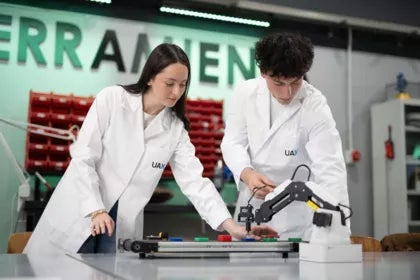
Degree in Industrial Electronics and Automation Engineering
In collaboration with:

Start:
September
Length:
4 years

Bachelor's Degree in Industrial Design Engineering and Product Development
In collaboration with:

Start:
September
Length:
4 years
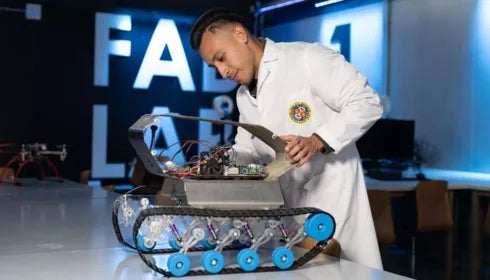
Degree in Mechanical Engineering
In collaboration with:

Start:
September
Length:
4 years
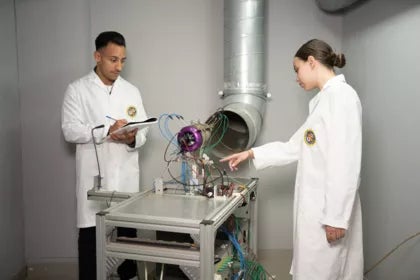
Bachelor’s Degree in Industrial Systems Engineering
Includes a professional certificate

Start:
September
Length:
4 years

Bachelor’s Degree in the Fundamentals of Architecture + Qualifying Master’s Degree
In collaboration with:

Start:
September
Length:
Five and a half years
The Degree Monitoring and Improvement Committee is made up of the degree programme management, two representatives of the degree teaching staff, two representatives of basic and specific subjects, two student representatives and one representative of the Vice-Rector's Office for Studies and Quality. In addition, guest members may be invited to deal with specific issues that need to be monitored.
This degree, according to RD 822/2021 (art. 34) must undergo the process of accreditation renewal. During the development of the process, an evaluation team from the Fundación para el Conocimiento Madrimasd will meet with different stakeholders of the degree. In addition, they provide us with a form so that any interested party can indicate to the Foundation those aspects they consider relevant to the development of this programme.