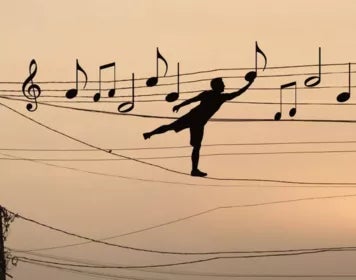
What is the Online Bachelor’s Degree in Applied Music Composition and Creation?
The Online Bachelor’s Degree in Applied Music Composition and Creation is an official university degree comprising 240 ECTS credits, which you can study entirely online. Spanning four academic years, it combines classical technical training for composers – including harmony, counterpoint and orchestration – with the most up-to-date applications: music for audiovisual media, video games, musical theatre and electroacoustic composition.
The curriculum is structured around three types of modules:
- Basic Training (FB): cross-disciplinary subjects shared with other degree programmes in the arts.
- Compulsory (OB): the specific core of the composition degree.
- Elective (OP): specialisation modules that you choose according to your career profile.
This curriculum ensures you have a solid foundation before moving on to the more creative and specialised areas.
In 2026, UAX announced a strategic partnership with Live Nation Spain, the world’s largest music promoter, to link the course with the real-world ecosystem of the music and live entertainment. This collaboration directly drove the development of the Bachelor’s Degree in Composition and Applied Music Creation.
What do you study in the first year?
The first year lays the foundations upon which you will build all your subsequent learning. Both semesters combine theoretical music theory with digital tools from day one.
First year
- Aural Training I: develop your perception of sound. Learning to listen actively and recognise intervals, chords and rhythmic structures is just as important as knowing how to write them down.
- Composition I: your first formal introduction to musical composition. You’ll work on phrasing, form and the internal coherence of your pieces.
- Harmony and Harmonic Languages I: the fundamentals of the tonal system, chords and their function. The foundation upon which the entire Western musical language is built.
- History and Analysis of Music I : the historical context enables you to understand where each technique comes from and why it sounds the way it does.
- Communication in a Foreign Language (English): English is the language of the global music industry. This module strengthens your communication skills so you can work in a borderless market.
- Composition II: you will progress in your composition skills by exploring more complex musical forms.
- Orchestration and Arrangement I: you will learn about the technical characteristics of each orchestral instrument and how to write idiomatically for them.
- History and Analysis of Music II: analysis of the Western musical repertoire from the early centuries to the late Baroque period.
- Musical Genres and Forms: you will study the major forms (sonata, fugue, suite, theme and variations) and the genres in which they have appeared throughout history.
- Digital Notation and Score Editing: you will master professional music notation software to write, edit and present your scores to a professional standard.
What do you study in the second year?
The second year expands your compositional tools, introduces the technological aspects of music production and prepares you to communicate as a professional in the sector.
Second year
- Aural Training II: consolidation and extension of the aural skills acquired in the first year.
- Composition III: more elaborate textures and greater autonomy in compositional decisions.
- Harmony and Harmonic Languages II: chromatic harmony, modulation and 20th-century harmonic languages.
- History and Analysis of Music III: from the Classical to the Romantic periods. A more technical and detailed structural analysis of the great works of the repertoire.
- Professional Communication Skills: you will learn to present projects, draft proposals and communicate with producers, directors and clients in the industry.
- Polyphonic Composition Techniques: counterpoint is one of the fundamental disciplines in any composer’s training. This module teaches you to master writing for multiple voices with technical rigour.
- Orchestration and Arrangement II: advanced orchestral techniques and arrangements for chamber and ensemble formations.
- History and Analysis of Music IV: contemporary repertoire and 20th-century avant-garde movements, from dodecaphonism to serialism and spectral music.
- Aesthetics: philosophical and theoretical reflection on music broadens your critical perspective and enriches your creative decisions.
- Computer Science and Music Technology I: an introduction to DAWs (Digital Audio Workstations) and the fundamentals of digital music production.
What do you study in the third year?
The third year marks a turning point in the degree programme. Your training moves beyond purely theoretical study, and you begin to create real-world projects applied to specific professional contexts.
Third year
- Composition IV: your compositional skills reach an advanced level. You work with forms and styles of greater structural and expressive complexity.
- Creative Projects I: you begin to develop your own musical projects with a professional approach, integrating the knowledge you have acquired over the previous two years.
- Philosophy of Music and Musical Thought: you explore the big questions surrounding music, its nature, its social function, and its relationship with language and emotion.
- Music Creation Applied to the Performing Arts: you will learn to compose for theatre, dance, opera and other performing arts, taking into account their specific expressive and synchronisation requirements.
- Music Production I: you will combine composition with studio work, including audio recording, editing and mixing.
- Orchestration and Arrangement III: an advanced-level course, with a particular focus on contemporary techniques of extended orchestral writing.
- Music Technology II: sound synthesis, advanced audio processing and production in a professional digital environment.
- Music Creation Applied to Audiovisual Media: you will learn to compose for films, TV series, advertising and documentaries, working with synchronisation techniques and sound design.
- Music Production II: mixing and mastering for complete music projects, geared towards commercial distribution.
- Elective I: first free-choice module to begin personalising your specialisation.
What do you study in the fourth year?
The final year consolidates your profile as a professional composer, with highly specialised modules, three creative projects and the Final Year Project.
Fourth year
- Applied Contemporary Compositional Techniques: 21st-century musical languages, ranging from spectralism to electronic concert music and computer-assisted composition.
- Creative Projects II: a larger-scale project demonstrating your artistic and technical maturity.
- Composition with Electroacoustic Media: integrating electronic and acoustic sounds into contemporary composition, working with synthesis, tape and sound spatialisation.
- Intellectual Property and Personal Branding: you will learn how to protect your work, register copyright, manage licences and build your professional identity as a composer.
- Music Creation Applied to Interactive Media and Video Games: the video game sector generates more revenue than the film and recorded music industries combined. You will learn specific techniques for interactive composition, adaptive audio and non-linear musical narrative.
- Creative Projects III: final creative project, which can serve as a direct basis for the Final Year Project.
- Elective II and Elective III: two further specialisation modules of your choice.
- Final Year Project (12 ECTS): the culminating project of the degree, carried out independently under the supervision of an expert.
Which electives can you choose?
Elective modules allow you to tailor your degree to the area that interests you most. In the third and fourth years, you have the following options:
| Third-year electives | Fourth-year electives |
| Music Creation Applied to Installations, Performance and Video Art | Songwriting |
| Sound Design and Soundscapes | Advanced Orchestral Composition |
| Harmony and Harmonic Languages | AI, Live Coding and Algorithmic Composition |
| Techniques of Choral Composition | Advanced Composition for Contemporary Ensemble |
| | Arrangements and Production for Modern Ensembles and Big Bands |
| | Applied Music Composition and Musical Theatre Production |
| | External Academic Placements |
Of particular note is the elective course IA, Live Coding and Algorithmic Composition, which directly addresses the transformation that artificial intelligence is bringing about in musical creative processes. Mastering these tools offers a clear competitive advantage in today’s job market.
Summary
The Music Composition curriculum of the UAX Online Bachelor’s Degree in Composition and Applied Music Creation is organised into four progressive years, each worth 60 ECTS credits. The first two years lay the technical foundations, covering harmony, counterpoint, analysis, history and digital tools. The third year introduces creative projects and composition applied to audiovisual media and the performing arts. The fourth year culminates in advanced specialisation, electroacoustic composition, composition for video games and the Final Year Project. Elective modules allow students to tailor their study path towards songwriting, AI applied to composition, or writing for large ensembles. A comprehensive, flexible programme that is closely linked to the most dynamic sectors of today’s music industry.
Frequently Asked Questions
How many ECTS credits are there in the Bachelor’s Degree in Composition and Applied Musical Creation? The degree comprises a total of 240 ECTS credits, spread over four years of study, each worth 60 credits. The Final Year Project accounts for 12 of these credits in the final year.
Is it possible to study Music Composition entirely online in Spain? Yes. The UAX Bachelor’s Degree in Applied Music Composition and Creation is delivered entirely online, allowing you to balance your studies with your musical activities or any other personal or professional commitments.
Is prior study of music required for admission? The entry requirements are the standard ones for any university degree in Spain: Baccalaureate + EBAU or equivalent. Although a prior music qualification is not compulsory, having a basic knowledge of musical theory makes it easier to follow the first-year modules.
What is the difference between this degree and studying at a higher conservatoire? Both pathways lead to the same level of qualification (MECES 2, 240 ECTS). The main difference lies in the approach: the conservatoire has a more academic and performance-oriented focus, whilst this university degree combines technical training with creative work applied to the audiovisual industry, video games and live entertainment.
Sources:

































.jpg.webp)