See all Online Master's Degrees in Health
See all Master's Degrees in Engineering
Most searched curriculums
Official Qualification
This officially recognised Master’s degree prepares you to lead nursing units and take on new roles in healthcare management, integrating emerging technologies such as digital health, care planning, mHealth, Big Data, research, management and leadership. Acquire the skills required for new roles in healthcare management and the leadership of nursing units. An officially recognised qualification, eligible for consideration in competitive examinations and public sector recruitment pools. Aimed at graduates with a degree in Nursing. Ranked No. 1 for the Best Master’s in Health Sciences in Spain, according to the 2026 Mundo Postgrado Ranking.
In collaboration with:
The Master’s Degree in Nursing Services Management prepares you to take on leadership or middle management roles in healthcare centres, with training based on agile methodologies, up-to-date content and a practical approach focused on real-world challenges in the healthcare sector. You will undertake a research project applied to healthcare management and gain a comprehensive understanding, with skills directly aligned with the sector’s requirements.
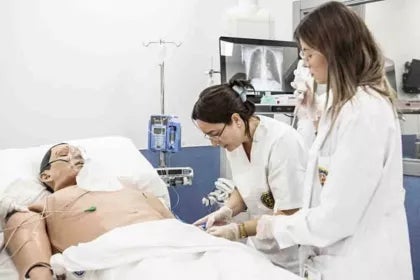
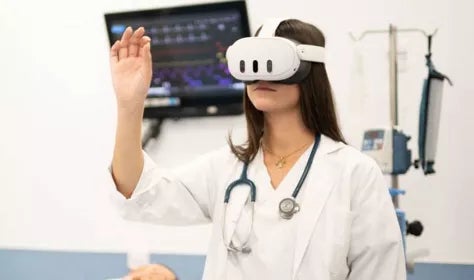
Specialise in healthcare management and lead innovation processes. You will learn to optimise resources, improve the quality of care and apply emerging technologies — such as artificial intelligence, Big Data and clinical simulation — to decision-making. The curriculum includes specialised modules in healthcare marketing, mHealth communication, digital tools and innovation, preparing you to lead digital transformation in complex and changing environments.
You will acquire key knowledge in the planning, leadership and management of nursing services, alongside managerial skills to coordinate teams, improve the patient experience and make strategic decisions. Furthermore, you will develop essential soft skills for healthcare leadership: communication, change management, critical thinking and a results-oriented approach.
Training in management, planning and optimisation of resources in health centres, with a practical focus and applied to the reality of healthcare.
Development of management skills to lead and coordinate nursing units, with a focus on planning and decision-making.
Differentiating subject focused on the use of AI, Big Data, IoT and clinical simulation.
You will learn to design research projects focused on improving healthcare quality.
Training in ICT, information systems and digital tools applied to health management.
Study of current management formulas: balanced scorecards, scheduling, chronic care, etc.
You will work on real cases, solve challenges in teams and apply the contents directly to professional contexts in the healthcare field.
This micro-credential equips you to use tools such as ChatGPT, Copilot, Gemini and Claude to analyse information, create content and optimise professional tasks, whilst integrating innovative solutions in an ethical and responsible manner within real-world contexts.

Develop your professional potential through leadership and interpersonal skills in healthcare settings. This micro-credential provides you with the keys to managing teams, communicating effectively and solving problems in real-world settings, by applying personal leadership techniques and practical productivity tools in the healthcare sector.
Master’s Degree in Nursing Services Management and Administration
First Year
ANNUAL SUBJECTS
| Code | Subjects | Character* | ECTS | ||||
|---|---|---|---|---|---|---|---|
| M131900 | Work placements | OB | 6 | ||||
Work placementsCódigo: M131900 Imprimir Year 1. Annual module. Compulsory. 6 credits. Profesores
Objectives Not applicable. Programme adapted to Royal Decree 822/2021. Entry requirements Hold a diploma or degree in Nursing. Competencies Not applicable. Programme adapted to Royal Decree 822/2021. Learning outcomes Knowledge RK0: Understands the structure, organisation and functioning of health and social care institutions, in order to promote the development of such institutions. RK1: Understands the management and leadership dynamics of public and private healthcare services to promote effective and efficient working practices within these institutions. RK10: Is familiar with the essential theoretical and practical aspects of Evidence-Based Nursing, with a view to developing and implementing good clinical practice. Skills and competences RS0: Applies different approaches to teamwork in order to exercise effective leadership. Competencies: RODS: Develops effective communication, teamwork, analytical thinking, creativity and ethical leadership from a cross-cutting perspective, clearly inspired by democratic principles and values, as well as the Sustainable Development Goals, in order to conduct oneself with integrity in the professional sphere. RC0: Proposes team management and leadership strategies to ensure the efficient, effective and high-quality management of the healthcare system. RC9: Carries out professional tasks relating to nursing management and leadership, using innovative tools within healthcare institutions, whilst applying the knowledge and skills acquired during the degree programme. RC10: Demonstrates the ability to work as part of a team, in collaboration with other professionals in the management team, to enhance communication and foster appropriate teamwork dynamics. Description of course content Professional placements in healthcare or social-healthcare centres External placements should facilitate the application, in real professional situations, of the competences, knowledge and skills acquired by the student. They will take place within the management departments of the centres and organisations with which the University has established the relevant educational collaboration agreements. Training activities AV2. Group classes (synchronous) – 2 hours AV4. Independent study, case studies, problem-solving and literature review (asynchronous) (TP) – 28 hours AV5. Virtual tutorial (blended) – 5 hours AV 7. External work placements (face-to-face) – 115 h Assessment system and criteria SE6: External tutor (40 per cent) SE7: Report by the academic tutor for the external placements (30 per cent) SE8: External placement report (30%) Appendix Bibliography: Kolb, D. A. (2015). Experiential Learning: Experience as the Source of Learning and Development (2nd ed.). Pearson Education. |
|||||||
| M131901 | Master’s Thesis | OB | 12 | ||||
Master’s ThesisCódigo: M131901 Imprimir Year 1. Annual module. Compulsory. 12 credits. Profesores
Objectives Not applicable. Programme adapted to Royal Decree 822/2021 Prerequisites Must have passed all modules. Learning outcomes Not applicable. Programme adapted to Royal Decree 822/2021 Learning outcomes Knowledge: RK0: Understands the structure, organisation and functioning of health and social care institutions, in order to promote the development of health and social care institutions. RK1: Understands the management and leadership dynamics of public and private healthcare services to promote effective and efficient working practices within these institutions. Skills and competences RS0: Applies different approaches to teamwork in order to exercise effective leadership. Competencies RODS: Develops effective communication, teamwork, analytical thinking, creativity and ethical leadership from a cross-cutting perspective, clearly inspired by democratic principles and values, as well as the Sustainable Development Goals, in order to conduct oneself with integrity in the professional sphere. RC0: Proposes strategies for team management and leadership to ensure the efficient, effective and high-quality management of the healthcare system. RC11: Summarises in a written assignment some of the challenges involved in the management of nursing services through constant updating and the integration of knowledge and technical foundations, with a view to presenting and defending it before an examination panel. Description of the course content Development of an original research project The content of the Master’s Thesis will be based on the development of an original piece of work agreed upon with the Thesis Supervisor. This work must be unpublished; it must not be purely bibliographical in nature; it must be designed so that the time invested by the student corresponds to the ECTS credits, and it must be distinct from any other work the student may have previously undertaken and which has already been academically assessed (Academically Supervised Projects, Reports, etc.). The thesis submitted must be defended before a university examination board in accordance with the assessment criteria outlined, and shall consist of a comprehensive project of a scientific nature. The permitted types of Master’s Thesis are: Research Project or Systematic Review. This project must demonstrate that the student has acquired the general and specific competences described in the general overview of this document. The minimum content to be covered in this project is as follows: Introduction Materials and methods Results Conclusions Bibliography Appendices Notes: The examination board shall consist of three members, all of whom shall hold a PhD and be members of the Master’s programme’s teaching staff or have experience in the field of nursing services management; one shall act as chair of the board, another as secretary, and the third as a member. The student’s supervisor may not be a member of the panel. The overall mark will take into account, at a minimum, the scientific and technical quality of the Master’s Thesis submitted, and the quality of the material provided. The assessment of the dissertation will include aspects such as: Achievement of the objectives initially set The student’s level of autonomy The student’s commitment to the Master’s Thesis Deductive reasoning Initiative and creativity Research skills Technical ability Clarity of written expression Training activities AV2. Group classes (synchronous) – 6 hours AV3. Project work and problem-solving (asynchronous) – 6 hours AV5. Virtual tutoring (blended) – 12 hours in total, 6 hours synchronous AV8. Master’s Thesis (asynchronous) – 274 hours AV9. Public oral defence (synchronous or face-to-face) – 2 h Assessment system and criteria SE4. Master’s Thesis report (40 per cent) SE5. Defence and presentation of the Master’s Thesis before the assessment panel (60 per cent) Appendix Bibliography: Creswell, J. W., & Creswell, J. D. (2023). Research design: Qualitative, quantitative, and mixed methods approaches (6th ed.). SAGE Publications. Greenhalgh, T. (2019). How to read a paper: The basics of evidence-based medicine and healthcare (6th ed.). Wiley-Blackwell. |
|||||||
| TOTAL: | 18 | ||||||
FIRST FOUR-MONTH PERIOD
| Code | Subjects | Character* | ECTS | ||||||||
|---|---|---|---|---|---|---|---|---|---|---|---|
| M131902 | Knowledge management | OB | 3 | ||||||||
Knowledge managementCódigo: M131902 Imprimir Course 1: First-term module. Compulsory. 3 credits. Profesores
Objectives Not applicable. Programme adapted to Royal Decree 822/2021. Prerequisites Hold a diploma or degree in nursing. Competencies Not applicable. Programme adapted to Royal Decree 822/2021. Learning outcomes RK1 Understands the dynamics of management and leadership in public and private healthcare services to promote effective and efficient working practices within organisations. RK10 Is familiar with the essential theoretical and practical aspects of Evidence-Based Nursing, with a view to developing and implementing good clinical practice. RS7 Applies the most innovative technological tools in knowledge management to provide healthcare and social care professionals with access to flexible training that is compatible with the working environment RC8 Develops continuing professional development plans within their department to ensure that professionals are adequately trained and qualified. Course content 1. Evidence-Based Nursing (EBN). Foundations and principles. Methodology and tools. Application to daily practice. Clinical practice guidelines 2. Continuing professional development in healthcare institutions. Planning training in nursing services. Management, evaluation and impact analysis. Funding for continuing professional development. 3. ICTs in knowledge management. Training activities AV 1. Lecture sessions (asynchronous) – 8 hours AV2. Interactive classes (synchronous) – 15 hours AV3. Project work and problem-solving (asynchronous) – 7 hours TA4. Self-study, case studies, problem-solving and literature review (independent work) – 40 hours AV5. Virtual tutorials (synchronous/asynchronous) – 3 hours AV6. Knowledge assessments (face-to-face) – 2 h Assessment system and criteria 1. Practical activities (case studies, problem-solving and challenges, project work, oral presentations, debates, etc.) (30 per cent) 2. Portfolio (20%). 3. Final assessment (50%). Appendix Bibliography: Melnyk, B. M., & Fineout-Overholt, E. (2023). Evidence-based practice in nursing & healthcare: A guide to best practice (5th ed.). Wolters Kluwer. Gray, M., Grove, S. K., & Sutherland, S. (2020). Burns and Grove’s The Practice of Nursing Research: Appraisal, Synthesis, and Generation of Evidence (9th ed.). Elsevier. |
|||||||||||
| M131903 | Leadership and team management | OB | 6 | ||||||||
Leadership and team managementCódigo: M131903 Imprimir Course 1: First-term module. Compulsory. 6 credits. Profesores
Objectives Not applicable. Adapted to Royal Decree 822/2021. Prerequisites Hold a diploma or degree in Nursing. Competencies Not applicable. Adapted to Royal Decree 822/2021. Learning outcomes RK1: Understands the dynamics of management and leadership in public and private healthcare services to promote effective and efficient working practices within organisations. RS0: Applies different approaches to teamwork in order to exercise effective leadership. RC2: Manages teams of staff in the healthcare sector to ensure effective team management and leadership. RC3: Carries out nursing staff management functions to ensure equity and the correct working dynamics within the nursing team. RC4: Develops the necessary managerial skills and tools for effective leadership to facilitate the management of nursing teams. RC8: Develops continuing professional development plans within their department to ensure that professionals are adequately trained and qualified. Course content 1. Leadership in nursing teams. Leadership styles. Management skills. 2. HR planning in nursing. Workforce management. 3. Skills and tools in people management. Motivation, recruitment, remuneration and incentives, career development. 4. Employment relations: Employment legislation. Recruitment. Occupational health and safety. 5. Continuing professional development in healthcare institutions. Planning training in nursing services. Management, evaluation and impact analysis. Funding for continuing professional development. Training activities AV1. Theoretical sessions (asynchronous) – 15 hours AV2. Group classes (synchronous) – 22 hours AV3. Project development and problem-solving (asynchronous) – 23 hours AV4. Independent study, case studies, problem-solving and literature review (practical work) – 80 hours AV5. Virtual tutoring (synchronous/asynchronous) – 7 hours AV6. Knowledge assessments (synchronous) – 3 h Assessment system and criteria 1. Practical activities (case studies, problem-solving and challenges, project work, oral presentations, debates, etc.) (20 per cent) 2. Portfolio (20%). 3. Final knowledge assessment (60%). Appendix Bibliography: Marquis, B. L., & Huston, C. J. (2023). Leadership Roles and Management Functions in Nursing: Theory and Application (11th ed.). Wolters Kluwer. |
|||||||||||
| M131904 | Research Methodology | OB | 6 | ||||||||
Research MethodologyCódigo: M131904 Imprimir Course 1: First-term module. Compulsory. 6 credits. Profesores
Objectives Not applicable. Programme adapted to Royal Decree 822/2021. Entry requirements Hold a diploma or degree in Nursing. Competencies Not applicable. Programme adapted to Royal Decree 822/2021. Learning outcomes RS0: Applies different teamwork approaches in order to exercise effective leadership. RK4: Understands the fundamental concepts of research in nursing and health services in order to apply them in healthcare and social care settings. RS2: Gains an in-depth understanding of the main quantitative and qualitative analytical methods in order to develop research projects. RC1: Integrates research programmes into the management of nursing services to promote research in the field of nursing. RK10: Understands the essential theoretical and practical aspects of Evidence-Based Nursing, with a view to developing and implementing good clinical practice. Description of the content 1. Nursing research. Fundamental concepts: the research question, research paradigm, literature search, variables. 2. Quantitative research design. Descriptive and analytical studies. 3. Qualitative research 4. Applied statistics 5. Management of nursing research. Funding 6. Evidence-Based Nursing (EBN). Foundations and principles. Methodology and tools. Application to daily practice. Clinical practice guidelines Training activities AV1. Theoretical sessions (asynchronous) – 15 hours AV2. Group classes (synchronous) – 22 hours AV3. Project development and problem-solving (asynchronous) – 23 hours AV4. Self-study, case studies, problem-solving and literature review (independent work) – 80 hours AV5. Virtual tutoring (synchronous/asynchronous) – 7 hours AV6. Knowledge assessments (synchronous) – 3 hours Assessment system and criteria 1. Practical activities (case studies, problem-solving and challenges, project work, oral presentations, debates, etc.) (20 per cent) 2. Portfolio (20%). 3. Final knowledge assessment (60%). Appendix Bibliography: Polit, D. F., & Beck, C. T. (2021). Nursing Research: Generating and Assessing Evidence for Nursing Practice (11th ed.). Wolters Kluwer. Gray, J. R., Grove, S. K., & Sutherland, S. (2020). Burns and Grove’s The Practice of Nursing Research: Appraisal, Synthesis, and Generation of Evidence (9th ed.). Elsevier. |
|||||||||||
| M131905 | Healthcare system and health economics | OB | 6 | ||||||||
Healthcare system and health economicsCódigo: M131905 Imprimir Course 1: First-semester module. Compulsory. 6 credits. Profesores
Objectives Not applicable. Programme adapted to Royal Decree 822/2021 Prerequisites Hold a diploma or degree in Nursing Competencies Not applicable. Programme adapted to Royal Decree 822/2021 Learning outcomes RK0 – Understands the structure, organisation and functioning of health and social care institutions, in order to promote the development of such institutions RK2 – Identifies the main healthcare and social care models, their existing organisational structures and key characteristics, so as to be able to apply this knowledge to their working environment RK3 – Is familiar with the main measures of healthcare outcomes and their implications for healthcare organisation, in order to measure, design, plan and implement plans within a healthcare institution RS1 – Applies strategies for the efficient management of healthcare institutions, based on an understanding of the economic and financial structure of a healthcare organisation Course content description Two modules: Module 1: The healthcare system 1. Healthcare systems. 1.1. Main models of healthcare systems worldwide. Key characteristics. The Beveridge model, the Bismarck model. Other healthcare models. 1.2. The Spanish healthcare system. Basic legal framework. Key characteristics. 1.3. Main organisational models for healthcare service providers. 2. Social and healthcare integration. 2.1. Levels of care. Overview. 2.2. Social and healthcare coordination. The role of the liaison nurse. Module 2: Health economics. 1. Economics in the healthcare sector. 1.1. Concept. Importance. 1.2. Health outcomes. Measuring health outcomes. 1.3. Economic evaluation in healthcare. 2. The economic and financial structure of a healthcare organisation. 2.1. Concept of the economic and financial structure. 2.2. The Balance Sheet and the Profit and Loss Account. Interpretation and analysis 2.3. The operating account. Concept and preparation. 2.4. Economic and financial indicators and ratios. Concept, calculation and interpretation. 3. The budgetary cycle of a healthcare organisation. 3.1. Economic valuation of clinical activity. 3.2. Budget preparation. Training activities AV1. Theoretical sessions (asynchronous) – 15 hours AV2. Group classes (synchronous) – 22 hours AV3. Completing assignments or projects and solving challenges (asynchronous) – 23 hours AV4. Independent study, case studies, problem-solving and literature review (TP) – 80 hours AV5. Online tutoring (blended) – 7 hours AV6. Knowledge assessments (synchronous) – 3 h Assessment system and criteria 1. Practical activities (solving case studies, problems and challenges; carrying out projects; oral presentations; debates, etc.) (20 per cent) 2. Portfolio (20%). 3. Final knowledge assessment (60%). Appendix Bibliography: Blank, R. H., & Burau, V. (2014). Comparative health policy (4th ed.). Palgrave Macmillan. |
|||||||||||
| M131910 | Project Management and Innovation in Care Services | OB | 3 | ||||||||
Project Management and Innovation in Care ServicesCódigo: M131910 Imprimir Course 1: First-term module. Compulsory. 3 credits. Profesores
Objectives Not applicable. Programme adapted to Royal Decree 822/2021 Entry requirements An official Spanish university diploma or degree in nursing, or another qualification of equivalent issued by a higher education institution within the European Higher Education Area (EHEA) which, in the country issuing the qualification, entitles the holder to access Master’s degree programmes. Competencies Not applicable. Programme adapted to Royal Decree 822/2021 Learning outcomes RK1: Understands the dynamics of management and leadership in public and private healthcare services to promote effective and efficient working practices within institutions. RS3: Learns the principles and tools of nursing management with a view to ensuring efficient management. RS7: Applies the most innovative technological tools in knowledge management to provide healthcare and social care professionals with access to flexible training that is compatible with the working environment. RC0: Develops team management and leadership strategies to ensure efficient, effective and high-quality management of the healthcare system. RC2: Manage teams of staff in the healthcare sector in order to ensure effective team management and leadership. RODS: Develops effective communication, teamwork, analytical thinking, creativity and ethical leadership from a cross-cutting perspective, clearly inspired by democratic principles and values, as well as the Sustainable Development Goals, in order to conduct oneself with integrity in the professional sphere. Course content description Strategy in nursing services. Analysis of the healthcare environment. Competitive advantage in public and private management. Applied strategic planning. Design and management of healthcare projects. Identification of opportunities for improvement. Definition of SMART objectives. Resource and schedule management. Key performance indicators (KPIs). Innovation and organisational transformation. Incremental versus disruptive innovation. Change management. Leadership in transformative environments. Operational management and performance monitoring. Balanced scorecards. Information systems. Impact assessment. Data-driven decision-making. Training activities AV1. Theoretical sessions (asynchronous) – 8 hours AV2. Group classes (synchronous) – 8 hours AV10. Workshop or laboratory activities (synchronous) – 7 hours AV3. Project development and problem-solving (asynchronous) – 8 hours V4B. Course forum (asynchronous) – 7 hours AV4. Independent study, case studies, problem-solving and literature review (TA) – 40 hours AV5. Virtual tutorial (synchronous) – 3 h AV7. Knowledge assessments (synchronous) – 2 h Assessment system and criteria 1. Practical activities (case studies, problem-solving and challenges, project work, oral presentations, debates, etc.) (20 per cent) 2. Portfolio (20 per cent) 3. Final knowledge assessment (60%) Appendix Bibliography: Kaplan, R. S., & Norton, D. P. (1996). The balanced scorecard: Translating strategy into action. Harvard Business School Press. |
|||||||||||
| TOTAL: | 24 | ||||||||||
SECOND FOUR-MONTH TERM
| Code | Subjects | Character* | ECTS | ||||||
|---|---|---|---|---|---|---|---|---|---|
| M131906 | Leadership and management of care services | OB | 6 | ||||||
Leadership and management of care servicesCódigo: M131906 Imprimir Course 1: Second-term module. Compulsory. 6 credits. Profesores
Objectives Not applicable. Programme adapted to Royal Decree 822/2021 in accordance with quality standards. Prerequisites Hold a diploma or degree in Nursing. Competencies Not applicable. Programme adapted to Royal Decree 822/2021 in accordance with quality standards. Learning outcomes RC0: Proposes team management and leadership strategies to ensure the efficient, effective and high-quality management of the healthcare system. RC5: Successfully carries out managerial functions relating to the evaluation and monitoring of care provision, alongside the strategic planning of health services, in order to ensure excellence in healthcare management and leadership. RK5: Is familiar with the main nursing care models and the new professional roles in nursing, enabling them to manage nursing teams to the highest standards of quality and efficiency. RS3: Learns the principles and tools of nursing management in order to manage efficiently. Course content description 1. Leadership and strategic planning in nursing. 2. Current models of nursing management. Patient-centred care. Self-care models. Case management nursing and models of care for chronic conditions. Alternatives to hospitalisation: Home hospitalisation; Day hospital. Care management and work organisation. Advanced practice nursing. 3. Clinical management tools. Clinical pathways. Process-based management. 4. Lean Healthcare Management. Efficiency in care management. 5. Evaluation and monitoring of nursing services. Cost-effectiveness, cost-benefit and cost-utility analyses. Training activities AV 1. Theoretical sessions (asynchronous) – 15 hours AV2. Group classes (synchronous) – 22 hours AV3. Project work and problem-solving (asynchronous) – 23 hours AV4. Independent study, case studies, problem-solving and literature review (practical work) – 80 hours AV5. Virtual tutoring (synchronous/asynchronous) – 7 h AV6. Knowledge assessments (synchronous) – 3 h Assessment system and criteria 1. Practical activities (case studies, problem-solving and challenges, project work, oral presentations, debates, etc.) (20 per cent) 2. Portfolio (20 per cent) 3. Final knowledge assessment (60%) Appendix Bibliography: Marquis, B. L., & Huston, C. J. (2024). Leadership Roles and Management Functions in Nursing: Theory and Application (11th ed.). Wolters Kluwer. Huber, D. (2021). Leadership and Nursing Care Management (7th ed.). Elsevier. |
|||||||||
| M131907 | Quality Management and Patient Safety | OB | 6 | ||||||
Quality Management and Patient SafetyCódigo: M131907 Imprimir Course 1: Second-term module. Compulsory. 6 credits. Profesores
Objectives Not applicable. Programme adapted to Royal Decree 822/2021. Prerequisites Hold a diploma or degree in nursing. Competencies Not applicable. Programme adapted to Royal Decree 822/2021. Learning outcomes Knowledge RK9: Learns the essential elements of quality audits in healthcare, with the aim of successfully passing them. Skills and competences RS6: Applies the main quality models in the healthcare sector to improve management. Competencies RC0: Devise management and team leadership strategies to ensure the efficient, effective and high-quality management of the healthcare system. RC7: Develop a culture of patient safety within your organisation to ensure that the process of continuous quality improvement is carried out. Course description 1. Quality in Healthcare. History of quality. Fundamentals. 2. Main quality management models in healthcare centres. ISO. EFQM, Joint Commission. Certification and accreditation. 3. Planning, design and development of healthcare quality plans in nursing units. 4. Patient safety. General concepts. Risk management. Key risks in the nursing environment. Adverse events. Recording and reporting. 5. Developing a culture of patient safety. Tools for analysing adverse events. Improvement strategies. Training activities AV 1. Theoretical sessions (asynchronous) – 15 hours AV2. Group classes (synchronous) – 22 hours AV3. Project work and problem-solving (asynchronous) – 23 hours AV4. Independent study, case studies, problem-solving and literature review (practical work) – 80 hours AV5. Virtual tutorials (synchronous/asynchronous) – 7 in total, 3 synchronous AV6. Knowledge assessments (synchronous) – 3 hours Assessment system and criteria 1. Practical activities (case studies, problem-solving and challenges, project work, oral presentations, debates, etc.) (20 per cent) 2. Portfolio (20%) 3. Final knowledge assessment (60%) Appendix Bibliography: Donabedian, A. (2003). An Introduction to Quality Assurance in Health Care. Oxford University Press |
|||||||||
| M131908 | Innovation and new technologies applied to healthcare | OB | 6 | ||||||
Innovation and new technologies applied to healthcareCódigo: M131908 Imprimir Course 1. Second-term module. Compulsory. 6 credits. Profesores
Objectives Not applicable. Adapted to Royal Decree 822/2021. Prerequisites Hold a diploma or degree in nursing. Competencies Not applicable. Adapted to Royal Decree 822/2021. Learning outcomes RS0 Applies different teamwork approaches in order to exercise effective leadership RS5 Manages relevant information and works with large volumes of data from information systems to ensure the quality management of nursing services. RK7 Identifies the key elements of new technologies applied to healthcare, in order to promote technological innovation and the digital transformation of healthcare organisations RK8 Understands the development of innovation processes or new technologies in healthcare settings in order to apply them and add value to nursing care and support Course content description 1. New Technologies in Nursing. Digital competencies of the healthcare leader. 2. Information Systems and Patient Classification. Analysis of the nursing output. Prediction and analysis. Precision in care. 3. The digital transformation of healthcare. Development of healthcare innovation plans. 4. Artificial Intelligence, IoT, Big Data and Machine Learning in healthcare. 5. Clinical Simulation Training activities AV 1. Lecture Sessions (asynchronous) – 15 hours AV2. Interactive classes (synchronous) – 22 hours AV3. Project work and problem-solving (asynchronous) – 23 hours AV4. Independent study, case studies, problem-solving and literature review (self-directed work) – 80 hours AV5. Virtual tutoring (synchronous/asynchronous) – 7 hours AV6. Knowledge assessments (face-to-face) – 3 hours Assessment system and criteria 1. Practical activities (20 per cent): Student participation in the various activities (10 per cent) + Completion of online tests (10 per cent) 2. Portfolio (20 per cent): Assessment of reports on various assignments, projects and case studies set for completion, applying the knowledge acquired in the different modules (20 per cent). 3. Final knowledge assessment (60%): An in-person written examination that comprehensively assesses the skills acquired by the student (60%). Appendix Bibliography: McGonigle, D., & Mastrian, K. G. (2024). Nursing Informatics and the Foundation of Knowledge (6th ed.). Jones & Bartlett Learning. |
|||||||||
| M131909 | Marketing, communication and mHealth | OB | 3 | ||||||
Marketing, communication and mHealthCódigo: M131909 Imprimir Course 1: Second-term module. Compulsory. 3 credits. Profesores
Objectives Not applicable. Adapted to Royal Decree 822/2021. Prerequisites Hold a diploma or degree in Nursing. Competencies Not applicable. Adapted to Royal Decree 822/2021. Learning outcomes RC0: Proposes team management and leadership strategies to ensure the efficient, effective and high-quality management of the healthcare system. RC6: Develops the communication strategies required of a healthcare manager, with a view to applying them in healthcare settings. RK6: Learns the basic principles of healthcare marketing to design and implement efficient strategies. RS4: Utilises the benefits offered by mobile technologies in the management of nursing services to ensure the efficient and effective management of nursing services. Course content description 1. Marketing in healthcare services. The role and objectives of marketing. The dimensions of healthcare marketing. The healthcare service. Marketing strategies. Structuring the provision of healthcare services. 2. Internal marketing. The internal marketing mix in healthcare. 3. Communication and brand image. 4. mHealth. Mobile health and the connected patient. Health apps. The Liquid Hospital. Training activities AV 1. Theoretical sessions (asynchronous) – 8 hours AV2. Group classes (synchronous) – 15 hours AV3. Project development and problem-solving (asynchronous) – 7 hours AV4. Independent study, case studies, problem-solving and literature review (practical work) – 40 hours AV5. Online tutoring (synchronous/asynchronous) – 3 h AV6. Knowledge assessments (synchronous) – 2 h Assessment system and criteria 1. Practical activities (case studies, problem-solving and challenges, project work, oral presentations, debates, etc.) (20 per cent) 2. Portfolio (20 per cent) 3. Final knowledge assessment (60%) Appendix Bibliography: Kotler, P., Shalowitz, J., & Stevens, R. J. (2021). Strategic Marketing for Health Care Organisations: Building a Customer-Driven Health System (3rd ed.). Jossey-Bass. Berkowitz, E. N. (2021). Essentials of Health Care Marketing (5th ed.). Jones & Bartlett Learning |
|||||||||
| M131911 | Digitalisation and New Technologies in Healthcare | OB | 6 | ||||||
Digitalisation and New Technologies in HealthcareCódigo: M131911 Imprimir Course 1. Second-term module. Compulsory. 6 credits. Profesores
Objectives Not applicable. Programme adapted to Royal Decree 822/2021. Prerequisites An official Spanish university diploma or degree in Nursing, or another qualification with equivalent educational content awarded by a higher education institution within the European Higher Education Area (EHEA) which, in the country issuing the qualification, entitles the holder to access Master’s degree programmes. Competencies Not applicable. Programme adapted to Royal Decree 822/2021 Learning outcomes RK7: Identifies the key elements of new technologies applied to healthcare, in order to promote technological innovation and the digital transformation of healthcare organisations. RK8: Understands the development of the innovation process or new technologies in healthcare settings in order to apply them and add value to nursing care and support. RS0: Applies different teamwork approaches in order to exercise effective leadership. RS5: Manages relevant information and works with large volumes of data from information systems to ensure the quality management of nursing services. RS7: Applies the most innovative technological tools in knowledge management to provide healthcare and social care professionals with access to flexible training that is compatible with the working environment. Course content description 1. New Technologies in Nursing. Digital skills for healthcare leaders. 2. Information systems and patient classification. Analysis of nursing outcomes. Prediction and analysis. Precision in care. 3. The digital transformation of healthcare. Development of healthcare innovation plans. 4. Artificial Intelligence, IoT, Big Data and Machine Learning in Healthcare. 5. Clinical Simulation Training activities AV1. Theoretical sessions (asynchronous) – 15 hours AV2. Group classes (synchronous) – 22 hours AV3. Preparation of assignments or projects and problem-solving (asynchronous) – 23 hours AV4. Independent study, case studies, problem-solving and literature review (TP) – 80 hours AV5. Virtual tutoring (synchronous/asynchronous) – 7 h AV6. Knowledge assessments (synchronous) – 3 h Assessment system and criteria 1. Practical activities (case studies, problem-solving and challenges, project work, oral presentations, debates, etc.) (20 per cent) 2. Portfolio (20%) 3. Final knowledge assessment (60%) Appendix Essential reading: - Delaney C W, Weaver C A, Sensmeier J, Pruinelli L and Weber P (eds.) (2022) Nursing and informatics for the 21st century: embracing a digital world. Book 1: Realising Digital Health: Bold Challenges and Opportunities for Nursing. 3rd ed. New York: Routledge. - Vasilica C M, Gillaspy E and Withnell N (2023) Digital skills for nursing studies and practice. London: Learning Matters. Specific bibliography: - Morin, A. et al. (2025). Grounded in Proficiency: A Crosswalk Between Nurse Leader Digital Transformation Guidelines and Core Competencies. *Nurse Leader*. Analyses the digital competencies of nursing leadership. |
|||||||||
| TOTAL: | 27 | ||||||||
*Character: BT: Basic Training, Ob: Required, Op: Optional
At UAX, you can balance your studies with your professional and personal life. What sets us apart is our barrier-free approach, centred on you and your desire to learn.
What is our online approach like?
Teaching consists of 100% online classes and face-to-face practical sessions to help you achieve your qualification.
From day one, we prepare students to advance their professional careers by acquiring managerial skills and competencies. To this end , we place particular emphasis on practical learning, which you will gain from expert professionals currently holding management positions, who will provide you with a realistic, down-to-earth and up-to-date insight into the sector.
Work placements are organised to ensure your experience is enriching ( rotation through various areas of management).
Students will be able to undertake external academic work placements in prestigious hospitals and healthcare centres, including:
The full list of centres with which UAX has collaboration agreements for external academic placements can be found via the following link.
The flexibility of online learning, with opportunities to connect
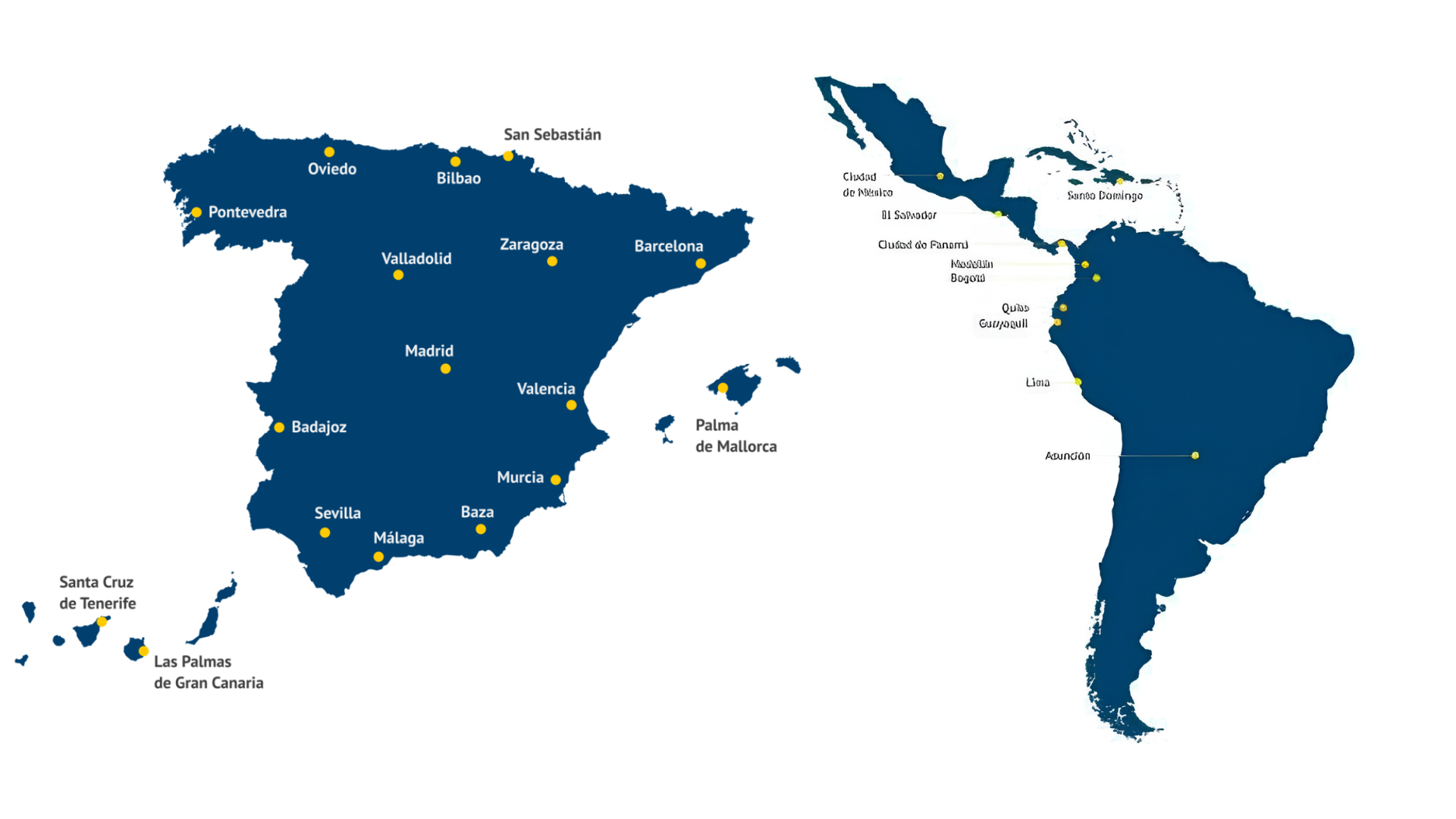
Take your exams online wherever you are or, if you prefer, in person at our designated centres in Spain and Latin America, subject to availability and capacity.
Furthermore, as a student at UAX Online, you’ll have access to our Campus Hubs, a network of exclusive physical spaces where you can study, access libraries, work in co-working areas and connect with other students. Because studying online doesn’t mean studying alone.
Campus Hubs available in: Alcobendas, Alcorcón, Valencia San Vicente, Murcia, Barcelona, Málaga, Seville and Arganda.
Access is granted with your UAX student card, subject to availability and the opening hours of each centre.
You can view the full list of academic staff via the following link.
Thanks to UAX’s more than 8,800 agreements with institutions and companies in the healthcare sector, you will be able to undertake your work placements at leading healthcare centres. Furthermore, if you are a practising professional, you can apply for an accreditation assessment to have your professional experience recognised, making it easier to balance your master’s degree with your work commitments.
Faculty

Graduate in Nursing, with postgraduate training in emergency medicine, intensive care, nursing prescription and health services management. She has extensive experience in care and supervision in emergency, ICU, hospitalisation and radiodiagnosis in highly complex hospitals. She is currently Vice-Dean of Nursing and Psychology.

Secretary General of the General Nursing Council of Spain. Nurse manager with more than 30 years of experience in healthcare leadership, including more than eleven years as Director of Nursing in university hospitals. Doctor and MBA, his career integrates executive management, leadership research and university teaching, and he is the author of several reference works on care management and quality of care.

Deputy Director of Research at the Spanish Institute of Nursing Research. She has more than a decade of experience in senior nursing management, having been Deputy Director at leading university hospitals such as Gregorio Marañón and Puerta de Hierro. Her career combines clinical leadership and strategic management, backed by postgraduate training in health management and human resources.

PhD in Biochemistry and Molecular Biology, with extensive experience in clinical research project management, clinical trial management and university teaching. He is currently Clinical Site Director at FutureMeds and has solid experience in team leadership, regulatory compliance, quality management, research methodology and knowledge transfer to healthcare.

Doctor and graduate in Nursing and Speech Therapy, with an extensive career in healthcare and healthcare management. She is currently Director of Nursing at Quirónsalud A Coruña Hospital. She has experience in emergency, haemodynamics and pre-hospital care, as well as in team leadership, care quality and clinical management in complex hospital environments.

PhD in Health Sciences, with an extensive clinical career as a nurse, and solid experience in university teaching and research in the field of nursing. She has developed her professional career combining nursing practice, academic leadership and research activity, being principal investigator of a group focused on nursing care.

Graduate in Nursing, specialist in Geriatrics, and Graduate in Business Administration and Management. He has advanced training in analysis and management, with a Master's degree in Applied Statistics, a Master's degree in Public Policy Evaluation and a PhD in Applied Economics. His professional career combines economic-financial management in the field of social and health care with university teaching.

Graduate in nursing with postgraduate training in emergency medicine, perinatal care and management. Extensive healthcare and supervisory experience in hospital settings, with experience in emergencies, specialised care and coordination of care for ostomised patients. Currently Nursing Supervisor at the Hospital Universitario Rey Juan Carlos.

He holds a Diploma in Nursing and is a PhD candidate in Education at the UAH, with a strong track record in healthcare management, team leadership and university teaching. He has spent his professional career working in highly complex hospital settings. He is currently Project Manager of the One Health Business Unit at UAX.

PhD in Health Sciences and researcher specialising in the field of social and health care and neuromuscular diseases. She combines a solid dual training as a Graduate in Nursing and Occupational Therapist with more than a decade of experience in the academic and associative environment. She is a member of the Advisory Committee of the Spanish Federation for Rare Diseases and runs her own professional initiative, CuidandodeTO.
Number of places for new students:
120 places (60 online and 60 blended learning).
Entry requirements
The entry requirements will be determined in accordance with the provisions of Royal Decree 822/2021 of 28 September, which regulates access to and admission to official Master’s degree programmes, as set out in Article 18.
Entry requirements
The entry requirements for this Master’s programme are that applicants must hold an official Spanish university diploma or degree in nursing, or an equivalent qualification issued by a higher education institution within the European Higher Education Area (EHEA) which, in the country issuing the qualification, entitles the holder to access Master’s degree programmes.
Where demand exceeds supply, the following admission criteria will apply:
The Admissions Department, in coordination with the Head of Studies, will be responsible for managing and assessing applications for admission to the programme. In the event of any queries or appeals, the case will be referred to the Faculty/School Board to which this Master’s degree programme is affiliated.
Alfonso X El Sabio University has approved and published regulations brought into line with Royal Decree 822/2021 to address the transfer and recognition of credits.
https://www.uax.com/download/9959/file/Normativa-TRC.pdf
The Master’s Degree in Nursing Services Management and Leadership provides for the recognition of up to 6 ECTS credits for the external academic placement module on the basis of professional experience.
The recognition of credits for professional experience will require a personalised and detailed assessment to advise the student on which activities within the workplace ensure the acquisition of the set of competences specific to the degree; this assessment will be carried out by the degree’s credit recognition committee and the UAX admissions department.
According to the World Economic Forum, it is estimated that Spain must increase the number of nursing professionals by 80%, incorporating 238,000 new professionals by 2030.
What positions will you be able to apply for?
That’s what the rankings say
Alfonso X el Sabio University (UAX) is ranked amongst the best universities in Spain according to the leading rankings.
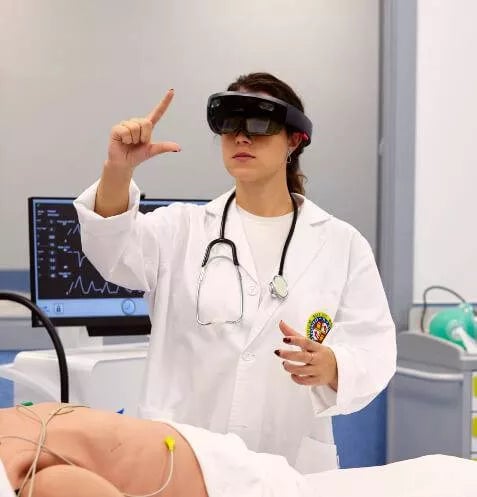
Forbes ranks UAX as the private university with the most graduates working in its area (nearly 90%), thanks to a unique educational model firmly linked to the labour market through more than 8,800 agreements with companies.
The prestigious ranking of the BBVA Foundation and the IVIE recognises us as the university with the best job placement in Spain in 2023, consolidating our model focused on the real employability of our graduates.
The Coordenadas Institute of Governance and Applied Economics places UAX as the private university of reference in Madrid, highlighting our practical training model aligned with the reality of the market.
Ranked as the second-best university in Spain for studying nursing, with particular emphasis on specific qualifications such as the Diploma of Expertise in A&E, Emergencies and Critical Care and the AHA’s Basic and Advanced Life Support Certification.
A unique centre in Spain to complete your training in the most innovative, well-rounded way. Find out more

First healthcare facility created by UAX to provide you with the most comprehensive training focused on real-world practice. Find out more
Study from wherever you like without missing out on a university experience that is accessible, practical and geared towards your professional development.
Live lessons that are always available
Flexibility to study at your own pace
Practical learning based on real-life cases
Personalised academic support
Teachers who are currently working and have links to the sector
Training aimed at improving employability
Scholarships and financial support for studying at UAX
We know that studying is an investment. That’s why we want to remove financial barriers and make things easier for you. Fill in the form and let our advisers help you discover the scholarships, agreements and personalised financial support that best suit your situation.

Ministry of Education, Vocational Training and Sport
Find out about the scholarships and grants offered by the Ministry of Education, Vocational Training and Sport, categorised by type and level of education.

Attracting Pre-doctoral Research Talent
Financial support for outstanding students who wish to carry out innovative research and contribute to the advancement of knowledge in their disciplines.
If you’ve already decided to take the plunge, enrol early and benefit from a direct grant. It’s a way of rewarding your commitment and helping you plan for your future with a head start.
*Please speak to your adviser at UAX Mare Nostrum

Students from Ibero-America
This programme is aimed at Ibero-American citizens or foreign nationals legally resident in countries within the OEI’s sphere of influence. The scholarship covers a 50 per cent discount on the total tuition fees.

Students from Ecuador
This programme is aimed at citizens with Ecuadorian nationality and/or residence who wish to undertake an online master’s degree in Spain. The scholarship covers a 50 per cent discount on the total tuition fees.

2025, 2nd Edition
Grants for students on higher-level vocational training, undergraduate, postgraduate or master’s programmes enrolled at Spanish universities with a Santander agreement. A financial supplement to support you whilst undertaking your work placements.
If you graduated from UAX and are now thinking of studying for a new degree, we want to continue supporting you. That’s why we’re offering you a 10% discount on tuition fees.
If you have an immediate family member (up to second degree of kinship) enrolled at UAX, you can benefit from a 5 per cent discount on tuition fees. Because studying as a family is even better.
Studying for two degrees at the same time is a challenge, and we want to support you. If you’re already at UAX and enrol on a second degree programme, you’ll receive a grant towards your booking fee and tuition fees.
If you’d like to continue your studies with us and progress from vocational training to a bachelor’s degree, from one bachelor’s degree to another, or from a bachelor’s degree to a postgraduate degree, we’re here to support you with a grant covering up to 25 per cent of your tuition fees.
If you have a strong academic record, we would like to recognise your talent with a scholarship designed for new students. (Excludes the degree in Medicine).
*Terms and conditions to be published
If you’re a high-performance athlete, at UAX we want to help you balance your passion with your studies. We offer specific grants that can cover up to 50 per cent of your tuition fees.
*Please speak to your advisor at UAX Mare Nostrum
We need to know a little bit about you so that we can provide you with a personalised service.

All fields are required
Other related qualifications
We offer a wide range of academic programmes, so you’re sure to find one that suits you.

Master’s Degree in Adult A&E for Nursing Professionals
In collaboration with:
Start:
October
Length:
9 months
Master’s Degree in Healthcare Management (Online)
In collaboration with:
Start:
October
Length:
9 months
Online Master's Degree in Bioinformatics
Start:
October
Length:
9 months
Degree in Nursing
In collaboration with:
Start:
September
Length:
4 years
UAX promotes a culture of quality within the university community through the UAX Quality System (SIUAX), for which the University Management bears ultimate responsibility, ensuring that the system’s planning is implemented to effectively meet quality objectives and satisfy the needs, requirements and expectations of customers and stakeholders.
The bodies responsible are:
The Degree Programme Monitoring and Improvement Committee is composed of:
You can view the various indicators via the following links:
Improvement measures implemented within the degree programme:
Enquiries, complaints and claims
We respond to the genuine needs of our students and staff, because we believe in the continuous improvement of our results. That is why we always want to hear whatever you have to say.
If you are already part of UAX, please visit the ‘Customer Service: complaints, suggestions and compliments’ section on thevirtual campus , logging in with your username and password.
This degree, according to RD 822/2021 (art. 34) must undergo the process of accreditation renewal. During the development of the process, an evaluation team of the Foundation for Knowledge Madrimasd will meet with different stakeholders of the degree. In addition, they provide us with a form so that any interested party can indicate to the Foundation those aspects they consider relevant to the development of this programme.