




















Table of Contents
What should you study to become a Clinical and Biomedical Laboratory Technician?
Where can you study Clinical and Biomedical Laboratory Technology?
What to bear in mind when choosing a centre
Study modes: face-to-face, blended learning and online
The importance of practical training
Why is it important to choose your place of study carefully?
Choosing where to study to become a Clinical and Biomedical Laboratory Technician is not just a question of the institution or delivery method, but of understanding what kind of training you need to thrive in a real healthcare environment. This professional role requires precision, technical judgement and the ability to work with specialised technology, so the quality of your training is crucial right from the start. If you’re considering this option, it’s worth finding out what pathways are available, what you should bear in mind when choosing an institution, and how to ensure that your training truly prepares you for today’s clinical and biomedical environment.
What do you need to study to become a Clinical and Biomedical Laboratory Technician?
To work in this field, you must complete the official Higher National Diploma in Clinical and Biomedical Laboratory Technology, an advanced vocational training programme focused on the analysis of biological samples and support for clinical diagnosis. During the course, you will acquire knowledge relating to:
- Clinical and biomedical analysis
- Laboratory techniques
- Microbiology and biochemistry
- Management of biological samples
- Healthcare regulations and quality control
This is a technical course, where it is not just theory that matters, but the ability to apply procedures rigorously in a professional setting.
Where can you study Clinical and Biomedical Laboratory Science?
When deciding where to study Clinical and Biomedical Laboratory Science, there are several options within the Spanish education system. However, not all institutions offer the same level of specialisation or the same learning conditions. Generally speaking, you can find this course at:
- Public vocational training centres
- Specialised private centres
- Educational institutions with a healthcare focus
The difference usually lies not only in the curriculum — which is set by the government — but also in how the course is taught and the resources available during the training.
What to bear in mind when choosing a centre
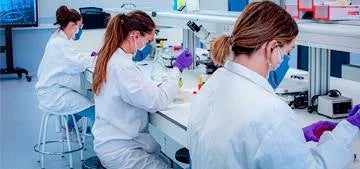
Beyond location or cost, there are several factors that make a difference when choosing where to study to become a clinical and biomedical laboratory technician. One of the key aspects is access to practical settings. This course requires students to familiarise themselves with laboratory equipment, protocols and working practices, so it is important that the training has a practical focus. It is also worth assessing the centre’s links with the professional world. The opportunity to undertake work placements in hospitals, clinics or laboratories is crucial for gaining real-world experience and facilitating entry into the job market. Another important point is whether the course content is kept up to date. The biomedical field is evolving rapidly, so it is important that the course is aligned with the sector’s current techniques and tools.
Study modes: face-to-face, blended learning and online
Depending on your personal circumstances, you can choose from different study formats. The face-to-face format allows for greater immersion in the learning environment and provides access to practical resources right from the start. On the other hand, online or blended learning may offer greater flexibility, although these programmes will always require a practical component in a real-world setting. Which option you choose will depend on your availability, but also on how you prefer to learn and the type of learning experience you are seeking.
The importance of practical training
In a course such as this, the practical component is not merely a supplement, but the very core of the training. Working with biological samples, following strict protocols or handling technical equipment requires real-world training. That is why it is essential that the institution provides Work-Based Learning (WBL) in healthcare settings, where you can apply what you have learnt and understand how a clinical laboratory operates on a day-to-day basis. This experience often makes all the difference when it comes to entering the job market.
Why is it important to choose your place of study carefully?
The healthcare sector is demanding and requires well-trained professionals. Choosing the right place to study to become a clinical and biomedical laboratory technician directly influences your ability to adapt to a real-world professional environment. It is not just about obtaining a qualification, but about developing technical skills, professional judgement and confidence in your day-to-day work. In this regard, training in an environment that combines a solid theoretical foundation with practical application can help you build a more competitive profile right from the start.
Career prospects for clinical laboratory technicians
Upon completion of the Higher Technical Diploma in Clinical and Biomedical Laboratory Technology, graduates can work in various settings within the healthcare system and the scientific sector, where sample analysis is key to diagnosis, research or quality control. This is a technical role closely linked to the inner workings of the healthcare system, with a presence across multiple areas and duties that require precision, responsibility and knowledge of clinical protocols. In practice, career opportunities are not limited to a single type of centre, but span different settings where laboratory work is essential:
1) Clinical analysis laboratories
This is the most common setting. Here, the technician works with biological samples such as blood, urine or tissue to carry out analyses that enable the detection of diseases, the monitoring of treatments or the prevention of conditions. For example, they may be responsible for preparing samples, operating automated equipment or validating results under medical supervision.
2) Hospitals and health centres
Within the hospital setting, technicians in this role form part of the diagnostic team, working alongside doctors and other healthcare professionals. Their work is crucial in areas such as microbiology, haematology and clinical biochemistry. On a day-to-day basis, this can involve anything from analysing infections to assisting in emergency situations where response time is critical.
3) Private clinics and specialist centres
In private clinics or specialist medical centres, laboratory technicians carry out more specific diagnostic tests, such as hormone analyses, genetic studies or specific tests relating to particular conditions. In these settings, they usually work with advanced technology and highly specialised protocols.
4) Biomedical research centres
Another significant career path is in the field of research. In biomedical laboratories, universities or research centres, laboratory technicians may collaborate on scientific projects relating to diseases, drug development or clinical trials. For example, they may be involved in analysing samples in clinical trials or in research into new therapies.
5) Pharmaceutical and biotechnology industry
Beyond the clinical setting, there are also opportunities in companies within the pharmaceutical or biotechnology sector. In these cases, the technician may work on product quality control, the analysis of raw materials or the development of processes related to the production of medicines. Overall, this is a role with a well-established presence within the healthcare sector, particularly in the field of health, which is one of the key training areas within the UAX Group’s Vocational Training programme. The versatility of these career paths allows professionals to direct their careers towards clinical diagnosis, research or industry, depending on their experience, specialisation and working environment.
SOURCES
- SEPE – State Public Employment Service – Information on healthcare professions and roles related to clinical laboratories.
- INE – National Institute of Statistics – Labour Force Survey (EPA), used to provide context for employment in the healthcare sector in Spain.
- Ministry of Health - Health Survey in Spain.
- BOE – State Agency for the Official State Gazette – Royal Decree 771/2014, establishing the qualification of Senior Technician in Clinical and Biomedical Laboratory Science.