





















Table of Contents
What are the 9 key symptoms of BPD?
Does BPD have different levels of severity?
Can BPD manifest itself physically?
What other disorders can BPD be confused with?
What treatments are evidence-based for BPD?
How can you live with someone who has BPD?
What exactly is BPD?
BPD is a mental health condition that affects three areas of life: emotions, relationships with others and the way a person perceives themselves. Those affected experience very intense and rapid emotional changes, difficulties in maintaining stable relationships and a chronic sense of not really knowing who they are.
It is important to emphasise this from the outset: BPD is not a choice, nor is it a way of seeking attention, nor is it a character flaw. It is an internationally recognised medical condition, classified in the Diagnostic and Statistical Manual of Mental Disorders (DSM-5) and in the World Health Organisation’s International Classification of Diseases (ICD-11).
How many people have BPD?
BPD affects between 1.4 per cent and 5.9 per cent of the general population. It is more common than many people realise, and the diagnosis is particularly frequent in mental health services and hospital A&E departments. It is worth noting that it affects men and women equally, although historically it has been diagnosed more frequently in women – a bias that is now being corrected.
What are the nine key symptoms of BPD?
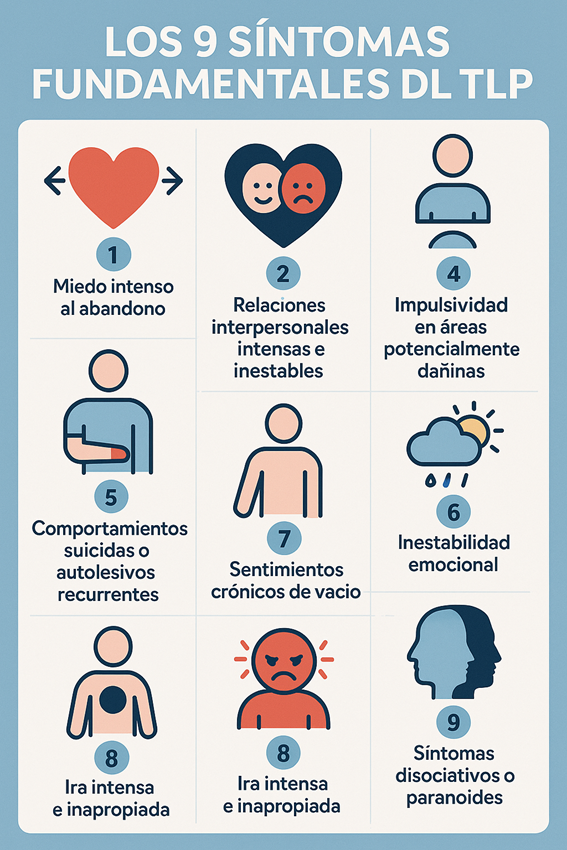
To understand what a person with BPD is like, it is essential to be familiar with the nine diagnostic criteria set out in the Diagnostic and Statistical Manual of Mental Disorders (DSM-5). It is important to note that, whilst some symptoms may appear during adolescence, a formal diagnosis of Borderline Personality Disorder is not usually made before the age of 18, as a developing personality may exhibit temporary instabilities. Not everyone with BPD experiences all of these symptoms, and their severity can vary considerably:
- Intense fear of abandonment. People with BPD experience a profound terror of being abandoned, whether real or imagined. This fear can lead them to make desperate efforts to avoid abandonment, even when there is no real threat.
- Intense and unstable interpersonal relationships. The relationships of people with BPD tend to be very intense but volatile. They may idealise someone one day and devalue them the next. This swinging between extremes can be exhausting for both them and their loved ones.
- Identity disturbance. A person with BPD’s self-image can change drastically. One day they may feel certain of who they are, and the next they may experience a profound identity crisis. This instability in self-image is one of the most challenging features of the disorder.
- Impulsivity in potentially harmful areas. Impulsivity can manifest as excessive spending, risky sexual behaviour, substance abuse, reckless driving or binge eating. These behaviours are often a way of coping with intense emotions.
- Recurrent suicidal or self-harming behaviours. This is perhaps the most alarming symptom. People with BPD may resort to self-harm as a way of regulating intense emotions or expressing emotional pain.
- Emotional instability. The emotions of people with BPD can change rapidly and be extremely intense. They can swing from euphoria to deep depression in a matter of hours.
- Chronic feelings of emptiness. Many people with BPD describe a persistent feeling of inner emptiness, as if something fundamental were missing.
- Intense and inappropriate anger. Anger in BPD can be disproportionate to the situation that triggers it and may manifest as temper tantrums or physical violence.
- Dissociative or paranoid symptoms. In stressful situations, people with BPD may experience dissociative symptoms (feeling disconnected from themselves or from reality) or temporary paranoid thoughts.
Does BPD have different levels of severity?
Contrary to what many believe, BPD is not an ‘all-or-nothing’ condition. There are different degrees of BPD, ranging from milder forms to more severe presentations. Some professionals refer to ‘silent’ or ‘quiet’ BPD, where symptoms are directed inwards rather than manifesting externally.
The severity of BPD can be classified according to:
- The intensity of the symptoms
- The level of social and occupational functioning
- The frequency of emotional crises
- The ability to maintain stable relationships
It is important to remember that chronic BPD does not mean it is untreatable. With the right treatment, many people experience significant improvements in their quality of life.
Does BPD affect intelligence?
A frequently asked question concerns the relationship between BPD and intelligence. The reality is that BPD does not affect intellectual ability. In fact, many people with BPD are extremely intelligent and perceptive. Their emotional intelligence can be very acute, which, paradoxically, can make them more sensitive to the emotional subtleties of situations.
Intelligence in people with BPD often manifests itself in:
- High emotional sensitivity
- The ability to read others’ emotions
- Creativity and innovative thinking
- Well-developed coping skills
Can BPD manifest itself physically?
Although BPD is primarily an emotional and behavioural disorder, it can also manifest through physical symptoms that are secondary to the chronic stress and emotional dysregulation characteristic of the disorder. These are not primary symptoms of BPD, but rather comorbidities or related manifestations:
- Frequent headaches
- Muscle tension
- Gastrointestinal problems
- Chronic fatigue
- Sleep disturbances
- Somatic symptoms with no apparent medical cause
Why does BPD develop?
BPD does not have a single cause. Research points to a combination of three factors:
- Biological vulnerability. Some people are born with greater emotional sensitivity: they respond more intensely to stimuli and take longer to regain their composure. This is not a defect; it is simply how their nervous system is wired.
- Difficult childhood experiences. A significant proportion of people with BPD have experienced abuse, neglect or major relational losses during their development. Although this is not the case for everyone, the impact of these experiences on emotional regulation is very significant.
- An environment that did not validate emotions. Growing up in an environment where emotions were systematically downplayed, ignored or punished makes it difficult to learn how to regulate them. When this occurs in a person with high biological sensitivity, the risk of developing BPD increases considerably.
What other disorders can BPD be confused with?
BPD can be confused with other mental health conditions, which makes a careful professional diagnosis crucial:
- Bipolar disorder: Both involve mood swings, but in BPD the changes are more reactive to external events and last for a shorter period.
- Major depressive disorder: Depression can be a component of BPD, but BPD involves a broader pattern of instability.
- Anxiety disorders: Separation anxiety may appear similar to the fear of abandonment seen in BPD.
- Post-traumatic stress disorder: Many people with BPD have a history of trauma, but PTSD has distinct characteristics.
A thorough differential diagnosis by a specialist is essential to ensure treatment is correctly targeted.
What treatments are evidence-based for BPD?
BPD is treatable. Over recent decades, a range of psychological therapies backed by robust evidence has emerged, which have transformed the prognosis for the disorder.
- Dialectical Behaviour Therapy (DBT). This is the gold standard treatment. Developed specifically for BPD by Marsha Linehan, it combines cognitive-behavioural techniques with acceptance and mindfulness strategies. Its main aim is to teach specific skills for regulating emotions, tolerating distress and improving interpersonal relationships. Studies show that it significantly reduces self-harming behaviours, hospital admissions and overall distress.
- Mentalisation-Based Therapy (MBT). Developed by Bateman and Fonagy, it focuses on the ability to understand one’s own mental states and those of others. People with BPD tend to lose this ability during times of high emotional stress, which distorts the way they perceive situations and relationships. MBT is particularly recommended where there is a history of relational trauma.
- Transference-Focused Therapy (TFP). Developed by Kernberg from a psychodynamic perspective, it addresses deeper relational patterns through the therapeutic relationship itself. It has proven effective both in reducing symptoms and in improving interpersonal functioning.
- Other therapies with growing evidence. Acceptance and Commitment Therapy (ACT) and other Cognitive Behavioural Therapy protocols adapted for BPD offer complementary options depending on each person’s profile.
- Medication and crisis resources. There is no medication specifically approved for BPD, but psychiatry can support treatment with medication for specific symptoms such as emotional instability or impulsivity. In high-risk situations, access to crisis care resources or partial hospitalisation programmes may be necessary.
These treatments have transformed the prognosis for BPD, but accessing them is not always easy. Professionals with specific training in DBT or MBT are few and far between in the public health system, and the stigma still surrounding the disorder can delay diagnosis or lead to interventions that are poorly suited to the individual’s needs. Added to this is the fact that BPD frequently co-occurs with other disorders such as depression, anxiety or PTSD, which adds complexity to the approach and requires careful therapeutic planning.
With appropriate and sustained treatment, studies show that a significant proportion of people with BPD experience genuine remission of symptoms over time. The most acute symptoms tend to subside, and many people learn to manage their emotions and build a stable life.
How to live with someone with BPD
If you have a loved one with BPD, here are some important strategies:
- Learn about the disorder: Understanding BPD will help you respond more effectively and compassionately.
- Set clear boundaries: Consistent and loving boundaries are essential for maintaining healthy relationships.
- Practise validation: Acknowledge and validate your loved one’s emotions, even if you do not fully understand their intensity.
- Look after your own mental health: You cannot help others if you do not look after yourself.
- Seek professional support: Both for your loved one and for yourself.
The most challenging behaviours associated with BPD, such as disproportionate reactions, threats, or idealisation and devaluation, are overwhelmingly desperate responses to basic emotional needs that the person does not know how to meet in any other way. They are not calculated strategies. Understanding this does not mean tolerating everything, but it does allow you to respond with understanding rather than conflict.
Would you like to specialise in mental health?
There is a growing demand for specialists in BPD and personality disorders, both in private practice and within hospital teams, crisis services and research. If you’d like to know what specific career opportunities this specialisation opens up, you can find out in our guide to career prospects for the Bachelor’s Degree in Psychology and the Master’s Degree in General Health Psychology.
Learning how the mind works is the first step; knowing how to intervene is the next. If you wish to take both, the Bachelor’s Degree in Psychology and the Online Master’s Degree in General Health Psychology at UAX are designed precisely for that purpose.
Summary
Borderline Personality Disorder is a real, diagnosable and treatable condition that affects the way a person regulates their emotions, perceives themselves and relates to others. Its symptoms manifest across a spectrum of intensity, do not affect intelligence and may also have physical manifestations. Its origins stem from a combination of biological vulnerability, difficult developmental experiences and an environment that did not facilitate emotional learning. With treatments such as DBT or MBT, the prognosis has improved significantly: recovery is possible.
Sources:
- DSM-5 (APA)
- ICD-11 (WHO)
- NICE guidance on personality disorders
- International Society for Personality Disorders (ISPD)