See all Online Master's Degrees in Health
See all Master's Degrees in Engineering
Most searched curriculums
Transform education with strategies of pedagogical accompaniment and emotional education that enhance talent and well-being in the classroom. Learn to apply active methodologies and educational coaching techniques to create inclusive and motivating learning environments. Specialise in an innovative approach and take teaching to the next level. Improve your scale for the Teacher or Secondary School Civil Service Examinations. Limited places.
The Online Master’s Degree in Emotional Education and Pedagogical Support prepares you to approach teaching from a people-centred perspective, promoting the development of social skills and conflict resolution. Its innovative approach is based on four key pillars: sustainability, humanism, inclusion and training in key skills for the educators of the future. Furthermore, it equips you to implement strategies for pedagogical support and educational coaching, two approaches that are increasingly in demand in both educational and professional settings.
This officially recognised Master’s degree is based on a practical and flexible methodology that connects directly with the challenges of the real-world educational environment. Through case studies, projects and creative activities, students develop skills that can be applied immediately in their teaching practice. Through active methodologies such as problem-based learning, experiential teaching and collaborative learning, the programme provides tools for more effective teaching that is aligned with the current needs of the education system. Furthermore, its online format allows students to balance their studies with their professional lives, ensuring a learning experience tailored to each teacher.
This master’s degree will provide you with advanced training in emotional education and pedagogical support, equipping you with the necessary tools to integrate these skills into different educational settings. You will learn how to foster emotional wellbeing, promote healthy relationships and design inclusive strategies for the holistic development of pupils.
All fields are required
Discover the importance of emotional education in student development and learn how to manage your own emotions in the educational context.
Learn techniques and strategies to guide learning in an individualised way, promoting the personal development of students.
Developing leadership based on empathy, effective communication and conflict resolution to improve coexistence and learning.
Create educational environments that strengthen emotional support and foster healthy relationships between teachers and students.
It develops strategies to meet the emotional and educational needs of all pupils, with special attention to vulnerable groups.
You will learn to adapt to the needs of infant, primary, secondary, baccalaureate or vocational training students.
Enhance your teaching practice by understanding learning through the lens of neuroeducation. This micro-credential equips you to analyse students’ cognitive, emotional and behavioural processes, identify potential difficulties at an early stage, and apply evidence-based inclusive teaching strategies in the classroom.

Transform the way you work with generative artificial intelligence. This micro-credential empowers you to apply tools like ChatGPT, Copilot, and Gemini to analyze information, create content, and make decisions in real-world academic contexts, integrating solutions ethically and responsibly within the educational field.

Develop your potential in education through leadership and interpersonal skills. This microcredential provides you with the keys to managing teams, communicating effectively, and solving problems in real-world educational settings, combining personal leadership techniques with practical productivity and collaboration tools.
This master's degree in emotional education is aimed at active teachers, recent graduates and professionals in the field of education who are looking to improve emotional management in the classroom, strengthen the accompaniment of students and teams, and enhance the quality of teaching through a more human and innovative approach.
Entry requirements:
The Master's Degree in Emotional Education and Pedagogical Accompaniment is aimed at professionals in the educational and social fields. To access, it is necessary to have one of the following degrees:
This degree does not qualify as a pedagogical counsellor, as this accreditation can only be obtained through the Master's Degree in Teacher Training.
Master's Degree in Emotional Education and Pedagogical Accompaniment
First Year
FIRST FOUR-MONTH PERIOD
| Code | Subjects | Character* | ECTS | ||
|---|---|---|---|---|---|
| SM150900 | The individual as the focus of action | OB | 6 | ||
The individual as the focus of actionCódigo: SM150900 Imprimir Course 1: First-semester module. Compulsory. 6 credits. Profesores
Objectives To produce written and oral presentations on the human being conceived as ‘person’ • To develop arguments on the importance of understanding the historical development of the human being, based on the evolution of the concept of the person, as a for teaching in the areas of support and emotional education. • Acquire the ability to define the characteristics of the educational process based on a specific conception of the human being. • Design guided group activities tailored to the specific needs of students to foster processes of openness and connection. Prerequisites None required Skills Core competences • Adapt knowledge relating to the individual to enhance teaching practice teaching practice. • Demonstrate a proactive commitment to the assessment of the student, understood as individual. • Use the available theoretical and practical resources to foster that encourage students to open up. • Design strategies, based on the knowledge acquired, to foster relationship-building processes with groups of students. • Link the concept of the individual to strategies related to and support. • Assess the importance of the teacher in building meaningful relationships with students. Specific competences • To understand the concept of the person as a unique individual who also has the right to be treated with dignity. • To understand the historical development of the human being, based on the evolution of the concept of the person. • To analyse the different approaches to understanding human beings based on the sciences and philosophical anthropology. • To analyse the various conceptions of the human being and their impact on education. • To compare the different conceptions of the faculties and dimensions of the person. • To assess the importance of holistic education. • To analyse the importance of the process of openness for the personal and social development of the student, understood as a person. • Apply tools such as the sociogram and group dynamics to foster relationship-building processes amongst the social actors involved in the educational process. General competences (only for regulated professions) • Assess the importance of the teacher in the secondary socialisation process. • Analyse the fundamental role of the teacher in shaping future citizens in societies facing crises. • Understand the need to accept the diversity and differences that exist in each student, viewed as an individual. • To analyse the leading role of the teacher in providing educational support to the individual students and people in general. • To develop teaching skills to build relationships with students within the context of the student’s emotions and affective life. • To analyse the educational process as a social phenomenon. Learning outcomes • Produces written and oral presentations on the human being conceived as ‘person’ . • Develop arguments on the importance of understanding the historical development of the human being, based on the evolution of the concept of the person, as a for teaching in the areas of support and emotional education. • Acquires the ability to define the characteristics of the educational process based on a specific conception of the human being. • Designs guided group activities tailored to the Description of the content • The historical development of the human being • Knowledge of the human being • The faculties and dimensions of the person • Holistic education • The person’s capacity for openness • Relationships as a key element Formative activities Forum Feedback Project Assessment system and criteria Your final mark will be based on the following assessment system: • 40 per cent of your mark will come from your continuous assessment. This will the following will be taken into account: o Participation in forums, contributing your views, knowledge and experiences: 10 per cent of the final mark. o The course project: 30 per cent of the final mark. This is carried out in groups, but may be completed individually. • The final exam for the module will account for: 60 per cent of the final mark. • The exams are multiple-choice, although they may include one essay question. Ordinary examination session To pass the module in the ordinary examination session, you must achieve a mark of 5.0 or above out of 10.0 in the final face-to-face (weighted ) for the module and, in addition: The average mark for all activities in each subject must be equal to or greater than 5.0 out of 10.0 to be included in the average with the exam. Similarly, the exam mark must be 5.0 out of 10.0 or higher to be included in the average with the coursework. Extraordinary examination session To pass the module in the resit, students must achieve a mark of 5.0 out of 10.0 or higher in the final mark (weighted average) for the module. Assignments not passed during the ordinary assessment period must be submitted, after receiving the relevant feedback on them from the lecturer, or those that were not submitted. |
|||||
| SM150901 | Person-centred education | OB | 6 | ||
Person-centred educationCódigo: SM150901 Imprimir Course 1: First-semester module. Compulsory. 6 credits. Profesores
Objectives . To explain the fundamentals of Person-Centred Education and justify its importance in professional practice. • Relate the contributions of leading authors to the principles and pillars of person-centred education. • Select and apply appropriate strategies and methodologies to promote person-centred learning. • Critically evaluate the impact of person-centred education on the the learner’s holistic development. • Design innovative educational proposals that integrate support, personalisation and the development of emotional and ethical skills. • Rigorously analyse the current challenges facing education and propose solutions from a humanistic and person-centred perspective. Prerequisites None required Competencies Core competences • To understand the philosophical, pedagogical and psychological foundations of Person-Centred Education and its relevance to teaching practice. • Apply the knowledge acquired to the analysis and resolution of real-life educational situations, whilst respecting the dignity and individuality of each pupil. • Develop critical and reflective thinking that enables well-founded judgements on current educational practices and their . • To communicate the main ideas of the subject, in both academic and professional contexts. • Foster autonomy and the capacity for lifelong learning, integrating personal reflection and collaborative work. Specific competences • Understand the principles and foundations of Person-Centred Education and its relationship with the personalist and humanist tradition. • To identify strategies and methodologies consistent with a personalised educational personalised approach, such as pedagogical support and active learning. • To design educational programmes that promote the holistic development of the the student (intellectual, emotional, social, ethical and spiritual). • Analyse the impact of person-centred education on key dimensions such as self-esteem, autonomy, self-regulation, critical thinking and ethical and social awareness. • Recognise the contemporary challenges affecting personalised education personalised education and propose innovative, evidence-based responses. Learning outcomes . Explain the principles of Person-Centred Education and justify its importance in professional practice. • Relate the contributions of leading authors to the principles and pillars of person-centred education. • Select and apply appropriate strategies and methodologies to promote person-centred learning. • Critically evaluate the impact of person-centred education on the the learner’s holistic development. • Design innovative educational proposals that integrate support, personalisation and the development of emotional and ethical skills. • Rigorously analyse the current challenges facing education and propose solutions from a humanistic and person-centred perspective. Course description • Introduction to person-centred education. • Characteristics of person-centred education. • The pillars of person-centred education. • Strategies and methodologies for person-centred education • The impact of person-centred education on student development. • Challenges and difficulties in implementing person-centred education. Training activities Forum Feedback Group work Assessment system and criteria Your final mark will be based on the following assessment system: • 100 per cent of your mark will be based on your continuous assessment. This will the following will be taken into account: o Participation in forums, contributing your views, knowledge and experiences: 5 per cent of the final mark. o Individual activities: 15 per cent of the final mark. o Group activities: 20 per cent of the final mark. • The final exam for the module will account for: 60 per cent of the final mark. Ordinary examination session To pass the module in the ordinary assessment period, you must achieve a mark of 5.0 or higher out of 10.0 in the final mark (weighted average) for the module and, in addition: The average mark for all activities in each module must be equal to or higher than 5.0 out of 10.0 to be included in the average with the exam. Similarly, the exam mark must be 5.0 out of 10.0 or higher to be included in the average with the coursework. Extraordinary examination session To pass the module in the resit, students must achieve a mark of 5.0 out of 10.0 or higher in the final mark (weighted average) for the module. Assignments not passed during the ordinary assessment period must be submitted, after receiving the relevant feedback on them from the lecturer, or those that were not submitted. |
|||||
| SM150902 | Communication skills | OB | 6 | ||
Communication skillsCódigo: SM150902 Imprimir Course 1: First-semester module. Compulsory. 6 credits. Profesores
Objectives To explore the principles and techniques of effective communication by analysing which expressive skills enable the development of clear and coherent ideas that enhance teaching practice. Master’s in Emotional Education and Pedagogical Support 2 Study Guide Communication skills Understanding the principles and functioning of as a fundamental strategy for supporting and strengthening based on collaboration and reflective dialogue. Prerequisites None required Competencies Core competences • RC1. Understanding the needs, motivations and behaviours of people in order to create a positive and productive working environment. • RC2. Convey information clearly, concisely and persuasively, both orally and in writing during the support process and in the development a solid educational relationship that is focused and firm in its expectations. Specific competencies • RODS. Develop effective communication, teamwork, analytical thinking, creativity and ethical leadership from a and clearly inspired by democratic principles and values, as well as the Sustainable Development Goals, in order to conduct oneself with integrity in the professional sphere. • RPAE. To apply, in a practical and integrated manner, the knowledge, skills and competencies from the degree programme’s modules in the course of their supervised professional placement at placement centres. Learning outcomes To gain a deeper understanding of the principles and techniques of effective communication by analysing which expressive skills enable the development of clear and coherent ideas that enhance teaching practice. Master’s in Emotional Education and Pedagogical Support 2 Learning Guide Communication skills Understanding the principles and functioning of as a fundamental strategy for supporting and strengthening teaching practice Course content description • Language and thought • Communication in different contexts (adolescence, youth, teams, etc.) • Intrapersonal and interpersonal communication • Assertive communication • Non-verbal communication • Resources for developing communication skills Training activities Forum Feedback Project Assessment system and criteria Your final mark will be based on the following assessment system: • 40 per cent of your mark will be based on your continuous assessment. This will the following will be taken into account: o Participation in forums, contributing your views, knowledge and experiences: 10 per cent of the final mark. o Individual and/or group activities: 10 per cent (individual activity) and 20 per cent (group activity) of the final mark. • The final exam for the module will account for: 60 per cent of the final mark. Ordinary examination session To pass the module in the ordinary assessment period, you must achieve a mark of 5.0 or higher out of 10.0 in the final mark (weighted average) for the module and, in addition: The average mark for all activities in each module must be equal to or higher than 5.0 out of 10.0 to be included in the average with the exam. Similarly, the exam mark must be 5.0 out of 10.0 or higher to be included in the average with the coursework. Extraordinary examination session To pass the module in the resit, students must achieve a mark of 5.0 out of 10.0 or higher in the final mark (weighted average) for the module. Assignments not passed during the ordinary assessment period must be submitted, after receiving the relevant feedback on them from the lecturer, or those that were not submitted. |
|||||
| SM150903 | Emotional development | OB | 6 | ||
Emotional developmentCódigo: SM150903 Imprimir Course 1: First-semester module. Compulsory. 6 credits. Profesores
Objectives . To identify the key processes involved in emotional development. • Analyse the factors that influence emotional regulation. • Apply educational intervention models focused on emotional support . • Design teaching approaches that integrate emotional skills into teaching practice. Prerequisites None required Competencies Core competences • Understanding knowledge in a field of study that provides an original basis for application in educational contexts (CB6). • Apply acquired knowledge and solve problems in new or familiar settings (CB7). • Integrate knowledge and deal with the complexity of making judgements based on incomplete information (CB8). • Communicate conclusions and knowledge to specialist and non-specialist non-specialist audiences (CB9). Specific competences • CE1: understand the theoretical and practical foundations of emotional development within the educational context. • CE2: design pedagogical support strategies focused on and self-regulation. • CE3: evaluate educational programmes and initiatives from an emotional perspective. Learning outcomes . Identify the key processes of emotional development. • Analyse the factors that influence emotional regulation. • Apply educational intervention models focused on emotional support emotional support. • Design teaching approaches that integrate emotional skills into teaching practice. Course content description • Education, motivation and learning • Emotional intelligence • Emotional regulation • Self-esteem and self-confidence • Positive psychology • Emotional wellbeing and mental health Training activities Forum Feedback Group work Assessment system and criteria Your final mark will be based on the following assessment system: • 40 per cent of your mark will be based on your continuous assessment. This will the following will be taken into account: o Participation in forums, contributing your views, knowledge and experiences: 10 per cent of the final mark. o Individual and/or group activities: 30 per cent of the final mark. • The final exam for the module will account for: 60 per cent of the final mark. Ordinary examination session To pass the module in the ordinary assessment period, you must achieve a mark of 5.0 or higher out of 10.0 in the final mark (weighted average) for the module and, in addition: The average mark for all activities in each module must be equal to or higher than 5.0 out of 10.0 to be included in the average with the exam. Similarly, the exam mark must be 5.0 out of 10.0 or higher to be included in the average with the coursework. Extraordinary examination session To pass the module in the resit, students must achieve a mark of 5.0 out of 10.0 or higher in the final mark (weighted average) for the module. Assignments not passed during the ordinary examination period must be submitted, after receiving the relevant feedback on them from the lecturer, or those that were not submitted. |
|||||
| SM150904 | Educational support | OB | 6 | ||
Educational supportCódigo: SM150904 Imprimir Course 1: First-semester module. Compulsory. 6 credits. Profesores
Objectives • To identify the key processes involved in pedagogical support. • To analyse the factors that influence support. • Apply educational intervention models focused on support. • To design pedagogical proposals that integrate the appropriate competences into teaching practice. Prerequisites None required Competencies Core competences • Understand knowledge in a field of study that provides an original basis for application in educational contexts (CB6). • Apply acquired knowledge and solve problems in new or unfamiliar settings (CB7). • Integrate knowledge and deal with the complexity of making judgements based on incomplete information (CB8). • Communicate conclusions and knowledge to specialist and non-specialist audiences (CB9). Specific competences • CE1: Understand the theoretical and practical foundations of pedagogical support within the educational framework. • CE2: Design strategies for pedagogical support. • CE3: Evaluate educational programmes and initiatives from the perspective of pedagogical support. Learning outcomes • Identify the key processes involved in pedagogical support. • Analyse the factors that influence support. • Apply educational intervention models focused on support. • Design teaching proposals that integrate the appropriate competences into teaching practice. Course description • What is pedagogical support? • Models of pedagogical support • The profile of the pedagogical support provider • Pedagogical support in different educational contexts • Challenges and opportunities in pedagogical support • Competencies and skills for pedagogical support Training activities . Forum . Feedback activity (individual) . Group activity (project) Assessment system and criteria Your final mark will be based on the following assessment system: • 40 per cent of your mark will be based on your continuous assessment. The following will be taken into account: o Participation in forums, contributing your views, knowledge and experiences: 10 per cent of the final mark. o Individual and/or group activities: 30 per cent of the final mark. • The final exam for the module will account for: 60 per cent of the final mark. Ordinary examination session To pass the module in the ordinary examination session, you must achieve a mark of 5.0 out of 10.0 or higher in the final mark (weighted average) for the module and, in addition: The average mark for all activities in each module must be 5.0 out of 10.0 or higher to be included in the overall average with the exam. Similarly, the exam mark must be 5.0 out of 10.0 or higher to be included in the overall average with the activities. Extraordinary examination session To pass the module in the resit, students must achieve a final mark (weighted average) of 5.0 out of 10.0 or higher. Students must submit any assignments that were not passed during the ordinary assessment period, after receiving the relevant feedback from the lecturer, or any assignments that were not submitted at all. |
|||||
| TOTAL: | 30 | ||||
SECOND FOUR-MONTH PERIOD
| Code | Subjects | Character* | ECTS | ||
|---|---|---|---|---|---|
| SM150905 | Developing social skills and conflict resolution | OB | 6 | ||
Developing social skills and conflict resolutionCódigo: SM150905 Imprimir Course 1. Second-term module. Compulsory. 6 credits. Profesores
|
|||||
| SM150906 | Metacognition and NLP | OB | 6 | ||
Metacognition and NLPCódigo: SM150906 Imprimir Course 1. Second-term module. Compulsory. 6 credits. Profesores
|
|||||
| SM150907 | The process of educational support and talent development | OB | 6 | ||
The process of educational support and talent developmentCódigo: SM150907 Imprimir Course 1. Second-term module. Compulsory. 6 credits. Profesores
|
|||||
| SM150908 | External academic placements | OB | 6 | ||
External academic placementsCódigo: SM150908 Imprimir Course 1. Second-term module. Compulsory. 6 credits. Profesores
|
|||||
| SM150909 | Master’s Thesis | OB | 6 | ||
Master’s ThesisCódigo: SM150909 Imprimir Course 1. Second-term module. Compulsory. 6 credits. Profesores
|
|||||
| TOTAL: | 30 | ||||
*Character: BT: Basic Training, Ob: Required, Op: Optional
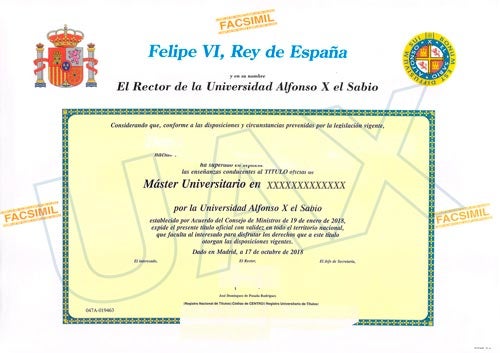
Our degree is official, verified by the Council of Universities and fully valid in Spain, as well as in the European Higher Education Area.
It is recognised by the Education Systems of Latin America, being recognised and approved by the different Ministries of Education in Latin America:
SENESCYT, MEN (MinEducation), SEP, Mescyt, among others, automatically.
The online master's degree in Emotional Education includes 6 ECTS of internships: 150 curricular hours (105 classroom hours at the centre), which will be carried out in the second four-month period.
We have agreements with more than 700 associations and educational centres such as:
If you have related professional experience, you will be able to validate the internship. Contact our advisors for a personalised study of ECTS recognition.
The flexibility of online learning, with opportunities to connect
Take your exams online wherever you are or, if you prefer, in person at our designated centres in Spain and Latin America, subject to availability and capacity.
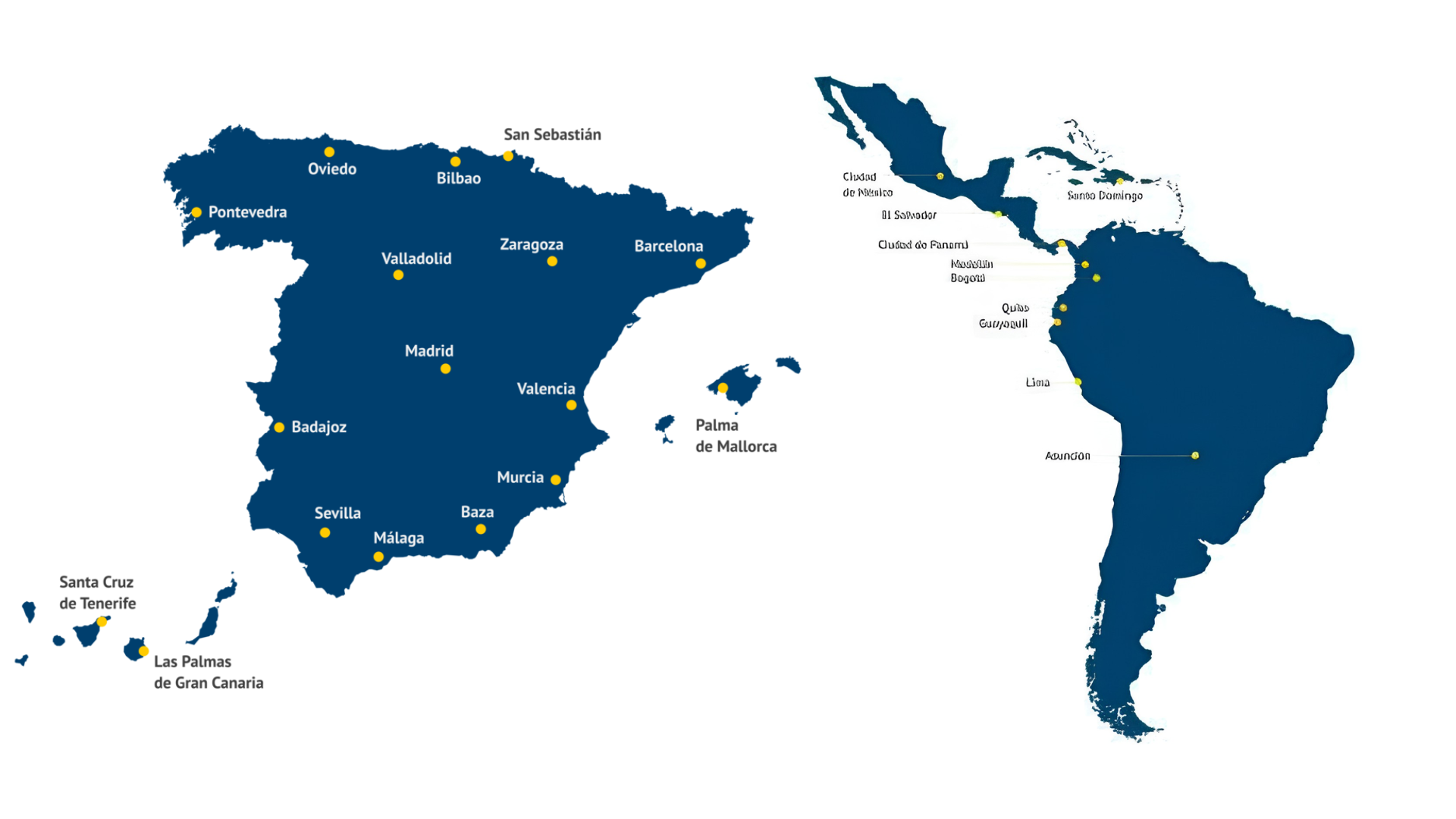
What’s more, as a student at UAX Online, you’ll have access to our Campus Hubs – a network of exclusive physical spaces where you can study, access libraries, work in co-working areas and connect with other students. Because studying online doesn’t mean studying alone.
Campus Hubs available in: Alcobendas, Alcorcón, Valencia San Vicente, Murcia, Barcelona, Málaga, Seville and Arganda.
Access is via your UAX student card, subject to availability and the opening hours of each centre.

Teaching Staff
PhD in Education, degree in Hispanic Philology and master's degree in Educational Innovation and Educational Accompaniment. With more than 20 years of experience in teaching and school management, he currently runs an educational centre in Madrid. He is an ICF-certified educational and executive coach, specialising in leadership and personal development.

Specialist in English teaching with more than 12 years of experience in Primary, ESO and Baccalaureate. She accompanies students in their pre-university transition and is trained as a certified coach, specialising in dialogic coaching, neuro-linguistic programming and non-verbal non-conscious communication.

PhD in Humanities, with a background in Fine Arts, Digital Animation and a Masters in Humanities. Her research focuses on the thought of Henri Bergson and she is currently broadening her specialisation in Philosophy, focusing on the History of Philosophy and Contemporary Thought. She is a lecturer in the Department of Humanities.

Psychologist specialising in childhood and adolescence, with extensive experience in educational guidance and emotional support. She directs the guidance department in a school and collaborates as a teacher in degrees and master's degrees in education. She is also a therapist and trainer in emotional intelligence and family communication.

PhD in Communication Sciences, Sociology and History, with postgraduate training in Musicology. In addition to his multidisciplinary academic career, he has advanced studies in musical composition. His work combines research in communication, history and music from a critical and humanistic perspective. Accredited by ANECA and with numerous publications of reference.
Scholarships and financial support for studying at UAX
We know that studying is an investment. That’s why we want to remove financial barriers and make things easier for you. Fill in the form and let our advisers help you discover the scholarships, agreements and personalised financial support that best suit your situation.

Ministry of Education, Vocational Training and Sport
Find out about the scholarships and grants offered by the Ministry of Education, Vocational Training and Sport, categorised by type and level of education.

Attracting Pre-doctoral Research Talent
Financial support for outstanding students who wish to carry out innovative research and contribute to the advancement of knowledge in their disciplines.
If you’ve already decided to take the plunge, enrol early and benefit from a direct grant. It’s a way of rewarding your commitment and helping you plan for your future with a head start.
*Please speak to your adviser at UAX Mare Nostrum
Students from Ibero-America
This programme is aimed at Ibero-American citizens or foreign nationals legally resident in countries within the OEI’s sphere of influence. The scholarship covers a 50 per cent discount on the total tuition fees.

Students from Ecuador
This programme is aimed at citizens with Ecuadorian nationality and/or residence who wish to undertake an online master’s degree in Spain. The scholarship covers a 50 per cent discount on the total tuition fees.

2025, 2nd Edition
Grants for students on higher-level vocational training, undergraduate, postgraduate or master’s programmes enrolled at Spanish universities with a Santander agreement. A financial supplement to support you whilst undertaking your work placements.
If you graduated from UAX and are now thinking of studying for a new degree, we want to continue supporting you. That’s why we’re offering you a 10% discount on tuition fees.
If you have an immediate family member (up to second degree of kinship) enrolled at UAX, you can benefit from a 5 per cent discount on tuition fees. Because studying as a family is even better.
Studying for two degrees at the same time is a challenge, and we want to support you. If you’re already at UAX and enrol on a second degree programme, you’ll receive a grant towards your booking fee and tuition fees.
If you’d like to continue your studies with us and progress from vocational training to a bachelor’s degree, from one bachelor’s degree to another, or from a bachelor’s degree to a postgraduate degree, we’re here to support you with a grant covering up to 25 per cent of your tuition fees.
If you have a strong academic record, we would like to recognise your talent with a scholarship designed for new students. (Excludes the degree in Medicine).
*Terms and conditions to be published
If you’re a high-performance athlete, at UAX we want to help you balance your passion with your studies. We offer specific grants that can cover up to 50 per cent of your tuition fees.
*Please speak to your advisor at UAX Mare Nostrum

With this master's degree you will obtain an interdisciplinary training that will allow you to go beyond a profession related to this branch of knowledge, as you will obtain the status of educational counsellor. As a graduate, you will be able to play roles in the following areas:
It is important to note that the master's degree does not in itself qualify students to work in regulated professions; students must first have the corresponding university degree or master's degree.
Emotional education is an ongoing educational process that seeks to develop key emotional competences: self-awareness, self-regulation, empathy, social skills and responsible decision-making. Its integration with the school curriculum promotes a positive emotional climate and improves learning, motivation and coexistence.
In 2025, studying this master's degree takes on special relevance: in an increasingly complex and digital society, socioemotional skills are essential for mental health, resilience and inclusion. Training in this field trains professionals to respond to current challenges in education, emotional health and collective well-being.
A professional emotional educator has key roles such as teaching you to manage and understand your own and other people's emotions, promote positive attitudes and prevent emotional conflicts. In educational contexts, they teach strategies for students to identify, express and regulate their emotions with practical tools. In addition:
The official master's degree in emotional education at UAX combines theory and applied practice in modules such as Pedagogical Accompaniment, Social Skills and Conflict Resolution, or NLP and Metacognition.
Activities of note:
Although they are related concepts, emotional education and emotional intelligence are not the same. The main difference is in the approach: the former is an educational process; the latter is a personal capacity.
Concept | Emotional education | Emotional intelligence |
| Definition | Continuous and systematic process of developing emotional competencies. | Individual ability to recognise, understand and regulate emotions. |
| Objective | To train in emotional skills from childhood, in a planned way. | To apply emotional skills in personal or work contexts. |
| Approach | Educational, social and pedagogical. | Psychological and personal. |
| Scope of application | Schools, educational contexts, adult training projects. | Companies, coaching, personal development. |
| Duration | Throughout the whole educational life. | Variable, depending on the person. |
| Intervention | Prevention, promotion and accompaniment in collective environments. | Improvement of individual emotional skills. |
Choose a training in emotional education if you want to:
On the other hand, a training in emotional intelligence is more appropriate if:
The teacher acts as an emotional role model and the main agent of change in the classroom. Their roles include:
In addition, UAX research shows that emotional training for teachers significantly improves their ability to manage the classroom climate more empathetically and effectively.
Other related qualifications
We offer a wide range of courses, so you’re sure to find a programme that suits you.
Master’s Degree in Supporting Diversity and Inclusive Education (Online)
In collaboration with:

Start:
October
Length:
9 months

Online Master's Degree in Educational Innovation
Start:
October
Length:
9 months

Master's Degree in Psychopedagogy (online)
In collaboration with:
Start:
October
Length:
9 months

Master’s Degree in Educational Neuropsychology (Online)
In collaboration with:

Start:
October
Length:
9 months

Master's Degree in Educational Technology and Digital Competences for Teachers - ICT (online)
In collaboration with:
Start:
October
Length:
9 months

Master’s Degree in Instrumental Pedagogy (Online)
Start:
October
Length:
9 months

Online Master's Degree in Leadership and Management of Educational Centres
In collaboration with:
Start:
October
Length:
9 months

Master’s Degree in Teacher Training for Compulsory Secondary Education and Sixth Form
In collaboration with:
Start:
October
Length:
1 year

Online Master's Degree in Didactics in Mathematics
Start:
October
Length:
9 months

Master’s Degree in Teaching Spanish as a Foreign Language (Online)
In collaboration with:

Start:
October
Length:
9 months

Online Master's Degree in Conflict Prevention and Mediation in Educational Settings
Start:

October
Length:
9 months
Online Master's Degree in Research Methodologies in Education
Start:
October
Length:
9 months
Enquiries, complaints and claims
We respond to the genuine needs of our students and staff, because we believe in the continuous improvement of our results. That is why we always want to hear whatever you have to say.
If you are already part of UAX, please visit the ‘Customer Service: complaints, suggestions and compliments’ section on thevirtual campus , logging in with your username and password.
You can view the various indicators via the following links:
Employability: View
Satisfaction results: View
Rates and indicators: View
Improvement measures implemented for the degree programme during the academic year: