See all Online Master's Degrees in Health
See all Master's Degrees in Engineering
Most searched curriculums
Official qualification
Learn to apply new advances in Digital Dentistry in a multidisciplinary way with a pioneering official master's degree in Spain. You will be trained with a flexible methodology that is compatible with your professional and personal life, you will apply what you have learnt by working in digital flow in the clinic with patients and you will develop a personalised, efficient, more precise and less invasive digital dentistry. Limited places.
In collaboration with:

With the University Master's Degree in Digital Dentistry you will receive formal training in digital dentistry, with one of the most innovative curricula in Spain, which combines 100% online theoretical training and practical learning applied in the clinic.
What skills will you acquire?
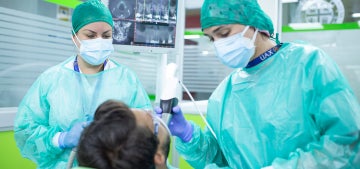
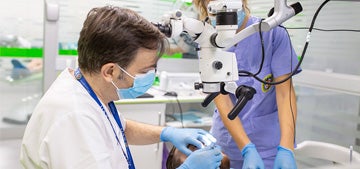
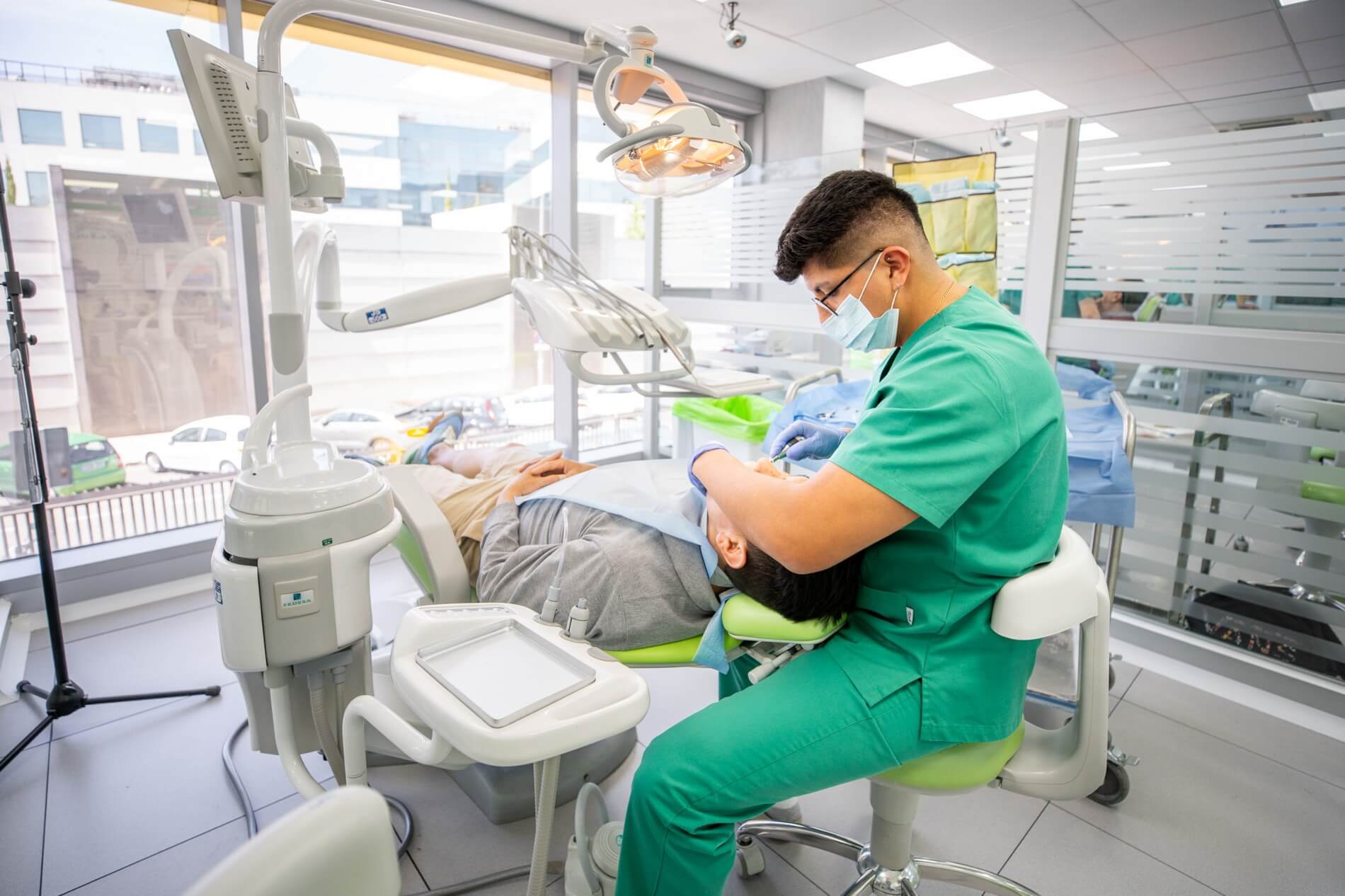
We have two of our own dental clinics in Madrid with the latest in dental technology.
In them, we have 13,000 patients a month and our students receive a 360º vision of the profession as a dentist in areas such as periodontics, endodontics, orthodontics, implantology, aesthetics, surgery, etc. Our clinics have 150 fully digitalised boxes, state-of-the-art technology in each consultation room, and more than 225,000 patients a year trust in our clinics! The UAX Dental Centre has certifications that accredit the high quality of its services.

Master's Degree in Digital Dentistry
First Year
FIRST FOUR-MONTH PERIOD
| Code | Subjects | Character* | ECTS | ||||||||||
|---|---|---|---|---|---|---|---|---|---|---|---|---|---|
| M190200 | Digital Surgery and Digital Implantology | OB | 6 | ||||||||||
Digital Surgery and Digital ImplantologyCódigo: M190200 Imprimir Course 1: First-semester module. Compulsory. 6 credits. Profesores
Objectives The aim is to examine and analyse how computer applications and big data are implemented within the technological and digitalised environment of dentistry to optimise data management and improve patient care. This includes the integration and use of advanced digital technologies in implantology, dental restoration and oral surgery to improve the precision and efficiency of treatments. Furthermore, the aim is to identify and compare the various materials and instruments available for the design and manufacture of surgical guides, assessing their specific characteristics and applications. It is also crucial to develop advanced skills in the use of specialised computer applications for large-scale databases to plan and design complex, personalised dental treatments. Furthermore, it is necessary to investigate and evaluate the characteristics and applications of various materials and instruments used in implant treatments and in the creation of surgical guides and splints, with a focus on digital dentistry techniques. Finally, the aim is to implement and manage digital methods and techniques for biological design, the collection of clinical data and the rehabilitation of patients with partial or total edentulism, ensuring optimal and personalised outcomes. Competencies To possess and understand knowledge that provides a foundation or opportunity for originality in the development and/or application of ideas, often within a research context. Students should be able to apply the knowledge they have acquired and their problem-solving skills in new or unfamiliar environments within broader (or multidisciplinary) contexts related to their field of study. Students should be able to integrate knowledge and tackle the complexity of making judgements based on information which, whilst incomplete or limited, includes reflections on the social and ethical responsibilities associated with the application of their knowledge and judgements. Students should be able to communicate their conclusions and the underlying knowledge and reasoning to specialist and non-specialist audiences in a clear and unambiguous manner. Students should possess the learning skills that enable them to continue their studies in a manner that will be largely self-directed or independent. Learning outcomes To examine specific computer applications for large-scale databases and their implementation within the highly technological and digitised context of dentistry. Apply digital technology in implantology, restorative dentistry and surgery. Distinguish between the materials and instruments used to design surgical splints. Master the use of specialised large-scale database software applications that support the planning and design of the most advanced treatment for each dental condition to be treated. Assess the characteristics and applications of the various materials and instruments used to carry out implant treatments, surgical guides and surgical splints using digital dentistry techniques. Treat partial or total edentulism through biological design, the collection of clinical evidence and rehabilitation using digital methods and techniques. Course content Open-source and guided surgery software used in digital dentistry: STL, DICOM, PLU, OBJ, DCM. 3D surgery. Large-scale databases for implant planning. Implant splints: dental and mucosal support, post-extraction implant guides and mixed splints. Materials and techniques for the fabrication of surgical splints. Taking digital impressions following immediate implant placement. Training activities Interactive classes. 15 hours, 100% face-to-face. Asynchronous theory sessions. 14 hours, 0% face-to-face. Synchronous workshop and/or laboratory activities. 8 hours, 100% face-to-face. Clinical placements. 8 hours, 100% face-to-face. Preparation of assignments and projects. 15 hours, 100% face-to-face. Independent study, case or problem-solving, and literature reviews. 80 hours, 0% face-to-face. Online tutorials. 7 hours, 0% face-to-face. Knowledge assessments. 3 hours, 100% face-to-face. Assessment system and criteria Without prejudice to any other requirements that may be specified in the relevant course syllabus, as a general rule, failure to attend more than 70 per cent of the course’s teaching activities—which require the student’s physical or online presence—will result in the loss of the right to continuous assessment during the standard examination period. In this case, the examination to be held during the official period set by the University will be the sole assessment criterion, with the weighting specified in the course syllabus. ---- Practical activities (case studies, problem-solving and challenges, project work, oral presentations, debates, etc.). 10%. Final knowledge assessments. 60%. Laboratory practical logbook. 10%. Clinical placement portfolio. 20%. |
|||||||||||||
| M190201 | Clinic I | OB | 6 | ||||||||||
Clinic ICódigo: M190201 Imprimir Course 1: First-semester module. Compulsory. 6 credits. Profesores
Objectives The aim is to understand how new technological devices function in different clinical scenarios and to examine specific software applications for large-scale databases within the highly technological and digitised context of dentistry. This includes the use of new technologies across the various disciplines of dentistry and the management of digital dental devices according to the complexity of each clinical case. Furthermore, the course aims to enable students to master the use of specialised software applications for large-scale databases in the planning and design of advanced treatments for various dental conditions. It is essential to provide proper patient care through the use of new technologies at all stages of treatment, from diagnosis to the resolution of complications. The course also aims to develop multidisciplinary, sequential and integrated dental treatments for patients of all ages and conditions, including those requiring specialised care. Finally, the course covers the delivery of digital aesthetic treatments from a multidisciplinary perspective and the digital design of smiles using various specialised tools and software. Competencies Possessing and understanding knowledge that provides a foundation or opportunity for originality in the development and/or application of ideas, often within a research context. Students should be able to apply the knowledge they have acquired and their problem-solving skills in new or unfamiliar environments within broader (or multidisciplinary) contexts related to their field of study. Students should be able to integrate knowledge and tackle the complexity of making judgements based on information which, whilst incomplete or limited, includes reflections on the social and ethical responsibilities associated with the application of their knowledge and judgements. Students should be able to communicate their conclusions and the underlying knowledge and reasoning to specialist and non-specialist audiences in a clear and unambiguous manner. Students should possess the learning skills that enable them to continue their studies in a manner that will be largely self-directed or independent. Learning outcomes Understand how new technological devices function in different clinical cases. To examine specific computer applications for large-scale databases and their implementation within the highly technological and digitised context of dentistry. To use new technologies across the various disciplines of dentistry. Use new digital dental devices in different clinical cases according to their level of complexity. To master the use of specialised large-scale database software applications that support the planning and design of the most advanced treatment for each dental condition to be treated. Provide appropriate patient care through the use of new technologies at the various stages (diagnosis, treatment planning, dental treatment and the resolution of complications). Develop sequential, integrated, multidisciplinary dental treatments for patients of all ages and conditions, or those requiring specialised treatment depending on the degree of complexity. To carry out digital aesthetic treatments from a multidisciplinary perspective. Carry out digital smile design, utilising various tools, principles and software skills. Course content Placement in a clinic specialising in digital workflows. Applications of chairside design for the fabrication of restorations or temporary restorations. Fabrication of digital surgical guides for implantology and periodontics. Basic digital smile design (DSD®) diagnostic protocol: design, ideal digital wax-up of the patient, and treatment and therapy plan · Photographic techniques and alternative methods for creating the virtual patient. Digital treatment plan for a real clinical case. Steps of the clinical procedure demonstrated live. Final clinical documentation for the patient. Bite splint, articulator mounting and bite registration. Training activities Clinical placements. 200 hours, 100% face-to-face. Self-study, case or problem-solving, literature reviews. 80 hours, 0% face-to-face. Online tutoring. 14 hours, 0% face-to-face. Assessment system and criteria Without prejudice to any other requirements that may be specified in the relevant course syllabus, as a general rule, failure to attend more than 70 per cent of the course’s teaching activities requiring the student’s physical or virtual presence will result in the loss of the right to continuous assessment during the standard examination period. In this case, the examination to be held during the official period set by the University will be the sole assessment criterion, with the weighting specified in the course syllabus. ---- Practical activities (case studies, problem-solving and challenges, project work, oral presentations, debates, etc.). 20%. Final knowledge assessments. 60%. Clinical placement learning portfolio. 20%. |
|||||||||||||
| M190202 | Basic Principles of Digital Technology in Dentistry and its Application in Dental Practice | OB | 6 | ||||||||||
Basic Principles of Digital Technology in Dentistry and its Application in Dental PracticeCódigo: M190202 Imprimir Course 1: First-semester module. Compulsory. 6 credits. Profesores
Objectives The aim is to identify the main digital techniques in the field of dentistry and to examine specific computer applications involving large databases within the highly technological and digitised context of dentistry. This includes gaining a thorough understanding of both the hardware and software used in digital dentistry, understanding their purposes in relation to the conditions being treated, as well as the use of specialised software applications for large-scale databases that support the planning and design of advanced treatments for various dental conditions. Competencies Possess and understand knowledge that provides a basis or opportunity for originality in the development and/or application of ideas, often within a research context. Students should be able to apply the knowledge they have acquired and their problem-solving skills in new or unfamiliar environments within broader (or multidisciplinary) contexts related to their field of study. Students should be able to integrate knowledge and tackle the complexity of forming judgements based on information which, whilst incomplete or limited, includes reflections on the social and ethical responsibilities associated with the application of their knowledge and judgements. Students should be able to communicate their conclusions and the underlying knowledge and reasoning to specialist and non-specialist audiences clearly and unambiguously. Students should possess the learning skills that enable them to continue their studies in a manner that will be largely self-directed or independent. Learning outcomes Identify the main digital techniques used in the field of dentistry Examine specific computer applications for large-scale databases and their implementation within the highly technological and digitised context of dentistry. Master the hardware and software used in digital dentistry and their objectives according to the conditions to be treated. Master the use of specialised big data software applications that support the planning and design of the most advanced treatment for each dental condition to be treated. Course content Types of hardware used in digital dentistry and knowing when to use them. Laboratory and clinical intraoral scanners. Types of software available and the purpose of each (CAD). Matching files from large-scale databases. Workflows using different export systems and 3D printing tools for dentistry. 3D design using software, and printing or milling in digital dentistry. Design of digital inlays and digital post-and-core restorations. Training activities Asynchronous theory sessions. 8 hours, 0% face-to-face. Synchronous interactive lectures. 22 hours, 0% face-to-face. Synchronous workshop and/or laboratory activities. 15 hours, 0% face-to-face. Assignments or projects. 15 hours, 0% face-to-face. Independent study, case studies or problem-solving, and literature reviews. 80 hours, 0% face-to-face. Online tutoring. 7 hours, 0% face-to-face. Knowledge assessments. 3 hours, 100% face-to-face. Assessment system and criteria Without prejudice to any other requirements that may be specified in the relevant course syllabus, as a general rule, failure to attend more than 70 per cent of the course’s teaching activities—which require the student’s physical or virtual presence—will result in the loss of the right to continuous assessment during the standard examination period. In this case, the examination to be held during the official period set by the University will be the sole assessment criterion, with the weighting specified in the course syllabus. ---- Practical activities (case studies, problem-solving and challenges, project work, oral presentations, debates, etc.). 25%. Final knowledge assessments. 60%. Laboratory practical logbook. 15%. |
|||||||||||||
| M190203 | Digital Restorative Dentistry, Prosthodontics and Occlusion | OB | 6 | ||||||||||
Digital Restorative Dentistry, Prosthodontics and OcclusionCódigo: M190203 Imprimir Course 1: First-semester module. Compulsory. 6 credits. Profesores
Objectives The aim is to use digital programmes to assess temporomandibular joint (TMJ) disorders or oral habits that may cause or exacerbate malocclusions. Furthermore, the course aims to enable students to master the technology and digital equipment used in the most advanced techniques within restorative dentistry, including the digital planning of complex cases to ensure precise and effective treatment outcomes. Competencies To possess and understand knowledge that provides a foundation or opportunity for originality in the development and/or application of ideas, often within a research context. Students should be able to apply the knowledge they have acquired and their problem-solving skills in new or unfamiliar environments within broader (or multidisciplinary) contexts related to their field of study. Students should be able to integrate knowledge and address the complexity of making judgements based on information that, whilst incomplete or limited, includes reflections on the social and ethical responsibilities associated with the application of their knowledge and judgements. Students should be able to communicate their conclusions and the underlying knowledge and reasoning to specialist and non-specialist audiences in a clear and unambiguous manner. Students should possess the learning skills that enable them to continue their studies in a manner that will be largely self-directed or autonomous. Learning outcomes To assess, using digital software, TMJ disorders or oral habits likely to cause or exacerbate malocclusions. Use digital technology and equipment applied to the most cutting-edge techniques in restorative dentistry, including digital planning for complex cases. Course content Digital impression-taking, cleaning the impression and orienting the model along the spatial axes. Stages of pre-treatment aesthetic testing. The digital occlusion process: articulator adjustment (lateral and protrusive movements) and mounting using scans, photographs and CBCT Design of fixed prostheses, temporary restorations on natural teeth and the digital profile. Simple wax-up in occlusal relation. Wax-up for veneers (single and full anterior arch). Techniques for transferring the provisional design to the final restoration. Training activities Asynchronous theory sessions. 8 hours, 0% face-to-face. Synchronous interactive lectures. 22 hours, 0% face-to-face. Synchronous workshop and/or laboratory activities. 15 hours, 100% face-to-face. Clinical placements. 15 hours, 100% face-to-face. Self-study, case or problem-solving, and literature reviews. 80 hours, 0% face-to-face. Online tutorials. 7 hours, 0% face-to-face. Knowledge assessments. 3 hours, 100% face-to-face. Assessment system and criteria Without prejudice to any other requirements that may be specified in the relevant course syllabus, as a general rule, failure to attend more than 70 per cent of the course’s teaching activities requiring the student’s physical or virtual presence will result in the loss of the right to continuous assessment during the standard examination period. In this case, the examination to be held during the official period set by the University will be the sole assessment criterion, with the weighting specified in the course syllabus. ---- Practical activities (case studies, problem-solving and challenges, project work, oral presentations, debates, etc.). 10%. Final knowledge assessments. 60%. Laboratory practical logbook. 10%. Clinical placement portfolio. 20%. |
|||||||||||||
| M190204 | Pre-clinical Practical Training I | OB | 6 | ||||||||||
Pre-clinical Practical Training ICódigo: M190204 Imprimir Course 1: First-semester module. Compulsory. 6 credits. Profesores
Objectives The aim is to acquire knowledge of the new digital instrumentation systems used in the clinical and radiological diagnosis of oral diseases and conditions in areas such as periodontics, surgery, implantology, prosthodontics, restorative dentistry, rehabilitation dentistry and orthodontics. Furthermore, the course aims to provide an understanding of the evolution and development of materials used in the manufacture of dental appliances, prostheses and splints, using both CAD and CAM processes. It also aims to examine specific computer applications for large-scale databases and their implementation within the highly technological and digitised context of dentistry, ensuring proficiency in the use of specialised software applications that support the planning and design of the most advanced treatment for each dental condition. It also aims to evaluate the characteristics and applications of various materials and instruments used in implant treatments, as well as surgical, orthodontic and orthopaedic guides and splints, using digital dentistry techniques. Finally, the course covers the ability to carry out 3D planning and printing for the prototyping of models in accordance with digital protocols Competencies To possess and understand knowledge that provides a foundation or opportunity for originality in the development and/or application of ideas, often within a research context. Students should be able to apply the knowledge they have acquired and their problem-solving skills in new or unfamiliar environments within broader (or multidisciplinary) contexts related to their field of study. Students should be able to integrate knowledge and tackle the complexity of forming judgements based on information which, whilst incomplete or limited, includes reflections on the social and ethical responsibilities associated with the application of their knowledge and judgements. Students should be able to communicate their conclusions and the underlying knowledge and reasoning to specialist and non-specialist audiences in a clear and unambiguous manner. Students should possess the learning skills that enable them to continue their studies in a manner that will be largely self-directed or autonomous. Learning outcomes To be familiar with new digital instrumentation systems for the clinical and radiological diagnosis of oral and dental diseases or pathologies in the fields of periodontics, surgery, implantology, prosthodontics, restorative dentistry, rehabilitation dentistry and orthodontics. To understand the evolution and development of materials used in the manufacture of dental appliances, prostheses and splints, using both CAD and CAM processes. To examine specific computer applications for large-scale databases and their implementation within the highly technological and digitised context of dentistry. To master the use of specialised large-scale database software applications that support the planning and design of the most advanced treatment for each dental condition to be treated. To evaluate the characteristics and applications of the various materials and instruments used in implant treatments, as well as surgical, orthodontic and orthopaedic guides and splints, using digital dentistry techniques. Carry out planning and 3D printing for the prototyping of models in accordance with digital protocols. Course content Digital techniques: photographs, X-rays (CBCT, PAN) and 3D videos. Extraoral and intraoral facial scanning of the patient. 3D printing using different printers and milling techniques in digital dentistry. Models and the individual impression tray. Articulator adjustments Temporary restorations and dental restorations using digital tools Simple wax-up and veneer wax-up techniques. Designing the digital emergence profile Careful selection of materials and fabrication techniques for surgical splints. Producing various types of digital inlays and digital post-and-core restorations. Training activities Asynchronous theory sessions. 8 hours, 0% face-to-face. Synchronous interactive lectures. 21 hours, 0% face-to-face. Workshop and/or laboratory activities. 5 hours, 100% face-to-face. Clinical placements. 10 hours, 100% face-to-face. Preparation of assignments and projects. 15 hours, 0% face-to-face. Self-study, case or problem-solving, and literature reviews. 80 hours, 0% face-to-face. Online tutorials. 8 hours, 0% face-to-face. Knowledge assessments. 3 hours, 100% face-to-face. Assessment system and criteria Without prejudice to any other requirements that may be specified in the relevant course syllabus, as a general rule, failure to attend more than 70 per cent of the course’s teaching activities—which require the student’s physical or virtual presence—will result in the loss of the right to continuous assessment during the standard examination period. In this case, the examination to be held during the official period set by the University will be the sole assessment criterion, with the weighting specified in the course syllabus. ---- Practical activities (case studies, problem-solving and challenges, project work, oral presentations, debates, etc.). 10%. Final knowledge assessments. 60%. Laboratory practical logbook. 10%. Clinical placement portfolio. 20%. |
|||||||||||||
| TOTAL: | 30 | ||||||||||||
SECOND FOUR-MONTH PERIOD
| Code | Subjects | Character* | ECTS | ||||||||
|---|---|---|---|---|---|---|---|---|---|---|---|
| M190205 | Clinic II | OB | 6 | ||||||||
Clinic IICódigo: M190205 Imprimir Course 1. Second-term module. Compulsory. 6 credits. Profesores
Objectives The aim is to understand how new technological devices function in different clinical cases and to examine specific computer applications involving large databases within the highly technological and digitised context of dentistry. This includes the use of new technologies across the various disciplines of dentistry and the management of digital dental devices according to the complexity of each clinical case. Furthermore, the aim is to master the use of specialised software applications for large-scale databases in the planning and design of advanced treatments for various dental conditions. It is essential to provide proper patient care through the use of new technologies at all stages of treatment, from diagnosis to the resolution of complications. Competencies To possess and understand knowledge that provides a foundation or opportunity for originality in the development and/or application of ideas, often within a research context. Students should be able to apply the knowledge they have acquired and their problem-solving skills in new or unfamiliar environments within broader (or multidisciplinary) contexts related to their field of study. Students should be able to integrate knowledge and address the complexity of making judgements based on information which, whilst incomplete or limited, includes reflections on the social and ethical responsibilities associated with the application of their knowledge and judgements. Students should be able to communicate their conclusions, and the underlying knowledge and reasoning that support them, to specialist and non-specialist audiences clearly and unambiguously. Students should possess the learning skills that enable them to continue their studies in a manner that will be largely self-directed or autonomous. Learning outcomes Understand how new technological devices function in different clinical scenarios. To examine specific computer applications for large-scale databases and their implementation within the highly technological and digitised context of dentistry. To use new technologies across the various disciplines of dentistry. Use new digital dental devices in different clinical cases according to their level of complexity. To master the use of specialised large-scale database software applications that support the planning and design of the most advanced treatment for each dental condition to be treated. Provide appropriate patient care through the use of new technologies at the various stages (diagnosis, treatment planning, dental treatment and the resolution of complications). Develop sequential, integrated, multidisciplinary dental treatments for patients of all ages and conditions, or those requiring specialised treatment depending on the degree of complexity. To carry out digital aesthetic treatments from a multidisciplinary perspective. Carry out digital smile design, utilising various tools, principles and software skills. Course content Placement in a clinic specialising in digital workflows. Applications of chairside design for the fabrication of restorations or temporary restorations. Fabrication of digital surgical guides for implantology and periodontics. Basic digital smile design (DSD®) diagnostic protocol: design, ideal digital wax-up of the patient, and treatment and therapy plan · Photographic techniques and alternative methods for creating the virtual patient. Digital treatment plan for a real clinical case. Steps of the clinical procedure demonstrated live. Final clinical documentation for the patient. Bite splint, articulator mounting and bite registration. Training activities Clinical placements. 200 hours, 100% face-to-face. Self-study, case or problem-solving, literature reviews. 80 hours, 0% face-to-face. Online tutoring. 14 hours, 0% face-to-face. Knowledge tests. 6 hours, 100% face-to-face. Assessment system and criteria Without prejudice to any other requirements that may be specified in the relevant course syllabus, as a general rule, failure to attend more than 70 per cent of the course’s teaching activities—which require the student’s physical or virtual presence—will result in the loss of the right to continuous assessment during the standard examination period. In this case, the examination to be held during the official period set by the University will be the sole assessment criterion, with the weighting specified in the course syllabus. ---- Practical activities (case studies, problem-solving and challenges, project work, oral presentations, debates, etc.). 20%. Final knowledge assessments. 60%. Clinical placement learning portfolio. 20%.
|
|||||||||||
| M190206 | An Introduction to Research | OB | 6 | ||||||||
An Introduction to ResearchCódigo: M190206 Imprimir Course 1. Second-term module. Compulsory. 6 credits. Profesores
Objectives The aim is to be able to use data analysis software and new reference management tools in research work within the field of health sciences. This involves effectively comparing information obtained from research sources and large-scale databases to formulate working hypotheses in the field of digital dentistry, applying the knowledge acquired regarding digital workflows. It also aims to analyse various large-scale databases and formulate hypotheses to predict the effectiveness of treatments carried out using digital dentistry. Competencies To possess and understand knowledge that provides a basis or opportunity for originality in the development and/or application of ideas, often within a research context. Students should be able to apply the knowledge they have acquired and their problem-solving skills in new or unfamiliar environments within broader (or multidisciplinary) contexts related to their field of study. Students should be able to integrate knowledge and address the complexity of making judgements based on information which, whilst incomplete or limited, includes reflections on the social and ethical responsibilities associated with the application of their knowledge and judgements. Students should be able to communicate their conclusions and the underlying knowledge and reasoning to specialist and non-specialist audiences in a clear and unambiguous manner. Students should possess the learning skills that enable them to continue their studies in a manner that will be largely self-directed or autonomous. Learning outcomes Use data analysis software and new bibliographic management tools in research work within the field of health sciences. Effectively cross-check information gathered from research sources and large-scale databases to formulate working hypotheses in the field of digital dentistry, applying the concepts learnt regarding digital workflows. Analyse various large-scale databases and formulate hypotheses to predict the effectiveness of treatments carried out using digital dentistry. Description of the content Bibliographic sources, management tools and data analysis software. Key protocols and criteria for scientific publications in dentistry. Databases in digital dentistry: analysis and interpretation. Training activities Online tutorial. 14 hours, 0% face-to-face. Knowledge assessments. 6 hours, 100% face-to-face. Asynchronous theory sessions. 8 hours, 0% face-to-face. Synchronous interactive lectures. 12 hours, 0% face-to-face. Activities in synchronous workshops and/or laboratories. 20 hours, 0% face-to-face. Preparation of assignments or projects. 20 hours, 0% face-to-face. Self-study, case studies or problem-solving, literature reviews. 80 hours, 0% face-to-face. Online tutoring. 7 hours, 0% face-to-face. Knowledge assessments. 3 hours, 100% face-to-face. Assessment system and criteria Without prejudice to any other requirements that may be specified in the relevant course syllabus, as a general rule, failure to attend more than 70 per cent of the course’s teaching activities—which require the student’s physical or virtual presence—will result in the loss of the right to continuous assessment during the standard examination period. In this case, the examination to be held during the official period set by the University will be the sole assessment criterion, with the weighting specified in the course syllabus. ---- Practical activities (case studies, problem-solving and challenges, project work, oral presentations, debates, etc.). 40%. Final knowledge assessments. 60%. |
|||||||||||
| M190207 | Digital Orthodontics | OB | 3 | ||||||||
Digital OrthodonticsCódigo: M190207 Imprimir Course 1. Second-term module. Compulsory. 3 credits. Profesores
Objectives The aim is to examine specific computer applications for large-scale databases and their implementation within the highly technological and digitised context of dentistry. Furthermore, the aim is to apply digital technology in the field of orthodontics and invisible orthodontics, mastering the use of specialised software applications for large-scale databases to plan and design the most advanced treatment for each dental condition. It also aims to select the most appropriate digital techniques for fitting braces or aligners, taking into account the type of condition diagnosed, in order to ensure optimal treatment outcomes. Competencies To possess and understand knowledge that provides a foundation or opportunity for originality in the development and/or application of ideas, often within a research context. Students should be able to apply the knowledge they have acquired and their problem-solving skills in new or unfamiliar environments within broader (or multidisciplinary) contexts related to their field of study. Students should be able to integrate knowledge and tackle the complexity of forming judgements based on information which, whilst incomplete or limited, includes reflections on the social and ethical responsibilities associated with the application of their knowledge and judgements. Students should be able to communicate their conclusions and the underlying knowledge and reasoning to specialist and non-specialist audiences in a clear and unambiguous manner. Students should possess the learning skills that enable them to continue their studies in a manner that will be largely self-directed or independent. Learning outcomes To examine specific computer applications for big data and their implementation within the highly technological and digitised context of dentistry. Apply digital technology in orthodontics and invisible orthodontics. Master the use of specialised big data software applications that support the planning and design of the most advanced treatment for each dental condition to be treated. Select digital techniques for the placement of braces or aligners according to the type of condition diagnosed. Course content 3D treatment plan in digital orthodontics. Manufacturing process for clear aligners. Large-scale databases containing aligner sequence designs. Digital techniques for fitting braces. Training activities Asynchronous theory sessions. 5 hours, 0% face-to-face. Synchronous interactive lectures. 10 hours, 0% face-to-face. Synchronous workshop and/or laboratory activities. 7 hours, 0% face-to-face. Clinical practice. 8 hours, 100% face-to-face. Independent study, case or problem-solving, literature reviews. 40 hours, 0% face-to-face. Online tutorials. 4 hours, 0% face-to-face. Knowledge assessments. 1 hour, 100% face-to-face. Assessment system and criteria Without prejudice to any other requirements that may be set out in the relevant course syllabus, as a general rule, failure to attend more than 70 per cent of the course’s teaching activities—which require the student’s physical or virtual presence—will result in the loss of the right to continuous assessment during the standard examination period. In this case, the examination to be held during the official period set by the University will be the sole assessment criterion, with the weighting specified in the course syllabus. ---- Practical activities (case studies, problem-solving and challenges, project work, oral presentations, debates, etc.). 10%. Final knowledge assessments. 60%. Laboratory practical logbook. 10%. Clinical placement portfolio. 20%. |
|||||||||||
| M190208 | Periodontics and Digital Implant Prosthetics | OB | 6 | ||||||||
Periodontics and Digital Implant ProstheticsCódigo: M190208 Imprimir Course 1. Second-term module. Compulsory. 6 credits. Profesores
Objectives The aim is to examine specific software applications for large-scale databases and their implementation within the highly technological and digitised context of dentistry, whilst effectively managing digital scanners and files in STL and DICOM formats. Furthermore, the course aims to enable students to master the use of specialised software applications for large databases that support the planning and design of the most advanced treatment for each dental condition. It also aims to assess gingival volume in patients using digital technology to design treatment plans for periodontal plastic surgery and to address partial or total edentulism through biological design, the collection of clinical evidence and rehabilitation using digital methods and techniques. Competencies To possess and understand knowledge that provides a foundation or opportunity for originality in the development and/or application of ideas, often within a research context. Students should be able to apply the knowledge they have acquired and their problem-solving skills in new or unfamiliar environments within broader (or multidisciplinary) contexts related to their field of study. Students should be able to integrate knowledge and address the complexity of making judgements based on information which, whilst incomplete or limited, includes reflections on the social and ethical responsibilities associated with the application of their knowledge and judgements. Students should be able to communicate their conclusions and the underlying knowledge and reasoning to specialist and non-specialist audiences in a clear and unambiguous manner. Students should possess the learning skills that enable them to continue their studies in a manner that will be largely self-directed or autonomous. Learning outcomes To examine specific software applications for large-scale databases and their implementation within the highly technological and digitised context of dentistry To use digital scanners and STL and DICOM files effectively. Master the use of specialised big data software applications that support the planning and design of the most advanced treatment for each dental condition to be treated. Assess gingival volume in patients using digital technology to design a treatment plan for periodontal plastic surgery. Treat partial or total edentulism through biological design, the collection of clinical evidence and rehabilitation using digital methods and techniques. Course content Periodontal techniques and identification of soft tissue profiles using digital techniques. Maintenance of keratinised gingiva in implant cases. Periodontal plastic surgery in digital implantology. Large-scale databases for periodontal analysis. Temporary and final implants in simple and complex cases. Taking impressions in partially and completely edentulous patients: implant-supported and mucosa-supported prostheses. Training activities Asynchronous theory sessions. 8 hours, 0% face-to-face. Synchronous interactive lectures. 22 hours, 0% face-to-face. Synchronous workshop and/or laboratory activities. 15 hours, 100% face-to-face. Clinical practice. 15 hours, 100% face-to-face. Self-study, case or problem-solving, and literature reviews. 80 hours, 0% face-to-face. Online tutorials. 7 hours, 0% face-to-face. Knowledge assessments. 3 hours, 100% face-to-face. Assessment system and criteria Without prejudice to any other requirements that may be specified in the relevant course syllabus, as a general rule, failure to attend more than 70 per cent of the course’s teaching activities—which require the student’s physical or virtual presence—will result in the loss of the right to continuous assessment during the standard examination period. In this case, the examination to be held during the official period set by the University will be the sole assessment criterion, with the weighting specified in the course syllabus. ---- Practical activities (case studies, problem-solving and challenges, project work, oral presentations, debates, etc.). 10%. Final knowledge assessments. 60%. Laboratory practical logbook. 10%. Clinical placement portfolio. 20%. |
|||||||||||
| M190209 | Pre-clinical Practical Training II | OB | 3 | ||||||||
Pre-clinical Practical Training IICódigo: M190209 Imprimir Course 1. Second-term module. Compulsory. 3 credits. Profesores
Objectives The aim is to familiarise students with the new digital instrumentation systems used in the clinical and radiological diagnosis of oral diseases and conditions in areas such as periodontics, surgery, implantology, prosthodontics, restorative dentistry, rehabilitation dentistry and orthodontics. It also aims to provide an understanding of the evolution and development of materials used in the manufacture of dental appliances, prostheses and splints, using both CAD and CAM processes. Furthermore, the course aims to explore specific computer applications for large-scale databases and their implementation within the highly technological and digitised context of dentistry, ensuring proficiency in the use of specialised software applications that support the planning and design of the most advanced treatment for each dental condition. It also aims to evaluate the characteristics and applications of various materials and instruments used in implant treatments, as well as surgical, orthodontic and orthopaedic guides and splints, using digital dentistry techniques. Finally, the course covers the ability to carry out 3D planning and printing for the prototyping of models in accordance with a digital protocol. Competencies Possessing and understanding knowledge that provides a foundation or opportunity for originality in the development and/or application of ideas, often within a research context. Students should be able to apply the knowledge they have acquired and their problem-solving skills in new or unfamiliar environments within broader (or multidisciplinary) contexts related to their field of study. Students should be able to integrate knowledge and tackle the complexity of forming judgements based on information which, whilst incomplete or limited, includes reflections on the social and ethical responsibilities associated with the application of their knowledge and judgements. Students should be able to communicate their conclusions and the underlying knowledge and reasoning to specialist and non-specialist audiences in a clear and unambiguous manner. Students should possess the learning skills that enable them to continue their studies in a manner that will be largely self-directed or independent. Learning outcomes To be familiar with new digital instrumentation systems for the clinical and radiological diagnosis of oral and dental diseases or pathologies in the fields of periodontics, surgery, implantology, prosthodontics, restorative dentistry, rehabilitation dentistry and orthodontics. To understand the evolution and development of materials used in the manufacture of dental appliances, prostheses and splints, using both CAD and CAM processes. To examine specific computer applications for large-scale databases and their implementation within the highly technological and digitised context of dentistry. To master the use of specialised large-scale database software applications that support the planning and design of the most advanced treatment for each dental condition to be treated. To evaluate the characteristics and applications of the various materials and instruments used to carry out treatments, including implants, surgical guides and splints, as well as orthodontic and orthopaedic devices, using digital dentistry techniques. Carry out planning and 3D printing for the prototyping of models in accordance with digital protocols. Course content Digital techniques: photographs, X-rays (CBCT, PAN) and 3D videos. Extraoral and intraoral facial scanning of the patient. 3D printing using different printers and milling techniques in digital dentistry. Models and the individual impression tray. Articulator adjustments Temporary restorations and dental restorations using digital tools Simple waxing techniques and waxing for veneers. Designing the digital emergence profile Selecting appropriate materials and fabrication techniques for surgical splints. Producing various types of digital inlays and digital post-and-core restorations. Training activities Asynchronous theory sessions. 8 hours, 0% face-to-face. Synchronous interactive lectures. 21 hours, 0% face-to-face. Workshop and/or laboratory activities. 5 hours, 100% face-to-face. Clinical placements. 10 hours, 100% face-to-face. Preparation of assignments and projects. 15 hours, 0% face-to-face. Self-study, case or problem-solving, and literature reviews. 80 hours, 0% face-to-face. Online tutorials. 8 hours, 0% face-to-face. Knowledge assessments. 3 hours, 100% face-to-face. Assessment system and criteria Without prejudice to any other requirements that may be specified in the relevant course syllabus, as a general rule, failure to attend more than 70 per cent of the course’s teaching activities—which require the student’s physical or virtual presence—will result in the loss of the right to continuous assessment during the standard examination period. In this case, the examination to be held during the official period set by the University will be the sole assessment criterion, with the weighting specified in the course syllabus. ---- Practical activities (case studies, problem-solving and challenges, project work, oral presentations, debates, etc.). 10%. Final knowledge assessments. 60%. Laboratory practical logbook: 10%. Clinical placement portfolio: 20%. |
|||||||||||
| M190210 | Master’s Thesis | OB | 6 | ||||||||
Master’s ThesisCódigo: M190210 Imprimir Course 1. Second-term module. Compulsory. 6 credits. Profesores
Objectives The purpose of the Master’s Thesis (TFM) is for students to demonstrate, in an integrated manner, the knowledge, competencies and skills acquired throughout the programme. Its main objective is to develop the ability to use data analysis software and reference management systems applied to research in health sciences. Furthermore, the aim is for students to be able to produce a research project in the form of a literature review across the various fields of dentistry, applying the concepts and methodologies learnt regarding digital workflows and big data tools linked to digital dentistry, whilst ensuring efficiency and accuracy in the collection, analysis and presentation of the results. The methodology for undertaking the Master’s Thesis is based on an individual, tutored process. Each student selects the topic for their thesis and chooses a supervisor based on the alignment between the lecturer’s area of specialisation and the chosen topic. Under the supervision of the supervisor, the student plans and carries out the research project, attending weekly tutorials aimed at monitoring progress, resolving queries, reviewing progress and applying the appropriate methodological and technological tools. The supervisor is responsible for drawing up a progress report during the process and a final report confirming that the thesis meets the academic and scientific criteria required for its submission. Once the work has been approved by the supervisor, the student will defend it before an assessment panel comprising three members: one from the same Master’s programme, a lecturer from Alfonso X el Sabio University (UAX) and a third member from outside the institution. This composition aims to ensure objectivity, academic rigour and transparency in the assessment. The Master’s Thesis assessment process will evaluate the scientific, methodological and formal quality of the thesis, the consistency between the objectives and conclusions, the correct application of digital tools and data analysis methods, as well as the student’s ability to communicate and defend their work before the panel. Competencies To possess and understand knowledge that provides a basis or opportunity for originality in the development and/or application of ideas, often within a research context. Students should be able to apply the knowledge they have acquired and their problem-solving skills in new or unfamiliar environments within broader (or multidisciplinary) contexts related to their field of study. Students should be able to integrate knowledge and address the complexity of making judgements based on information which, whilst incomplete or limited, includes reflections on the social and ethical responsibilities associated with the application of their knowledge and judgements. Students should be able to communicate their conclusions and the underlying knowledge and reasoning to specialist and non-specialist audiences in a clear and unambiguous manner. Students should possess the learning skills that enable them to continue their studies in a manner that will be largely self-directed or independent. Learning outcomes Use data analysis software and new bibliographic management tools in research projects within the field of health sciences. To produce a research project integrating the concepts learnt regarding digital workflows and big data tools applied to digital dentistry. Course content Research based on scientific evidence, Definition of objectives and project planning. Critical analysis of the results obtained and their contribution to research in the field of digital dentistry. Training activities Synchronous interactive lectures. 6 hours, 0% face-to-face. Online tutorial sessions. 12 hours, 0% face-to-face. Master’s thesis preparation. 130 hours, 0% face-to-face. Public defence of the Master’s thesis. 2 hours, 100% face-to-face. Assessment system and criteria Assessment criteria: - Master’s Thesis report: 40% - Defence and presentation of the Master’s Thesis before the Assessment Panel: 60% The Master’s Thesis (TFM) must be an unpublished document, for which the student is solely responsible. The use of artificial intelligence (AI)-based tools in its preparation is restricted to auxiliary functions such as grammar checking, the generation of outlines or the search for general information. Any use of AI must be properly cited, specifying the tool used, its specific function and when it was applied. The use of AI to draft substantial content, carry out critical analysis or interpret results compromises the originality and authorship of the thesis. Checks for plagiarism and/or the use of AI will be carried out using the tool provided on the virtual campus and will be assessed by the tutor to verify the integrity of the work submitted. |
|||||||||||
| TOTAL: | 30 | ||||||||||
*Character: BT: Basic Training, Ob: Required, Op: Optional
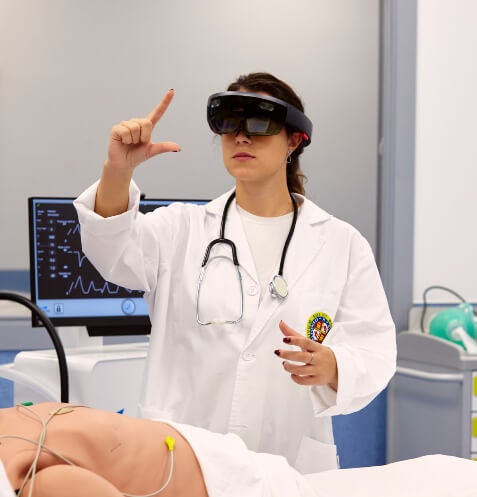
The methodology of the UAX University Master's Degree in Digital Dentistry is designed for you to learn alongside expert lecturers through dynamic, innovative training that is totally oriented towards real clinical practice. From day one you will work with an applied approach, combining cutting-edge technology, advanced simulation, experiential learning and supervised practice.
The programme integrates lectures that combine synchronous and asynchronous sessions with active methodologies such as problem-based learning, collaborative learning and working in digital simulation environments. This combination will allow you to understand the theoretical foundations and apply them directly in clinical and digital planning situations.
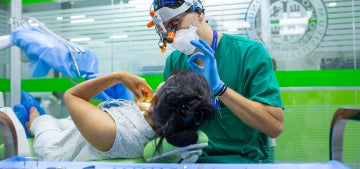
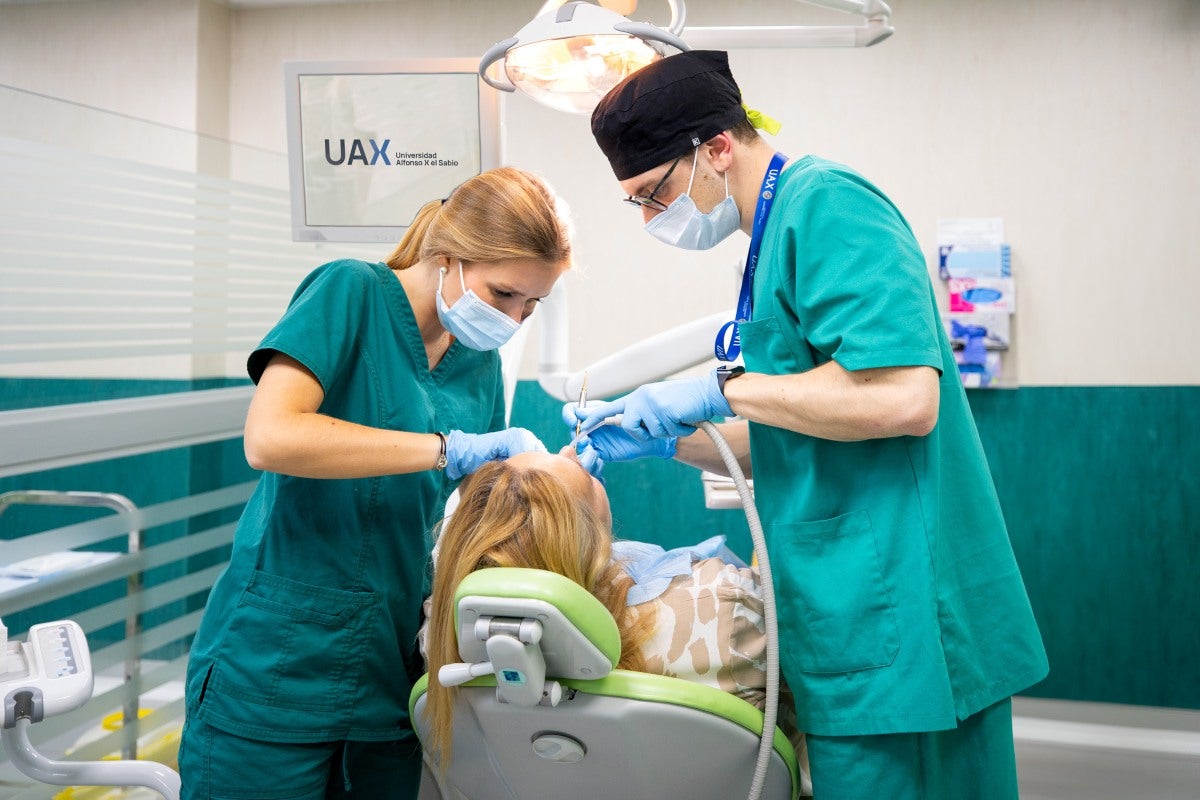
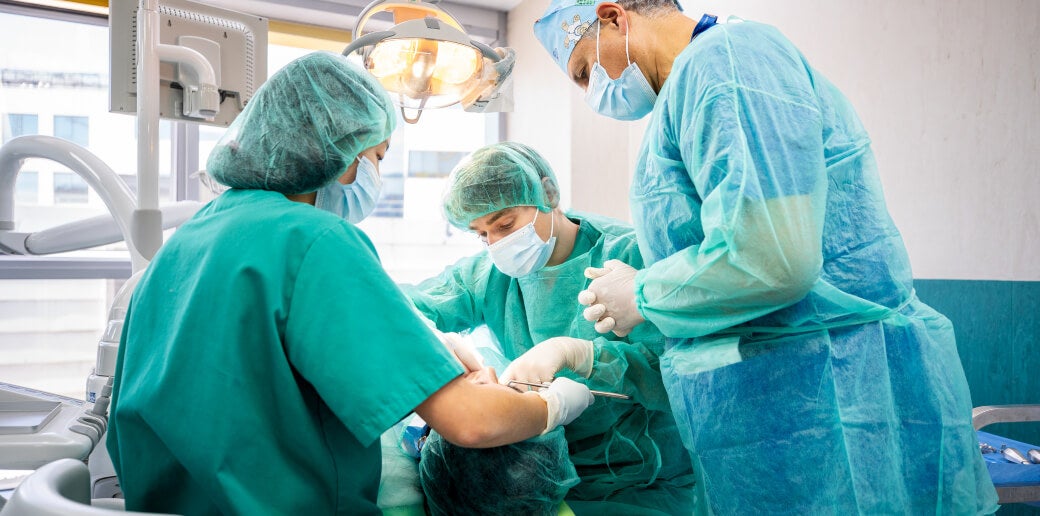
Throughout the master's degree you will carry out pre-clinical and clinical practice in the UAX's own dental clinics, where you will be trained in the main areas of digital dentistry: prosthetics, implants, surgery, periodontics, orthodontics and dental aesthetics. The sessions are developed through interactive classes, specialised workshops, laboratories and experiential learning activities that will strengthen your technical skills and your clinical decision-making capacity.
These placements include 9 ECTS of pre-clinical training (blended learning) and 12 ECTS of face-to-face clinical practice.
At UAX we have two dental clinics of our own, 9,000 m2 of facilities where more than 125,500 patients a year trust us and we attend to 13,000 patients a month. You will study your Master's degree in dentistry at the Centro Odontológico de Innovación y Especialidades Avanzadas, a pioneer in Spain and the largest in Europe in terms of dental care.
There you will acquire intense practical training by attending to real patients, dealing with cases of varying complexity and forming part of the clinic's great professional team, in a relaxed and collaborative environment. All this will allow you to enjoy training at the highest level, so that you will become a specialist with a great future projection and high employability.
At UAX we pay special attention to the acquisition of state-of-the-art equipment and technology:
In the Master's Degree in Digital Dentistry you will train alongside prestigious dentists who combine teaching with their professional activity in dental clinics, offering you expert and applied knowledge in digital technologies.
Consult the list of faculty members here
In order to establish the conditions for access to this degree, the provisions of article 18 of Royal Decree 822/2021, of 29 September, which establishes the organisation of university education and the procedure for quality assurance, must be taken into account:
The possession of an official university degree of Spanish Graduate or equivalent is a condition for access to a University Master's Degree, or where appropriate to hold another University Master's Degree, or degrees of the same level as the Spanish Bachelor's or Master's Degree issued by universities and higher education institutions of an EHEA country that in that country allows access to Master's studies.
Similarly, access to a Master's Degree in the Spanish university system may be granted to persons holding degrees from educational systems that do not form part of the EHEA, which are equivalent to the Bachelor's Degree, without the need for official recognition of the degree, but with verification by the university of the level of training involved, provided that in the country where the degree has been issued it allows access to postgraduate university studies. In no case will access by this route imply the homologation of the previous degree held by the interested party or its recognition for purposes other than that of carrying out the Master's degree studies.
Universities may exceptionally establish, on the basis of specific regulations approved by their governing bodies, conditional enrolment procedures for access to a Master's Degree. This shall consist of allowing a Bachelor's degree student who has up to 9 ECTS credits remaining to complete the TFG to access and enrol in a University Master's degree, although under no circumstances may he/she obtain the Master's degree if he/she has not previously obtained the Bachelor's degree. The universities will guarantee priority enrolment for students who have an official university degree.
This procedure may take into account credits pending recognition or transfer in the Bachelor's degree, or the requirement to pass a certain level of knowledge of a foreign language in order to obtain the degree.
You can consult the regulations for the recognition of credits at the following link.
The University Master's Degree in Digital Dentistry has 24 places available.
Complete our form, give us a call or request a visit to UAX. We’re excited to show you everything we’ve prepared for you.
A professional from our university will offer guidance and help you select the path that aligns best with your interests.
Enrol in your courses, meet the deadlines and follow the payment procedures to secure your place and fulfil the legal admission requirements.
You’re now part of UAX! Prepare to embark on a unique educational journey where you’ll take centre stage. Welcome to your university!
We need to know a little about you so that we can give you a personalised service.
All fields are required
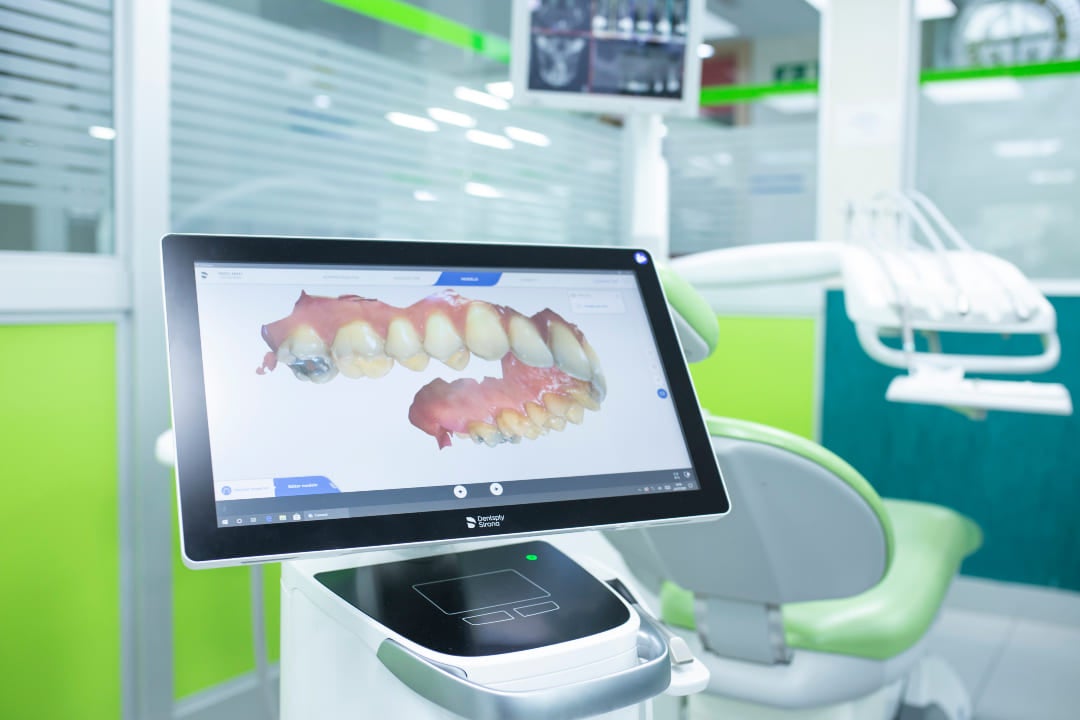
At the end of your training, you will be able to apply your knowledge in different areas of dental practice:
Not sure?
We can help you choose the programme that best suits your profile.
The master's degree in digital dentistry has a duration of 1 year and 60 ECTS and starts in September.
Podrán acceder a un Máster Universitario del sistema universitario español personas en posesión de títulos procedentes de sistemas educativos que no formen parte del EEES, que equivalgan al título de Grado, sin necesidad de homologación del título, pero sí de comprobación por parte de la universidad del nivel de formación que implican, siempre y cuando en el país donde se haya expedido dicho título permita acceder a estudios de nivel de postgrado universitario. En ningún caso el acceso por esta vía implicará la homologación del título previo del que disponía la persona interesada ni su reconocimiento a otros efectos que el de realizar los estudios de Máster.
El perfil de ingreso para el máster en odontología digital es cualquier profesional de la odontología que busque actualizar sus conocimientos con la aplicación de las nuevas tecnologías y la inteligencia artificial.
Para acceder al postgrado en odontología debes cumplir alguno de los siguientes perfiles:
Entrevista personal (30%)
Expediente académico + Curriculum Vitae (70%)
The training for the master's degree in digital dentistry focuses on digital processes in the field of patient planning and diagnostics, as well as the implementation of digital work protocols in daily practice in dental clinics. You will perform 100% digital multidisciplinary treatment planning.
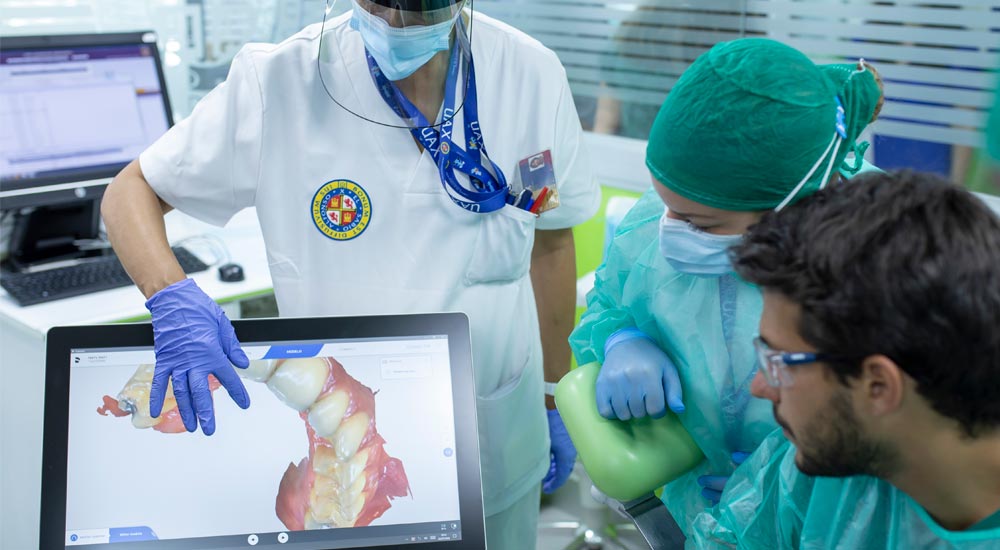
You will identify and handle the latest digital protocols for dental treatment, the most commonly used types of hardware and software, the operation of intraoral scanners and different scanning strategies, digital treatment planning.
It is a multidisciplinary training, you will learn digital dentistry in different areas:
In addition, you will learn the technologies based on Big Data and Artificial Intelligence to deal more effectively with dental practice, manage databases and learn about the most relevant research methodologies.
Upon completion of your master's degree in digital dentistry you will enhance your professional career by developing the skills most in demand in clinics, such as improved efficiency and practising more accurate, predictable and less invasive dentistry.
Some of the career opportunities in digital dentistry include:
Si, en el postgrado en odontología digital más del 70% de las horas presenciales son prácticas clínicas y preclínicas con pacientes reales.
Con esto nos aseguramos que al cursar odontología digital adquieras la experiencia práctica en todos los ámbitos tratados y seas capaz de aplicar en tu clínica/puesto profesional las técnicas aprendidas.
Other related qualifications
We have a very diverse academic offer, you are sure to find a programme that suits you.
Master's Degree in Orthodontics
In collaboration with:

Start:
September
Length:
2 años
Master's Degree in Dental Aesthetics and Restorative Dentistry
In collaboration with:

Start:
September
Length:
10 months
Master's Degree in Oral Implantology and Implant-Supported Prosthetics
In collaboration with:
Start:
September
Length:
2 years
Master's Degree in Oral Surgery, Implantology and Periodontology
In collaboration with:
Start:
September
Length:
2 years
Diploma of Specialisation in Endodontics and Restorative Dentistry
In collaboration with:

Start:
February
Length:
6 months
You can view your timetable and indicative timings via the following link .
You can consult the different indicators in the following links:
Main action plans for the degree:
The degree's Internal Quality Assurance System is led and supervised by the Degree Monitoring and Improvement Committee, the body responsible for analysing, assessing and promoting actions to ensure academic, teaching and training quality. This committee is made up, by name, of the following profiles:
- Dean of Faculty: Margarita Gómez Sánchez
- Head of Studies: Teresa Gragera
- Clinical Coordinator: Susana Arenas
- Laboratory Technician: Josefa Díaz Martín
- Centre Quality Coordinator: Floraligia Arcondo
- Head of the Vice-rectorate for Quality: Ana Oller
- Representative of the Teaching Staff
- Student Representative
In addition, the committee may have invited members when it is necessary to address specific issues or carry out specialised monitoring in specific areas.
We listen to the real demand of our students and employees, because we believe in continuous improvement of results. Therefore, we always want to hear what you want to tell us.
Link to the complaints and suggestions mailbox.
If you already belong to UAX, through the virtual campus in the section Customer service: complaints, suggestions and congratulations, entering your username and password.
Telephone: 91 810 94 00
E-mail: paramejorar@uax.es
Opening hours: Monday to Friday from 9:00 am to 6:00 pm